
What Is Expense Management? a Clear Guide

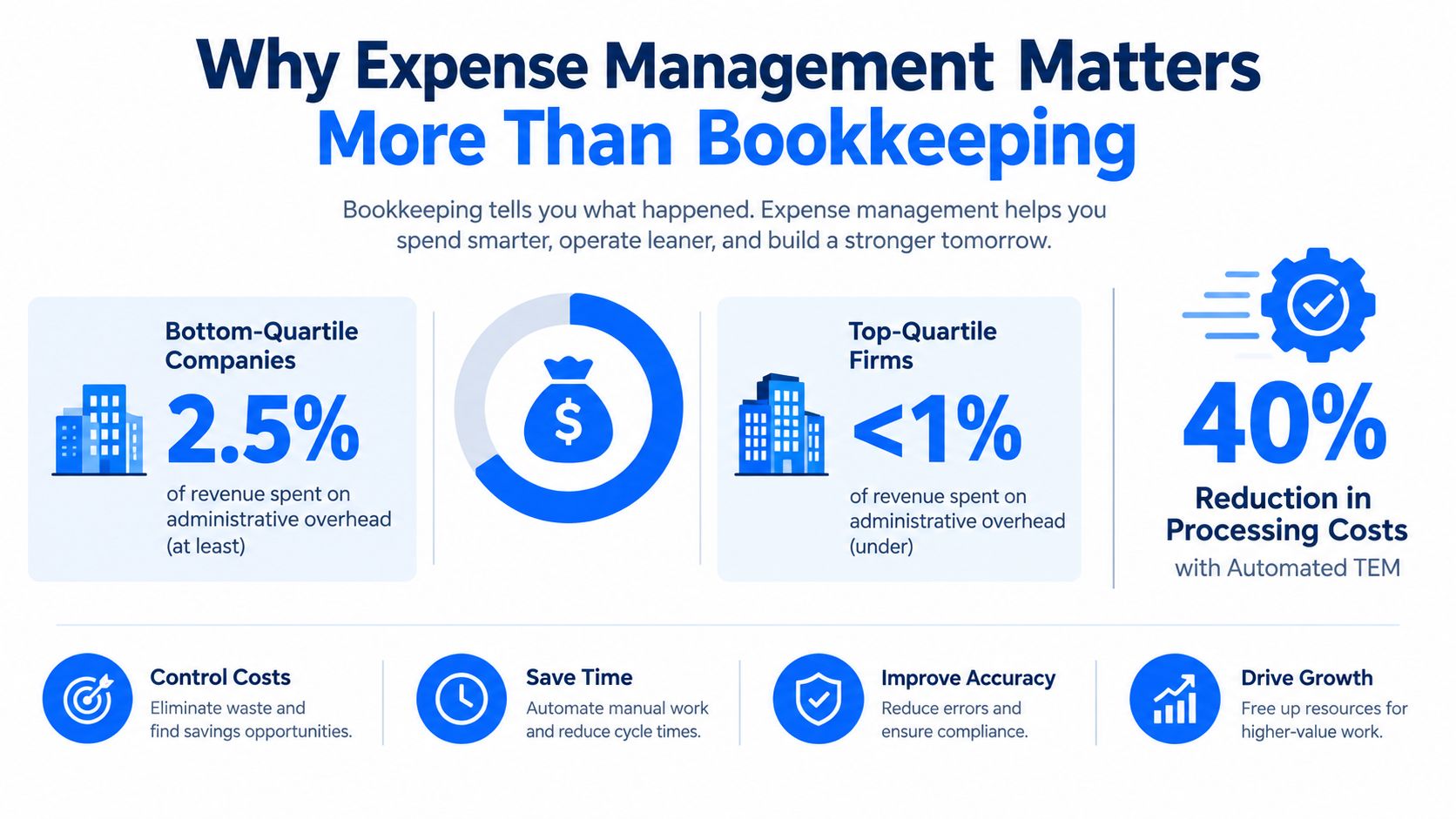
Top-performing organizations spend $2.07 or less per invoice, while bottom-quartile organizations spend at least $10, making expense management a structural differentiator rather than a simple accounting task. In practical terms, expense management is the discipline of controlling, approving, recording, reimbursing, and analyzing business spending so every payment is authorized, traceable, and useful for decision-making.
That gap matters most in technology portfolios. Cloud subscriptions, telecom services, software licenses, hardware purchases, managed services, and project invoices rarely arrive with consistent identifiers or clean classifications. Without a governed process, organizations pay for unused capacity, miss renewal obligations, accept billing errors, and lose the evidence needed to challenge suppliers.
A technology broker sees this pattern repeatedly. The invoice itself is rarely the whole problem. The bigger issue is the absence of a reliable connection between the contract, the service consumed, the person who approved it, and the business outcome it was meant to support.
Why Expense Management Matters More Than Bookkeeping
APQC's benchmark, covering 1,485 organizations, shows that the bottom 25% spent at least $10 per invoice, while top-performing organizations spent $2.07 or less and the median was $5.83. The figures are reported in CFO's analysis of APQC accounts-payable benchmarking. This isn't just a labor comparison. It shows how workflow design, data quality, automation, approval controls, and policy clarity change the cost of handling the same underlying spending activity.
The process is broader than reimbursement
Expense management covers employee expense reports, corporate-card transactions, travel and entertainment costs, supplier charges, invoices, payment workflows, policy enforcement, and management reporting. It answers practical questions that bookkeeping alone can't answer:
- Was the purchase authorized?
- Was it coded to the correct cost center, project, or account?
- Does the invoice match the purchase order and receipt?
- Does the service still support a current business need?
- Can the organization prove who approved and paid it?
That makes expense management a control layer across finance, procurement, IT, HR, and business-unit leadership. A finance team may record a cloud invoice correctly while still missing that several departments bought overlapping services or that a renewal continued after a project ended.
Practical rule: If a spending process records transactions but can't connect them to policy, contracts, ownership, and business purpose, it tracks costs without managing them.
The same principle applies to international operations. Teams handling cross-border payments, travel, and supplier charges need consistent documentation and clear approval paths, while still allowing for local tax and operational requirements. A practical resource on expense tracking for South African exporters can help organizations think through documentation and visibility where transactions cross currencies and jurisdictions.
The strategic value comes from turning transaction data into action. Leaders can challenge unnecessary renewals, consolidate suppliers, correct invoice errors, forecast commitments, and decide whether a technology service is delivering enough value to keep.
How Technology Expense Management Works
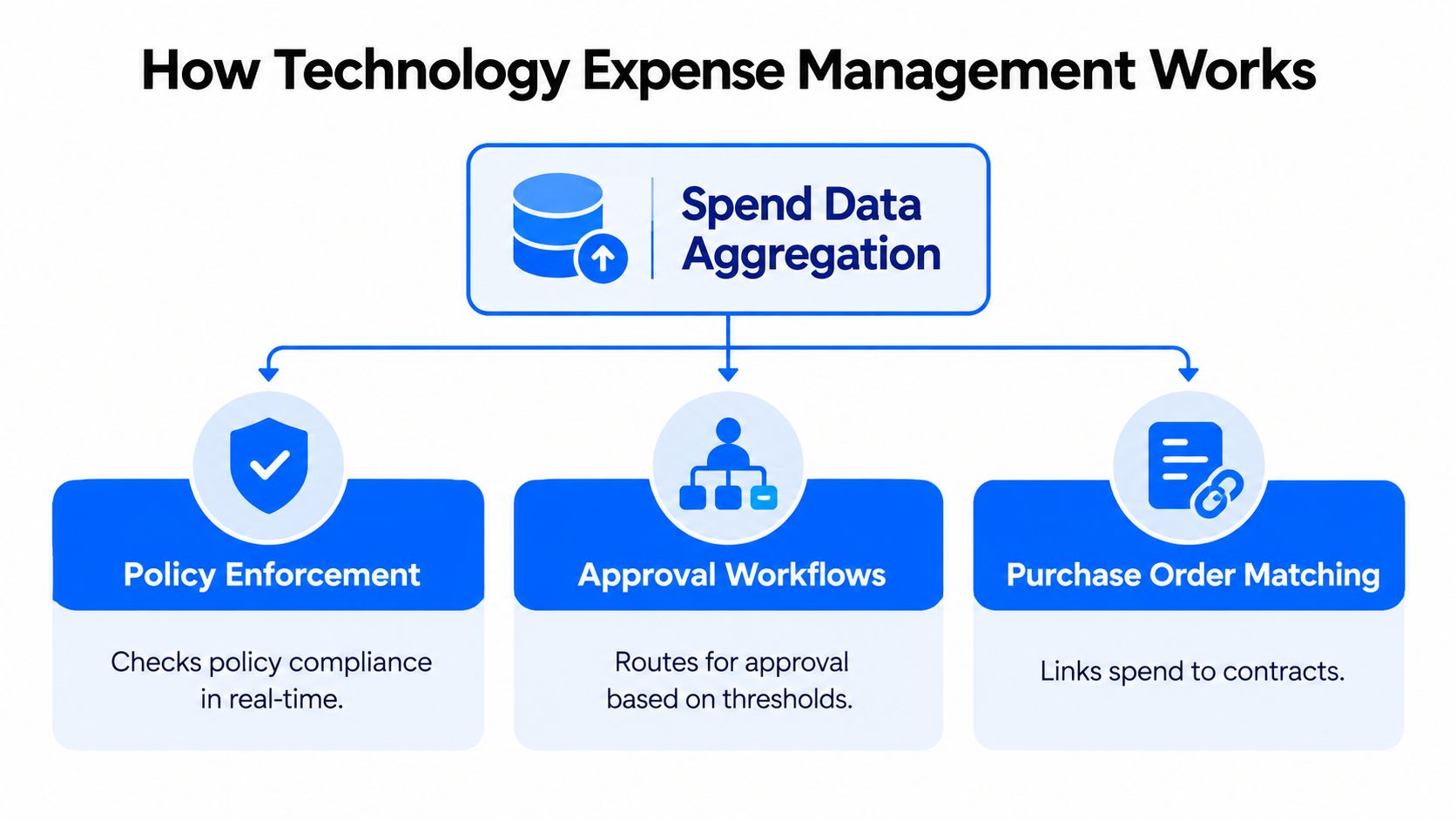
Technology expense management works as a connected lifecycle, not as a receipt-scanning application. The architecture combines spend-data aggregation, policy enforcement, approvals, purchase-order and invoice matching, accounting classification, exception handling, and reporting. Each component strengthens the next one.
Start with a normalized spend model
Data typically comes from procurement systems, accounts payable, corporate cards, contracts, enterprise resource planning platforms, and the general ledger. The organization then maps inconsistent supplier names, service descriptions, billing units, renewal dates, and account codes into a common taxonomy.
That normalization is essential for IT. One supplier might bill licenses by user, infrastructure by consumption, telecom by circuit, and managed services by a recurring statement of work. A spreadsheet can store these values, but it won't reliably connect them without deliberate data modeling.
Put controls before payment
Useful controls include:
- Budget checks: Confirm available budget before a commitment is made.
- Role-based approvals: Route transactions according to value, category, business unit, or risk.
- Segregation of duties: Keep requesting, approving, and paying responsibilities appropriately separated.
- Duplicate detection: Compare invoice numbers, suppliers, amounts, dates, and line items.
- Three-way matching: Link the purchase order, receipt, and invoice before payment.
- Exception handling: Send unusual, incomplete, or high-risk transactions to a human reviewer.
- Post-payment analytics: Identify recurring leakage, unused services, and contract deviations after settlement.
The GAO internal-control framework connects improper payments with inadequate controls and unavailable or untimely data. That principle applies directly to technology portfolios. If the contract repository, billing records, and service ownership data remain separate, reviewers can't verify whether a charge is valid before money leaves the business.
For a practical overview of technology expense management, focus on how the process links invoices to contracts, consumption, approvals, and ongoing governance. A platform that only imports transactions may improve visibility, but it won't resolve unclear ownership or weak purchasing discipline.
The Operational Burden of Manual Processes
Manual expense processing creates a direct administrative cost and a less visible control problem. A finance-automation benchmark reported that the average expense report costs approximately $58 to process and takes about 20 minutes. It also reported that 19% of expense reports contain errors, with each error adding roughly $52 and 18 minutes of rework. The figures come from Quadient's finance-automation benchmark summary.
Consider what that means inside a busy technology department. An employee submits a software or travel charge days after purchase. The manager questions the category, finance requests missing documentation, the employee resubmits the claim, and someone later reconciles it to the card statement or ledger. Every handoff consumes time, and every correction delays reliable reporting.
Paper-based workflows make the problem worse. The same benchmark reported that moving from paper-based to electronic expense reporting can reduce processing costs by 58%, because electronic capture creates a searchable record and supports automated routing.
Errors affect more than payroll
A data-entry mistake can place a cloud charge against the wrong department. A missing receipt can weaken an audit trail. A duplicate invoice can survive when reviewers compare spreadsheets manually. An unapproved renewal can continue because nobody has connected the supplier bill to the contract owner.
Digital records support duplicate detection, out-of-policy checks, and analysis by employee, department, project, supplier, location, or category. They also help finance teams distinguish a genuine exception from a recurring process failure.
The historical shift from paper receipts to electronic capture, policy-based workflows, corporate-card feeds, and accounting integrations reflects a change in control timing. Manual systems mostly discover problems after payment. Digitized systems can identify missing evidence, unusual values, or policy conflicts while a transaction is still moving through approval.
Manual Versus Automated Expense Management
Manual and automated expense management differ mainly in when the organization can act. Manual workflows review transactions after employees spend money. An integrated system applies rules during capture, approval, card authorization, matching, and posting.
| Dimension | Manual Process | Automated System |
|---|---|---|
| Cost per transaction | Repeated data entry, review, reconciliation, and correction | Electronic capture, routing, matching, and accounting integration reduce handling |
| Accuracy and errors | The benchmark reports a 19% error rate for expense reports, with rework attached to each error (Quadient benchmark) | Validates fields, checks duplicates, applies coding rules, and routes exceptions |
| Auditability and compliance | Evidence may sit in paper files, email, spreadsheets, and separate card systems | Connects the transaction, receipt, approval, policy result, and payment |
| Insight generation | Finance compiles reports after the fact | Leaders analyze spending by supplier, category, project, employee, or department |
| Policy enforcement | Review often happens after purchase | Rules check eligibility, thresholds, documentation, and approval paths earlier |
| Exception handling | Reviewers may inspect every line item | Routine transactions follow rules while unusual activity receives human attention |
How to assess your current state
Do not judge expense software by its interface alone. Test whether it prevents policy violations or merely documents them. Check whether it connects to the general ledger without manual reformatting, and whether technology invoices can be traced to contracts, owners, usage, and renewal decisions.
A mobile receipt tool may reduce scanning work while leaving approval bottlenecks untouched. A dashboard may display spend while relying on inconsistent supplier names. The strongest systems remove unnecessary handoffs rather than making each handoff slightly faster.
A control also needs to work across the technology estate. A cloud subscription, telecom service, or software renewal can pass through an expense workflow while remaining disconnected from its contract, owner, and usage data. That gap leaves finance able to record the payment but unable to challenge waste before the next commitment.
For example, a 200-person firm processing 400 reports each month at $58 per report would spend roughly $278,000 annually on processing alone. That calculation excludes rework, delayed approvals, weak renewal decisions, and the cost of staff time spent resolving exceptions. Automation should therefore be assessed by the decisions it improves, not only by the keystrokes it removes.
The practical test is simple: can the organization stop, redirect, or question spend before payment and renewal? If the answer is no, the system may be recording activity without providing effective technology governance.
Evaluating Technology Expense Management Services
A technology expense management service should be judged by the decisions it improves, not by the length of its feature list. CIOs and IT directors need to test whether a provider can control costs, improve forecasts, govern suppliers, and support policy compliance within the organization's existing systems.
Start with a diagnostic review of the current environment. Map suppliers, invoice routes, contracts, card data, approval paths, renewal dates, and reporting gaps. Look for disconnected business units, inconsistent service names, invoices without accountable owners, and recommendations shaped by a provider's commercial incentives.
The evaluation should answer five practical questions:
- Is the provider vendor-neutral? Recommendations should follow documented requirements, not a resale target.
- Can it connect relevant systems? Examine ERP, procurement, accounts payable, card, contract, and reporting integrations in detail.
- Will it govern the portfolio after implementation? The service should support renewals, supplier changes, usage reviews, and exception handling.
- Can it measure outcomes? Require a benefits framework covering realized savings, avoided spend, invoice-error recovery, and compliance.
- Will employees use the process? Excessive friction leads to bypasses, incomplete records, and weaker controls.

A vendor-neutral brokerage can coordinate discovery, subject-matter expertise, providers, commercial terms, and delivery responsibilities. That structure gives buyers an independent comparison when a supplier recommends replacing a platform, bundling services, or extending a contract. It also clarifies who owns each decision when several vendors share delivery.
Organizations comparing technology expense management companies should ask who owns the data model, validates supplier claims, and remains accountable across the service. A tool records transactions. A governance partner should help leadership make defensible technology portfolio decisions.
From Transaction Data to Preventive Controls
Expense management becomes a governance capability when transaction data drives action before costs harden into commitments. Standardized records support consistent categorization. Categorization enables policy checks and portfolio comparisons. Those comparisons expose unused services, billing errors, leakage, and renewal risk, giving technology leaders evidence for rightsizing, renegotiation, cancellation, or competitive sourcing.
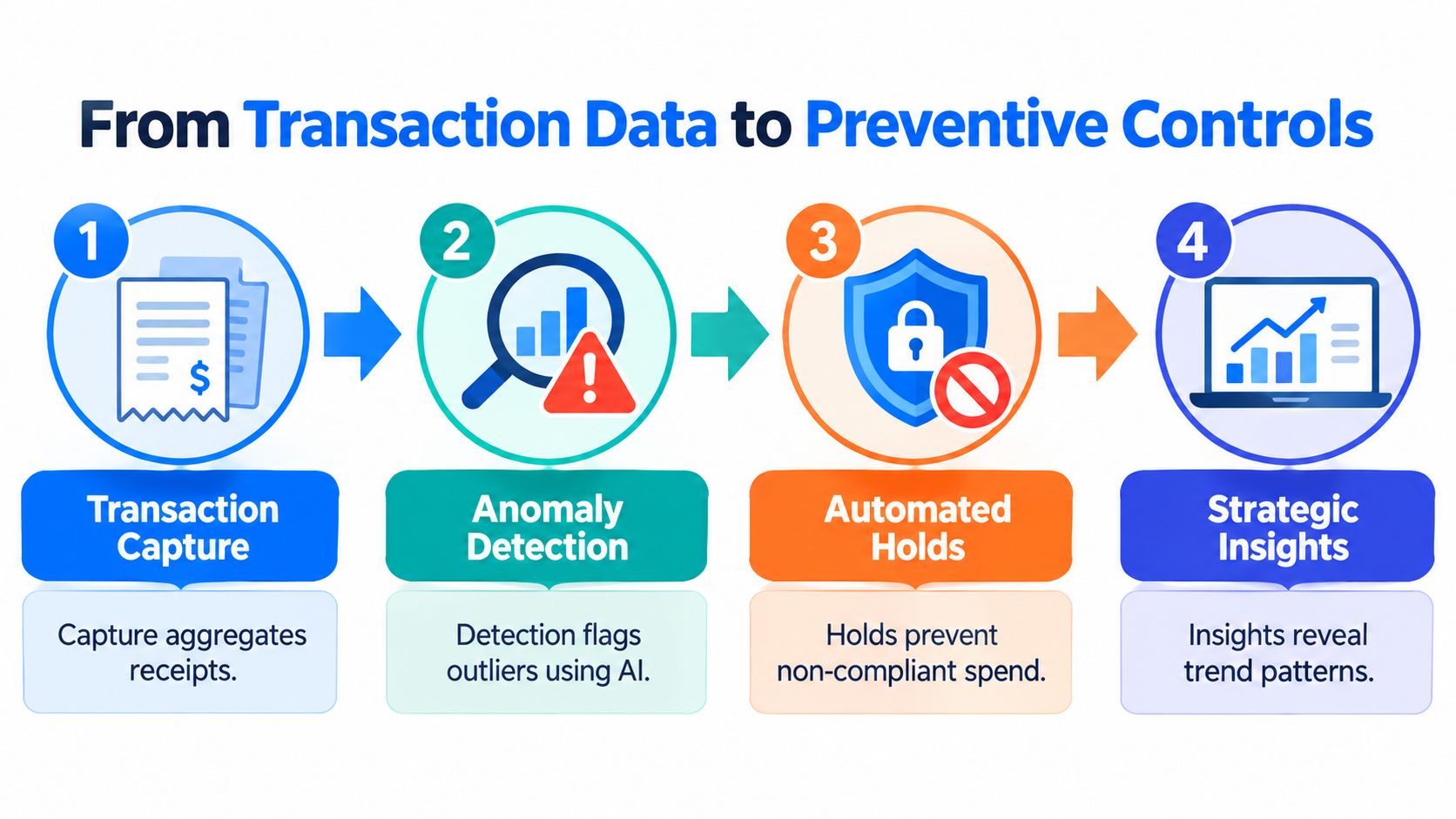
Controls should reflect the risk of the spend. Stable, low-value recurring charges can pass through automated rules when supplier, contract, amount, and approval patterns align. A large purchase, unusual transaction, regulated service, or approaching renewal warrants stronger approval and human review. Applying the same scrutiny everywhere creates unnecessary delay, while weak review around strategic technology commitments leaves room for expensive mistakes.
A workable control environment needs five foundations:
- A common supplier and service taxonomy, allowing comparable services and charges to be grouped.
- Immutable approval and invoice evidence, preserving an audit trail that cannot be casually rewritten.
- Contract-to-bill linkage, testing invoices against agreed pricing and terms.
- Source reconciliation, keeping dashboards consistent with the ledger.
- Clear ownership, assigning responsibility for service value and renewal decisions.
GAO's audit-control guidance supports periodic comparisons of expected and actual results, source reconciliation, risk assessment, accountability, data sharing, and technology-assisted matching. These principles translate well to technology spend, where a vendor-neutral review can expose commitments that individual suppliers have little incentive to question.
Dashboards should distinguish committed, invoiced, paid, and forecast spend. Without those states, a delayed payment can look like savings, while an approved contract remains hidden from the obligation view.
Control principle: Automate predictable activity. Reserve human judgment for risk, exceptions, and decisions that affect the technology portfolio.
The AI Fraud Threat and Compliance Gap
Analytics adoption does not demonstrate preventive-control maturity. In a 2025 international survey of 600 CFOs, 67% considered employee use of AI to falsify travel expenses or receipts at least somewhat likely, including 9% who said they knew it was happening.
The survey also found that only 36% of organizations automatically upload receipts and run travel-and-expense compliance checks, while 81% frequently use analytics to optimize costs. That gap creates a practical risk: a finance team may analyze spending accurately after approval while fabricated documentation still enters the reimbursement process.
Receipt automation needs several independent checks. Optical character recognition extracts fields, but it cannot prove that a transaction occurred. An AI detector can flag a suspicious document, but the flag still requires investigation.
Use the available evidence together:
- Merchant and transaction data: Compare receipt details with card, supplier, date, amount, and location records.
- Duplicate detection: Search for repeated documents, amounts, merchants, and claims.
- Document forensics: Examine formatting, metadata, totals, and itemization for inconsistencies.
- Approval segregation: Stop one person from submitting, approving, and paying the same claim.
- Risk-based sampling: Test approved transactions instead of assuming automation catches every issue.
- Human review: Give trained reviewers authority to assess context and legitimate exceptions.
Controls also need an explanation trail. Preserve why a claim was flagged, provide an appeal route, and test detection models for false positives across countries, currencies, languages, and legitimate travel patterns. Employees should know how automated checks affect reimbursement and who can overturn a decision. This governance protects compliance while keeping legitimate claims from being rejected solely because an automated system lacks context.
Building an Expense-Management Operating Model
Expense management works best as an operating model, not as a finance application installed and forgotten. Finance owns payment accuracy and reporting. Procurement manages suppliers and commercial discipline. IT validates services and ownership. HR helps define employee policy. Security considers access, data handling, and risk. Business-unit leaders remain accountable for the value they consume.
Establish shared ownership
The foundation is a common supplier and service taxonomy that connects invoices, contracts, usage, owners, cost centers, and renewal dates. Preserve approval evidence and contract-to-bill relationships so reviewers can reconstruct the decision behind a charge without searching across email threads and disconnected spreadsheets.
Dashboards should distinguish committed, invoiced, paid, and forecast spend. That view helps leaders understand both immediate cash movement and future obligations. It also supports more honest conversations about whether a budget improvement comes from genuine savings, delayed purchasing, or an unrecorded commitment.
The operating model should measure outcomes such as:
- Savings realization, not just negotiated discounts.
- Avoided spend, including prevented renewals or duplicate purchases.
- Invoice-error recovery, with evidence of corrected charges.
- Unused-license reduction, tied to verified ownership and usage.
- Contract-compliance rate, including pricing and service terms.
- Time-to-close, showing whether cleaner data improves finance operations.
Policy design also determines adoption. Business travel data reported that only 56% of travelers used their company's preferred booking tool, while 55% of travel managers ranked booking compliance as a top expense-management priority, according to Booking.com for Business travel research. Strict rules won't work if employees can't follow them in real conditions. Build clear exception paths, document legitimate reasons, and measure policy friction alongside leakage.
For organizations formalizing the procurement side, procurement in IT should connect sourcing decisions with contracts, service ownership, security requirements, and ongoing expense governance. That approach prevents a low invoice price from masking integration work, cyber risk, service disruption, or premature replacement costs.
MR2 Solutions helps mid-market and enterprise organizations evaluate, procure, implement, and govern technology through a vendor-neutral brokerage approach, including technology expense management for complex multi-vendor portfolios. Visit MR2 Solutions to discuss how your organization can improve spend visibility, control renewals, and connect technology costs to business outcomes.