
Fractional CISO Services: A Practical Guide for 2026

Your CIO is staring at two deadlines that don't care about the staffing plan. A ransomware disclosure decision is moving through Legal while a SOC 2 audit is approaching, and the IT team is already consumed by operations. The organization needs someone who can set direction, own controls, brief executives, and make decisions now, but a full-time CISO search would take time the business doesn't have.
That's where fractional CISO services can fit. The useful version of this model isn't a consultant who delivers a risk report and disappears. It's a part-time executive security function with a defined cadence, explicit authority, and responsibility for moving the security program forward. It can give a mid-market organization governance it lacks, but it can also strain badly when the business needs constant presence, deep internal authority, or complex regulatory coordination.
What Fractional CISO Services Really Are
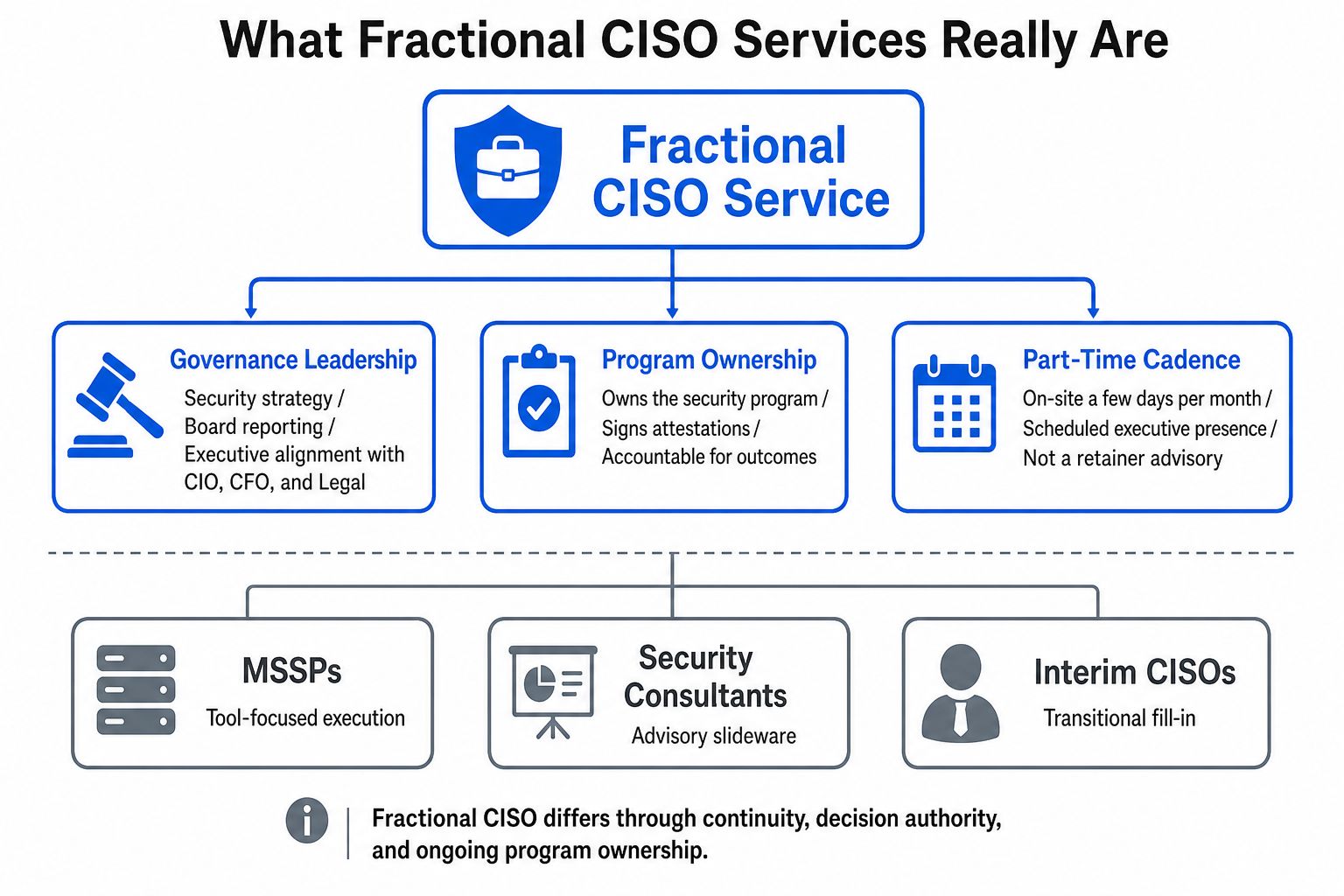
The CIO brings in a fractional CISO for scheduled leadership time each month. The practitioner joins executive meetings, works directly with IT and Legal, reviews the incident response position, establishes an audit plan, and reports security risk to the board. They aren't merely recommending that someone else create a roadmap. They own the roadmap, assign accountable owners, track remediation, and make the tradeoffs visible to leadership.
A fractional CISO is typically engaged part-time, often around 10 to 40 hours per month, with published benchmarks placing monthly costs around $3,000 to $20,000. Many mid-market engagements cluster near $3,000 to $12,500 per month, while hourly advisory rates commonly fall around $200 to $400, according to published fractional CISO market benchmarks. The right scope depends on control maturity, regulatory exposure, incident readiness, and how much authority the organization expects the role to exercise.
The role sits inside the accountability chain
The practical distinction is ownership. A capable fractional CISO operates as the accountable security leader, even though the person works part-time. The engagement should specify who owns security strategy, who approves policies, who signs or supports attestations, who prepares board reporting, and who has decision rights during a security event.
That separates the role from adjacent services:
- An MSSP operates security technology and monitoring, such as Microsoft Sentinel, CrowdStrike, or managed detection workflows. It usually doesn't own enterprise security governance.
- A security consultant may assess controls, recommend improvements, or produce a framework package. The consultant may not remain accountable for implementation.
- An interim CISO usually fills a temporary vacancy while the organization recruits a permanent leader. A fractional CISO can be a longer-term operating model, with a recurring cadence and defined boundaries.
Practical rule: If the provider won't attend leadership meetings, maintain an active risk register, and answer for overdue controls, you're buying advice, not CISO leadership.
The strongest engagements combine governance with control execution. The fractional leader defines the policy architecture, establishes evidence ownership, coordinates remediation, and makes unresolved risk difficult for executives to ignore. That doesn't mean the practitioner personally configures every endpoint or writes every technical procedure. It means the practitioner owns the management system that ensures those activities happen, are documented, and are tested.
Why adoption is moving quickly
The market has already moved beyond a niche experiment in North America. A 2024 survey reported that 21% of MSPs and MSSPs offered vCISO services, up from 19% the previous year, while 98% of providers that didn't yet offer them said they planned to add them in the future. The report also said 39% expected to have services available by the end of 2024, as documented in the 2024 State of the vCISO report.
That capacity expanded sharply in the following report. Coverage of the Cynomi 2025 report said 67% of North American MSPs and MSSPs offered vCISO services, compared with 21% in 2024, a reported 319% year-over-year increase. The same coverage said 96% of providers reported high or moderate customer interest, and 43% identified improved customer security as the top benefit, as described in BlueRadius' coverage of the 2025 vCISO market report.
The lesson isn't that every organization should outsource the CISO role. It's that buyers increasingly need a structured leadership layer between technical execution and executive accountability.
Core Responsibilities of a Fractional CISO
A fractional CISO should produce operational decisions and artifacts, not a recurring stream of generic recommendations. The work normally falls into four connected domains: governance, compliance, risk, and incident response.
Governance gives security a decision structure
The fractional CISO starts by translating business objectives into a security program. That includes a security strategy, target operating model, policy hierarchy, investment priorities, and escalation paths. The leader should align regularly with the CIO, CFO, Legal, Human Resources, product leadership, and the board or audit committee.
Concrete governance outputs include:
- Security strategy: A prioritized plan tied to business services, material risks, customer commitments, and regulatory requirements.
- Policy library: Approved policies with owners, review dates, exceptions, and links to the controls they support.
- Executive reporting: A board-ready view of top risks, overdue remediation, incident trends, third-party exposure, and decisions requiring funding.
- Decision records: Documented acceptance, transfer, mitigation, or avoidance of significant risks.
Governance matters because technical teams can identify vulnerabilities without having authority to decide which business risks the organization accepts. The fractional CISO turns those findings into accountable executive decisions.
Compliance converts frameworks into evidence
For SOC 2, HIPAA, PCI, or ISO 27001, the role should own the operating rhythm behind the audit. That means defining scope, mapping requirements to controls, naming evidence owners, reviewing evidence quality, coordinating with auditors, and tracking remediation through closure.
The deliverable isn't a policy folder. It's a control program with evidence that someone can retrieve, explain, and defend.
Risk management keeps the register alive
A risk register should identify the affected asset or business process, threat scenario, control condition, accountable owner, likelihood, impact, treatment decision, target date, and residual exposure. The fractional CISO facilitates interviews with business and technical owners, reviews vendor risk, challenges weak assumptions, and reports movement to leadership.
Quantification can use likelihood and impact scoring, financial exposure, service criticality, or other methods approved by the organization. The important point is consistency. A risk score that changes because the scoring method changes isn't useful for board decisions.
Incident response tests authority before a crisis
The fractional CISO owns the incident response plan, defines roles, facilitates tabletop exercises, and maintains runbooks for scenarios such as ransomware, cloud credential compromise, data exposure, and third-party compromise. During a material incident, the engagement should state whether the practitioner serves as incident commander, executive coordinator, or strategic advisor to an internal commander.
A useful engagement leaves behind exercise findings, assigned corrective actions, communications templates, legal escalation criteria, and an improvement log. Without those artifacts, the organization is relying on memory during its worst operational moment.
| Domain | Owned Activities | Example Deliverable |
|---|---|---|
| Governance | Strategy, policies, executive alignment, board reporting | Approved security roadmap and quarterly risk report |
| Compliance | Control mapping, evidence ownership, audit liaison, remediation | Framework control matrix and evidence tracker |
| Risk | Risk register, vendor reviews, treatment decisions | Prioritized risk register with accountable owners |
| Incident response | Playbooks, tabletops, escalation, response leadership | Tested incident plan and corrective-action log |
Compliance and Risk Management Benefits
Fractional CISO leadership improves compliance when it treats the framework as an operating system for risk, not as an audit-season documentation project. The practitioner establishes control ownership early, connects evidence to real processes, and gives auditors one accountable person who can explain why a control exists and how the organization tests it.

SOC 2 readiness needs evidence discipline
A SOC 2 program typically fails in the gaps between a written control and the person expected to prove it. The fractional CISO should first define the in-scope systems and services, then map Trust Services Criteria expectations to controls, evidence owners, collection methods, and review points.
That work creates a practical sequence:
- Scope the audit boundary: Identify services, systems, vendors, identities, and teams that affect the examination.
- Map controls to owners: Assign each control to a named person or function, rather than to an abstract department.
- Test evidence quality: Check whether access reviews, change records, risk assessments, and incident records demonstrate the control consistently.
- Track exceptions: Record gaps, compensating controls, remediation dates, and executive decisions.
- Coordinate with the auditor: Resolve questions through a controlled evidence process instead of sending fragmented responses from multiple teams.
Organizations building automated guardrails can also review CloudCops GmbH's resource on policy-as-code and audit readiness, especially where cloud configuration and compliance evidence need to stay aligned.
HIPAA and ISO 27001 require operating ownership
For HIPAA, the fractional CISO should connect the Security Rule to a documented risk analysis, safeguards, access governance, workforce procedures, business associate oversight, and breach notification readiness. Healthcare organizations can also examine this HIPAA compliance example involving cloud migration to see why infrastructure decisions and compliance responsibilities need to be managed together.
ISO 27001 requires more than a collection of policies. The fractional CISO drives the ISMS lifecycle, including the statement of applicability, risk treatment, internal audits, corrective actions, and management review. The leader should show executives how control performance changes residual risk, not just whether a document exists.
That connection is the benefit most organizations miss. A control that reduces unauthorized access, improves recovery readiness, or clarifies vendor accountability can strengthen audit evidence and reduce operational exposure at the same time. Leadership should track that progress through closed corrective actions, fewer unresolved exceptions, stronger evidence coverage, and consistent risk treatment decisions. Don't promise a specific audit speed or insurance reduction without baseline data. Measure the starting position first, then report the movement.
Engagement Models and Pricing Structures
The engagement model should follow the problem, not the provider's preferred billing format. A single audit-readiness buildout needs a different structure from ongoing board reporting, vendor oversight, and incident leadership.
Published benchmarks describe fractional CISO work at roughly 10 to 40 hours per month, monthly costs around $3,000 to $20,000, and hourly rates commonly around $200 to $400. More complex regulated environments can require deeper involvement and budgets in the $8,000 to $25,000 per month range, particularly where continuous control management and audit preparation are expected, according to PurpleShield's description of fractional CISO operating bands.
| Model | Hours / Cadence | Typical Cost Band | Best-Fit Scenario | Where It Strains |
|---|---|---|---|---|
| Project-based | Defined workplan with a fixed completion point | Scope-based pricing | SOC 2 readiness, initial risk program, or vendor risk buildout | Doesn't provide durable ownership after delivery |
| Monthly retainer | Scheduled leadership hours each month | Benchmark range of $3,000 to $20,000 monthly | Ongoing governance, compliance oversight, and board reporting | Can become too shallow if priorities exceed the time block |
| Embedded or part-time | Regular leadership presence integrated with internal teams | Scope and cadence determine budget | Complex remediation, regulated operations, or transition to a permanent hire | Can expose authority and continuity limits if the role remains part-time |
Project engagements solve defined gaps
Use project-based work when the output is clear and measurable. Examples include a control gap assessment, a vendor risk program, an incident response redesign, or an audit-readiness plan. Write acceptance criteria into the statement of work, including the systems covered, interviews required, deliverables, review cycles, and handoff expectations.
Retainers support continuity
A retainer makes sense when leadership needs a recurring operating rhythm. The provider should specify scheduled meetings, response expectations, included deliverables, unused-hour treatment, incident support, and escalation rules. If the contract only says “strategic advisory,” it isn't scoped well enough.
Embedded work is the bridge to deeper ownership
An embedded model places the practitioner into leadership and operating meetings on a recurring basis. It works when the organization needs active coordination across IT, engineering, Legal, procurement, and compliance. It can also serve as a transition while the company evaluates a permanent hire.
For organizations that need broader implementation capacity alongside leadership, IT staff augmentation may address execution gaps, but it shouldn't be confused with CISO accountability. Extra hands can complete tasks. They don't automatically create governance.
Expected Deliverables and Reporting Outputs
A fractional CISO earns credibility through artifacts that executives can use, auditors can inspect, and internal teams can maintain. Ask for a delivery calendar before signing. The schedule should show what the leader will produce, who will review it, and how the organization will use it.
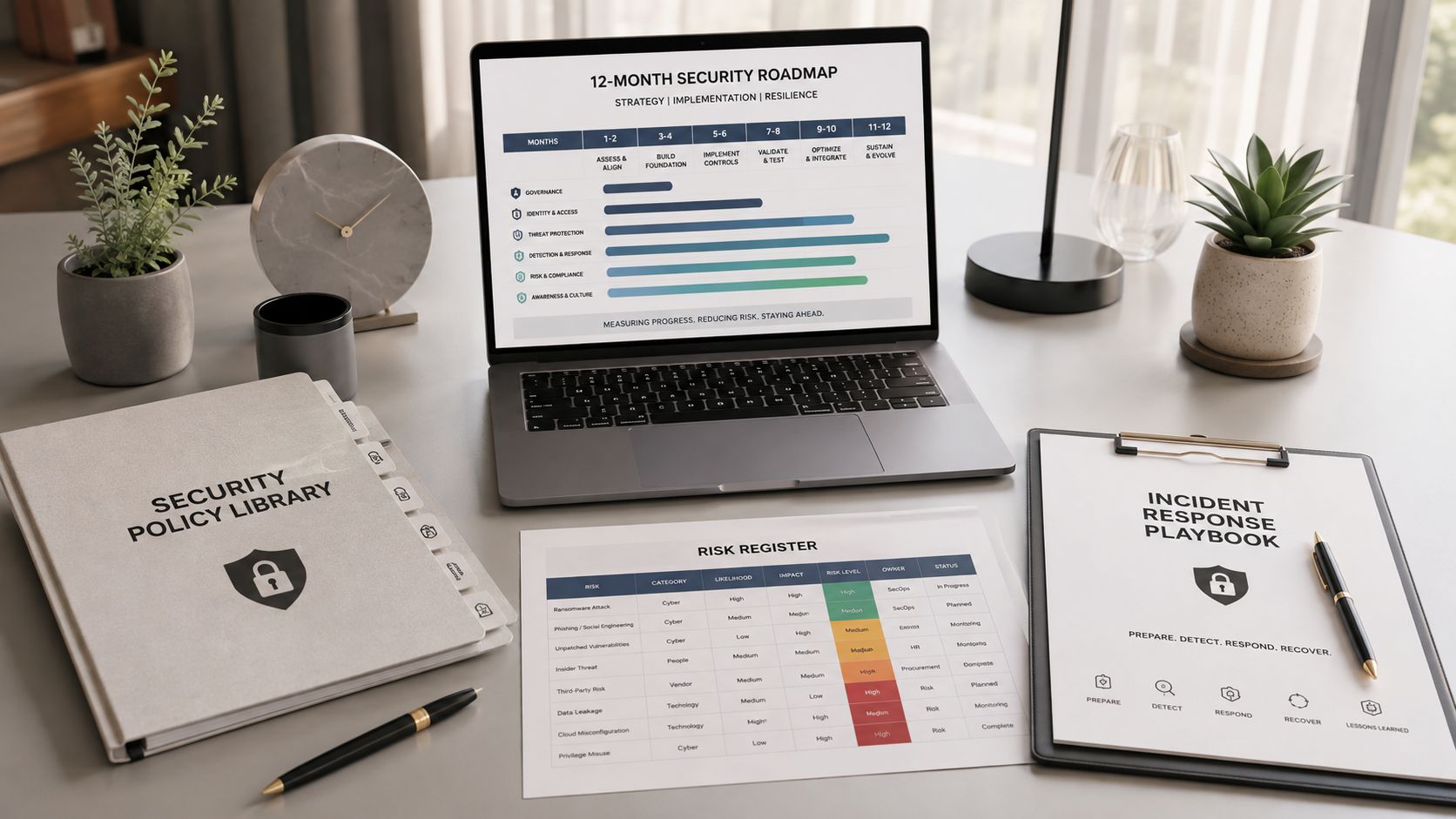
The roadmap turns security into an investment plan
A useful roadmap covers the organization's priorities over a defined planning horizon, commonly 12 to 24 months in executive planning. It should come from interviews, technical reviews, control gap analysis, business objectives, and risk discussions. Each initiative needs an owner, dependency, target outcome, decision requirement, and status.
The board doesn't need a list of security tools. It needs to know which business risks the roadmap addresses, what remains exposed, and where leadership must choose between funding, schedule, and risk acceptance.
The policy library must map to controls
Policies should align to a selected framework and the organization's actual operating model. The fractional CISO should remove contradictions, assign policy owners, define review cycles, and connect statements to procedures and evidence. A policy that nobody follows creates audit risk instead of reducing it.
Reporting must support decisions
A monthly steering-committee update can cover active risks, remediation status, control exceptions, incidents, vendor concerns, and upcoming decisions. A board report should be shorter and more business-focused, with trends, material changes, risk acceptance requests, and management actions.
Other core artifacts include:
- Risk register: Built through stakeholder workshops and control reviews, then updated as owners change conditions or complete treatment actions.
- Incident response playbooks: Written around realistic scenarios, tested in tabletop exercises, and revised after every exercise or event.
- Vendor assessments: Prioritized by data access, business criticality, concentration risk, and contractual obligations.
- Audit evidence tracker: Organized by control, owner, evidence type, period, review status, and outstanding issue.
- Handoff package: A current roadmap, risk register, policy index, open decisions, vendor inventory, incident records, and recurring meeting calendar for a future full-time CISO.
Treat documentation as an operating asset. Strong project management support can help coordinate owners and dependencies, but the fractional CISO remains responsible for defining the security outcomes and escalation points.
A deliverable is only valuable if a named person uses it to make a decision or complete a control.
Where Fractional CISO Services Fall Short
Fractional CISO services aren't a universal substitute for a permanent security executive. The model works best when the organization needs experienced governance and has enough internal capacity to execute. It strains when the business expects one part-time leader to provide continuous command, cultural authority, regulatory depth, and team development at once.
Continuity becomes a real risk during incidents
A fractional CISO may serve multiple organizations. During a serious incident, the contract must define availability, backup coverage, incident-command authority, communications ownership, and escalation to forensic, legal, insurance, and public-relations resources. If those terms are vague, the organization may discover the limitation at the worst possible time.
Part-time presence also limits relationship depth. Security decisions often depend on trust with engineering, product, HR, procurement, and Legal. A leader who appears only for scheduled meetings may struggle to challenge a rushed product launch, enforce a vendor requirement, or change behavior inside a resistant team.
Larger environments expose authority gaps
The model becomes harder to sustain as organizational complexity grows. An enterprise with multiple business units, extensive third-party dependencies, continuous product delivery, and strict regulatory oversight may need daily executive coordination. Banking, critical infrastructure, and similarly high-consequence environments usually need more than periodic governance.
A recent Sophos CISO report highlights the underserved gap in treating virtual CISOs as a broad answer to enterprise-grade threats. That criticism is fair. Marketing pages often frame the role as a cheaper substitute for hiring, while complex organizations need continuity, documented control ownership, integration with internal staff, and measurable executive accountability.
Internal talent development doesn't happen automatically
A permanent CISO can build a security organization, coach managers, shape career paths, and develop institutional knowledge. A fractional leader can transfer knowledge and define operating processes, but the client must assign internal owners and fund execution.
Plan the transition early. If the organization keeps adding regulatory obligations, incident volume, business units, or executive dependencies, start recruiting a permanent leader before the fractional arrangement becomes a bottleneck.
Choosing the Right Fractional CISO for Your Organization
Choose the individual who will do the work, not the firm name on the proposal. Ask to meet that person before signing, confirm their availability, and require evidence that they've operated in environments similar to yours.
Start with artifacts. Request redacted board reports, risk registers, control matrices, incident playbooks, and remediation dashboards. The samples don't need to reveal client information, but they should show whether the candidate writes for executives, assigns accountability, and tracks outcomes beyond recommendations.
Test operating depth before discussing polish
Probe specific experience with SOC 2 Type II readiness, HIPAA Security Rule assessments, and ISO 27001 statement of applicability work. Ask the candidate to explain how they handled evidence ownership, auditor questions, control exceptions, and conflicts between security requirements and delivery deadlines.
Then test authority. If an MSP runs infrastructure, the candidate must explain how they'll divide responsibilities with that provider. If the CIO owns IT operations, the candidate must describe how security decisions will be escalated without creating a shadow hierarchy. If Legal owns breach notification, the candidate should define how incident command interacts with counsel.
| Criterion | What to Verify | Red Flag |
|---|---|---|
| Named practitioner | The person attends leadership meetings and owns the work | The provider refuses to identify the assigned CISO |
| Relevant framework experience | Direct evidence from your regulatory and audit environment | A long framework list with no concrete examples |
| Decision authority | Written approval, escalation, and incident responsibilities | “Advisory only” language despite ownership expectations |
| Deliverables | Redacted reports, registers, policies, and playbooks | No samples or only marketing decks |
| 30-60-90 day plan | Early activities tied to measurable control maturity outcomes | A generic onboarding schedule |
| Availability | Scheduled cadence, incident coverage, and backup arrangements | Response terms hidden behind a vague retainer |
| Scope boundaries | Clear division with IT, MSP, Legal, HR, and procurement | Every security task is assumed to belong to the CISO |
Demand a 30-60-90 day plan that identifies discovery, urgent risk decisions, control ownership, reporting cadence, and the first measurable outcomes. Pricing should show time allocation and excluded work. A low retainer with no defined hours, no incident coverage, and no named backup is not a bargain. It's an unpriced risk.
MR2 Solutions offers vendor-neutral technology brokerage alongside fractional IT and security leadership, helping organizations evaluate, procure, implement, and govern technology through its TBaaS framework. For a mid-market or regulated organization, that model can be relevant when security leadership must coordinate with broader infrastructure, managed services, and technology decisions.
MR2 Solutions can help you scope fractional CISO services around governance, compliance, risk ownership, and the internal capacity required to execute the plan. Visit MR2 Solutions to discuss a vendor-neutral assessment of your security leadership and technology needs.