
Sd Wan Edge
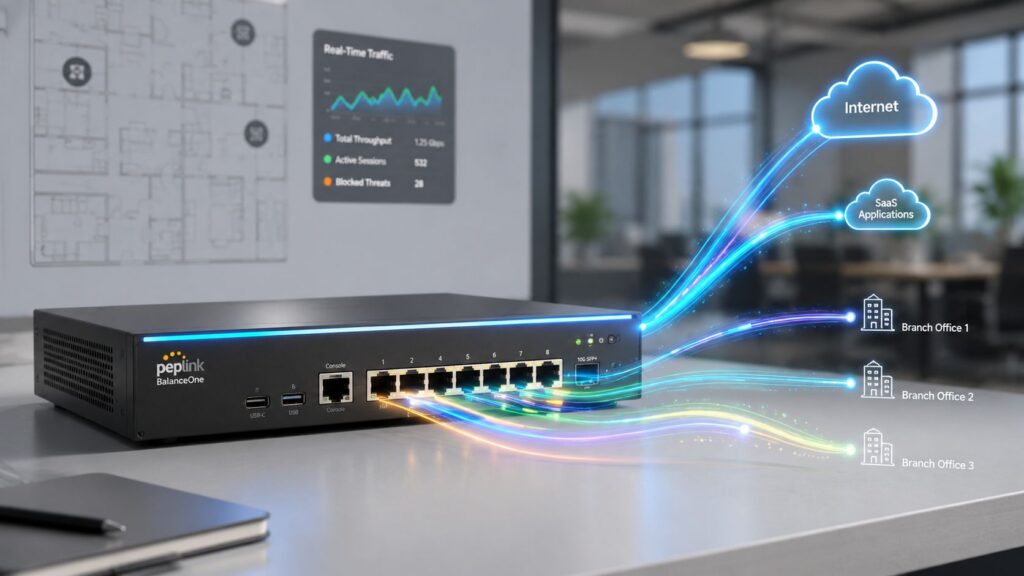
A regional retailer discovers the problem during the busiest part of the day. A voice call breaks up while point-of-sale traffic competes with cloud applications, a backup job consumes the available link, and the central IT team sees only that the branch is “online.” The site still has connectivity, but users experience an unreliable network.
That's the situation the SD-WAN edge is designed to address. It places policy, traffic steering, security controls, and performance measurement at the locations where applications and users connect. The decision isn't whether SD-WAN can route traffic across multiple links. Buyers must determine which edge form factor fits each site, how much encrypted throughput it can sustain, where it should sit, and how the rollout will coexist with an existing WAN.
Why Every Network Conversation Now Centers on the Edge
For years, many enterprise WANs assumed that applications lived in a data center. A branch sent traffic toward headquarters, security controls inspected it there, and users accepted the delay as the cost of centralized architecture. That model becomes difficult when employees use SaaS platforms, voice and video services, cloud infrastructure, and internet-based tools directly from offices, stores, clinics, and factories.
Market data reflects that architectural change. One industry estimate states that more than 70% of enterprise workloads now sit outside the data center, across SaaS, IaaS, and edge environments, a shift identified as a driver of SD-WAN adoption in market reporting on software-defined wide area networks. The branch is no longer a simple endpoint of a data-center network. It's a working access point for distributed applications.
The branch is where policy becomes real
An SD-WAN controller can define application and security policy centrally, but the local edge executes that policy. It sees traffic entering from the LAN, evaluates available paths, applies prioritization, establishes encrypted tunnels, and can send suitable internet traffic directly to a cloud service. That makes the edge the practical execution point of the architecture.
Consider a chain with stores in several regions. A store may have broadband, a private WAN service, and cellular connectivity. The edge can use those transports as a combined connectivity foundation, while the logical overlay determines how traffic moves between stores, data centers, cloud environments, and security services.
The global SD-WAN market reached approximately USD 7.33 billion in 2025, with roughly 31% compound annual growth since 2020, according to Research and Markets' SD-WAN market analysis. North America represented 51.4% of global value, or about USD 3.77 billion, in that estimate. Those figures don't prove that every organization needs SD-WAN, but they show why the edge has moved from a specialist networking topic into mainstream enterprise planning.
This guide focuses on the decisions behind the box, virtual machine, or cloud service: what the edge does, how hardware compares with software, how encrypted performance affects sizing, where placement creates value, and why legacy integration and internal adoption often determine the project outcome.
What the SD-WAN Edge Actually Is
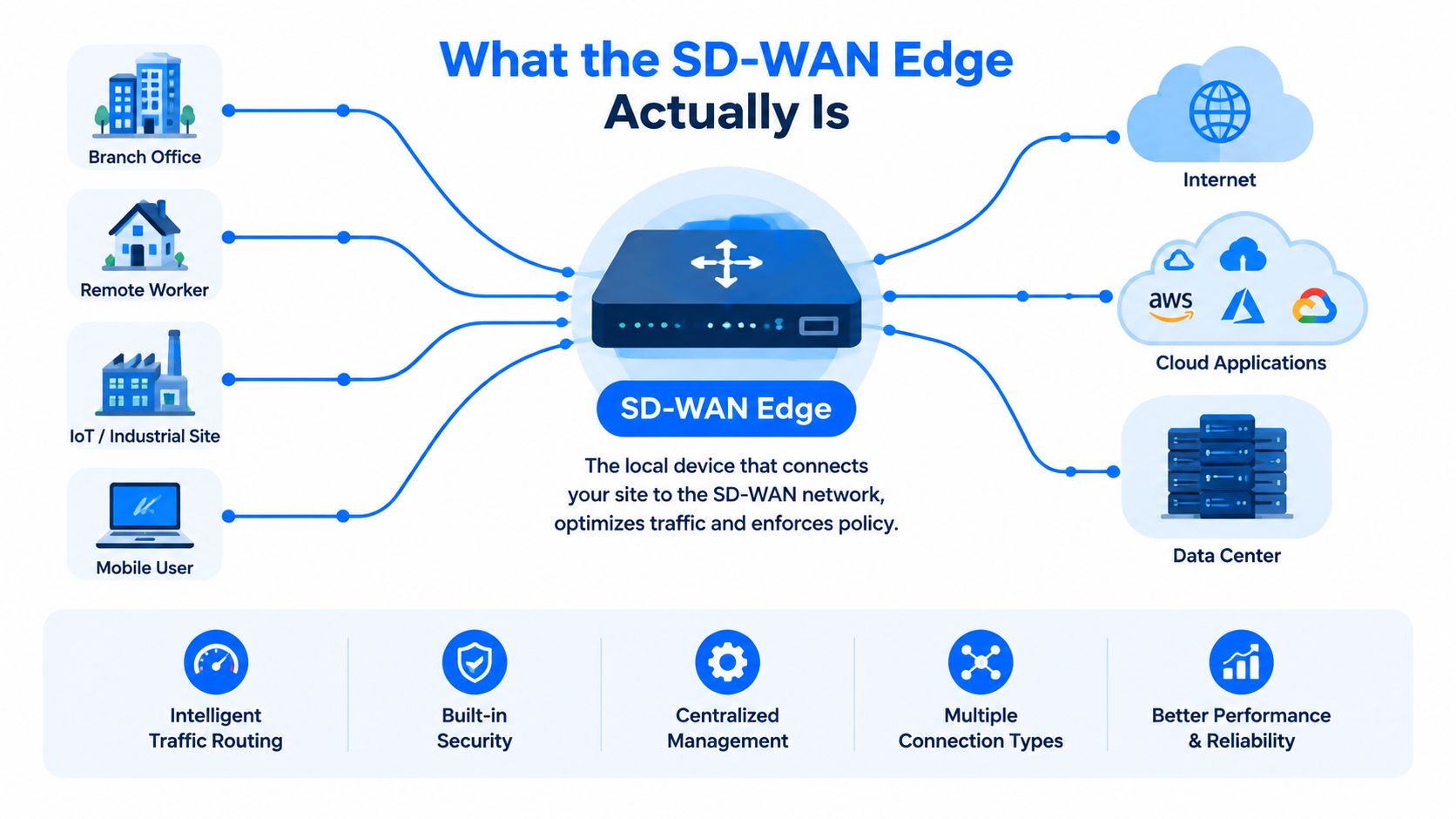
Think of an SD-WAN edge as a smart local traffic controller. It sits at a branch, data center, colocation facility, or cloud location and decides how local traffic should use the available network paths. Instead of sending every packet toward a central headquarters by default, it applies policy close to the users and applications generating the traffic.
Start with a simple branch drawing:
- Users, phones, cameras, and local servers connect to the LAN.
- The LAN connects to the SD-WAN edge.
- The edge connects to one or more WAN transports, such as broadband, MPLS, or LTE and 5G.
- Encrypted overlay tunnels connect that site to other sites, cloud environments, data centers, or security points of presence.
- A centralized management and control system distributes policy and provides operational visibility.
The physical services beneath the tunnels form the underlay. The encrypted logical paths form the overlay. The underlay might be stable, congested, private, public, wired, or wireless. The overlay gives the organization a consistent policy framework across those different transport types.
The edge isn't the controller
This distinction causes frequent confusion. The edge device is the local forwarding and enforcement point. The controller or orchestrator is the system administrators use to define topology, routing behavior, application policy, and configuration. A cloud management plane may host those functions, but it doesn't replace the edge at the branch.
The edge still has to forward traffic if the management system is temporarily unreachable. Exact behavior varies by platform, so buyers should test how policy, tunnels, and failover operate during management-plane disruption rather than assuming that every product behaves identically.
An edge can be a dedicated hardware appliance, a software instance running on a server or hypervisor, a universal customer premises equipment platform, or a cloud-hosted network function. The word “edge” describes its architectural role and position, not a single product shape.
For a branch sketch, draw the LAN on the left, the edge in the middle, and the transports on the right. Above the edge, draw the management plane. Around the transports, draw the encrypted overlay. That basic picture is enough to understand the relationship between local execution, centralized policy, physical connectivity, and logical networking. For broader context, see this overview of SD-WAN architecture and services.
Core Functions the Edge Performs
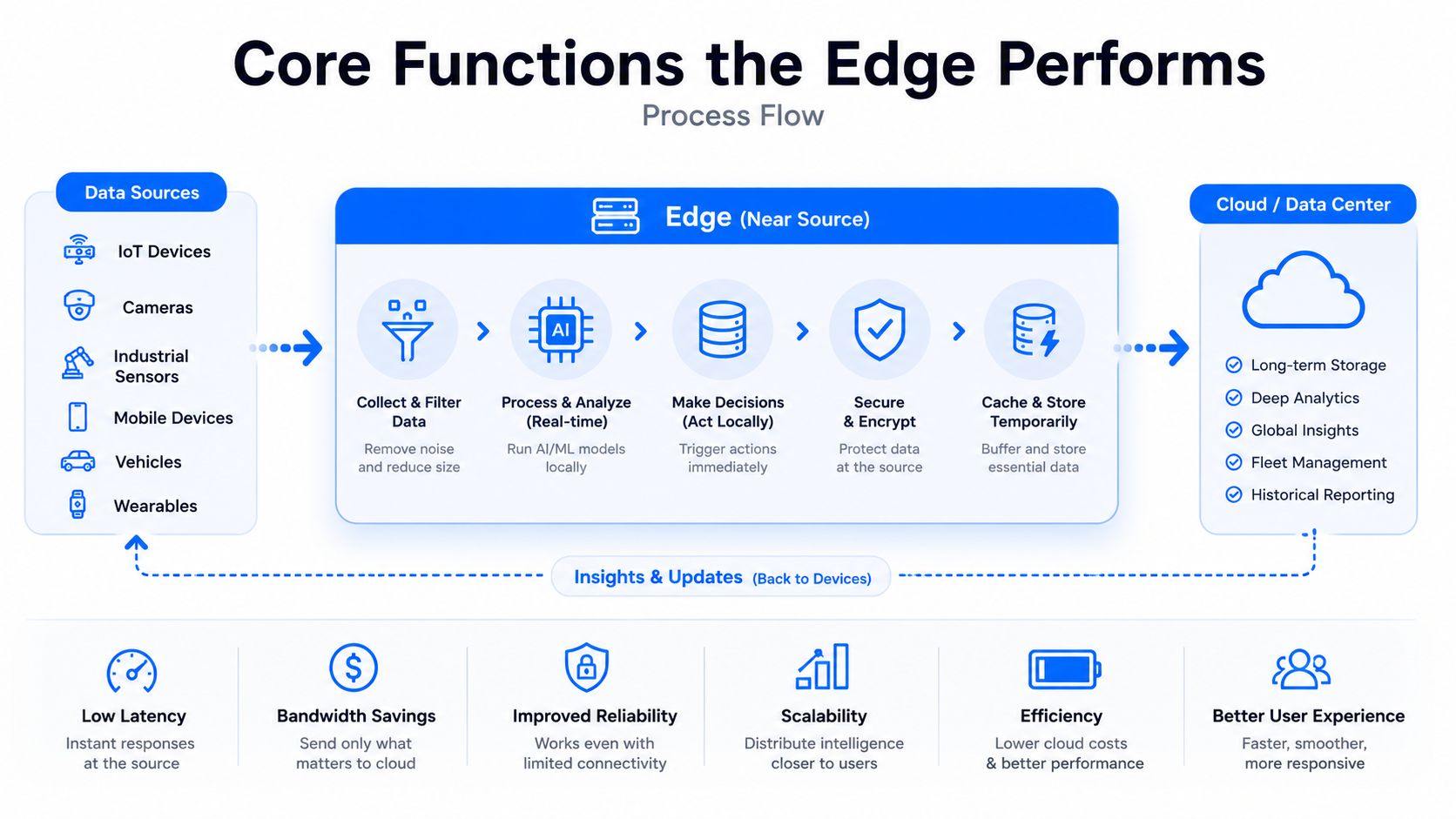
The SD-WAN edge earns its place in the branch by making decisions continuously, not by merely terminating a cable. Its functions should be evaluated as operational capabilities that users can feel when conditions change.
Application-aware forwarding
The edge identifies traffic according to the platform's application classification methods and matches it to policy. A real example might involve a live collaboration call, a point-of-sale transaction, and a large backup job arriving at the same branch. The administrator can assign different treatment to those flows, rather than allowing the backup to consume every available queue.
Application awareness doesn't mean the edge can solve every application problem. Encrypted application traffic, changing service endpoints, browser privacy features, and vendor-specific classification methods can affect accuracy. During evaluation, ask how the platform identifies cloud applications and how administrators verify that the intended policy is being applied.
Dynamic path selection
A branch with multiple transports has choices, but choices only help when the edge can measure them and apply a defined policy. A high-priority voice flow might use the path currently meeting its quality requirements, while less sensitive traffic uses another link.
The important question is whether the product selects paths using live performance data or only basic link availability. Modern WAN edge implementations expose loss, latency, and jitter telemetry and use those measurements for path selection. Cisco documents how BFD-based probes can calculate mean loss, latency, and jitter across tunnel buckets, supporting earlier movement to a healthier path when transport quality deteriorates. The behavior is described in Cisco's WAN edge loss, latency, and jitter documentation.
Suppose a broadband circuit remains technically up but begins dropping packets during a collaboration session. An edge that measures quality can steer affected traffic toward a healthier transport before users describe the call as unusable. That's different from waiting for a circuit to fail completely.
Local internet breakout and encrypted overlays
Cloud-bound traffic doesn't always need to travel through headquarters. Local internet breakout can reduce unnecessary backhaul, but it also changes the security inspection path and compliance conversation. The design must show where web filtering, firewalling, secure access service edge controls, logging, and data-loss policies are enforced.
The edge also establishes encrypted overlay tunnels across the underlay. Encryption protects the logical connection, but it consumes processing resources. A throughput claim that describes unencrypted forwarding may not represent the capacity available when the appliance is classifying, encrypting, decrypting, shaping, and inspecting traffic at the same time.
Network teams should pair edge telemetry with broader methods to monitor network traffic effectively. That wider view helps correlate branch application behavior with link utilization, tunnel health, and downstream service performance. For related networking planning, review enterprise networking capabilities.
Hardware Appliances vs Software and Cloud Edges
The right form factor follows the site's workload and operating model. A retail store with limited local IT support has different needs from a data center that already runs a virtual infrastructure team. Treating every location as an identical appliance deployment can create unnecessary cost or leave a critical site underpowered.
Dedicated hardware at the branch
A hardware appliance provides a known forwarding platform with dedicated interfaces, predictable installation procedures, and a physical device that can connect directly to branch circuits. It often fits locations where throughput, local survivability, or simple replacement matters more than infrastructure flexibility.
The trade-off is hardware lifecycle management. Teams must account for shipping, spares, rack or cabinet space, power, firmware maintenance, and replacement logistics. A high-capacity appliance can also be wasteful at a small site if its resources remain unused.
Virtual, universal, and cloud-based choices
A software edge works well where the organization already operates servers, hypervisors, or cloud networking environments. It can be deployed near workloads and adjusted as the environment changes, but it shares CPU, memory, and network resources with other systems. Performance depends on the host, virtual switching path, security functions, and competing workloads.
Universal CPE can host multiple virtual network functions on a common platform. That can consolidate routing and security roles, although it adds an orchestration and troubleshooting layer. A cloud-hosted edge or provider point of presence can bring policy enforcement closer to cloud applications, but the design must account for provider dependency, service reachability, and recurring consumption costs.
| Deployment Option | Strengths | Trade-offs | Best Fit |
|---|---|---|---|
| Dedicated hardware appliance | Consistent forwarding, purpose-built interfaces, straightforward branch installation | Hardware lifecycle, logistics, physical failure domains | Branches, stores, clinics, and sites needing dedicated performance |
| Software or virtual edge | Flexible placement, uses existing compute, suits cloud and data-center environments | Shared resources, host dependency, more complex performance validation | Data centers, cloud on-ramps, and virtualized sites |
| Universal CPE | Consolidates multiple network functions on one platform | More functions can create operational coupling and troubleshooting complexity | Locations seeking a consolidated network and security stack |
| Cloud-hosted edge | Places services near cloud workloads and supports distributed access | Provider dependency, recurring service costs, connectivity design requirements | Cloud-centric enterprises and regional connectivity hubs |
A hybrid model is usually more practical than a single universal answer. A network team might use hardware at stores, virtual edges in a private data center, and cloud-based points of presence for SaaS access. Organizations reviewing equipment reuse and lifecycle options may also find Reworx Recycling enterprise telecom solutions relevant to responsible handling of retired telecom assets.
Decision rule: Choose the form factor from the workload outward. Don't force a branch appliance into a cloud problem or a virtual edge into a site that lacks reliable local infrastructure.
How to Size and Place Your SD-WAN Edges
Sizing begins with traffic evidence, not a vendor's largest headline number. Gather current utilization, expected application growth, peak behavior, and the traffic that must remain available during link failure. Separate ordinary forwarding from the more demanding combination of encryption, application recognition, quality-of-service processing, firewall inspection, and tunnel termination.
The most important distinction is raw link speed versus encrypted throughput. An internet circuit may advertise a certain capacity, but the edge must process the encrypted overlay at the rate the business requires. Broadcom's documentation describes RFC 2544 throughput testing across bandwidth, latency, frame loss, and back-to-back frames. Those standardized measures help characterize forwarding performance under load and are particularly relevant when encrypted traffic could create queueing or drops. See the SD-WAN edge performance and scale data.
Build the sizing record
For every site category, document:
- Bandwidth demand: Record current traffic by direction, application, and busy period, then include the organization's forecast.
- Encrypted capacity: Require test results for the exact security and tunnel features the design will enable.
- Concurrent sessions and tunnels: Include branch-to-branch, branch-to-cloud, data-center, and security-service connections.
- Failover behavior: Size the surviving transport or edge so critical traffic remains usable when a preferred path disappears.
- Headroom: Leave operational capacity for bursts, policy changes, new applications, and inspection features.
Undersizing appears at the worst time. The edge may pass normal traffic during a quiet test, then add delay and packet loss when users launch cloud applications, voice, backups, and security processing together. A lab test should reproduce the expected feature set and traffic mix, not just measure basic packet forwarding.
Place the edge where decisions matter
At a branch, place the edge between the local LAN and the WAN transports so it can see the traffic that requires policy. A hub-and-spoke overlay can simplify control and inspection, while mesh or partial-mesh designs can reduce unnecessary detours between locations. Regional hubs can provide a middle path for organizations with many sites and different regulatory or operational regions.
Critical sites may need dual edges, diverse circuits, separate power paths, or independent facilities. A cloud or colocation edge can improve access to distributed workloads, but it must have diverse connectivity rather than adding another logical service over the same physical dependency.
Use a site inventory to verify:
- User and application location: Identify where traffic originates and where it terminates.
- Transport diversity: Confirm that “multiple links” don't share an unrecognized failure point.
- Security proximity: Place enforcement where inspection and logging requirements can be met.
- Operational access: Confirm who can replace, reboot, and troubleshoot the edge.
- Growth tolerance: Validate that the selected platform can support foreseeable features and traffic.
Real-World Deployment Friction and How to Handle It
SD-WAN can simplify policy management after deployment, but simplification in the management plane doesn't eliminate migration work. Existing WAN circuits, routing conventions, security appliances, monitoring systems, and support contracts all have to coexist with the new edge.
Frost & Sullivan's 2023 Global Voice of the Customer Network Survey, which included 1,390 decision makers, identified interoperability with the existing WAN as the top-cited SD-WAN deployment challenge, followed by resistance from internal teams. The same survey coverage also identifies international deployment difficulties tied to regulations and on-site support. Those findings appear in coverage of the forces reshaping the SD-WAN landscape.
Treat interoperability as a design task
A rip-and-replace plan creates avoidable risk. Start with a coexistence design that preserves the legacy WAN while the new edge is introduced at selected sites. Define routing boundaries, address overlapping networks, decide which device owns firewall and NAT functions, and document how traffic returns when a tunnel or service is unavailable.
Run a pilot that includes an ordinary branch and a difficult branch. The difficult site may have an older circuit, unusual routing, local servers, or limited hands-on support. A smooth pilot at a modern office doesn't validate the broader estate.
Bring operations into the decision
Resistance from internal teams often reflects legitimate operational concerns. Network engineers may worry about loss of CLI control, security teams may question inspection visibility, and field support may lack a recovery procedure. Include those teams before the design is locked, and give them access to policy workflows, telemetry, logs, and rollback methods.
Use a staged rollout:
- Discover: Inventory circuits, routing, applications, security dependencies, and site contacts.
- Pilot: Test coexistence, failover, monitoring, and change procedures.
- Expand by site type: Move through controlled groups rather than treating every location as identical.
- Review: Compare observed application behavior with policy intent before wider deployment.
- Retire carefully: Remove legacy services only after dependencies and support paths are documented.
International deployments require region-specific planning. Compliance rules, data handling requirements, carrier availability, language, time zones, and on-site support can affect the edge design as much as throughput. Sequence regions according to operational readiness, not just commercial priority.
Choosing an Edge Strategy That Fits Your Business
An SD-WAN edge is increasingly a security policy execution point, not only a routing device. Dell'Oro market coverage forecasts cumulative SASE spending across SSE and SD-WAN at $97 billion from 2025 through 2030, and describes SD-WAN as evolving into an execution layer that determines how traffic reaches cloud-delivered controls and where enforcement occurs. That forecast is summarized in SASE market coverage from Coherent Market Insights.
A separate Gartner-related projection reported in the same coverage says 60% of new SD-WAN purchases will be part of a single-vendor SASE offering by 2026, compared with 15% in 2022. Because that is a projection, buyers should use it as a planning signal, not a guarantee that every standalone SD-WAN deployment will become obsolete.
Evaluate the strategy in this order:
- Inventory sites and workloads: Map users, applications, cloud services, transports, and compliance boundaries.
- Define performance thresholds: Test encrypted throughput, tunnels, sessions, inspection, and failover under realistic load.
- Assign form factors: Match hardware, virtual, universal, and cloud edges to each site category.
- Design placement and redundancy: Decide where traffic should be inspected and how critical locations will survive failures.
- Pressure-test operations: Validate legacy interoperability, support coverage, internal ownership, and regional deployment constraints.
- Assess security integration: Check policy visibility, logging, identity controls, SSE connectivity, and compatibility with the existing security stack.
A vendor-neutral advisory model can help compare providers without reducing the decision to a product demonstration. MR2 Solutions describes managed services for ongoing IT operations alongside its broader technology brokerage approach, which is relevant when the edge must be governed after implementation rather than just installed.
MR2 Solutions can help your team evaluate, design, procure, and implement SD-WAN edge options across branch, data-center, and cloud environments. Visit MR2 Solutions to discuss a vendor-neutral assessment that connects sizing, security integration, deployment readiness, and ongoing network governance to your business requirements.