
Data Center Migration Playbook for Mid-Market IT Leaders

Your facility renewal is approaching, finance wants a smaller infrastructure bill, and the application team wants modernization without downtime. Meanwhile, your inventory still contains servers nobody confidently owns. You're being asked to choose a destination before you've established what can move, what must stay, and who will operate the result.
Data center migration isn't primarily a moving project. It's an operating-model decision. Treat it that way, and you can make defensible choices about workload placement, suppliers, cost, and recovery. Treat it as a deadline-driven relocation, and you risk inheriting a more expensive version of the environment you already struggle to manage.
Why Data Center Migration Is a Distributed Operating Model Now
Stop asking which facility or cloud should receive everything. Ask where each business service belongs and how your team will support it across organizational and supplier boundaries.
The Uptime Institute's 2024 Global Data Center Survey reported that the average share of organizational workloads hosted off-premises rose from 42% in 2020 to 55% in 2024. That's a majority outside enterprise-owned facilities, not evidence that every workload belongs in public cloud.
The practical distinction matters. Colocation, hosted infrastructure, private environments, and public cloud represent different ownership and support arrangements. Your destination decisions should follow business requirements, not a vendor's preferred architecture.
Define the operating responsibilities first
Before requesting proposals, establish what the business needs from its infrastructure:
- Service outcomes: Identify the transactions, clinical workflows, customer interactions, and internal operations that must remain available.
- Ownership boundaries: Assign responsibility for infrastructure, operating systems, application support, security controls, and incident command.
- Commercial expectations: Decide where predictable spending matters more than elasticity, and where the business can tolerate variable consumption.
- Operating capacity: Match the design to the people you have, including their availability outside normal working hours.
A destination that looks economical on a proposal can be unsuitable if your team can't operate it. Compare managed services and colocation options together rather than treating facility selection and support coverage as unrelated purchases.
Keep application decisions separate from vendor preference
An application-specific resource such as Kogifi's cloud migration guide for Sitecore can inform a focused planning discussion. Use that alongside your own dependency and operating requirements, not as a substitute for portfolio-wide assessment.
A broker-style advisor should help you compare viable destinations, expose contractual assumptions, and coordinate suppliers. Ask how the advisor evaluates alternatives and discloses commercial relationships. Don't accept a recommendation that starts with a provider and works backward to your requirements.
Practical rule: Choose the operating model before you choose the destination. Otherwise, the supplier's service boundaries become your architecture by default.
Discovery and Assessment Before You Touch a Workload
A server list isn't a migration assessment. You need a service dependency record that connects business ownership, technical components, data handling, and acceptance criteria.
The migration survey summarized by CloudMagazin's analysis of recurring migration barriers identifies complexity as the leading barrier at 38%, followed by insufficient senior-management backing at 31%; reported complexity spans IT infrastructure (45%), data protection and compliance (37%), and security/disaster recovery (32%). That supports a discovery phase covering governance and dependencies, not merely hardware.
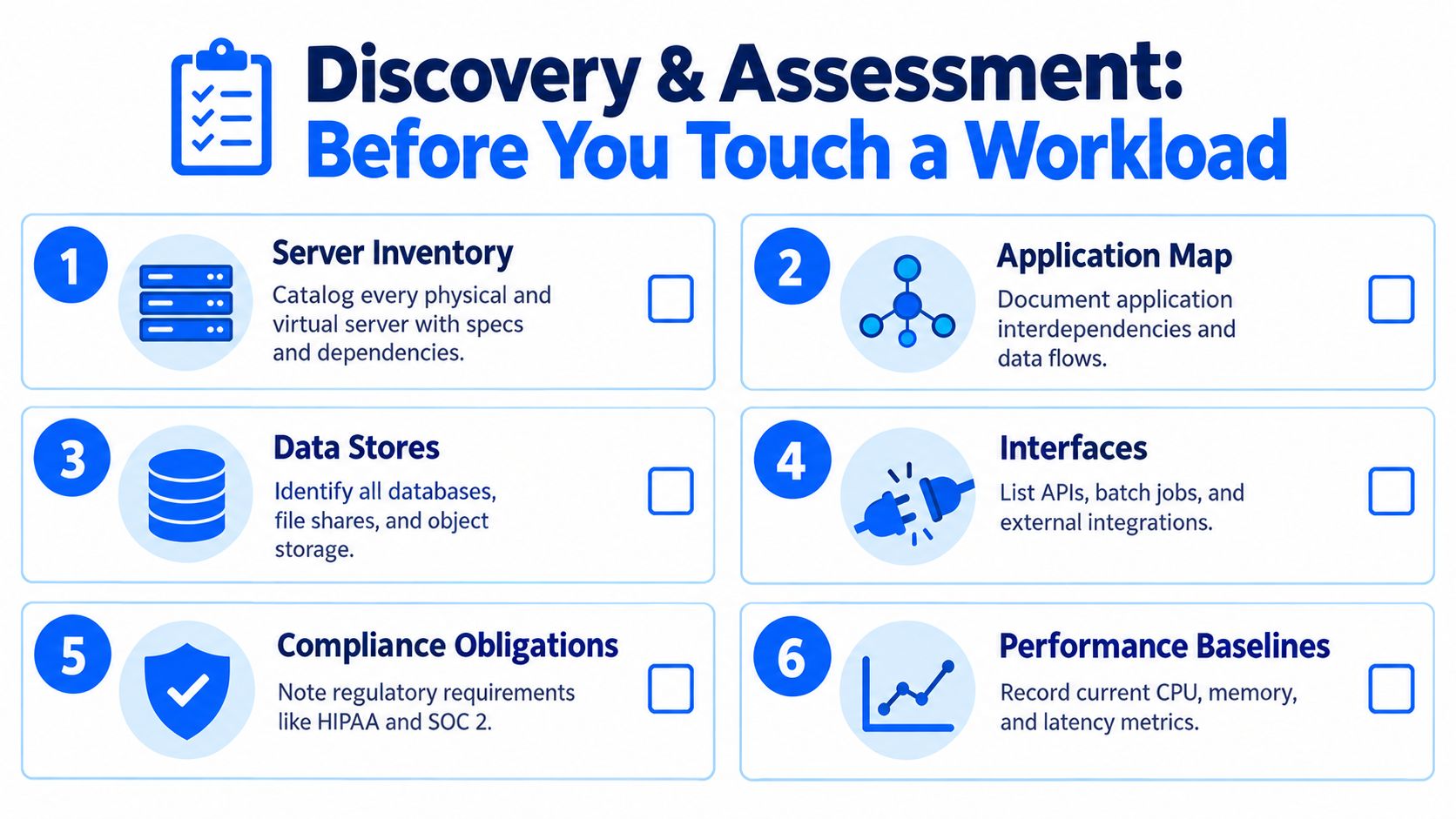
Use the checklist to organize collection, then validate the findings with application owners.
Produce evidence your engineers can execute
Start with a shared register, but don't let it become an unchecked spreadsheet. Compare infrastructure exports, observed connections, application documentation, and owner interviews.
- Asset record: Capture physical and virtual servers, installed software, support status, utilization, and accountable owners. Mark unknowns explicitly.
- Dependency map: Document application calls, authentication, databases, storage, external integrations, and scheduled jobs. Group components that must transition together.
- Data register: Identify data stores, sensitivity, retention expectations, backup locations, and approved access paths.
- Baseline evidence: Record application response time, transaction throughput, resource demand, and behavior during the business's busiest operating periods.
Cloudvara's guide to cloud app and cost checks is a useful companion for structuring readiness questions. Keep unresolved application and financial assumptions visible in your decision register.
Make compliance part of the inventory
Consider a hypothetical mid-market healthcare team assessing a patient scheduling application. Its inventory should identify where protected health information enters the workflow, where copies persist, which support providers can access it, and which proposed arrangements need legal review for business associate agreement implications.
The output shouldn't just say “healthcare application.” It should name the privacy owner, approved data destinations, access requirements, and evidence needed before approval. Have counsel and compliance staff determine the obligations rather than expecting an infrastructure engineer to interpret them alone.
Finally, require business owners to confirm what's still needed. Separate retirement candidates from migration candidates, and flag systems whose owners can't explain their purpose. Don't approve a wave while critical dependencies remain unresolved just because the asset-counting exercise is complete.
Choosing the Right Migration Pattern for Each Workload
Lift-and-shift, replatforming, and hybrid placement aren't competing philosophies. They answer different questions. Rehosting and replatforming describe how a workload changes; hybrid placement describes where its components operate.
Organizational scale belongs in that decision. The European Commission's cloud adoption figures show that 45.2% of EU businesses used cloud services in 2023, up 4.2 percentage points from 2021, with adoption at 77.6% among large enterprises, 59.0% among medium-sized businesses, and 41.7% among small businesses. Don't copy a large enterprise's architecture without matching its staffing and governance capacity.
Migration pattern selection by workload signal
| Workload signal | Default pattern | When to override |
|---|---|---|
| Stable application with supported software and limited coupling | Lift-and-shift | Compatibility or licensing makes unchanged deployment unsuitable |
| Database or runtime needs material modernization | Replatform | Redesign would exceed the approved business scope |
| Strict latency or data-control requirements | Hybrid placement | Testing and compliance review support consolidated placement |
| Variable demand with an operationally ready team | Cloud placement, using the appropriate migration pattern | Consumption costs or support gaps outweigh flexibility |
| Unclear ownership or weak business value | Retain temporarily pending disposition | An accountable owner validates retirement or migration |
Lift-and-shift keeps application change narrow. Use it when the immediate objective is leaving a facility or replacing infrastructure, not redesigning the service. Don't describe it as modernization unless you've specified what improves.
Replatform when a database engine, runtime, or supporting service needs change to meet the target requirements. Budget for application-owner involvement and testing rather than assuming infrastructure engineers can handle every compatibility issue.
Hybrid placement is appropriate when service components have different constraints. The trade-off is ongoing coordination across environments, so require an explicit explanation of why that complexity is justified.
Sequence by evidence, not enthusiasm
Choose a pilot that's low risk but still representative. A disposable development server won't tell you much about production identity integration, data movement, or user access.
For workloads involving endpoint-held information, include device-side handling in the plan. The myhalo guide to safe device data moves can support that narrower discussion without replacing application-level validation.
Document the selected pattern and rejected alternatives for every service. Use a multi-cloud strategy assessment when multiple providers are necessary, not just available.
Your team should be able to explain each placement in plain language: this service needs local responsiveness, that application benefits from managed operations, and this system should remain unchanged until its replacement is ready.
Site Selection That Accounts for Water, Power, and Community Risk
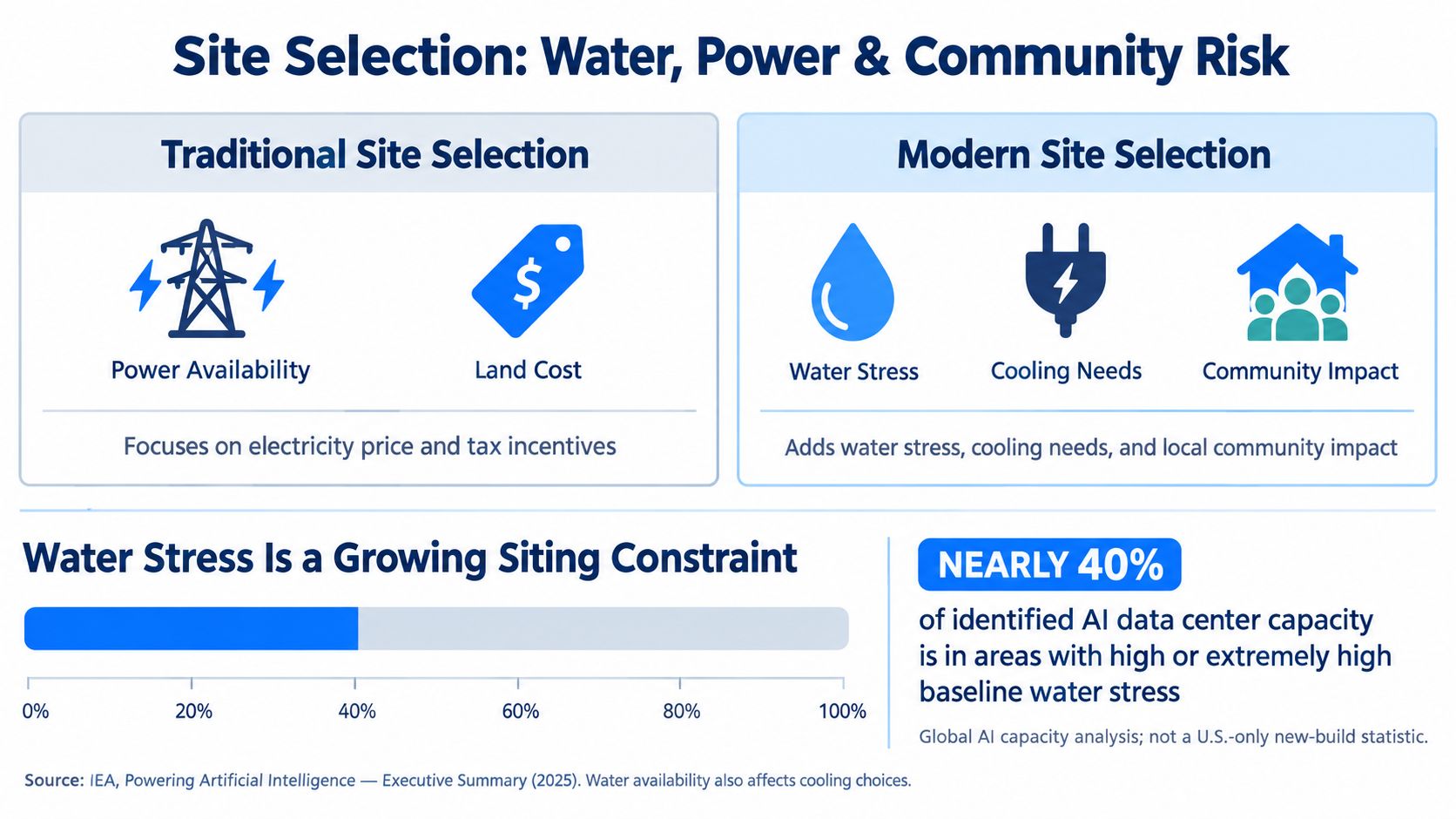
An energy-efficient destination can still be the wrong destination. Evaluate water availability and utility constraints before you commit to capacity, particularly when planning dense workloads.
The IEA estimates described in Bloomberg's examination of data-center water demand put global consumption at roughly 560 billion liters annually, with a projection of about 1.2 trillion liters by 2030 and approximately 60% associated indirectly with electricity generation; the same reporting says about two-thirds of U.S. data centers built or under development since 2022 are in high water-stress areas.
Those figures don't establish that any particular facility is unsuitable. They establish why a procurement team shouldn't accept an environmental summary without examining local conditions.
Build a water-aware destination scorecard
Ask shortlisted providers for site-specific evidence, not portfolio averages.
- Watershed conditions: Examine seasonal availability, competing local demand, and restrictions that could affect operation or expansion.
- Cooling design: Identify the cooling method, its water requirements, and any trade-offs between lower water consumption and electricity demand.
- Withdrawal versus consumption: Require separate definitions and reporting so returned water isn't confused with water consumed.
- Utility exposure: Check power availability, curtailment provisions, generation-related water intensity, and whether proposed capacity is contractually secured.
- Community constraints: Request documentation of permits, expansion approvals, local restrictions, and unresolved concerns.
Use qualitative ratings backed by evidence rather than an impressive-looking numerical score with arbitrary weights. Record missing information as an unresolved risk, not a favorable assumption. Incorporate those findings into the data center design assessment before approving the target architecture.
Reject unsupported green claims
Consider a hypothetical regulated healthcare provider comparing destinations. A facility presents strong energy-efficiency credentials, but its proposal doesn't explain seasonal water restrictions or the local power supply's water intensity.
The provider should pause selection until those questions are answered. If the evidence reveals unacceptable operational or reporting exposure, reject the site despite its efficiency claims.
A sustainability claim isn't a capacity guarantee. Ask what happens to your contracted service when the utility or community imposes restrictions.
This is a procurement decision as much as an environmental one. Put evidence requirements and expansion assumptions into the contract review, and distinguish capacity available today from capacity dependent on future approvals.
Testing, Cutover, and Rollback That Beat the Failure Curve
Don't authorize production movement because replication completed. Authorize it because the team has demonstrated service readiness, can explain the financial exposure, and has rehearsed a recoverable transition.
MedhaCloud's compiled migration statistics report that 38% of migrations exceed budget, with average overruns of 23%, while 31% miss their timeline; reported success rates are 79% for databases and 61% for legacy applications, and formal readiness assessments are associated with 2.4 times higher success rates. Treat those compiled figures as directional risk evidence, not a forecast for your project.
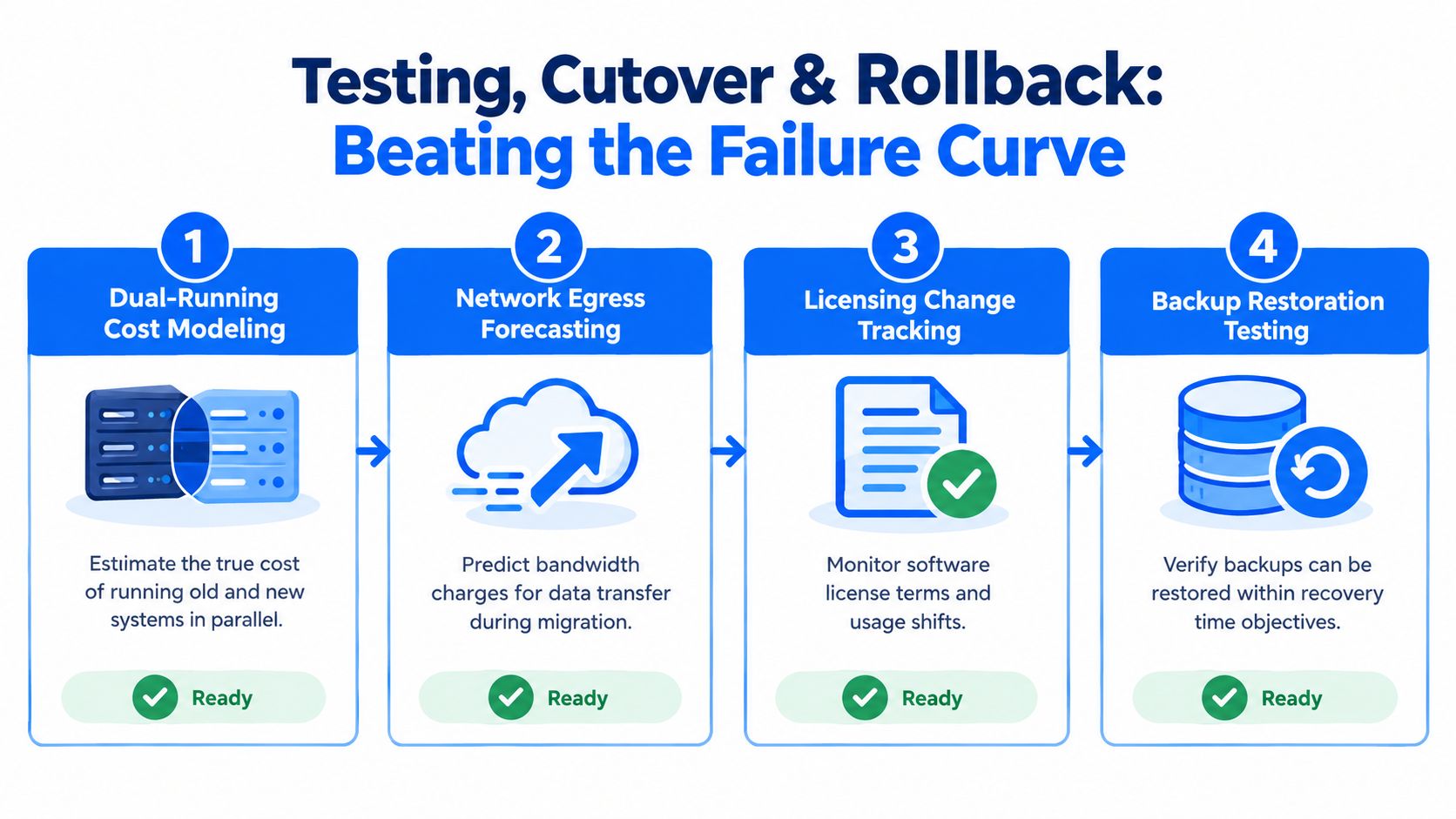
Use readiness gates to expose assumptions before they become production incidents.
Close the financial and technical gates
Finance should review a cost model covering parallel operation, network egress, licensing changes, storage growth, backup, monitoring, and support staffing. Include the cost of delaying legacy retirement. Don't count projected savings before the old commitments can end.
Engineering should test representative workloads under peak demand and failure conditions. Exercise application access, security controls, backup restoration, and disaster recovery, then compare the results against the discovery baseline.
Require evidence for approval:
- Data integrity: Reconcile source-to-target record counts and checksums, with documented treatment of data that changes during replication.
- Application performance: Measure latency and throughput through the user journey, not just infrastructure dashboards.
- Recovery capability: Demonstrate restoration against the approved recovery objectives and record exceptions.
- Operational readiness: Confirm monitoring, escalation access, support coverage, and the availability of decision-makers during the window.
Write a runbook that supports decisions
A useful cutover runbook names the accountable lead, lists prerequisites, defines the replication and write-control sequence, and assigns each execution task. It also specifies validation evidence, business communications, approval authority, and rollback actions.
Set a time-bounded rollback trigger before the window starts. Tie it to service loss, unacceptable data divergence, or inability to restore agreed functionality, not merely the number of healthy servers.
Cutover discipline: A checkpoint without an owner, evidence requirement, and decision deadline isn't a readiness gate.
Keep source systems recoverable through the agreed stabilization period. Any decision to disable recovery capability should require explicit business approval.
The team should rehearse the runbook and record actual execution times. If the rehearsal leaves too little time for validation and reversal, revise the wave scope rather than hoping production will go faster.
Modeling the Real Cost of Failure After Cutover
Successful cutover doesn't eliminate operational risk. Your team must now manage different network paths, access arrangements, supplier processes, and recovery dependencies.
The Uptime Institute's 2025 Annual Survey found that 50% of data-center operators had experienced an impactful outage during the preceding three years; among respondents experiencing a significant outage, one in five reported costs exceeding $1 million. Those aren't migration-failure probabilities, and you shouldn't present them as such.
Use them to justify a business-service exposure model rather than claiming that a newer destination makes outages irrelevant.

Calculate exposure using business-owned inputs
For each critical service, have finance and its business owner define revenue at risk during disruption, contractual consequences, manual-workaround costs, and the operational effect of delayed or lost transactions. Keep these categories separate to avoid double-counting.
Have security and legal identify relevant notification obligations and contractual escalation deadlines. Engineering should document recovery-time and recovery-point variance, including dependencies that can extend either beyond the approved objective.
| Exposure component | Evidence to request |
|---|---|
| Service interruption | Business impact assessment and validated workaround |
| Data divergence | Replication status and reconciliation procedure |
| Supplier dependency | Escalation path, access rights, and incident responsibilities |
| Continued parallel operation | Contract commitments and operating-cost forecast |
| Recovery boundary | Conditions that prevent safe return to the source |
Work backward from the point of no return
Consider a hypothetical order-processing service that begins accepting transactions at the destination after cutover. Returning traffic to the source isn't safe unless the team can account for destination-only orders and external payment acknowledgments.
The rollback decision therefore depends on whether the team can reconcile those records, whether the payment provider supports the required reversal process, and whether the source remains operationally and contractually available.
Calculate feasibility using the rehearsal's detection, decision, reversal, and reconciliation durations. Compare that total with the approved service interruption tolerance and remaining source availability. If it won't fit, define forward recovery as the contingency rather than promising an unusable rollback.
Before signing destination or managed-service contracts, require incident notification terms, named escalation responsibilities, diagnostic access, evidence retention, and participation in recovery exercises. Service credits don't restore a business workflow. Your contracts should make the supplier's operational obligations clear when your team needs assistance most.
Ninety Days to a Defensible Migration Plan
Use ninety days as a planning horizon, not a promise that the whole estate will move. The deliverable is a steering-committee-ready plan with accountable owners, justified destinations, executable waves, and documented exceptions.
Protect the discovery and testing work when deadlines tighten. Reduce scope before you remove controls.
Set weekly deliverables
- Weeks one and two: Confirm executive sponsorship, business outcomes, decision authority, contract deadlines, and discovery access.
- Weeks three and four: Validate service ownership and dependency maps. Assign owners and closure dates to unknowns.
- Weeks five and six: Select migration patterns and compare destination options against operating requirements.
- Weeks seven and eight: Complete water-utility review, commercial assessment, and supplier responsibility mapping.
- Weeks nine and ten: Rehearse a representative pilot, evaluate readiness evidence, and adjust wave scope.
- Weeks eleven and twelve: Secure business acceptance criteria, incident obligations, and stabilization requirements.
- Final planning days: Present the funded schedule, unresolved exceptions, and approval decisions to the steering committee.
These are proposed milestones. If evidence collection takes longer, revise the schedule openly rather than labeling incomplete assessment as finished.
Report decisions, not activity
Give the board a concise dashboard covering off-premises workload share, measured time-to-cutover by wave, validated rollback readiness, post-migration service-loss exposure, and environmental risk status. Define each metric, identify its owner, and show whether it reflects measured evidence or an assumption.
Don't use workload share as a cloud adoption target. Don't count a rollback document as a successful rehearsal. Environmental ratings should identify the underlying site evidence and unresolved constraints.
Engage a broker-style advisor when multiple suppliers, limited internal capacity, or conflicting contract terms prevent a coherent decision. Require a provider-neutral comparison and a shared decision register, not another sales presentation.
This week, convene application owners, finance, security, procurement, and infrastructure operations. Assign the discovery lead, approve the evidence register, and pause destination commitments that depend on unverified assumptions. That meeting should end with named owners and deliverables, not a general agreement to modernize.
MR2 Solutions offers vendor-neutral data center, colocation, hybrid-cloud advisory, and project coordination to help align infrastructure decisions with business outcomes. Visit MR2 Solutions to discuss your migration scope, provider evaluation, and governance requirements before committing to a destination.