
Mobility Managed Services: A 2026 Buyer Guide
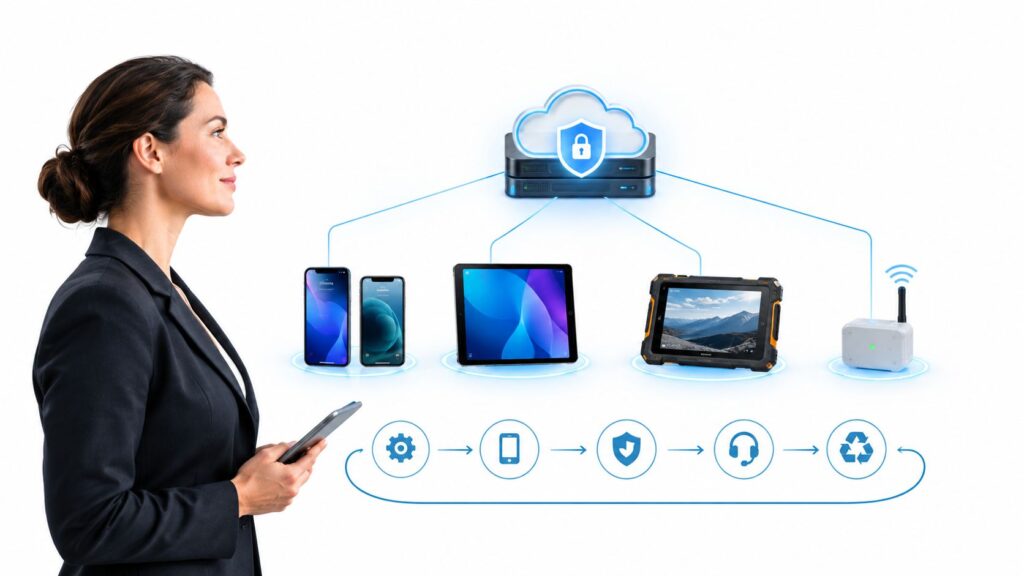
You've inherited a mobility program that grew one exception at a time. A regional team bought rugged devices from a local carrier, executives use personally owned phones, and field staff rely on tablets configured by whoever had time. The invoices keep arriving, but no one can confidently say which devices meet policy, who owns support, or what happens when a worker leaves.
That isn't just a device problem. It's an operating-model problem, and it calls for more than negotiating handset prices. The global managed mobility services market reached approximately $23.1 billion in 2025, with cloud-based offerings accounting for 68.4% of the market, according to managed mobility services market estimates. The scale reflects a shift from basic device administration toward coordinated provisioning, security, applications, connectivity, monitoring, and support.
The Mobile Sprawl Problem Most IT Teams Underestimate
The first surprise for a new IT leader is usually how many teams have a hand in mobility. Procurement selects devices, security writes policies, regional offices choose carriers, and employees open support tickets wherever they can get a response. Each group may be acting reasonably. Together, they can create a fleet that's hard to inventory, secure, support, and retire consistently.
The risk isn't limited to lost phones. An unmanaged device can keep access longer than it should, run outdated software, or hold company information after its user changes roles. Meanwhile, finance may be paying for service lines no one can confidently match to a current business need.
Start with the operating reality: A device is not managed just because the organization bought it. The organization needs a reliable record of its owner, configuration, access, support route, and end-of-life path.
Fragmentation also hides in the exceptions. A BYOD user may need a different privacy approach from an employee with a company-owned phone. A field technician may need rugged hardware and specialized apps, while a remote employee needs reliable access to collaboration tools. A single blanket policy can be too permissive for one group and unnecessarily restrictive for another.
For a practical view of regional mobile-device management considerations, 2026 MDM strategies for Canada offers useful context. But the broader decision for a CIO is whether to keep coordinating disconnected processes internally or establish a managed operating model that makes responsibilities and controls explicit.
Treat the program as a connected set of decisions: device lifecycle, connectivity, management platforms, security, user support, spending oversight, and governance. If any one of those areas is missing from the service scope, the provider may be managing a slice of mobility rather than the program.
What Mobility Managed Services Actually Include
A useful definition of mobility managed services is an accountable service that coordinates devices, connectivity, controls, support, and costs across their working life. Don't score a proposal by its service label. Score it by whether it covers the operating tasks your organization needs.
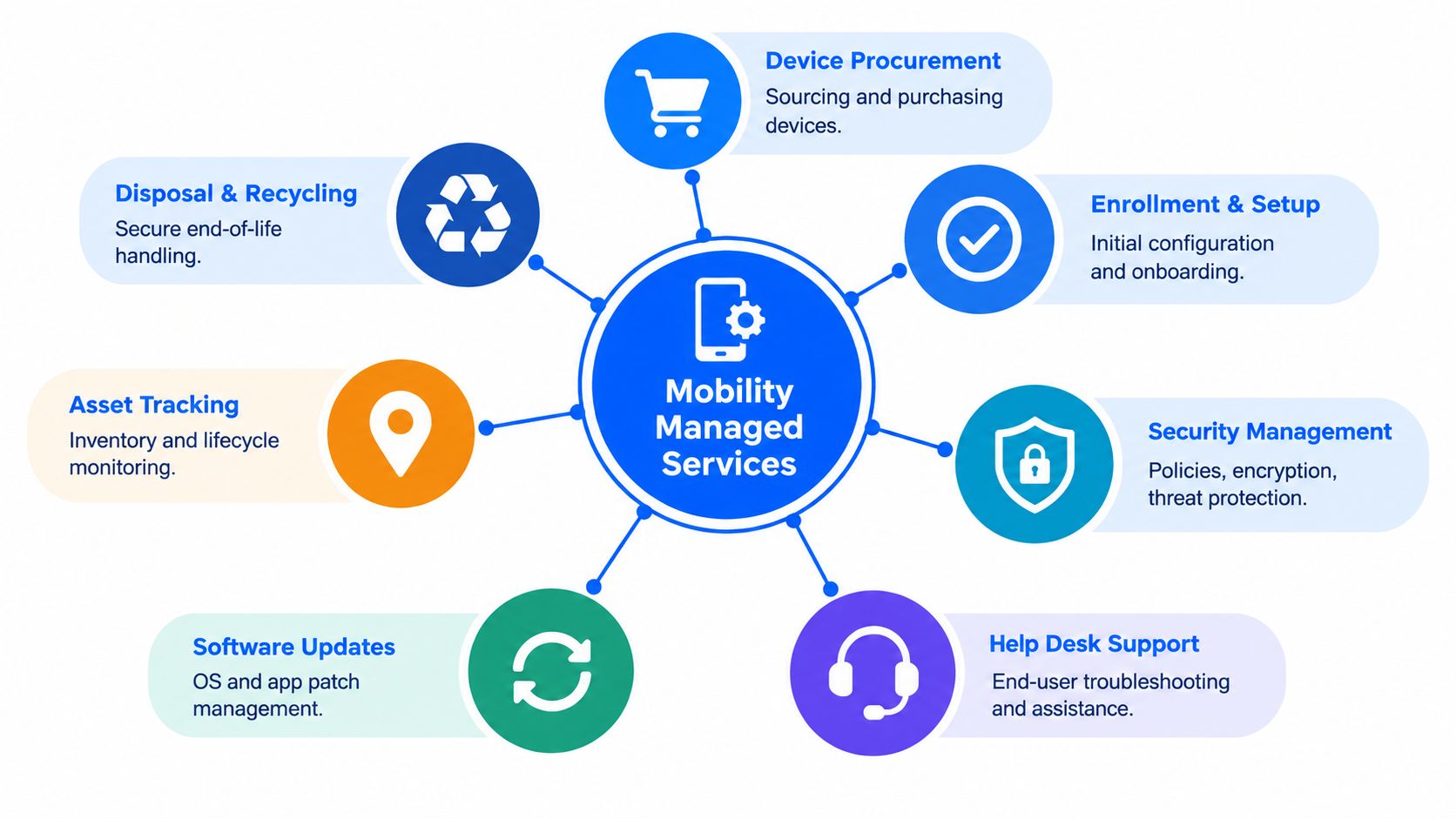
Use these seven service blocks as a proposal review grid:
- Device lifecycle and procurement: The provider helps select, source, stage, assign, repair, and retire equipment. A new hire should receive a prepared device through a defined workflow, not an improvised chain of emails.
- Connectivity and carrier management: Someone needs to manage service lines, plans, roaming, suspensions, and carrier changes. When a worker leaves, the process should address the device and its service line together.
- Mobile Device Management: The service configures and administers the management platform, including enrollment, policy, app distribution, and compliance. Ask who owns the policies and how exceptions are approved.
- IoT connectivity: This covers connected equipment beyond employee phones. For example, a fleet operator may need to track service and connectivity for SIMs in trucks or remote sensors.
- Security and compliance: The provider implements agreed controls, reports exceptions, and coordinates with your security team. A product list isn't a substitute for defined responsibilities.
- End-user support: Employees need a clear route for help with device setup, connectivity, and approved mobile applications. Clarify how issues move between the help desk, carrier, and internal IT.
- Billing and technology expense management: The service should help reconcile usage, service lines, invoices, and business needs. A lower monthly plan isn't useful if unused lines remain active or charges can't be explained.
The blocks need to work together. A lost device, for instance, can trigger a security response, a carrier suspension, a replacement request, and an asset-record update. If those actions sit with disconnected providers, internal staff become the integration layer.
For organizations managing connected devices alongside employee endpoints, mobility and IoT services are relevant to the broader service picture. Use the same scope test for every proposal: who performs each task, what evidence proves completion, and who remains accountable when a handoff fails?
Anatomy of a Mature MDM and EMM Control Plane
A mature Enterprise Mobility Management (EMM) service follows the device through its full lifecycle. NIST's guidance describes a lifecycle that includes planning, risk assessment, deployment, operation, auditing, and disposal, and places Mobile Device Management within a broader architecture that can also include mobile threat defense, application vetting, VPN, and endpoint-protection controls. That model is more useful than evaluating an MDM product by its enrollment screen alone. See the NIST guidance for managing mobile-device security.
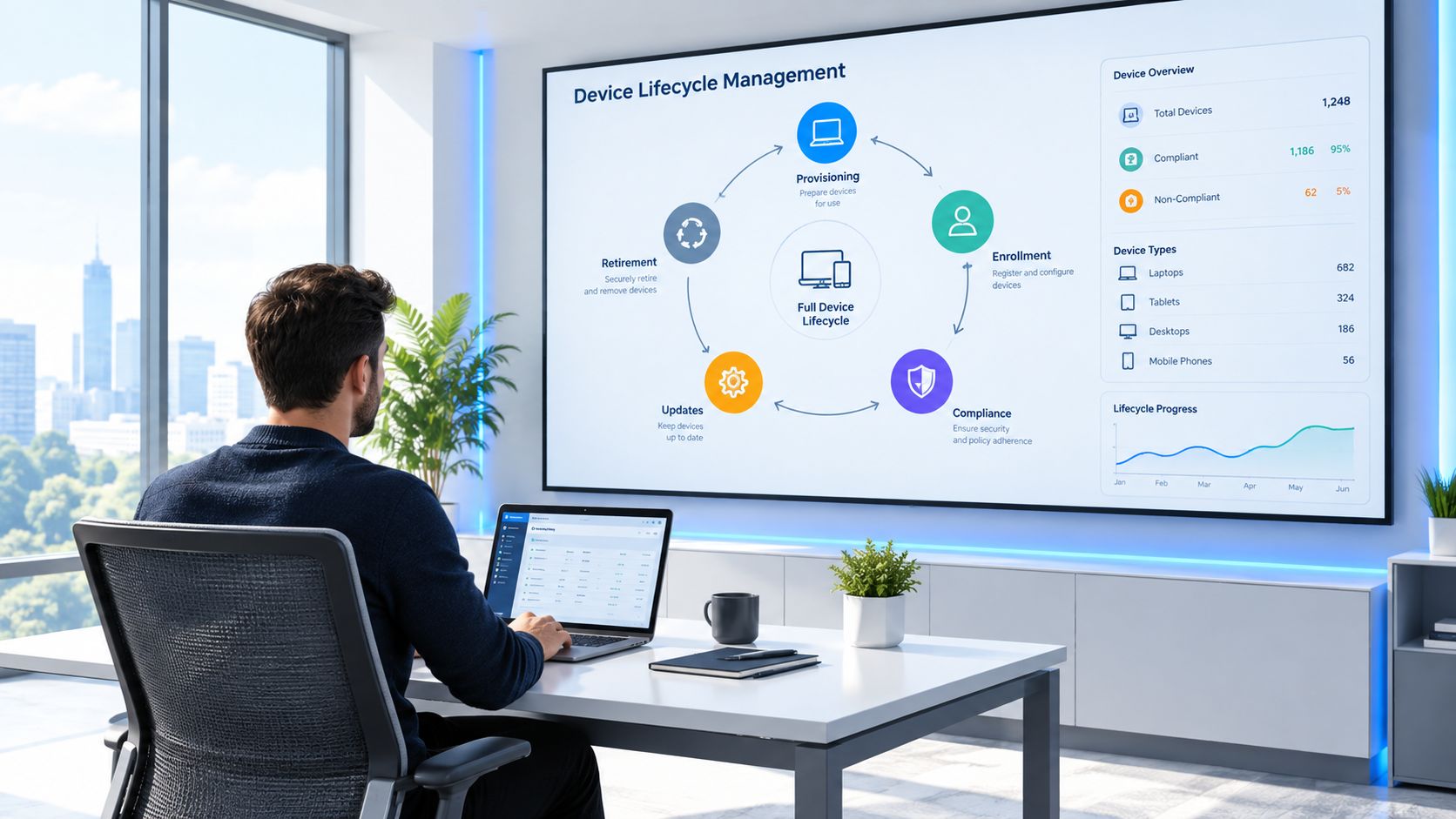
Before enrollment, your team should define supported device types, user groups, access needs, and risk requirements. During enrollment, the service applies configuration and security policy. In operation, it checks compliance and manages application controls. Auditing should provide evidence of state and exceptions, while retirement should remove access and handle company data appropriately.
The control plane's purpose is to make access depend on device posture. It inventories endpoints, applies policy, checks whether devices comply, and blocks or remediates devices that fail the rules. That only works if the provider and your security team agree on what counts as compliant and what happens when a device falls short.
Put operational measures in the contract
Ask vendors to report service performance in terms that reveal control effectiveness. Useful measures include enrollment coverage, compliance-evaluation latency, patch-age thresholds, mean time to revoke access, remote-wipe success rate, and the share of corporate applications distributed through managed channels. Define each measure precisely, including how exceptions and failed actions will be reported.
BYOD requires its own rules. The provider should separate company data from personal data through containerization or equivalent controls, explain what administrators can and can't see, and document support and offboarding procedures. A policy that promises privacy without describing the actual controls is not enough.
Don't accept “we support BYOD” as a complete answer. Ask the provider to demonstrate what happens to work data, personal data, and access when an employee leaves.
Why MDM Is Quietly Becoming an AI Governance Control
When an employee enters sensitive company information into a generative-AI app on a phone, who owns the response? The answer can't stop at the application team or the security team. The organization needs policies that connect mobile access, identity, data protection, acceptable use, training, and audit evidence.
A 2025 survey of 762 professionals found that organizations using MDM were more likely than non-users to provide AI-risk training covering all areas (55% versus 39%), enforce generative-AI usage policies (59% versus 45%), and audit AI-generated content (63% versus 48%), according to the 2025 Mobile Security Index. Those results don't prove that MDM alone produces stronger AI governance. They do show why mobile management belongs in the governance conversation.
The practical question isn't just which platform to deploy. It's how to control the mobile pathways employees use to reach AI tools and how to respond when policy isn't followed. A provider that reports enrollment and ticket volumes but ignores AI-app use is leaving a material governance gap.
Make mobile AI rules operational
Set clear ownership before configuring controls. Security, privacy, legal, business leaders, and IT should agree on approved applications, restricted data, and the process for handling exceptions. Then translate that policy into controls employees can follow:
- Application rules: Identify which mobile AI applications are approved and how new requests are reviewed.
- Role-based access: Set different permissions according to a user's work and data access, rather than treating every employee identically.
- Monitoring boundaries: Explain what the organization monitors and what remains private, particularly on BYOD devices.
- Incident response: Define who receives an alert, who investigates, and when an event becomes a reportable incident.
- Outcome measures: Track policy exceptions and prevented data exposure, not just the number of managed devices.
MDM isn't an AI policy by itself. It can, however, help enforce and evidence mobile controls that an AI governance program depends on. Put that responsibility into the service scope instead of assuming it comes with device enrollment.
Comparing the Three Service Models Buyers Actually Choose
Most buyers aren't choosing between outsourcing and doing everything themselves. They're choosing how much mobility responsibility to place with a provider, and whether that provider will coordinate with the rest of the IT environment.
| Service Model | Best Fit For | Strengths | Trade-offs |
|---|---|---|---|
| Telco-led managed mobility | Organizations with concentrated carrier relationships and straightforward fleet needs | Direct alignment with connectivity, service plans, and carrier processes | May center the engagement on one carrier's environment; test neutrality and support for other platforms |
| Pure-play mobility MSP | Teams seeking focused device, lifecycle, and user-support operations | Can bring operational depth across provisioning, support, and device administration | Scope and integrations vary; confirm how it works with your existing security and IT service-management tools |
| Full-service technology brokerage | Organizations with complex, multi-vendor IT and a need for independent evaluation | Can connect mobility choices to broader sourcing, security, and expense decisions | Advisory work doesn't replace day-to-day service delivery; clarify which provider performs each operational task |
A telco-led model can make sense when connectivity is the dominant challenge and the organization accepts a closer relationship with the carrier. A pure-play MSP may fit when internal teams need a specialist to run the mobility service but can manage wider IT integrations themselves. A brokerage model can help when the hard problem is not a single platform but choosing and coordinating providers across a complicated environment.
None of those models is automatically neutral, all-encompassing, or well integrated. Ask whether the provider can support multiple carriers, operating systems, MDM platforms, and security tools. Check how it handles data ownership, escalation, reporting, and contract changes. Above all, distinguish between the party advising on a decision and the party accountable for delivering the service.
For a broader view of how managed operations fit into a multi-provider environment, consider managed services and operations. Use one scorecard across all candidates: scope, neutrality, integration, geographic coverage, and commercial structure. Then identify which trade-offs your organization can tolerate.
Lifecycle Cost, Sustainability, and the New Regulatory Floor
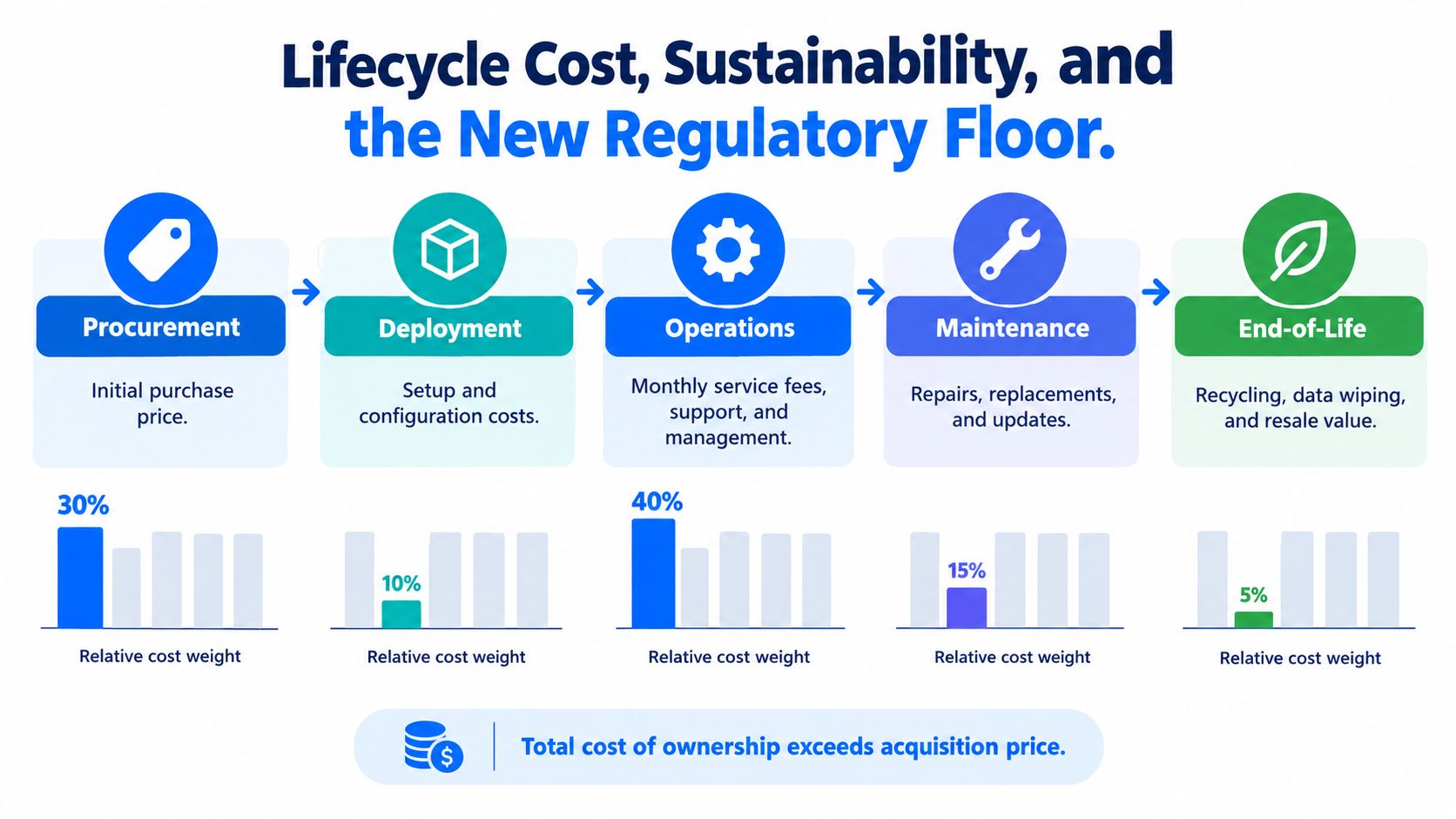
Acquisition price is visible and easy to compare. It's also a poor measure of what a device program costs to operate. A useful total-cost view includes procurement, setup, support, repair, replacement, secure reuse, data destruction, and retirement. If your financial model ends at purchase, it misses the work and disruption that follow.
Regulation is raising the bar for lifecycle planning. New EU rules applying from June 20, 2025 require smartphones and tablets to meet repairability and durability requirements, including access to key spare parts within 5–10 working days and for at least seven years after a model leaves the market, as described in the European Commission's announcement on smartphone and tablet rules. Global organizations should account for these requirements in EU operations rather than assume a single device catalog works everywhere.
Put lifecycle controls into sourcing
Ask providers to help build regional catalogs and define repair-versus-replace thresholds. A device with a lower purchase price can prove more expensive if repairs are difficult, support ends early, or replacement is frequent. Keep chain-of-custody records for devices that are repaired, reused, resold, or retired.
Track lifecycle outcomes alongside spend. Useful measures include repair rates, average device life, avoided replacements, parts lead times, secure reuse, and certified data destruction. These indicators help procurement and sustainability teams see whether a sourcing choice is reducing waste and avoiding avoidable replacement work.
Technology expense management should cover the whole financial picture, not just monthly carrier charges. A technology expense management approach can help connect spend oversight with the operational records needed to explain what the organization is paying for. Ask vendors to show how device, service-line, repair, and retirement records relate, and how regional policy differences will be documented.
Patch Automation and Continuous Compliance in Practice
Mobile devices regularly work outside corporate networks, so a security process that depends on an employee connecting to an office network will leave gaps. CISA recommends enabling automatic updates through the MDM or EMM platform so available updates are applied promptly. Its organizational mobile-security checklist also provides a practical reference for mobile controls.
The operating sequence should be clear. Central policy automates OS and application updates, device configuration, encryption, and authentication requirements. Compliance telemetry identifies devices that fall behind or violate policy. Conditional access then restricts access for noncompliant endpoints, while remote lock or wipe helps limit exposure after a device is lost or stolen.
Put measurable controls in the service schedule
Ask vendors to document the control, evidence, owner, and response for each requirement. A dashboard should show:
- Patch compliance: Report compliance by severity and age, with the agreed patch-age thresholds visible.
- Unmanaged-device discovery: Show how the provider detects endpoints accessing company resources without approved management.
- Policy violations: Identify violation types and affected groups, not just an overall count.
- Remediation time: Record how quickly the provider resolves or escalates a device that fails policy.
- Posture checks: Report the percentage of access events evaluated against device posture.
These measures are more useful than a device count because they connect provider activity to access control and exposure. Require the provider to explain what happens when an update can't be installed, when a device is offline, or when a user disputes a policy action. NIST also recommends centralized management across deployment, use, and disposal, reinforcing the need to treat patching as part of lifecycle operations rather than an occasional cleanup task.
A Vendor Selection Checklist for Mid-Market and Enterprise Buyers
A shortlist should be tested against your operating needs, not a vendor's presentation. Ask candidates to show actual workflows, reports, and escalation paths. If they can't demonstrate how a process works, don't treat a promise as a control.
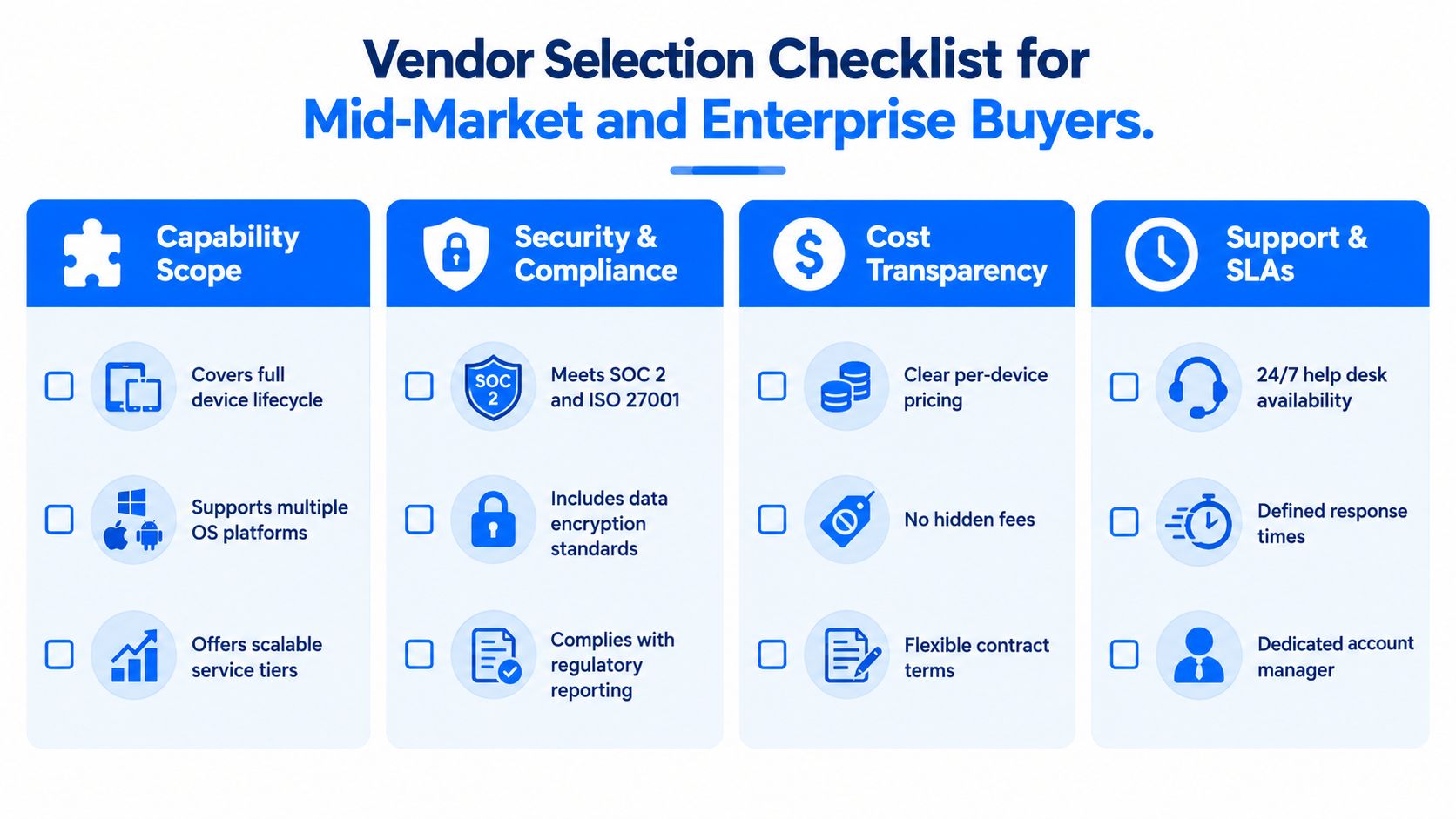
Use four buckets to structure the review:
- Capability scope: Does the provider cover your required lifecycle tasks? Can it support multiple operating systems, ownership models, carriers, and existing management tools? Who handles IoT devices and connected lines?
- Security and compliance: Can it separate work data from personal data on BYOD devices? Does it document enrollment, access revocation, remote lock or wipe, patch-age thresholds, and audit evidence?
- Commercial terms: Is the service scope clear enough to compare proposals? Can you identify charges for support, staging, repairs, replacements, and offboarding? Are responsibilities for subcontractors disclosed?
- Exit rights: Can you retrieve inventory and configuration records in a usable format? How are devices unenrolled, access revoked, data removed, and service lines handled when the agreement ends?
Weight the buckets according to your risk and complexity. A regulated organization may prioritize evidence and escalation; a distributed workforce may care more about regional support, carrier coordination, and delivery. Run a pilot with representative user groups and device types, then test exceptions, lost-device procedures, patch reporting, and offboarding. Don't let a smooth demo replace evidence from a real workflow.
A practical decision path begins with an inventory and responsibility map. Next, define requirements and evaluate providers against the same scorecard. Then test the leading service model in a controlled pilot, resolve gaps in scope and reporting, and negotiate exit provisions before committing.
The procurement question isn't “Who has the cheapest price per device?” It's “Who can deliver the highest governed value across the device lifecycle, with evidence that the controls work?” MR2 Solutions provides vendor-neutral technology brokerage, mobility and IoT services, and technology expense management to help organizations evaluate and govern these choices. If you're reassessing a fragmented mobility program, visit MR2 Solutions to discuss a structured approach to provider selection and implementation.