
Managed Services Operations: A CIO’s Guide to Success

You're paying several vendors, yet an outage still produces the same question: who owns the problem? The network provider points to the cloud platform, the cloud provider points to the application, and your internal team spends the incident call reconstructing a service it thought someone else was watching. Meanwhile, the monthly invoice shows activity, but not whether the business is becoming faster, safer, or more resilient.
That gap defines the core challenge in managed services operations. The objective isn't to offload tasks and hope the provider handles the rest. It's to design an operating model in which people, processes, technology, and governance work as one delivery engine, with clear ownership and measurable business consequences.
Beyond Outsourcing Your IT Problems
A managed services partnership fails subtly before it fails loudly. It starts with a contract organized around device counts, response windows, and included support hours. Those details matter, but they don't tell a CIO whether employees can complete critical work, whether a product launch is protected, or whether technology risk is declining.
The better model treats the provider as an integrated operating capability. Your internal team retains accountability for business priorities, architecture, risk appetite, and strategic decisions. The provider contributes specialized skills, continuous monitoring, repeatable execution, and operational scale. The relationship works when both sides agree on how services are delivered, who owns each decision, and how performance connects to business results.
A useful starting point is understanding what a managed service provider contributes. The label can cover help desk support, infrastructure management, cloud operations, cybersecurity, network monitoring, or a coordinated combination of these services. The label alone doesn't create value. The operating design does.
The invoice is not the outcome
The global managed services market is projected to grow from USD 401.2 billion in 2025 to USD 847.4 billion by 2033, according to Grand View Research's managed services market estimate. That scale reflects a structural shift. Organizations are placing infrastructure, security, support, and operational control into recurring service models, not treating outsourcing as an isolated cost-cutting exercise.
This creates a higher standard for buyers. A provider should be able to explain how its monitoring detects risk, how its service desk protects productivity, how its engineers manage change, and how its governance team proves improvement. If the conversation stops at “we'll manage your environment,” the service definition is incomplete.
A practical commercial review should therefore examine more than the monthly price. Your managed IT services cost analysis should account for internal oversight, transition effort, tooling, service exclusions, project work, security requirements, and the cost of unresolved incidents. A low recurring fee can become expensive if it creates duplicate tools, unclear escalation paths, or repeated business disruption.
Practical rule: Buy an operating model, not a collection of technical tasks.
Design the control plane
The most effective partnerships establish a control plane above individual technologies and vendors. That control plane includes a service catalog, ownership matrix, incident hierarchy, change authority, reporting model, and improvement backlog. It gives executives one view of performance while allowing specialists to work inside their domains.
The CIO's role is to define what the business must be able to rely on. The provider's role is to translate those expectations into operational routines. When those responsibilities are explicit, managed services operations become a source of resilience and agility rather than another layer of vendor coordination.
The Three Pillars of a High-Performing Operations Model
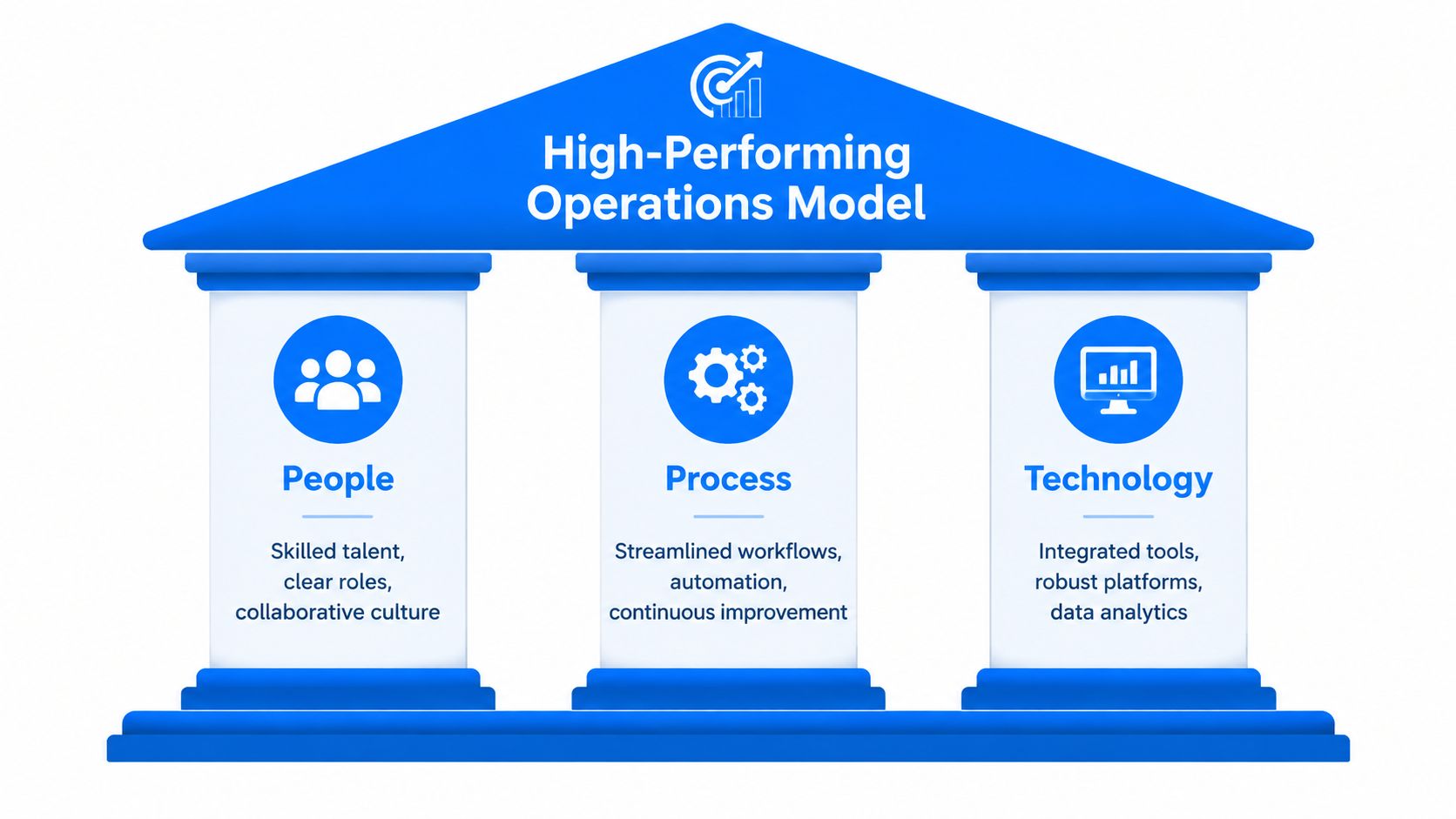
A strong operations model resembles a building. People are the occupants and craftspeople, processes are the structural plans, and technology is the infrastructure that makes the building usable. Remove one pillar and the other two can't compensate for long. Advanced tools won't rescue unclear ownership, and skilled engineers can't deliver consistent service through chaotic workflows.
People establish accountability
Start by identifying the capabilities the service requires, not the job titles a provider wants to sell. Infrastructure engineering, cloud architecture, identity management, security operations, service desk leadership, vendor management, and business relationship management may all have different owners.
Document who makes decisions during an outage, who approves a high-risk change, who communicates with executives, and who owns the post-incident review. A named escalation manager is more useful than a generic support mailbox. The provider should also disclose how it handles absences, specialist dependencies, knowledge transfer, and after-hours coverage.
Your internal team shouldn't disappear from the model. It should focus on architecture, product priorities, risk decisions, and business context while the provider handles agreed operational responsibilities. That division keeps accountability with the organization while giving the delivery team enough authority to act.
Process turns effort into repeatability
Use IT service management practices to define the path from signal to resolution. Incident management restores service. Problem management investigates recurring causes. Change management protects stability while allowing the environment to evolve. Request fulfillment handles standard user needs without consuming senior engineering capacity.
The process should be proportionate. Excessive approval steps slow recovery and encourage workarounds. Weak controls create avoidable outages and audit problems. The right design distinguishes routine, pre-authorized changes from changes that require architectural or business review.
Leaders who manage support organizations may also benefit from this guide for B2B support leaders, particularly when aligning service desk practices with customer experience, knowledge management, and operational consistency.
Technology provides visibility and leverage
The technology layer should connect monitoring, ticketing, asset data, configuration information, automation, reporting, and security telemetry. Integration matters more than feature volume. If an alert creates a ticket without service context, the engineer still has to investigate manually. If a change record doesn't connect to affected services, the organization can't learn from incidents.
The operating model has also become cloud-first and security-centric. Cloud deployment accounted for 52.35% of managed services revenue in 2025, while managed security services were growing at an 11.72% CAGR through 2031, and large enterprises held 66.95% of market share, according to Mordor Intelligence's managed services market analysis. Those figures reflect a shift toward integrated operations across hybrid cloud, networks, applications, and security.
Assess each pillar together. A new monitoring platform without process ownership creates more noise. A redesigned workflow without trained staff creates exceptions. A capable team without reliable telemetry operates on assumptions.
Measuring What Matters with SLAs and KPIs
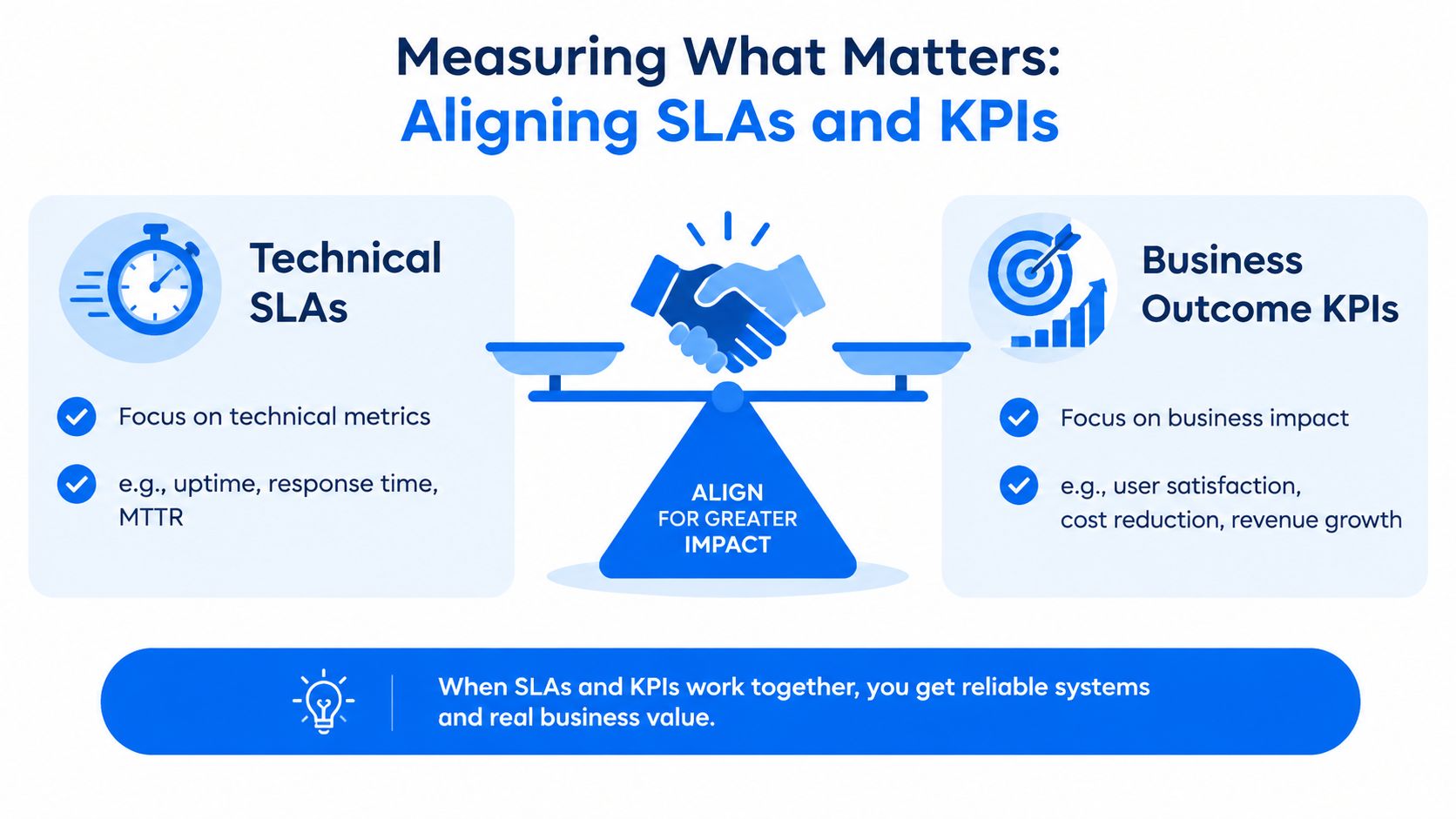
A provider can meet a technical SLA while the business still feels underserved. An infrastructure service may remain available while employees can't complete a critical transaction, a customer-facing feature remains degraded, or a release is delayed by a change failure. Uptime is evidence of technical performance, not proof of business value.
The answer isn't to discard SLAs. It's to place them inside a broader measurement system. SLAs define the service commitment. KPIs explain whether that commitment is improving the organization's performance.
Pair technical measures with business measures
Build the dashboard in two layers. The first layer should answer, “Did the provider operate the service as agreed?” The second should answer, “What did that performance mean for the business?”
| Technical SLA | Business KPI |
|---|---|
| Availability of a defined service | Productivity preserved during critical business periods |
| Initial response time | Time before the right business owner receives useful information |
| Mean time to resolve | Duration of business disruption |
| Change success rate | Delivery speed and stability after releases |
| Ticket backlog and reopen rate | User friction and recurring operational effort |
For P1 incidents, benchmark guidance cites an MTTR target of 4 hours or under, critical initial response often contracted at under 15 minutes, and 98% or higher SLA compliance on premium tiers, as described in MSP NOC KPI guidance. Use these figures as reference points, not automatic contract terms. Your critical services, regulatory obligations, operating hours, and tolerance for disruption should determine the final thresholds.
Make the service catalog business-readable
A service catalog should describe services in terms business owners recognize. “Cloud infrastructure monitoring” is an operational capability. “Order processing platform” is a business service supported by infrastructure, applications, identity, networks, and people.
For each business service, document:
- Service owner: The person accountable for business priority and acceptable risk.
- Technical owner: The person accountable for engineering execution.
- Critical dependencies: The systems, vendors, data flows, and teams required for delivery.
- Impact tiers: The consequences of degradation, not merely the number of alerts generated.
- Communication rules: Who receives updates, through which channel, and at what point.
- Recovery expectations: The response and restoration commitments appropriate to the service.
This structure prevents a common failure mode: reporting every ticket equally. A large queue of low-impact requests can distract leaders from a small number of recurring incidents that damage revenue, compliance, or customer trust.
A useful test: If a KPI improves but no business owner changes a decision, it may be a reportable metric rather than a management metric.
Review trends, not isolated scores. Ask why a particular incident class keeps reopening, why changes fail in one service but not another, and whether automation is removing work or merely moving it downstream. A monthly SLA report should be the starting material for decisions, not the final deliverable.
The Technology Stack That Powers Proactive Operations
Technology should support the operating model rather than dictate it. A practical stack usually combines Remote Monitoring and Management, Professional Services Automation, and an intelligence layer that can correlate events across the environment.
Remote Monitoring and Management tools collect telemetry from endpoints, servers, networks, and other managed assets. They can identify conditions such as failed services, capacity pressure, missing patches, or device health issues. The important design question is what happens after detection. An alert that lands in an unowned queue is not proactive operations. A signal tied to a runbook, service owner, priority rule, and escalation path is.
Professional Services Automation platforms connect the operational work to tickets, contracts, time records, approvals, assets, and reporting. They provide the workflow spine for service desks and engineering teams. Configure the PSA around the service catalog and ownership model. If the platform reflects the provider's internal categories but not your business services, executive reporting will remain difficult to interpret.
Move from alerting to correlation
Traditional monitoring often evaluates isolated thresholds. AIOps adds context by correlating logs, metrics, traces, and events across the estate. The goal is to distinguish a genuine incident from multiple technical symptoms produced by one underlying cause.
Independent managed services material describes benchmarks of 70% or more reduction in alert volume and a 25% to 45% decrease in operating costs when AIOps reduces manual triage and escalations, as reported by AIOps managed services guidance. Treat those figures as benchmark claims, not guaranteed results. The outcome depends on telemetry quality, integration, rule tuning, runbook maturity, and human review.
Automation should begin with safe, repeatable actions. Restarting a failed service, enriching a ticket with dependency data, or routing a known alert class can be appropriate. A change that affects customer data, identity, financial systems, or regulated workloads needs stronger approval and audit controls.
Security operations belong in the same conversation. Providers evaluating continuous assurance may consider capabilities such as automated pentesting for MSSPs, but testing must connect to remediation ownership, risk acceptance, and evidence management. A vulnerability report without a prioritized treatment process only adds another queue.
MR2 Solutions describes managed services as proactive IT management and support, including monitoring and alerting, patch management, engineering support, reporting, help desk services, and maintenance. Those capabilities illustrate the difference between a tool purchase and a managed operating service. The buyer still needs to define how the components connect.
Integrating Vendor Teams with Your Internal Staff
The “us versus them” problem usually begins with mismatched incentives. Internal staff protect business context and long-term architecture. Provider teams protect queue performance and contracted service levels. Both may be acting rationally, yet the organization experiences delay, duplicate work, and defensive escalation.
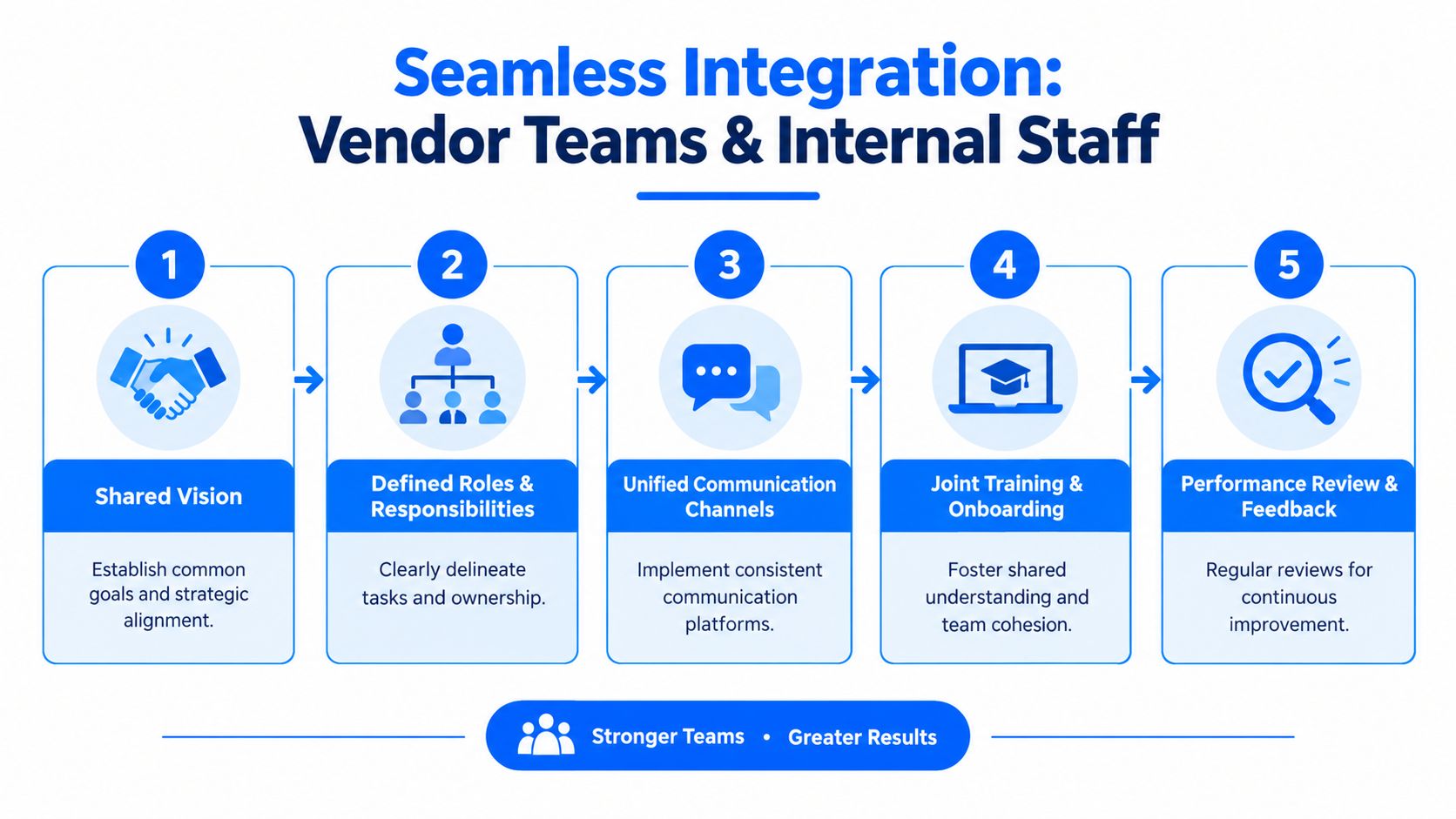
Create a one-team model deliberately. That doesn't mean pretending the contract doesn't exist. It means giving everyone a shared operating language, a common priority model, and an agreed route for resolving conflict.
Clarify ownership before the first incident
Build a RACI matrix around services and decisions, not just departments. Identify who is responsible for execution, accountable for the result, consulted before action, and informed afterward. Include major incidents, standard changes, emergency changes, access approvals, vulnerability remediation, vendor escalation, and executive communications.
Then test the matrix with scenarios. Ask who declares a major incident, who can authorize a workaround, who speaks to customers, who decides that service is restored, and who owns the post-incident action list. If two groups answer differently, the contract and operating procedures aren't finished.
Communication cadence should match the work:
- Operational check-ins: Review active incidents, changes, risks, and blocked work.
- Service reviews: Examine trends, recurring problems, automation opportunities, and capacity.
- Leadership reviews: Discuss business impact, investment choices, risk posture, and roadmap decisions.
- Incident reviews: Focus on contributing conditions and corrective actions, not blame.
Share knowledge as an operating asset
A shared knowledge base should contain service maps, support procedures, escalation contacts, known errors, recovery steps, and decision history. Internal engineers should be able to understand what the provider changed. Provider engineers should understand the business consequences of a failure.
Training should run in both directions. The provider needs the organization's terminology, business calendar, compliance constraints, and critical workflows. Internal staff need the provider's tooling, escalation model, automation boundaries, and reporting logic. Joint onboarding is faster than forcing each side to infer context during an outage.
Staff augmentation can be useful when the operating model needs temporary capacity or specialist skills. A staff augmentation approach should still preserve role clarity and knowledge transfer. Adding people without integrating them into service ownership can increase coordination overhead rather than reduce it.
The partnership becomes real when the provider can explain the business impact of an incident, and the internal team can explain the operational action required to resolve it.
Use shared objectives wherever possible. If the provider is measured only on ticket closure, engineers may optimize closure speed. If both teams are measured on restoration quality, recurrence reduction, change stability, and stakeholder communication, they have a reason to improve the whole service.
Building a Governance Framework for Continuous Value
Governance is not a monthly presentation of green status indicators. It's the mechanism that keeps the partnership aligned as business priorities, threats, applications, and operating constraints change.
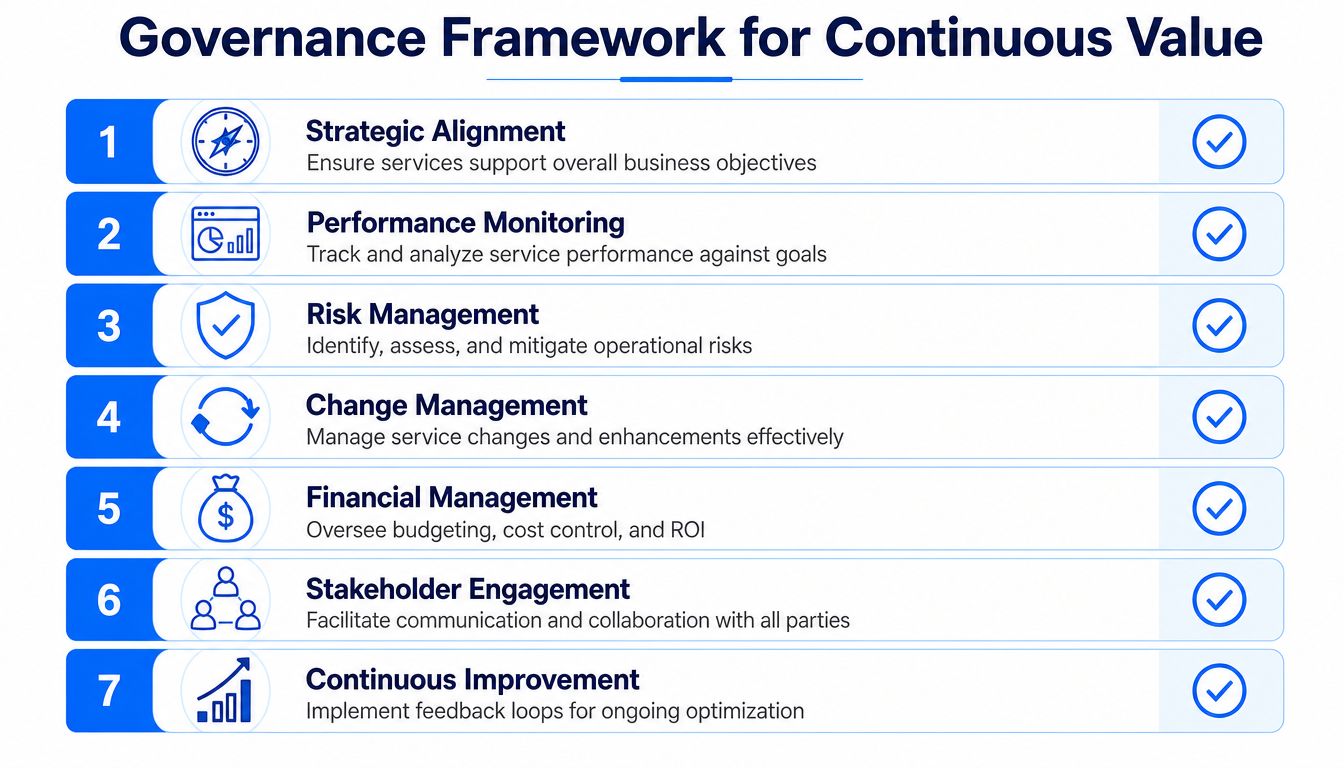
A strong governance cycle connects strategy to execution. Business leaders define outcomes and risk tolerance. Service owners translate them into service requirements. Operations teams deliver and measure the work. Governance reviews the evidence, decides what should change, and assigns the next improvement actions.
Make QBRs decision forums
A useful Quarterly Business Review should answer more than whether the provider met its SLA. It should show how the service affected business priorities, where risk is accumulating, which changes are pending, and what investments could improve performance.
Bring the right participants. The provider's service leader, your IT operations owner, security representative, finance or procurement partner, and relevant business service owners should contribute when the agenda affects their responsibilities. A presentation that excludes the people who own business outcomes will produce discussion without decisions.
Use the meeting to review:
- Outcome alignment: Which services support the organization's current strategic priorities?
- Performance patterns: Which incidents, requests, and changes indicate systemic issues?
- Risk position: Which vulnerabilities, dependencies, skills gaps, or vendor exposures need action?
- Financial control: Are consumption, licensing, project charges, and service scope understood?
- Improvement pipeline: Which automation, architecture, process, or experience changes deserve priority?
- Accountability: Who owns each action, what evidence will show completion, and when will leaders review it?
The shift toward outcome-based services is clear. A KPMG report indicates that two-thirds of buyers expect their provider to have a significant impact on business and operating model transformation within two years, as summarized in KPMG's analysis of the new managed services era. That expectation changes the governance question from “Did the provider complete the work?” to “Did the operating model help the organization perform better?”
Keep commercial and operational decisions connected
Technology expense management should sit inside governance, not in a separate procurement exercise. Reviewing technology expense management alongside utilization, service quality, architecture direction, and business demand helps leaders distinguish necessary investment from unmanaged complexity.
The governance framework should also define how the partnership changes. Include contract adjustment rules, transition procedures, data access, documentation ownership, audit rights, security responsibilities, exit assistance, and knowledge transfer. These provisions don't signal distrust. They protect continuity when the environment or relationship evolves.
Managed services operations are never “set and forget.” The strongest partnerships use a repeating loop: align priorities, measure service and business outcomes, identify risk, decide improvements, execute changes, and verify the result. That loop turns a vendor arrangement into an operating capability the CIO can govern with confidence.
MR2 Solutions helps organizations evaluate, procure, implement, and govern managed services through a vendor-neutral technology brokerage model aligned to business outcomes. If you're redesigning your managed services operations, visit MR2 Solutions to connect your service strategy, provider selection, implementation, and ongoing governance.