
Fractional CTO Services: A Practical Guide for 2026

You're looking at a board deck that needs a technology plan, an ERP program that keeps slipping, and a vendor shortlist that nobody senior has really challenged. The team is busy, the stakes are real, and the question isn't whether you need tech leadership, it's whether you need a full-time CTO or a tighter, better-scoped way to get executive control without adding permanent overhead.
That's where fractional CTO services make sense, but only when they're treated as embedded leadership with clear governance, not as a cheap substitute for a real executive. The strongest buyers use the model to create decision speed, bring discipline to architecture and vendors, and give the board a credible technology voice. The weak buyers hire a stopgap, then wonder why nothing changes.
When a Growing Organization Outgrows Its Tech Leadership
The moment usually arrives in a meeting, not on a hiring plan. A CIO or IT director looks across the table and realizes the technology agenda has outrun the current leadership structure, but the business still can't justify a permanent CTO seat. The symptoms are easy to spot, a delayed ERP modernization, architecture decisions made by an overstretched team, a board asking for a cloud cost roadmap, or a private equity sponsor wanting a technology plan after an acquisition.
That is the point where fractional CTO services stop being a niche option and start being a practical response. The problem isn't a lack of effort inside IT. It's that senior decisions need someone who can own the roadmap, challenge vendors, and translate technical tradeoffs into business consequences.
The real inflection point
Mid-market firms often feel this first because their systems become more complex long before they can support another executive salary. Enterprise business units hit the same wall when the corporate CTO mandate doesn't extend into their P&L, their regulatory burden, or their integration backlog. In both cases, the organization needs a senior technology decision-maker who can move faster than a committee and still stay accountable.
The market context explains why this model has become mainstream. Industry reporting says the broader fractional executive boom grew from about 60,000 professionals in 2022 to 120,000 in 2024, and technology roles make up roughly 10% of the fractional CIO, CTO, and CISO segment, while one market guide estimated more than 12,000 active fractional CTOs globally by 2025 and a market size of about $2.8 billion (market guide). That's not a fad. It's a hiring pattern.
Practical rule: if your internal team can execute but can't make the strategic calls fast enough, you need senior leadership, not more hands.
The buying decision should be simple. If the organization needs scoped executive leadership with clear governance, fractional is a valid answer. If it just wants a warm body in a title, the model will fail.
What a Fractional CTO Actually Does
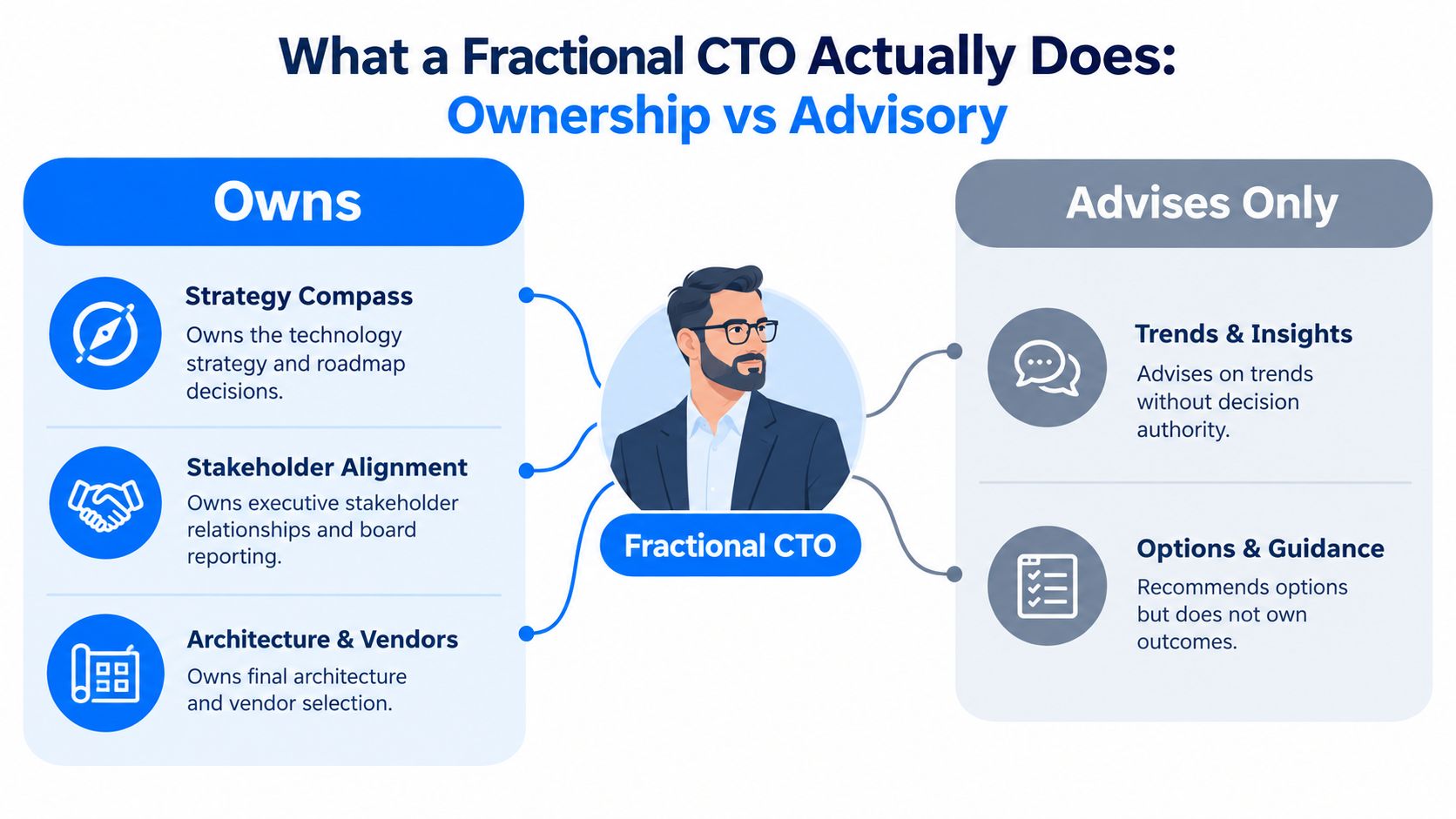
A fractional CTO owns technology strategy, executive stakeholder management, and final architecture and vendor decisions. That ownership matters in mid-market and enterprise settings, where someone has to carry the risk of the choice, defend it to the CFO, the board, or the audit committee, and keep vendors from steering the roadmap.
The role stops there. A fractional CTO usually does not write code, run daily standups, or manage every engineer directly. If the need is hands-on delivery, hire an engineering lead or a delivery manager. If the need is senior judgment, cross-functional alignment, and a steady hand on technology decisions, this role fits.
Where mid-market firms feel this first
Mid-market firms usually hit the wall first because their systems get complex before the budget supports another executive salary. Enterprise business units run into the same problem when the corporate CTO mandate does not extend into their P&L, regulatory burden, or integration backlog. In both cases, the organization needs a senior technology decision-maker who can move quickly and still remain accountable.
That is why the model has become common. Industry reporting says the broader fractional executive group grew from about 60,000 professionals in 2022 to 120,000 in 2024, and technology roles make up roughly 10% of the fractional CIO, CTO, and CISO segment, while one market guide estimated more than 12,000 active fractional CTOs globally by 2025 and a market size of about $2.8 billion (market guide). This is a hiring pattern, not a novelty.
Practical rule: if your internal team can execute but cannot make strategic calls fast enough, you need senior leadership, not more hands.
A competent engagement should produce tangible artifacts, not vague reassurance. The core deliverables usually include a 12-month technology roadmap, an architecture review board charter, a vendor selection scorecard, a board-level technology update template, and a cybersecurity posture assessment aligned to a framework like NIST or ISO 27001.
A useful external reference for adjacent fractional IT framing is CloudOrbis Inc. fractional IT guide, especially if you are comparing the leadership layer against broader fractional support models. That comparison matters because organizations need different levels of executive ownership.
A practical engagement looks like this. A 280-employee logistics firm might bring in a fractional CTO to stabilize a fragmented SaaS stack, renegotiate an AWS contract, and prepare for SOC 2. The work is a sequence of decisions, approvals, and remediation items that have to land inside the operating model.
Success should be measured through decision quality, roadmap progress, and risk reduction, not by how many hours the executive sat in meetings.
How Fractional CTO Engagements Are Structured
Fractional CTOs own technology strategy, executive stakeholder management, and final architecture and vendor decisions. That ownership matters.
Most engagements fall into three structures, and the right one depends on whether you need ongoing executive oversight, a defined deliverable, or a narrow diagnostic. Buyers who treat the role as a vague stopgap usually get weak accountability and fuzzy handoffs.
The pricing data is useful because it shows how vendors package the work. One benchmark found that a typical 10 to 20 hour-per-week fractional CTO retainer cost 62% of the annual cost of a comparable full-time hire and that median monthly retainers sat at $15,000 for a two-day-per-week engagement, with typical hourly rates at $200 to $500 (benchmark). A separate market guide places public pricing commonly in the $150 to $400/hour range, with retainers often around $8,000 to $15,000 and premium work reaching $25,000/month.
The three dominant models
| Engagement Model | Typical Commitment | Cost Range | Best Fit |
|---|---|---|---|
| Retainer | Part-time executive leadership, often 10 to 20 hours per week | Commonly around $8,000 to $25,000 per month, depending on scope and urgency | Ongoing leadership across multiple workstreams |
| Project-based | Defined deliverables over a fixed period | Structured to the work, often for initiatives like integration or selection | Post-merger integration, ERP selection, cloud transition |
| Advisory sprint | Short, targeted diagnostic or output | Defined to the assignment, often for an assessment or audit | Board support, spend review, focused architecture review |
Retainers work best when the organization needs continuity across several workstreams and a leader who can keep decisions moving. The risk is scope creep. Project-based work forces clarity around a specific outcome, which suits integration and selection work, but it needs a hard handoff at the end. Advisory sprints are useful for fast diagnosis or board input, yet they do not carry an organization through execution.
Contract language matters more than the title. Spell out IP ownership, define exit clauses, and state what happens if a CEO changes or a private equity sponsor resets priorities. If those points stay vague, the engagement will drift as soon as the leadership context changes.
Fractional Versus Full-Time CTO Tradeoffs
A technology team hits this decision point when leadership needs change faster than the org chart can. The question is whether you need scoped, accountable leadership for a defined outcome, or a permanent executive seat that lives inside the company every day.
A full-time CTO makes sense when daily presence matters, internal politics are heavy, or long-range platform ownership needs one steady executive. A fractional CTO fits when the company needs fast direction, tight focus, and the ability to scale involvement without adding a permanent payroll burden.
Hiring speed separates the two. A vetted fractional executive can often start in two to four weeks, while a full executive search commonly takes four to six months. That gap matters during vendor selection, security remediation, or acquisition integration, when waiting for a long search cycle creates real friction. For a broader look at cost structure in adjacent IT models, see MR2 Solutions managed IT services cost guidance.
Key tradeoffs
| Dimension | Fractional CTO | Full-Time CTO |
|---|---|---|
| Cost structure | Part-time, scoped engagement | Permanent salary, benefits, and broader overhead |
| Time to value | Fast start, often within weeks | Slower, tied to search and onboarding |
| Governance continuity | Strong when scope and reporting are explicit | Strong by default because the seat is permanent |
| Scalability | Hours can rise or fall with demand | Fixed presence, easier for daily management |
Speed is usually the first win. Flexibility comes next. A strong fractional leader can surge during vendor due diligence, architecture resets, or board reporting cycles, then reduce hours when the work steadies.
Full-time wins when the company needs a permanent decision-maker inside a complex culture. If the role requires constant mediation across engineering, product, operations, and finance, a fractional seat may not cover the load. This signals a different operating design need, not a model failure.
For mid-market and enterprise buyers, the buying decision should follow the operating model, not the title. If governance is tight, decisions are documented, and the scope is narrow enough to manage cleanly, fractional leadership is the better buy. If the organization needs a lasting executive with broad internal authority, hire full-time. The model fails when companies ask a fractional CTO to behave like a resident executive without giving the role the mandate, cadence, or decision rights to do that work.
Bottom line: fractional is not a discount CTO. It is a narrower, more deliberate leadership buy.
Governance, Risk, and Integration in Complex Environments
Most articles avoid the hard part. They talk about fractional leadership as if the only issue is price, but the actual buyer risk is operational. If the engagement isn't wired into governance, procurement, security, and reporting, the work stays in slide decks and never reaches the business.
The first issue is capacity risk. A fractional leader is shared across clients, so the contract should state coverage expectations and escalation paths when availability tightens. If the business needs rapid response during a cutover, a security event, or a board cycle, that availability has to be explicit. Otherwise, you've bought partial leadership and full expectation.
The four governance questions that matter
- Capacity discipline: define who gets priority when deadlines overlap.
- Decision rights: document who signs off on architecture, vendors, and security exceptions.
- Vendor neutrality: require disclosure of any prior or current relationships that could shape recommendations.
- Operating-model fit: integrate the role into procurement gates, risk reviews, and board reporting.
The second issue is accountability gaps. The fractional CTO should not sit in a gray zone where everyone expects leadership but nobody knows who owns the final call. Put decision rights in writing. If architecture changes need CIO approval, say so. If the CFO or audit committee needs visibility on risk exceptions, define that path too.
The third issue is vendor neutrality. A fractional CTO has to disclose prior engagements and avoid steering purchases toward companies where they hold equity or advisory positions. That's not optional. Mid-market and regulated organizations need trust in the recommendation process, not just confidence in the presenter.
The fourth issue is enterprise integration. A fractional CTO should be looped into procurement, SOC 2 or ISO 27001 controls, and board reporting cycles. Without those hooks, the role becomes a smart external voice with no operational traction.
A useful complement here is how to build governance from Vision, especially if your organization is formalizing decision rights around a new executive model. For security-specific structure, MR2 Solutions fractional CISO services are relevant because the technology leader and the security leader need a shared control model, not separate silos.
The market commentary is blunt on this point. A 2026 guide notes that buyers should ask how many clients the CTO serves at once and what successful handoff to full-time leadership looks like, because average engagements have stretched to 8.3 months, only 60% meet or exceed stated objectives, and 43% now begin at seed stage or earlier (market commentary). The takeaway is simple. Scope creep and governance failure are bigger threats than access to advice.
How to Scope and Hire a Fractional CTO
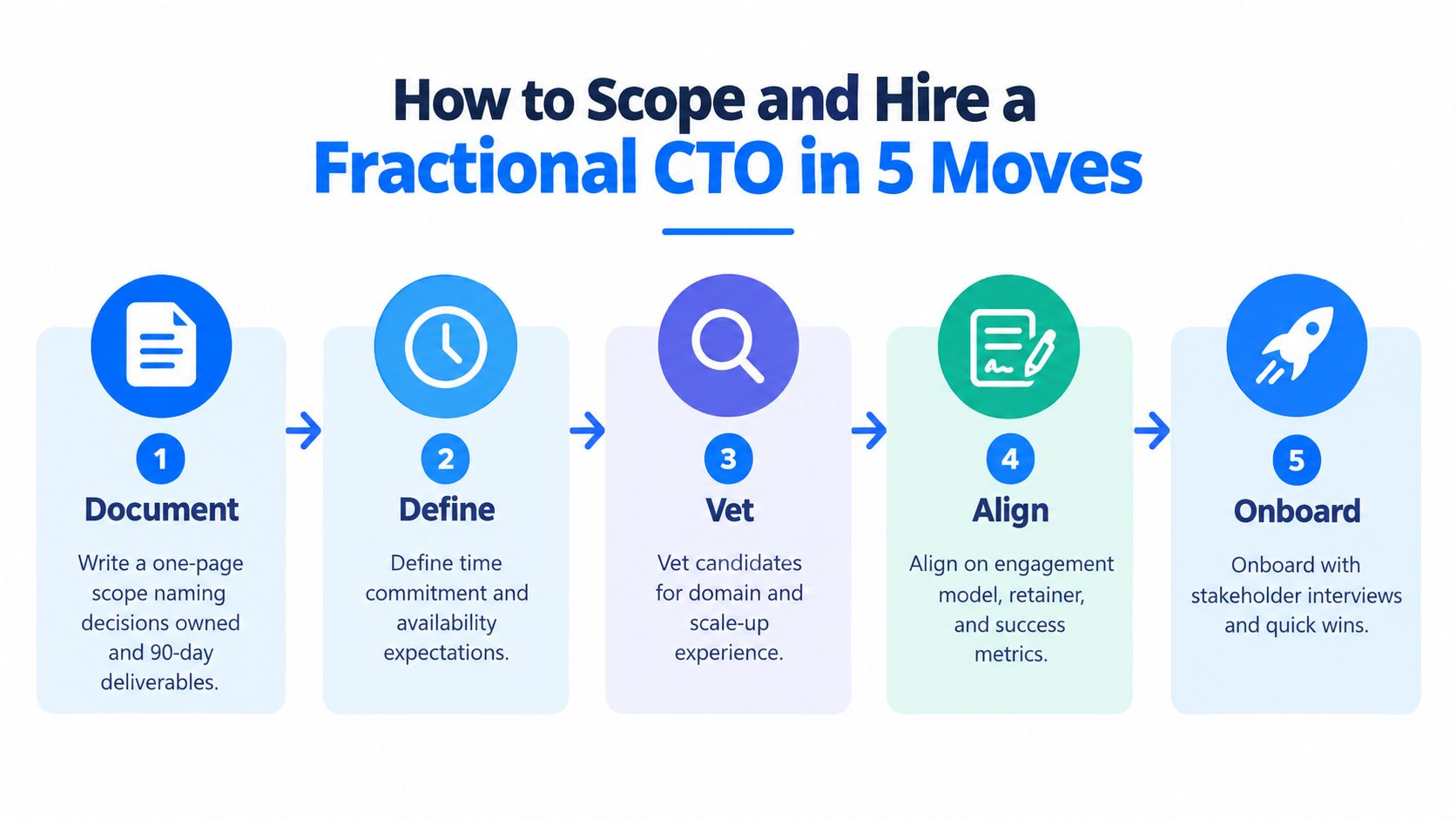
Start with a one-page scope of work. Name the decisions the fractional CTO will own, the deliverables expected in the first 90 days, and what sits clearly out of scope. If the document can't fit on one page, the organization probably hasn't decided what it needs yet.
The next choice is the engagement model. Use a retainer if the company needs continuous executive presence across multiple workstreams. Use a project structure if the need is a defined outcome, such as a cloud migration or platform rationalization. Use an advisory sprint if the board wants a diagnostic or a clean recommendation fast. For a broader staffing comparison, MR2 Solutions staff augmentation helps clarify the line between adding capacity and buying leadership.
Vet for operating experience, not résumé polish
The best candidates have verifiable experience at your scale, references from comparable engagements, and clean vendor-conflict disclosures. If they've never worked in a mid-market environment with procurement, security, and board pressure in the mix, they're probably not the right fit.
Red flags show up fast. Walk away from candidates who refuse to put deliverables in writing, push equity-heavy compensation instead of fees, or can't name prior client outcomes. Those are signals that the person wants ambiguity, not accountability.
A practical onboarding checklist is short. Grant the right system access, introduce the stakeholder map, and set the reporting cadence before the first week ends. If the executive can't meet the CFO, CIO, security lead, and key vendor owners quickly, the engagement will stall.
One resource that pairs well with this buying process is the full list of services from Faberwork LLC, because it helps buyers compare advisory, delivery, and fractional models without blurring the differences. The point is to choose the right operating shape, not just the right title.
Hiring rule: don't buy a fractional CTO until you know exactly which decisions they own and who else sits in the approval chain.
Choosing Fractional CTO Services the Right Way
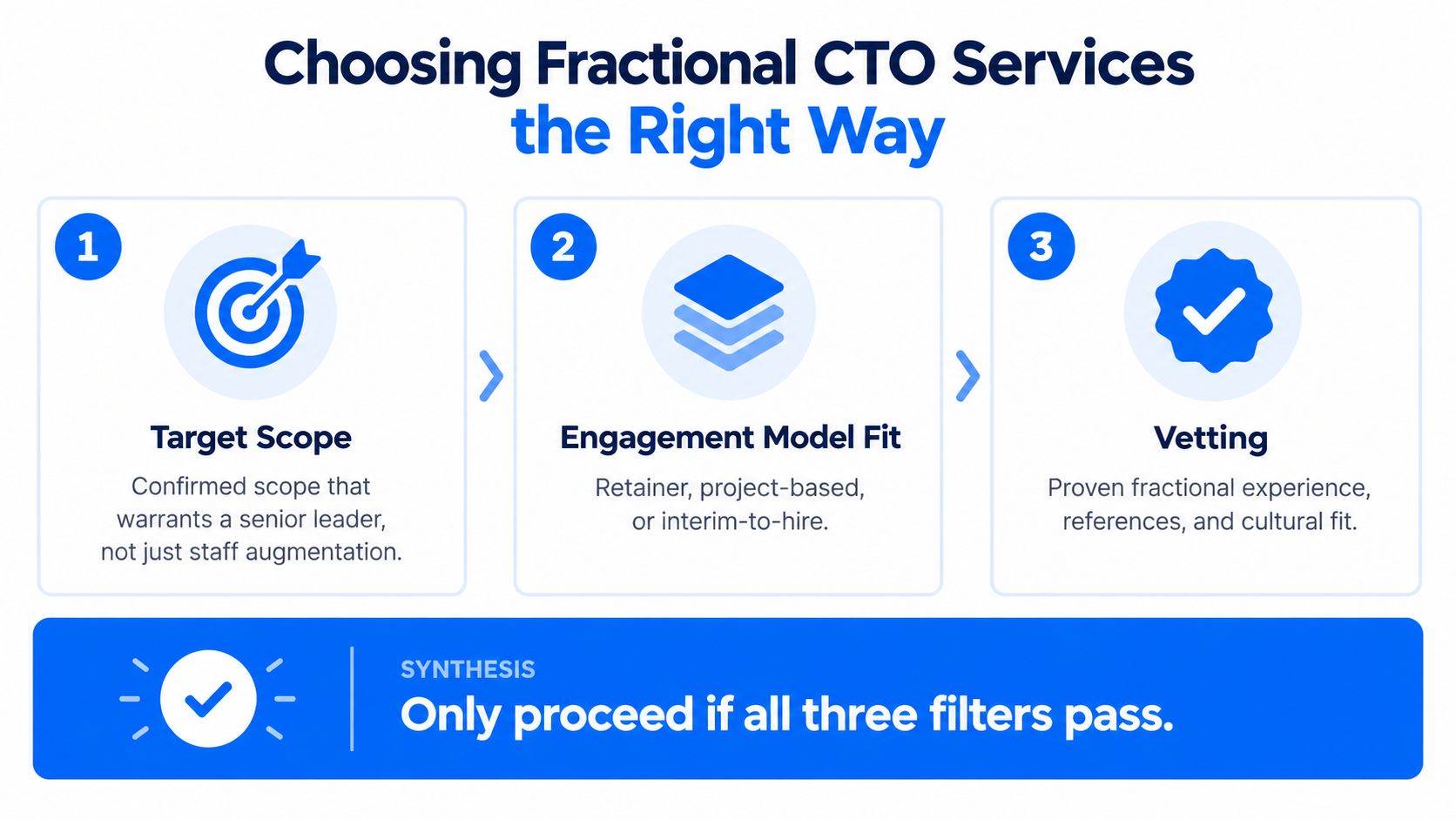
Use three gates. First, confirm that the business has a real leadership gap that justifies a senior technologist. Second, match the engagement model to the problem, retainer for ongoing leadership, project-based for a defined outcome, sprint for a narrow diagnostic. Third, vet for proven fractional experience, references, and cultural fit in a mid-market or enterprise environment.
The fastest way to move is with a two-week diagnostic sprint, followed by a 90-day deliverables contract and explicit off-ramp clauses. That gives procurement enough structure, gives the executive enough authority, and keeps the board from revisiting the same governance questions every month.
If you're evaluating vendors for a broader operating model, use the same discipline MR2 Solutions applies through its vendor-neutral brokerage and fractional leadership work. Their approach is built to align technology decisions with business outcomes, which is exactly what a fractional CTO engagement should do when it's working properly.
If your organization needs vendor-neutral technology leadership, governance discipline, and a cleaner way to evaluate fractional CTO services, talk to MR2 Solutions. Their team helps mid-market and enterprise buyers connect strategy, procurement, risk, and execution without turning the role into a vague consulting patch. Visit MR2 Solutions to start a focused conversation about scope, governance, and the right operating model.