
Digital Strategy vs Digital Transformation for Leaders

Your cloud migration is moving, an AI pilot is waiting for approval, and operations wants more automation. Yet the executive meeting keeps returning to the same questions: Which investment matters most? Who owns the result? Why aren't completed projects producing the business improvement everyone expected?
The useful question in digital strategy vs digital transformation isn't whether you need a plan or better execution. It's how much organizational change the business problem requires. Choose too little change, and you preserve the constraint. Choose too much, and you fund disruption the business doesn't need.
Why Leaders Misclassify Digital Change
Consider a CIO reviewing a portfolio of cloud, AI, automation, and data initiatives. Each proposal has a sponsor, a technology rationale, and a transformation label. But when the CIO asks which business constraint each initiative removes, the answers describe software capabilities rather than operating results.
That's where classification should begin. A technology category doesn't tell you whether an initiative needs portfolio alignment, technical modernization, or a different operating model.

Separate the investment from the ambition
Use digital strategy, digital enablement, and digital transformation as different management categories, not escalating badges of importance.
- Digital strategy establishes the choices that guide investment and organizational priorities.
- Digital enablement improves an existing activity through technology without materially changing how the business creates value.
- Digital transformation changes the processes, responsibilities, and operating behavior through which that value is delivered.
An infrastructure upgrade can be essential without being transformational. Conversely, a modest technology deployment may support substantial organizational change if it alters who makes decisions and how work crosses departmental boundaries.
Practical rule: Classify the business change before classifying the technology.
The label affects executive expectations
Calling every initiative a transformation obscures the burden of change. Leaders may approve implementation funding without committing the business owners, frontline capacity, or policy changes necessary to achieve the intended result.
The distinction has consequential evidence behind it. In McKinsey's global survey on digital transformation, only 16% of respondents said their organizations had improved performance and sustained those improvements; another 7% reported improvements that weren't sustained.
Those findings don't mean modernization lacks value. They support a stricter executive standard: technology delivery and durable business improvement aren't interchangeable.
Before approving a broad program, require a clear account of the business outcome, the capabilities needed, and the organizational changes required. If sponsors can't explain those connections, fund discovery rather than a transformation commitment. A crowded roadmap isn't evidence that the business needs more change.
Understanding the Shared Digital Agenda
Digital strategy and digital transformation serve the same purpose: connecting digital investment to business outcomes. They aren't competing approaches, and neither should become an isolated IT exercise. The difference lies in the decisions executives must make and the responsibilities they must accept.
Strategy determines where to compete and which capabilities deserve investment. Transformation coordinates the changes needed when those choices require the organization to operate differently.
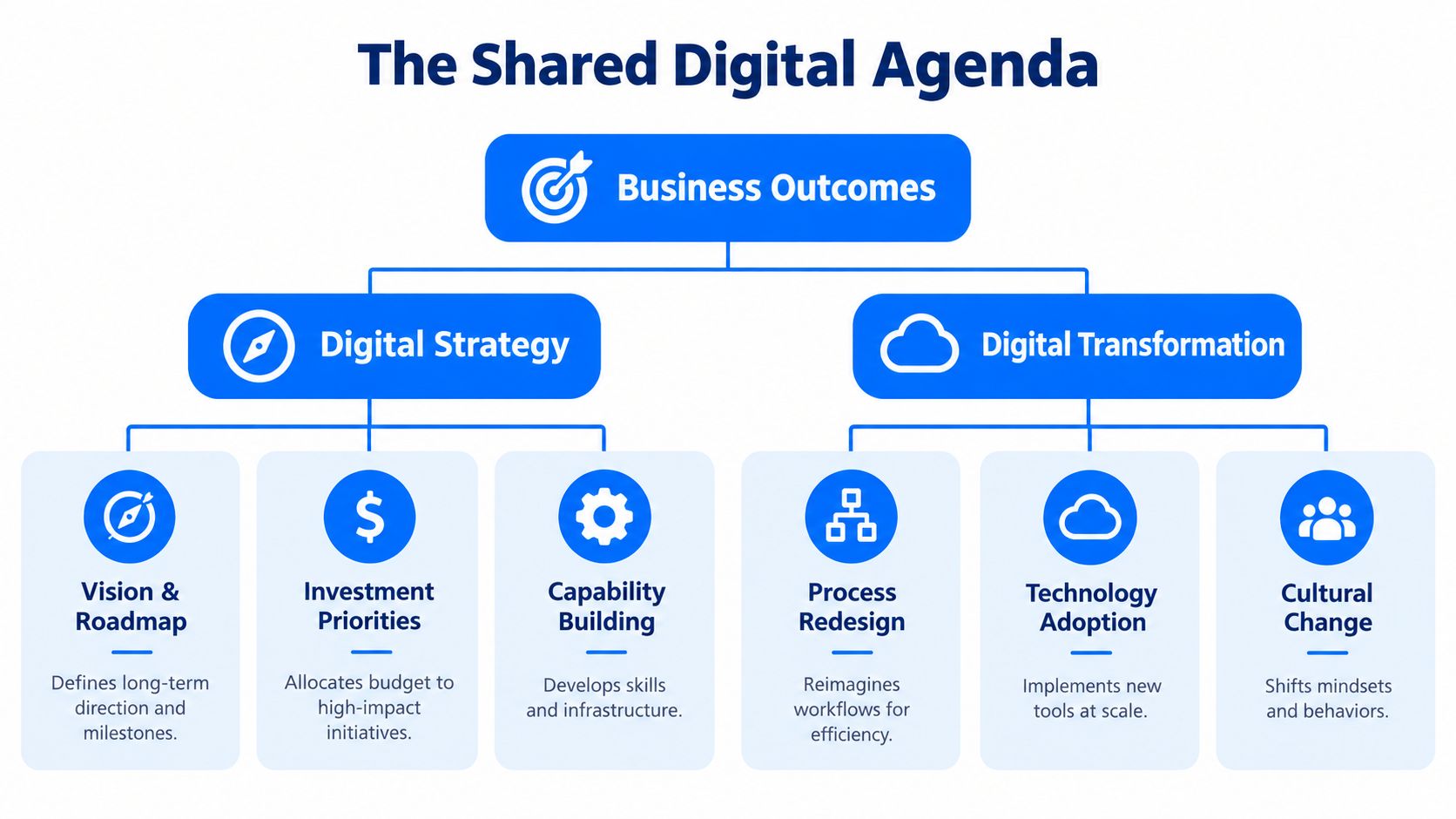
Strategy makes explicit choices
A useful digital strategy doesn't merely endorse innovation, customer focus, or efficiency. It specifies which opportunities the organization will pursue, which capabilities it must develop, and which investments it won't make.
It should also establish architecture principles, decision ownership, risk tolerance, and a measurement model. Those choices let executives reject an attractive platform when it doesn't support the business direction.
For additional scope vocabulary, Cleffex Digital ltd.’s digital transformation tiers explained is a useful companion resource. Use tier models to sharpen discussion, not to assume that a broader transformation is automatically preferable.
Transformation requires business participation
When strategic choices require redesigned workflows, shared data, different incentives, or new customer experiences, implementation becomes more than a technical assignment. Business leaders must make decisions about responsibilities, exceptions, service commitments, and how employees will work.
Digital enablement remains a legitimate alternative. Consider an illustrative document-approval process: replacing manual document movement with electronic routing may improve the existing workflow. Removing unnecessary approvals and redistributing authority represents a different level of change.
Before assigning a label, distinguish the management question:
- Direction: Have executives agreed on the capability and its business purpose?
- Enablement: Can the organization achieve the result while preserving its current operating arrangements?
- Transformation: Must people change how they coordinate, decide, or deliver value?
These questions are complementary. A company can use strategy to govern its portfolio, enablement to address immediate technical needs, and transformation selectively where the operating model must change. The aim isn't maximum transformation. It's an appropriate level of change.
Comparing Goals Governance and Delivery
The most useful comparison concerns executive controls, not terminology. A strategy proposal should demonstrate sound choices before major implementation begins. A transformation proposal must also explain how leaders will coordinate delivery, adoption, and sustained business results.
Use the following comparison to identify what a proposal contains and what's missing.
Digital Strategy and Digital Transformation Compared
| Decision Criterion | Digital Strategy | Digital Transformation |
|---|---|---|
| Purpose | Select business outcomes and the digital capabilities needed | Realize those outcomes through coordinated change |
| Scope | Investment portfolio, capabilities, architecture principles, and governance | Processes, platforms, data flows, roles, and customer journeys |
| Time horizon | Continuing strategic direction with periodic reassessment | Sequenced delivery and adaptation within that direction |
| Decision rights | Establish who prioritizes, funds, and accepts risk | Apply and, where necessary, redesign operational authority |
| Investment approach | Compare opportunities, dependencies, and alternatives | Release funding against delivery and value evidence |
| Governance | Portfolio alignment and investment discipline | Execution oversight, adoption, risk, and benefits realization |
| Typical deliverables | Capability roadmap, investment thesis, ownership model | Redesigned workflows, integrated systems, changed responsibilities |
| KPI design | Define outcomes, baselines, and measurement ownership | Measure implementation effects and sustained operating performance |
| Evidence of success | Coherent choices and traceable investment logic | Demonstrated business improvement that persists in operation |
Different cadences, overlapping horizons
Don't impose a rigid sequence in which strategy ends and transformation begins. Executives should revisit strategic assumptions when delivery exposes a capability gap, an adoption barrier, or an unacceptable risk.
The difference is the question each review answers. A portfolio review asks whether the organization is funding the right capabilities. A transformation review asks whether coordinated changes are producing the intended results and what leaders must adjust.
The responsibilities overlap, but they shouldn't blur. A steering committee that reviews project status without reconsidering priorities isn't performing strategic governance. An executive team that repeatedly revises its vision without resolving operational obstacles isn't managing transformation.
Evaluate evidence rather than artifacts
An API, migrated application, automated workflow, or data product demonstrates technical progress. None establishes business success by itself. Require the sponsor to connect that artifact to a measurable change in operations.
McKinsey's detailed transformation research supports evaluating performance improvement and sustainability rather than treating implementation completion as the finish line. For executive review, make the distinction concrete:
- Delivery evidence: The system functions, integrations operate, and technical acceptance criteria are satisfied.
- Adoption evidence: Employees use the intended workflow rather than maintaining parallel workarounds.
- Value evidence: The relevant business measure improves without unacceptable effects elsewhere.
For example, a faster approval workflow shouldn't count as an unqualified success if downstream errors increase. The executive scorecard needs both the intended benefit and the guardrails that protect service, reliability, and risk.
A completed technology project is an input to the investment decision, not the final verdict on it.
When comparing proposals, ask sponsors to show both sides of the table. A roadmap without execution accountability is incomplete. A delivery plan without strategic traceability is equally incomplete.
Choosing by Business Situation
Start with the constraint, then choose the lightest approach capable of resolving it. The following situations are illustrative decision scenarios, not claims about particular companies or achieved results.
This visual provides a starting classification, not a mandatory progression toward deeper change.
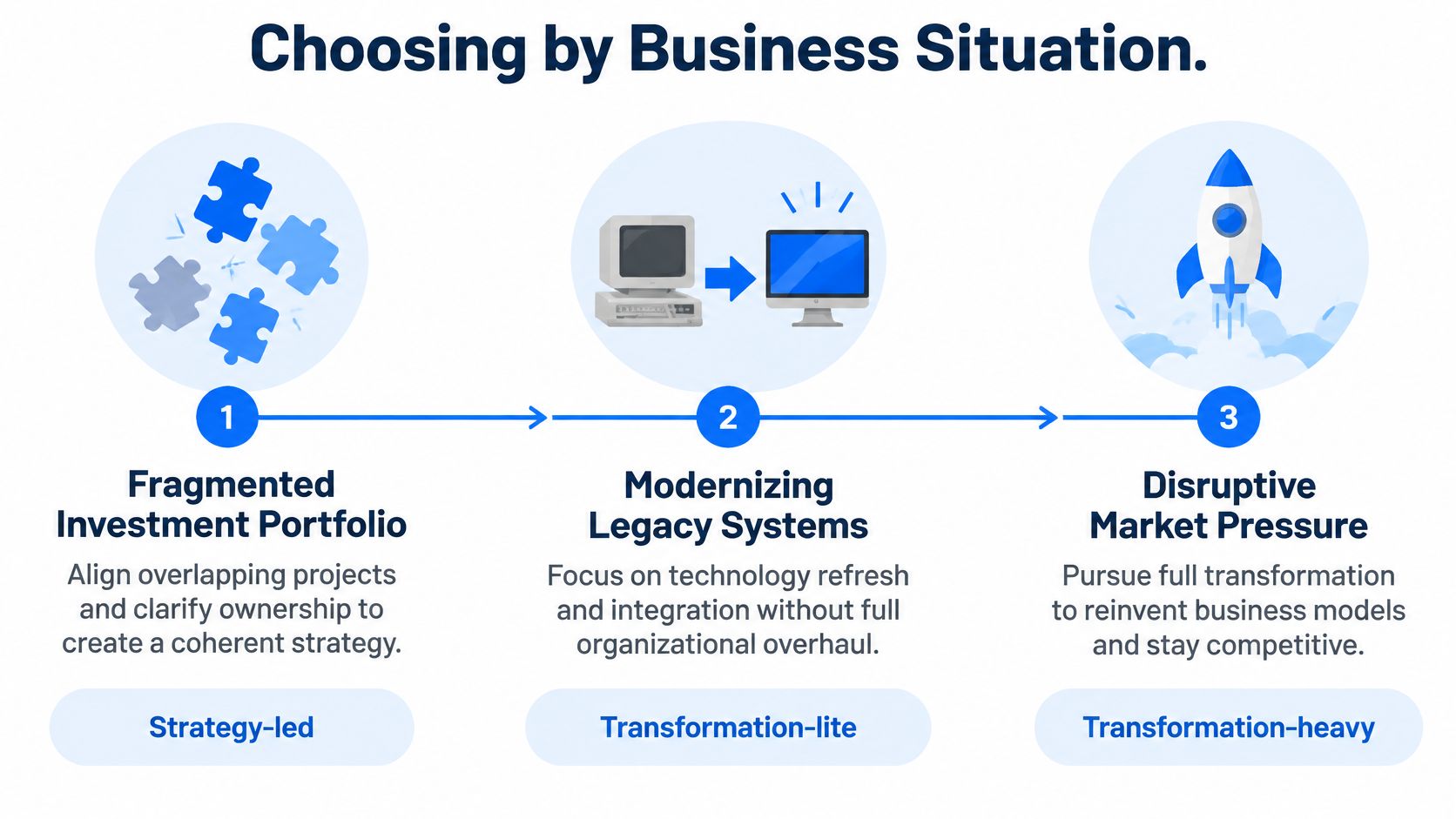
Match the response to the constraint
A fragmented investment portfolio needs strategic alignment. If departments are buying overlapping capabilities and executives can't agree on priorities, don't launch another enterprise program. Establish portfolio ownership, identify duplication, and decide which business capabilities deserve funding.
Escalate into transformation only when that review exposes operating barriers that investment coordination alone can't resolve. Shared ownership of a customer journey, for example, may require more than consolidating tools.
A technically constrained business may need modernization. If the operating model remains appropriate but systems can't meet agreed reliability, integration, or security requirements, focus on technical remediation. A multi-cloud strategy belongs in that discussion when placement, interoperability, and governance decisions span cloud environments.
Don't attach an organizational overhaul to an infrastructure requirement unless the evidence supports it. Equally, don't preserve a failing workflow just because the migration scope excludes process change.
Recognize when the business design is the problem
A customer journey that breaks between sales, fulfillment, and service may require transformation. If each department optimizes its own queue while customers repeat information and chase ownership, replacing the interface alone leaves the underlying responsibility problem unresolved.
Structural cost or competitive pressure calls for a similarly direct examination. Ask whether the disadvantage comes from outdated technology, avoidable work, or the way the organization creates and delivers value.
- Modernize when the current business design remains sound and technology is the limiting factor.
- Redesign when handoffs, authority, incentives, or service commitments prevent the required outcome.
- Investigate first when leaders disagree about the cause or can't substantiate the expected benefit.
Use the accompanying video as a discussion prompt after identifying which situation resembles your organization.
Your classification should remain provisional until you examine actual work. Review exception paths, speak with frontline employees, and inspect where customers or staff wait. The right starting point is the constraint people encounter, not the program category executives prefer.
Testing Whether Transformation Is Justified
A working system isn't proof that the organization has transformed. Employees can complete training, dashboards can report activity, and IT can meet acceptance criteria while business leaders preserve the same approval bottlenecks and conflicting incentives.
The threshold should be material change to how the organization creates or delivers value, not the novelty of the technology.
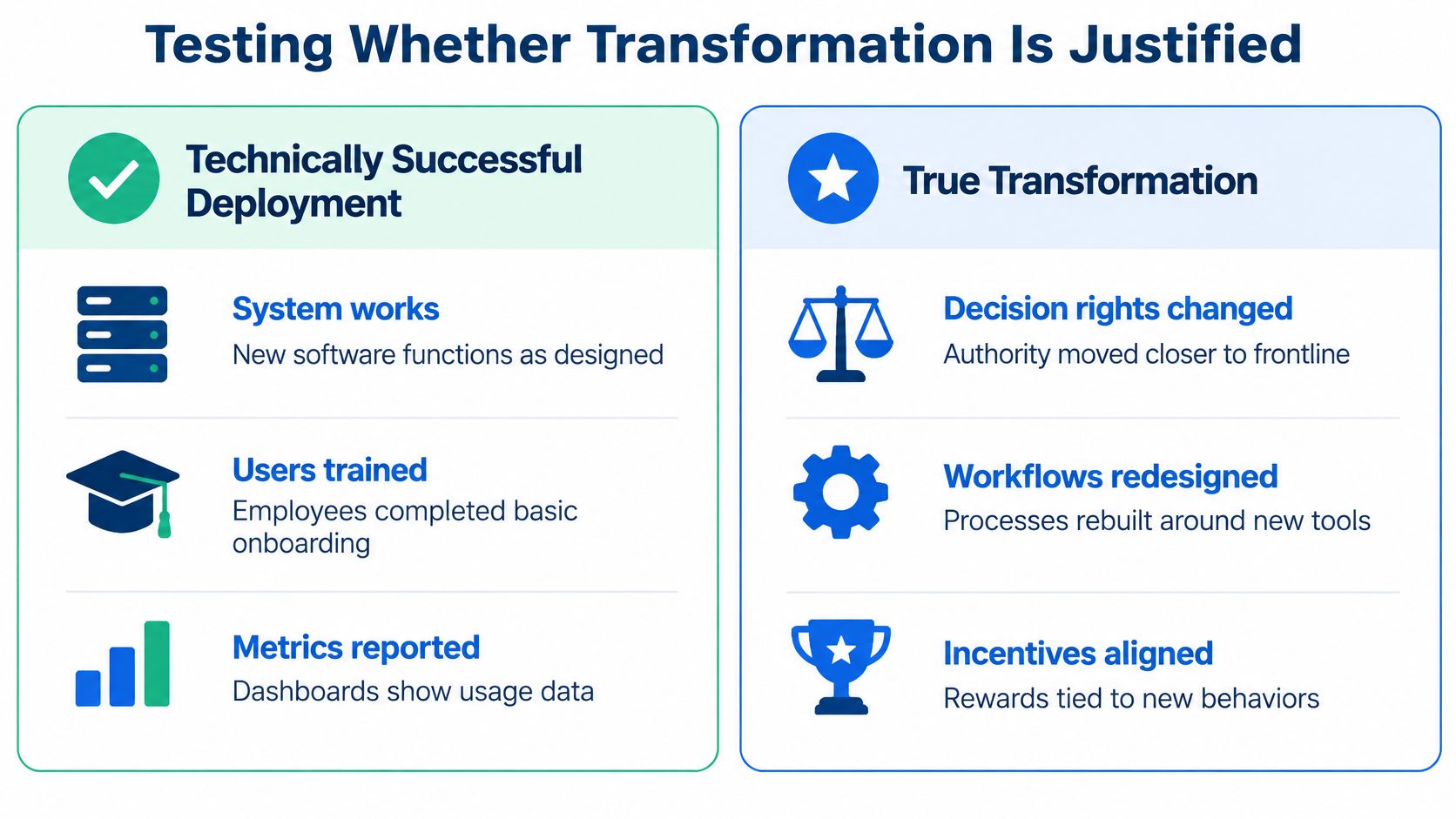
Demand evidence of an operating constraint
Reporting on Gartner's priorities for CIOs states that only 48% of enterprise digital initiatives meet or exceed intended business outcomes, while fewer than half of IT leaders say their organizations prioritize operating-model adaptation. That gap warrants a tougher diagnostic before procurement.
Ask business sponsors to substantiate the need for deeper change:
- Customer friction: Where do customers repeatedly encounter delays, duplicated effort, or unresolved handoffs?
- Structural cost: Which expenses arise from the design of work rather than the tools supporting it?
- Regulatory obligations: What must change in accountability, control execution, or evidence collection?
- Competitive exposure: Does the business need a different value proposition or delivery model, rather than a better version of its current systems?
These aren't automatic reasons to approve transformation. They're reasons to investigate whether targeted improvements are insufficient.
Test willingness as well as necessity
Require leaders to identify the decisions they'll change. Who will own shared data? Which approvals will disappear? Who can resolve cross-functional exceptions? What responsibilities will frontline employees gain or lose?
If sponsors expect a different outcome but refuse every associated organizational change, the proposal isn't ready. Don't ask procurement to solve that contradiction through vendor selection.
Investment warning: A preferred platform is not evidence that the business needs transformation.
Apply the same discipline to AI for digital transformation. Before evaluating capabilities, specify who reviews outputs, handles exceptions, owns data quality, and accepts operational risk.
Modernization may still be the right decision after this test. It can address an urgent technical requirement without changing the business model. Approve it on those terms, with an honest scope and appropriate success criteria, rather than inflating its ambition to secure executive attention.
Building Governance That Delivers Value
Run strategy as an active portfolio discipline and transformation as measurable value realization. That requires a common investment record, explicit decision gates, and business accountability alongside IT delivery ownership.
BCG's analysis of 825 senior executives found that only 30% of transformations met or exceeded target value and produced sustainable change. Treat that finding as a reason to demand evidence throughout execution, not merely at approval.
Establish an investment record
For every initiative, document the business outcome, starting baseline, accountable owner, technical dependencies, and principal risks. Include how the organization will collect evidence and who can authorize continuation, redesign, or termination.
- Business ownership: Assign a leader accountable for operating results and the decisions necessary to achieve them.
- Delivery ownership: Name the person responsible for implementation, integration, and technical acceptance.
- Measurement ownership: Identify who validates benefits and prevents inconsistent reporting across workstreams.
Maintain a shared view of initiative status and benefits. Keep delivery metrics separate from outcome measures so a green implementation dashboard doesn't conceal weak adoption or an unchanged business result.
Release commitment as evidence improves
Use stage gates to answer different questions as uncertainty declines. Early work should validate the problem and feasibility. Subsequent gates should test employee adoption, measurable value, security, compliance, and operational readiness before broader commitment.
Distinguish relatively reversible decisions, such as limited pilots and sandbox integrations, from consequential commitments involving core-platform replacement, sensitive-data migration, or multi-year outsourcing. Apply greater scrutiny where changing direction would be difficult.
CIO research on changing technology priorities reported full AI-project implementation among only 14% of surveyed CIOs, with legacy integration, data silos, and infrastructure gaps identified as barriers. Before scaling an experiment, require an integration path, named data owners, access controls, and a credible support model.
Make stopping an acceptable decision
Define stop criteria before enthusiasm and sunk effort influence the review. An initiative may need to pause when adoption remains inadequate, integration risk exceeds tolerance, or the business owner can't deliver the required process changes.
Use telemetry to examine actual workflow use, exceptions, reliability, and the selected business measure. Review interoperability and exit requirements before provider dependence becomes difficult to unwind.
Where internal leadership capacity is limited, fractional chief information officer support is an option for establishing this discipline. It should strengthen executive decision-making, not replace business accountability.
The governing principle is straightforward: authorize more commitment when the evidence improves, not only when the project reaches its next scheduled milestone.
Make the Right Decision for Your Context
Choose digital strategy when executives lack agreement on priorities, investment logic, capability gaps, ownership, or measurement. Don't use a transformation program to postpone those decisions. Implementation teams can't compensate for unresolved executive choices.
Choose transformation when achieving the required result demands material changes across the business. That means accepting the management work involved, including difficult decisions about authority, responsibilities, and established ways of operating.
Use a staged combination when needs differ
An immediate modernization requirement doesn't have to wait for a complete enterprise redesign. Separate urgent technical work from broader organizational commitments, while making dependencies explicit.
Approve necessary remediation on its own merits. Test the wider change through controlled work, then expand only when the business demonstrates readiness and the evidence supports commitment.
Choose neither yet when sponsors can't describe the constraint, establish a credible baseline, or name an accountable owner. In that situation, authorize diagnosis. Buying technology or announcing transformation would move the organization past an unresolved investment question.
Require an executive decision checklist
Before authorizing procurement, confirm that the proposal answers these questions:
- Business constraint: What specific problem must the organization resolve, and what evidence establishes its importance?
- Required change: Can targeted modernization achieve the result, or must the organization operate differently?
- Accountable ownership: Which business leader can make the necessary decisions and accept responsibility for results?
- KPI baseline: What starting condition will the organization use to judge improvement?
- Governance model: Who reviews value, adoption, architecture, security, and compliance?
- Stop or scale criteria: What evidence would justify expansion, revision, or termination?
Only then should providers enter the comparison. Evaluate them against capability requirements, implementation responsibilities, measurement needs, interoperability, and exit conditions. Don't let feature demonstrations redefine the problem.
The strongest answer to digital strategy vs digital transformation is contextual, but it isn't indecisive. Choose the least disruptive approach that can credibly deliver and sustain the required outcome. Demand deeper change where the evidence warrants it, and refuse it where a focused modernization will do.
MR2 Solutions offers vendor-neutral technology evaluation, procurement, implementation coordination, and governance through its Technology Brokerage-as-a-Service framework. Visit MR2 Solutions to discuss your business constraint, assess the level of change required, and compare providers against agreed outcomes before committing to a platform or transformation program.