
AI for Digital Transformation: A Practical Guide

You've been given an AI budget, a board mandate, and a shortlist of vendors that all promise to transform the enterprise. One platform claims to modernize customer service. Another leads with analytics. A third offers agents that can act across systems. Meanwhile, security wants controls, procurement wants commercial advantage, and business leaders want evidence that the investment will improve results rather than add another layer of software.
The expensive mistake is to treat AI for digital transformation as a purchasing exercise. AI creates value when it changes how work gets decided, approved, executed, and measured. The technology matters, but it follows the operating model.
The Decision Moment Every Transformation Leader Faces
The pressure is understandable. AI adoption has moved beyond isolated experimentation. Stanford's 2025 AI Index reports that the share of surveyed organizations using AI in at least one business function rose from 55% in 2023 to 78% in 2024, while generative AI adoption increased from 33% to 71% over the same period. Corporate AI investment reached $252.3 billion globally in 2024, and generative AI attracted $33.9 billion in private investment that year. These figures establish AI as a serious transformation priority, not a side project (McKinsey's State of AI 2025).
Yet adoption doesn't equal enterprise value. The same evidence shows that most organizations reporting AI-related savings recorded savings below 10%, and more than 80% of respondents in McKinsey's global survey reported no tangible enterprise-level EBIT impact from generative AI. The board's question therefore shouldn't be, “Which model should we buy?” It should be, “Which operating outcome are we prepared to redesign, govern, and fund?”
Boardroom thesis: AI transformation is an operating-model program with a technology component, not a technology program with an adoption target.
The pressures behind the business case
CIOs are balancing several competing realities:
- Talent gaps: Teams may have access to tools without the data, integration, security, and change-management skills required to deploy them responsibly.
- Security scrutiny: AI introduces new exposure through data retrieval, prompt injection, model changes, sensitive outputs, and uncontrolled employee experimentation.
- Unclear economics: A successful demo can still fail to improve margin, customer outcomes, resilience, or compliance.
- Portfolio sprawl: Each business unit can launch a technically plausible pilot before anyone establishes shared priorities or exit criteria.
The right response isn't to pause until the market settles. It's to impose investment discipline. Leaders who want a practical perspective on governing AI agents effectively will recognize the same principle: autonomy must be matched with clear accountability, controls, and operational boundaries.
A defensible program starts with a business problem, a baseline, a responsible owner, and a defined decision gate. The sections that follow apply that logic to value streams, workflow design, sequencing, governance, vendor evaluation, and benefits realization.
What AI for Digital Transformation Actually Means
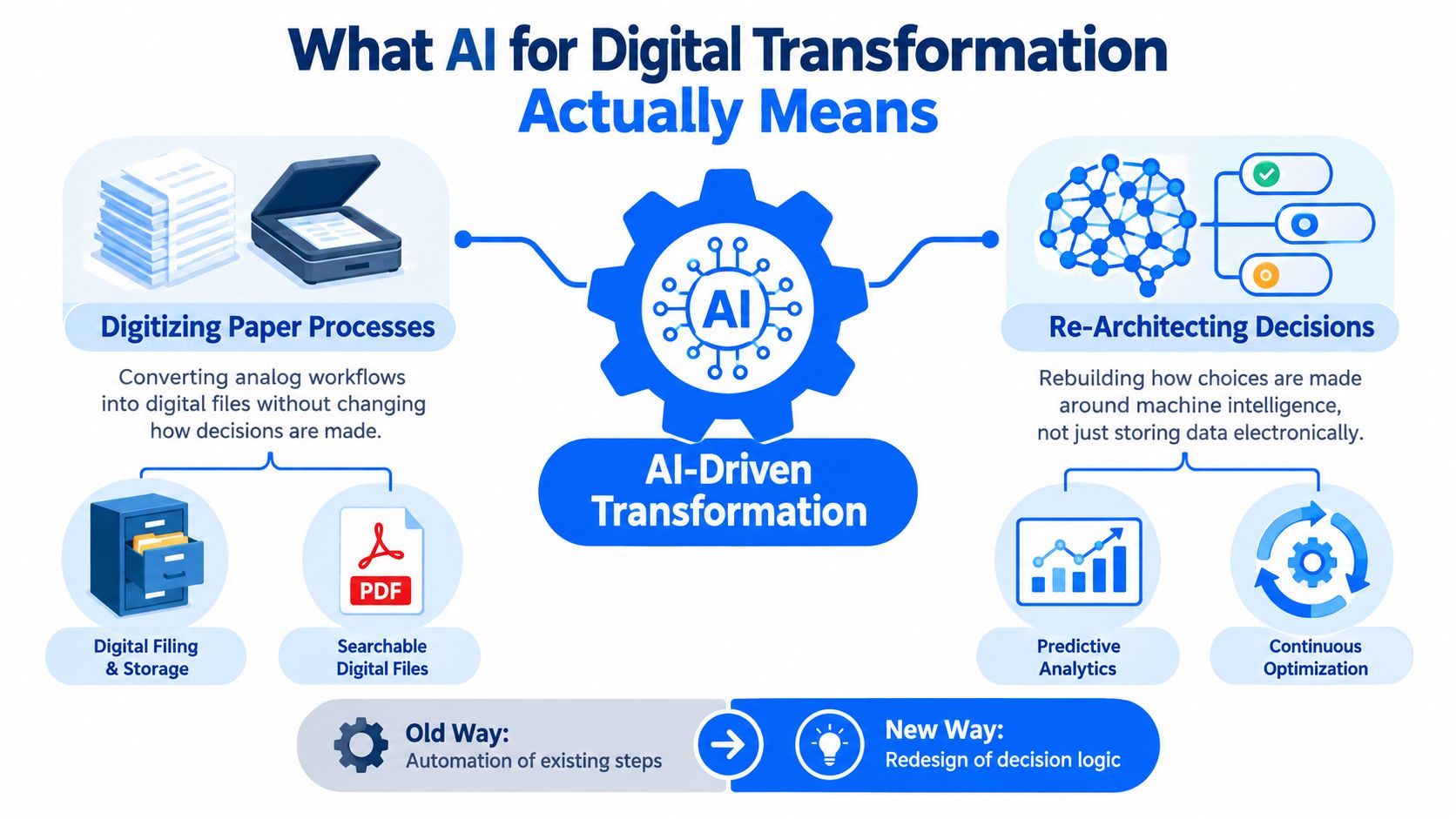
Digitizing a process means converting an existing activity into a digital format. A paper form becomes a PDF. A manual approval becomes an online form. The organization may gain speed and visibility, but the decision logic often remains unchanged.
AI-driven transformation goes further. It changes how the organization senses conditions, evaluates options, makes recommendations, and routes work. The distinction is similar to a warehouse that replaces paper pick lists with tablets versus a warehouse that redesigns fulfillment around demand signals, inventory position, delivery constraints, and dynamic prioritization.
The relationship with traditional modernization
Traditional digital transformation builds the environment AI needs:
- Cloud and infrastructure provide scalable computing and integration.
- ERP, CRM, and operational platforms hold the records that business processes depend on.
- Data platforms make information available across organizational boundaries.
- Cybersecurity and identity controls determine who can access systems and information.
- Product and delivery practices create the feedback cycles needed for continuous improvement.
AI adds a decision-and-automation layer across that foundation. It can classify customer requests, recommend next actions, summarize evidence, forecast demand, identify exceptions, or coordinate tasks across systems. It doesn't eliminate the need for reliable source data. It makes poor data, fragmented ownership, and weak controls more visible.
This is why executive alignment matters. The CIO should own the architecture and transformation portfolio. Business leaders should own the outcomes and process decisions. Security and legal teams should define acceptable risk. Procurement should test commercial dependence, portability, and total cost. A steering committee that calls every software implementation “transformation” will struggle to distinguish progress from activity.
Applied examples of this relationship, including the role of data, organizational agility, and redesigned business capabilities, are also discussed in Prometheus Agency AI transformation insights. The practical test is simple: if the initiative only stores an existing process electronically, it's digitization. If it changes who decides, how decisions are made, or how work flows through the enterprise, it may qualify as transformation.
The Three Enterprise Value Streams Where AI Earns
AI programs become easier to govern when leaders group them by the business mechanism they improve. Three value streams appear repeatedly across enterprise portfolios: customer experience, analytics and insight, and process automation.
Customer experience
Customer-facing AI should improve the path from demand to resolution. Typical applications include intelligent self-service, agent assistance, interaction summarization, intent classification, and next-best-action recommendations.
The relevant metric isn't the number of conversations handled by a bot. It's the operating outcome. Leaders should examine first-contact resolution, handling time, escalation rate, customer satisfaction, and cost per interaction. A virtual assistant that deflects contacts but creates repeat calls isn't producing transformation. An agent-assist tool that generates polished summaries but slows the representative down has failed its operational test.
Analytics and insight
Analytics-oriented AI supports forecasting, anomaly detection, scenario analysis, and decision support. The value appears when managers make better decisions earlier, not when dashboards contain more generated commentary.
A supply-chain team might use AI to identify likely stock exceptions. A finance team might use it to explain forecast variance. A commercial team might use it to prioritize accounts. The business owner must specify which decision changes, what evidence the system uses, and how a human confirms or rejects the recommendation.
Process automation
Process automation targets repetitive, document-heavy, or exception-driven work. Examples include claims intake, invoice handling, case triage, contract review, and employee-service requests.
The important measure is straight-through processing, supported by error rate, exception rate, cycle time, and cost per transaction. Automation should route uncertain cases to people rather than conceal uncertainty inside an opaque workflow.
| Value Stream | Representative Use Cases | Operating Metric Moved | System of Record Required |
|---|---|---|---|
| Customer experience | Self-service, agent assistance, next-best action | First-contact resolution, handling time, satisfaction | CRM, contact center, knowledge base |
| Analytics and insight | Forecasting, anomaly detection, decision support | Forecast accuracy, decision latency, exception detection | ERP, data warehouse, planning systems |
| Process automation | Document intake, case triage, invoice processing | Straight-through processing, cycle time, error rate | Workflow, ERP, content repositories |
The selection principle is direct: choose the value stream where a measurable business constraint is visible, the underlying records are accessible, and an accountable executive can authorize process change. Don't start with the most impressive demonstration. Start with the process that can defend its economics.
Why Workflow Redesign Beats Model Selection Every Time
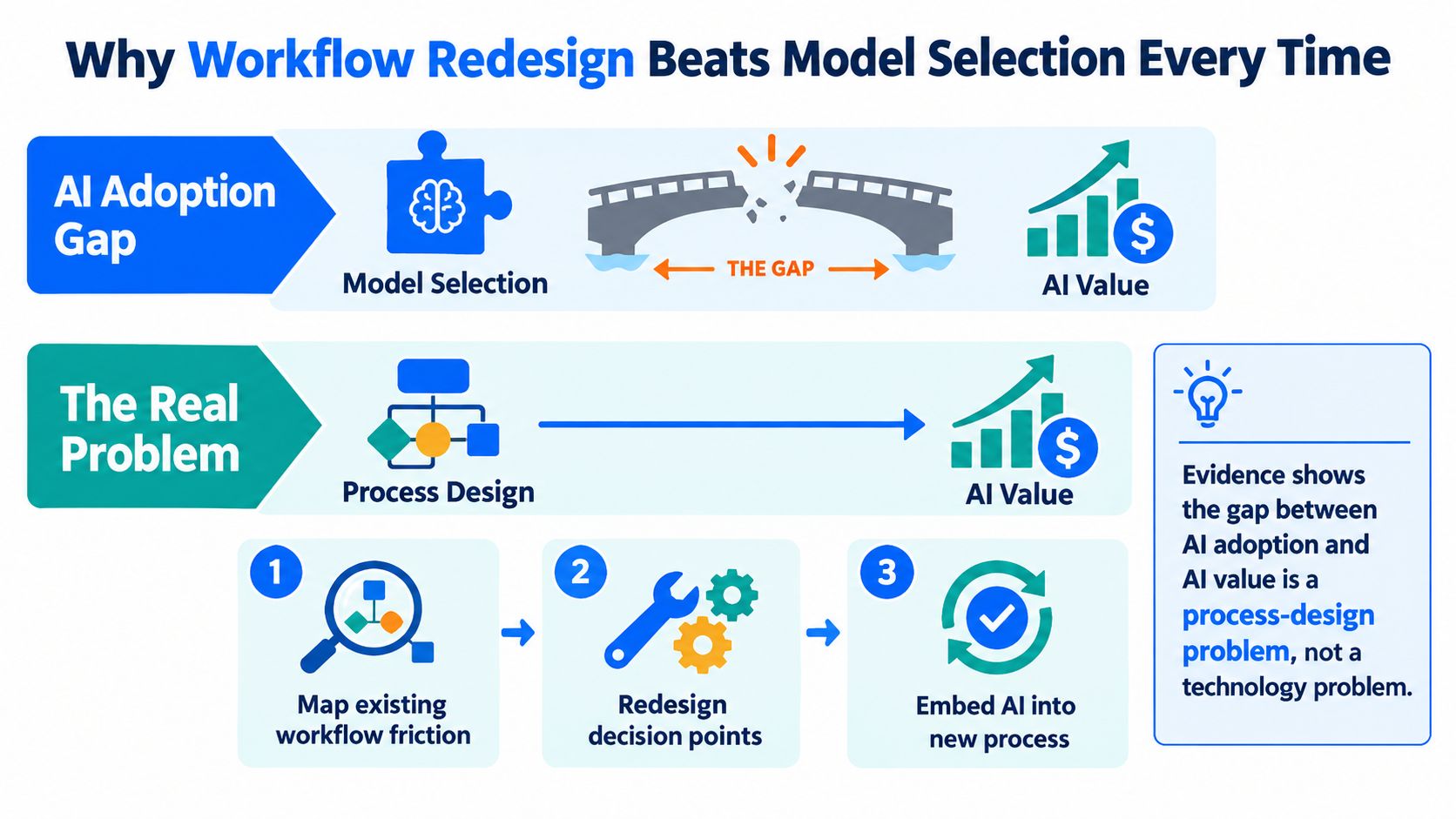
Organizations often spend too much time comparing models and too little time examining the workflow those models are meant to improve. That reverses the value chain.
McKinsey's 2025 global survey found that only 21% of respondents said their organizations had redesigned at least some workflows. The survey also found that workflow redesign had the strongest relationship among tested organizational attributes with achieving EBIT impact, while more than 80% reported no tangible enterprise-level EBIT impact from generative AI (McKinsey's 2025 AI survey).
Start with the work, not the tool
Take customer-service case resolution. The current workflow may include intake, classification, entitlement checking, knowledge search, response drafting, approval, and closure. A model can assist with several tasks, but inserting a chatbot into the existing sequence may leave the slowest handoffs untouched.
A better design separates the workflow into explicit components:
- Decision points: Identify where the process classifies, prioritizes, approves, or escalates work.
- AI-assisted tasks: Assign bounded activities such as summarization, retrieval, classification, or recommendation.
- Human approval gates: Reserve final decisions for trained staff where the impact, uncertainty, or regulatory exposure requires judgment.
- System actions: Define which approved outputs can update the CRM, trigger a workflow, or notify another team.
- Measurement checkpoints: Track cycle time, error rate, handling time, first-contact resolution, exception rate, and cost per transaction.
Redesign the handoffs
Suppose an underwriting team spends time collecting information from multiple sources before a reviewer can assess an application. AI may extract documents and identify missing evidence, but the redesign might involve changing the intake form, consolidating retrieval permissions, and routing only material exceptions to the underwriter. The model is one component. The redesigned sequence creates the economic value.
Practical rule: Never approve a pilot because the model performs well in isolation. Approve it because the redesigned workflow has a credible path to a measurable operating improvement.
Prioritize a small number of high-volume workflows. Each should have a named owner, baseline data, integration requirements, risk classification, and a decision about what happens when the AI is unavailable or uncertain. Model selection then becomes an engineering and procurement decision inside a business case, rather than the business case itself.
A Sequenced Roadmap That Survives the Board
A board should be able to stop an AI initiative before it becomes a permanent cost. Structure the roadmap like a capital project, with stage gates, controlled funding, benefits realization, and explicit exit criteria. Each release of budget must follow evidence, not enthusiasm.
Stage 1, diagnose the enterprise
Start with the operating model. Assess systems, data, decision bottlenecks, workforce capability, security exposure, and existing AI activity, including sanctioned tools and shadow AI. Produce a ranked inventory of business problems, constraints, and dependencies. A catalogue of fashionable use cases is not a transformation strategy.
Gate 1, continue only if: an accountable sponsor accepts the problem definition, relevant data owners are identified, and the organization can document the baseline process and expected benefit.
Stage 2, prioritize the portfolio
Score candidate initiatives against business value, feasibility, strategic alignment, risk, integration effort, and change impact. Separate near-term operating improvements from foundation work. A use case that requires major data remediation may deserve funding, but classify it as a foundation program rather than presenting it as immediate automation.
Gate 2, continue only if: the initiative has a measurable outcome, an approved owner, a delivery hypothesis, a benefits-realization measure, and explicit exit criteria.
Stage 3, select architecture and suppliers
Evaluate models, platforms, implementation partners, security controls, integration patterns, data-residency requirements, support obligations, and commercial terms as one decision. Keep procurement vendor-neutral until requirements are stable. Require a clear record of assumptions, dependencies, switching costs, and the conditions that would justify stopping or changing suppliers.
Gate 3, continue only if: security and integration reviews pass, procurement accepts the commercial exposure, and total cost of ownership fits the value case.
Stage 4, pilot, scale, or stop
Run a controlled pilot with production-relevant data, representative users, monitoring, human review, and a rollback path. Compare the baseline with the redesigned operation, then measure benefits against the approved target. User enthusiasm is useful feedback, not a scale decision. Scale only when the process delivers the intended outcome within defined risk thresholds. Stop when it cannot.
Workforce readiness belongs in every gate. Assign model-risk ownership, define role-specific training, specify mandatory human review, and provide a sanctioned route for experimentation. Nearly 89% of surveyed businesses said they would need new technology skills within the following 12 months, while only 15.8% strongly agreed that employees had received adequate AI training (S&P Global's workforce transformation analysis). That gap can turn a controlled rollout into workarounds, inconsistent decisions, and unmanaged risk.
Governance as Architecture, Not Afterthought
An acceptable-use policy cannot govern a production AI estate alone. Put governance into the architecture, procurement scorecard, operating procedures, and evidence trail before deployment. Treat each use case like a capital project, with stage gates, benefits realization, and explicit exit criteria.
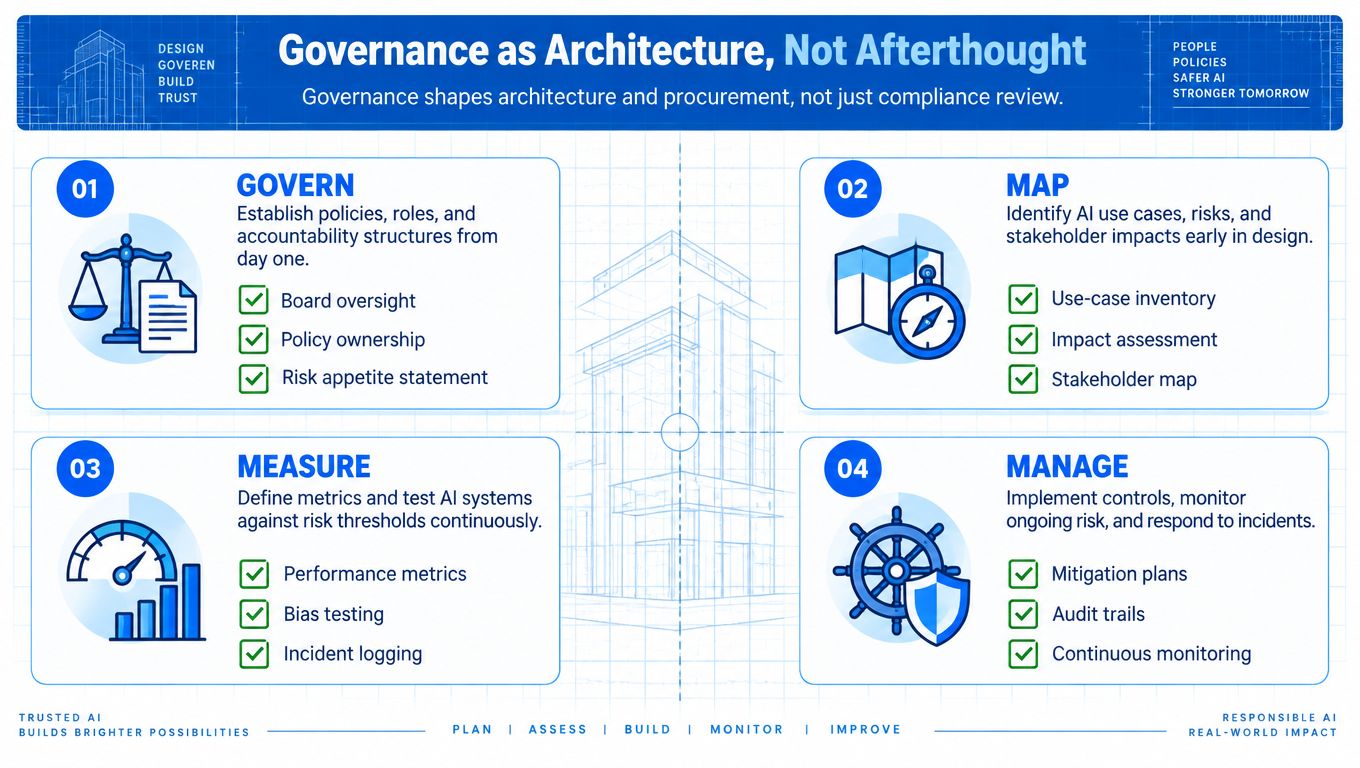
The NIST AI Risk Management Framework provides a practical structure through four functions: GOVERN, MAP, MEASURE, and MANAGE.
GOVERN assigns authority
Name the use-case owner, deployment approver, suspension authority, and incident lead. The board or executive committee should set risk appetite. CIO, CISO, legal, compliance, procurement, and business owners need defined decision rights, not shared accountability that belongs to nobody.
MAP makes exposure visible
Document purpose, users, data sources, dependencies, affected stakeholders, foreseeable harms, and system boundaries. Maintain an inventory covering the model, vendor, version, retrieval sources, downstream actions, and human-review requirements. This record supports investment decisions and creates a clear basis for an exit decision.
MEASURE tests the system
Set thresholds for accuracy, reliability, privacy, security, bias, latency, and operational performance. Test prompt injection, data exfiltration, unsafe outputs, and behavior changes after model or retrieval updates. Log prompts and responses with sensitive-data redaction, allowing investigation without creating another security problem.
MANAGE keeps control active
Apply mitigations, monitor drift, manage model and version changes, maintain audit trails, and define retirement criteria. Use least-privilege access for retrieval sources. High-impact decisions should retain human review, with the reviewer's role and override authority documented.
Governance needs executive alignment as well as technical controls. Bring risk, ethics, architecture, procurement, and business owners into design decisions early. Practical perspectives in Yellow.ai enterprise governance can supplement the framework, but accountability remains inside the enterprise. The CIO's responsibilities for architecture, risk, and business alignment also make this CIO job description relevant.
At every gate, require evidence that the use case meets its benefit target, stays within approved risk thresholds, and has a documented stop condition. That discipline prevents pilot enthusiasm from becoming permanent operational exposure.
Evaluating Vendors Through a Transformation Lens
A vendor scorecard should expose the cost and control implications of a solution, not reward the longest feature list. Compare suppliers against the operating outcome, architecture, governance model, and exit strategy.
| Evaluation area | Questions to ask | Eliminate a finalist when |
|---|---|---|
| Business value | Which workflow changes, and who owns the benefit? | The vendor can't connect features to an operating metric |
| Integration | How does the solution connect with CRM, ERP, identity, data, and workflow systems? | Integration depends on manual exports or unclear interfaces |
| Portability | Can the organization change models, retrieval sources, or hosting arrangements? | Data and prompts are trapped without a practical exit |
| Governance | What logging, access control, testing, monitoring, and review capabilities exist? | Controls require undocumented custom work |
| Total cost | What are licensing, inference, integration, support, data, training, and change costs? | The commercial model makes consumption unpredictable |
| Delivery capability | Who implements, operates, trains, and improves the workflow? | The supplier treats deployment as the finish line |
Scale matters in the market. OECD analysis found that approximately 28% of firms in information and communications technology used AI in 2023, compared with 8% of firms across OECD economies overall. In 2024, AI use reached 40% among firms with 250 or more employees, compared with 20.4% among firms employing 50 to 249 people and 11.9% among firms employing 10 to 49 people (OECD analysis of inclusive digital transformation). Mid-market organizations should treat this gap as a reason for structured evaluation and phased delivery, not as a reason to accept weak controls.
A vendor-neutral advisor adds value when the organization lacks specialist capacity, faces a multi-vendor architecture, or needs an independent business case. MR2 Solutions' Technology Brokerage-as-a-Service approach is one example of a model that coordinates discovery, evaluation, procurement, implementation, and governance without tying the assessment to a single provider. Leaders building their own process can use the same logic in procurement in IT: define requirements first, compare total cost and risk, and preserve negotiating position.
Measuring Value Without Fooling Yourself
A pilot needs a baseline before anyone turns it on. Capture cycle time, error rate, cost per transaction, straight-through processing, first-contact resolution, exception rate, and relevant customer or compliance outcomes. Then specify how the benefit will be attributed when AI changes several handoffs at once.
The measurement problem is widespread. More than two-thirds of surveyed executives reported that their organizations didn't yet have a way to measure generative-AI project success, while 37% had dedicated budgets and 27% identified generative-AI costs as a pain point (Publicis Sapient's executive innovation report). Funding without benefits realization creates a portfolio of anecdotes.
Use stage gates to review actual results against the approved business case. Continue when the workflow meets its outcome and risk thresholds. Redesign when the technology works but the process doesn't. Stop when the initiative can't justify its cost, exposure, or change burden. Include ongoing license, consumption, integration, support, and skills costs in technology expense management.
AI for digital transformation is portfolio discipline wearing a technology label. The leaders who create durable value don't count demos or prompts. They fund accountable outcomes, govern the operating model, and remove initiatives that fail to earn their place.
MR2 Solutions helps organizations assess AI readiness, prioritize use cases, evaluate technology and data environments, select providers, and establish governance for deployment and ongoing monitoring. Visit MR2 Solutions to discuss a vendor-neutral roadmap that connects AI investment to measurable operating outcomes.