
Job Description of a CIO: 2026 Guide

The most common advice about the job description of a CIO is wrong. It treats the role like a longer version of an IT director, then stuffs it with uptime, help desk, and infrastructure language that doesn't match how boards use the position. That thinking is outdated, and it sets up the wrong hire from the start.
A modern CIO is judged on enterprise value creation and governance at the same time. The role has moved into the center of business-model change, AI oversight, vendor control, and board reporting, which means the job description has to be built for executive impact, not technical maintenance.
The Modern CIO Mandate
The old CIO profile, the one buried in the server room and measured by ticket volume, is dead. Boards don't need a glorified operations manager. They need a leader who can translate technology into business decisions, then defend those decisions in front of the CEO and the board.
The CIO now sits inside the business, not beside it
The shift is visible in the reporting line and in the work itself. One industry summary says 63% of CIOs now report directly to the CEO, up from 38% a decade earlier, and 72% are actively involved in business-model innovation (The Global Recruiter). The same source says 37% of CIO responsibilities are now tied to strategy and business, compared with 25% ten years ago, while risk and resilience responsibilities doubled from 10% to 20% of the overall workload (The Global Recruiter).
That is the job description of a CIO in 2026. The role is no longer just about keeping systems alive. It's about driving executive decisions, shaping product and customer outcomes, and managing enterprise risk with enough discipline that the business can move faster without breaking itself.
Practical rule: If your CIO job posting reads like a support-function checklist, you're hiring for yesterday's business.
The role is broader than most HR templates admit
A recent global survey of 1,000 CIOs found that the role is shifting from enablement to business value creation, and that nearly all CIOs now report to the board on ROI (Logicalis). Foundry's 2026 State of the CIO survey says 46% of CIOs identify primarily as business leaders rather than technology operators (Logicalis). That should change how boards write the job.
A modern CIO needs to be positioned as a connector across finance, operations, customer experience, and transformation. If the organization wants a narrow IT operator, say that plainly and hire accordingly. If it wants enterprise change, the posting has to say so.
Core Responsibilities and Strategic Alignment
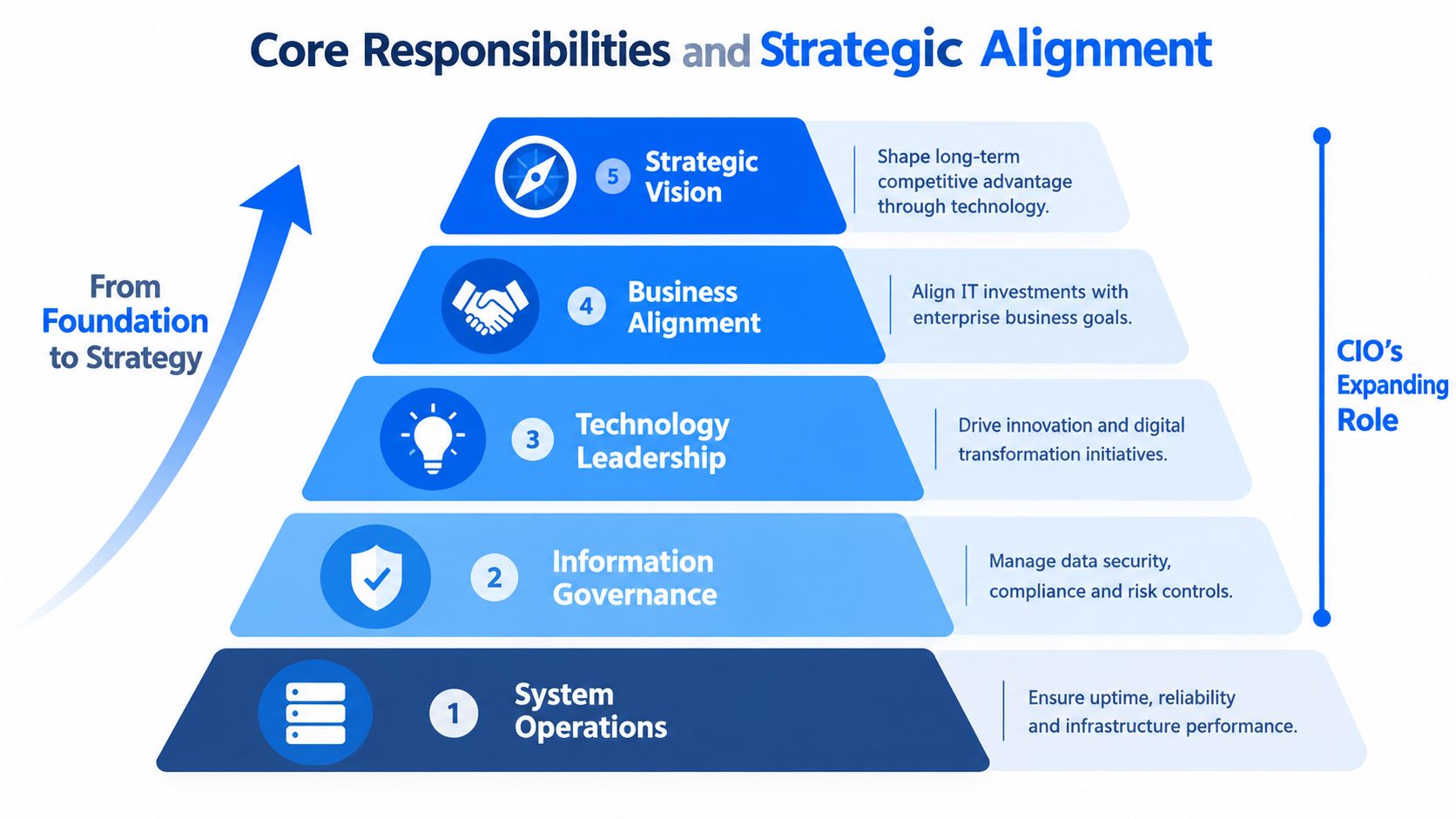
The foundational CIO responsibilities haven't disappeared, they've become more demanding. A CIO still manages staff, budgets, systems, policies, and executive communication, but those duties now sit inside a much heavier framework of enterprise governance and continuity. That's the part many job descriptions miss.
Start with governance, then build outward
A widely used CIO job description says CIOs manage IT staff, develop department goals, oversee the IT budget, plan and maintain systems, set IT policies and best practices, and explain the benefits and risks of technology projects to the board and other executives (TechTarget). U.S. federal guidance also makes CIOs explicitly responsible for strategic planning across information and information-technology management functions (TechTarget).
That's the baseline. But the modern role adds information governance, continuity, protection, and compliance. ISACA's guidance describes the CIO as accountable for sustainable management of enterprise information, including processing, continuity of related services, information protection, legal and regulatory compliance, and oversight to ensure alignment with enterprise objectives (ISACA). For mid-market and enterprise firms, that means the CIO is no longer just coordinating systems. The CIO is coordinating the control environment.
Treat architecture, operations, and compliance as one system
If your organization runs hybrid cloud, multiple vendors, and data-heavy workflows, the CIO can't manage those pieces as separate silos. Architecture choices affect operations. Operations affect continuity. Continuity affects auditability. Auditability affects regulatory defensibility. That chain has to be designed on purpose.
A CIO who can't explain how technology controls support the business won't survive board scrutiny for long.
The Government Accountability Office's CIO guidance reinforces the same discipline, assigning strategic planning, standards and policy-setting, budget and acquisition oversight, and technology portfolio prioritization to the role (GAO). If you're structuring the function for an enterprise or a regulated mid-market company, that's the model to follow. If the CIO can't influence investment and policy, the role is too small.
For organizations that need operating rigor underneath that governance layer, MR2 Solutions' managed services operations can be part of the support model, but only if the CIO owns the standards and controls that shape how those services run.
AI Governance and Vendor Strategy
A lot of job descriptions still talk about digital transformation as if AI governance were an optional extra. It isn't. The CIO now sits at the center of AI selection, policy, model oversight, and vendor discipline. If the posting doesn't say that, it's incomplete.
Draw the line between ownership and delegation
The CIO should own AI strategy, AI governance, and the decision framework for what can and can't be deployed. That means setting policy for use cases, access, review, escalation, and business approval. The CIO should also own the vendor conversation, because AI products are not bought as isolated tools, they become part of the enterprise control stack.
Execution is different. The CISO should handle security controls, threat modeling, and defensive monitoring. The CTO should own platform and engineering execution when AI is embedded into products or technical architecture. Data leaders should own data quality, lineage, and stewardship. The CIO orchestrates the whole thing.
Recent coverage says 80% of CIOs are responsible for researching and evaluating AI products, which makes them central to enterprise AI selection and control (Forbes Research). The same reporting says 82% of CIOs say the role is becoming more of a connector across departments (Forbes Research). That lines up with what most boards are already seeing. The CIO is becoming the person who has to make AI usable without making it reckless.
Buy governance, not just features
Vendor strategy has to be disciplined. The GAO guidance says CIOs maintain visibility into planning, budgeting, acquisition, project management, expenditures, and human-capital aspects of IT resources (GAO). That's why the CIO should select providers using governance criteria, lifecycle cost, service levels, and compliance fit, not just a slick demo.
If you need a practical external reference for building controls around AI adoption, practical guardrails for enterprise AI is a useful starting point for thinking about policy, approval paths, and operational boundaries.
Use a simple rule in the posting and in the interview process:
- CIO owns enterprise AI direction, policy, vendor approval, and risk alignment.
- CISO owns security control design and incident response.
- CTO owns technical delivery where AI is part of product or platform engineering.
- Data leadership owns data governance and quality.
- Business leaders own use-case sponsorship and value realization.
That split keeps the CIO from becoming a single point of failure. It also prevents the classic mid-market mistake, where one executive gets the mandate for AI but not the authority, staff, or governance support to carry it.
Required Skills and Executive Competencies
Technical fluency gets a candidate through the door. It doesn't make them a CIO. Boards need someone who can explain tradeoffs in business language, defend capital decisions, and keep cross-functional leaders moving in the same direction during critical moments.
Financial fluency is non-negotiable
The modern CIO must understand budgets, acquisition, portfolio prioritization, and lifecycle cost. That's not just accounting hygiene. It's how the CIO earns trust from the CFO and prevents technology from becoming a loose collection of disconnected purchases.
The job description should say the candidate can build and defend the technology investment case, manage the budget, and tie spend to business outcomes. If the organization is serious about cost discipline, a technology expense management capability belongs in the operating model, not as an afterthought. MR2 Solutions' technology expense management fits that need when a company wants outside support for spend visibility and optimization.
Communication is a leadership tool, not a soft skill
A CIO has to explain the benefits and risks of technology projects to the board and to executives who don't live in the architecture stack. That means crisp writing, strong meeting control, and the ability to reduce complexity without oversimplifying risk.
The role also demands talent leadership. The CIO isn't just hiring engineers. The CIO is shaping succession, capability, and retention across infrastructure, applications, data, and security. If the team can't scale, the executive can't scale.
Board-level test: If the candidate can't talk about risk, value, and accountability in the same sentence, they're not ready.
A good posting should ask for executive presence, change management, vendor leadership, and people development. A great candidate will have war stories, but they should also show structure. They should know how to set standards, drive adoption, and decide what gets delegated.
Organizational Reporting and Structure
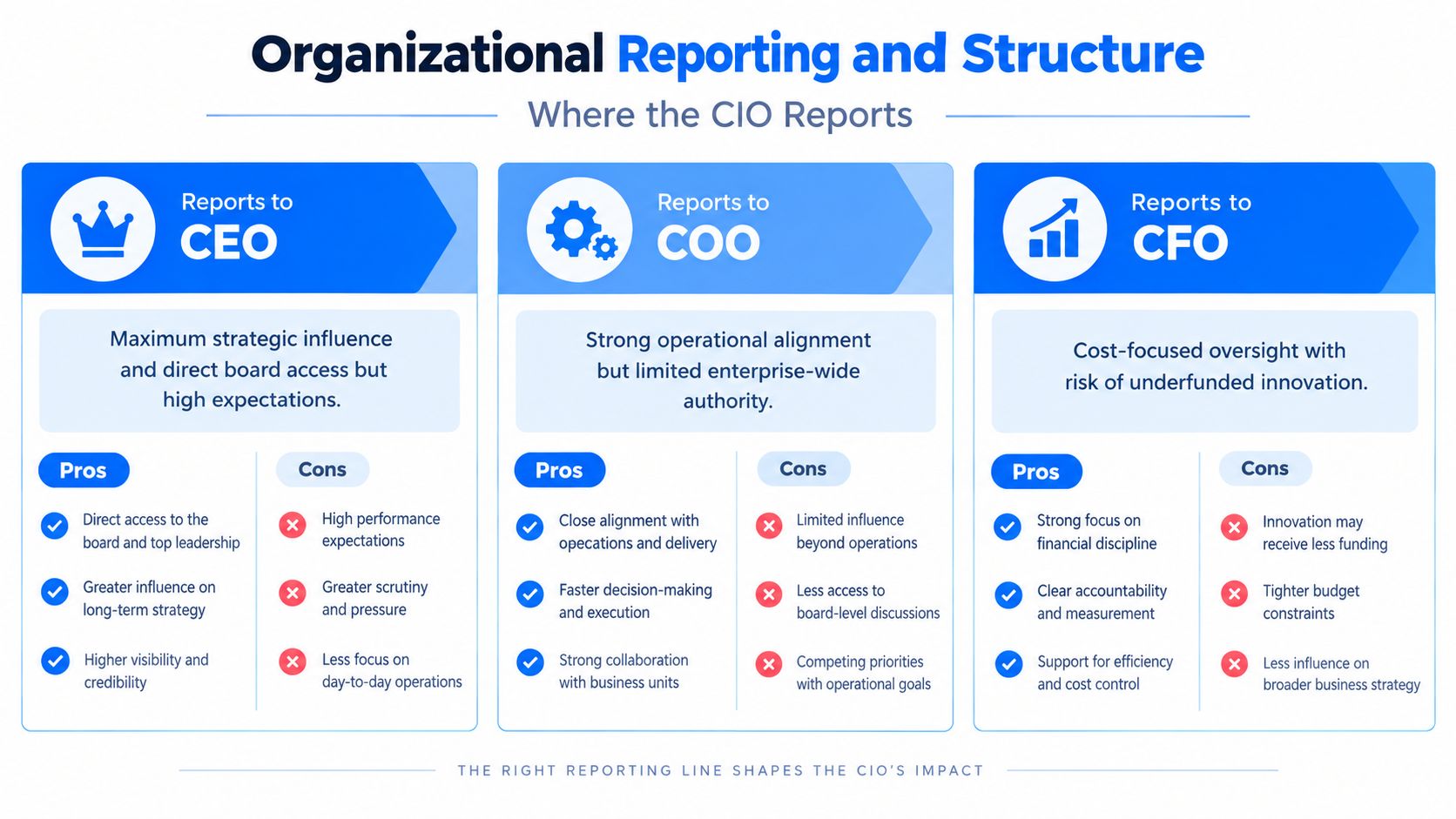
Where the CIO sits changes what the CIO can do. Reporting lines aren't cosmetic. They shape influence, speed, and the kinds of decisions the role is allowed to make.
CEO reporting gives the CIO room to lead
The data is clear on the direction of travel. 63% of CIOs now report directly to the CEO, up from 38% a decade earlier (The Global Recruiter). That structure makes sense when the CIO is responsible for business-model innovation, board reporting, and enterprise AI governance.
Reporting to the CEO gives the CIO direct access to strategic priorities, faster escalation paths, and better alignment with transformation goals. It also raises the bar. The CEO will expect the CIO to carry enterprise tradeoffs, not just operational status updates.
CFO or COO reporting narrows the mandate
Reporting to the CFO can work when the organization mainly wants cost control, procurement discipline, and operational efficiency. That's useful, but it often pulls the CIO toward expense management at the expense of transformation. Reporting to the COO can strengthen operational alignment, especially in highly process-driven organizations, but it can also keep the CIO too close to service execution and too far from enterprise strategy.
Neither structure is wrong in every case. Both become a problem when the company says it wants innovation but structures the role for maintenance.
Under the CIO, the internal team should be built around clear ownership lines, not an overload of direct reports. Use fractional leadership, managed services, and specialist partners where the gap is capacity rather than authority. For organizations that need a technology brokerage model to coordinate those pieces, MR2 Solutions is one option among several. The point is to preserve executive bandwidth for strategy and governance.
A simple structural filter
Use this test when you design the org chart:
- If the company wants transformation, the CIO should report to the CEO.
- If the company wants cost containment, the CFO line may be acceptable.
- If the company wants execution discipline, the COO line can work.
- If the company wants all three, the role needs explicit board access and clear charter language.
That's the design choice. Titles don't fix misalignment. Reporting structure does.
Key Performance Indicators and Success Metrics
A CIO should never be judged by activity alone. If the dashboard only tracks uptime and tickets, the board is measuring the wrong thing. The CIO should be held to metrics that show whether technology is enabling the business and reducing exposure at the same time.
Replace legacy IT metrics with business metrics
Traditional operational measures still matter, but they're not enough. A modern CIO KPI framework should connect technology work to budget control, risk posture, and strategic execution.
| Category | Operational Metric (Legacy) | Strategic Metric (Modern) |
|---|---|---|
| Service delivery | Uptime, ticket closure time | Service continuity against business requirements |
| Spend | Budget consumed | Lifecycle cost and investment discipline |
| Security | Number of alerts | Risk reduction and control effectiveness |
| Vendor management | Contract renewals completed | Performance against service levels and governance criteria |
| Transformation | Projects delivered | Business outcomes enabled and adoption achieved |
The board should also expect the CIO to show how the technology portfolio supports compliance and defensibility, especially when vendors, cloud services, and regulated data are involved. That's why the CIO should own portfolio prioritization, not just project tracking.
Use metrics that force tradeoffs
A good dashboard makes choices visible. If the CIO is investing in AI, then there should be evidence of governance controls, business sponsorship, and vendor due diligence. If the company is cutting spend, the dashboard should show where savings came from and what risk increased as a result.
For teams trying to formalize this discipline, a dedicated expense review process helps. The MR2 Solutions page on technology expense management is relevant here because cost control and portfolio governance belong together.
The best CIO metrics answer one question, did technology make the business stronger or just busier?
Keep the scorecard tight. The board doesn't need 30 disconnected KPIs. It needs a small set of indicators that connect spend, service, risk, and business value in a way people can act on.
Full-Time Executive vs Fractional CIO
Not every company needs a full-time CIO on day one. Some need executive judgment before they need a permanent seat at the table. The right answer depends on scale, complexity, and whether the company can support the workload without breaking the person.
Use a fractional CIO when scope outruns headcount
A fractional CIO makes sense when the organization has real governance gaps, budget pressure, or stalled technology decisions, but not enough scale to justify a full-time executive. That model works best when leadership needs strategic planning, vendor selection, and a better operating rhythm without carrying a permanent C-suite cost.
MR2 Solutions' fractional-cto-services page is one example of how this kind of support can be structured, especially when a company needs executive guidance without immediately expanding payroll.
The decision is simple. If the business needs steady board presence, broad cross-functional leadership, and constant oversight of a large internal technology estate, hire full time. If the business mainly needs governance, prioritization, and transformation support while the team is still small or stretched, fractional leadership is the cleaner move.
Don't buy a title to cover a workload problem
Mid-market companies often overhire too early, then underuse the executive. Others underhire and expect one person to cover strategy, operations, security, procurement, and AI. Both mistakes create burnout.
Use this filter:
- Choose full-time when technology is a major business differentiator and the portfolio is large enough to demand constant executive attention.
- Choose fractional when the organization needs structure, senior judgment, and better decisions before it needs a permanent office-holder.
- Upgrade later when the function becomes too broad for part-time leadership and the company can support the full charter.
The right choice isn't about prestige. It's about fit. If the scope is unclear, a fractional model often surfaces the true requirements faster than a rushed executive search.
Sample CIO Job Posting Template
A weak CIO posting attracts candidates who want to manage infrastructure. A strong posting attracts leaders who want to run technology as a business function. The language has to be explicit, or you'll get the wrong applicant pool.
Chief Information Officer
About the Role
The Chief Information Officer is a member of the executive leadership team and reports to the Chief Executive Officer. The CIO owns enterprise technology strategy, technology governance, AI oversight, vendor strategy, and the business case for technology investment. This role is accountable for aligning technology execution with business objectives, customer experience, operational resilience, and risk management.
What You'll Own
You'll direct the enterprise technology roadmap, annual budget planning, and portfolio prioritization. You'll define governance for infrastructure, applications, data, security, and AI use cases. You'll work with the CFO on investment discipline, with the CISO on defensible risk controls, and with business leaders on adoption and value realization.
Core Responsibilities
- Strategy and alignment, translate business goals into a technology roadmap.
- Budget and portfolio leadership, manage spend, prioritize investments, and defend tradeoffs.
- AI governance, set policy for model use, approval, data access, and oversight.
- Vendor strategy, evaluate partners using governance, lifecycle cost, and service criteria.
- Operational resilience, ensure continuity, reliability, and recovery readiness.
- Executive reporting, provide clear board updates on progress, risk, and value.
Required Experience
- Senior technology leadership experience in a complex organization.
- Demonstrated board communication and executive stakeholder management.
- Experience leading transformation, governance, and cross-functional change.
- Strong command of cybersecurity, compliance, vendor oversight, and budget discipline.
- Proven ability to build and retain a high-performing technology team.
Preferred Qualifications
- Experience with enterprise AI programs and governance frameworks.
- Industry-specific regulatory or operational experience.
- Familiarity with hybrid cloud, multi-vendor, and multi-site operating models.
That structure does two things well. It tells senior candidates the job is strategic, and it tells legacy operators not to apply unless they're ready to lead at the enterprise level. If you want to avoid wasting time, be blunt in the posting. Ambiguity only helps the wrong people.
Quick Reference and Evaluation Checklist
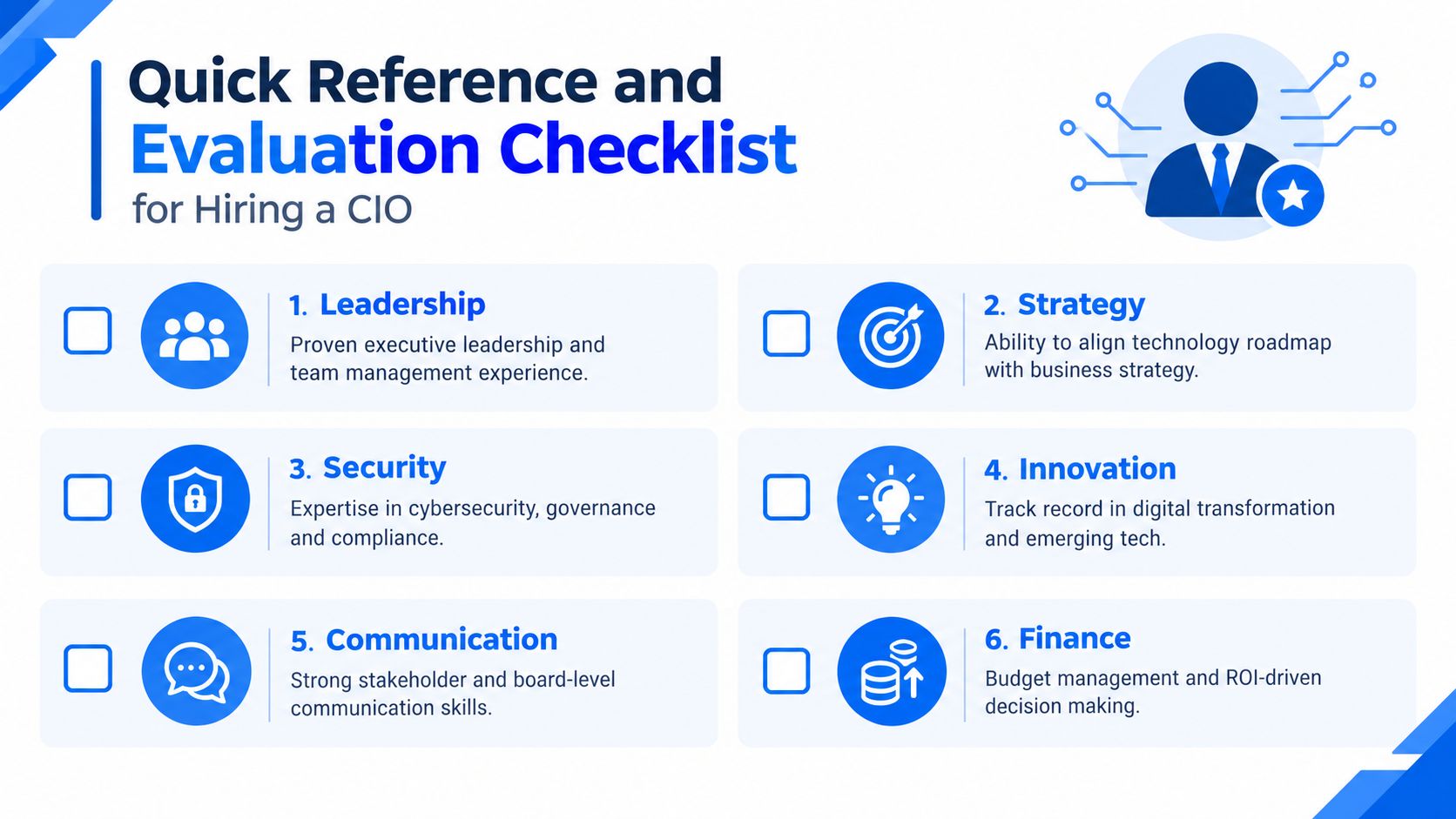
Use this as the final filter before you approve a CIO posting or interview slate. If any of these items are missing, the role is probably underdefined.
What the role should include
- Leadership: Proven executive leadership and team management experience.
- Strategy: Ability to align the technology roadmap with business strategy.
- Security: Expertise in cybersecurity, governance, and compliance.
- Innovation: Track record in digital transformation and emerging technology.
- Communication: Strong stakeholder and board-level communication skills.
- Finance: Budget management and ROI-driven decision making.
What to check before you post
A strong CIO job description makes the mandate obvious, not implied. It spells out reporting line, board access, governance scope, vendor authority, and AI accountability. It also separates what the CIO owns from what the CISO, CTO, and data leaders own.
Use the posting to screen for executive maturity. If the candidate can't speak to risk, value, change, and operating model in one conversation, they're probably not the right fit. If the role description doesn't mention AI governance, board reporting, and investment discipline, the company isn't ready for a real CIO yet.
The simplest test is this. Read the posting as if you're a sitting CIO at a peer company. If you'd laugh at it, rewrite it.
If you're reshaping a CIO role or trying to hire the right one, MR2 Solutions can help with vendor-neutral technology brokerage, fractional leadership, governance support, and spend control. Visit MR2 Solutions to see how their approach can align CIO priorities with business outcomes and reduce the risk of hiring or structuring the role the wrong way.