
Hybrid Cloud Management: A Practical Guide for 2026

Your hybrid cloud is probably not failing because the platform is weak. It's failing because the people who own security, operations, and spend don't all see the same facts, and they certainly don't make the same decisions at 2 a.m. That's why the core problem isn't just tooling sprawl, it's governance drift, and if you're a CIO staring at cost overruns, audit anxiety, and teams arguing over who approved what, you're already living it.
Hybrid cloud management in 2026 is the discipline of running private infrastructure, multiple public clouds, and the connections between them as one operating fabric. It's not a dashboard. It's not a brokered list of vendors. It's the set of decision rights, controls, and telemetry that tells you where each workload runs, who owns it, what it costs, and which policy governs it. If you need a quick contrast between deployment models, cloud strategy key differences is a useful reference, and if you're still working through operating model decisions, MR2 Solutions' multi-cloud strategy material is worth a look.
The hard truth is that hybrid stopped being a transitional architecture years ago. Cisco's global survey showed 82% of organizations had adopted hybrid cloud, 92% were using multiple public clouds, and 58% were using 2 to 3 public IaaS providers for workloads, which is why coordination across identity, networking, governance, and workload placement became a core operating model rather than a side project (Cisco survey summary).
What Hybrid Cloud Management Really Means in 2026
A regional bank is a good proxy for what many enterprises look like now. Core lending runs on private infrastructure, customer-facing apps sit across two public clouds, analytics land in a third environment, and nobody can answer a simple question fast enough: where does a workload live, and who pays for it? That is a governance failure, and it becomes an accountability failure the moment finance, risk, and platform teams give different answers.
Hybrid cloud management is the discipline that keeps that sprawl from turning into operational debt. It covers workload orchestration, data governance, spend control, and security enforcement across private and public environments as one system. If your team still treats each cloud like a separate kingdom, you are managing vendor accounts, not hybrid infrastructure. For a practical comparison of operating models, cloud strategy key differences is a useful reference, and MR2 Solutions' multi-cloud strategy material helps frame the decision cleanly.
The point is control, not collection
The old language around "cloud broker" or "multi-cloud admin" misses the core job. In 2026, the job is to define who can place workloads, who must approve exceptions, who sees the bill, and who gets paged when policy fails. That belongs in the CIO and CISO operating model, not just in the platform team's backlog.
The distinction between hybrid and multi-cloud matters because it changes the operating logic. Hybrid ties private and public environments together through shared policy and operational intent. Multi-cloud can be nothing more than a stack of separate public providers. If that split is still under debate, keep the operating question in view, not the product category.
Practical rule: if your team cannot answer cost, placement, and ownership for one critical workload without three separate meetings, you do not have hybrid cloud management. You have distributed confusion.
The market has already moved on from the idea that this is temporary. Forecasts put the hybrid cloud management market at $12.21 billion in 2025 and project $29.05 billion by 2030 with an 18.9% CAGR (market forecast). That growth does not prove maturity. It proves enterprises need a control layer badly enough to pay for it at scale.
Why Hybrid Cloud Became the Default Operating Model
A CIO does not choose hybrid cloud because it is tidy. The business pushes there because one environment never satisfies every workload. Latency, compliance, data residency, legacy dependencies, and specialized compute keep forcing decisions that split across private and public infrastructure.
The structural drivers are permanent
AI workloads are a clear example. If a team needs a specific GPU capability or a managed service that only exists in one place, the workload goes there. Sovereignty rules force the same outcome. If data must stay in a geography or under a specific control regime, architecture follows the rule, not the preference. Legacy systems and acquisition sprawl add private and on-premises baggage that cannot be removed on a clean schedule.
That is why hybrid has become the default operating model for serious enterprises. A major mistake is still treating single-cloud consolidation as the end state. For most large organizations, that end state does not exist.
The adoption pattern is already mixed. The Cisco survey shows 82% hybrid adoption and 92% multiple public cloud use, which means mixed estates are now normal rather than exceptional (Cisco survey summary). The market forecast also points to North America as the largest region in 2025 and Asia-Pacific as the fastest-growing, which reinforces the same point, hybrid management is now a global infrastructure category, not a temporary workaround (market forecast).
| Driver | Why It Forces Hybrid | Typical Impact |
|---|---|---|
| Latency-sensitive apps | Some workloads need to sit close to users or internal systems | Placement becomes a performance decision |
| Compliance and residency | Rules can dictate where data lives and who controls it | Segmented architecture stays in place |
| Legacy systems | Older platforms resist clean migration | Private infrastructure remains part of the stack |
| AI and specialized services | Teams chase the best available compute or managed service | Workloads spread across providers |
| M&A and inherited estates | New environments get added faster than they can be rationalized | Operational debt grows unless governance tightens |
The strategic issue is not elegance. Hybrid is messy. The issue is governance. Who approves placement, who owns exceptions, who sees the bill, and who answers when policy fails? Those questions have to sit in the CIO and CISO operating model, not buried in platform backlog. Until that is clear, hybrid cloud management becomes an expensive exercise in distributed confusion.
The Core Pillars of Day-to-Day Operations
Hybrid environments don't fail all at once. They fail at the seams. A transaction-heavy application might run its API layer in one cloud near users, keep the database tier in a second cloud for cost reasons, and push analytics on premises. The architecture sounds reasonable until identity doesn't propagate cleanly, latency grows, or someone discovers that egress is eating the savings.
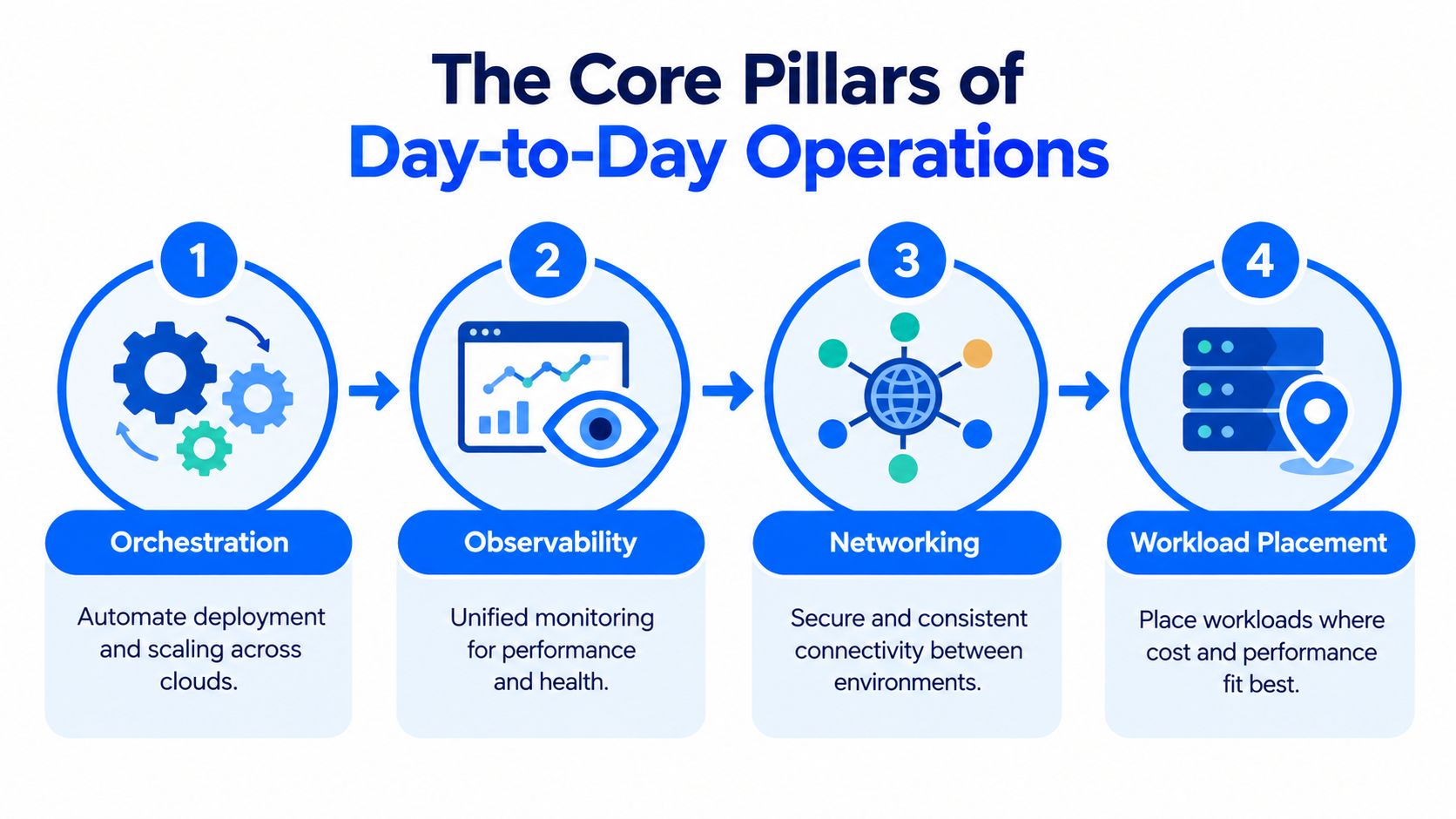
Orchestration and workload placement are the same conversation
Orchestration is not just deployment automation. It's policy-aware placement. If your pipeline can spin up infrastructure but can't respect data class, residency, or cost rules, it's automation without governance. Workload placement is the continuous decision of where each service runs based on cost, compliance, and performance, and that decision should be explicit, not tribal.
The cross-cloud networking evidence is uncomfortable but useful here. A study found that keeping ingestion and transformation tasks inside the same cloud reduced cross-cloud egress by 45% and cut modeled monthly cost by about USD 1,200. The same study showed inter-cloud hops increased end-to-end latency from 3.4 s to 5.8 s, a 70% jump, and abstraction frameworks can add about 1.2 s of latency (hybrid-cloud networking study). That's why placement isn't a theoretical choice, it's a direct lever on both spend and experience.
Observability and networking carry the rest of the load
Observability has to span on-premises and cloud layers, because monitoring only internal state leaves blind spots that slow detection and remediation (Guidehouse observability guidance). In practice, that means one set of metrics, logs, and traces with consistent identity across environments.
Networking is the other half of the same problem. Peering, DNS, and zero-trust connectivity have to be designed as shared services, not local hacks. If those pieces are fragmented, application teams end up debugging transport when they should be shipping features.
Don't let every cloud team invent its own routing and monitoring habits. The first place hybrid operations break is where nobody owns the seam.
For disaster recovery and platform continuity planning, the disaster recovery for data platforms discussion is a solid complement to this operating model. MR2 Solutions' managed services operations page is also relevant if you're thinking about who should carry the day-to-day burden of keeping this fabric stable.
The Hidden Governance Gap Most Teams Miss
Hybrid cloud governance breaks for one reason, ownership does not match the architecture. Security teams assume they own control, database teams assume they own the data, operations teams assume they own uptime, and the incident crosses all three before anyone is clearly accountable.
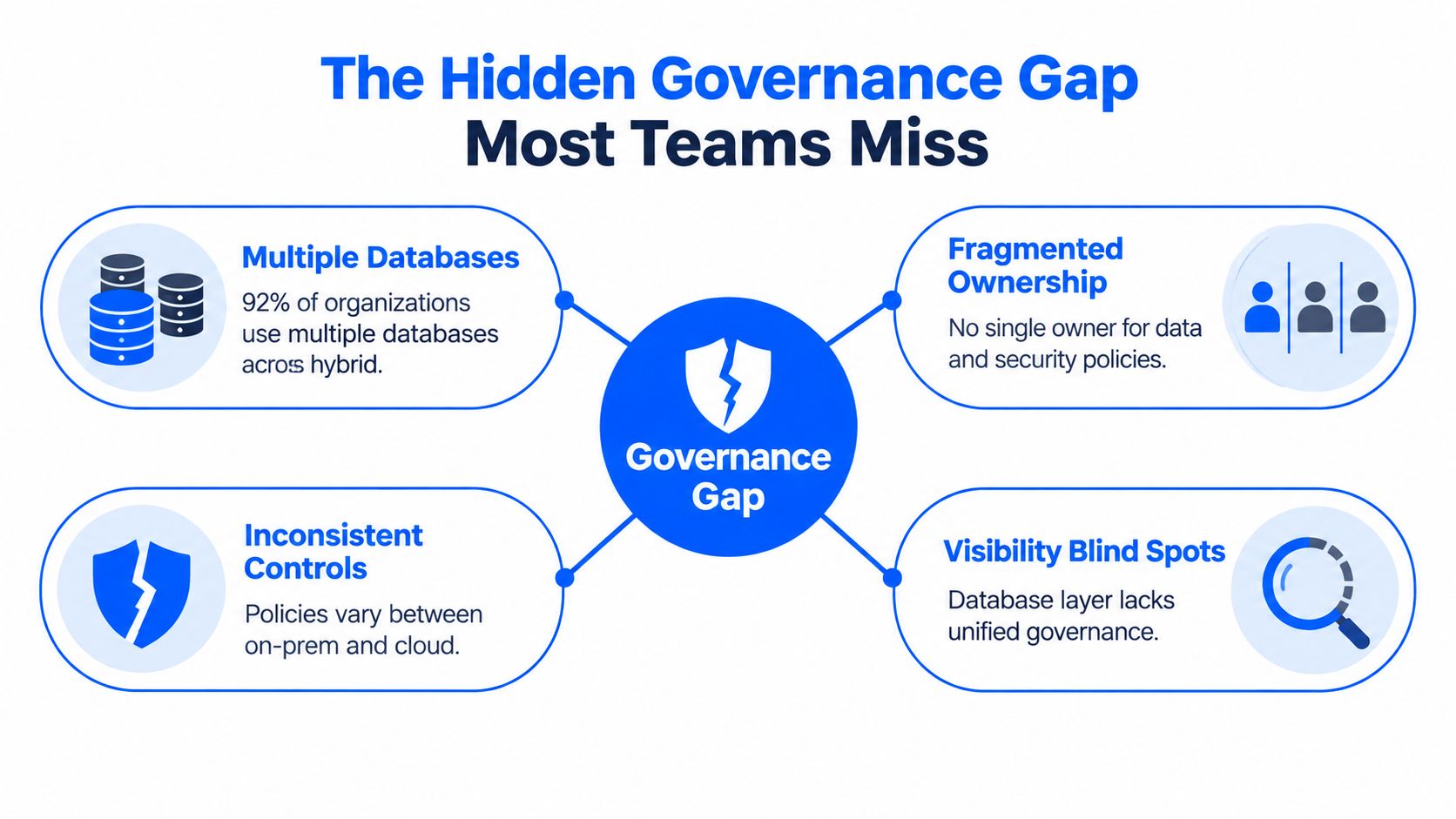
Fragmented ownership creates predictable failure modes
The 2026 reality is ugly. Analysts in the Redgate summary found that many respondents felt personally responsible for database security outcomes, while a large share of hybrid organizations reported data privacy or security issues. That does not point to a lack of effort. It points to blurred accountability across teams that do not share the same view of risk.
The same summary showed operational staff were more likely than senior leaders to call out cost management as a problem, and far fewer operational teams had access to cloud cost analytics than senior leaders. That gap matters. Engineers cannot govern what they cannot see, and executives cannot correct what they only see at aggregate level.
The real flaw is in decision rights
Tooling alone will not fix this. The deeper problem is how organizations assign decision rights, escalation paths, and reporting lines for distributed infrastructure. When data teams, security teams, and platform teams each control a slice of the workflow, controls drift between environments, audits become painful, and exceptions turn into the default state.
Hybrid cloud management fails when the person approving the exception is not the person carrying the risk. Fix that by rewriting ownership and accountability, not by buying another policy engine.
Bold recommendation: make one executive accountable for cross-environment governance, then force every team to report cost, risk, and compliance through the same operating model.
If you are evaluating partner models for a fragmented estate, MR2 Solutions' cloud services brokerage market discussion fits this governance problem better than a pure tooling pitch.
Controlling Cost and Security Across Mixed Environments
The uncomfortable 2026 baseline is that 85% of organizations still rank cloud spend as a top challenge and 82% still rank security as a top challenge. Plenty of teams bought the tools and still did not gain control. The pattern is predictable. They instrumented each environment differently and expected a dashboard to create coherence.
Start with consistent signals
FinOps ideas like showback, rightsizing, and commitment management still matter, but hybrid breaks clean accounting. Chargeback fails when one workload spans on-premises and multiple clouds, because the cost units no longer line up. If tagging, identity, and provisioning rules are inconsistent, the numbers become argument fuel instead of management data.
Security follows the same logic. Policy-as-code only helps when it runs the same way across AWS, Azure, and private infrastructure. Cross-cloud identity federation matters because access control is only as strong as the identity layer underneath it. If you cannot enforce unified tagging at provisioning time, you will keep chasing orphaned spend after the fact.
Use controls that travel with the workload
The practical levers are boring, which is exactly why they work.
- Unified tagging taxonomies: enforce them at provisioning, not in cleanup.
- Cross-cloud identity federation: remove separate trust models where possible.
- Policy-as-code: make the same control logic run everywhere.
- Hybrid-aware anomaly detection: tune alerts for traffic patterns that cross environments.
- Shared cost and risk instrumentation: give engineers and executives the same source of truth.
Hybrid control fails when each team sees a different version of the truth. Finance needs attribution. Security needs policy enforcement. Platform teams need telemetry that connects both. If those views do not share the same identifiers and reporting rules, cost and security drift apart, and the gap gets expensive fast.
| Control Lever | What It Solves | Where Hybrid Breaks Without It |
|---|---|---|
| Unified tagging | Makes spend traceable by workload | Costs hide across environments |
| Identity federation | Keeps access consistent | Permissions drift between clouds |
| Policy-as-code | Enforces standards automatically | Manual review can't keep up |
| Hybrid observability | Correlates signals across layers | Teams troubleshoot in silos |
| Anomaly detection | Flags unusual spend or behavior | Noise overwhelms the team |
Why Adoption Is Outrunning Control
A CIO does not have a tooling problem first. The failure is governance. Cloud and AI teams keep adding workloads because the business rewards speed, while the operating model still cannot answer basic questions about approval, ownership, and risk.
AI is accelerating the control problem
Analysts keep reporting the same pattern. Hybrid use keeps rising, while cost, security, and compliance remain the pressure points. That should not surprise anyone. Once AI workloads enter the mix, the environment gets harder to classify, harder to bill, and harder to secure. Operational teams often see fragments of that picture. Executives see the financial and risk exposure more clearly, and that gap drives bad decisions.
Business units push AI into production fast because they want results now. Security review queues grow. Finance loses clean attribution when GPU-heavy workloads sit beside ordinary compute. Control does not catch up on its own.
The only question that matters is who decides
Stop debating which platform is “best” in the abstract. Ask who can provision, who must approve, who owns the risk, and who sees the bill. Those are governance questions. The tool only reflects the decisions already in place.
If your operating model cannot classify an AI workload before it is live, the problem is not deployment speed. The problem is accountability.
If AI can be launched faster than your operating model can classify it, approve it, and bill it, then your control framework is already behind.
For teams still working through adoption friction, the overcome cloud migration roadblocks resource is a useful reminder of where execution breaks down. The harder lesson is different. Migration speed is not the same thing as governance maturity.
A Vendor-Neutral Evaluation Framework
Start with governance, not software. A hybrid cloud management platform, an MSP, or a brokerage should earn its place by matching decision rights to the people who carry the risk when something fails.
Score candidates on six criteria
- Cross-cloud abstraction depth. Does the solution manage private and public estates, or only surface them?
- Governance enforcement. Can it apply policy across environments, or does it depend on manual cleanup?
- FinOps integration. Can it tie workload placement to cost signals engineers will use?
- Security posture coverage. Does it show risk across identity, data, and infrastructure, or only one layer?
- Onboarding cost. How much operational effort does adoption consume before it delivers value?
- Exit portability. If you leave, do you keep your data, policy logic, and operating knowledge?
Pick the model that cuts ambiguity when something drifts at 2 a.m. A platform that gives you dashboards but leaves the hard decisions in your lap gives you visibility without accountability.
Ask who carries the risk
That question matters just as much for brokers as it does for software vendors. The cloud services brokerage market framing is useful because it treats selection as risk allocation, not just procurement. Use that standard everywhere.
| Decision Criterion | What to Ask | Red Flag to Watch |
|---|---|---|
| Cross-cloud abstraction depth | Can it govern private and public environments together? | It only reports after the fact |
| Governance enforcement | Does policy apply automatically across estates? | Manual exceptions dominate |
| FinOps integration | Can engineers see cost at workload level? | Cost data lives only in finance |
| Security posture coverage | Does it connect identity, data, and infrastructure risk? | Security is bolted on later |
| Onboarding cost | How long before the team can run it cleanly? | Adoption depends on consultants forever |
| Exit portability | What happens if you change vendors? | You lose process, data, or leverage |
Treat vendor choice as an operating-model test. If the answer still depends on heroic manual effort, the tooling is just decorating a broken control framework.
Putting It All Together This Quarter
Name one executive who owns hybrid governance across security, database, and operations. Give that person authority to force decisions across silos, or the debt stays.
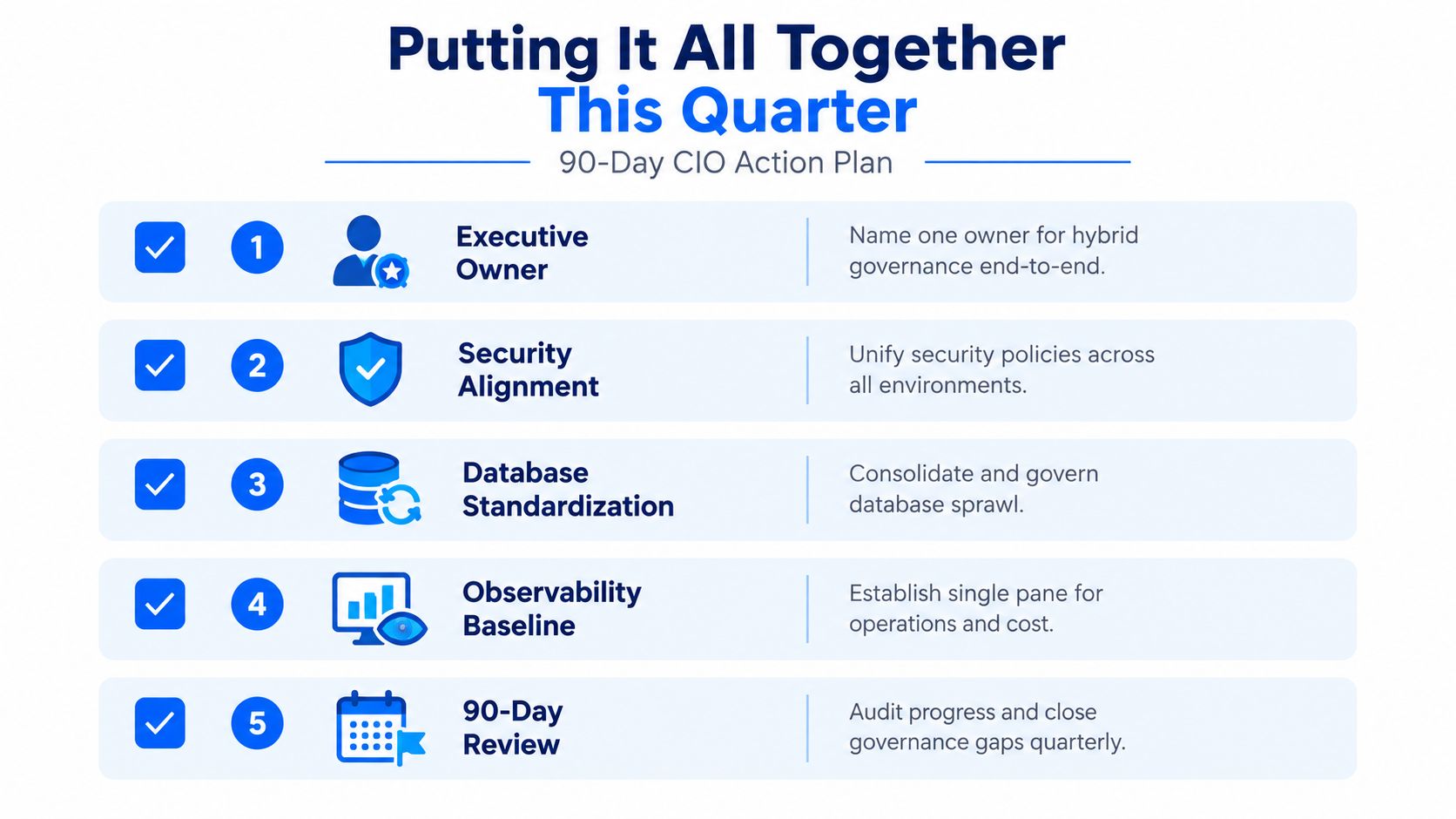
Then expose cost and risk signals so engineering pods and the board work from the same facts, just at different levels of detail. Run the six-criterion vendor and partner evaluation against your current stack, because consolidation may beat another tool. Use the next 90 days as a reset window before AI workloads widen the control gap. If you cannot show who approves policy, who sees spend, and who owns exit terms, you do not have hybrid cloud management. You have operational drift.