
SD WAN Services Explained for Modern Multi Site Networks

Your branch teams are still calling about slow file pulls, finance wants to know why the MPLS bill never seems to shrink, and security keeps asking whether the new cloud apps are really safe over the internet. That's the usual starting point for SD WAN services, not a clean sheet of paper. Most IT leaders already have a WAN, a VPN stack, and a cloud roadmap, they just need a better way to connect all three without making operations messy.
SD-WAN has moved from a niche alternative into a mainstream enterprise networking category over roughly a decade. IDC's 2024 U.S. Enterprise Communications Survey explicitly tracked the uptake of SD-WAN services, and market forecasts point to continued expansion, including one projection of USD 23.23 billion in 2025 rising to USD 52.05 billion by 2030 with 17.5% CAGR over that period (IDC survey reference). Another forecast places global SD-WAN revenue at about USD 23 billion in 2025 and USD 42 billion by 2030, while estimating SD-WAN sites will grow from 45% to 76% of sites on average by 2030 (IDC survey reference). That's why the smarter question isn't whether SD-WAN matters, it's how to adopt it without breaking what already works.
The practical way to think about SD-WAN is as a service model, not just a box or software feature. That service may include edge devices, centralized policy control, transport abstraction, security integration, and ongoing monitoring, all wrapped into a delivery model that can be managed by your team, a provider, or both. For organizations with branches, clinics, stores, factories, or regional offices, the key decision is how much to own and how much to outsource while the WAN keeps running.
Introduction to SD WAN Services for Distributed Organizations
A regional healthcare group might have a data center, several clinics, and a growing list of cloud apps. On paper, the network is “working,” but in practice the radiology app lags, the EHR is sensitive to packet loss, and every new site becomes another round of circuit ordering, firewall setup, and troubleshooting. Retail looks similar, just with point-of-sale systems, inventory tools, and guest Wi-Fi all competing for the same aging links.
That's where SD WAN services change the conversation. Instead of treating each branch as a separate networking project, you treat the WAN as a managed service with common policy, visibility, and transport choices across the footprint. The service can ride over MPLS, broadband, LTE, or 5G, but the business sees a single operational model rather than a pile of disconnected circuits.
Why the service lens matters
A product-only comparison usually misses the part that hurts most, who owns day-to-day operations. If your team still has to build policy, watch link quality, handle failover design, and chase vendor support separately, then the “modern” WAN can still feel like a second full-time job. A service lens forces the harder questions about accountability, rollout pace, reporting, and lifecycle ownership.
Practical rule: if a network proposal focuses only on features, ask who handles the first 90 days after go-live, and who is responsible when a branch starts failing over more often than expected.
That's also why procurement teams should look at the migration path, not just the target state. A good plan can start with a pilot group, preserve legacy WAN paths where needed, and gradually shift sites and applications instead of forcing a disruptive cutover. For buyers comparing approaches, the essential question is simple, how much operational control do you want to keep, and how much complexity do you want to hand off?
How SD WAN Services Work Behind the Scenes
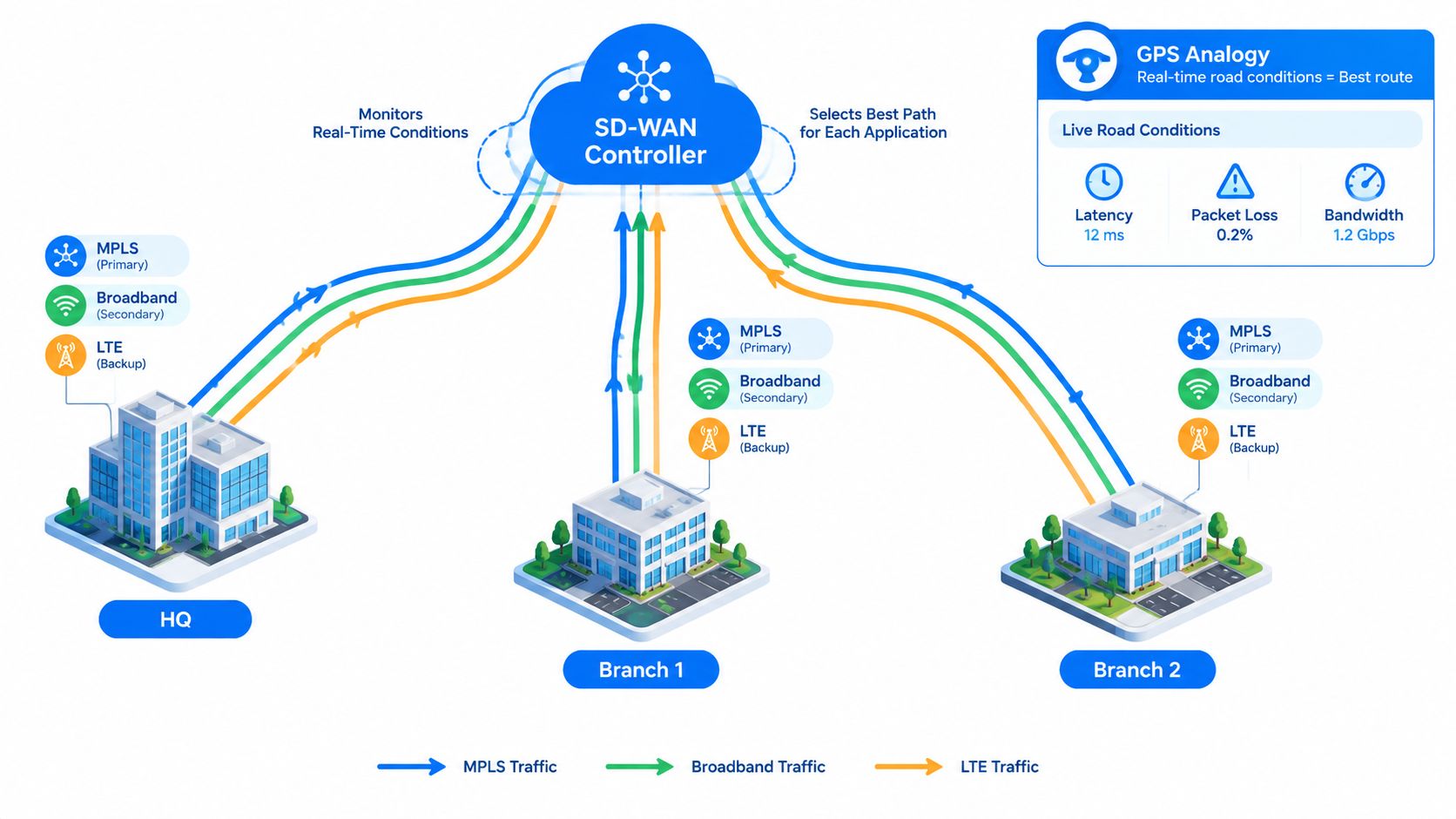
Think of SD-WAN like a smart GPS for network traffic. A normal WAN often sends packets over a prechosen route and hopes the link stays healthy. SD-WAN watches live conditions such as loss, delay, and jitter, then chooses the path that best fits the application at that moment.
Overlay and underlay in plain language
The underlay is the actual transport, such as MPLS, broadband, or LTE. The overlay is the virtual path SD-WAN builds on top of those links, so the network can steer traffic based on policy instead of fixed circuit habits. That distinction matters because the business outcome is not “use the internet,” it's “keep voice, ERP, file sync, and SaaS each on the path that suits them.”
A centralized controller usually sets policy, while the branch edge enforces it. That gives IT a single place to define which apps should prefer the low-latency path, which ones can ride cheaper internet, and which ones should fail over if a circuit degrades. The logic is simple, but the payoff is operational, fewer manual changes at every site and faster reaction when a link goes bad.
Key concept: SD-WAN doesn't replace physics. It makes better choices faster by measuring the links you already have and steering traffic accordingly.
If you want a broader operations lens on connectivity and bandwidth planning, the Centipid Technologies ISP billing guide is a useful adjacent read because it shows how providers think about service tracking and capacity discipline. That kind of operational mindset is close to what buyers need when they start comparing WAN services.
For leaders who already understand MPLS and VPNs, the mental shift is this, SD-WAN is less about tunnel creation and more about continuous traffic decisions. The network becomes policy-driven, application-aware, and more responsive to changing link conditions.
Core Components That Make Up an SD WAN Service
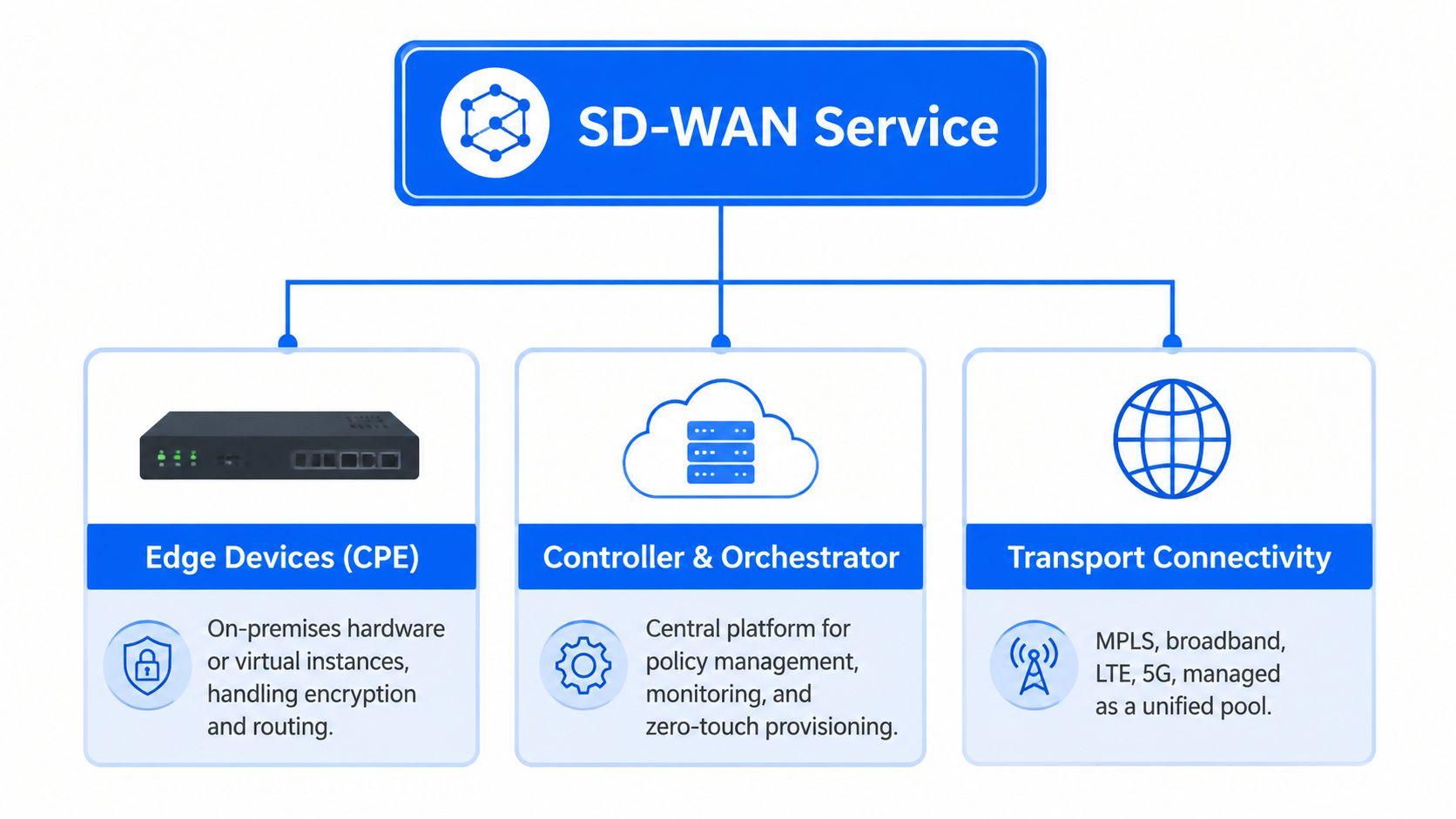
A buyer rarely purchases “SD-WAN” as a single product. The service is really a set of parts that work together, much like a branch office needs routers, policy, and circuits before it can carry traffic well. If you separate those parts clearly, vendor comparisons get easier and transition planning becomes less risky.
The edge handles local traffic
The edge device, delivered as physical CPE or a virtual instance, sits at the branch and enforces local policy. It encrypts traffic, makes routing decisions, and reacts when a path slows down or fails. If the edge is weak or badly managed, users feel it first, because that is the point where application traffic meets the WAN.
The control layer keeps sites aligned
The controller and orchestrator act as the central policy layer. They distribute configuration, collect telemetry, and keep new sites from becoming one-off builds that are hard to support later. That matters during a phased rollout, because teams often need to run hybrid WAN for months while some branches stay on existing MPLS and others move to broadband or LTE. Buyers evaluating migration planning should ask how the control plane handles that overlap and how much day-to-day work stays inside IT versus the provider.
Transport is a pool, not a shrine
The transport side combines MPLS, broadband, LTE, and 5G into a shared set of paths the service can choose from based on policy. That abstraction helps when a company cannot replace every circuit at once, or when one site needs a backup path while another still depends on legacy underlay. For a direct SD-WAN vs MPLS comparison, the question is how the service uses each path, not which label is on the circuit.
Procurement should also check application-aware policy, security integration, and analytics. Application awareness lets the service treat voice differently from bulk backup. Security integration shows whether segmentation, encryption, and threat controls are built into the service or added through separate tools. Analytics reveal whether the platform gives operators visibility before users start reporting problems.
If you are comparing edge options for a branch rollout, the overview at MR2 Solutions SD-WAN edge is a practical reference for how edge choices are usually framed in enterprise environments.
A clean component list helps you spot duplicated functions. If one proposal includes a controller, a monitoring portal, and a separate analytics add-on, ask what is native and what still depends on extra integration.
A vendor-neutral view of these parts is often more useful than a long feature matrix. It shows where the service will be straightforward to run during migration, and where it may become a support burden.
Comparing Managed DIY and Hybrid SD WAN Service Models
The hardest part of adopting SD-WAN is not the routing logic. It's deciding who owns the service after it's installed. That decision affects staffing, accountability, and how much operational risk your team is willing to carry during the migration.
| Service Model | Who Operates | Best Fit | Trade Off |
|---|---|---|---|
| Managed | Provider runs most day-to-day operations | Teams that want predictable operations and fewer internal support tasks | Less direct control, more dependence on the provider |
| DIY | Internal IT designs and runs the environment | Organizations with deep WAN expertise and strong network operations maturity | More control, but higher staffing and monitoring burden |
| Hybrid | Shared responsibilities between internal team and provider | Companies that want to keep policy control while outsourcing routine operations | Requires clear boundaries, or ownership gets blurry |
A managed model works well when network staff are already stretched across cloud, security, and site support. It can reduce operational load, but only if the contract defines what “managed” really covers, including monitoring, incident response, reporting, and policy changes. A service brochure that says “we'll manage it” isn't enough.
A DIY model gives your team the most control, which can be useful in highly customized environments. It also means you own design quality, documentation, escalation paths, and the discipline to keep policies consistent across sites. Many organizations underestimate how much effort that takes once multiple transports and security layers are in play.
A hybrid model is often the most realistic middle ground. Internal teams retain strategic control over policy and architecture, while a provider handles provisioning, routine monitoring, or after-hours support. That approach fits organizations that want to move carefully without giving up the ability to govern the service themselves.
The transition from one model to another is where many projects get stuck. A managed services operations framework is useful here because it forces clarity around handoffs, reporting, and steady-state ownership rather than assuming everyone means the same thing by “managed.” If those boundaries aren't written down, they usually show up later as missed tickets and duplicated work.
Decision rule: choose the model that matches your operating maturity, not the one that sounds most modern in a sales deck.
Deployment Models and Phased Migration in Practice
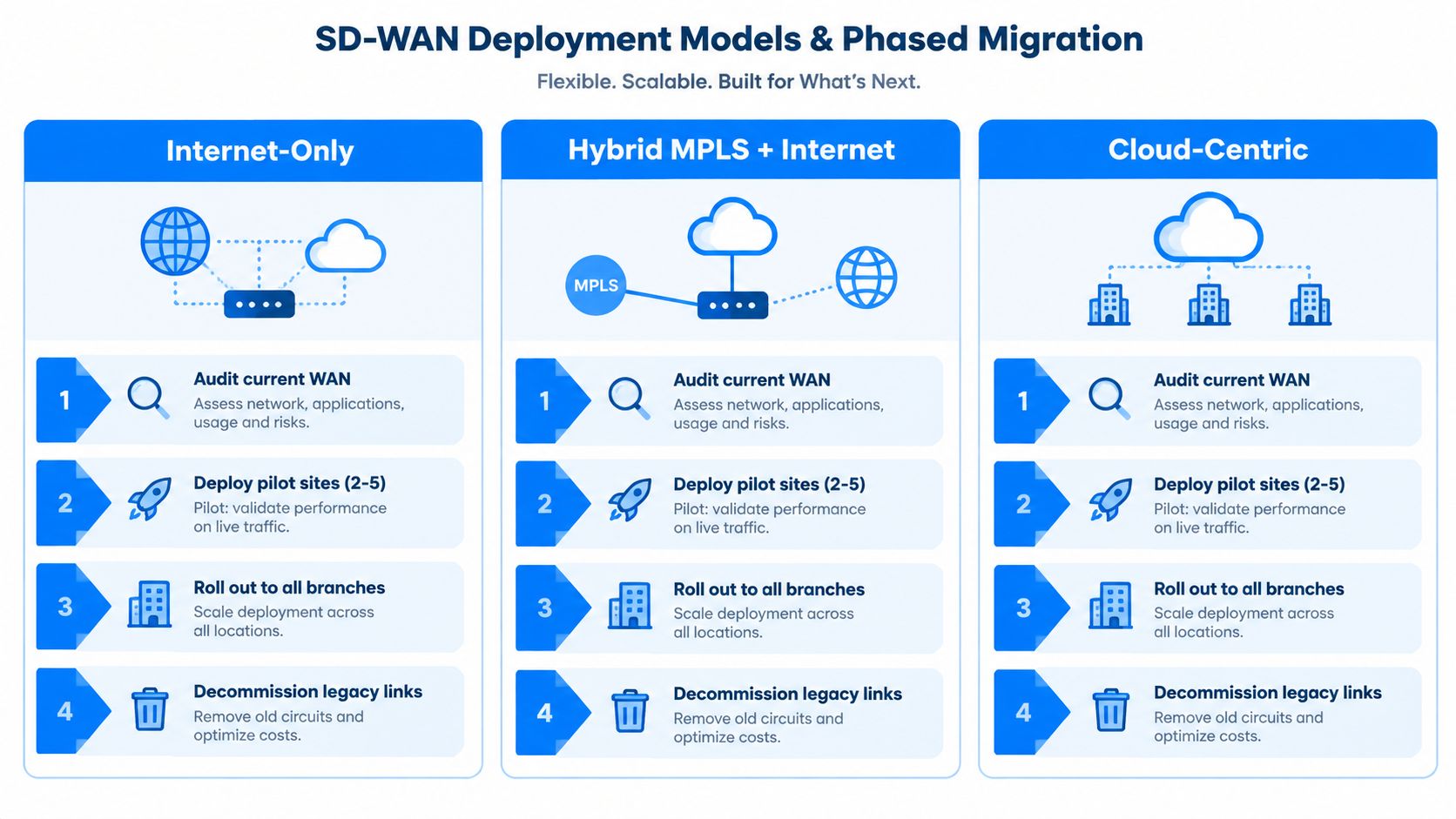
Deployment choices usually fall into three patterns. Some organizations go internet-only for branches that don't need private circuit dependence. Others run hybrid MPLS plus internet during the transition because they want continuity while they test the new path logic. A third group goes cloud-centric, especially when SaaS and cloud workloads dominate traffic patterns.
Roll out in waves, not in one big cutover
The transition architecture problem is really a sequencing problem. Start by auditing the current WAN, which sites are stable, which applications are sensitive, and where legacy links are still carrying critical traffic. Then move a small pilot group first, watch what happens under production load, and only then expand to more branches.
A phased rollout is the safest way to avoid duplicated spend and avoid disrupting users who still depend on older circuits. Legacy WAN and SD-WAN can coexist for months while policies, segmentation, and application steering are tuned. That's not indecision, it's operational prudence.
Keep the hub strategy aligned with applications
Branch migration and hub migration shouldn't follow the same timetable. A branch can sometimes move quickly if it has straightforward apps and a simple failover design. A hub or shared services site often needs a slower pace because it carries a wider mix of traffic, more dependencies, and tighter change control.
A cloud-first design can also make sense when the bulk of traffic goes to SaaS and cloud services instead of centralized applications. In that case, the migration priority is often to reduce unnecessary backhaul and make sure branch exits are local enough to keep user experience stable. The point isn't to chase an architecture trend, it's to match path design to where the applications really live.
The cleanest migrations use a small number of repeatable steps, pilot, validate, expand, and retire the old path only after monitoring proves the new one is stable. Teams that skip the validation stage usually end up doing the same work twice.
Procuring and Governing SD WAN Services Wisely
The best procurement process for SD WAN services starts with discovery, not vendor names. Before you ask for pricing, map current circuits, application sensitivity, branch types, and the operational pain points your team feels. That gives you a grounded baseline for comparing proposals instead of letting each provider define the problem for you.
The next step is a structured RFP that asks for service behavior, not just product checkboxes. Require clarity on orchestration maturity, security integration, visibility, onboarding, incident response, and how the provider handles change during the first year. If you're evaluating multiple service paths, a vendor-neutral brokerage model can shorten comparison time by putting proposals into a common framework rather than forcing your team to translate every quote manually.
What to insist on in contracts
Contracts and SLAs should describe what gets monitored, how exceptions are escalated, and who owns remediation when a site fails over unexpectedly. They should also spell out policy governance, reporting cadence, and how bandwidth allocation decisions are approved. If a provider can't explain how they'll keep service behavior stable after go-live, the contract is incomplete.
- Discovery discipline: document circuits, app tiers, site criticality, and current pain points before the RFP goes out.
- Operational clarity: define who handles configuration, changes, monitoring, and after-hours response.
- Service reporting: ask for consistent visibility into uptime, failover behavior, and path selection.
- Expense control: align network spend with business use, especially during coexistence with legacy links.
A brokerage and advisory model can help here when internal teams need support across evaluation, implementation, and governance. MR2 Solutions fits that description as a vendor-neutral technology brokerage that helps organizations evaluate, procure, implement, and govern IT solutions, including SD-WAN and broader network services. That's relevant when procurement wants one decision framework instead of a pile of disconnected vendor conversations.
Practical rule: if a provider can't describe how they'll handle policy drift six months after rollout, you're buying a project, not a service.
Ongoing governance matters just as much as the initial award. A service can drift if bandwidth policies aren't reviewed, failover isn't tested, or site-level changes happen without central oversight. The buyers who stay happiest are usually the ones who treat SD-WAN as an operating discipline, not a one-time procurement event.
Avoiding Hidden Security and Resilience Gaps
SD-WAN doesn't automatically make the network safer. A weak design can still send traffic over public paths you didn't intend to use, especially if default settings aren't audited or if failover logic is loose. Security and resilience depend on how the service behaves during normal operation, not just during a clean demo.
A 2025 academic review of SD-WAN security points to continuing issues in interoperability, automation, monitoring, QoS, and scalability, and it also highlights denial-of-service exposure and control-plane bottlenecks in larger deployments (academic review). That lines up with a more practical warning, if encryption policies aren't validated and tunnels aren't checked during failures, sensitive traffic can end up on paths the team never meant to trust.
Validation steps that belong in rollout plans
Before broad deployment, audit encryption behavior, especially what happens when a link drops or a tunnel is unavailable. Test failover during partial outages, not only during perfect maintenance windows, because that's when weak designs usually show up. Also check how the platform handles monitoring and scale as more sites are added.
Those checks matter even more during the SD-WAN to SASE transition, where teams are trying to combine connectivity and security in one operating model. Many organizations expect integration to be simple, but the hard part is governance, making sure the service keeps policy, visibility, and resilience aligned while the architecture evolves.
For teams still deciding how SD-WAN fits alongside VPN access, the comparison in SD-WAN vs VPN is a sensible companion because it helps separate remote-access habits from branch-network design. That distinction matters, since branch resilience and user VPN access solve different problems.
Choose the rollout pace that lets you validate the service under real conditions, with real failover behavior, and real security review. Then keep testing after go-live, because the riskiest assumption is that a successful pilot means the whole footprint is safe.
If you're planning an SD-WAN migration, MR2 Solutions can help you assess service models, compare provider options, and govern the rollout with a vendor-neutral process. Visit MR2 Solutions to explore how their brokerage and advisory approach can support your WAN transition, from discovery through steady-state management.