
Sd Wan vs Vpn

Most SD-WAN vs VPN content asks the wrong question. It treats the choice like a clean technology contest, when the issue is whether your team needs simple encrypted connectivity or a managed way to govern dozens of links, sites, and application paths without drowning in exceptions. That's why so many buyers end up overbuying SD-WAN, or underbuilding with VPN, and then blame the tool instead of the operating model.
| Criterion | VPN | SD-WAN |
|---|---|---|
| Primary job | Secure tunnels between endpoints | Steer traffic across multiple links with policy |
| Traffic handling | Usually static once configured | Adjusts paths based on live conditions |
| Cloud access | Often backhauls through a central point | Can break out locally for cloud apps |
| Operations | Simple at small scale | Better for distributed environments |
| Best fit | Fewer sites, basic security needs | Many sites, SaaS-heavy, cloud-heavy networks |
The smarter frame is lifecycle governance. If your main problem is “we need encryption and a dependable tunnel,” VPN still does the job. If your main problem is “we need to keep distributed applications working as the network changes,” SD-WAN starts to matter. The point isn't that one is modern and the other is old. The point is that they solve different operational pain.
Why the SD-WAN vs VPN Question Is Usually Framed Wrong
The default comparison is usually built to produce one answer, not a useful one. SD-WAN gets presented as the inevitable upgrade because it sounds more advanced, more centralized, and more future-proof. VPN gets reduced to a basic tunnel, which makes it look obsolete even though it still solves a real, common problem well.
The real decision is about operating burden
VPNs are older and far more widely used for secure remote access, and that matters because maturity is not the same thing as irrelevance. One 2026 summary estimated about 1.6 billion VPN users globally, roughly 30% of the world's internet users, while another estimate put usage at over 1.75 billion, about one-third of all internet users worldwide as of May 2025. VPN is still a mainstream answer because many teams just need encrypted connectivity, not a new control plane. VPN usage and market data summary
SD-WAN is different. It became a distinct enterprise WAN category in 2014, and by 2025 to 2026 it had grown into a large market with strong adoption and investment, including a 2025 estimate of USD 7.92 billion and a forecast to USD 28.32 billion by 2031. That growth says a lot about demand for application-aware steering and centralized policy control, not about universal replacement of VPN. SD-WAN market study
Practical rule: If the network pain is mostly “secure the tunnel,” don't force an SD-WAN project. If the pain is “keep apps usable across many links and sites,” VPN alone is usually too blunt.
Cost and complexity can be the wrong tradeoff
A lot of organizations buy SD-WAN because they're told it will fix “network problems.” That's too vague. If the actual issue is bandwidth sizing, cloud access patterns, or poor policy hygiene, SD-WAN can add an expensive orchestration layer on top of the same underlying weaknesses.
The better question is blunt. How many sites do you run, how cloud-dependent are your users, and do you have the internal discipline to operate a policy-driven WAN? If the answer to those questions is “not much,” the right move may be to keep VPN simple and solve the actual bottleneck elsewhere.
What SD-WAN and VPN Actually Do on the Wire
A VPN creates an encrypted tunnel between two endpoints. That tunnel can connect a user to a network or one site to another site, and it usually terminates at a concentrator or security gateway. In many classic designs, traffic then gets carried back to a central location before it reaches applications, which keeps the model simple but can add detours.
SD-WAN still uses tunnels, but it treats them as part of a broader overlay architecture. Instead of relying only on a fixed tunnel path, it measures link conditions and makes forwarding decisions based on live telemetry. That lets the edge choose among broadband, LTE, MPLS, or other underlays without asking the administrator to hand-tune every path.
The architectural difference is control, not just encryption
Think of VPN as a secure pipe. Think of SD-WAN as a distributed traffic manager that can still encrypt traffic, but also decides where that traffic should go. The difference is not cosmetic. One is centered on confidentiality between endpoints. The other is centered on keeping applications moving well across multiple links.
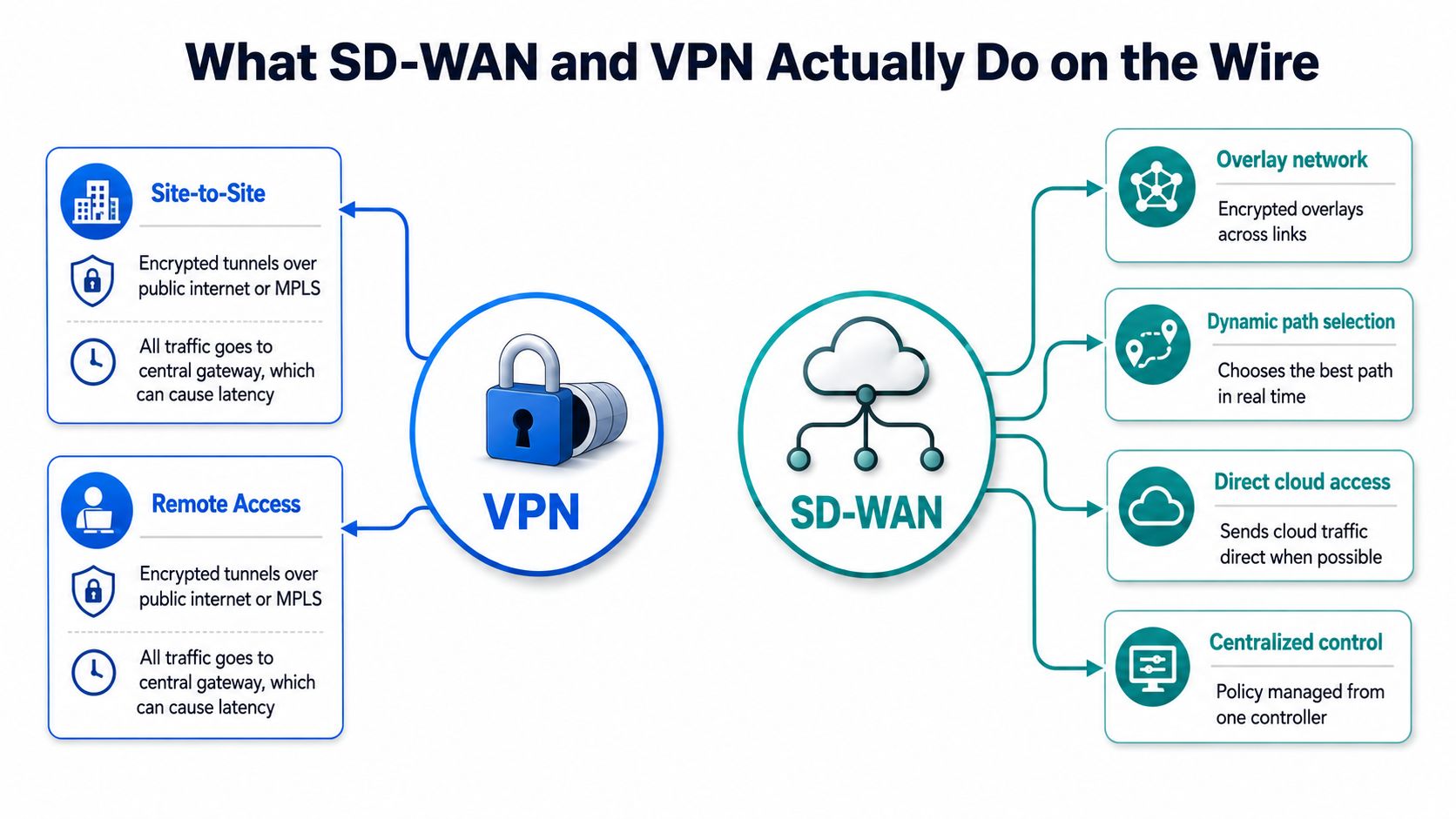
For a non-networker, the shortest explanation is this. VPN protects a path. SD-WAN manages a path. That's why the same company can use both without contradiction.
Cloud access is where the split becomes obvious
For branch-to-cloud workloads, SD-WAN's direct internet breakout and policy-based quality controls avoid the backhaul penalty common in hub-and-spoke VPN designs. Research on SD-WAN monitoring also treats latency, jitter, packet-loss ratio, and recovery time as core benchmarking metrics, which is the right lens to use when judging whether a WAN design helps users. SD-WAN monitoring and benchmarking discussion
VPNs do not natively optimize routing or performance. They encrypt transport. SD-WAN watches the links and shifts traffic accordingly. If you need a concise internal explainer, the overview on SD-WAN edge design captures the architectural shift well, especially for teams comparing branch, cloud, and overlay designs.
Comparing SD-WAN and VPN Across the Criteria That Matter
The cleanest comparison is not “which is newer,” it's how each behaves under pressure. Performance, security, manageability, scalability, and cost all look different once you stop talking about marketing copy and start talking about real branch traffic.
Side by side at the level that matters
| Criterion | VPN | SD-WAN |
|---|---|---|
| Performance | Secure, but often static and backhauled | Uses live path telemetry and application-aware steering |
| Security | Strong encrypted tunnels | Encrypted transport plus policy-driven segmentation in broader stack designs |
| Manageability | Tunnels and rules grow manually | Centralized orchestration and template-based control |
| Scalability | Each new site adds configuration work | New sites are easier to standardize and roll out |
| Cost | Often simplest at small scale | Can reduce dependence on rigid legacy WAN designs, but adds platform overhead |
The performance gap matters most for voice, collaboration, and SaaS. SD-WAN can keep latency-sensitive traffic on the lowest-latency path and push bulk traffic elsewhere, while VPN usually keeps the tunnel logic relatively fixed unless you bolt on additional traffic engineering. That doesn't make VPN bad. It makes VPN less adaptive.
Security is often oversold in SD-WAN conversations. VPN's job is straightforward, encrypted transport between endpoints. SD-WAN often sits in a broader security and connectivity stack, so buyers need to separate transport security from firewall policy, segmentation, and remote access control. Those are related, but they are not the same thing.
Useful test: If a vendor keeps talking about encryption but won't show you how application steering, failover, and policy orchestration work together, you're not comparing architectures. You're comparing buzzwords.
For buyers who want a structured way to compare suppliers, find supplier comparison tools can help force discipline into the evaluation. That matters because the issue is rarely “does it encrypt.” It's “can the team operate this model cleanly for years.”
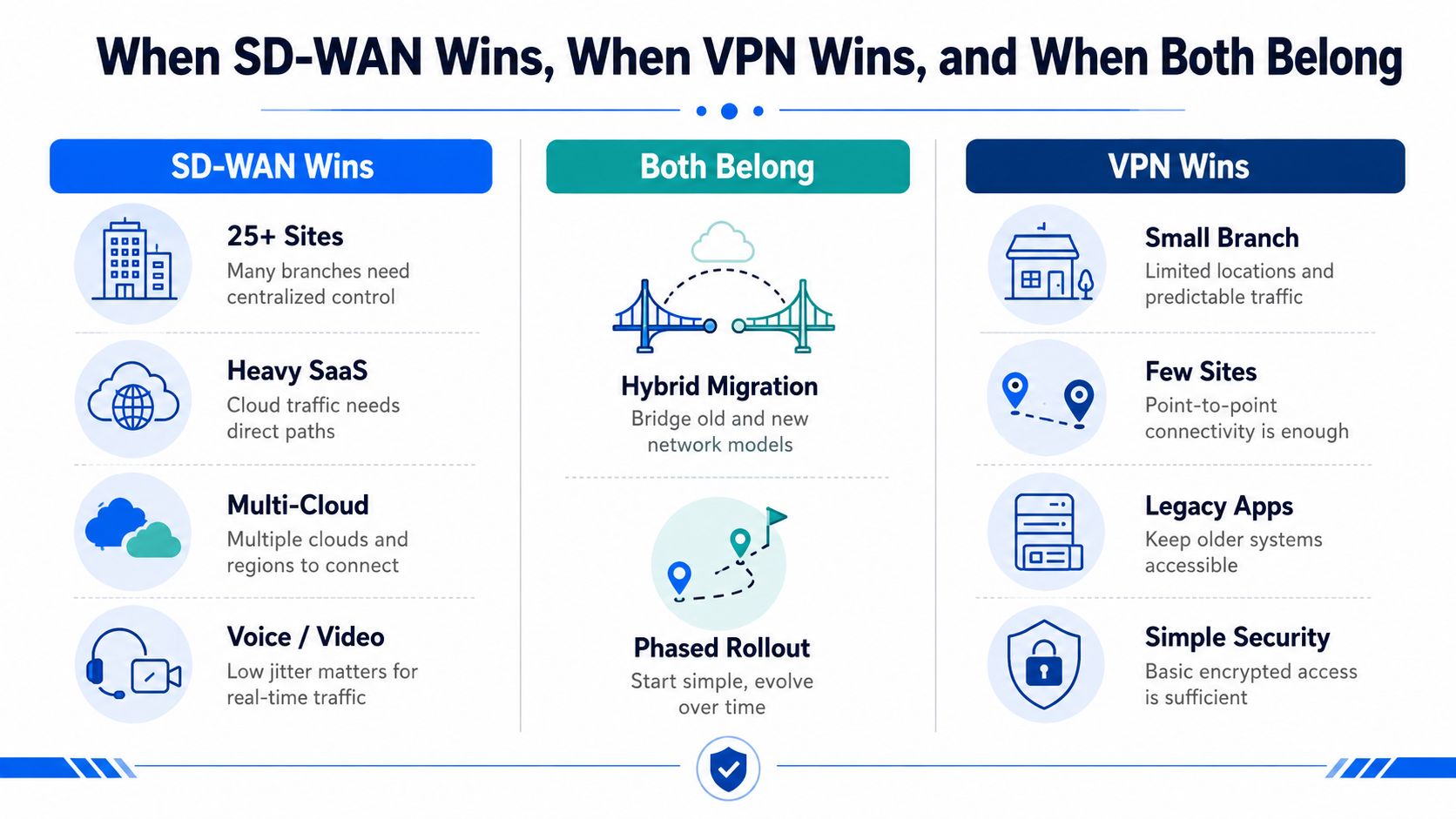
When SD-WAN Wins, When VPN Wins, and When Both Belong
SD-WAN wins when network complexity is real, not hypothetical. That usually means many sites, heavy SaaS use, cloud workloads, and a team that needs centralized policy instead of per-site tinkering. It also tends to win when user experience matters enough that you can't afford to let one bad link ruin voice or collaboration sessions.
Use SD-WAN when the network has outgrown static tunnels
Retail chains, multi-branch service firms, and cloud-first enterprises feel the pain fastest. Their traffic patterns shift, their apps live in multiple places, and their users notice when one branch goes sideways. In those environments, SD-WAN's value is less about “modernization” and more about control.
VPN still wins in simpler environments. If you have fewer than ten sites, mostly branch-to-datacenter traffic, and a team that wants encrypted connectivity without a new orchestration layer, VPN is the lower-risk answer. It is also the safer choice when you need short-term contractor or partner access and you don't want to introduce a broader WAN management model just to solve a narrow access problem.
If your branch environment is still small and stable, the branch networking resources on MR2 Solutions' site are a better reference point than a generic SD-WAN pitch deck.
The honest answer is often hybrid
Most real networks end up there. VPN can terminate inside an SD-WAN overlay for legacy sites, cloud provider tunnels can coexist with branch overlays, and remote users can stay on VPN while site traffic rides SD-WAN. That isn't indecision. It's phased architecture.
A hybrid design is often a maturity marker, not a compromise. Organizations rarely get to a clean end state in one move, and the teams that pretend otherwise usually create avoidable outages. If you need a practical uptime lens for that kind of mixed environment, the MSP checklist for network uptime is a useful sanity check for redundancy planning and operational readiness.
Migrating From VPN to SD-WAN Without Breaking Production
A bad migration happens when teams swap the transport before they understand the traffic. The right sequence starts with discovery, not hardware. Inventory the existing VPN tunnels, map which sites carry which applications, and decide what “better” means before a single branch is touched.
Four phases keep production safe
- Discovery. Document tunnel inventory, site risk, and application sensitivity. Define success in operational terms, such as lower latency for critical apps, less jitter on real-time traffic, and faster site provisioning.
- Pilot. Pick one or two low-risk sites and run dual tunnels so VPN stays available during soak testing. Keep the pilot boring.
- Rollout. Expand in waves using templates and centralized policy. Do not rebuild every site by hand.
- Optimize. Watch the live behavior, adjust policies, and retire VPN only when monitoring shows the new design is stable.
The monitoring piece matters because SD-WAN is not a “set it and forget it” product. Industry discussion increasingly focuses on analytics, telemetry, and application experience monitoring, which tells you where the hidden work really sits. That work includes tunnel stability, path MTU problems, cloud latency variability, and policy drift when legacy dependencies stay in the mix. SD-WAN analytics and operational issues
Non-negotiable: If rollback isn't ready, the migration isn't ready.
The usual failure points are predictable
Teams get burned when they undersize internet circuits, forget QoS for voice, skip firewall rule audits, or assume SD-WAN replaces security tooling. It doesn't. It changes how traffic is steered and governed, but it doesn't magically remove the need for disciplined policy management. The cleanest migrations keep the fallback alive until the new path has proven itself under real load.
MR2 Solutions' TBaaS consulting fits naturally here as a vendor-neutral planning and governance option for organizations that need help comparing architectures, designing a pilot, and managing implementation without getting locked into a single stack.
Choosing the Right Path for Your Organization
The decision comes down to three inputs, site count, cloud dependence, and operational maturity. If those three are low, stay on VPN. If all three are high, SD-WAN usually makes sense. If they're mixed, the answer is hybrid.
A simple decision rule beats a long vendor debate
A five-site business with light SaaS usage and a hands-on network admin usually doesn't need SD-WAN today. A forty-site retailer moving workloads into Azure does. The gap between those two environments is not subtle, and pretending they need the same architecture is how projects miss the mark.
Use this short self-check before you buy anything:
- Circuit diversity. Do your sites depend on a single connection, or can you run multiple underlays without chaos?
- Application mix. Are users mostly in one datacenter app, or spread across SaaS, cloud, voice, and collaboration?
- Internal skill set. Can your team manage templates, policies, and telemetry, or do they need simpler point-to-point control?
- Compliance constraints. Do you need tight tunnel control and straightforward auditability, or can you support a more distributed policy model?
If your organization does not have documented change control and monitoring hygiene, SD-WAN can turn into complexity without value. That's the part most buyers miss. Readiness matters more than feature count.
Making a Confident Decision With the Right Advisory Partner
SD-WAN vs VPN is not a binary upgrade path. It's a governance decision about how much complexity your team can operate while still meeting security and performance goals. A vendor-neutral advisor should translate site count, cloud use, compliance needs, and staff maturity into an architecture you can defend, not a product you're told to buy.
What good advisory work looks like
It starts with discovery, then proof-of-concept design, then cost modeling, then post-deployment governance. That sequence keeps you from buying a transport model that looks elegant in a slide deck but fails in production. The right advisor also pressures vendor claims against your actual application mix instead of accepting a generic feature comparison.
For organizations that want structured network evaluation and implementation support, MR2 Solutions' vendor-neutral technology brokerage model is relevant because it aligns selection, delivery, and governance instead of treating procurement as the finish line.
Make your next step practical. Run a network and application discovery, pilot the strongest vendor claims in a live environment, and align the final design to a three-year operating plan instead of a single quote. That's how you avoid tunnel vision, whether you stay with VPN, move to SD-WAN, or run both for a long transition.
If you want a vendor-neutral view of your WAN options, MR2 Solutions can help you map current VPN pain points, test SD-WAN in a controlled pilot, and build a rollout plan that fits your team's operating maturity. Visit MR2 Solutions to start a discovery conversation and pressure-test the architecture before you commit.