
Cloud Services Brokerage Market: A Practical Buyer Guide

A mid-sized European bank can run a stable cloud estate and still struggle to manage it. Its applications may sit across AWS, Azure, and a sovereign cloud partner, while invoices arrive in different formats, tagging rules vary by provider, and compliance teams spend too much time proving where data resides. Add AI workloads with unpredictable consumption, and the question changes from “Which cloud should we buy?” to “Who can govern the whole environment without adding another layer of friction?”
That tension explains why the cloud services brokerage market now deserves a buyer-focused analysis rather than another market-size recap. Forecasts place the category in the low-teens billions of dollars in the mid-2020s, with strong double-digit growth projected into the early 2030s, but the numbers matter less than the operating problem behind them. The test is whether a broker can coordinate providers, contracts, cost controls, security policies, and compliance more effectively than native cloud tools and an internal platform team.
Why the Cloud Brokerage Conversation Matters in 2026
Cloud adoption has created a management problem that direct provider relationships don't always solve. A bank may have valid reasons to use several clouds, including resilience, data residency, application fit, and access to specialized services. Yet each additional provider can introduce another billing model, identity boundary, support process, policy language, and evidence trail for auditors.
AI makes that fragmentation harder to ignore. Model training, inference, data pipelines, and storage can move through different services and providers, creating cost and governance questions that aren't answered by a single dashboard. FinOps teams need reliable allocation, security teams need consistent controls, and regulators need evidence that the organization knows where sensitive information is processed.
The category itself emerged as enterprises adopted multi-cloud and needed help selecting, integrating, governing, and managing services across public, private, and hybrid environments. Recent market research describes cloud brokerage as a recognized market with aggregation, intermediation, and arbitrage functions, rather than as a narrow resale activity. Mordor Intelligence's cloud services brokerage market analysis places the category at USD 9.98 billion in 2025 and USD 11.56 billion in 2026, with a projection of USD 24.11 billion by 2031 and a 15.84% CAGR from 2026 to 2031.
Practical rule: A multi-cloud footprint alone doesn't justify brokerage. The business case appears when provider diversity creates coordination work that native control planes can't remove.
The useful decision therefore has several parts. Buyers need to define what a broker does, interpret conflicting forecasts by scope, map operational pain to verifiable outcomes, compare delivery models, and calculate when intermediation costs more than it saves. The final question is not whether the market is growing. It's whether your environment has crossed the threshold where independent coordination becomes infrastructure.
What a Cloud Services Broker Actually Does
A cloud services broker sits between a buyer and one or more cloud providers. The closest procurement analogy is a wholesale buyer that aggregates demand, negotiates commercial terms, standardizes contracts, and gives business units a more consistent way to consume services. That analogy is useful, but incomplete, because brokerage can include technical integration and governance as well as purchasing.
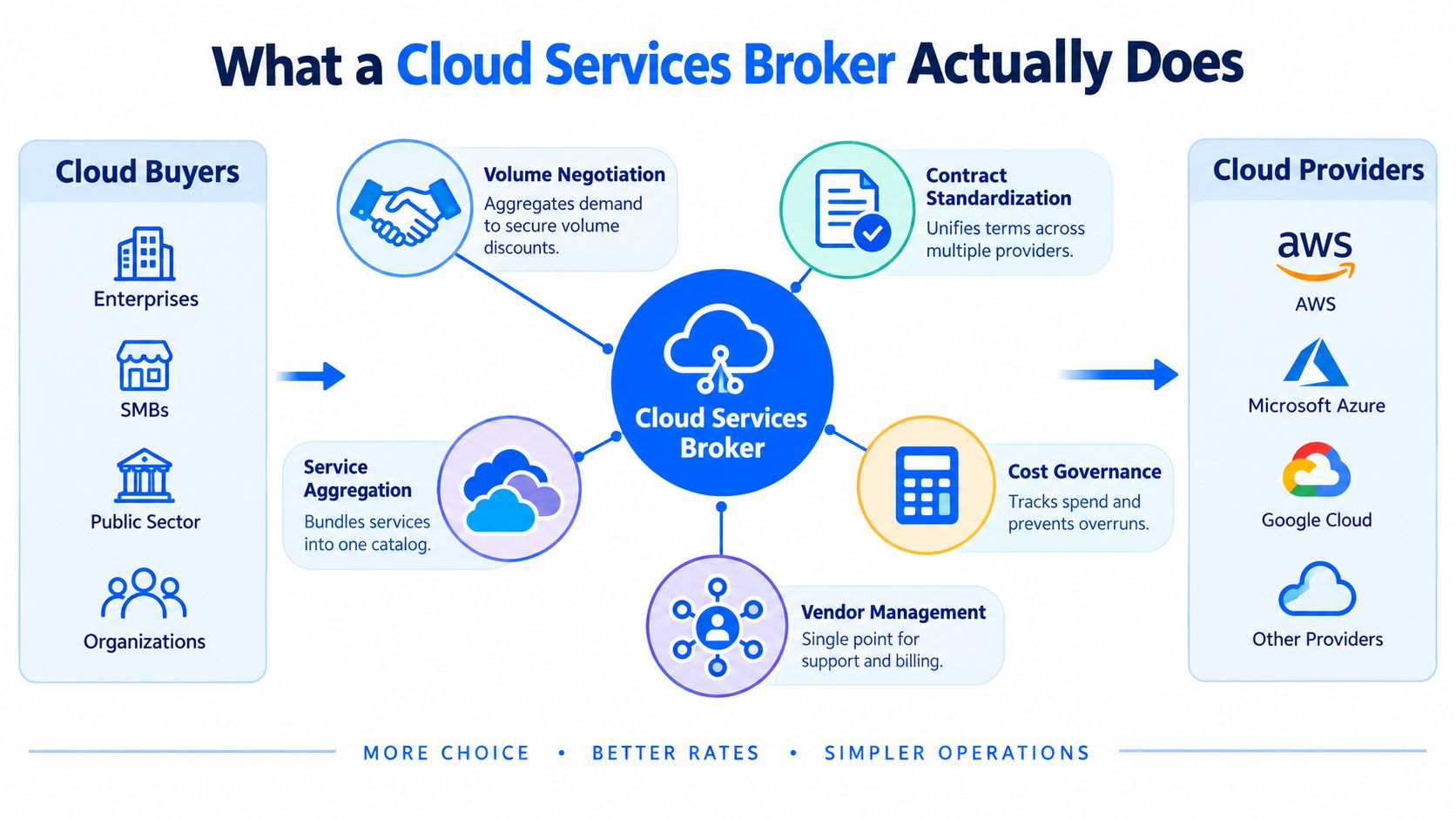
Three functions buyers should separate
Aggregation is the most visible function. A broker provides access to multiple provider catalogs, may consolidate billing, and can act as a commercial channel. This model is valuable when procurement teams want fewer invoices or when business units need a controlled catalog instead of unstructured purchasing.
Intermediation adds services around the cloud relationship. Those services can include architecture advice, migration coordination, managed operations, support escalation, and lifecycle management. The broker isn't merely passing through a provider service. It is adding a human or technical operating layer.
Governance arbitrage is the least obvious and often the most strategically important function. An independent layer can compare cost, security, resilience, and compliance across providers instead of optimizing for one provider's platform. It may also normalize reporting and policy decisions across environments that use different native tools.
These functions shouldn't be treated as interchangeable. A buyer that only needs consolidated invoicing doesn't need the same platform or contract as a regulated enterprise seeking cross-cloud policy enforcement. The cloud services brokerage market can look larger when marketplace resale, managed cloud services, and advisory work are grouped together, but that aggregation can obscure the value a particular buyer is purchasing.
Organizations with multi-tenant applications should also distinguish brokerage from application architecture. A broker can help govern the infrastructure and provider relationships, while a guide to multi-tenant architecture addresses how one application serves multiple customers or organizational tenants. Those concerns can intersect, particularly around isolation and cost allocation, but they solve different problems.
Market Size, Growth, and Why Forecasts Disagree
Market forecasts don't disagree only because analysts use different assumptions about growth. They often measure different markets under the same label. One estimate from MarketsandMarkets' cloud brokerage market research values the category at USD 13.6 billion in 2024 and projects USD 46.8 billion by 2033, implying a 14.02% CAGR from 2025 to 2033. The same source also presents a separate forecast of USD 15.36 billion in 2026 reaching USD 36.52 billion by 2031, at an 18.9% CAGR.
Mordor Intelligence uses another boundary. Its estimate starts at USD 9.98 billion in 2025, reaches USD 11.56 billion in 2026, and projects USD 24.11 billion by 2031, with a 15.84% CAGR over 2026 to 2031. These figures aren't directly comparable with the MarketsandMarkets estimates because the base years, forecast horizons, and category definitions differ.
| Analyst firm | Base year value | Forecast horizon | Forecast value | CAGR | Scope definition |
|---|---|---|---|---|---|
| MarketsandMarkets | USD 13.6 billion in 2024 | 2025 to 2033 | USD 46.8 billion by 2033 | 14.02% | Broad cloud brokerage category |
| MarketsandMarkets | USD 15.36 billion in 2026 | 2026 to 2031 | USD 36.52 billion by 2031 | 18.9% | Brokerage services with multiple functional segments |
| Mordor Intelligence | USD 9.98 billion in 2025 | 2026 to 2031 | USD 24.11 billion by 2031 | 15.84% | Aggregation, intermediation, and arbitrage |
| Research and Markets | USD 12.53 billion in 2026 | Through 2034 | USD 56.62 billion by 2034 | Not provided in the verified data | Broad global market coverage |
The most useful interpretation is methodological. A forecast that includes SaaS marketplaces, managed multi-cloud operations, and provider-direct resale will produce a broader total than one focused on independent intermediation and governance. Resale can also blur the difference between broker revenue and hyperscaler revenue, especially when a provider's channel program supplies the commercial transaction.
The forecasts still point in the same direction. Demand is associated with hybrid and multi-cloud complexity, cost governance, and centralized lifecycle management, not with buyers wanting another place to purchase cloud services. Asia Pacific is identified as the fastest-growing region in the Mordor Intelligence research, which reinforces that the category's demand isn't confined to North American or European enterprises.
Buyer Needs and the Real Value Proposition
A broker earns its place by removing work that the buyer can't efficiently coordinate alone. Four signals matter most: cloud spend that business owners can't explain, security controls that differ by provider, provisioning that depends on manual approval chains, and compliance evidence assembled from disconnected systems.
The value case should be written as an operating hypothesis, not a vendor promise. A CIO can test whether tagging coverage improves, whether teams identify shadow consumption, whether provisioning becomes more repeatable, and whether audit preparation requires fewer manual reconciliations. A broker that can't improve a visible operating measure may only be adding another contract and dashboard.
| Buyer need | Cost outcome | Risk outcome | Speed outcome | Governance outcome |
|---|---|---|---|---|
| Unexplained multi-cloud spend | Common allocation and chargeback view | Fewer unowned services | Faster financial review | Consistent budget policies |
| Fragmented security posture | Less duplicated tooling where appropriate | Consolidated compliance reporting | Faster evidence retrieval | Cross-provider policy visibility |
| Slow provisioning | Catalog-based purchasing and deployment | Fewer informal exceptions | More repeatable self-service | Approved services by default |
| Regulated operating model | Better contract and consumption oversight | Clearer residency and control evidence | Shorter audit preparation work | Centralized policy ownership |
That matrix compounds in large enterprises because the same control can serve many accounts, teams, and regions. In a mid-market organization, the economics may look different. A lighter governance service, selective advisory, or technology expense management program may address the largest pain without introducing a full brokerage platform. Buyers evaluating that route can review technology expense management services as one reference point for controlling and optimizing technology spend.
What to measure before signing
Start with internal baselines. Record the time required to provision a standard environment, reconcile provider invoices, prepare evidence for an audit, and identify unallocated consumption. Then define which measures the broker will influence and which remain the responsibility of the internal platform team.
The strongest business case usually combines more than one outcome. A billing-only service may be difficult to justify if native provider tools already produce acceptable reports. A governance layer becomes more defensible when it also reduces exception handling, supports independent policy decisions, and gives procurement one operating view across providers.
The Vendor Landscape from Hyperscalers to Specialists
The vendor environment divides into three broad delivery models, and each model solves a different part of the brokerage problem.
Hyperscaler-direct programs connect buyers to provider marketplaces and certified partners. AWS Marketplace Channel, Microsoft Partner Network, and Google Cloud Partner Advantage can simplify procurement and attach services to committed cloud consumption. Their strength is proximity to the platform, which can accelerate purchasing and support. Their weakness is structural: a program owned by one cloud provider has limited incentive to remain neutral when the buyer's best answer may involve another provider.
Traditional value-added resellers and global systems integrators, including Accenture, Deloitte, Wipro, and Rackspace, add brokerage capabilities to broader consulting or managed-services engagements. They can coordinate migration, operations, security, and commercial relationships in one program. That breadth helps complex enterprises, but large engagements can move slowly, require extensive governance, and make it harder for a platform team to change direction quickly.
Independent specialists and platform-native brokers focus more narrowly on aggregation, FinOps, or governance automation. Examples named in market discussions include CloudHealth and VMware Aria, Spot.io, Apptio, Morphlabs, and newer FinOps platforms. Their advantage is specialization. Their risk is lock-in to the broker's data model, workflows, or integration layer.
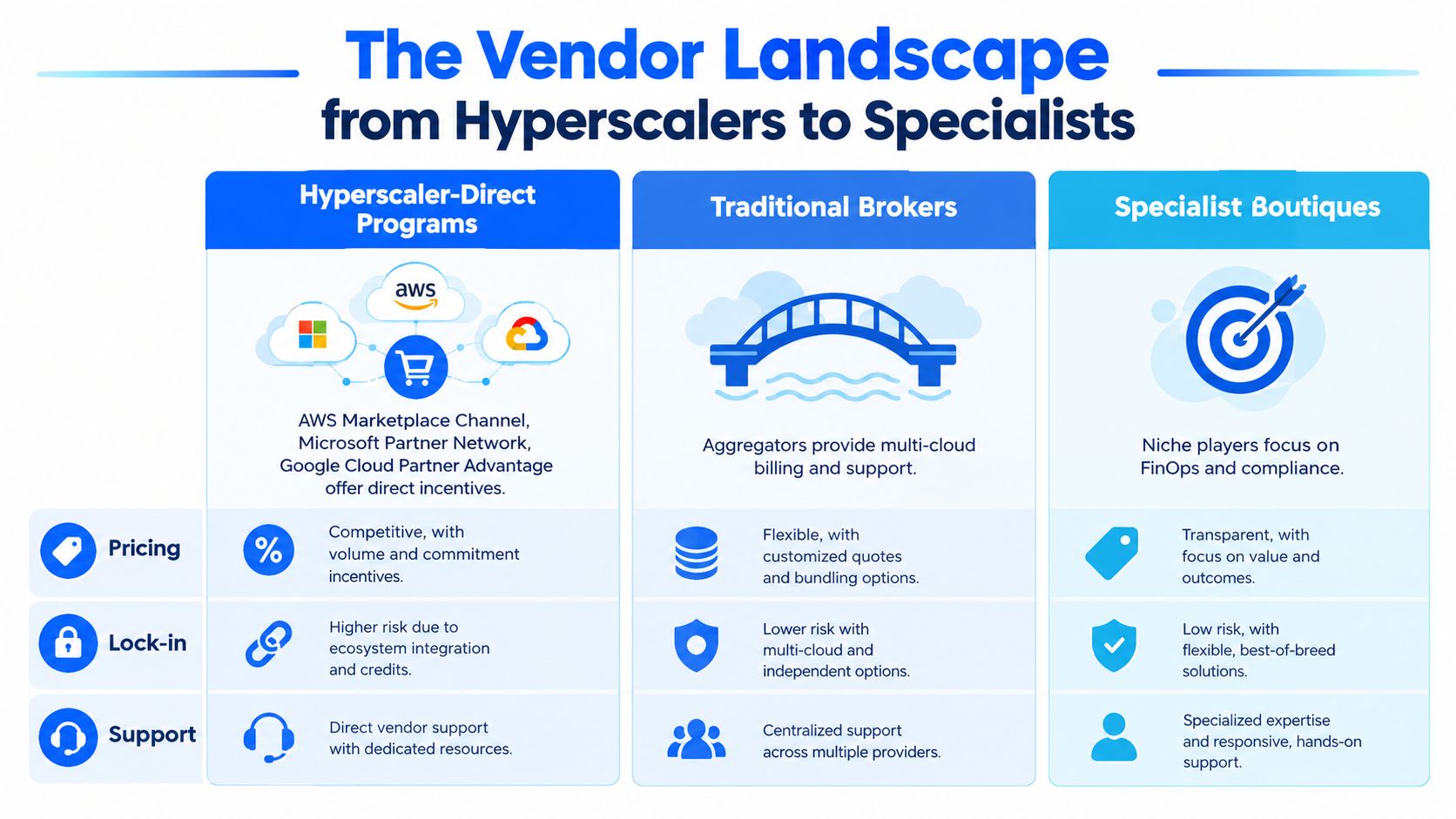
Match the model to the constraint
| Delivery model | Best fit | Main limitation |
|---|---|---|
| Hyperscaler-direct | Concentrated provider footprint and marketplace-led procurement | Provider bias |
| Traditional VAR or integrator | Complex transformation with operational outsourcing | Potentially slower decision cycles |
| Independent specialist | Cross-provider FinOps and governance automation | Switching costs and integration dependency |
The buyer shouldn't select a model because it has the largest catalog. The selection should follow the source of complexity. If the main problem is procurement speed inside one cloud, a hyperscaler channel may be sufficient. If the enterprise needs coordinated migration and managed operations, an integrator may be more practical. If the central problem is neutral policy and cost visibility across providers, an independent specialist deserves closer scrutiny.
A short visual explanation can help stakeholders distinguish these models before procurement discussions begin.
When Brokerage Stops Paying for Itself
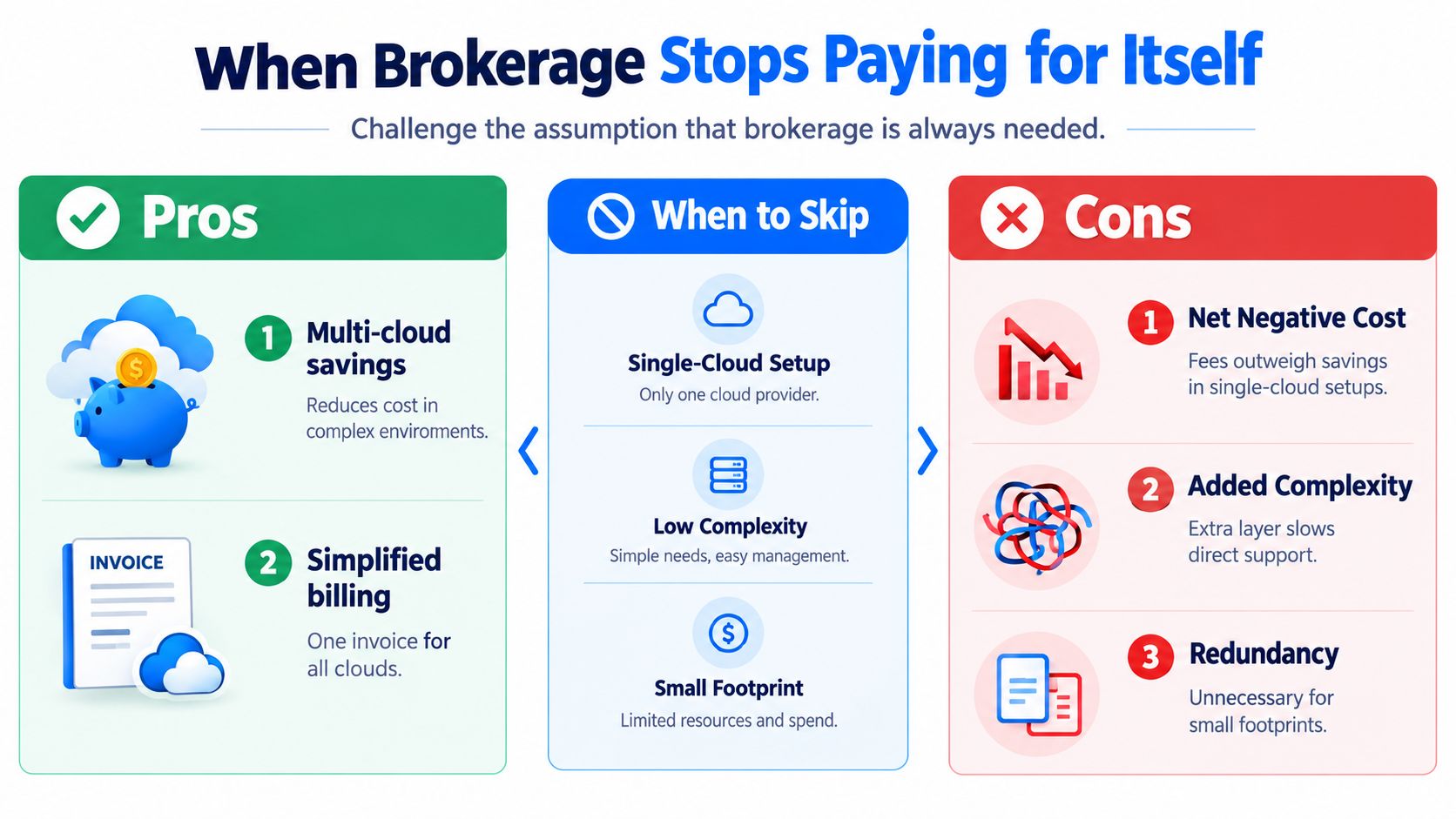
Brokerage isn't a mandatory component of every multi-cloud strategy. A small, standardized workload running primarily on one provider may be easier to manage through native billing, identity, policy, and cost tools. Adding an intermediary in that situation can create another support path without solving a material coordination problem.
The same caution applies when the internal team already has mature FinOps practices and clear governance ownership. If engineers can allocate spend, enforce tagging, manage commitments, and produce audit evidence through native control planes, a broker must demonstrate incremental value rather than repeat existing functions.
Three conditions usually weaken the case:
- Concentrated consumption: One provider and a narrow service catalog reduce the value of cross-provider normalization.
- Simple oversight: Basic security, data location, and approval requirements may fit native policy tools.
- Strong internal capability: An experienced platform and FinOps team may already provide the intermediation function internally.
There are also costs that don't appear in a headline forecast. A brokerage fee, integration effort, training requirement, and dependence on an external operating model all reduce the value of any savings. Abstracted tooling can also slow a platform team when engineers need direct access to provider-native features or support channels.
The correct comparison isn't broker versus no broker. It's brokered operations versus the internal labor, risk, and delay required to coordinate the same environment directly.
Buyers should avoid unsupported universal thresholds. The verified market material doesn't establish a general spend level, brokerage margin, or deployment duration that applies across organizations. Instead, calculate the break-even point from your own baseline: annual coordination cost, unallocated spend, audit effort, exception volume, and the commercial value of consolidated contracts.
A practical cost perspective is available through managed IT services cost considerations, but the decision still depends on scope. Brokerage pays when the independent layer removes more operational and commercial waste than it introduces. If the platform only adds a portal over a simple environment, native tools are likely the better answer.
How Brokerage Shows Up in Real Operations
Consider a regulated European bank with workloads distributed across AWS, Azure, and a sovereign cloud provider. The bank's problem isn't access to cloud capacity. It is the inability to apply one operating model to different providers, contracts, billing structures, and residency controls.
A broker could centralize negotiations, translate provider terms into a common commercial view, and coordinate FinOps reporting. It could also help the bank maintain evidence for data residency and privacy obligations, provided the controls are implemented and tested rather than merely documented. The measurable value would appear in reduced spend variance, clearer ownership, fewer manual reconciliations, and shorter audit preparation work.
Now compare that with a mid-market SaaS company whose engineering team is lean and whose provider footprint is concentrated. The company may gain from procurement advice or a targeted FinOps assessment, but a full brokerage layer could create dependency on external specialists. Engineers might need to route ordinary platform decisions through another operating process, while the broker's abstraction makes direct provider relationships less visible.
| Dimension | Regulated enterprise | Mid-market SaaS |
|---|---|---|
| Provider footprint | Several clouds, potentially including a sovereign environment | Often concentrated or less varied |
| Primary pain | Compliance, contracts, allocation, and cross-cloud control | Capacity, speed, and specialist skills |
| Strongest brokerage role | Independent governance and coordinated vendor management | Selective advisory or limited automation |
| Main risk | Incomplete policy enforcement across providers | Added process and external dependency |
| Success evidence | Audit readiness, allocation quality, and exception reduction | Faster decisions without platform friction |
The contrast is more useful than a generic success story because it exposes the boundary condition. Brokerage works best when the organization must coordinate unlike environments and cannot justify building every control internally. It underperforms when the operating model is already simple and the intermediary becomes a gatekeeper.
Operational support also matters after the initial design. Teams should clarify who maintains integrations, policies, catalogs, and automation, and they may find resources on automation maintenance and support useful when evaluating that responsibility. A broader multi-cloud strategy should likewise define ownership, exit options, and policy boundaries before a broker is selected.
The 2030 Outlook and a Practical Buyer Checklist
The cloud services brokerage market is likely to develop along three connected paths through the 2026 to 2030 period. First, AI workload management can move brokerage beyond cost dashboards toward inference-cost governance, model deployment coordination, and policy controls around data and model services. The verified research identifies AI, FinOps, and compliance pressure as important underserved questions, but it doesn't establish a universal performance or savings outcome.
Second, native hyperscaler tooling will continue to absorb routine FinOps capabilities. Rightsizing, budget alerts, commitment management, and policy enforcement are increasingly expected from cloud platforms themselves. That raises the bar for brokers. A broker must provide independent coordination, cross-provider normalization, or regulatory value that each provider can't deliver alone.
Third, data sovereignty, AI transparency, and cross-border processing requirements can sustain demand for neutral intermediaries in regulated sectors. The result won't be universal adoption. Smaller organizations with standardized workloads may rely on native tools, while complex enterprises use brokerage selectively around the areas where provider boundaries create the most risk.
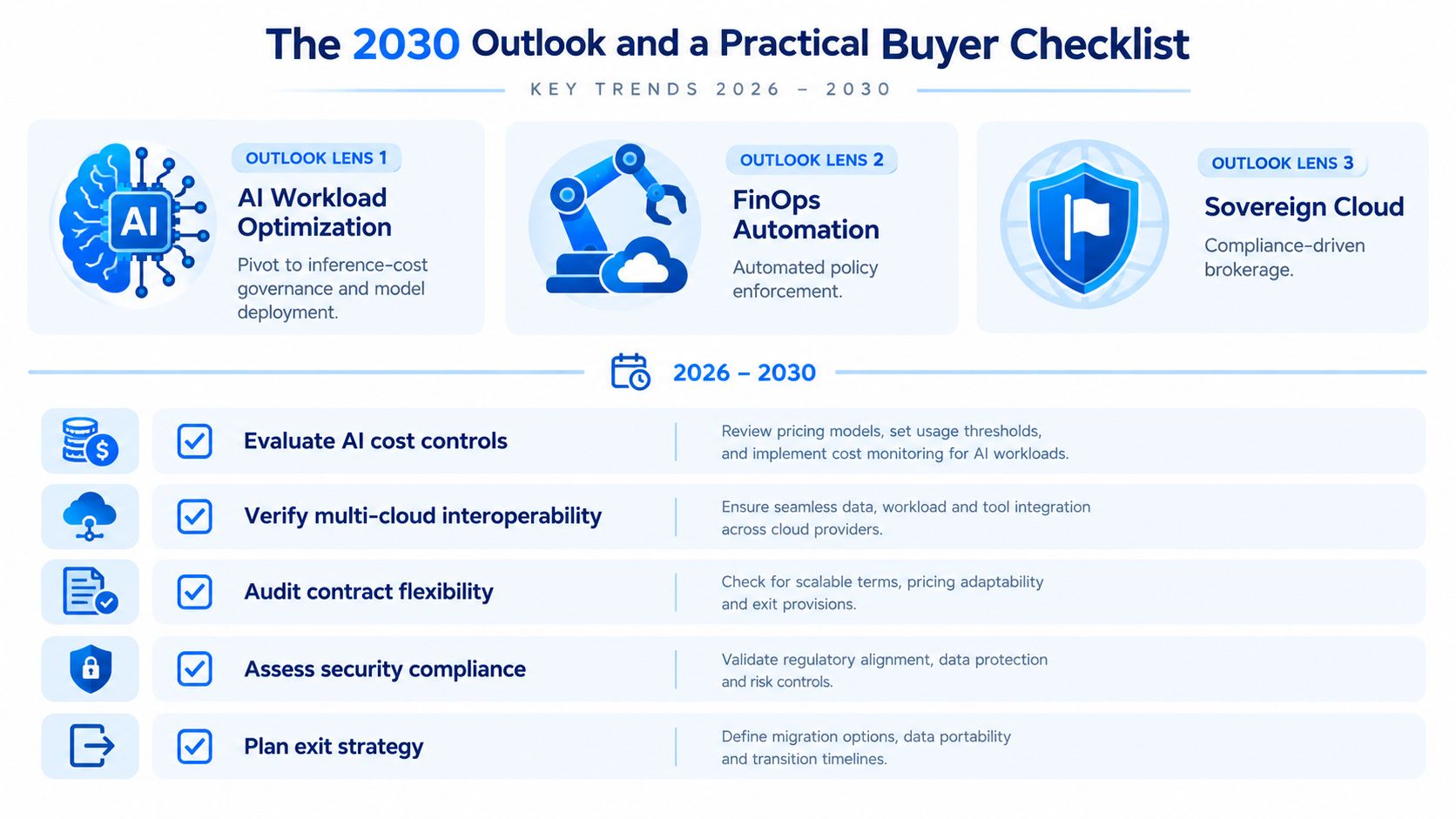
Seven questions for the buying team
- How varied is the footprint? Count providers, account structures, regions, and service models, not just contracts.
- How serious is the regulatory exposure? Identify residency, retention, audit, and sector-specific obligations.
- Can internal FinOps scale? Test allocation quality, ownership, forecasting, and policy enforcement.
- How complex are AI workloads? Separate predictable applications from rapidly changing model, data, and inference patterns.
- What contract value is available? Examine renewal timing, purchasing leverage, support terms, and exit rights.
- How much lock-in can the business tolerate? Review broker data portability, integration dependence, and direct-provider access.
- What is the total cost of intermediation? Include fees, migration effort, training, governance overhead, and internal coordination.
Organizations that meet three or more of these criteria should pilot brokerage around a defined workload or business unit, rather than outsource the entire estate immediately. Organizations below that level should strengthen native cloud controls and purchase selective advisory support. The pilot should have explicit baselines, named owners, exit conditions, and a comparison against direct provider management.
For a vendor-neutral assessment of cloud, security, expense, and governance options, MR2 Solutions provides Technology Brokerage-as-a-Service, combining structured discovery, provider evaluation, procurement, implementation coordination, and ongoing governance. Ask the team to map your multi-cloud, AI, compliance, and FinOps conditions against a direct-management baseline, then use that analysis to decide whether brokerage deserves a pilot.