
What Is Procurement Strategy Beyond Lowest Price

A procurement strategy is a structured, long-term approach to acquiring goods and services so purchases support organizational objectives, not merely the lowest immediate price. It sets how an organization decides what to buy, when to buy it, how to contract, and how to manage supplier performance over time.
You may be facing the decision right now: three proposals for a cloud, cybersecurity, or managed service look close in price, the renewal is approaching, and Finance wants a clear number for the quarter. The lowest quote is tempting, but it may leave out implementation, support, security requirements, or the cost of switching later. A procurement strategy helps the CIO and procurement lead judge the full decision, not just the number on the first page.
Why a Procurement Strategy Changes Buying Decisions
At a technology renewal meeting, three offers can solve the same problem in different ways. One cloud provider charges less, another includes migration support, and a third offers stronger continuity provisions. If the team compares invoice totals before agreeing what the service must deliver, a lower price can hide weaker resilience or added work after signing.
Transactional purchasing responds to an immediate request. A procurement strategy gives the CIO and procurement lead a consistent way to weigh the decision before quotes arrive, including expected outcomes, acceptable trade-offs, security requirements, and how results will be checked after award. It works like a navigation system: it keeps cost in view while helping the team account for risks that may only appear during implementation or a supplier change.
The scale of public procurement shows how buying decisions can affect more than one transaction. Across OECD countries, public procurement expenditure rose from 11.8% of GDP in 2007 to 12.9% in 2021, then stood at 12.7% in 2023. In 2023, it represented 29.9% of total government expenditure across the OECD. For an enterprise, the same principle applies to its IT budget: purchasing choices influence cost control, resilience, service quality, innovation, sustainability, and compliance.
Practical rule: Before comparing suppliers, write down the business outcome the purchase must protect.
A laptop purchase, for example, may need to support secure remote work, predictable support, and a consistent user experience. Those requirements give the team a stronger basis for evaluating business laptop sourcing from Blowfish Technology than unit price alone. For recurring services, reviewing managed IT services costs can help clarify which service requirements and cost components belong in the comparison.
Procurement works best as an ongoing decision process, not a queue for purchase orders. The team sets its priorities before a quote arrives, then checks whether the chosen supplier delivers the expected value after the contract begins.
What a Procurement Strategy Actually Includes
A technology team choosing a supplier faces more than a price comparison. One bid may cost less upfront but offer weaker security, limited service continuity, or few options if the relationship ends. A procurement strategy sets the decision rules before bids arrive, so the team can compare those trade-offs and account for results after award.
The strategy works like an architectural drawing: it connects the organization's goals to the choices and constraints that shape each purchase. It covers business objectives, supplier-market conditions, risk, contract terms, and how performance will be measured. In practical terms, it answers four questions: what to buy, when to buy it, how to contract for it, and how to govern supplier performance over time.
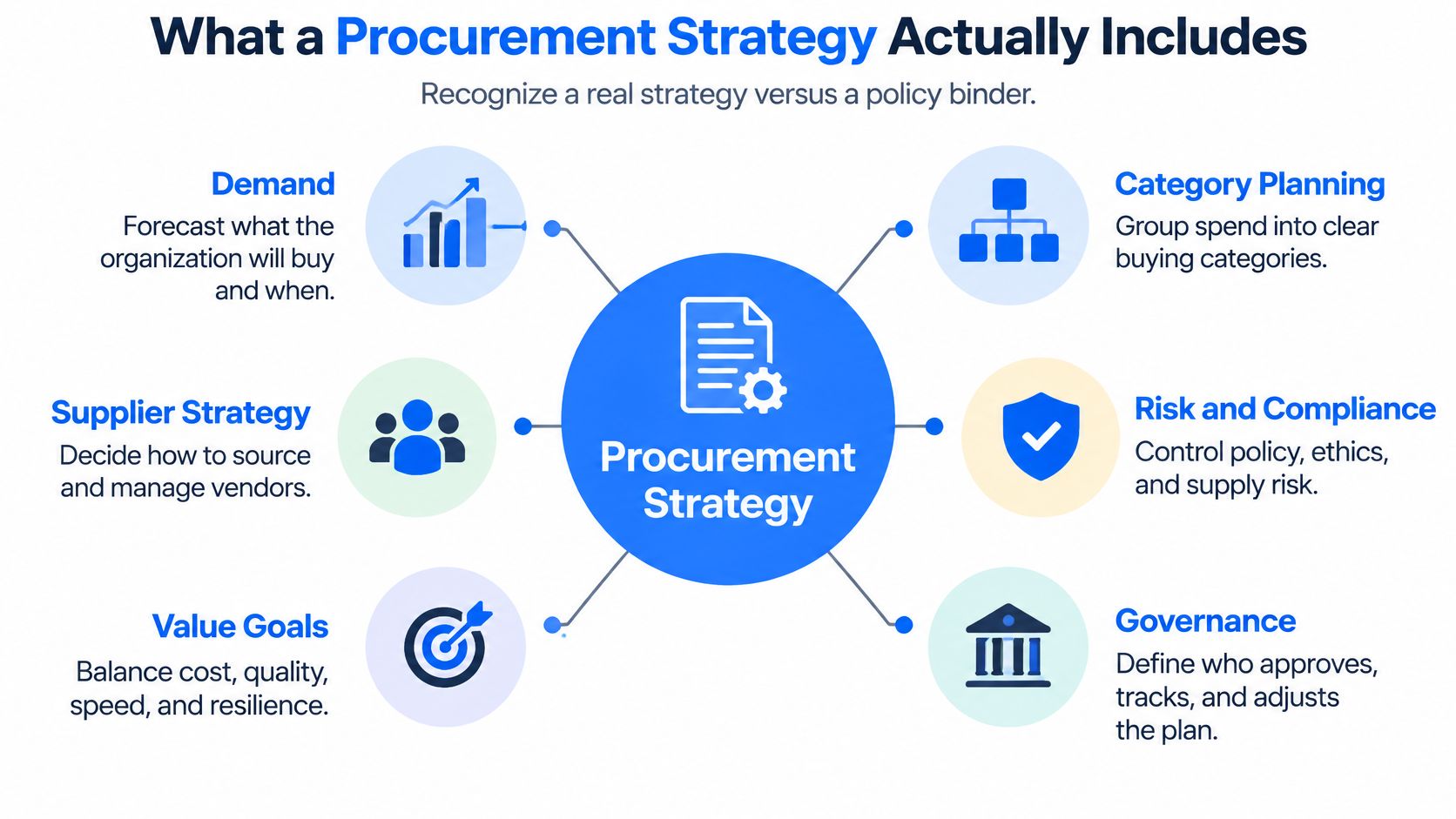
The parts that make the framework usable
Start with demand analysis: clarify what the organization needs and why. For technology, identify the users, systems, service expectations, timing, and dependencies. Without shared requirements, suppliers may price different versions of the request, making their bids hard to compare.
Then examine the supplier market and select suitable sourcing methods. Competition can work well when several providers meet the requirements. A specialized or business-critical service may call for closer technical and risk review. Contract design turns the intended relationship into manageable commitments, including performance obligations, security requirements, and exit provisions.
Risk management and performance measurement keep the decision active after signing. Assign owners to supplier risks, then track whether the service meets agreed goals. Counting orders or signed contracts shows activity, not whether the purchase delivers value.
Strategic procurement can also support goals beyond immediate cost, including sustainability, innovation, support for small and medium-sized enterprises, and social value. For a business, the parallel is to connect sourcing choices to measurable outcomes and total cost of ownership. That means considering the costs and consequences of using a service, not just its purchase price.
A useful one-page strategy names the category's purpose, accountable owners, evaluation priorities, and constraints that a price comparison cannot capture, such as security and service continuity. These choices form a continuous decision system: they shape supplier selection, guide oversight after award, and help the team judge whether the relationship is still delivering what the business needs. Without them, an organization may have buying rules but no clear basis for choosing.
How Procurement Strategy Moved Past Rigid Rules
A technology purchase can follow every required procedure and still leave the organization exposed to cyber risk, service disruption, or costly changes after award. Procurement's history shows how rules provide consistency, while strategy must also adapt to the decision in front of the organization.
The World Bank compiled its first written Operations Procurement rules in 1961. It later made Standard Bidding Documents mandatory for international competitive bidding in 1993, then revised its procurement guidelines in 1994 and 1995, including definitions related to corruption and misprocurement. These developments established common procedures, but a fixed process could also create bottlenecks or fit a project poorly.
The Bank began overhauling its procurement system in 2012. Its Board approved a new policy on July 21, 2015, and the framework took effect for investment-project financing on July 1, 2016 (World Bank procurement reform history).
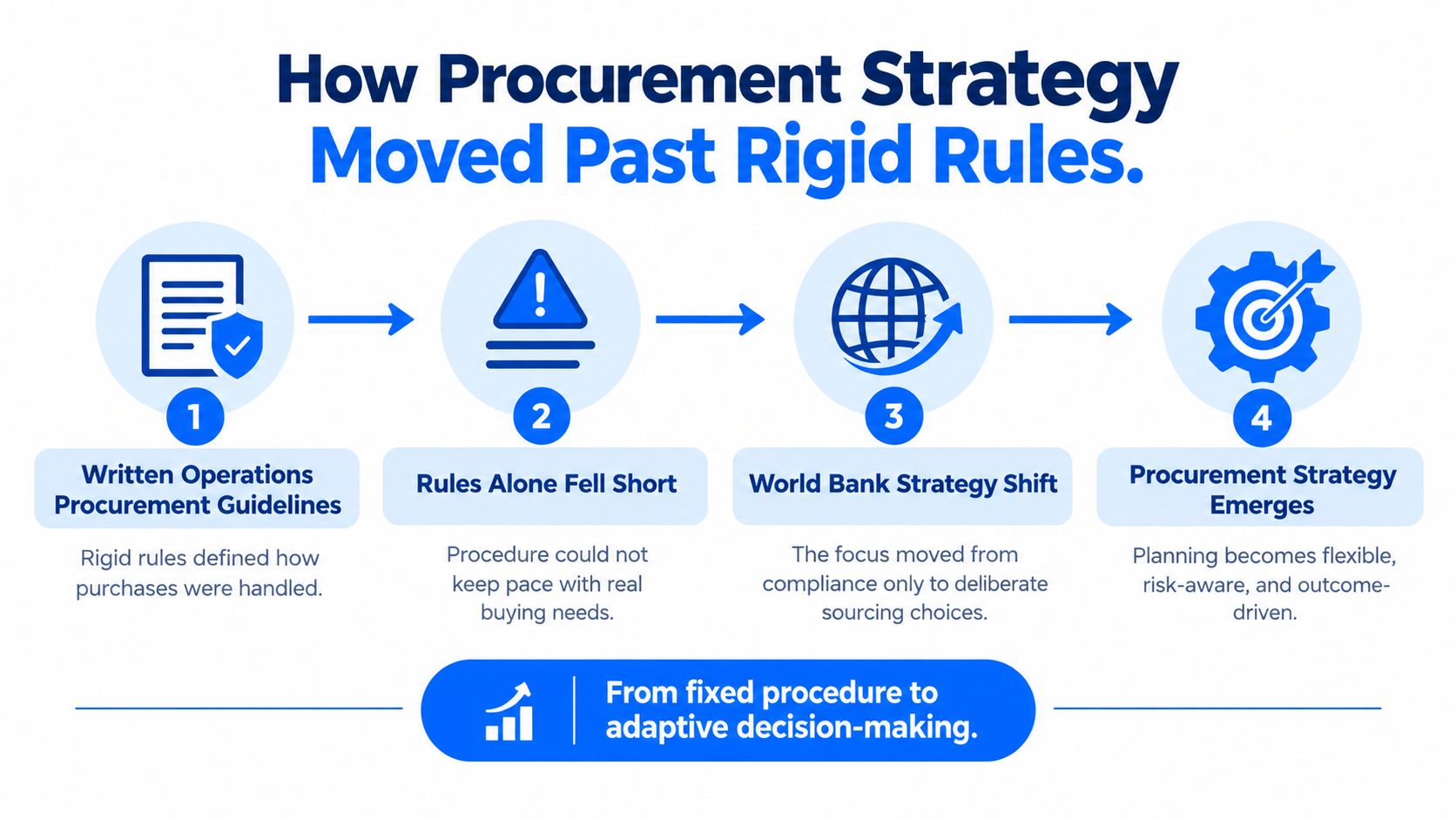
Fit the approach to the purchase
The reform introduced a fit-for-purpose model: the process should reflect the purchase's context and risk. A routine, readily replaceable item may need a lighter review than a platform that supports critical operations. The trade-off is straightforward: controls should preserve accountability without slowing every purchase equally.
For technology, a checklist or lowest-bid contest may miss risks tied to cybersecurity, integration, regulatory duties, or continuity of service. Requirements can also become outdated in a fast-changing category. Evaluations should therefore consider whether a solution can adapt, and whether supplier commitments will hold after the contract is awarded.
Competition and transparency remain valuable. They work best alongside relevant evaluation criteria, appropriate controls, and clear supplier accountability. Procurement strategy turns those choices into an ongoing decision system, connecting the process to organizational goals and risk rather than treating award as the finish line.
For the CIO and procurement lead, the practical question is whether each review matches the consequences of the purchase. Apply proportionate oversight, then keep attention on whether the selected technology delivers and remains fit for use.
Turning Demand into a Category Sourcing Plan
Once the organization knows the intended outcome and constraints, it can turn demand into a category-level sourcing plan. The plan should compare options on business value across the lifecycle, not on the initial price alone.
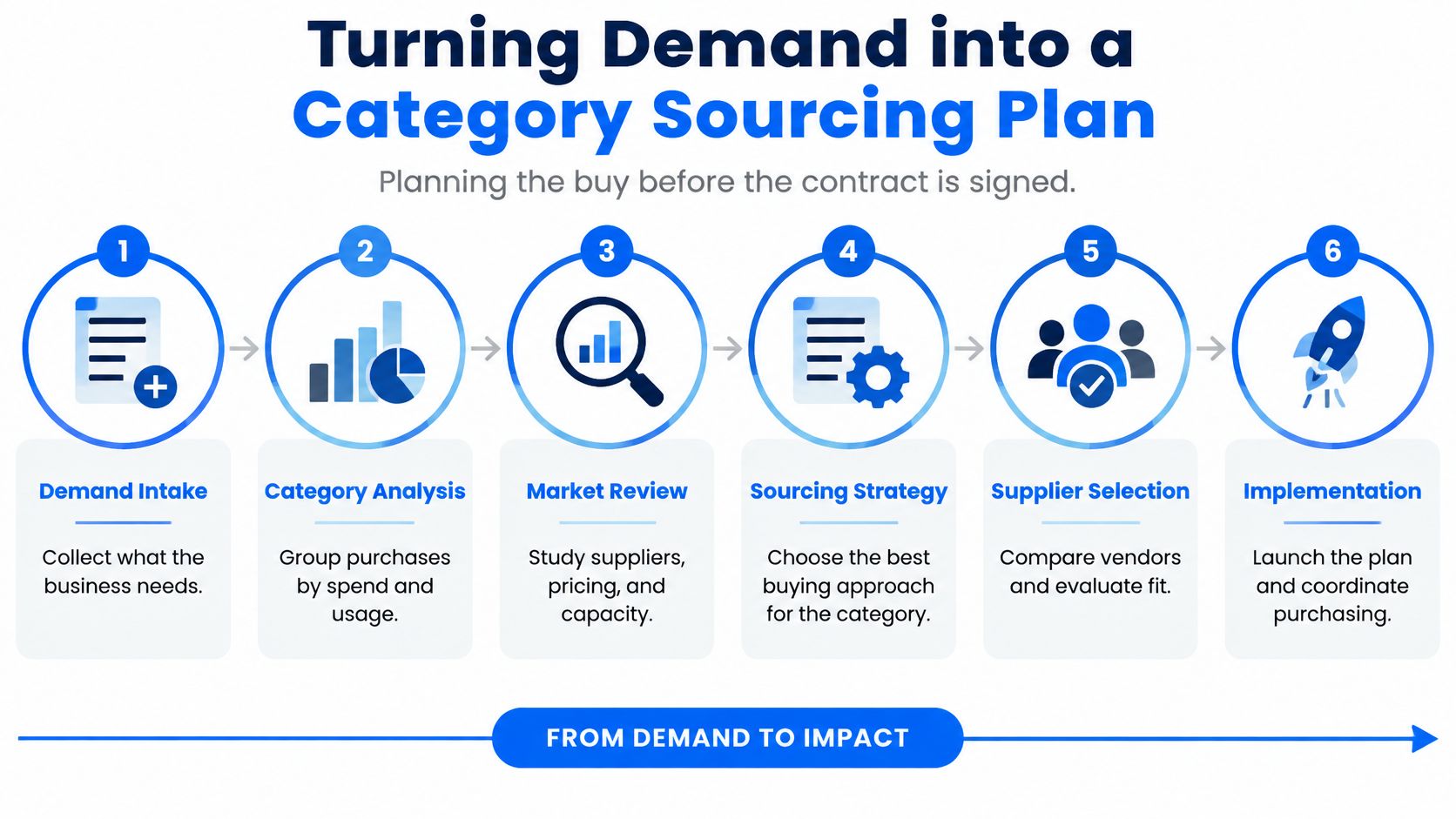
Start with spend analysis and demand definition. Identify what the organization buys in the category, how that demand is used, and what needs may be unnecessary, fragmented, or poorly matched to business requirements. Category management is the grouping logic: it lets teams apply a consistent approach to purchases with similar markets, suppliers, objectives, and risks.
Compare the whole lifecycle
Then research the market and benchmark available options. Market research can help identify supply risks and support better price forecasting. Public-sector procurement guidance distinguishes strategic sourcing from traditional purchasing by emphasizing total cost of ownership and non-price considerations such as quality and risk performance (NASPO strategic sourcing guidance).
Total cost of ownership (TCO) includes more than acquisition price. For an IT service, it can include implementation, integration, support, quality, operational disruption, switching, compliance, and supply-risk costs. A lower subscription price may be outweighed by migration labor, security controls, downtime exposure, data-egress charges, or contractual lock-in.
Use that analysis to select a sourcing approach and define weighted requirements. Weights should show which considerations matter most for the category. For cloud services, for instance, the team may prioritize integration, security, service continuity, and exit options alongside commercial terms. Supplier selection should document how each option meets those requirements, rather than relying on an informal preference.
The finished category plan should be usable in negotiation and execution. It can include:
- Weighted requirements that make trade-offs explicit.
- Approved supplier architecture showing which vendors or service types fit the category.
- Negotiation levers and target terms tied to the organization's needs.
- Risk mitigations for relevant supplier, operational, and compliance exposures.
- Governance measures such as contract-compliant spend, spend under management, service-level attainment, renewal lead time, realized savings, and avoided cost.
That gives the CIO and procurement lead a reusable plan for cloud, cybersecurity, networking, unified communications, or managed services. The category strategy shapes how to buy; supplier governance keeps the chosen arrangement accountable after selection.
Governing Technology Value After Supplier Selection
A signed contract doesn't guarantee the intended outcome. Implementation, adoption, security monitoring, usage, and renewal decisions often fall between teams, even though each can change the value of a technology purchase.
Digital procurement can improve transparency, monitoring, evaluation, and risk management, according to the OECD's work on digital transformation of public procurement. The broader lesson for technology buyers is to keep award information connected to financial and operational governance after the contract is signed.
Before sourcing, define outcomes such as service availability, cybersecurity controls, implementation milestones, user adoption, carbon impact, and TCO. Assign an owner to each measure. Security may own control evidence, IT operations may track service levels, Finance may monitor consumption and cost, and the business sponsor may assess whether users are adopting the service.
A negotiated discount can disappear if nobody checks whether the organization is using what it bought.
Unused licenses, weak adoption, fragmented suppliers, rising consumption, or unmonitored risk can erode the value of a deal. These issues matter especially with cloud, cybersecurity, communications, AI, and managed services, where switching costs and integration dependencies can make an apparently inexpensive contract difficult to change.
Keep the decision connected to delivery
Carry the vendor-neutral evaluation criteria into implementation. If the team selected a supplier because of a particular security control, integration capability, or service commitment, verify that it appears in delivery plans and operating reviews. Structured implementation oversight can surface gaps before they become routine.
Then review the supplier against the original business outcome, not just the contract checklist. A review should make clear what is working, what has changed, whether consumption remains appropriate, and what needs attention before renewal. This is also where technology expense management can help teams connect technology usage and costs to ongoing oversight.
The post-award strategy needs named owners, meaningful measures, and a review rhythm. Without those, the organization has selected a supplier but hasn't built a system to protect the value of the decision.
Balancing Cost with Resilience and Compliance
A low quote can look attractive until a supplier outage, regulatory gap, or difficult transition adds costs the bid never showed. Price still matters, but technology sourcing should weigh it alongside resilience, cybersecurity, compliance, and the consequences of changing providers.
Procurement priorities increasingly include sustainability, regulatory compliance, and ethical sourcing. EY reports that 64% of procurement organizations align with enterprise targets in these areas. The report also says 21% of decision-makers lacked systems to monitor geopolitical, environmental, and regulatory threats, while 62% regarded sustainable purchasing as very important or a top priority over the following one to two years (EY CPO survey). Those findings point to a practical gap: organizations need clear risk criteria and evidence requirements before comparing bids.
For technology, criteria can cover data location, incident response, subcontractors, software concentration, interoperability, exit rights, accessibility, and lifecycle cost. A compliance review should test verifiable evidence, not broad supplier assurances. A cybersecurity and compliance framework can help teams identify relevant controls and assign ownership.
| Decision point | Price-only buying | Risk-adjusted strategy |
|---|---|---|
| Supplier cost | Compare the quoted price or subscription | Include lifecycle and transition costs |
| Security and compliance | Treat requirements as a pass-or-fail checklist | Assess evidence, responsibilities, and escalation conditions |
| Supplier dependency | Favor consolidation if it lowers the quote | Balance efficiencies against concentration and exit risk |
| Service continuity | Assume the supplier will maintain service | Set continuity expectations and examine disruption scenarios |
| Sustainability | Accept general claims at face value | Use criteria that can be verified and monitored |
Consider a security platform that replaces several tools with a smaller set of interoperable providers. Consolidation may simplify management and strengthen control, yet it can also deepen dependence on one supplier. The team can assign agreed weights to price, security, interoperability, and exit options, then test each choice against scenarios such as changed contract terms, a security incident, or a missed service commitment.
This comparison does not automatically favor the safest or most expensive bid. It makes the trade-offs visible, so decision-makers can judge whether the savings justify the exposure and whether the supplier can support the organization after award. Procurement becomes a continuing technology decision system: resilience and compliance shape supplier choice, while the agreed terms make the accepted risks clear.
Choosing How to Run Procurement Strategy Next
The operating model should fit the organization's complexity, capacity, and risk. An internal team may be well placed to run category plans when it has the necessary market knowledge, time, and cross-functional support. A traditional multi-vendor RFP can support transparent comparison, but it can also demand significant coordination across requirements, evaluation, contracting, and implementation.
A third option is a vendor-neutral brokerage that coordinates discovery through governance. MR2 Solutions offers Technology Brokerage-as-a-Service for vendor-neutral discovery, evaluation, and selection, supported by a People, Process, and Portfolio framework. Its work includes diagnostic assessments intended to shorten cycle time, access to subject-matter experts and fractional CIO, CISO, or CAIO leadership, and coordination across a curated ecosystem of more than 400 providers.
Match the model to the problem
| Operating approach | Where it can fit | Trade-off to consider |
|---|---|---|
| Internal category team | The organization has the expertise and capacity to lead market research, evaluation, and governance | Internal priorities or skills gaps may limit comparison and follow-through |
| Traditional multi-vendor RFP | The organization needs a documented competitive process and can coordinate several stakeholders | A broad RFP can add time and leave implementation coordination to the buyer |
| Vendor-neutral brokerage | The decision spans providers, expertise, implementation, or ongoing optimization | The organization must still define outcomes and retain ownership of its decisions |
MR2 Solutions describes its scope as strategy, implementation oversight, and ongoing optimization for mid-market and enterprise clients. The company reports more than 30 years in operation and support for more than 500 organizations across three continents. Those credentials are relevant when technology complexity, budget pressure, security and compliance, skills gaps, or delivery risk make an independent coordination role useful.
The next step can be small. This month, choose one upcoming IT category, write its business outcome, list the TCO and risk weights, name the post-award owner, and decide whether the work should stay internal or needs an unbiased advisor before the next renewal.
MR2 Solutions helps organizations evaluate, procure, implement, and govern IT solutions through a vendor-neutral brokerage approach. If you're preparing a technology sourcing decision and want to connect supplier selection with resilience and post-award outcomes, visit MR2 Solutions.