
Unified Communications as a Service Guide
Unified communications as a service is a cloud subscription that combines business calling, video meetings, messaging and collaboration so one directory and one client replace a premises PBX plus disconnected apps.
The harder question is whether that replacement should cover your whole estate. For a CIO running several phone systems, the decision reaches beyond handsets into carrier contracts, emergency calling, network readiness and ownership of communication records. A cleaner interface doesn't automatically mean a lower bill or a simpler compliance workload.
What Unified Communications as a Service Is Now
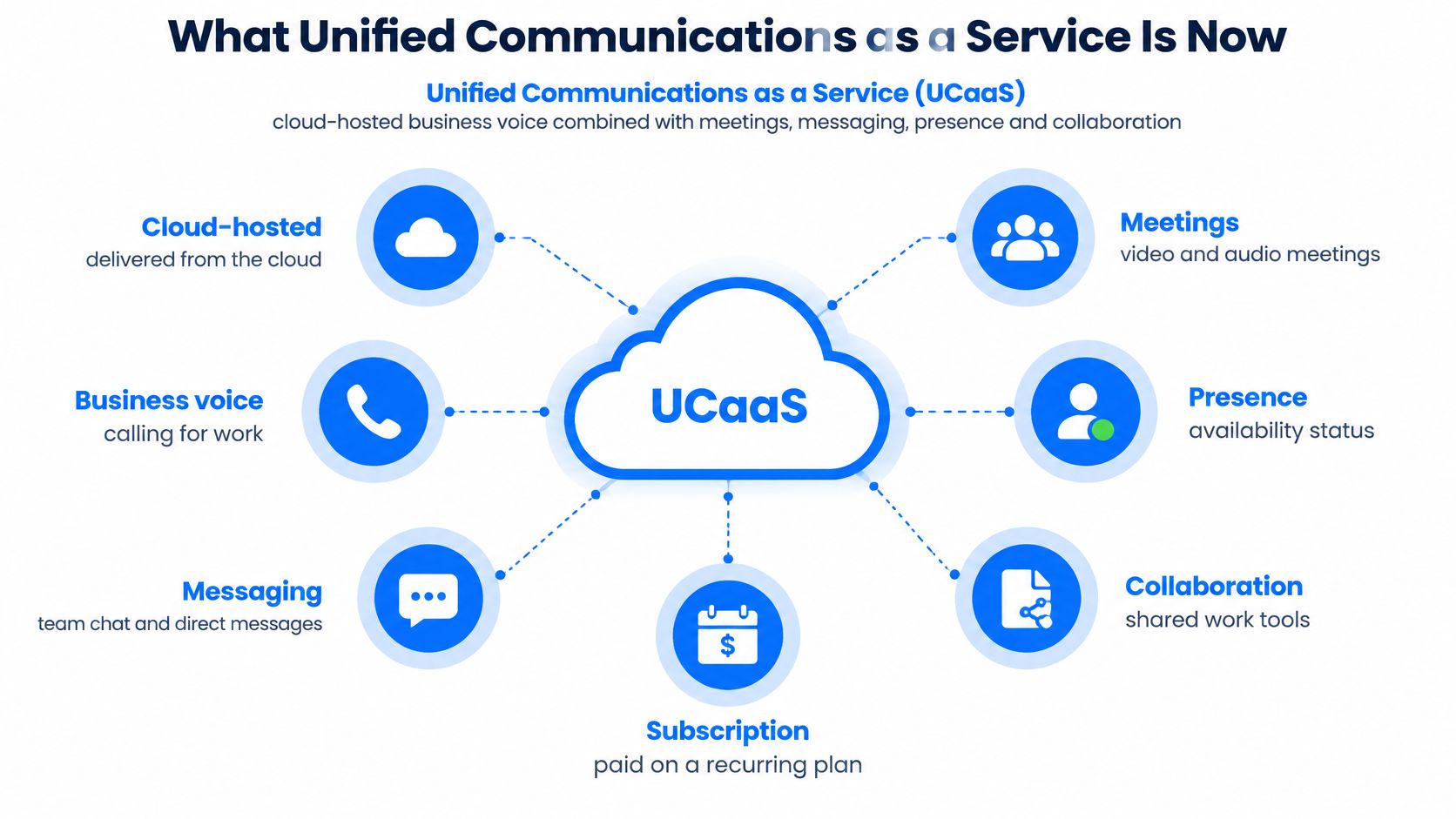
Unified communications as a service (UCaaS) brings cloud-hosted business voice, meetings, messaging, presence and collaboration under subscription-based administration. The provider operates the communications platform, while your organization still owns decisions about identity, access, connectivity, records and business continuity.
Software delivery is already central to business communications. IDC reported that UC collaboration and UCaaS together accounted for 89% of worldwide UC&C revenue in 2023, and that the broader UC&C market reached $69.2 billion in 2024. Those figures describe the wider market, not UCaaS alone, but they explain why communications procurement now belongs alongside other enterprise software decisions.
What changes for the user
Say an operations manager starts work at headquarters, takes a supplier call at home and joins a project meeting from a mobile device. The intended outcome is a consistent business identity, accessible conversation history and an extension that doesn't depend on a particular desk.
A premises private branch exchange, or PBX, is like a switchboard locked in the basement. UCaaS leases that communications floor as a service, so the extension, availability status and meeting space can follow the user.
Networking2000's explanation of unifying office and mobile communications is useful context for evaluating that cross-device experience. Treat it as a workflow requirement to demonstrate, not a benefit to accept from a presentation.
Practical rule: Buy the operating model you can govern, not just the application employees prefer.
Subscription pricing replaces some hardware-refresh decisions with recurring commitments. It doesn't remove endpoint management, network engineering or responsibility for employees' access.
For a split estate, the useful questions are concrete: which functions must share a client, which systems should remain, and which contracts can end? The answers should determine the deployment, cost model and migration controls before anyone selects new desk phones.
Capabilities One Client Should Carry
Start with a real business interaction: a customer calls a published number, a receptionist finds an available specialist, and that specialist brings a colleague into the conversation. A suitable platform must support the whole interaction, not merely provide an attractive meeting window.
Unified should mean a common identity, coordinated administration and a client that lets employees move between communication modes without rebuilding the conversation. Some services still use separate administrative portals, so test the operational experience rather than counting logos on an integration slide.
What belongs in UCaaS versus a neighboring system
| Capability | Confirm these functions | Usually replaces |
|---|---|---|
| Calling and PSTN | Direct inward dial numbers, auto attendants, hunt groups, voicemail-to-email, call recording where policy allows, dispatchable emergency location | Premises PBX and PRI or SIP trunks |
| Meetings and video | Ad-hoc and scheduled meetings, webinars, room systems, guest join without an account | Standalone video app plus room codecs |
| Team messaging | Direct chat, channels, presence, persistent history | Some internal email and consumer chat tools |
| Workspaces | Files, whiteboards and tasks in the same client and directory | Disconnected drives and side project tools |
| Contact center, adjacent | Queues, omnichannel routing, workforce management, often licensed as CCaaS | Legacy automatic call distributor on the old PBX |
Calling comes first when you're replacing a phone system. Direct inward dial numbers let callers reach people or departments without an operator. Hunt groups distribute calls among designated employees, while auto attendants route callers through menus. Confirm actual call flows, including unanswered calls, overflow, holidays and out-of-hours routing.
Meetings require a different demonstration. Have an external participant join without an account, connect an existing room system and test whether a scheduled meeting becomes a usable recording under your policies. Webinars and room connectivity may require additional licenses or equipment.
Test continuity, not just feature availability
Messaging should preserve the context that disappears when a voice call ends. Presence should help an employee decide whether to send a message or place a call, but it shouldn't be treated as an infallible indicator of availability.
Pebb's discussion of a unified app for distributed team communication offers a useful employee-facing checklist. Pair that perspective with administrative tests: directory synchronization, guest removal and ownership of shared files in Microsoft 365 or Google Workspace.
Our specialists cover UCaaS platforms, contact center solutions and VoIP systems as related but separate purchases. Our unified communications technologies services address voice, video and collaboration, but the scope still needs explicit boundaries.
Basic call queues may be included in a calling package. Omnichannel routing, workforce management and specialist contact-center workflows belong in a separate CCaaS evaluation unless the proposal explicitly includes them. A platform that's strong in meetings but can't satisfy PSTN calling and emergency-location requirements isn't yet a phone-system replacement for your organization.
When the Five-Year Cost Works
Metrigy's UCaaS assessment reports that 58.6% of surveyed organizations used UCaaS as their sole phone and collaboration platform, while the global UCaaS market reached $23.0 billion in 2025, growing 6% year over year. For established buyers, the task is increasingly to optimize an operating model rather than just leave a PBX behind.
That distinction matters because a seat price isn't a total-cost calculation. A proposal can look inexpensive while excluding the work needed to make it usable across your estate.
Five-year UCaaS cost scenarios
| Scenario | Fits when | Costs that stretch payback | Main risk |
|---|---|---|---|
| Full replacement | Aging PBX, many carriers, simple call flows | Number porting, emergency calling, endpoint replacement, LAN and WAN upgrades, exit cost | Single-vendor concentration |
| Hybrid coexistence | Live contact center, international numbers, heavy compliance, undepreciated PBX | Dual administration, split identity, separate support tiers, unused seats | Long coexistence and weak leverage |
| Phased by site or region | Multi-site estate that can move in waves | Parallel circuits, temporary call routing, repeated training | Stalled cutover and shadow systems |
Build each scenario from the same demand assumptions. Separate ordinary office users, shared devices, receptionists, mobile workers and contact-center agents instead of assigning the most expensive bundle to everyone.
Include these costs explicitly:
- Telephony and usage: Carrier charges, calling allowances, international traffic, number porting and emergency-calling services.
- Implementation: Integration development, endpoint replacement, network upgrades, engineering labor and role-based training.
- Records and features: Recording storage, retrieval, compliance integrations and premium AI licenses.
- Operations and departure: Support tiers, unused seats, connectivity resilience, data export and exit or repatriation work.
When cloud can cost more
A compliance-heavy organization may need to keep an existing recording archive while paying for a new capture service. A business with a functioning PBX and a tightly coupled contact center may retain most of its old support costs while adding cloud subscriptions. In either case, the financial benefit depends on which expenses disappear.
Don't count a canceled carrier contract until its termination terms and replacement dependencies are understood. Likewise, don't treat accounting depreciation as the entire decision: distinguish sunk expenditure from future cash costs, contractual commitments and useful remaining capacity.
A subscription creates a predictable billing mechanism. It doesn't prove that the underlying architecture is economical.
Our technology expense management work gives organizations visibility into current IT spend and opportunities for optimization. That baseline helps separate real consolidation from merely adding another invoice.
Single-vendor procurement can simplify administration while increasing concentration risk. Through TBaaS™, we help organizations compare architecture, pricing models and integration capabilities before committing, which helps avoid vendor lock-in.
Choose the financial scenario before requesting final pricing. Otherwise, vendors will price different assumptions, and procurement will compare totals that describe different services.
Deployment Shapes for a Split Estate
Coexistence isn't an unusual exception. Metrigy reported that 50.4% of businesses use UCaaS as their sole phone platform, while 39.2% still operate multiple phone systems. Those measures concern phone-platform adoption, not the broader phone-and-collaboration scope used in other surveys.
For an organization with acquired businesses, regional carriers and a specialist contact center, consolidation is an architectural task. You need to decide where calls enter, which platform owns each extension and what happens when a connection fails.
UCaaS deployment shapes
| Shape | How it runs | Fits | Plan for |
|---|---|---|---|
| Multi-tenant cloud | Shared provider cloud, per-seat subscription | Standard office, remote and mobile users | Provider upgrade calendar and shared operations |
| Private or dedicated instance | Isolated cloud tenancy or dedicated media processing | Residency, custom retention, regulated workloads | Potentially higher run cost and slower feature cadence |
| Hybrid routing | Cloud users plus a live PBX or contact center | International numbering or a complex automatic call distributor | Split directories, recording and emergency calling |
| Phased site cutover | Region or site waves with temporary tandem routing | Multi-site estates that can't move together | Parallel trunks until that wave is stable |
Multi-tenant cloud is the straightforward starting point for standard requirements. The provider maintains a shared service, so your team needs a process for release notices, endpoint compatibility and testing changes that affect reception or other critical workflows.
A private or dedicated arrangement deserves consideration when a documented requirement calls for isolation, particular processing locations or customized controls. Don't assume dedicated hosting automatically satisfies a regulator or solves residency. Require evidence about the relevant service components, including where media processing and administrative access occur.
Give every number a clear owner
Hybrid routing is useful when a business must preserve a legacy call flow while moving selected users to cloud calling. Maintain an authoritative numbering plan showing each number's carrier, destination, routing dependencies and operational owner.
Avoid accidentally giving an employee active voicemail or recording paths on competing platforms. Define which system controls busy handling, forwarding and caller identification before connecting the systems.
Phased site cutover is a migration sequence, not a distinct hosting model. A business can move sites in waves into a multi-tenant service while retaining hybrid routing during the transition.
Overlapping platforms also create offboarding risks. Removing a user from the cloud directory may leave a legacy extension, forwarding rule or recording entitlement active. Make the leaver process cover every live platform.
Match the architecture to the business constraint: standard users suit shared cloud operations; documented isolation needs justify dedicated evaluation; protected legacy workflows favor hybrid routing; and regional dependencies favor staged cutovers. No deployment shape removes the need for an explicit retirement plan.
How Buyers Score a Shortlist
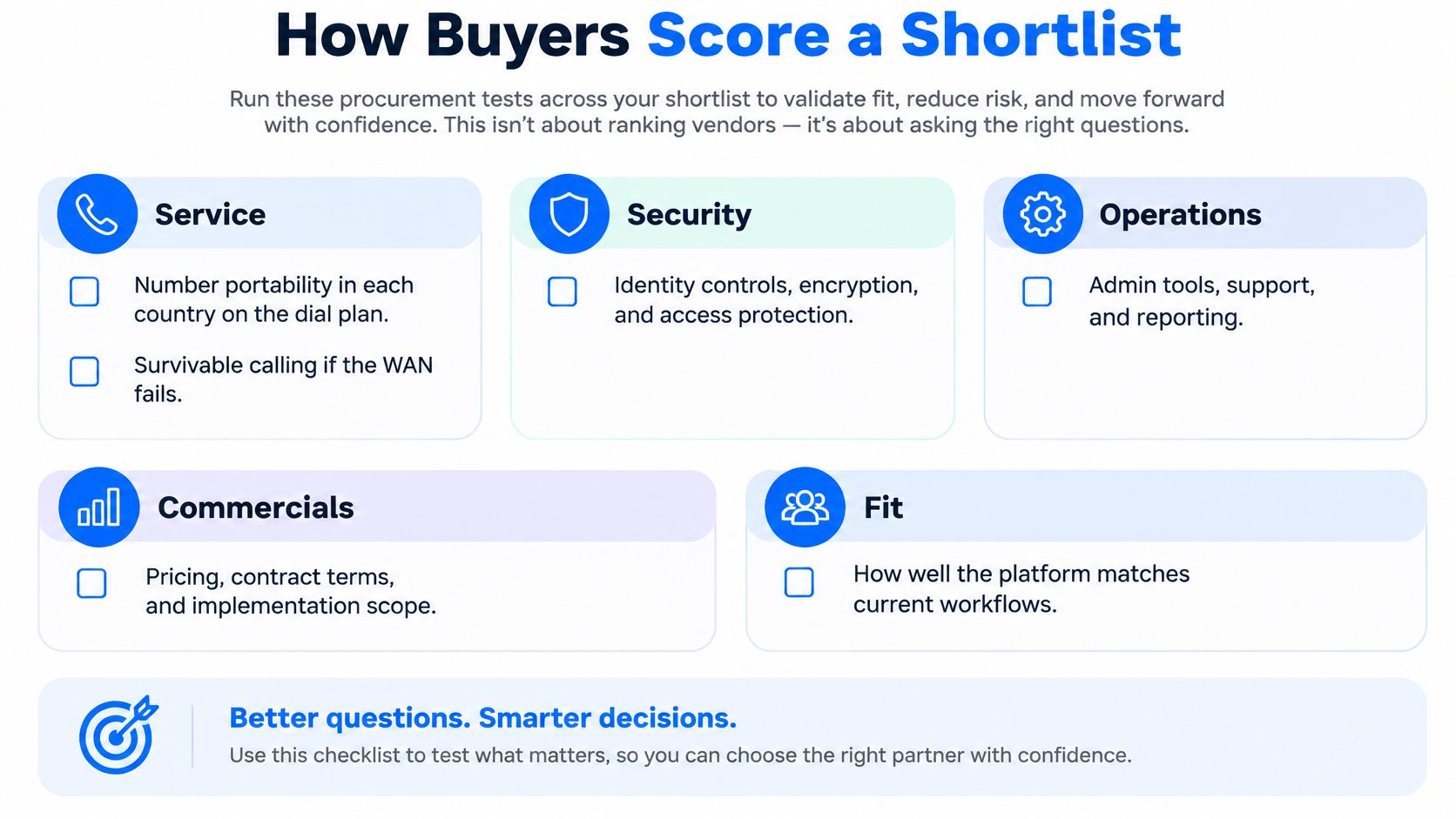
Score a shortlist in two stages. First decide which vendors may stay on the list. Then rank the survivors. That order matters because weighted scoring lets a polished demo blur a failed emergency call. A vendor cannot offset an unsafe calling path with better whiteboards, and a discount cannot replace missing operational evidence.
A structured IT procurement process ties each requirement to a demonstration, a contractual commitment or a pilot result. For communications, the shortlist should prove the operating model, not just the interface. A low per-seat quote can score badly once hybrid routing, compliance controls and records work are priced across five years.
Pass or fail shortlist checks
| Test | Pass threshold | Evidence required |
|---|---|---|
| Emergency calling | Tested dispatchable location on desk phone, softphone and mobile | Fail if any required path is untested |
| Interactive quality | ITU-T Y.1541 Class 0 reference targets: delay no more than 100 ms, delay variation no more than 50 ms and packet loss no more than 0.1% | Per-site pilot telemetry at headquarters, branch, home and mobile, with measurement boundaries documented |
| Encryption | For WebRTC media, DTLS-SRTP keying and SRTP/SRTCP protection, with no plain RTP or null ciphers | Fail on insecure fallback; inspect other access paths separately |
| Telemetry | Per-site loss, jitter, latency, MOS or QoE, availability and incidents | Fail if not exposed to the buyer |
| Number porting | Coverage for each country on the dial plan | Written port timeline per wave |
| Identity and admin | SSO, SCIM provisioning and role-based administration, with applicable controls across access paths | Demonstrated in pilot |
| Exit | Data export, recording retrieval and a priced exit | Written terms before signature |
Those network targets are an engineering reference, not a universal promise about every end-to-end call. Specify where measurements begin and end, then pilot under representative operating conditions. A clean speed test can still hide wireless contention, congested queues or unstable routing. Inspect setup failures, interruptions, clipping and video freezing alongside telemetry.
Verify security at the correct boundary
The IETF WebRTC security architecture requires protected media using DTLS-SRTP keying and SRTP/SRTCP, and prohibits plain-media and null-encryption fallback. Those are WebRTC requirements. They are not proof that an ordinary PSTN call is encrypted end to end.
Ask for evidence of identity binding, certificate handling and rejection of packets that fail integrity checks. Examine relay-credential lifetimes, session revocation and browser or device controls where appropriate.
For identity, demonstrate provisioning and removal instead of accepting an SSO checkbox. Desktop, mobile, browser, guest and PSTN entry paths need appropriate controls, though they will not all use the same authentication mechanism.
Contract checkpoint: A provider's core-cloud availability commitment doesn't guarantee the performance of your Wi-Fi, LAN or last-mile connection.
Name measurement points, incident ownership and remediation duties in the contract. Verify supported interfaces for Microsoft 365, Google Workspace, your identity provider and the contact center, including who supports each integration.
Only then weight usability, administration, support, integration fit, commercial terms and the five-year cost of the chosen deployment shape. Failed emergency calling, insecure fallback or unavailable quality telemetry should disqualify the proposal, not merely reduce its score.
Govern Records Then Move the Numbers
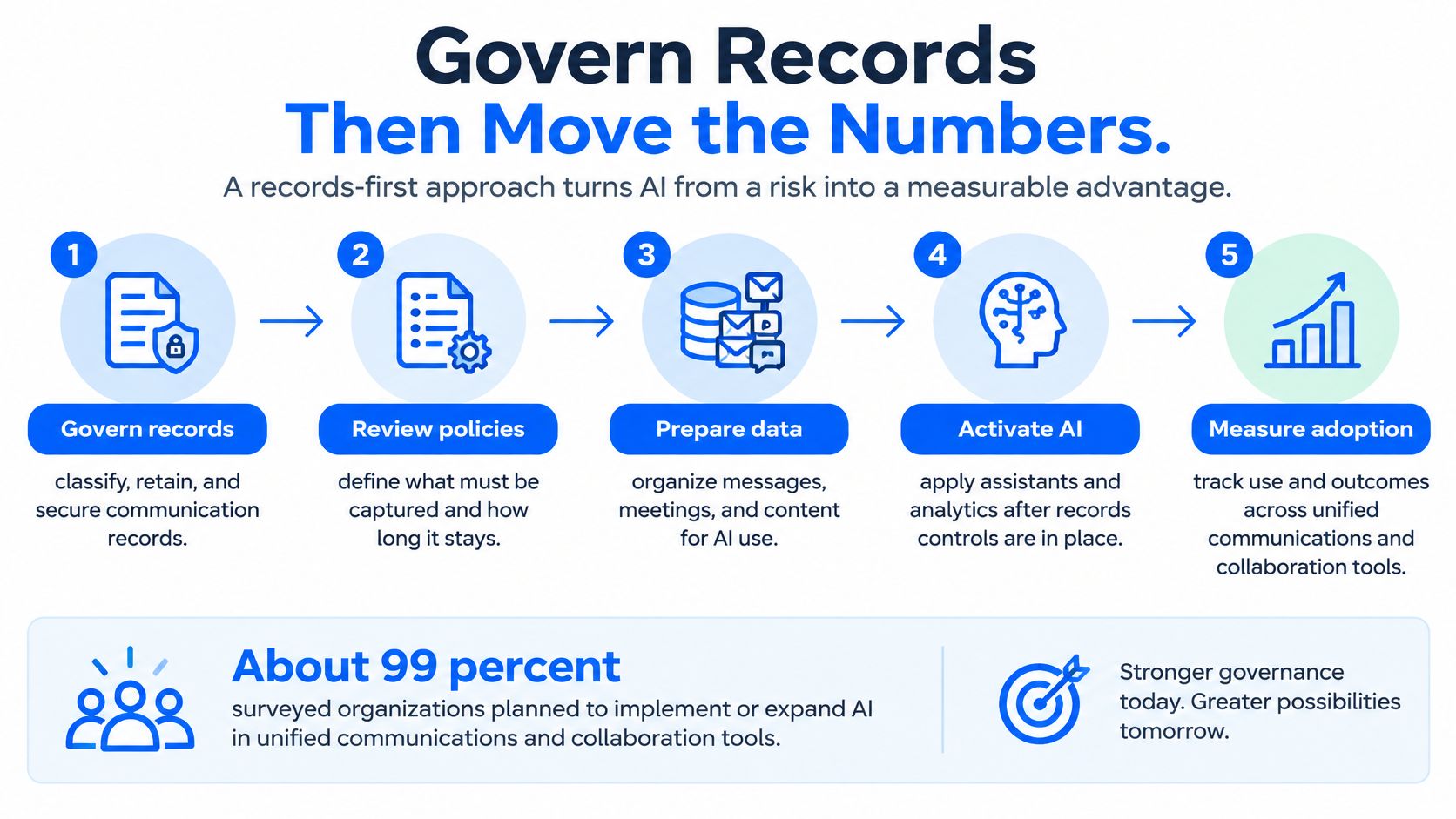
AI assistants create communication records as well as convenience. The Theta Lake Digital Communications Governance Report found that 99% of surveyed organizations planned to implement or expand AI capabilities in unified communications and collaboration tools. Transcripts, summaries and searchable content therefore deserve procurement attention before broad activation.
Set ownership before activation
Classify conversations by sensitivity and name the business owner of generated records. Define retention, deletion, legal-hold handling and access by role, including whether someone who missed a meeting may retrieve its summary.
Document whether customer content is used to train models. Require auditability of prompts and outputs where supported and appropriate, and human review for high-risk clinical, legal or HR workflows. A plausible summary isn't automatically an accurate or approved business record.
Procurement should require data-flow diagrams covering media, metadata, recordings, transcripts and encryption keys. Verify regional processing options and whether guest participation or third-party integrations change where information goes.
Execute a records-first migration
- Inventory the estate. Capture numbers, devices, call flows, contact-center dependencies and existing recordings. Include shared phones and non-user devices.
- Approve records policies. Freeze retention and AI-access rules before enabling transcription licenses.
- Map identities and integrations. Align users with the corporate directory and decide which meetings, files and guest links synchronize with Microsoft 365 or Google Workspace.
- Prepare connectivity. Validate site readiness and configure SD-WAN and queueing policies for voice and video.
- Pilot representative users. Include an office site and remote cohort. Accept the service only when emergency calling, failover and quality evidence satisfy the agreed criteria.
- Port in controlled waves. Keep hybrid routing until inbound, outbound, transfer and overflow paths work correctly for the migrated group.
- Train by role. Give receptionists routing exercises, administrators access-control tasks and employees practical calling and meeting scenarios.
- Retire and audit. Remove the old PBX after a defined stable period and dependency sign-off. Continue reviewing meeting creation, admission, recording, transcription and file sharing.
Assign an accountable owner across the workstreams. Our coordinated project types include UCaaS, VoIP, contact centers, SD-WAN, circuit installations, network refreshes and identity management, so a migration plan should connect those dependencies rather than treat them as unrelated tickets.
Hypothetical illustrations
These are hypothetical illustrations written for this guide, not reported customer results.
A professional-services firm phases regional offices into cloud calling while retaining its contact center on hybrid routing. It retires each regional trunk only after routing and recording checks pass, rather than canceling all carrier services at contract signature.
A hospital network blocks AI summaries on clinical lines until its records and security owners approve retention, access and processing locations. Staff can use approved calling functions while governance owners resolve the separate question of generated clinical content.
AI readiness can add records work. Enable it where ownership and controls are clear, not wherever the license makes it available.
Lock the Decision Before You Sign
Make signature conditional on a small set of approved artifacts. Each should name an owner and resolve a business decision, not just record that a demonstration occurred.
- Capability scope: Mark which functions constitute true phone replacement and which are collaboration add-ons or adjacent contact-center purchases.
- Financial choice: Approve a full-replacement, hybrid or phased cost scenario with explicit retirement assumptions.
- Shortlist evidence: Document the mandatory service, security and operational gates, supported by pilot results.
- Records authorization: Approve written retention and AI-access rules before enabling the relevant licenses.
Don't average away conflicts between these artifacts. A low-cost proposal that can't retrieve required recordings or establish responsibility for poor call quality isn't ready for signature.
Run the representative pilot across office, branch, home-broadband and mobile conditions. Put measurement boundaries, remediation duties, implementation responsibilities and exit terms into the order before porting starts.
TBaaS™ supports CIOs and IT leaders who need vendor-neutral evaluation rather than a predetermined product recommendation. Its deliverables include vendor comparisons, evaluation summaries, solution recommendations, cost insights and an implementation roadmap aligned with business priorities.
MR2 Solutions helps organizations evaluate, procure, implement and govern unified communications through a vendor-neutral brokerage process. Bring your current phone-system inventory, carrier commitments and records requirements to MR2 Solutions to develop a provider comparison, cost assessment and implementation roadmap grounded in your operating needs.