
Data Center Outsourcing Guide: Models, Costs and Risks

USD 150.6 billion is how large the global data center outsourcing market was in 2024, according to Grand View Research. Outsourcing is a major infrastructure decision, not just a way to rent cheaper server space.
For a CIO, the harder questions concern control: Who can authorize a change? What happens when capacity runs out? Can the business recover if the provider fails, and can it leave without an expensive redesign? A sound decision starts with workload requirements, then tests operating responsibility, full-term costs, recovery evidence, and exit terms.
Data Center Outsourcing Models Compared
Data center outsourcing means handing part of the facility, hardware, or operations to a third party under a service contract. The model you choose determines which responsibilities move and which stay with your team.
Outsourcing models by ownership and operating responsibility
| Model | Who owns the hardware | Who runs operations | Best fit |
|---|---|---|---|
| Colocation | Customer | Customer, with the provider running facility services | Owned servers that need secure space, power, and interconnection |
| Managed hosting | Provider, or leased to the customer | Provider manages the operating system, monitoring, and patching to the agreed scope | Teams without spare operations capacity |
| Public cloud | Cloud provider | Shared, with the customer managing workloads and configuration | Variable demand and fast provisioning |
| Hybrid | Mixed across owned, colocated, and cloud environments | Shared across all environments | Estates with different risk, latency, or compliance needs |
The distinction between colocation and managed hosting is particularly important. Renting a cabinet doesn't mean someone will patch your servers, restore your database, or investigate an application alert. Even when remote-hands assistance is available, define whether it covers physical tasks, such as replacing a drive, or administrative work inside the operating system.
Public cloud moves more infrastructure responsibility to the provider, but it doesn't remove your responsibility for access permissions, application design, or data protection. Hybrid combines models, typically through private networking, and requires an operating approach that works across them.
Choose by workload, not preference
Keep applications that require direct hardware access or specific network designs in colocation or owned rooms. Consider managed hosting for stable, non-differentiating systems when your team needs operational support. Use cloud for variable demand or frequent provisioning, provided the application can use that flexibility economically.
For a practical comparison of the physical-control and consumption-model choices, Beyond Surplus offers an IT leaders' colocation and cloud guide. When evaluating managed services and colocation, separate the facility service from the management scope rather than treating them as interchangeable.
Say a manufacturer has a hardware-bound production application and a customer portal with unpredictable demand. Placing both on the same platform for purchasing convenience could create unnecessary compromises. The production application may belong on owned hardware, while the portal may benefit from metered resources.
For each application, answer these questions:
- Hardware control: Does it require physical access, specialized equipment, or a fixed network topology?
- Operational coverage: Does your team need someone else to monitor and operate it around the clock?
- Platform readiness: Can it move to metered infrastructure without substantial redesign?
Why Workloads Are Leaving Owned Facilities
The average share of enterprise workloads in corporate data centers fell from 58% in 2020 to 48% in 2023, according to Uptime Institute's global survey. That marks a shift away from ownership as the default, not the disappearance of enterprise facilities.
Organizations can retain systems that benefit from direct control while outsourcing workloads that need different capacity, connectivity, or operating support. The resulting estate is distributed, and its quality depends on how deliberately leaders assign responsibilities across it.
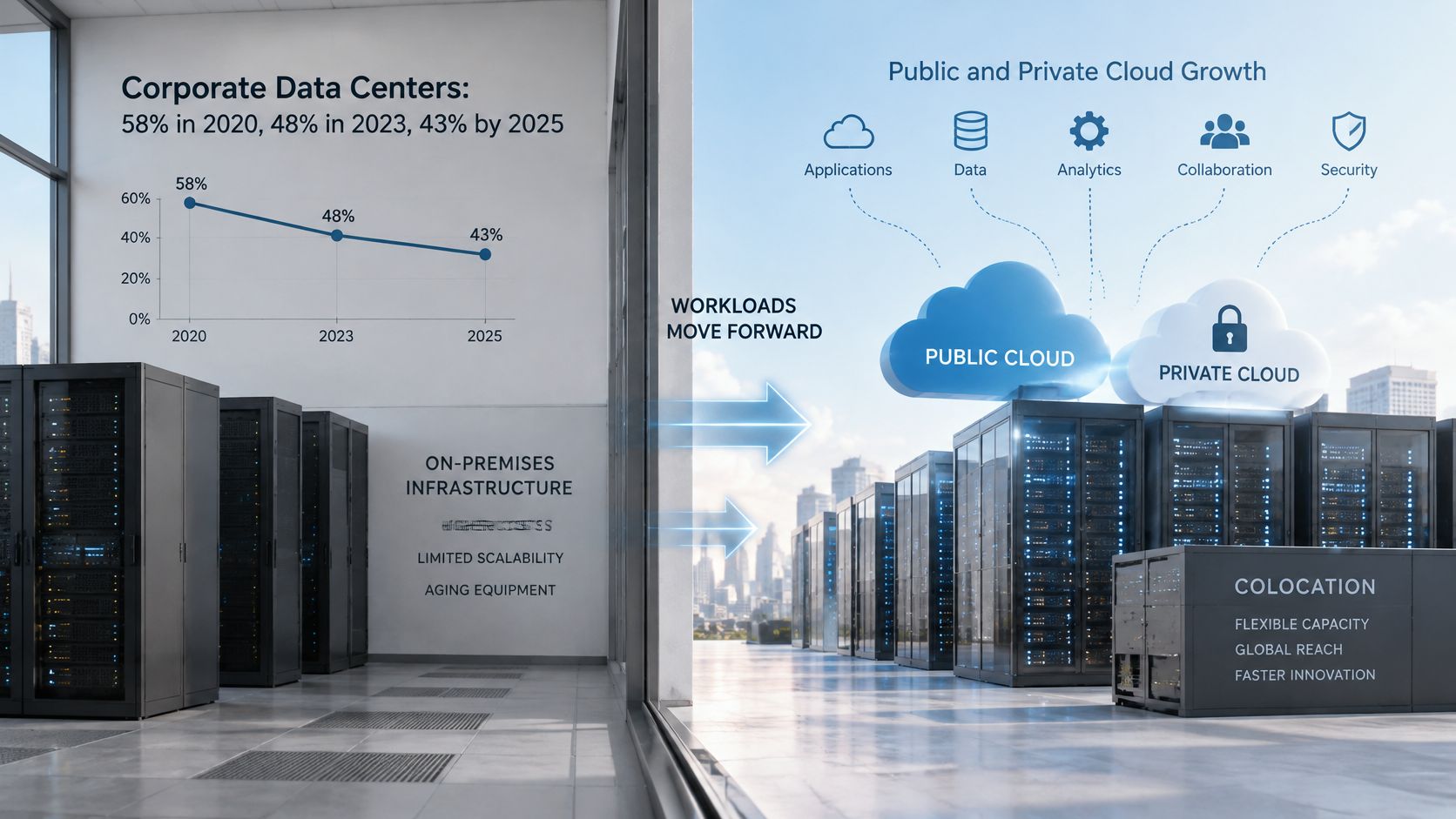
The pressures behind placement decisions
Operating expense can make ownership harder to justify. An internal facility budget must accommodate electricity, cooling maintenance, equipment replacement, and specialist labor, even when the business would rather direct capital toward applications.
Skills coverage is another constraint. A capable infrastructure team may still lack the electrical, mechanical, networking, and security expertise needed to operate a facility reliably. Outsourcing can fill specific gaps, but only if the contract identifies which tasks the provider takes over.
Expansion timing can also determine placement. When a business needs capacity before an internal construction or utility project can finish, available third-party space may offer a workable alternative. Confirm that capacity is commissioned and usable, rather than merely planned.
Placement test: Choose the environment that your organization can govern and operate effectively, not simply the one it can purchase most easily.
Migration planning should connect application requirements to the target environment before anyone schedules a move. For teams preparing that analysis, Rite NRG migration consulting provides a relevant starting point for considering migration scope.
The exercise for leadership is straightforward: list the main workloads, mark each as owned, outsourced, or cloud, and name who answers when it fails. Add security ownership, compliance obligations, and budget accountability. Any blank field identifies a governance decision that needs attention before procurement.
Benefits and Risks to Weigh Before Signing
Outsourcing changes who performs the work. It does not change who answers for recovery, cost, and exit. Judge each promised gain by the evidence and contract language behind it.
A buyer should translate each expected benefit into a commitment that can be checked:
Lower upfront capital spend avoids some facility or hardware purchases. Usable capacity provides power and cooling without building the supporting plant. Expansion and reach place workloads beyond the existing corporate site. Maintenance support moves defined tasks to a staffed operating team. Audit evidence supplies assurance reports and certifications within the contracted scope.
Third-party failures remain a common cause of major incidents. 42% of respondents in Uptime Institute's annual outage analysis reported an outage in the previous three years caused by a problem at a third-party data-center service provider.
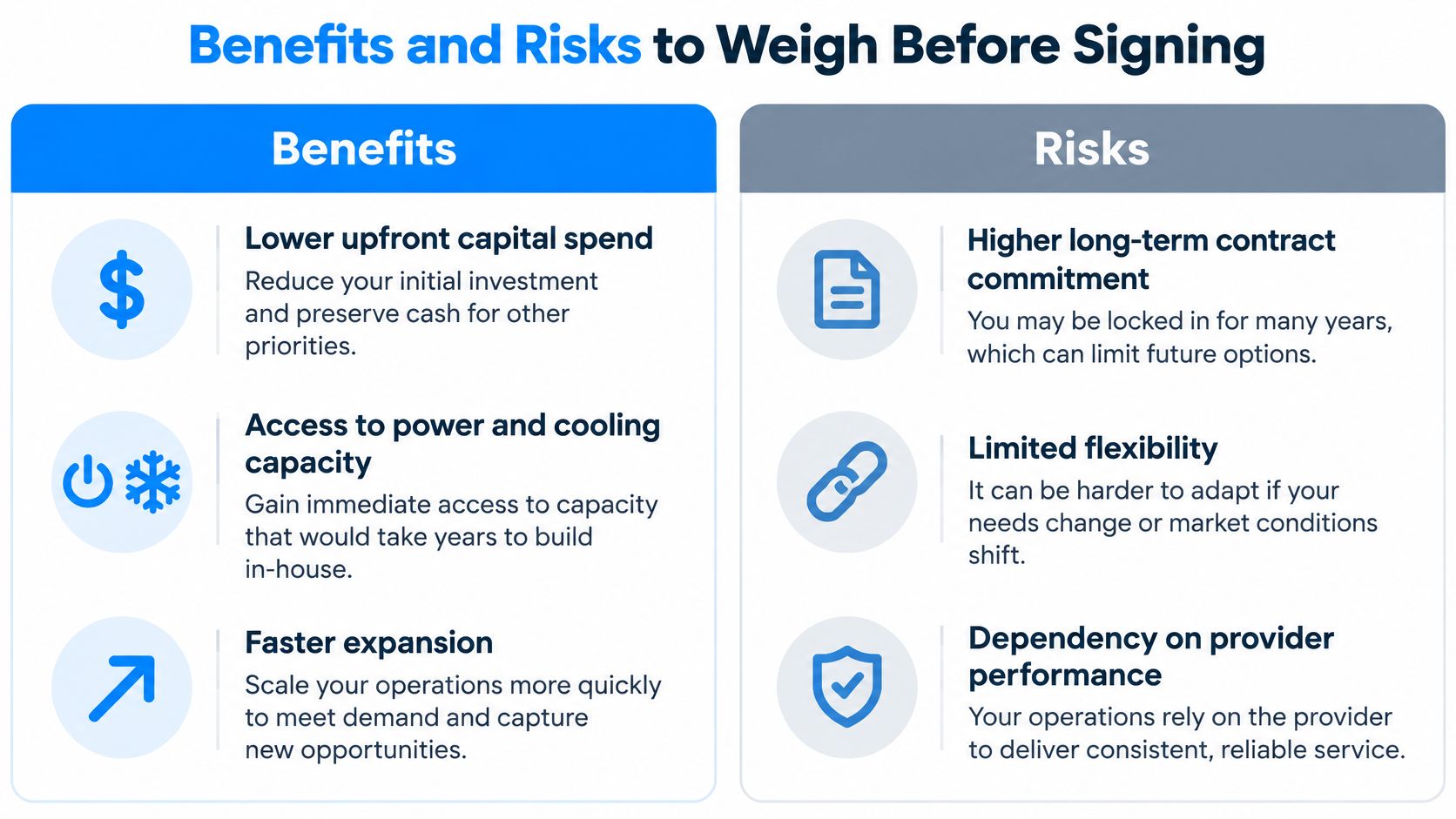
Match every gain to a control
Lower capital spending can come with a longer commitment. Minimum payments, equipment financing, and early-termination charges restrict the ability to change direction. Require a clear commitment schedule and a written termination calculation before signing.
Faster expansion can create dependence on the provider delivery program. A growth clause should name the capacity reserved, the conditions for accessing it, and the remedy if delivery slips. An option to request space is not the same as a commitment to supply it.
Provider-run maintenance reduces hands-on work but can reduce visibility into changes. That trade-off needs explicit handling. Establish advance notice, approval requirements for customer-affecting work, and access to maintenance records. Include subcontractors in those obligations rather than assuming the primary provider performs every task.
| Expected gain | Risk to price | Contract control |
|---|---|---|
| Geographic reach | Shared carriers or operational dependencies | Dependency disclosure and separation requirements |
| Compliance support | Assurance evidence excludes relevant services | Audit rights and explicit scope |
| Convenient interconnection | Proprietary connections complicate departure | Transfer assistance and documented interfaces |
| Outsourced administration | Customer and provider assume the other owns a task | Named responsibility and escalation ownership |
Assurance reports such as SOC 2 and certifications such as ISO 27001 require careful reading. Check the covered entity, locations, services, exceptions, and customer responsibilities. A provider assurance report does not automatically establish compliance for your application.
The governing rule is simple: every benefit needs a named control. Do not accept flexibility without workable exit terms, compliance support without evidence access, or expansion promises without delivery obligations.
What Outsourcing Costs Over Three to Five Years
The rack rate is only one line in a data center outsourcing comparison. Build a full-term model that includes the resources you retain internally as well as the services you buy.
Cost lines to model in an outsourcing comparison
| Cost line | In-house | Colocation | Managed hosting |
|---|---|---|---|
| Power and cooling | Paid directly, including facility overhead | Commonly capacity-based or metered, so check billing terms | May be included, so check caps and surcharges |
| Space | Owned or leased building cost | Priced per rack, cabinet, or dedicated area | Included within the managed scope |
| Hardware purchase and refresh | Full capital cost | Customer capital cost | Provider capital recovered through fees |
| Operations staff | Full internal coverage | Customer operations team still needed | Outsourced to the contracted scope, with retained oversight |
| Connectivity | Internal carrier contracts | Carrier, cross-connect, and installation fees | Check bundled allowances, transfer, and egress charges |
| Migration project | No relocation cost if remaining in place; refresh projects still apply | Physical move, testing, and overlapping services | Move costs plus any re-platforming |
| Exit and data retrieval | Retirement, disposal, and data-handling costs | Decommissioning, transfer, and shipping fees | Export, transition assistance, termination, and retrieval charges |
Normalize the bids before comparing them
Power pricing requires particular care. A kilowatt measures capacity or demand; a kilowatt-hour measures energy consumed over time. Establish whether the contract charges for committed capacity, measured consumption, peak demand, or a combination, and whether cooling overhead is included.
Compare per-rack pricing against the power allocation behind it. A lower-priced cabinet may provide less usable power or require additional cabinets for the same workload. Include redundant power-feed charges and clarify how consumption across those feeds is counted.
Managed hosting can bundle staff effort while charging separately for work outside the agreed scope. Database administration, emergency changes, backup restoration, and operating-system upgrades should each have a defined treatment. Otherwise, routine operational requests can become additional project fees.
Cloud belongs in the comparison where it's a credible alternative. Model sustained usage rather than assuming metered consumption is automatically cheaper, and include storage operations, network transfer, support, and retained engineering time.
A useful bid comparison prices the same workload, operating scope, growth assumption, and departure scenario across every option.
Build the full-term calculation
Use this framework:
Annualized total cost = fixed fees + usage charges + retained staff cost + allocated migration cost + allocated exit cost.
For a worked calculation, multiply your expected IT load by operating hours and the quoted energy rate. Add facility overhead only where it isn't already included. Spread one-time migration spending across the evaluation term, but retain the actual payment dates in the cash-flow model.
Then test a steady-state scenario and a growth scenario. Apply renewal increases, expansion charges, hardware refreshes, and any unavoidable overlap between old and new environments. Finance should distinguish genuine cash savings from staff time that becomes available for other work.
Don't accept a bid comparison until every provider's exclusions have a cost owner.
Reading SLAs Beyond the Availability Percentage
An availability target is a budget for downtime. The percentage sounds precise, but the contract only becomes useful when you convert it into hours and minutes and then ask what those hours cover.
Availability targets converted to annual downtime
| Availability | Annual downtime allowed | Practical reading |
|---|---|---|
| 99.9% | Approximately 8.76 hours | One long incident can use most of the annual allowance |
| 99.99% | Approximately 52.6 minutes | A tighter allowance, but no evidence that the application recovers |
These conversions describe the mathematical allowance, not a forecast of service behavior. A provider can meet 99.99% for power at the cabinet and still miss the workload's recovery target because a load balancer, identity service, or storage replication path failed outside that measurement boundary. Contract periods may be monthly rather than annual, and exclusions can change what counts. Neither target proves incidents will be brief or evenly spaced.
Third-party supplier failures are a common cause of outages. A resilient building can still support an unavailable service if a software change, carrier problem, cooling-control error, or maintenance mistake interrupts operations. A generator test confirms the generator starts. It does not confirm the application returns.
Turn the clauses into questions
Read the SLA as a measurement and remedy document, not a complete continuity plan.
- Measurement boundary: Does availability cover power at the cabinet, network connectivity, a managed server, or the customer-facing service?
- Exclusions: Which maintenance activities, customer actions, and force-majeure events are excluded? How are disputed causes resolved?
- Notification: When must the provider notify your incident team, and what must the first notice contain?
- Restoration: What counts as restored service, and who validates that the workload is usable?
- Credits: What are the claim procedure, submission deadline, credit cap, and termination rights?
- Evidence: Must the provider supply timelines, incident records, contributing causes, and corrective-action updates?
Request historical incident metrics, mean time to detect and restore, maintenance-related outage records, and results from power-loss and site-failover exercises. Look for completed corrective actions, not just a description of redundant equipment. The difference matters at renewal: a provider that cannot show closed corrective actions is asking you to accept the same failure mode again.
Assign the work that makes recovery possible
Create a responsibility matrix with an accountable owner, an executing party, and an escalation contact for each activity.
| Activity | Ownership to document |
|---|---|
| Monitoring | Who detects failures and opens incidents |
| Configuration and patching | Who approves, performs, and verifies changes |
| Capacity thresholds | Who tracks headroom and triggers expansion |
| Security controls | Who operates controls and supplies evidence |
| Recovery testing | Who schedules tests and accepts results |
Document recovery time objectives, meaning acceptable interruption, and recovery point objectives, meaning acceptable data loss, for the workload rather than the facility. A colocation SLA may promise power and cooling, while your RTO depends on database failover, DNS changes, and the order in which services restart.
Last, inspect multi-site portability. Separate locations will not help if both rely on an unavailable identity platform, shared management system, or inaccessible replication path. Test the application with those dependencies deliberately unavailable. A second site is only a recovery option when the workload can run there without the first site's hidden services.
Select and Govern the Provider
The cheapest initial contract can become the most expensive option if the provider can't support growth, higher-density racks, or dependable power commitments. In its 2025 annual survey, Uptime Institute reported that concern about forecasting future capacity requirements increased by nine percentage points between 2023 and 2025.
Treat capacity as a deliverable with evidence and dates, not a general statement about campus expansion.
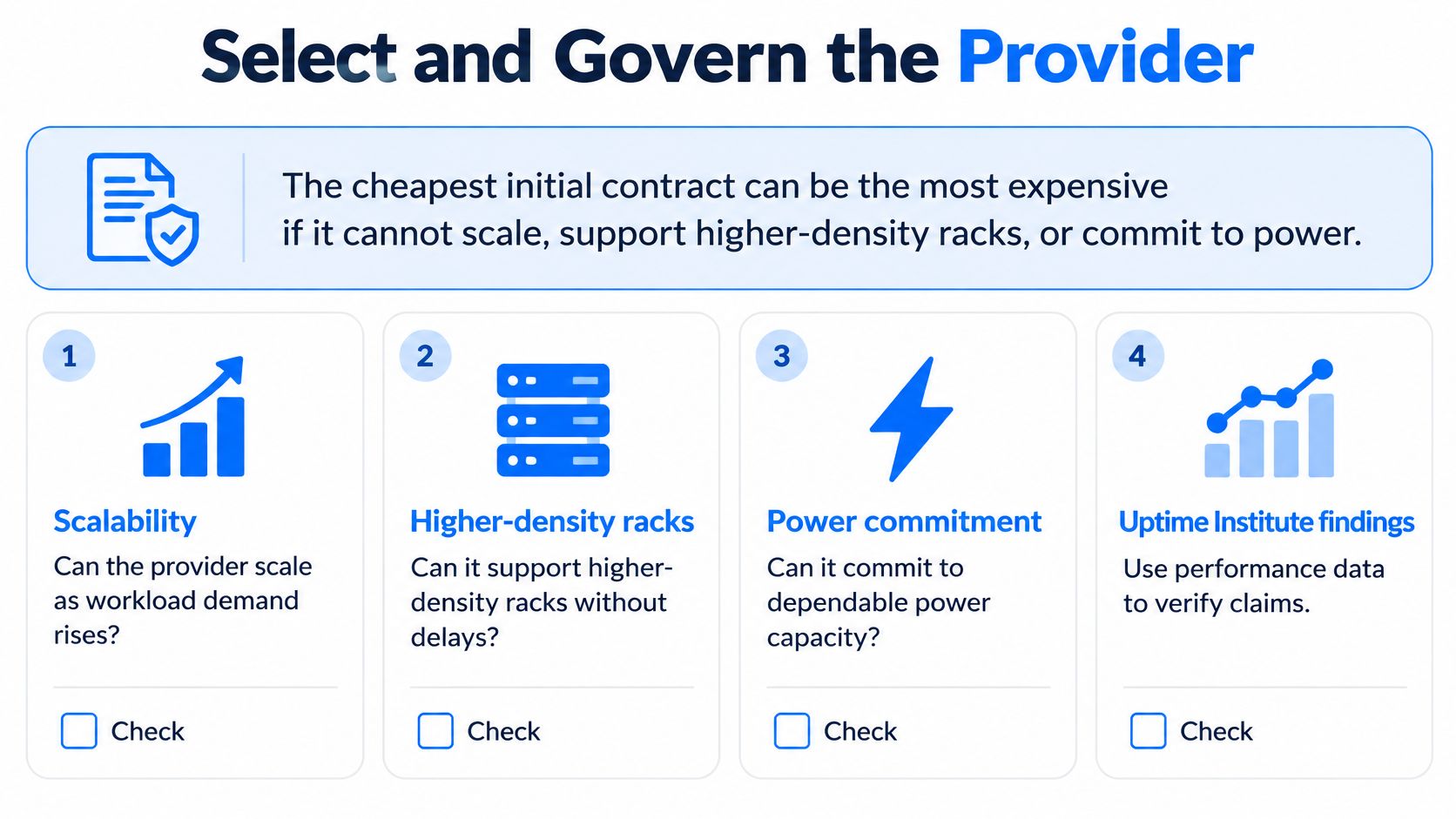
Provider scorecard for capacity and resilience
| Criterion | What to request |
|---|---|
| Expansion lead time | Months from order to live capacity, with dated commitments |
| Power commitment | Reserved versus interruptible kW, with the power-availability guarantee |
| Rack density | Maximum kW per rack and whether higher density is supported |
| Deployment dependencies | Equipment, utility, and construction dependencies behind each expansion |
| Supply-chain exposure | Critical components and their sources |
| Exit rights | Data retrieval, decommissioning, and transfer terms |
| Milestone remedies | Financial remedies for missed delivery dates |
| Continuity support | Geographic redundancy, recovery capacity, and failover test support |
Make selection evidence-led
Follow this order so commercial negotiation doesn't outrun technical validation:
- Define workload requirements. Specify recovery objectives, rack density, connectivity, data location, and compliance obligations. Identify requirements that disqualify a provider rather than merely lowering its score.
- Request the evidence package. Include incident history, recovery tests, operational procedures, and the proposed responsibility matrix. Record unanswered requests as evaluation gaps.
- Score consistently. Use the same criteria and evidence standard for every candidate. Give contractual commitments more weight than verbal assurances.
- Speak with a comparable reference. Discuss similar workload characteristics, change handling, expansion delivery, and incident communication. A reference using a different service scope may offer little reassurance.
- Negotiate exit and remedies before price. Settle transfer assistance, missed milestones, termination triggers, and data access while you still have credible alternatives.
For owned equipment leaving the estate, include the downstream disposal partner in due diligence. Reworx Recycling's ITAD vendor selection criteria for 2026 can support that separate assessment of retirement and disposition arrangements.
Facility availability and application continuity are different contractual outcomes. Identify which party supplies the recovery environment and proves that it works.
A provider can satisfy a facility SLA while your application lacks recovery capacity. If internal engineering resources can't validate the proposed design, make independent technical review a prerequisite to signing.
Govern after the signature
Schedule quarterly service reviews and joint incident reviews. Track unresolved corrective actions, capacity headroom, delivery commitments, and upcoming changes. Keep the responsibility matrix current when either team changes its operating scope.
Our vendor-neutral data center brokerage approach supports comparison before commitment. Through TBaaS™, we help organizations avoid vendor lock-in by comparing architecture, pricing models, and integration capabilities across multiple options.
Plan the Workload Move Without an Outage
Turn the selected placement model into an executable change plan. An outage-free move is an objective, not a promise; the plan needs validation gates, rollback criteria, and authority to stop when conditions aren't met.
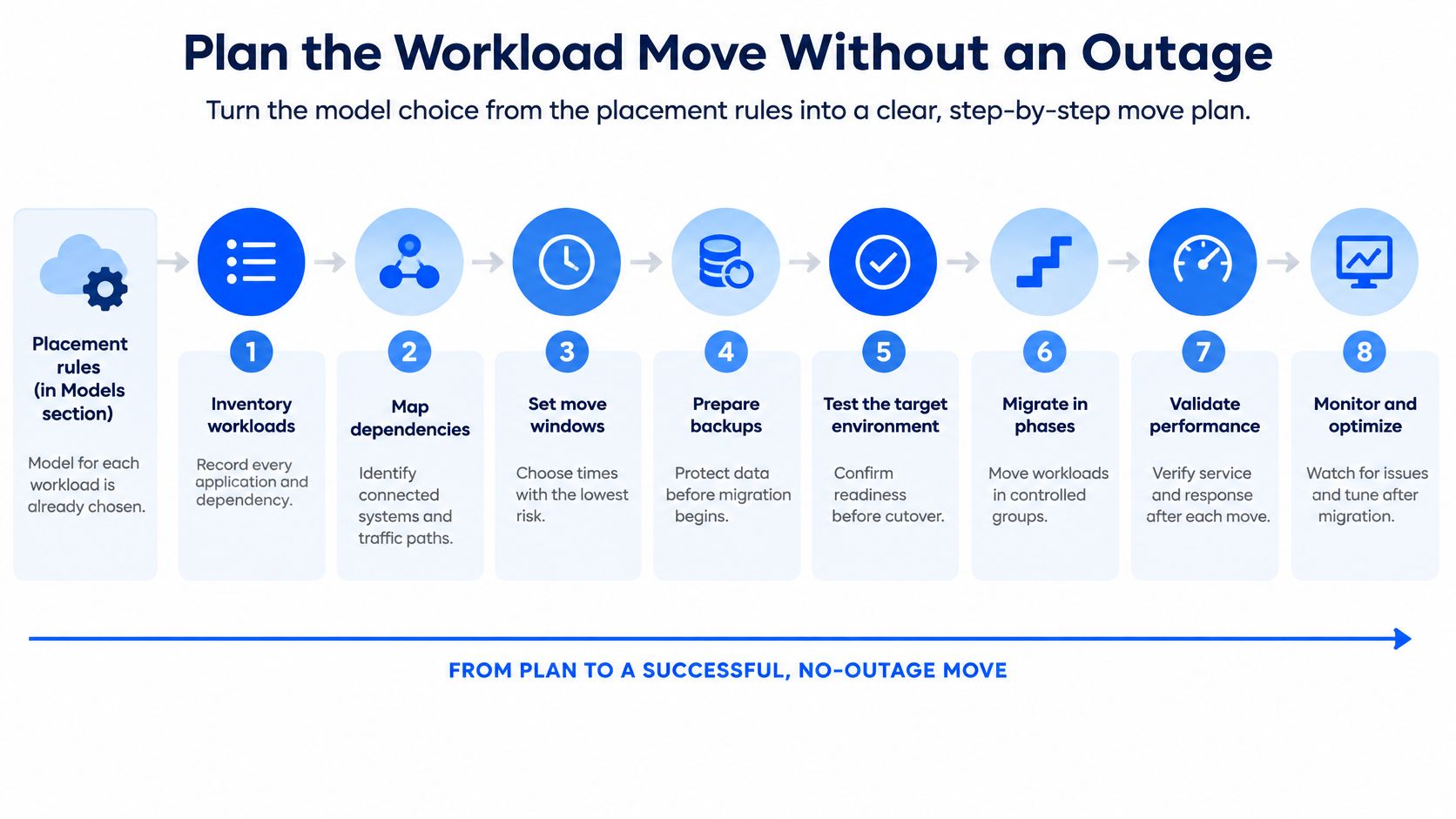
Move in controlled stages
- Inventory applications and dependencies. Record owners, servers, databases, certificates, scheduled jobs, backup locations, and integrations. Reconcile discovery output with application-owner interviews.
- Classify criticality and data residency. Identify services that must move together and restrictions on where production data, replicas, or backups may reside.
- Confirm the target model per workload. Validate the placement decision against the actual contract and target environment. Resolve unsupported operating systems, licensing restrictions, and hardware dependencies before scheduling.
- Map network, identity, and replication. Test routing, authentication, firewall policies, service accounts, and replication behavior. Include systems that remain behind.
- Pilot a low-risk workload. Choose an application with a representative operating pattern and a manageable rollback path. Measure its behavior against the accepted baseline.
- Run in parallel and test failover. Where the application permits parallel operation, verify consistency and recovery. Prevent conflicting writes, and prove that backups restore successfully.
- Cut over in a planned window. Assign a change commander, technical owners, business validators, and a rollback decision point. Obtain explicit acceptance before closing the change.
- Decommission and confirm destruction. Retire old access paths, stop unnecessary billing, reconcile assets, and obtain written confirmation of data destruction where applicable.
Prepare the operating team too
Staff responsibilities will shift from hands-on infrastructure work toward service oversight, capacity decisions, and vendor coordination. Update monitoring destinations, ticket routing, access permissions, and on-call runbooks before cutover. The provider's incident process must connect directly to your internal escalation path.
Jointly approve change windows and define who can pause work. A technically successful move isn't complete if the service desk can't route an incident or the security team can't retrieve logs.
For data center migration planning, we work alongside internal IT teams to strengthen decision-making and reduce evaluation workload. Our approach suits CIOs and business leaders seeking modernization without vendor bias, with access to a bench of over 15 subject matter experts and a dedicated project coordinator after selection.
This week, score your strongest provider candidates using the capacity-and-resilience scorecard. Book a joint review with finance and security, and leave with named owners for every unresolved cost, recovery, and exit question.
MR2 Solutions offers vendor-neutral guidance for evaluating colocation, hybrid, and cloud options, with vendor comparisons, cost insights, solution recommendations, and an implementation roadmap aligned with business priorities. Visit MR2 Solutions to discuss your workload requirements and build an outsourcing decision around capacity, recovery, and full-term value.