
Data Center Brokerage Explained for Smarter Decisions

Your lease renewal is approaching. Your AI team wants more compute. Your security lead is asking tougher questions about resilience and compliance. Meanwhile, the sites that looked available six months ago now seem either underpowered, overpriced, or too slow to deliver.
That's the moment when many CIOs realize they're not just shopping for space. They're making a chain of connected decisions about power, cooling, interconnection, execution risk, commercial terms, and future flexibility. A cabinet quote or a real estate tour won't answer those questions on its own.
Data center brokerage sits in the middle of that problem. At its best, it gives you a vendor-neutral way to compare colocation, hybrid infrastructure, and development-ready options without reducing the decision to square footage or headline rent. It helps you ask the right questions before a contract locks you into the wrong site.
Introduction to Data Center Brokerage Today
A familiar situation looks like this. A company placed infrastructure in a colocation facility years ago when rack density was modest, cloud adoption was simpler, and future growth felt predictable. Then AI workloads arrive, backup windows tighten, compliance reviews deepen, and the old footprint starts showing its limits.
Now the team faces competing pressures. Finance wants cost control. Operations wants a fast path with minimal disruption. Security wants stronger governance. Application owners want capacity that won't run out after the next deployment cycle.
That's why data center brokerage has changed. It used to be easy to treat it like a narrow real estate function. Today it's much closer to strategic sourcing for critical infrastructure.
The market itself helps explain the shift. Large data center sales reached $3.23 billion in 2025, up from $3.04 billion in 2024, with 11 trades above $100 million compared with 6 the year before, according to market reporting on 2025 data center sales activity. That kind of concentration tells you something important. Decisions are getting larger, more specialized, and harder to price casually.
When brokerage becomes necessary
You usually need outside brokerage guidance when one or more of these conditions show up:
- A renewal is no longer routine because your current provider can't support your new power density or expansion timeline.
- A cloud strategy has limits and some workloads need colocation, private infrastructure, or a hybrid design.
- A relocation decision carries operational risk because migration timing, cross-connects, and service continuity matter as much as price.
- Your team lacks market visibility into what providers can deliver in the right geography.
For operations leaders also thinking about facility readiness, resources on data center equipment for warehouses can help frame the physical environment questions that often get overlooked when sourcing discussions stay too high level.
Practical rule: If the wrong site could delay deployment, force retrofits, or trap you in poor expansion terms, the decision has already moved beyond simple procurement.
A vendor-neutral process also matters when internal teams need a common language. Finance sees cost. Engineering sees capacity. Security sees control. Brokerage helps convert those separate concerns into one decision model. For a useful adjacent view of how neutral advisory models work in broader IT sourcing, see this overview of the cloud services brokerage market.
How Data Center Brokerage Actually Works
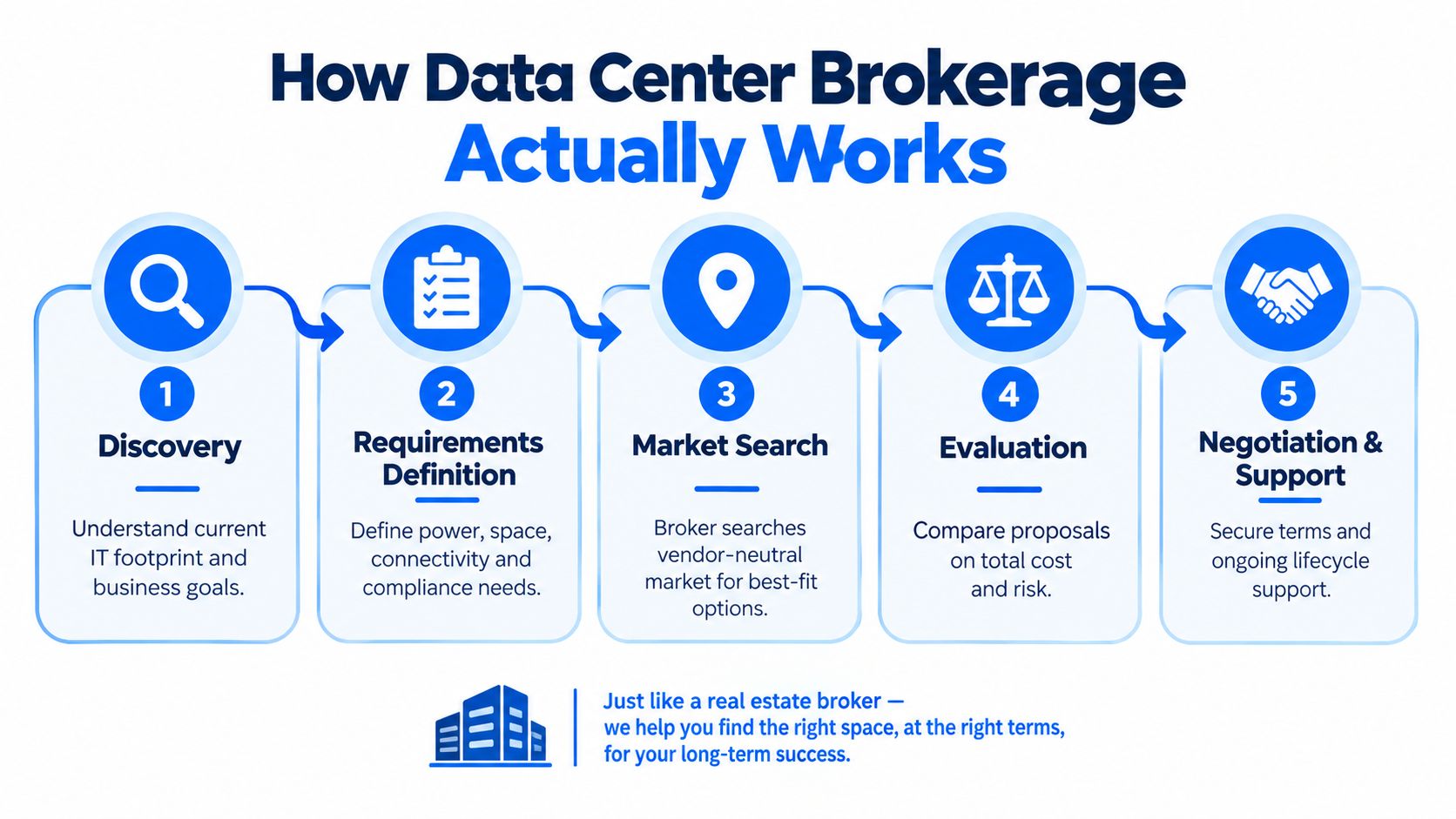
Understand what a real estate broker does: you explain what you need, the broker narrows the field, tests the market, compares options, and helps negotiate terms. Data center brokerage works in a similar way, except the asset isn't just space. It's usable, supportable infrastructure capacity.
A strong process starts by translating business needs into technical and commercial requirements that providers can answer clearly. That sounds obvious, but many projects go sideways because the client asks for “a few cabinets in a major market” when need is dense compute with future cooling headroom, specific network paths, and a migration sequence that won't disrupt production.
Discovery before shopping
Good brokerage begins with discovery, not pricing.
That means documenting your current footprint, application dependencies, latency sensitivities, compliance obligations, remote hands expectations, and likely growth pattern. It also means asking uncomfortable questions early. Are you solving for near-term relief, or for a platform that must support future AI adoption? Are you replacing a facility, splitting workloads, or creating a hybrid operating model?
The best teams organize this around three practical lenses:
- People. Who approves the decision, who owns the migration, and who carries operational risk after go-live?
- Process. How will options be gathered, scored, negotiated, and documented?
- Portfolio. Which providers, markets, and deployment models deserve consideration?
Requirements that providers can actually answer
After discovery, the broker converts broad goals into a requirements package. That package should cover far more than square footage.
A useful request typically includes:
- Power profile with current and expected rack density, redundancy expectations, and expansion assumptions
- Cooling fit including whether standard air cooling is enough or whether denser environments require more specialized design review
- Connectivity needs such as carrier diversity, cloud on-ramps, and cross-connect expectations
- Operational support including remote hands scope, response expectations, and maintenance coordination
- Commercial structure covering term flexibility, ramp schedules, renewal exposure, and implementation timing
A vague requirement creates false choice. A clear requirement eliminates sites that were never viable in the first place.
Market mapping and negotiation support
Once the requirements are clear, the broker maps the market. In MR2 Solutions' published company information, its Technology Brokerage-as-a-Service model is built around People, Process, and Portfolio and a curated ecosystem of 400+ providers, which illustrates the kind of structured comparison a neutral brokerage can bring to multi-vendor sourcing.
That market mapping stage is where ad hoc buying usually breaks down. Direct outreach often produces inconsistent quotes, uneven technical responses, and a lot of time spent interpreting provider language rather than evaluating actual fit.
A broker's role is to:
- Shortlist plausible providers rather than flood the team with options.
- Normalize proposals so costs, assumptions, and exclusions are easier to compare.
- Create competitive tension during negotiation without turning the process into a slow formal RFP.
- Support transaction execution through contract review, implementation coordination, and handoff into operations.
A good brokerage engagement doesn't just help you find a site. It helps your team avoid making a technically expensive decision for commercial reasons, or a commercially attractive decision that becomes operationally painful.
Why Vendor Neutral Guidance Changes Outcomes
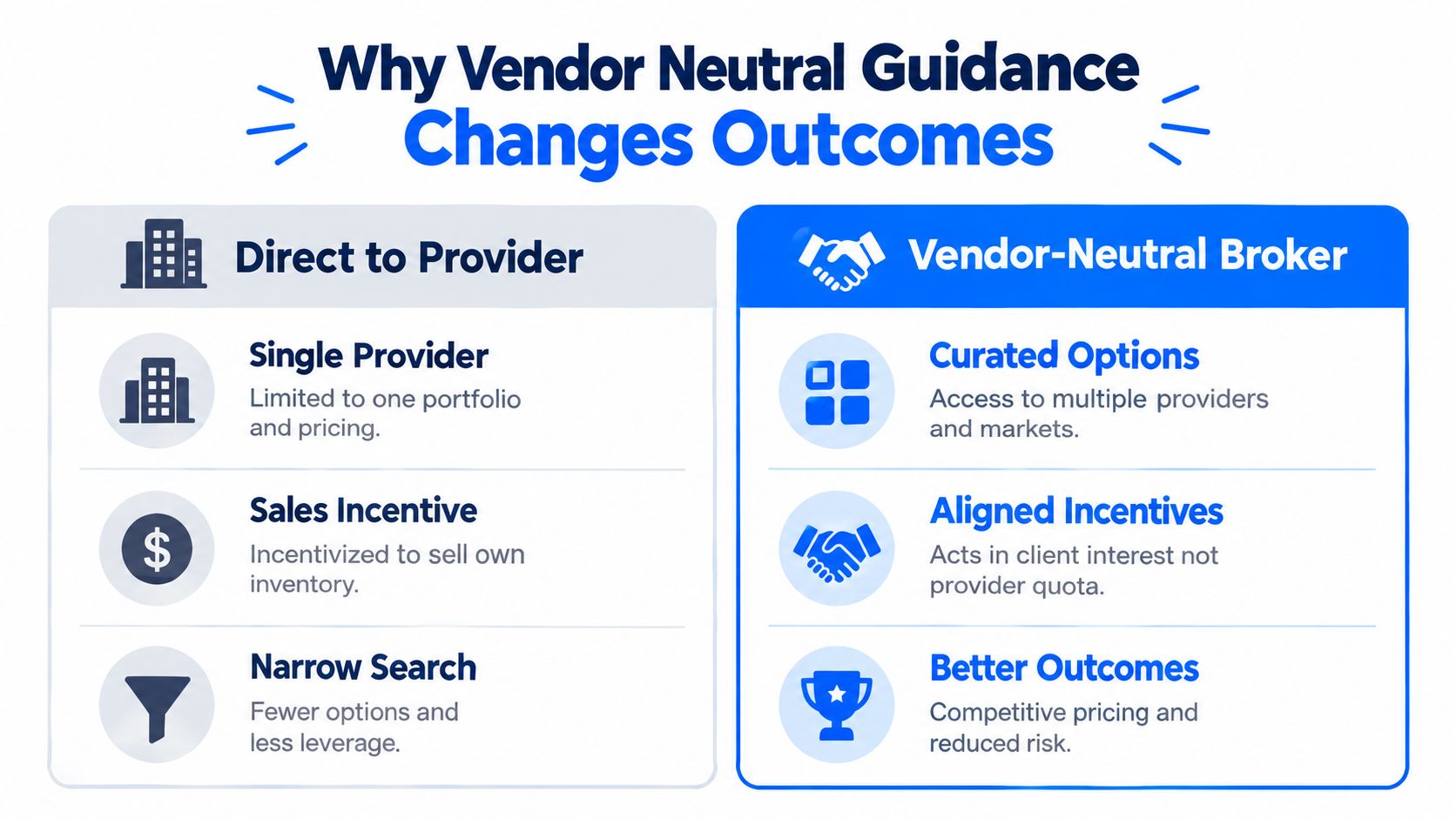
Going direct to a provider can work when your requirements are simple and your market timing is forgiving. But most data center decisions aren't simple anymore. The provider is selling its own inventory, in its own facilities, using its own assumptions about what matters.
That doesn't make direct sales wrong. It means the incentives are narrow.
A vendor-neutral broker approaches the market differently. The goal isn't to place you into a predetermined portfolio. The goal is to identify the option that best fits your workload, timeline, governance model, and cost tolerance.
Direct path versus neutral path
Here's the practical difference:
| Decision factor | Direct to provider | Vendor-neutral broker |
|---|---|---|
| Option set | Limited to one provider's footprint | Broader market view across multiple providers |
| Commercial leverage | Less competitive pressure | Easier to compare terms side by side |
| Technical fit | Filtered through one provider's design strengths | Assessed across varied facility profiles |
| Governance | Internal team coordinates every stream | One neutral point helps organize process |
| Risk visibility | Gaps may surface late | Trade-offs are documented earlier |
Where teams get confused
Some buyers assume brokerage adds a layer between them and the supplier. In practice, it often removes noise. Instead of taking separate calls from sales teams, network teams, solution architects, legal contacts, and implementation managers from multiple vendors, the client gets a coordinated process.
Others assume vendor-neutral means “more choices than we need.” Good brokerage does the opposite. It narrows the field to realistic options and explains why each made the cut.
Decision test: If two offers look similar on price, the better one is usually the proposal with fewer hidden constraints around power delivery, expansion rights, implementation timing, and operating support.
Why neutrality matters in constrained markets
Neutral guidance becomes more valuable when the market is tight, because the question isn't only what's available. It's what's available for your workload profile.
In a loose market, a provider can often absorb ambiguity. In a constrained market, ambiguity costs you. It leads to tours of sites that won't pass engineering review, quotes that don't include the support model you need, and negotiations that start before your internal team agrees on decision criteria.
That's why incentive alignment matters. A neutral advisor has reason to expose trade-offs plainly. If a secondary market gives you lower cost but weaker ecosystem support, your team should see that clearly. If a mature hub costs more but reduces execution risk, that should be visible too.
The value isn't just lower pricing. It's cleaner decisions.
Power Density Pricing and Market Realities You Must Understand
Many infrastructure teams still begin by asking, “How much space do we need?” That used to be a reasonable opening question. It isn't sufficient now.
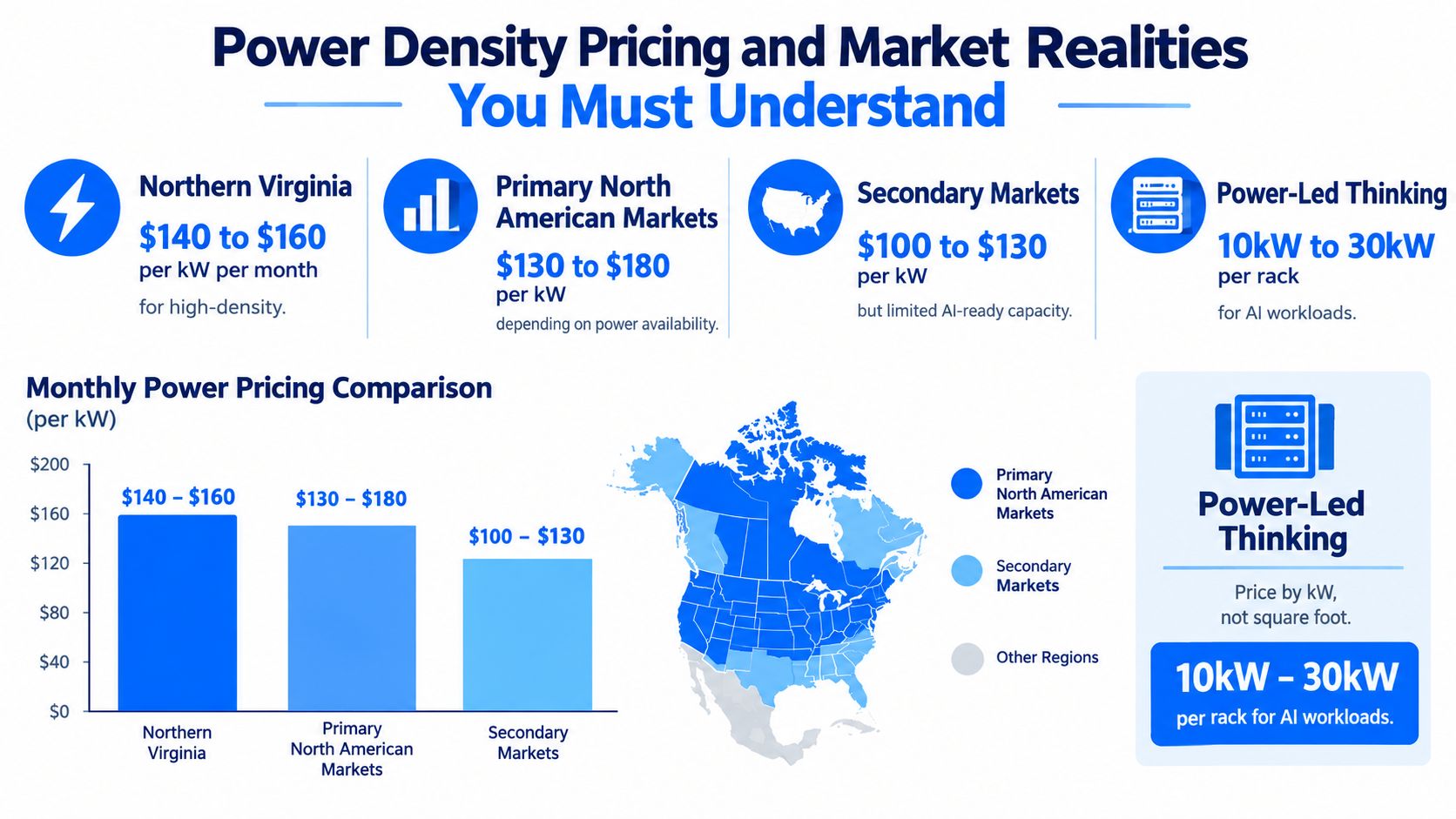
For modern colocation and hybrid data center sourcing, power is the primary unit of reality. Cabinets, cages, and suites only matter if the site can deliver the electrical capacity, cooling profile, and expansion path your workloads require.
What pricing actually signals
Wholesale colocation pricing shows how different markets behave. Benchmark pricing in primary North American markets sits around $196 per kW per month, Northern Virginia is near $173 per kW per month, and Singapore is near $403 per kW per month, according to wholesale colocation market benchmarks. Those spreads tell you pricing isn't just about the room. It reflects power availability, market depth, and supply-demand balance.
The same source notes that 250 to 500 kW requirements average about $196.25 per kW per month in North America, which is a useful reminder that commit size affects unit economics as much as location does.
Why vacancy and density change the math
A second reality is capacity scarcity. CBRE reported U.S. data center vacancy at a record low of 1.4% in H1 2026, and noted that close to 900 hyperscale data centers have been built worldwide, accounting for 37% of total capacity, according to reporting on vacancy and hyperscale growth. That combination pushes buyers into harder timing decisions. Waiting may improve internal certainty, but it can reduce your practical choices.
Then density enters the picture. Average rack density rose from roughly 16 kW in 2025 to 27 kW in 2026, and only one in five operators report readiness for 50 to 70 kW racks that are increasingly common in AI deployments, according to analysis of power density planning and liquid-cooled AI data centers.
That changes how you evaluate an offer. A site may look competitive on paper, but if it can't support your likely density path, the lower rate won't hold.
A better comparison lens
When procurement teams review offers, I suggest a risk-adjusted lens instead of a headline-rate lens.
Look at these factors together:
- Delivered power per rack instead of cabinet count alone
- Cooling topology and whether it aligns with your compute roadmap
- Expansion headroom for denser deployments later
- Time sensitivity if local scarcity could close off inventory
- Operating cost visibility across term length, support, and migration implications
For organizations trying to tie facility choices back to budget discipline, a structured view of technology expense management can help connect infrastructure sourcing with longer-term spend governance.
Cheap per-rack pricing can become expensive very quickly if the site forces de-rating, retrofit work, or a second migration earlier than planned.
How to Select the Right Colocation and Hybrid Partner
Selection gets easier when you stop treating every provider response like a sales pitch and start treating it like evidence. The point isn't to gather the most proposals. It's to build a decision record that your infrastructure, security, procurement, and finance teams can all defend later.
That means scoring providers on operational fit first, then commercial shape. A low-friction deal that can't support your workloads is still the wrong deal.
The criteria that separate viable from risky
Start with workload behavior. Some applications can tolerate distance and shared support models. Others can't. Your shortlist should reflect actual operational demands, not a generic “enterprise-grade” label.
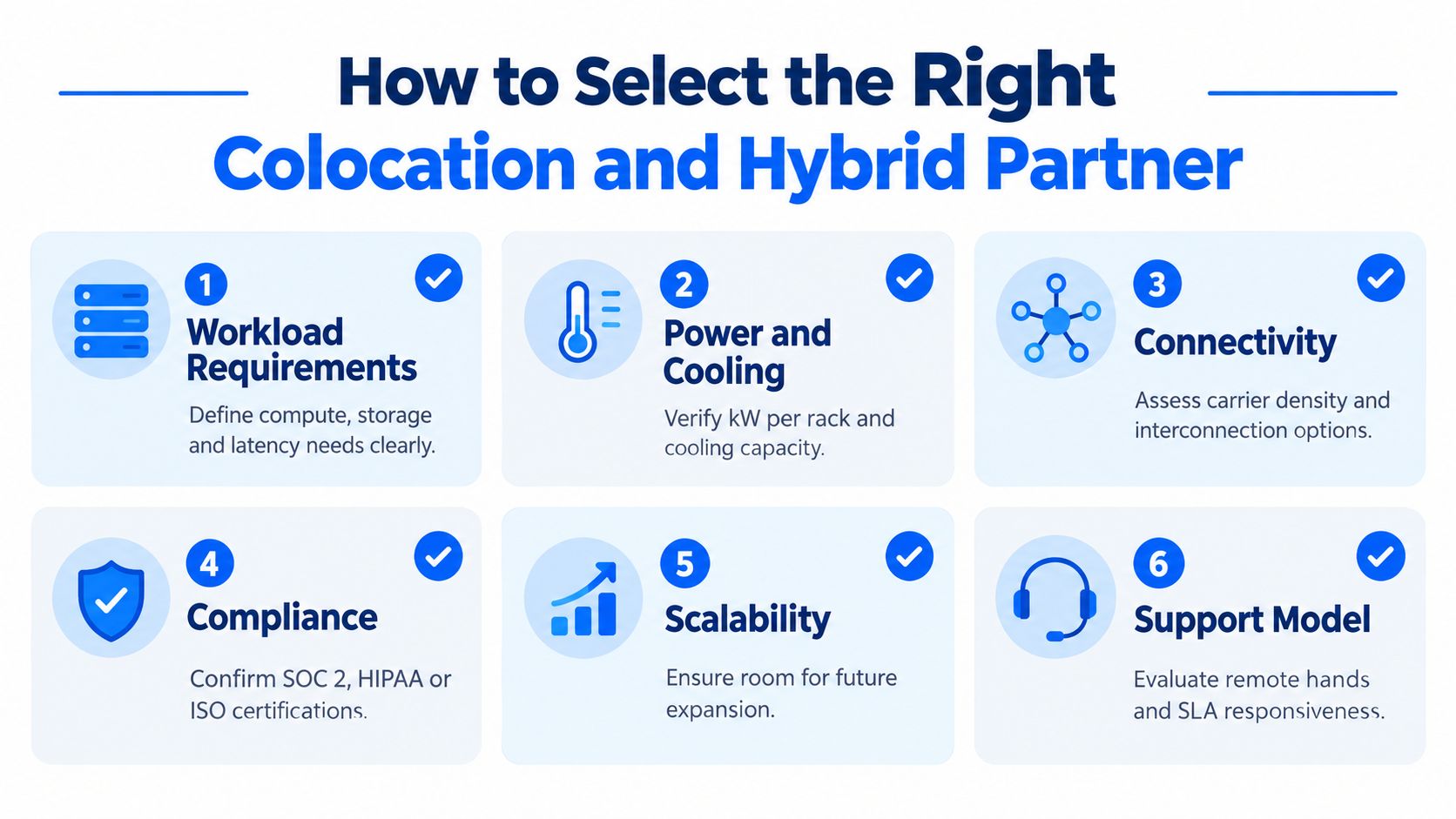
I'd organize the evaluation around six categories:
- Workload fit. Map compute, storage, backup, and latency needs to the facility's actual design and location profile.
- Power and cooling. Confirm present density support, not just future promises.
- Connectivity. Review carriers, cloud adjacency, and cross-connect practicality for your architecture.
- Compliance posture. Match the provider's certifications and control environment to your own obligations.
- Scalability path. Ask how expansion works in the same hall, same campus, or nearby market.
- Support model. Inspect remote hands, escalation, maintenance coordination, and accountability after move-in.
How to run the evaluation without a bloated RFP
A long traditional RFP often creates false precision. Providers respond with polished language, internal teams get buried in documents, and differences emerge late.
A better approach is a structured comparison workshop with a small scorecard. Assign clear owners. Infrastructure validates technical fit. Security reviews controls and audit support. Procurement compares terms. Finance checks cost shape over time. If your internal bench is thin, fractional CIO or CISO support can strengthen the evaluation by testing assumptions before contract signature.
For teams collecting supporting commercial inputs from outside vendors, tools that streamline telecom and connectivity quoting, such as Extend B2B quotes, can help organize adjacent sourcing work that often runs alongside a data center decision.
Governance matters more than the shortlist
Most bad outcomes don't come from choosing an obviously poor provider. They come from choosing a decent provider with weak governance around the decision.
Use a simple model:
| Governance question | What to document |
|---|---|
| Who decides? | Executive owner, technical approver, procurement lead |
| What matters most? | Ranked criteria and non-negotiables |
| What trade-offs were accepted? | Cost versus speed, market maturity versus price, flexibility versus term |
| What must happen after signature? | Migration tasks, dependencies, implementation checkpoints |
For organizations evaluating colocation as part of a broader operating model, managed services and colocation options can be reviewed together so the support model and facility decision stay aligned.
The aim is simple. By the time final negotiations begin, nobody on the client side should still be debating the scoring model.
Real World Applications and Governance After the Deal
The contract is only the midpoint. Once the provider is selected, the work shifts from comparison to execution.
A mid-market manufacturer, for example, may keep core ERP and plant-critical workloads in colocation while continuing to use public cloud for less sensitive applications. The sourcing decision isn't just about where servers go. It's about whether the chosen facility can support practical migration windows, resilient network paths, and operations staff who don't have time for constant onsite intervention.
Three situations that show the real trade-offs
A healthcare organization faces a different problem. Its leadership team may accept a somewhat narrower shortlist if the provider's compliance support, audit responsiveness, and operational discipline are easier to verify. In that case, brokerage helps by keeping the evaluation anchored to risk exposure rather than letting the process drift into a pure price discussion.
An enterprise considering a frontier market has another set of trade-offs. More than half of new North American construction volume is now in frontier markets, while mature hubs remain constrained. CBRE also noted that 74.3% of new capacity was already spoken for, average asking rates for 250 to 500 kW requirements in primary wholesale markets rose 6.6% year over year, and North America data center investment sales reached $1.7 billion in H1 2026, according to reporting on market maturity, frontier expansion, and constrained supply. That doesn't mean frontier markets are wrong. It means lower apparent cost has to be weighed against labor depth, vendor ecosystem strength, and time-to-operate risk.
The cheapest market on paper can be the slowest market to make usable.
What governance looks like after signature
Post-deal governance should cover implementation, not just invoices.
That includes:
- Project coordination between provider teams, network carriers, internal infrastructure staff, and security stakeholders
- Migration oversight so dependencies, handoffs, and outage tolerances are documented
- Commercial governance around billing start dates, service acceptance, and change requests
- Operational reviews that revisit support quality, growth assumptions, and optimization opportunities over time
Operational reminder: A signed contract doesn't create readiness. Your team still has to convert committed capacity into stable service.
The best brokerage relationships continue after the transaction because the environment keeps changing. New applications arrive. Density shifts. Renewal dates approach. Support expectations evolve. Governance protects the original business case from drifting off course once daily operations take over.
Making Confident Data Center Decisions With the Right Partner
The main shift is straightforward. Stop buying data center capacity as if it were mostly a space decision. Start evaluating it as a power-led, risk-adjusted infrastructure decision.
That changes how you compare providers. It changes what procurement should ask for. It changes how engineering, security, and finance work together. And it changes what a broker is there to do.
The right data center brokerage process should help you answer a short list of serious questions:
- Can this site support our workload density now and later?
- Are we paying for usable capacity or just reserving nominal space?
- What execution risks come with this market, provider, and timeline?
- Do the commercial terms match our migration and growth reality?
- Who will govern the service after signature?
If those answers aren't clear, the decision isn't ready.
A confident process usually has four qualities. It starts with rigorous requirements, not provider tours. It compares options through a neutral lens. It treats cost as part of a wider operating model, not as a standalone metric. And it carries governance through implementation and renewal planning.
That's where experienced guidance earns its keep. Not by adding noise, but by reducing avoidable mistakes before they become expensive operational constraints.
MR2 Solutions provides vendor-neutral technology brokerage, including support for data center, colocation, hybrid infrastructure, evaluation, contract review, and ongoing governance. If your team needs a structured way to compare providers, align technical and commercial requirements, and move from sourcing to implementation with less ambiguity, visit MR2 Solutions.