
Sd Wan Security
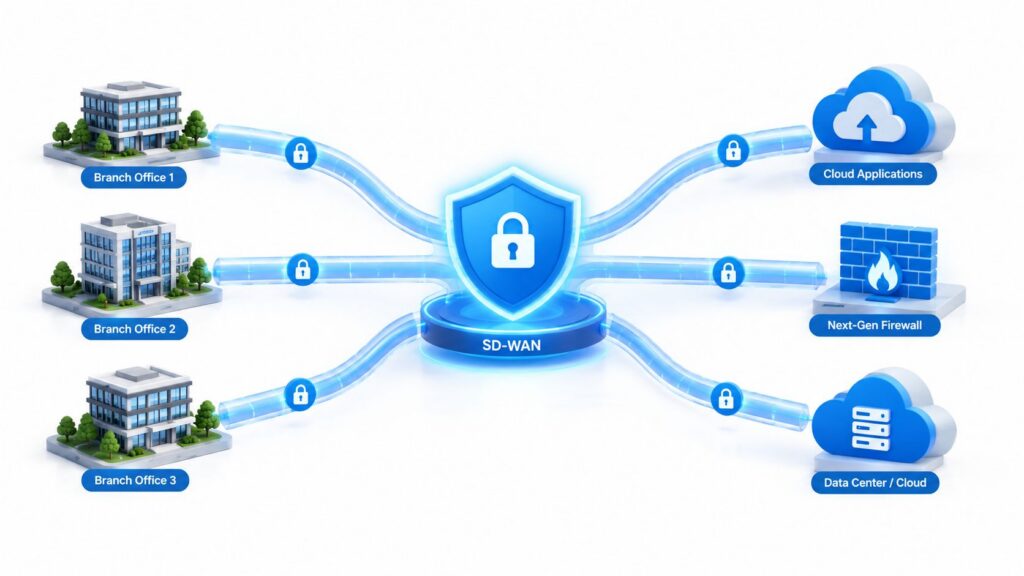
By the end of 2026, Gartner projects that 60% of new SD-WAN purchases will be part of a single-vendor SASE offering, up from 15% in 2022 (Dell'Oro coverage citing Gartner). That's the number that should reset how you think about SD-WAN security.
This isn't a router feature discussion anymore. It's a platform decision about who enforces policy, where inspection happens, how identities map to traffic, and whether your team can operate the thing after rollout.
Most articles stop at design. That's where vendors like the story. Real risk starts after the pilot goes live, the branch count expands, exceptions pile up, and somebody discovers six months later that half the edge fleet isn't on the firmware version they thought it was. That's the practical side of SD-WAN security that gets ignored.
Why SD-WAN Security Is Now a Board-Level Concern
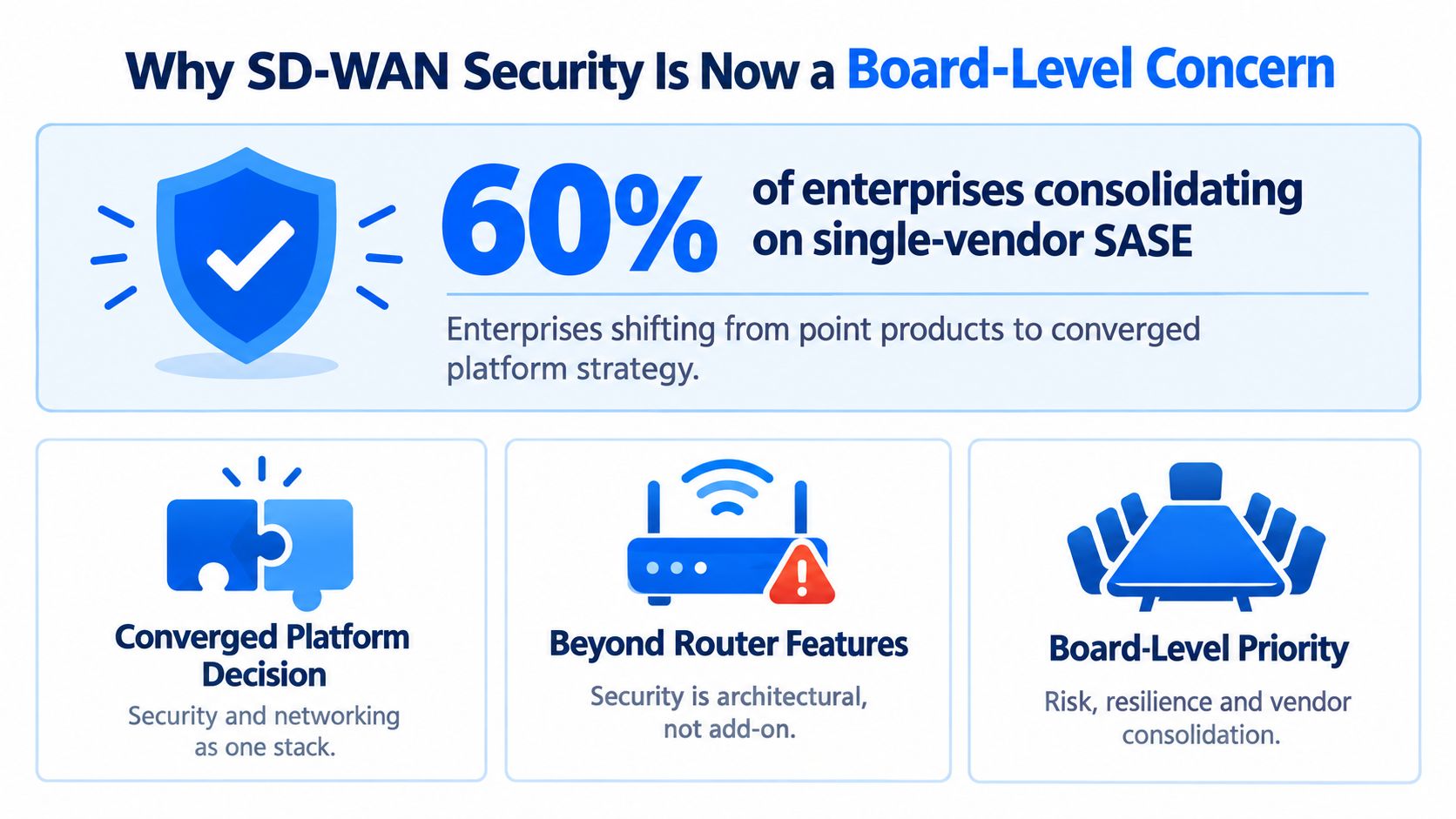
More than half of WAN teams are already using at least some SASE elements, and a further share are actively adopting them. That alone explains why SD-WAN security now lands in board conversations. The WAN edge no longer affects branch connectivity alone. It shapes internet breakout, traffic inspection, remote user access, and the vendor stack your team may be tied to for years.
Boards also understand concentration risk. One platform can now influence routing policy, segmentation, SaaS access, and security enforcement across dozens or hundreds of sites. If that platform fails, is misconfigured, or falls behind on patches, the problem is not confined to the network team. It becomes a business continuity issue and a cyber risk issue at the same time.
That operational reality gets missed in a lot of SD-WAN buying cycles.
Executives are paying attention for three practical reasons:
- Risk concentration: A single control plane can affect connectivity and security policy across the estate.
- Operational dependency: Day-two work matters more than the pilot. Patch cycles, certificate rotation, config drift, and exception handling decide whether the design stays secure.
- Vendor lock-in: Converged platforms can cut tool sprawl, but they also make migrations, contract exits, and hybrid operating models harder.
The vendor pitch usually focuses on architecture. The board should focus on failure modes.
If your SD-WAN provider also wants to own ZTNA, SWG, CASB, and branch inspection, treat that as a governance decision with security, procurement, and operations involved from the start.
A serious review should answer five blunt questions:
- Which controls run natively at the edge, and which only exist if traffic is hairpinned to a cloud security point?
- What happens to application performance when you turn on the inspection your security team requires?
- How will you patch, audit, and verify a live fleet after rollout, not just during acceptance testing?
- Can the operating model handle a mixed SD-WAN and SASE estate without duplicate policy sets and constant exceptions?
- Who owns incident response when the issue sits between networking, endpoint, identity, and a managed cloud security service?
That is why this has moved above the network team. The hard part is no longer selecting a feature set. The hard part is running the platform cleanly after deployment, especially in hybrid estates where bolted-on inspection adds latency, troubleshooting friction, and policy inconsistency.
How the SD-WAN Architecture Creates New Risks
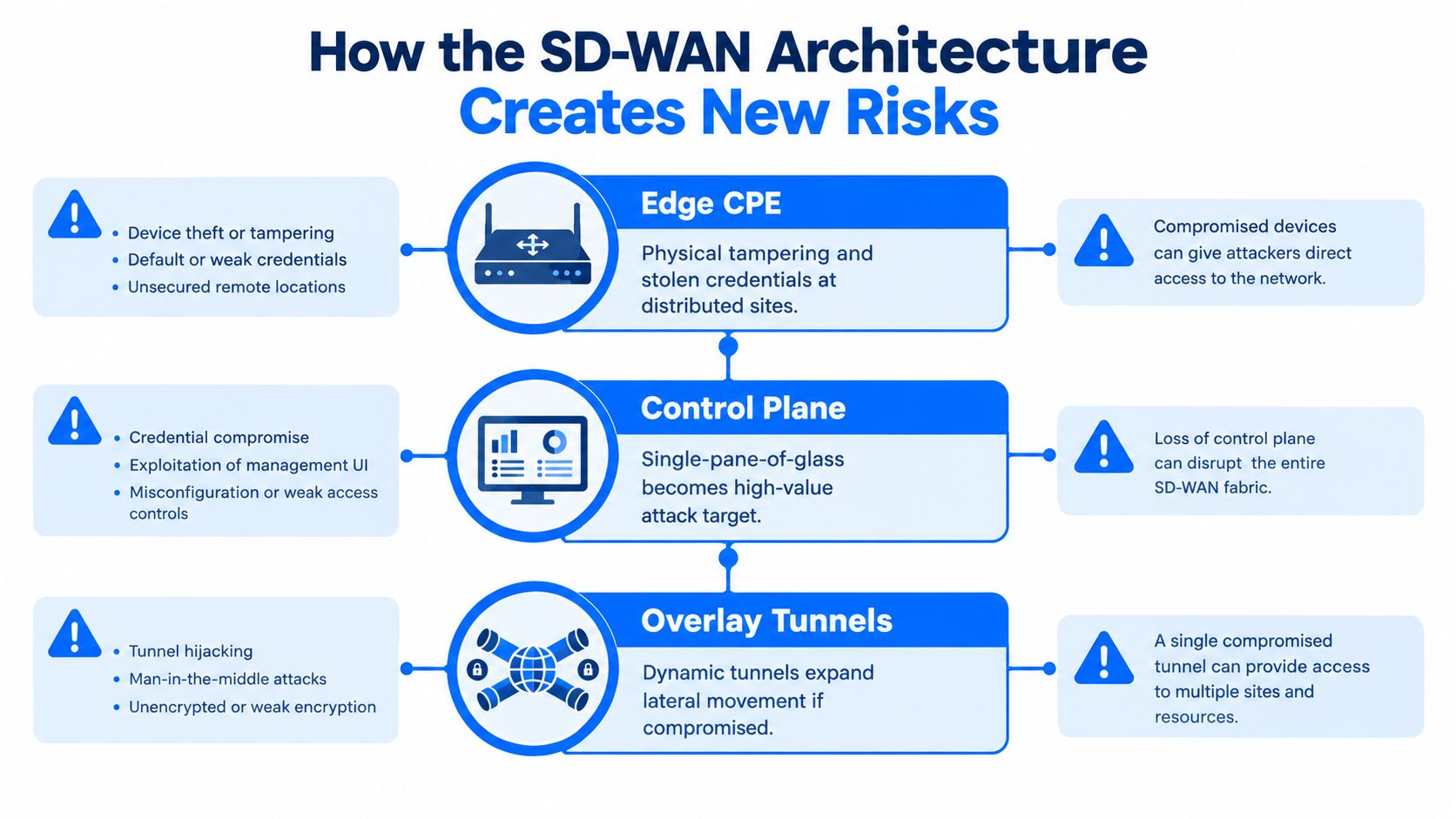
SD-WAN expands the security boundary. Traditional WANs were simpler to reason about. SD-WAN adds an orchestration layer, policy abstraction, encrypted overlays, and edge devices that often sit in lightly managed sites. Every one of those becomes a security-relevant component.
If you need a refresher on the moving parts, this overview of how SD-WAN works is a useful baseline before you assess the threat model.
The edge is where trust can fail first
Independent research on SD-WAN threats notes that weaknesses often concentrate at the customer-premises edge, especially during secure bootstrapping and device trust establishment. If an attacker compromises onboarding or device identity early, they can affect segmentation, traffic steering, and confidentiality across the fabric, not just one appliance (SD-WAN threat landscape research).
That's the piece many glossy vendor diagrams hide. A branch appliance isn't just a box that forwards traffic. It's a trust anchor.
Four layers security leaders should map to the risk register
| Layer | What it controls | Failure scenario | Why it matters |
|---|---|---|---|
| Edge CPE | Local forwarding and enforcement | Compromised onboarding or stale credentials | Bad trust starts before traffic enters the overlay |
| Control plane | Central policy and orchestration | Unauthorized policy changes or controller abuse | One mistake can propagate everywhere |
| Overlay tunnels | Site-to-site transport | Weak encryption posture or bad key lifecycle | Confidentiality and segmentation can collapse together |
| APIs and automation | Integrations and provisioning | Misused tokens or overexposed admin workflows | Supply chain and admin tooling become attack paths |
The design mistake I see most
Teams assume encryption equals security. It doesn't. Encrypted tunnels protect traffic in transit, but they don't fix bad trust decisions, overbroad admin roles, or weak segmentation logic.
A compromised orchestrator is worse than a compromised branch firewall because it can rewrite intent across the estate.
The right response starts before deployment with threat modeling, mandatory encryption on all overlays, and a strict zero-trust policy design that leaves no fallback path into cleartext or broad implicit trust. If your design depends on “temporary exceptions” to function, those exceptions will still be there a year later.
Built-In Protections Vendors Ship Today
A feature checklist is not a security posture. In live SD-WAN estates, the gap between what the datasheet says and what operations teams can keep enabled is where risk shows up.
Vendors ship a familiar set of controls: encrypted overlays, branch firewalling, IDS or IPS, URL filtering, DNS policy, and segmentation. Some of these are native and enforced in the forwarding path. Others are licensed add-ons, cloud services, or features that look good in demos and get scaled back once latency rises or hardware starts to choke.
That gap has been obvious for years. A 2018 SD-WAN security survey, summarized by Virtualization Review, found that many buyers were pursuing SD-WAN to improve security and cut appliance sprawl, while branch security operations remained a major pain point and direct internet access raised concern for many respondents. The same survey also reported prior breach experience across a large share of organizations. The buying intent was clear. The operating model was not.
What bundled security actually includes
Group the built-in protections into three categories and judge them differently.
- Transport and platform protections such as tunnel encryption, certificate handling, secure boot, controller authentication, and signed software images. These should be baseline features, not premium upsells.
- Inline policy enforcement such as stateful firewalling, application-aware rules, segmentation, and local internet breakout controls. These matter because they can stop bad traffic at the branch without hairpinning everything to a hub.
- Attached security services such as cloud sandboxing, DNS filtering, web filtering, and threat feeds. These can be useful, but they often depend on extra licenses, extra traffic steering, or a separate cloud control plane.
Treat those categories differently in evaluation. A vendor that bundles DNS filtering but still makes patching clumsy, certificate rotation manual, or local policy troubleshooting opaque has not solved the hard part.
Built-In SD-WAN Protections Claim vs. Reality
| Capability | Vendor Claim | What usually happens in production | Common gap |
|---|---|---|---|
| Overlay encryption | Secure fabric by default | Usually enabled and stable | Teams overestimate what encryption solves |
| Stateful firewall | Branch protection included | Good for baseline east-west and internet edge policy | Rules get widened to avoid branch outages |
| IDS or IPS | Threat prevention at the edge | Useful only when hardware sizing, signatures, and bypass behavior are understood | Performance hits push teams to disable or narrow inspection |
| URL filtering | Safer direct internet access | Works for common web controls | Policy coverage breaks across traffic paths, user groups, or license tiers |
| DNS security | Malicious domains blocked | Effective for known bad destinations | Logging and policy consistency are often weaker than expected |
| Segmentation tags | Zero Trust ready | Helps express intent across sites | Tags alone do not create least privilege |
Here is the vendor gloss that buyers miss. Security features are easy to ship. Security features that stay on after six months of change windows, ISP churn, emergency patching, and hybrid SD-WAN plus SASE policy drift are much harder.
The controls that deserve the closest scrutiny
If you are evaluating built-in security, focus on four things.
First, key and certificate lifecycle. Ask how the platform handles certificate issuance, rotation, revocation, and replacement after a device compromise. If the answer involves manual cleanup across dozens or hundreds of sites, you have an operational problem, not just a PKI detail.
Second, inspection under load. IDS, IPS, TLS inspection, and malware analysis all cost CPU and add delay. Vendors rarely lead with the throughput numbers after every recommended security control is turned on at the same time. Ask for that number.
Third, logging and forensics. Branch security that cannot produce usable logs during an incident is little better than blind filtering. You need session visibility, policy hit data, config change history, and export into the tools your SOC already runs.
Fourth, patching discipline. This gets ignored in pre-deployment guides. It should not. The branch appliance, the orchestrator, the controller stack, and any hosted management plane all need a clear patch cadence, rollback plan, and exposure window policy. Security debt in SD-WAN usually builds after go-live.
Why built-in protections still get underused
The common failure pattern is simple. The network team enables the headline features, traffic takes a performance hit, a few business apps break, and policy gets relaxed in the name of stability. Six months later the environment still looks secure on paper, but half the meaningful controls are running in monitor mode, bypassed for major apps, or inconsistent across regions.
This is even more common in hybrid estates. One policy lives on the branch appliance. Another lives in the cloud security stack. A third sits in the identity layer. Vendors sell that as convergence. Operations teams inherit split troubleshooting, split logs, and split ownership.
Ask one hard question during every product review: What security controls stay enabled in real customer environments after full rollout, and what performance penalty comes with them? If the vendor cannot answer that clearly, the feature sheet is carrying the argument.
SD-WAN and the Path to SASE Convergence
Cloud-delivered security spending keeps rising, but live SD-WAN estates are not converging into one clean model. They are turning into hybrids. That matters more in operations than in architecture diagrams.
The pre-sales version of SASE is tidy. One policy plane. One vendor. One path to secure internet and SaaS access. The live environment usually looks different. Branches still have local breakouts, some sites still inspect traffic on-prem, remote users sit on a separate stack, and exceptions pile up for latency-sensitive apps, regulated traffic, and acquired networks.
The market is converging unevenly
An Aryaka SASE survey report showed strong interest in integrated SASE and SD-WAN, while a meaningful share of organizations still planned to keep SD-WAN separate. That matches what operators see after rollout. Convergence is real. Full standardization is not.
Treat hybrid as the default state, not a temporary flaw. If your plan assumes every branch, user, and application will land on one enforcement model in the first phase, the plan is wrong.
What changes once SASE enters an existing SD-WAN estate
The decision is not whether SASE is good. The decision is where you want inspection to happen, how many policy systems your team can realistically run, and which traffic can tolerate extra hops.
| Dimension | Integrated NGFW at Branch | Single-Vendor SASE | Hybrid (Most Common) |
|---|---|---|---|
| Policy location | Mostly local or appliance-centric | Unified cloud-first control plane | Split by use case |
| Performance profile | Strong for on-prem inspection | Can add tunnel stacking and path complexity | Depends on traffic class and exception design |
| Tool familiarity | High for firewall teams | Higher consistency across users and sites | Mixed |
| Operational burden | More devices and policy surfaces | Less hardware sprawl, more platform dependence | Highest coordination load |
| Best fit | Regulated branches and local workloads | SaaS-heavy and distributed user environments | Enterprises balancing legacy, cloud growth, and regional constraints |
That last column is where many teams end up. Vendors present hybrid as a stepping stone. In practice, it often becomes the long-term operating model, especially after acquisitions, regional compliance requirements, or application performance complaints.
My recommendation on the trade-off
Keep branch-based firewalling where local applications, plant networks, or regulated data flows need low-latency inspection and tight local control. You will carry more hardware and more policy surfaces, but you avoid forcing every sensitive session through a cloud detour.
Use single-vendor SASE where internet access, SaaS usage, and roaming users dominate. It simplifies policy language across users and sites, which is valuable. It also creates hard dependencies on provider POP quality, identity integration, and troubleshooting across someone else's inspection path. If your team is also reviewing remote access strategy, this primer on SSL TLS VPN for MSPs is a useful reference point for how encrypted access choices affect the wider edge design.
If you are comparing designs, use a vendor-neutral view before you commit to a migration path. SD-WAN services for architecture assessment and rollout planning can help teams compare overlay-only, SASE-first, and hybrid operating models based on policy ownership, inspection latency, and support load, not just license bundles.
My advice is simple. Buy for the environment you will still be operating after year two. That means patches, policy drift, split logging, carrier variation, and performance exceptions. Not the polished convergence story from a sales deck.
Segmentation and Zero Trust Inside the WAN
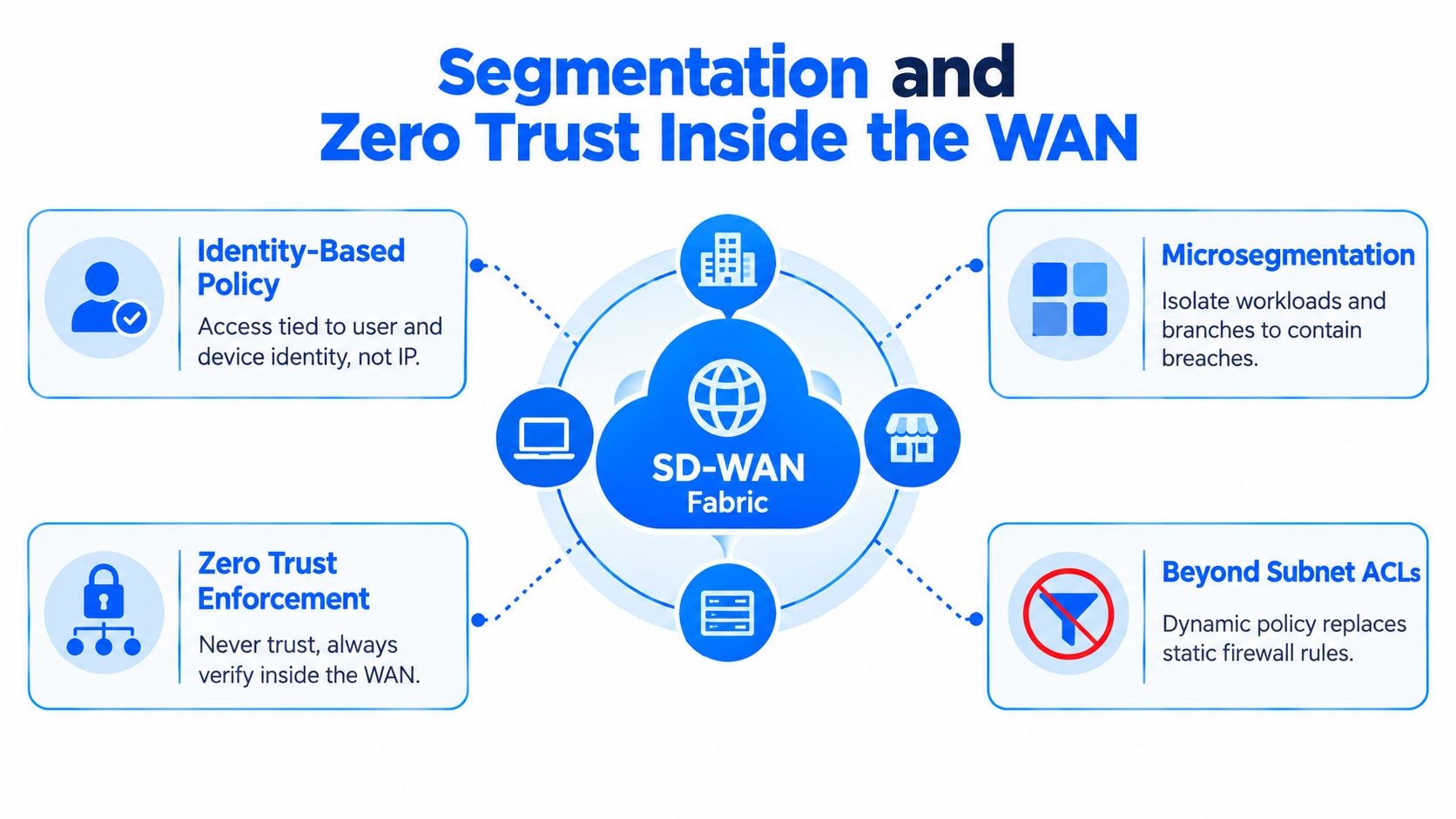
Most SD-WAN segmentation projects are too network-centric. They stop at VLANs, route domains, and ACLs. That's not enough once traffic moves across encrypted overlays and policy follows applications across sites and cloud edges.
Inside an SD-WAN fabric, segmentation has to be identity-aware. If it isn't, you're just recreating old trust zones with nicer orchestration.
Start with overlay-level isolation
Use separate routing domains or equivalent segmentation constructs for major trust boundaries. Guest access, point-of-sale, user traffic, OT, and server access should not share the same broad transport policy just because they happen to leave the same branch.
VLAN segmentation still has value locally, but it doesn't solve trust once sessions enter the fabric. If you need a simple business case for non-network stakeholders, this explainer on why segment your business network is a useful companion resource.
Then make policy identity-based
A workable zero-trust posture inside the WAN usually depends on three decisions:
- Tag by identity, not only by subnet. Use user, device posture, workload role, or application identity wherever the platform supports it.
- Author policy centrally. The orchestrator should push intent consistently so access follows the session instead of the branch topology.
- Default to least privilege. Branch-to-branch and branch-to-cloud paths should open only what specific users, applications, and services require.
What good policy looks like
| Design choice | Weak version | Strong version |
|---|---|---|
| Guest segmentation | Separate VLAN only | Separate overlay plus explicit internet-only policy |
| Branch-to-branch access | Broad any-to-any trust between sites | Specific app and role-based permissions |
| Admin access | Shared jump paths and static trust | Identity-bound admin policy with narrow scope |
| Cloud access | General egress rules | Per-app steering with inspection and posture checks |
The mistake that breaks zero trust
Teams often run one trust model for users and another for sites. That creates policy conflict immediately. The SD-WAN fabric needs the same identity provider, posture signals, and policy logic that govern user-to-application access. Otherwise, the branch network stays “trusted” while the user side becomes zero trust. That contradiction won't hold.
The Underserved Side Securing SD-WAN After Deployment
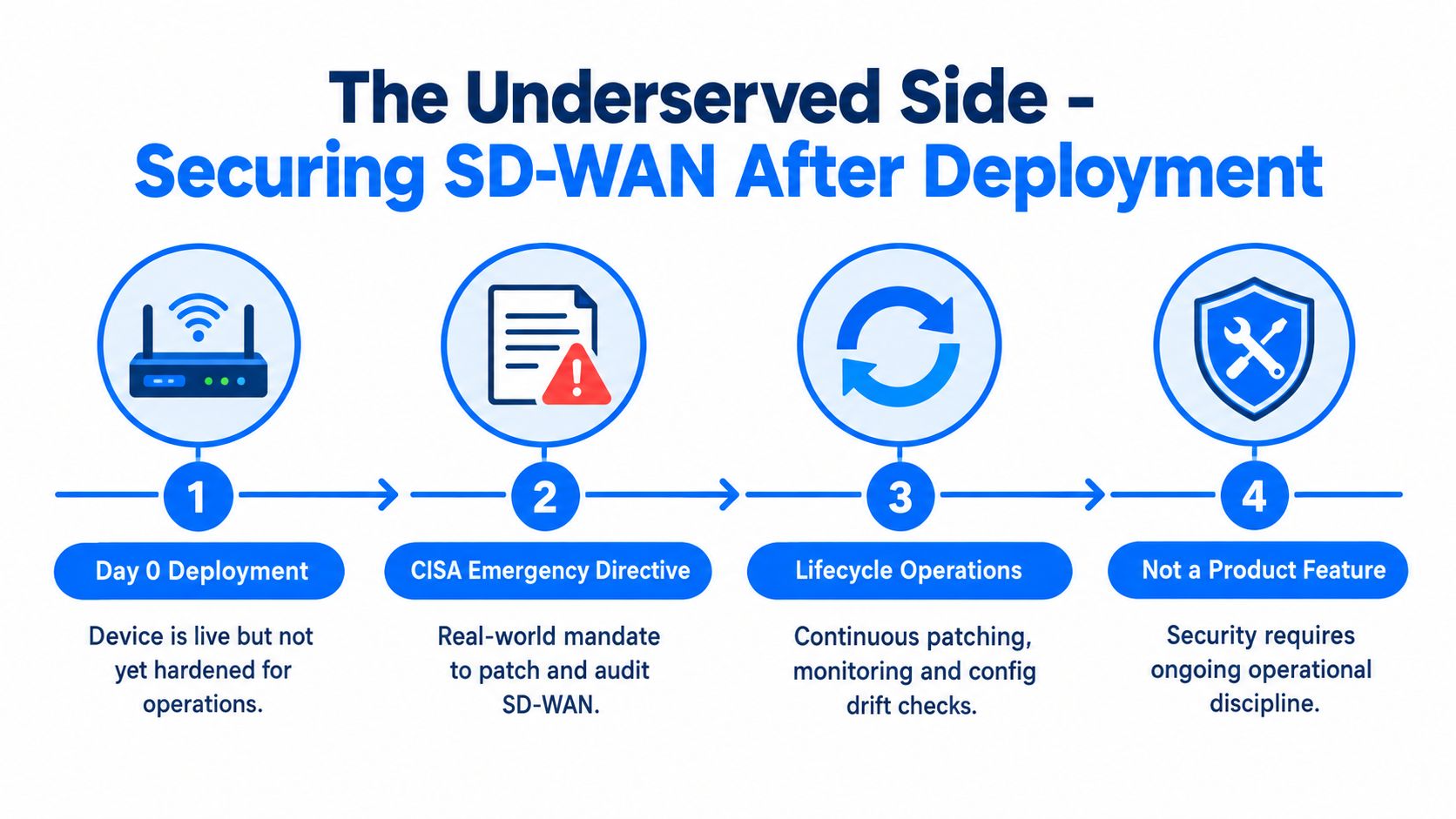
The most dangerous assumption in this market is that SD-WAN is secure once the rollout is done. It isn't. Deployment is the starting line. Real security depends on whether the team can patch, verify, rotate, audit, and recover across a live distributed fleet.
That blind spot became impossible to ignore in 2026 when CISA issued an emergency directive for Cisco Catalyst SD-WAN systems. Agencies were required to identify affected systems, patch them, collect artifacts, and report hardening actions. The same coverage noted that seven Catalyst SD-WAN CVEs were added to CISA's KEV catalog in 2026, including a maximum-severity authentication bypass and multiple privilege-escalation and file-overwrite issues (Industrial Cyber coverage of the CISA directive).
What secure operations actually require
A credible post-deployment SD-WAN security program includes:
- Continuous vulnerability tracking: Follow vendor PSIRT and advisory feeds. Don't rely on annual refresh reviews.
- Staged software rollouts: Update controllers and edge devices in a planned sequence with maintenance windows and rollback criteria.
- Certificate lifecycle management: Rotate tunnel and platform certificates on schedule, not only after incidents.
- Orchestrator hardening: Enforce MFA, disciplined RBAC, and audit logging into the SOC's SIEM.
- Drift validation: Compare intended policy in the orchestrator with what the branch is really enforcing.
The problems teams miss
I see the same failures repeatedly:
- Orphaned branches: A site was refreshed, moved, or carved out and never brought back into normal patch cadence.
- Shadow tunnels: Troubleshooting or temporary migration paths stay in place and bypass standard inspection logic.
- Config drift: The controller says one thing. The edge is doing another because of local changes, failed pushes, or partial remediation.
Secure SD-WAN is a daily operating discipline. It is not a certificate handed out at the end of implementation.
What leadership should ask for
Ask your network and security leads for evidence, not reassurance:
- A current inventory of controllers and edge appliances.
- A documented patch sequence and rollback method.
- Proof that admin access is protected with MFA and auditable.
- A process for validating that segmentation and tunnel policy still match intent after changes.
If the answer is “the platform handles that,” dig deeper. Platforms help. They don't replace operations.
Hardening Checklist for a Secure SD-WAN Deployment
This is the checklist I'd hand to a deployment team or use in an audit. It's ordered by what usually reduces risk fastest.
One design warning matters up front. Independent analysis notes that combining security appliances with SD-WAN overlays can reduce firewall throughput by roughly 35 to 55%, with throughput dropping from 10 to 20 Gbps to 6.5 to 9 Gbps because of processing overhead and tunnel encryption or decryption (JICRCR analysis on SD-WAN security architecture). If you size links and hardware as if security were free, you'll either suffer performance problems or weaken policy to compensate.
Tier one sizing and architecture
Before rollout, lock these down:
- Model the inspected path: Size bandwidth and hardware for real encrypted and inspected traffic, not idealized forwarding.
- Choose mandatory overlay encryption: Use AES-256 on the data plane and TLS 1.3 on control-plane communications where the platform supports those controls, as recommended in the same analysis.
- Define failure behavior: Decide what happens if an inspection service, tunnel, or controller path fails. Secure failure beats permissive fallback.
- Validate routing adjacencies: Lock down BGP or OSPF relationships so only intended peers can influence path decisions.
For deeper planning before procurement and implementation, this SD-WAN design guidance is a practical starting point.
Tier two configuration hardening
These are mandatory in production.
- Protect the orchestrator: MFA for all admin access. Strict RBAC. No shared admin accounts.
- Use least privilege segmentation: Don't let branch-to-branch trust default to broad connectivity.
- Disable weak exceptions: If compliance or policy requires it, remove split-tunnel behavior that creates uncontrolled egress paths.
- Harden management exposure: Keep admin interfaces tightly limited and fully logged.
Field advice: Most SD-WAN breaches won't start with a broken tunnel cipher. They'll start with weak administration, stale trust, or an exception nobody cleaned up.
Tier three post-deployment validation
After go-live, teams need recurring checks:
- Subscribe to PSIRT notifications: Firmware risk is now part of normal branch operations.
- Stage updates carefully: Test controller and edge changes before broad rollout. Document rollback every time.
- Run synthetic testing: Validate app paths, failover behavior, and policy continuity under load.
- Review drift quarterly: Compare a hardened golden template against live site configurations.
- Audit logging and alerting: Send control-plane and admin activity into the SOC workflow where it can be correlated.
The final test is failover under pressure. Many environments look secure on a clean primary path and become sloppy when links flap, controllers fail over, or inline inspection degrades. That's where hidden unencrypted escapes and broad bypass rules usually show up.
Making the Right Call for Your Network
There isn't one right SD-WAN security model. There's a right model for your operating reality. The wrong move is pretending every enterprise should collapse into a single architecture immediately.
A cloud-heavy company with few local workloads can tolerate different trade-offs than a regulated branch network with on-prem systems and strict evidence requirements. The decision should come down to policy consistency, operational maturity, and how much control-plane complexity your team can absorb.
Matching Deployment Posture to Organization Profile
| Org Profile | Recommended Posture | Key Trade-off | Break-Even Trigger |
|---|---|---|---|
| SaaS-heavy, distributed users, limited branch complexity | Pure SASE or SASE-first | Higher platform dependence | When user-to-app traffic matters more than site-to-site design |
| Regulated branches with local apps and mature firewall team | Best-of-breed SD-WAN plus cloud firewall where needed | More policy surfaces to manage | When local inspection and evidence requirements dominate |
| Mixed legacy WAN, growing cloud use, multiple regions | Hybrid | Two control planes and more governance overhead | When uniform policy and gradual migration both matter |
Questions worth taking into vendor reviews
Use these questions and don't let anyone dodge them:
- How is policy authored today? Network objects, identities, applications, or a mess of all three?
- How is policy audited? Not advertised. Audited.
- What is the exit path? Can you consume overlay, security, or both separately if the relationship changes?
- What breaks during failover? Ask for the ugly answer, not the demo answer.
- Who owns lifecycle operations? Internal team, managed provider, or shared model?
The decision most teams actually face
The practical choice isn't “SD-WAN or SASE.” It's whether you can run a hybrid estate without losing control of policy and patching. That usually decides the outcome more than feature count does.
If the team can support two control planes cleanly, hybrid often buys the best transition path. If it can't, simplification may be worth more than best-of-breed purity.
MR2 Solutions helps organizations evaluate SD-WAN, SASE, and hybrid network security models with a vendor-neutral process that covers architecture, provider selection, implementation coordination, and ongoing governance. If you need a second opinion on platform fit, operational risk, or how to harden a live multi-site estate, visit MR2 Solutions.