
Vendor Evaluation Template Guide: 10 Free Picks for 2026
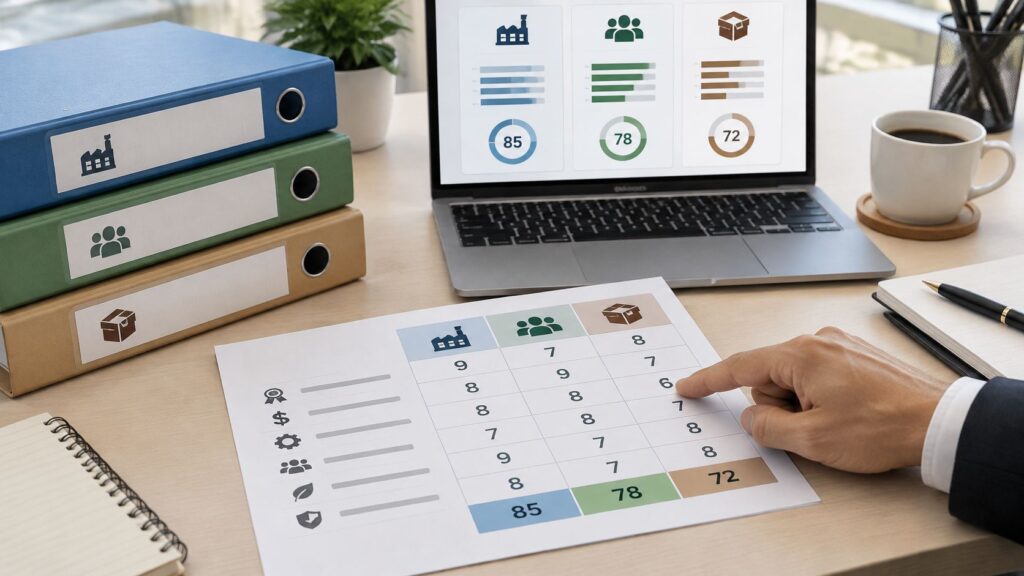
You've got five stakeholders in a room, five different opinions on the same three proposals, and a contract deadline that's already slipping. Finance likes the cheapest bid. Security trusts none of them. Operations cares about support cover at 2 a.m., and nobody wrote any of it down before the demos started.
That's how vendor selections turn into opinion contests. A good vendor evaluation template fixes the sequence. You agree criteria, weights, and pass or fail gates before you see prices, you score against evidence rather than presentation polish, and you keep a rationale you can defend to a CIO, an auditor, or a losing bidder six months later.
The ten free resources below aren't interchangeable, and that's the point. Some are weighted scorecards for head to head comparison. Some are security questionnaires that belong before scoring starts. Two are IT specific frameworks you'll need to turn into your own workbook. I grouped them by the job they do, so pick by procurement stage first and format second. If you're mid evaluation right now, start with a weighted scorecard, bolt on a security screen, and don't let a spreadsheet total override a failed mandatory requirement.
1. Smartsheet – Vendor Evaluation and Scorecard Templates
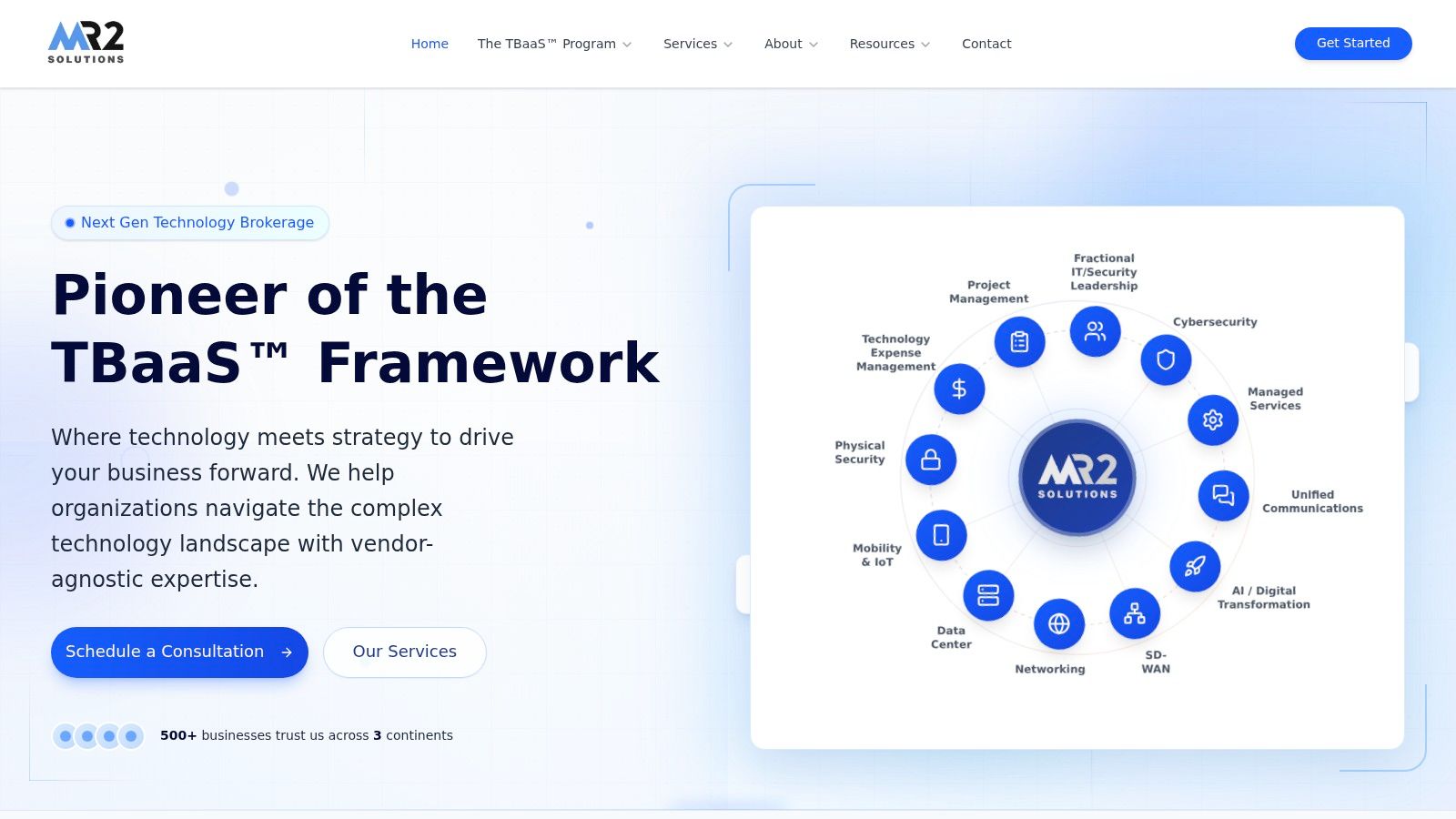
Start here if your team doesn't yet agree on what an evaluation should even contain. The Smartsheet vendor assessment collection bundles evaluation forms, assessment templates, scorecards, an IT vendor scorecard, and risk assessment materials in editable Excel and Word formats. Each pairs numeric ratings with written observations, which matters more than the score itself when stakeholders later ask why a vendor won.
That pairing of metrics and narrative is where most scorecards fall short. Gartner's supplier relationship management overview notes that 62% of organizations practicing supplier relationship management use supplier scorecards, but only 22% include both operational and nonoperational metrics. Smartsheet's range makes it easier to cover both, pairing delivery measures with risk and governance questions.
- Broad toolkit: Selection scorecards, ongoing review forms, and risk materials in one place.
- Familiar formats: Excel and Word files your evaluators already know how to use.
- Guidance included: Supporting content on evaluation and scorecard criteria to help you set your own.
The trade-off is decision overhead. You'll need to define your own criteria, weights, and scoring anchors, and the sheer range can leave a first time buyer unsure which file to open. There's also no governed workflow, so version control is on you. If you're tightening up how evaluation fits into broader procurement in IT, treat Smartsheet as raw material, not a finished process.
2. Nvelop – Weighted Vendor Evaluation Scorecard
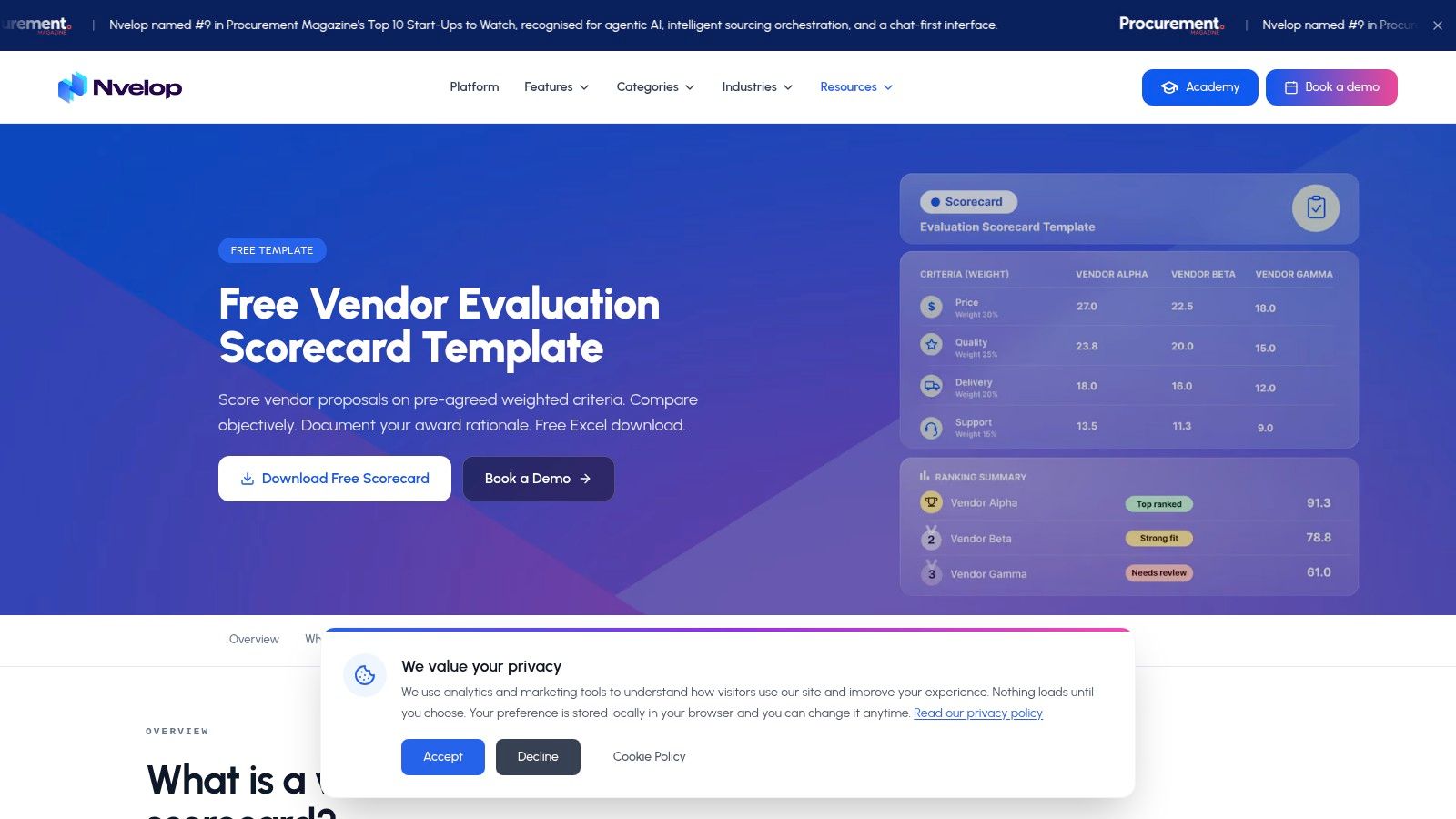
Nvelop does one job and does it cleanly. Its free Excel scorecard compares up to eight vendors against criteria and weights you fix in advance, with a validator that checks your weights total 100%, a rationale field per score, and a ranked summary tab for stakeholders. The Nvelop evaluation scorecard is advertised as downloadable without signup.
The method underneath it is well established. New Zealand Government Procurement guidance on evaluation methodology describes the weighted-attribute method in which evaluators assign percentage weights totaling 100%, multiply raw scores by those weights, and sum the results, with a worked example of criteria weighted 40%, 35%, and 25% producing a total score of 8.0 out of 10. Nvelop's structure follows that logic directly.
Preloaded dimensions cover technical fit, implementation, pricing, security, and support, which maps well to most IT purchases. The summary tab gives you a defensible ranking without a separate slide deck.
Practical rule: Lock the weights before proposals arrive. Changing them after you've seen prices is how a scorecard becomes a justification tool instead of a decision tool.
You'll still have to collect evidence and score consistently across evaluators, and the preloaded weights will need adjusting for your purchase. Nvelop also sells sourcing software, so keep the free template and the paid product separate in your mind.
3. Procurement Toolkit – Vendor Evaluation Excel Template
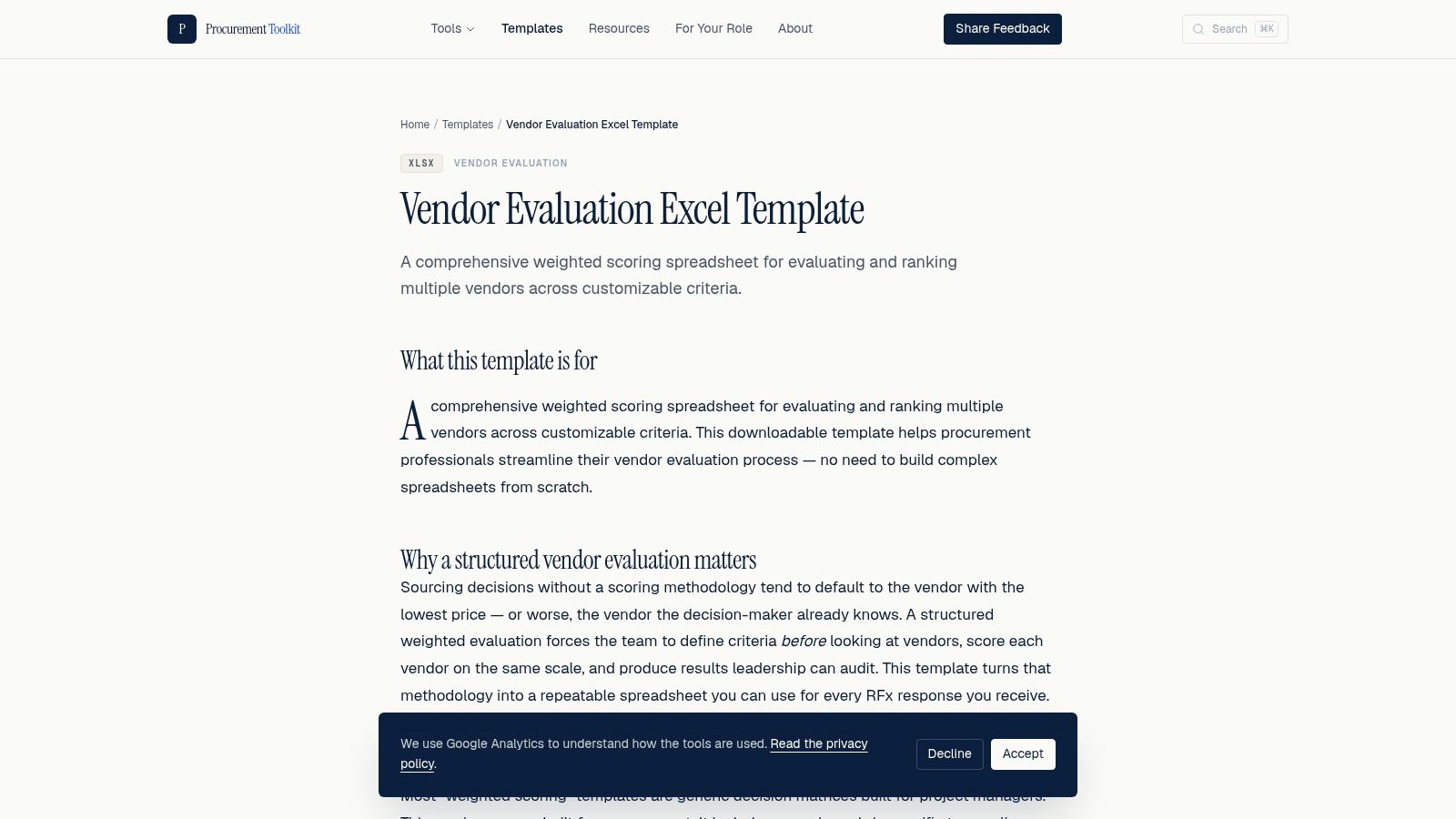
Procurement Toolkit is the fastest route from blank page to a working vendor evaluation template for a small, contained purchase. The Procurement Toolkit vendor evaluation Excel template is built around six weighted criteria: a configuration tab for weights, a scoring tab on a 1-to-5 scale, automatic rankings and charts, and a summary tab laid out for PDF sharing. The site says it runs in Excel and Google Sheets with no registration.
Six criteria is a sensible ceiling for a low-complexity buy. It forces you to decide what matters most instead of scoring thirty line items nobody can evidence.
Where Six Criteria Stop Being Enough
Regulated or multi-year technology decisions need more structure than a single weighted total. Government evaluations typically decompose the score instead of rolling it into one number. A typical weighting for that kind of procurement puts 50% on whole-of-life cost and 50% on quality, with the quality half split across demonstrated experience at 30%, capability at 20%, capacity at 20%, specification compliance at 15%, and industry participation at 15%. Each subcriterion needs its own evidence requirement and scoring guidance, which is more rows than this workbook ships with and the honest ceiling of what one Excel file can carry.
- Simple workflow: Configure, score, export a stakeholder summary.
- Adjustable weights: Priorities shift by purchase type without rebuilding the file.
- Charts built in: Rankings display visually, which helps non-procurement reviewers.
One gap matters more than the feature list. Add your own pass-or-fail gates before scoring starts, because a weighted total will happily rank a vendor that failed a mandatory requirement. The gating discipline in best practices in IT procurement pairs well with this file, since gates get decided at the requirements stage, not inside the spreadsheet.
4. Sourceably – Browser-Based Weighted Scorecard
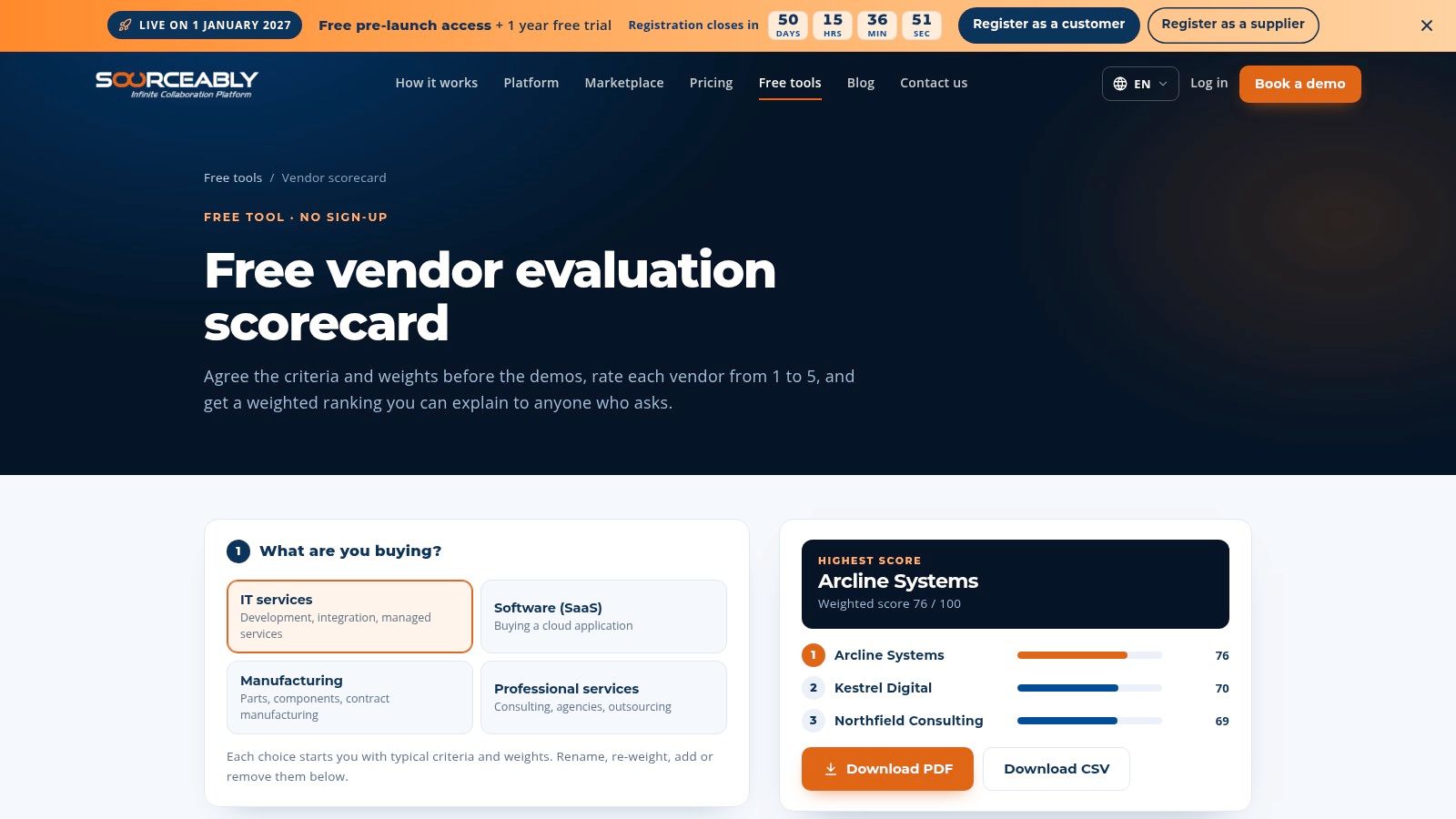
Sometimes you don't want another spreadsheet circulating by email. The Sourceably vendor evaluation scorecard runs in the browser, scores multiple vendors against weighted criteria, and exports the comparison as PDF or CSV. The provider says scoring runs locally and ratings aren't uploaded, and that the tool is free to use without an account.
Formal vendor-evaluation processes are now common practice, as the KPMG and GIPS procurement survey report reflects, while satisfaction with evaluation tools still varies by category. So weight what predicts a working deployment: adoption effort, operating outcomes, and support reality. Demo performance is the easiest criterion to score and the least predictive.
- No setup: No workbook to build before the first scoring session.
- Portable output: PDF for approvers, CSV if you want the numbers elsewhere.
- Evidence prompt: Guidance to base security ratings on certifications or audit reports, not vendor claims.
Two cautions before you rely on it. Entering contact details to download may result in those details being saved unless you opt out. And Sourceably produces a comparison. Approvals, evidence files, and the reasoning behind each score still need a governed home, so decide where that record lives before the scoring session starts.
5. CISA – Vendor SCRM Template
This one isn't a selection scorecard at all, and using it as one is a common mistake. CISA's Supply Chain Risk Management template is a security focused questionnaire for ICT hardware, software, and services, giving you a consistent baseline for procurement due diligence on vendor security posture and supply chain practices. Get it from CISA's guidance on procuring safe and secure ICT products and services.
Run it before weighted scoring, as a gate. A vendor that can't answer basic questions about its own suppliers, component provenance, or assurance practices shouldn't recover those points through a sharp price or a polished roadmap slide.
A security questionnaire that sits inside a weighted total isn't a control. It's a rounding error.
The ecosystem angle is where this template earns its place. Standard scorecards evaluate the product and skip the subcontractors, cloud dependencies, and exit path behind it. Pair CISA's questions with your own fields for critical subcontractors, fourth party exposure, data portability, and qualified alternatives, so you end up with a dependency picture alongside a vendor score.
Because it comes from a public sector cybersecurity agency, it carries weight with audit and compliance reviewers. The limits are real, though. It won't evaluate commercial fit, implementation capacity, or cost, and the questions need tailoring to vendor type and your own risk tolerance. Responses also need evidence validation. A self attested answer is a claim, not assurance.
6. ActZero – Cybersecurity Vendor Evaluation Package
Buying managed detection and response with a generic purchasing scorecard is how you end up comparing feature grids that tell you nothing about detection quality at 3 a.m. ActZero's package is built for cybersecurity providers specifically. It combines probing questions, explanations of what an answer may reveal, a scoring rubric, and a multi vendor comparison template. Start at ActZero to find the current package.
The most useful part isn't the template grid. It's the commentary on what responses reveal. That helps a generalist evaluator spot the difference between genuine response capability and alert forwarding dressed up as response.
What to Probe Beyond the Feature List
- Detection and response depth: How threats are detected, triaged, and contained, not just reported.
- Coverage: Which endpoints, identities, and cloud workloads are in scope.
- Scoring rubric: Defined anchors so two evaluators read the same answer the same way.
- Weighted comparison: Side by side scoring across providers once the probing is done.
Keep your critical faculties switched on. This is provider created content, so it may emphasize areas where the author is strong and underplay others. Check its coverage against your own architecture, threat profile, and internal staffing before you adopt it wholesale. And if you're evaluating anything other than security services, this is the wrong tool entirely.
7. TechnologyMatch – IT Vendor Scorecard
TechnologyMatch is the closest thing on this list to an IT leadership view rather than a purchasing view. Its scorecard covers security and compliance, SLAs and incident response, integration, AI governance, cost predictability, and roadmap alignment, with guidance on rating categories and weighting them by strategic importance. The TechnologyMatch IT vendor scorecard is described as usable online without a download or signup.
The AI governance dimension deserves its weight. Most templates ask whether a platform has AI features and stop there, which tells you nothing about training data use, model change notification, or output liability. An AI governance survey published by Arthur Cox found that 53% of organizations had an AI usage policy or technology committee, but only 20% had a fully approved AI risk policy and only 20% had an AI procurement policy in place. Scoring AI capability before you've settled how you'll govern it is backwards.
That makes this framework a strong prompt set for building your own evaluation record, particularly where integration risk and roadmap fit matter more than unit price. It also pushes you to connect scores to defined contract outcomes, which is where evaluation stops being paperwork.
Two caveats. The page also promotes a marketplace for finding IT partners, so separate the framework from the funnel. And you'll likely need to create your own downloadable record, with evidence standards and approval rules defined before any score supports an award decision.
8. IT-Toolkits – IT Supplier Management Toolkit
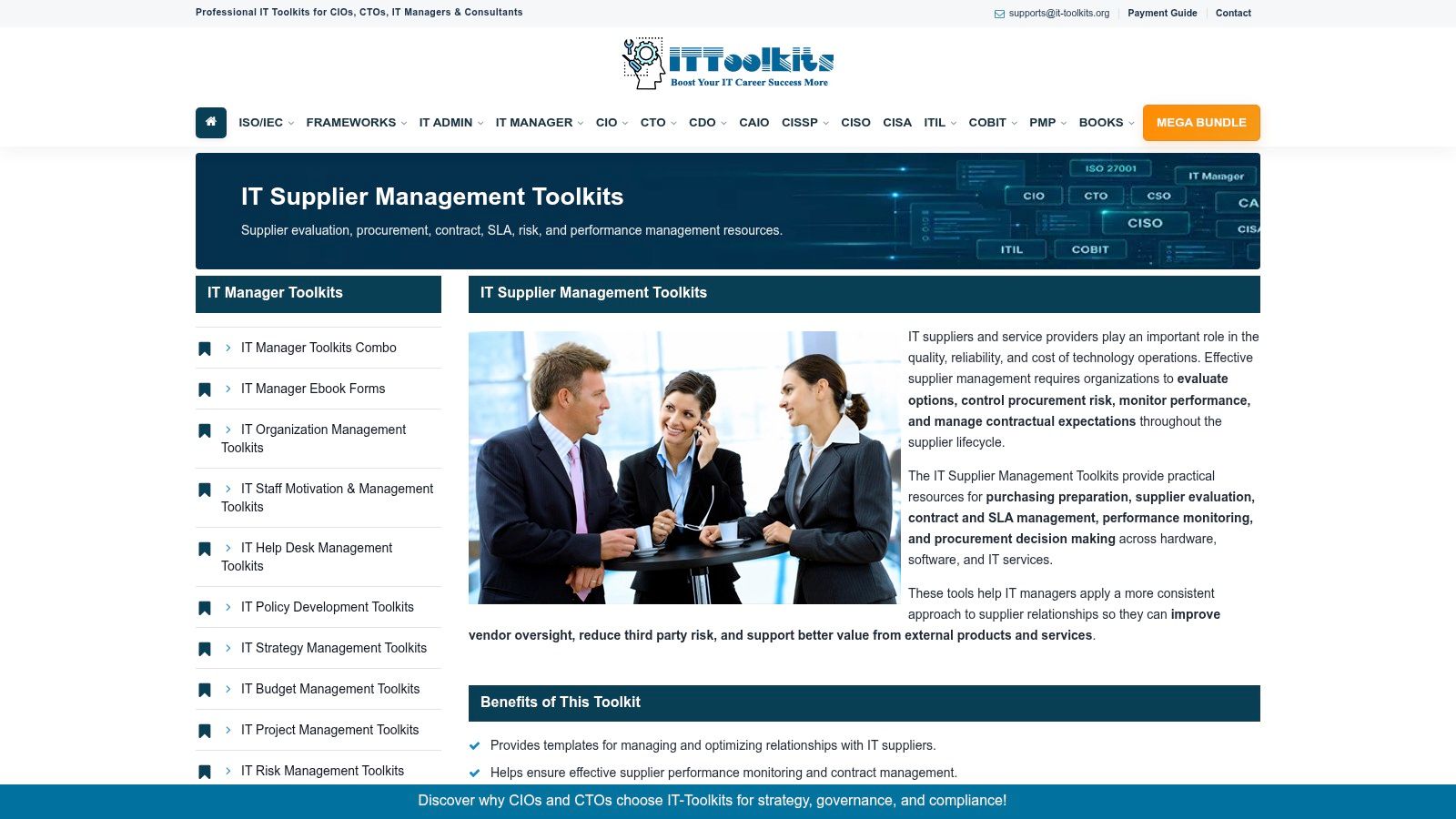
Think of IT-Toolkits as a filing cabinet rather than a scorecard. Its supplier management collection includes software evaluation criteria, vendor evaluation forms, IT vendor scorecards, third party service assessments, and proof of concept criteria, plus materials for due diligence, reference checks, and fit gap analysis. Browse the full set at IT-Toolkits supplier management resources.
That breadth is especially useful at the proof of concept stage. Most free scorecards assume paper evaluation, but a PoC needs its own success criteria agreed before the trial starts, or you'll argue about results afterward. Having supplier risk, contract, SLA, and performance monitoring documents in the same library also helps you carry evaluation commitments into the live contract instead of losing them at signature.
- Lifecycle coverage: Selection, risk, contracting, and performance monitoring in one collection.
- IT specific: Written for software and services, not adapted from goods procurement.
- Assembly model: Pick the documents that match your evaluation stages.
The cost is time and coherence. You'll inspect multiple standalone files to find what you need, and nothing ties them into a single workflow or scoring model. The page also doesn't establish that every file is current or aligned to your procurement policy, so review before you rely on any single document. For the governance that holds these pieces together after award, IT vendor management best practices covers the operating rhythm the toolkit assumes you already have.
9. Template.net – Vendor Evaluation Form
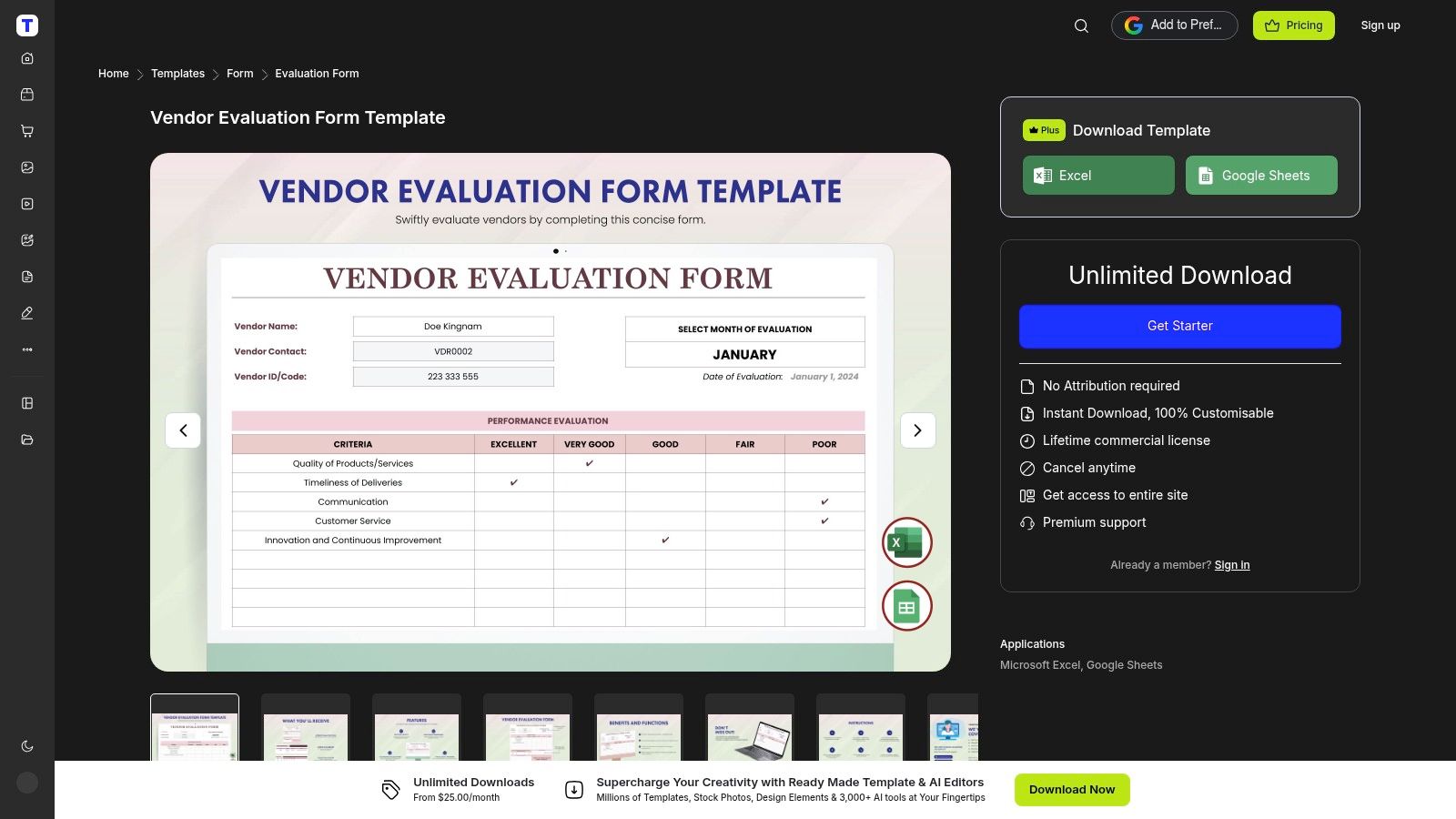
Not every purchase needs a weighted model. For a low value, low risk buy, or for collecting structured input from operational users, a simple form beats an empty scorecard nobody completes. The Template.net vendor evaluation form is an editable, general purpose form for Excel and Google Sheets that you can customize, print, or use for basic data collection.
Use it as a capture layer. Site managers, service owners, and end users can record delivery quality, responsiveness, and issues in a format they will fill in, and you consolidate their input into your real scorecard later. If your collection process grows beyond a spreadsheet, tools that let you create logic-driven online forms can route responses by vendor or category instead of leaving you to merge emailed copies.
Be clear about the ceiling here. The page doesn't establish that this form includes weighted scoring or IT security criteria, and I'd expect substantial customization before it could support an enterprise or regulated award. I'd also verify download access and licensing terms before you build an internal process on it.
That's not a dismissal. A lightweight form that gets completed is worth more than a vendor evaluation template that sits unused. Just don't present its output as a scored decision.
10. MR2 Solutions
A scorecard can rank answers, but it cannot manufacture the missing inputs: comparable architecture details, realistic pricing models, integration constraints, and evidence that survives security review. When those inputs are weak, even a good vendor evaluation template produces confident-looking scores built on uneven claims.
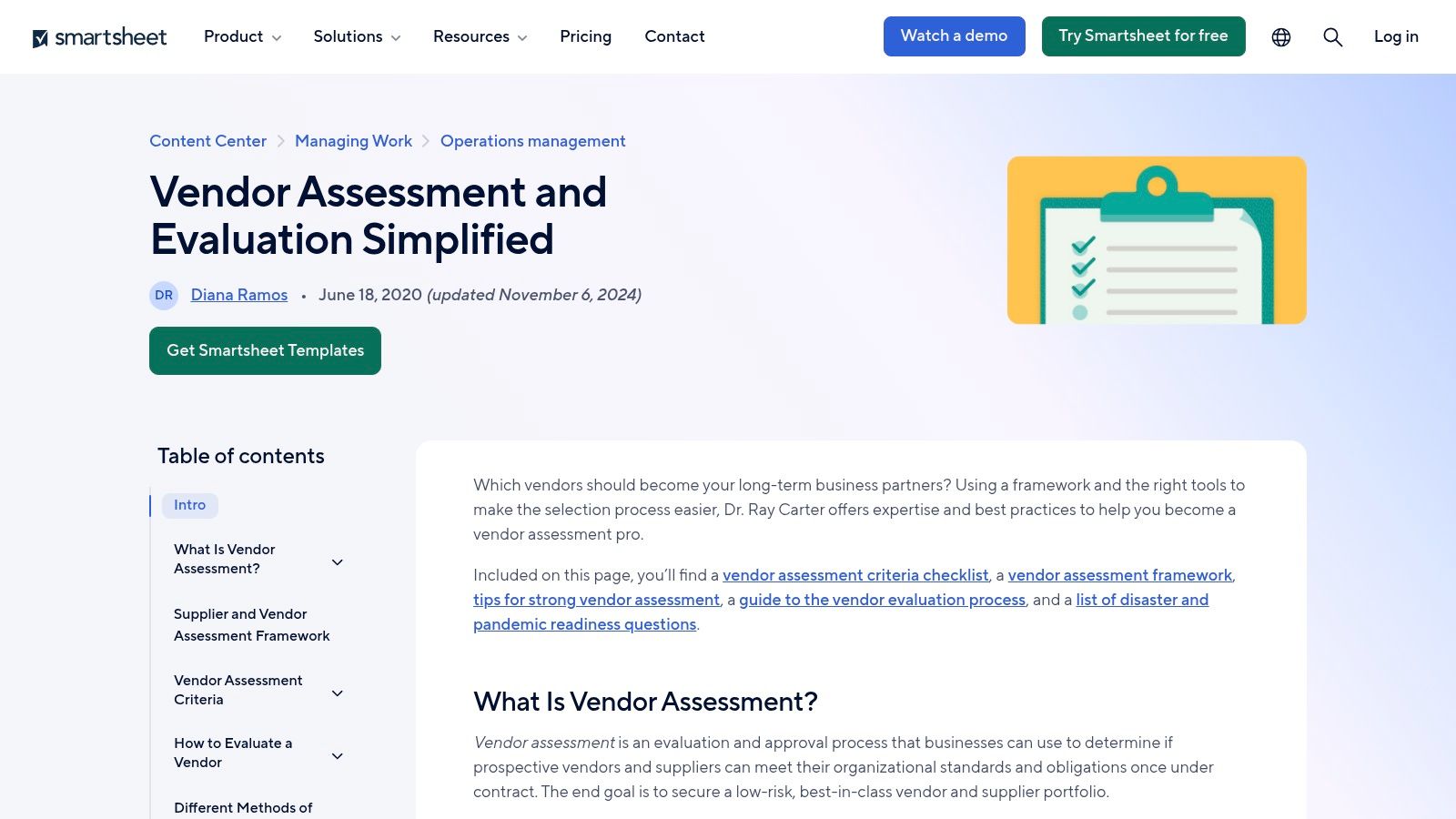
MR2 Solutions sits on the service side of that problem. Its Technology Brokerage-as-a-Service (TBaaS) model is a vendor-neutral evaluation framework built around expert people, a defined process, and a portfolio of 400+ solution providers. An engagement starts with structured discovery sessions that capture business goals, challenges, timelines, and constraints before vendor discussions begin. MR2 positions itself as representing the client's interests, with recommendations based on technical fit, operational alignment, and long-term value rather than vendor preference or sales incentives.
What You Actually Get from an Engagement
- Evaluation deliverables: vendor comparisons, evaluation summaries, solution recommendations, cost insights, and an implementation roadmap tied to business priorities.
- Coverage across categories: cybersecurity, cloud, networking, communications, AI, and managed IT, with fractional CIO and CISO leadership available.
- Lock-in pressure check: side-by-side options across architecture, pricing models, and integration capabilities before commitment.
- Negotiation support: guidance and benchmarking insight aimed at fair pricing and workable contract terms.
- Lifecycle support: discovery through selection, coordination, and optimization, while augmenting internal IT teams rather than displacing them.
The operating history is substantial: 30+ years in business and 500+ organizations supported across three continents. One client put the effect in concrete terms: “MR2 helped cut our selection process by 82% and save our organization $1,044,000 on our latest technology deployment,” said John. Another, Brandon, credited the vendor-agnostic approach with saving months of research and improving best-fit selection.
The limits are practical. Pricing is not published, so scope and cost need direct discussion. MR2 is strongest in advisory, evaluation, selection, and coordination; implementation is typically handled by the selected vendor or partner, which means responsibilities should be written explicitly into the plan. For CIOs, IT leaders, and executives comparing complex options, the quick, no-obligation assessment is the low-risk way to benchmark the environment before committing to a fuller evaluation.
10 Vendor Evaluation Templates Compared
Use this table by procurement stage rather than by rank. The first four rows score competing proposals side by side. Rows five and six screen vendors on security and supply-chain risk before any scoring starts. Rows seven and eight supply the IT-specific criteria generic scorecards tend to miss, row nine covers basic data collection, and row ten replaces the template approach with advisory evaluation when the spreadsheet itself becomes the bottleneck.
| Item | Format | Best For | Security Focus | Cost |
|---|---|---|---|---|
| Smartsheet, Vendor Evaluation and Scorecard Templates | Editable Excel and Word templates | Vendor selection and ongoing reviews | Related IT and risk assessment templates | Cost not specified |
| Nvelop, Weighted Vendor Evaluation Scorecard | Excel scorecard with weighted criteria | Comparing up to eight vendor proposals | Includes security among preloaded criteria | Free; no signup advertised |
| Procurement Toolkit, Vendor Evaluation Excel Template | Excel and Google Sheets workbook | Weighted scoring and stakeholder summaries | No specific security focus stated | Free; no registration required |
| Sourceably, Browser-based Weighted Scorecard | Browser-based scorecard with PDF or CSV export | Quick, evidence-based vendor comparisons | Includes guidance for assessing security evidence | Free; no account required |
| CISA, Vendor SCRM Template | Supply-chain risk questionnaire | Technology procurement due diligence | Vendor security posture and supply-chain risk | Public resource; cost not specified |
| ActZero, Cybersecurity Vendor Evaluation Package | PDF questions, scoring rubric, and comparison template | Comparing cybersecurity and MDR providers | Focused on security services, detection, and response | Cost not specified |
| TechnologyMatch, IT Vendor Scorecard | Online scorecard guidance | IT vendor evaluation and strategic fit | Covers security, compliance, and incident response | Online use described; cost not specified |
| IT-Toolkits, IT Supplier Management Toolkit | Collection of IT supplier-management documents | Multi-stage IT supplier assessment | Includes supplier-risk resources | Cost not specified |
| Template.net, Vendor Evaluation Form | Editable Excel and Google Sheets form | Basic vendor data collection and evaluation | IT security criteria not established | Verify access and licensing terms |
| MR2 Solutions (Recommended) | Vendor-neutral advisory and evaluation service | Technology selection, implementation coordination, and ongoing governance | Cybersecurity, compliance, and technology risk support | Pricing not published; free, no-commitment consultation |
One honest limit applies to every spreadsheet on this list. A scorecard records scores; it does not verify the evidence behind a vendor's claims, and it goes stale the moment a proposal or price changes. Weighting can also average away real disagreement, since two stakeholders who score the same vendor differently end up with a number reflecting neither view. When the vendor count or the internal politics outgrow a worksheet, a structured evaluation process does more than another tab.
Pick a Template, Then Make It Yours
A single vendor evaluation template rarely covers a full procurement cycle. Build a small stack instead. A security questionnaire such as CISA's handles screening and supply-chain due diligence. A weighted scorecard such as Nvelop or Procurement Toolkit handles comparison. An IT-specific framework such as TechnologyMatch or IT-Toolkits supplies the criteria a generic scorecard is missing. Each layer answers a different question, and collapsing them into one spreadsheet is where rigor disappears.
Set your pass-or-fail gates before you set any weights. Mandatory security controls, regulatory requirements, data residency, financial viability, and a clean exit path are requirements a vendor either meets or fails. If a vendor fails a gate, it leaves the process. That single rule prevents the most expensive failure mode in weighted scoring: a cheap, well-presented bid outscoring a compliant one, with nobody noticing until implementation.
Then score what's left, and score the ecosystem as well as the product. Deloitte's 2025 Chief Procurement Officer Survey identifies active alternative sources as the most effective risk-mitigation strategy, cited by 74% of respondents, followed by supply-chain visibility at 64% and supplier information sharing at 61%. Add fields for critical subcontractors, concentration risk, portability of data and configuration, recovery commitments, and named alternatives. A vendor that tops the matrix and can't be replaced leaves you holding concentrated dependency risk.
Document rationale while scores are fresh. Record the evidence behind each number, separate verified artifacts such as SOC reports and penetration test summaries from vendor assertions, and note confidence levels, assumptions, and unresolved risks. That discipline pays off directly. Amazon Business's 2025 State of Procurement Data Report found that 64% of procurement and organizational decision-makers worldwide identified improving data and insights as a top procurement priority in 2025, and evaluation records are where that data starts.
Know where spreadsheets break down.
They don't manage evidence, approvals, conflicts of interest, or audit history, and they multiply into competing versions the moment five evaluators score independently. For routine, lower-value buys, a disciplined workbook is enough. For cloud, cybersecurity, communications, or managed services decisions that run for years, tools such as tender tools for procurement managers can govern the process around the template, and outside support starts to pay for itself.
When the decision outgrows the workbook, a structured advisory engagement is the practical next step. Our TBaaS framework gives you a vendor-neutral evaluation methodology with diagnostic assessments and benchmarking insights for negotiation, plus a no-obligation technology assessment that benchmarks your current environment before you commit. If your team has the capacity to run the evaluation well, take the templates above and make them yours. If it doesn't, bring in help while the criteria are still being set, because a shortlist built on the wrong criteria is expensive to unwind.
If your next technology decision is too important to settle with an unweighted spreadsheet and five conflicting opinions, our vendor-neutral TBaaS team can run the discovery, structured comparison, and negotiation support for you across cybersecurity, cloud, networking, and managed IT. Start with a no-obligation technology assessment and see what an evidence-based shortlist looks like. Visit MR2 Solutions to book your consultation.