
Cyber Security Vendor Management: How to Build It in 2026

Your payroll provider emails on a Monday morning. There's been unauthorized access, employee bank details may be exposed, and the vendor can't yet say how many records were touched. You don't run that platform, you don't control its logs, and your contract contact left six months ago. Still, you have to decide fast whether this affects your business, your customers, and your reporting duties.
That's cyber security vendor management in practice. It's not an annual questionnaire you file and forget. It's whether you know who your vendors are, what they can reach, who owns each relationship, and how quickly you can get facts you can act on.
The Six Stages of a Vendor Management Program
A vendor incident becomes your problem the hour you decide it might be material. Legal, the CISO, and the CFO need scope, timing, and business impact in days, while the vendor is still reading its own logs. I treat the four-business-day disclosure clock, and the fourth parties behind the contracted vendor, as design constraints on every stage. They are not lines added to a questionnaire after signature.
The SEC final rule adopted cybersecurity disclosure rules on July 26, 2023, effective September 5, 2023, and states that a material incident on a third-party service provider's systems may also require disclosure. For public companies, Form 8-K Item 1.05 generally requires disclosure within four business days of determining materiality. The company that uses the platform still owns that determination.
The lifecycle at a glance
| Stage | Owner | Output | Done when |
|---|---|---|---|
| 1. Govern | CISO with legal and procurement | Written vendor policy and named owners | Executive sponsor has signed off |
| 2. Inventory | IT and procurement | Complete vendor register | Every contract and system connection is listed |
| 3. Tier | Vendor risk lead | Criticality tier per vendor | Each vendor has a tier and a business owner |
| 4. Assess and contract | Security and legal | Assessment evidence and signed clauses | Evidence matches the tier and required clauses are in place |
| 5. Monitor and respond | Security operations and vendor owners | Scorecards and incident runbooks | Every open issue has an owner and a deadline |
| 6. Review and exit | Business owner and procurement | Renewal decision or offboarding record | Access is revoked and data is returned or deleted |
The same two constraints sit on all six rows. You may not see a fourth party's logs, and a materiality decision can start a four-business-day clock.
Govern means the CISO, with legal and procurement, writes the vendor policy and names owners before anyone buys. The policy states who decides materiality, who contacts the vendor, and who is told when the fault sits with a subprocessor. Done when an executive sponsor has signed off.
Inventory means IT and procurement keep one register of every contract and system connection, including upstream providers you can identify. A small tool with remote access can still start the clock. Done when every contract and system connection is listed.
Tier means the vendor risk lead assigns a criticality tier and a business owner. Higher tiers get faster notice terms and fuller evidence, because a critical vendor's fourth party can force a materiality call before the next quarterly review. Done when each vendor has a tier and a business owner.
Assess and contract means security and legal collect evidence that matches the tier and put the required clauses in the agreement: incident notice early enough for a four-business-day determination, subprocessor disclosure, access revocation, and data return or deletion. Done when that evidence and those clauses are in place.
Monitor and respond means security operations and vendor owners run scorecards and incident runbooks. Every open issue has an owner and a deadline. The runbook assumes you do not hold the vendor's logs and may have to judge impact from what the vendor, and its fourth parties, will send.
Review and exit means the business owner and procurement record a renewal or an offboarding. Access is revoked and data is returned or deleted. A former vendor that still holds data can still create a disclosure problem.
Practical rule, name one executive sponsor and one vendor risk lead before you buy anything new, and keep a single register that every stage writes to.
Two habits keep the register from sitting unused between audits. Update it when a vendor, a connection, or a fourth party changes, not the week an auditor arrives. Tie that oversight to the same governance you use for the rest of security, which is why reviewing enterprise security best practices for 2026 helps you align vendor controls with board level governance rather than leaving them in procurement.
A working program passes one test. Every vendor has an owner, a tier, and a last review date. A blank in any of those three fields means you hold a contract, not oversight.
Inventory Vendors and Map Fourth-Party Dependencies
A payroll processor fails on a Tuesday because its cloud host is down. Your contract is with the processor, not the host. Finance then finds three other "independent" vendors on that same platform, and a four-business-day disclosure clock is already running on a dependency nobody mapped. You cannot tier, assess, or revoke access for a vendor you have not found. Procurement sees contracts, IT sees integrations, and finance sees payments. Those three views stay separate until someone merges them, and fourth-party exposure stays invisible until that merge includes who sits behind each vendor.
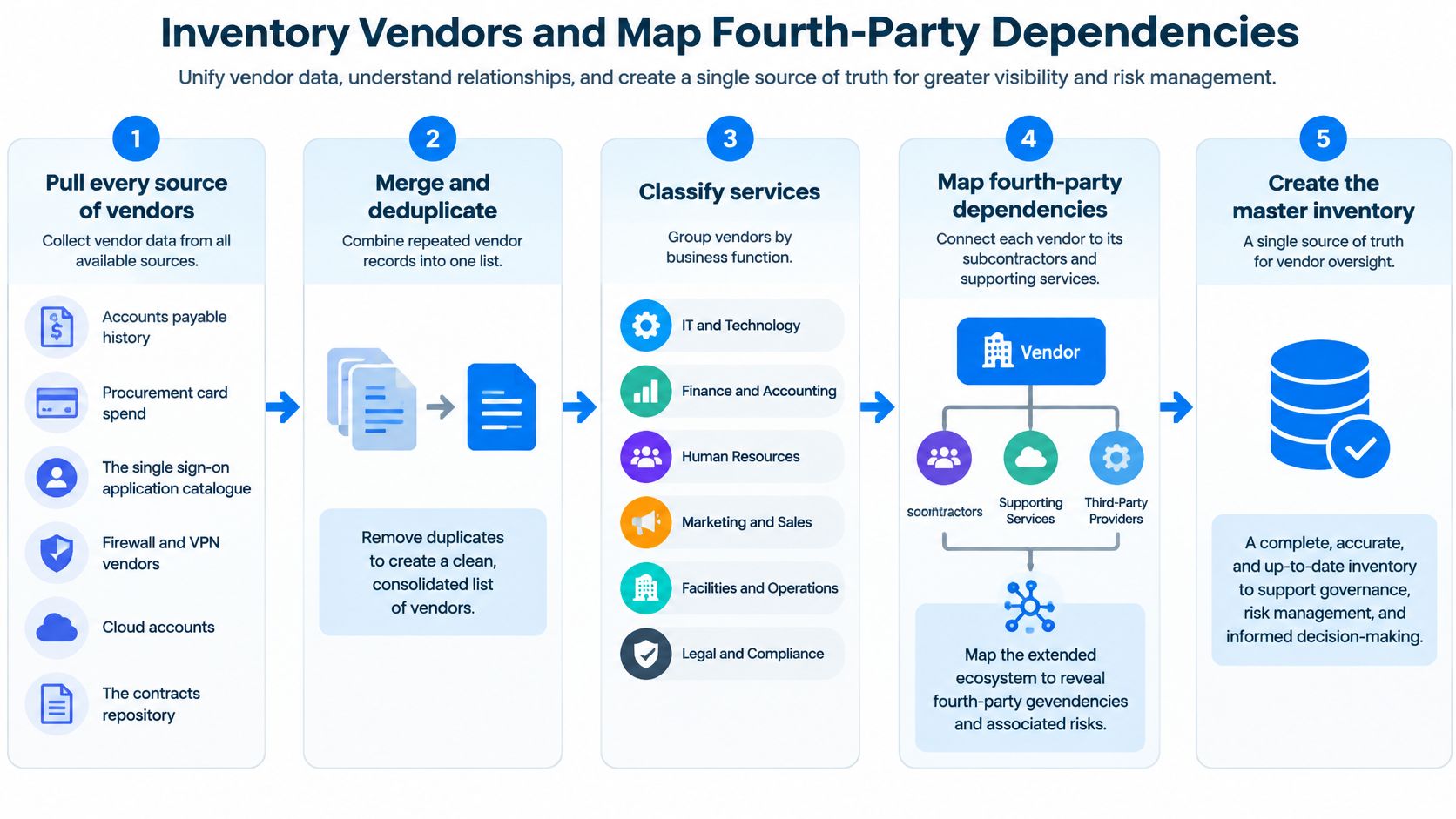
Build the master list in five steps
Treat the four-business-day clock and downstream dependencies as constraints on every step, not items you add after the questionnaire.
- Pull every source of vendors, including accounts payable history, procurement card spend, the single sign-on application catalogue, firewall and VPN vendor lists, cloud accounts, and the contracts repository. Shadow IT usually hides in card spend and free trials, and those tools still create fourth parties.
- Merge and deduplicate the records. The same provider often appears under a legal name, a product name, and a reseller name. One row, or you will undercount concentration.
- Record what each vendor touches, including the service, data types, any privileged or remote access path, the business owner, the incident contact, and the contract end date. Access and data drive risk more than contract value. The owner and contact are who you call when the clock starts.
- Flag system connections next, including API keys, shared service accounts, and remote access tools. A small contract can still hold a powerful credential, and that credential is often issued by a fourth party.
- Request subprocessor lists and dependency maps in the same request as the security questionnaire. Asking after signature gives you much less influence, and learning about a new host during an incident burns the disclosure window.
Why fourth parties change the picture
Your direct vendor is a third party. Its hosting provider, payment processor, support platform, and subprocessors are fourth parties, and their providers sit further down the chain. A failure or breach at that level can hit several of your supposedly independent suppliers at once. Many organizations still have limited visibility past the companies they pay, so fourth and fifth parties stay outside day-to-day oversight. A complete contract list can still hide the platform those contracts share.
The first full inventory usually looks worse than the contract report. It shows concentration risk, shared infrastructure, and critical services that depend on one underlying platform. That is what sound cybersecurity risk management strategies are meant to surface before an incident does.
Prioritize by impact, not vendor count. Map critical services first: payroll, payments, customer records, and remote access. Follow each one down to the host, identity provider, and support desk behind it. A low-spend tool with an always-on VPN account outranks a large contract with no data access, because you may have four business days to say which customers and which downstream providers were in scope.
If a critical vendor won't disclose its material downstream dependencies, don't accept silence as an answer.
Set a minimum for that situation. Require a current subprocessor list, advance notice of changes early enough to reassess before the four-business-day clock starts, and a contractual right to escalate or exit if a new dependency is unacceptable. I treat a vendor that cannot meet that floor as an open risk finding, and I record who accepted the opacity.
Tier Vendors and Set the Evidence Each Tier Needs
Tiering is how you avoid two common failures at once, burying low risk vendors in paperwork and giving critical vendors a light touch review. I would tier on five factors every time, business criticality, data sensitivity, privileged access, concentration risk, and recovery dependency.
| Tier | Typical criteria | Evidence required | Reassessment |
|---|---|---|---|
| Critical | Privileged access to core systems, regulated data or a concentrated service | Independent assurance report, penetration test summary, subcontractor list, SBOM where available | Every 6 to 12 months and after major change |
| High | Sensitive customer or employee data without privileged access | Current SOC 2 Type II or ISO 27001 certificate and incident response summary | Annually |
| Moderate | Limited internal data, integrated but not business critical | Completed security questionnaire with sample evidence | Every 2 years |
| Low | No data access and easily replaced | Signed attestation and baseline security terms | At renewal |
Where the boundaries sit
A payroll platform that stores employee bank details is Critical even if only a handful of staff log in. The data is regulated, the service is hard to replace mid cycle, and a failure stops people getting paid. User count is the weakest tiering signal you have, so don't let it override data and dependency.
Higher tiers need stronger proof. The CISA ICT supply chain risk management guidance supports requiring independent assurance reports, penetration test summaries, vulnerability management metrics, incident response exercises, software bill of materials availability, and subcontractor transparency for higher tiers, with proportionate attestations for low risk providers. That same risk tiered lifecycle approach also helps you meet your own obligations around compliance in IT security without applying identical depth to every supplier.
Watch the certificate trap. A framed ISO 27001 certificate or a SOC 2 logo tells you an assessment happened, not that controls work today or that the scope covered the service you're buying. Decide in advance how assurance will be measured for each tier, whether by self attestation, customer audit, or independent report, and set the review schedule before you sign.
- Check the scope, does the report cover the exact product, region, and subprocessors you'll use.
- Check the date, stale evidence describes a company that may have changed owners, hosting, or leadership since.
- Check the exceptions, auditor findings and carve outs often matter more than the headline opinion.
Put security into selection scoring early. When two offerings have broadly similar cost and functionality, prefer the more secure supplier and record that decision in the scoring sheet before price negotiation starts. If security evidence only appears after commercial terms are agreed, you've already lost your negotiating power.
Re tier when the relationship changes, not just on schedule. New data types, new integrations, or privileged access added for a support project can move a Moderate vendor to High overnight. The business owner should trigger that review, with the vendor risk lead confirming the new tier and evidence set.
Assess Contract and Onboard Each Vendor
Due diligence works best as a short, repeatable checklist that ends in contract language, not a long questionnaire that ends in a shared drive. Keep the assessment, the clauses, and onboarding in one flow so nothing gets approved in one place and forgotten in another.
Run due diligence before you negotiate price
- Confirm scope, data types, and data flows, including where data is stored, who can access it, and which subprocessors handle it.
- Read the assurance report properly, checking its date, scope, and carve outs, then map its controls to your own threat model instead of accepting the certificate as proof.
- Review the subcontractor list and vulnerability reporting process, and ask who owns security at the vendor and how often that person reports to leadership.
A structured vendor evaluation template keeps those answers comparable across bidders, so you're scoring evidence rather than presentation quality. Through its TBaaS™ model, MR2 helps organizations objectively evaluate managed service providers, negotiate vendor relationships, optimize service delivery, and ensure technology investments support business goals, which is the same discipline you need internally for every critical supplier.
Lock in clauses that protect a specific moment
| Clause | What it must say | Why it matters |
|---|---|---|
| Security obligations | Baseline controls matched to the vendor tier | Sets the control floor before go live |
| Breach and vulnerability notice | Initial notice within 24 to 72 hours to named contacts | Feeds the four business day materiality clock |
| Audit and evidence rights | Reports, samples or audit on a defined cadence | Tests claims after signature |
| Remediation timeframes | 15 to 30 days for critical findings | Turns findings into commitments |
| Access control | Least privilege and named accounts, no shared credentials | Limits the blast radius of a vendor account |
| Data return and deletion | Return or certified deletion, including subprocessors | Closes data risk at exit |
| Resilience testing | Annual recovery or exercise evidence for Critical vendors | Shows the service can be restored |
| Subprocessor change notice | Advance notice and a right to object, escalate or exit | Governs fourth party shifts |
| Termination assistance | Transition support and same day access revocation | Makes offboarding executable |
The 24 to 72 hour notice window isn't arbitrary. It gives legal, the CISO, and the CFO time to assess materiality inside the four business day disclosure window. If a vendor can take a week to tell you, your own clock may already be running before you've heard a word.
A clause without a named contact, a deadline, and a consequence is a preference, not a control.
Onboard before production access
After signature, complete five steps before go live. Enter the business owner, tier, data types, remote access paths, and contract end date in the register. Provision least privilege access through SSO, named API keys, and individual VPN accounts.
Store the current notification contact and escalation path where security operations can find them at 2 a.m. Name the person who can revoke access the same day. Schedule the first reassessment from the tier cadence.
Don't grant production access until that register row exists. It's a small gate, but it prevents the most common onboarding failure, a live integration that nobody owns and nobody can switch off quickly.
Handle Vendor Incidents Within the Four-Day Window
A vendor incident tests your program under time pressure. You need facts from a company that's also in crisis, while your own executives need a decision. Design the runbook around that tension, not around an ideal flow of information.
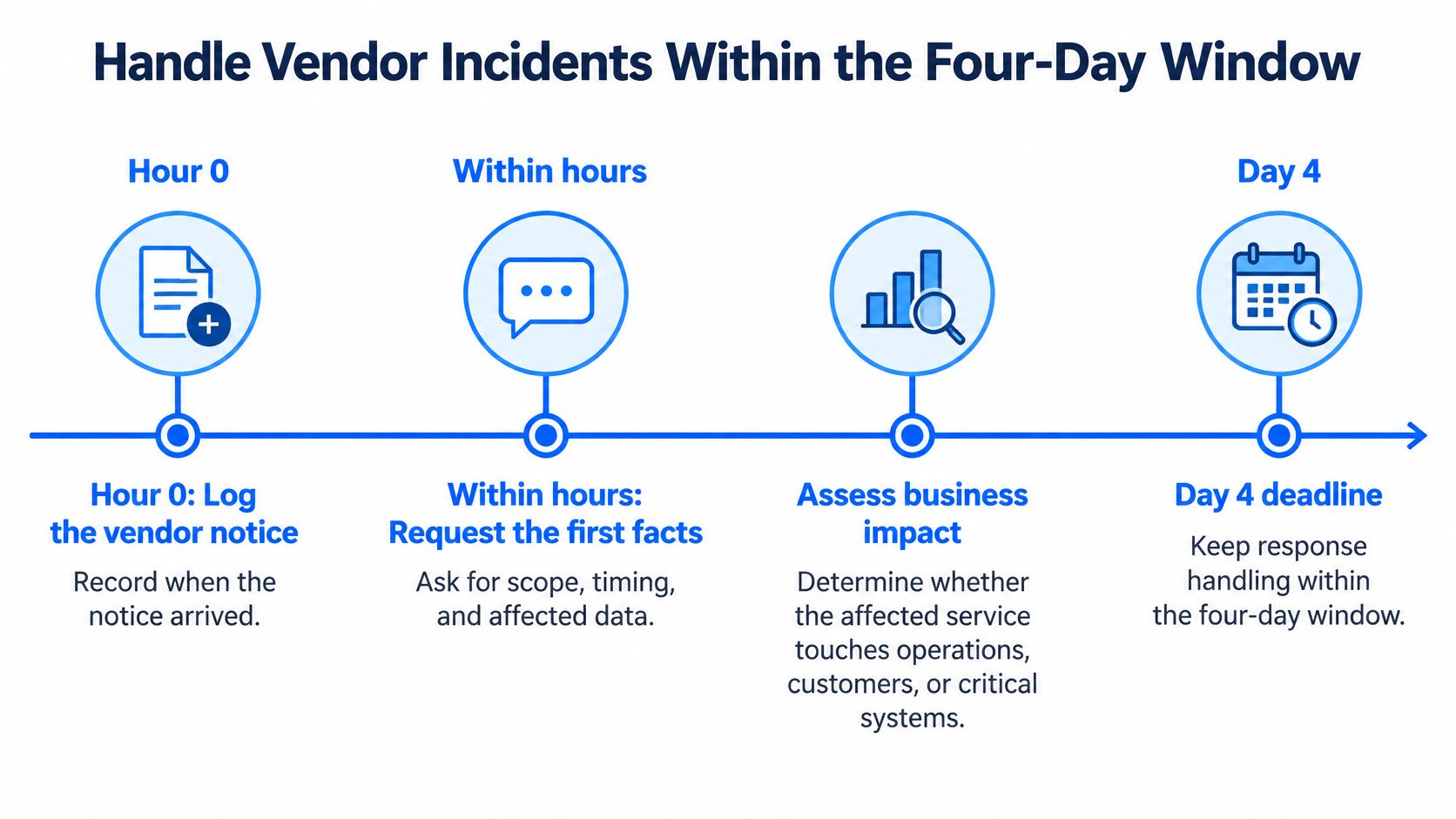
The response benchmark is clear. The SEC guidance on cybersecurity incident disclosure confirms that once a public company determines an incident is material, the Form 8-K filing deadline is generally four business days, even when a third party operates the affected system. Materiality doesn't depend on where the systems reside or who owns them.
Work the incident in order
- Log the notice time, record exactly when the vendor's notification arrived and who received it.
- Request first facts within hours, specifically scope, timing, and affected data, even if the vendor's answers are preliminary.
- Assess business impact, decide whether the service touches your operations, customers, or regulated data, which determines whether the event could be material.
- Escalate the same day to legal, the CISO, and the CFO, and name who makes the materiality call so the decision doesn't drift.
- Contain your exposure, revoke vendor tokens, rotate shared credentials, and cut remote access if the risk justifies it.
- Preserve evidence in writing, request logs, forensic summaries, and timelines through the contract contact, not informal channels.
- Decide on materiality and disclosure, then communicate with customers, the vendor, and regulators as your obligations require.
- Close the loop with root cause, a contract review, and an updated runbook entry.
Private discussion helps during that process. Companies may discuss a material incident privately with commercial counterparties, including vendors and customers, beyond what's in a public filing, provided disclosure controls and confidentiality requirements are respected. Use that channel to press for facts, but keep legal in the conversation.
Most delays aren't technical. They're stale notification contacts, escalation paths that stop at an account manager, and vendors who provide reassurance instead of scope and timing. Your contract notice clause and your register entry either solve that in advance or they don't.
Run a tabletop exercise with each Critical vendor every year. Walk through the first four hours, who calls whom, what facts you need, and who can revoke access. If the exercise reveals a dead phone number, that's a cheap lesson compared with learning it during a real breach.
Judge your whole program against one outcome. Can you identify, assess, escalate, and, if required, disclose a material third party incident within four business days of determining materiality. If you can't, that's your remediation backlog.
Monitor, Reassess and Offboard Vendors
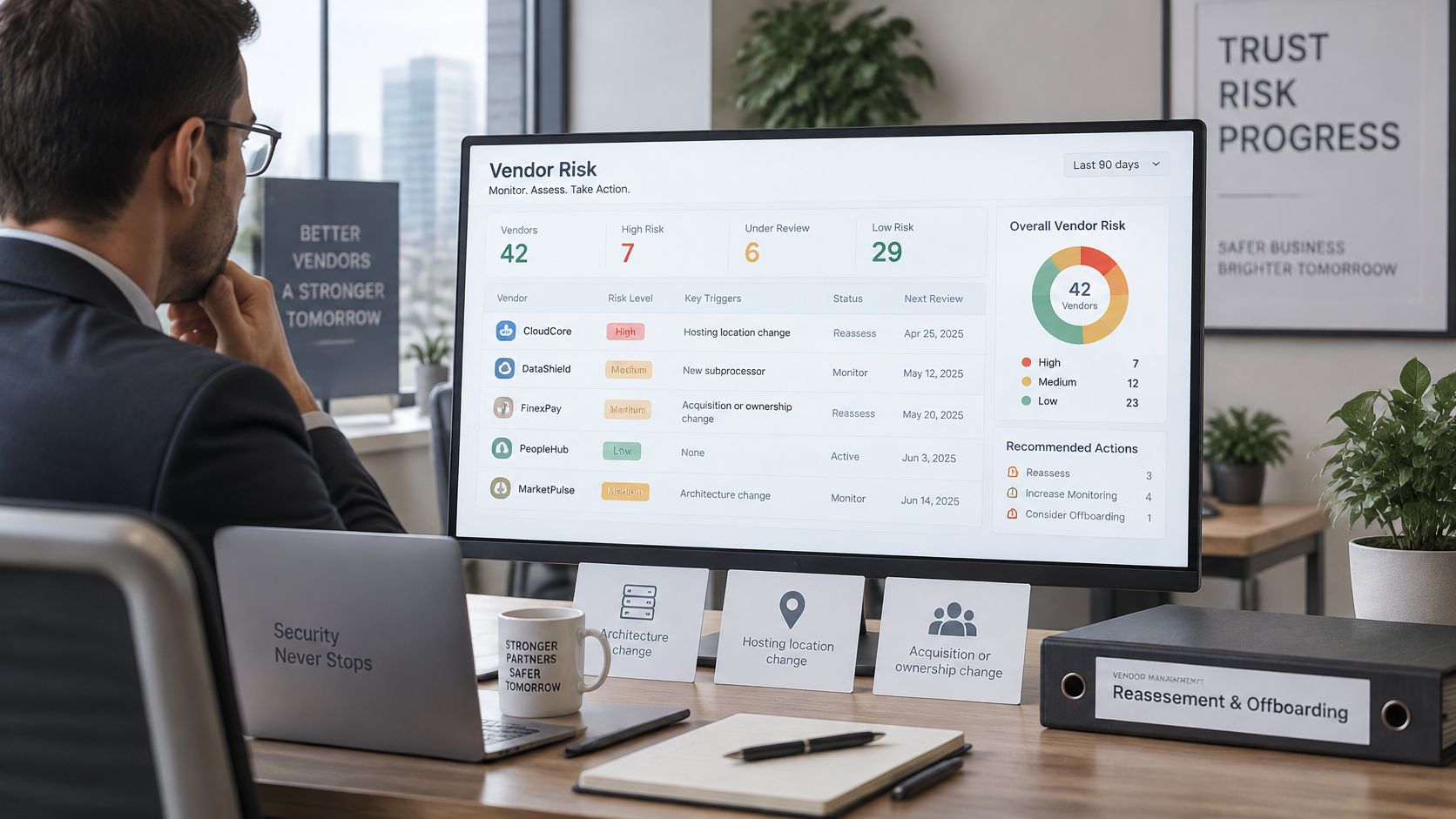
Vendors change between annual reviews. They get acquired, move hosting, swap subprocessors, and let certificates lapse. Monitoring exists to catch those changes when they happen, not at renewal.
Triggers that force an early reassessment
- Architecture or hosting change, a new cloud region or platform can change data residency and control scope.
- Acquisition or ownership change, new leadership may cut security investment or change subcontractors.
- New subprocessor, your data may move to a company you've never assessed.
- Vendor security incident, even one that didn't touch your data tests their response claims.
- Lapsed certificate or serious public vulnerability, both signal controls or patching may be slipping.
Say a logistics vendor is acquired mid contract and its new parent moves hosting overseas. That should trigger a review immediately, checking data location, the assurance report scope, and your exit rights. Waiting for renewal means accepting months of unassessed change by default.
For routine cadence, check scorecards and certificate expiry quarterly for Critical vendors and run annual reviews for High vendors. Keep each check short, evidence current, access still needed, open findings on track. Long annual ceremonies that nobody reads don't catch drift.
Offboard as a sequence, not an email
- Confirm the exit date and tell the business owner, so nobody renews access by habit.
- Revoke access the same business day, covering SSO, API keys, VPN accounts, and shared credentials.
- Obtain written confirmation of data return or deletion from the vendor.
- Verify subprocessor deletion using their written confirmation, because your data may sit in systems you never contracted with directly.
- Update the register, close the contract, and record the reason for exit.
Keep that exit record. During a later audit, it's your evidence that access ended and data was handled as the contract required. A missing offboarding record looks like a missing control, even if your team did the work.
Measure Vendor Controls and Start With Critical-Tier Vendors
Counting completed questionnaires tells you activity happened. It doesn't tell you controls work. That gap shows up clearly in the Ponemon Institute study, where only 26% of respondents said their process for assessing the controls of business partners, vendors, and other third parties was effective. Measure outcomes from your register and incident log instead of survey answers.
| Metric | What it shows | How to measure |
|---|---|---|
| Vendors with a named owner and current tier | Inventory completeness | Percentage of register entries with both fields filled |
| High risk vendors with validated assurance | Evidence quality | Percentage of Critical and High vendors with a current independent report |
| Mean time to revoke vendor access | Offboarding speed | Hours from exit decision to access removal |
| Critical findings past remediation SLA | Remediation discipline | Count of open critical findings grouped by age |
| Vendor notice to customer containment | Incident readiness | Hours from vendor notification to containment of your exposure |
| Concentration exposure by provider | Systemic risk | Share of critical services that depend on one platform or region |
Build the baseline first
Start with inventory health, percentage of vendors classified by risk, with named owners, with current contracts, and connected to critical systems. Add evidence quality for Critical and High tiers, current independent reports, privileged access reviewed on schedule, tested notification procedures, and critical findings inside the remediation SLA. Outcome measures then show whether the program moves, unresolved findings by age, revocation time, containment time, and concentration by provider or region.
These metrics catch two expensive failures. Applying the same review depth to every supplier wastes your small team's time on Low tier tools while Critical vendors wait. Omitting security measures from commercial SLAs means findings have no deadline anyone enforces. Both show up in the numbers within one quarter if you're measuring age and SLA compliance.
Our role in this kind of work is advisory and selection focused, with implementation typically handled by selected vendors or partners, and we represent the client's interests, not a vendor's quota, so every recommendation is objective. That separation matters when metrics point to replacing a supplier rather than renewing it.
A 30 day start on Critical vendors only
Don't try to fix the whole register at once. In the first month, confirm owner and tier for every Critical vendor, check each assurance report's scope and date, and verify the 24 to 72 hour notice contact still reaches a real person. Test the revocation runbook on one vendor account, then record your first baseline for the six metrics above.
That gives you a defensible starting point and a short list of gaps with owners. Expand to High tier next quarter with the same checks. A program that measures a few real outcomes beats a dashboard full of questionnaire counts every time.
If your Critical vendor list has blank owners, stale assurance reports, or notification contacts you've never tested, start with an objective review of those relationships before you buy more tooling. MR2 Solutions helps you evaluate providers, negotiate enforceable terms, and govern vendor performance through a vendor neutral advisory model built around your business goals. Visit MR2 Solutions to discuss how to tighten your cyber security vendor management program, starting with the vendors that could hurt you most.