
Compliance in IT Security Made Practical and Audit Ready

The audit calendar says one thing, your cloud estate says another. A compliance team is chasing screenshots from last quarter, identity groups have changed twice since then, and the logging view everyone signed off on no longer matches production. That is the pressure behind compliance in IT security today, proving that controls still work after the environment moves and that the proof is current, not stale.
Boards feel that pressure because the stakes are financial, legal, and operational. The EU's GDPR, which took effect on 25 May 2018, set a global benchmark for modern privacy enforcement, and its maximum administrative fines can reach €20 million or 4% of global annual turnover, whichever is higher as summarized in this compliance overview. Compliance rules now span many jurisdictions, which is why a single static policy binder does not hold up.
The cost of getting this wrong keeps climbing too. IBM-linked 2025 data put the global average breach cost at $4.44 million, while breaches with a noncompliance factor averaged $4.61 million in this compliance statistics review. In the United States, the average breach cost reached $10.22 million in 2025, a record high that makes governance, evidence, and remediation speed part of the financial conversation in this compliance statistics review.
The challenge is not writing more policy. It is keeping a control set alive while users, apps, cloud permissions, and AI tools keep shifting around it. A policy is the instruction manual. Continuous compliance is the maintenance log, the test results, and the change record that show the manual still matches reality.
Practical rule: if your evidence is older than your last meaningful environment change, you are not audit ready, you are just audit hopeful.
What Compliance in IT Security Really Means
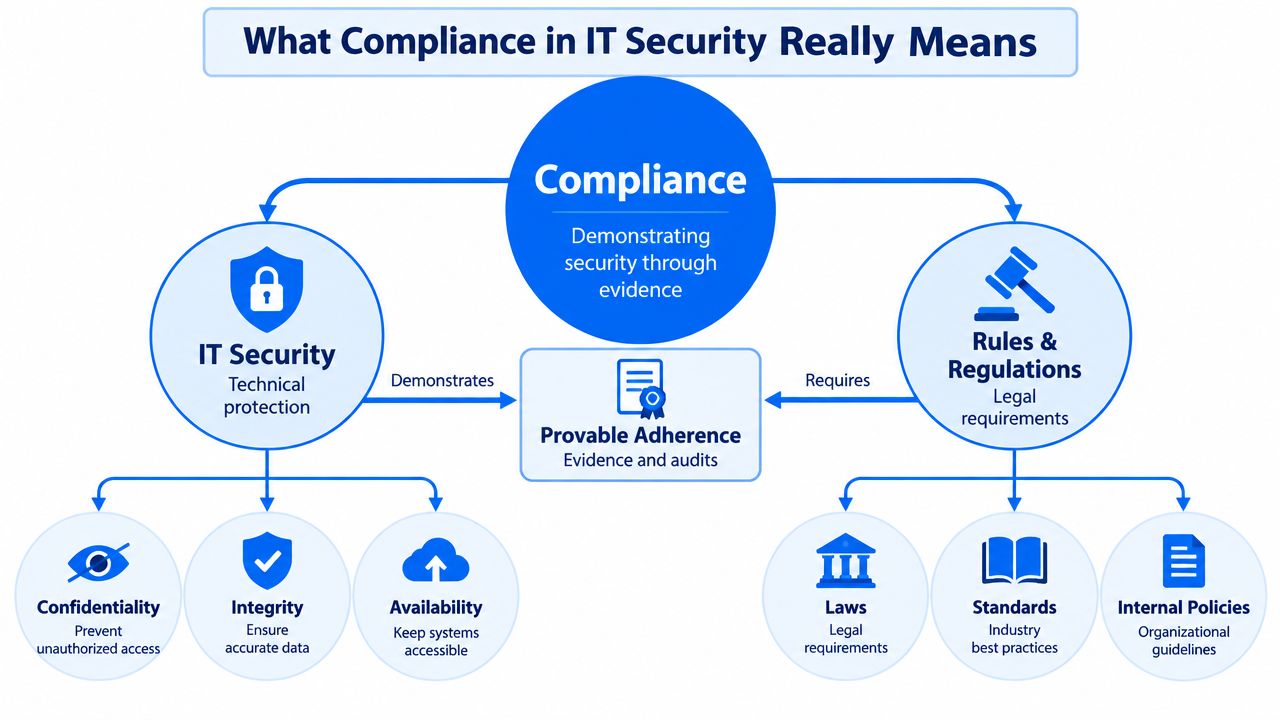
IT security protects systems, data, and access paths. Compliance proves that those protections meet a rule set, and that they keep meeting it after changes, exceptions, and handoffs. That distinction matters because an auditor doesn't just ask whether a control exists, they ask whether it's designed correctly, operating consistently, and supported by evidence.
A simple house analogy helps. Security is the lock on the door, the fire alarm, and the reinforced frame. Compliance is the building code that says those protections must be present, installed correctly, and documented so someone can verify them later. If the lock works but nobody can show inspection records, you may still fail the review.
The three pieces that make a control count
A control usually has three parts. First is the objective, such as protecting card data or limiting who can access sensitive systems. Second is the implementation, like MFA, encryption, logging, or segmentation. Third is the evidence, which shows the control is active and current.
That evidence is where many teams get stuck. A policy says access should be limited, but the actual question is whether your identity groups, approval flows, and periodic reviews match that policy right now. If they don't, the paper says one thing and production says another.
Why proof matters more than intention
Security teams often feel compliant because they've built the right controls. Auditors and regulators care whether those controls can be demonstrated on demand. That's why provable adherence sits between technical protection and legal requirements, it's the bridge that turns good intentions into testable assurance.
Practical rule: if a control can't be shown with a current artifact, it's not ready for an audit conversation.
Key Compliance Frameworks and Regulations You Should Know
A mid-market security program usually runs into three kinds of obligations: privacy law, payment security, and continuous control management. They overlap in practice, but they do different jobs. Once you separate them, compliance stops looking like one giant checklist and starts looking like a set of control layers with different proof requirements.
GDPR is the clearest privacy framework in this group. It governs organizations that process EU personal data, and it makes accountability visible to executives, legal teams, and auditors, as noted in the compliance overview. PCI DSS v4.0 is more prescriptive. It sets operational expectations for organizations that handle card data, and the official PCI SSC materials on PCI DSS 4.0 show how the standard is enforced in practice. NIST-based continuous monitoring models focus on whether controls still work after systems, users, and vendors change, which is why the NIST publication is useful for teams that need ongoing evidence rather than a one-time signoff.
For financial services teams, digital footprint check compliance is a useful reference, especially where customer due diligence, external exposure, and vendor reviews sit close to the control program.
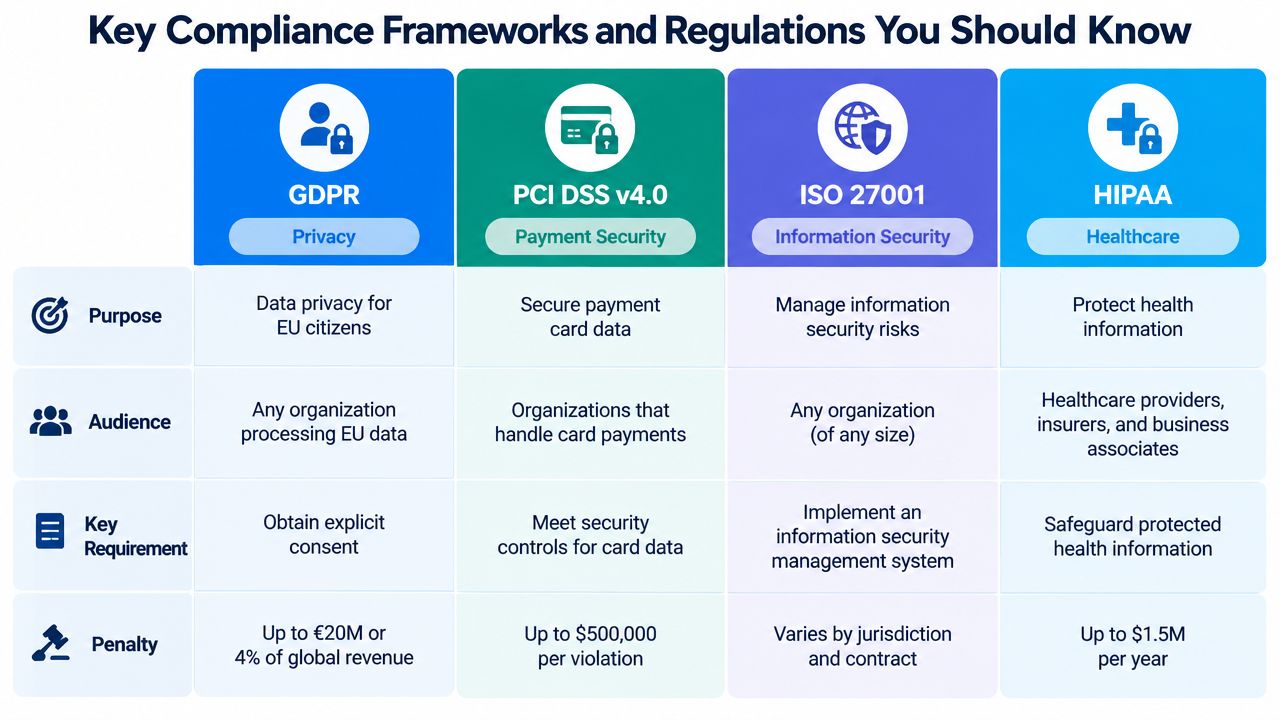
| Framework | Primary Audience | Enforcement Style | Operational Focus |
|---|---|---|---|
| GDPR | Organizations handling EU personal data | Regulatory privacy enforcement | Data rights, lawful processing, accountability |
| PCI DSS v4.0 | Merchants and service providers handling card data | Prescriptive security standard | Cardholder data protection and payment environment controls |
| NIST continuous monitoring models | Security and risk teams | Risk-based governance guidance | Ongoing control effectiveness |
| ISO 27001 | Organizations building an information security management system | Certifiable management framework | Repeatable governance and risk treatment |
How to choose what matters first
Start with the data and systems you run. If you process card data, PCI DSS v4.0 drives concrete technical controls. If you process EU personal data, GDPR shapes privacy duties and governance. If leaders want proof that controls stay current as identity groups, cloud settings, and vendor access change, NIST-style monitoring gives the operating rhythm.
A simple way to frame it is this. Privacy laws define what you are accountable for. Payment standards define how a specific environment must be protected. Continuous monitoring defines how you keep evidence current when drift, identity sprawl, or AI governance gaps start to change the picture.
For teams that need the same discipline across public exposure and third-party risk, the pattern is similar to a lock with a paper trail. The lock matters, but the record of inspections, access reviews, and exceptions is what lets you prove the control still works.
Mapping Security Controls to Regulatory Requirements
一個控制如果設計得好,可以同時支撐多項要求。問題不在於寫更多政策,而在於把控制、責任和證據連成同一條線。對中型 IT 團隊來說,這就是把合規從文件工作,轉成持續維護控制與證據的工作。
以 MFA 為例。對處理卡片資料的環境,PCI DSS v4.0 要求存取卡holder data environment 時使用 MFA PCI reference。在更廣泛的安全與隱私計畫中,它同樣支援存取控制原則,因為它把未授權登入的風險往下壓。
A mapping matrix keeps people honest
實用的對照矩陣通常有四欄,控制、法規要求、所支援的原則,以及可驗證的證據。證據可以是組態匯出、存取審查紀錄、加密政策,或日誌保存報告。重點不是堆文件,而是讓每個控制都能被追溯。
同樣的邏輯也適用於資料傳輸中的 TLS 1.2 or higher,以及 PCI DSS v4.0 對日誌保存的要求,保存至少 12 個月,且最近 3 個月可立即存取。這些都不是抽象口號,它們會直接影響架構、儲存、證據收集,還有誰負責維護控制。若你的環境同時分布在多個雲平台,控制定義更需要一致,可以參考這份 multi-cloud strategy resource 來整理不同平台上的控制對應方式。
| Security Control | PCI DSS v4.0 Requirement | GDPR Principle | Evidence Artifact |
|---|---|---|---|
| MFA for privileged access | MFA for access into the CDE | Access control and accountability | Authentication policy, system config, access logs |
| TLS for data in transit | TLS 1.2 or higher over open networks | Security of processing | Cipher configuration export, test result |
| Log retention | 12 months retained, 3 months available | Accountability and traceability | Retention policy, SIEM retention report |
| Least privilege review | Access control requirements | Data minimization and access limitation | Access review records, approval workflow |
Why the matrix saves time later
對應矩陣也能減少稽核摩擦。當稽核人員要看證據時,你不是按框架名稱找資料,而是按控制擁有者和證據類型去找。這會把「請拿出來看」縮短成「文件在哪裡」。
在雲端和混合環境裡,這一點更明顯。沒有一致的控制定義時,同一個控制可能在不同平台上長出好幾個版本,證據也會分散成幾套。控制先定義一次,再逐一映射到各平台,才不會讓身份群組、設定漂移和外部存取變更把證據弄舊。
Building Evidence and Audit Readiness That Lasts
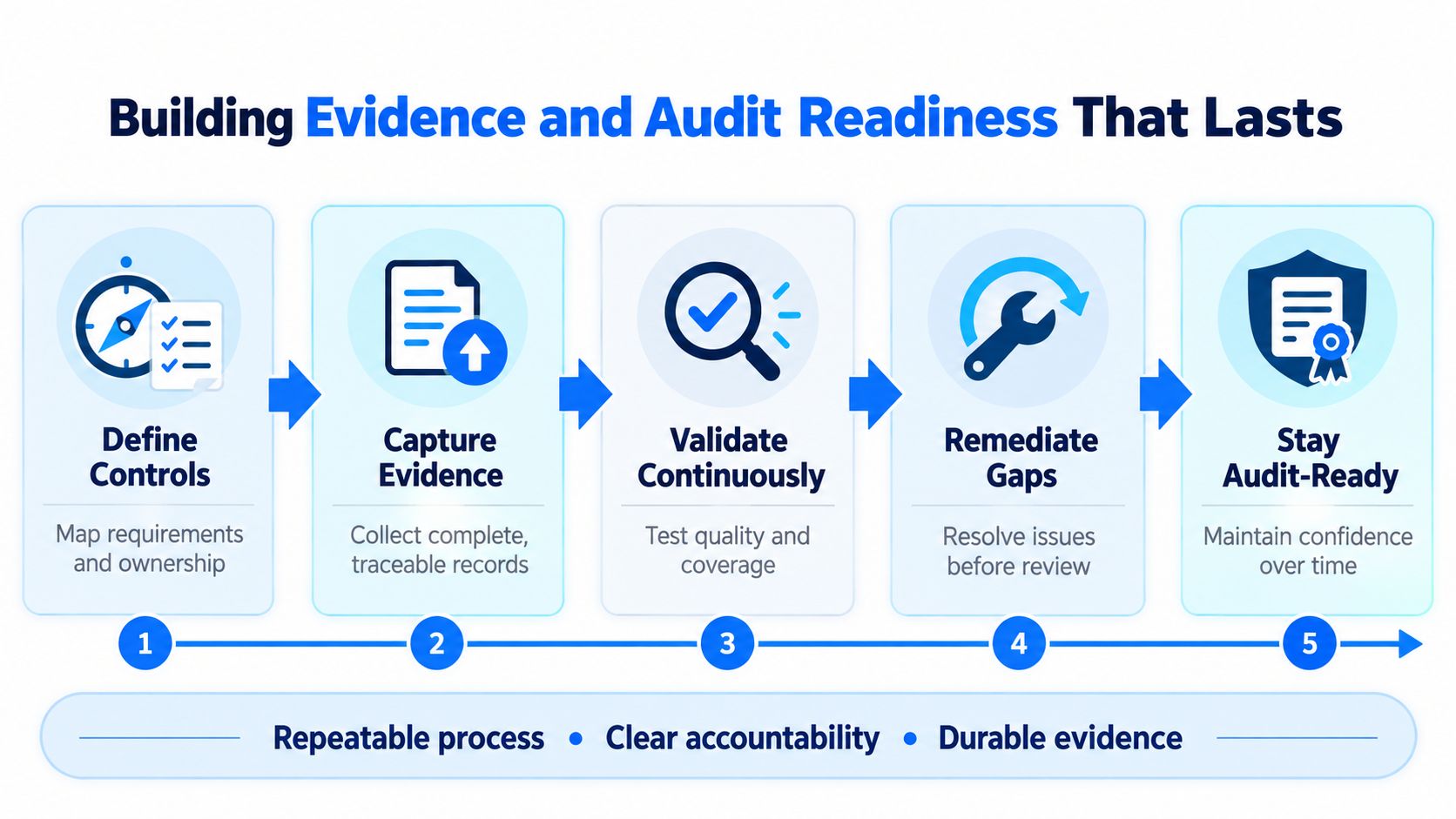
合規一旦只停在某個時間點,環境一變就容易失真。雲端權限會調整,新服務會上線,原本有效的證據也可能很快過期。對 IT 團隊來說,這表示合規不是先寫好文件就結束,而是要讓控制與證據持續跟著系統變化更新。
實務上,需要的是一條證據流程,不是稽核前臨時翻找試算表。只讀的 API 連到雲端、身分、HR 和程式碼系統後,可以定期拉出帶時間戳記的素材,對應到每一項控制,再在稽核前把漂移標出來。合規因此從臨時應付,變成日常運作的一部分。
What good evidence actually looks like
好的證據要符合三件事,最新、可追溯、可重複。它要能說明誰擁有這項控制、檢查何時執行、哪個系統產生結果,以及是否出現漂移。截圖可以當補充,但不該成為整個計畫的骨架。
若要把稽核軌跡做得更能抗改動,這篇 Blocsys Technologies cryptographic evidence 提供了清楚的參考。核心概念很直接,證據鏈越不容易被竄改,你花在證明證據可信度上的時間就越少。
The habits that keep readiness alive
三個習慣最有用。
- Assign one owner per control. 如果每個人都負責,最後通常沒有人真正負責。
- Track exceptions separately. 例外要看得見、要核准,也要有期限。
- Review drift continuously. 身分群組、設定或雲端政策一變,證據也要跟著更新。
Practical rule: 先自動化證據蒐集,再自動化報告。順序顛倒時,團隊常做出更漂亮的儀表板,卻不是更好的 readiness。
How to store evidence so it's usable
好的儲存庫會按控制、日期和擁有者整理。稽核時要能快速搜尋,保存規則改變時也要能乾淨地退場。如果證據庫需要靠某個人才能找出資料,結構就還沒準備好。
針對控制基線、調整與持續評估的 NIST 指引 之所以有用,是因為它提醒團隊,證據不是一次建好就完成,而是要隨控制版本、系統狀態與風險變化持續維護。
Real World Examples Where Compliance Gaps Become Breaches
A compliance gap does not need to look dramatic to cause damage. A stale access review, a missed logging setting, or a delayed exception approval can turn a routine incident into a more expensive one. That is why the financial difference between ordinary breaches and breaches tied to noncompliance matters, as shown in the compliance statistics review.
The United States is the clearest example of cost pressure, with the average breach cost at $10.22 million in 2025, from the same source. That does not mean every US breach follows the same pattern. It does mean regulatory exposure, response complexity, and slower remediation can raise the impact when controls and evidence lag behind reality.
When manual checks fall behind
The usual problem is not a broken framework, it is an outdated review process. Teams that still rely on periodic spreadsheet checks can miss identity sprawl, orphaned entitlements, and silent configuration drift. The control was approved, but the environment moved on.
Continuous controls monitoring keeps coming up in board conversations for that reason. Independent benchmarking shows 94.2% of CISOs say continuous controls monitoring improves security and compliance, yet only 72% have implemented it benchmark reference. The gap between belief and execution is where many audit findings begin.
The AI governance blind spot
AI adds a different kind of exposure. Recent 2026 data shows 69% of security and compliance leaders said AI adoption is outpacing their controls, 55% ranked AI-related data exposure or misuse as their top breach concern, and 57% believed AI incidents are the most likely trigger for regulatory action or customer fallout AI governance benchmark. Another benchmark found AI security maturity at 38%, attack detection on AI systems at just 10%, while 76% of organizations had defined AI rules.
That combination is risky. A policy exists, a monitoring tool exists, but containment still trails. For regulated buyers, the question is whether the organization can produce evidence that the governance works.
For teams facing that gap in healthcare and regulated operations, this HIPAA compliance with cloud migration example shows how control design and operating reality have to move together.
Governance Processes That Keep Compliance Continuous
Continuous compliance doesn't come from more policies. It comes from governance that treats controls like living assets. That means regular ownership reviews, risk-based prioritization, and reporting that shows whether control health is improving or slipping.
A strong operating model starts with the right cadence. High-risk controls get reviewed more often, change management feeds evidence collection automatically, and unresolved findings stay visible until they're closed or formally accepted. If your board only hears about compliance during audit season, the program is already too reactive.
The habits that hold the line
- Tie controls to business risk. A control that protects critical revenue, regulated data, or privileged access deserves tighter monitoring.
- Separate evidence from opinion. Board reporting should show control health, not just reassurance.
- Use continuous monitoring where drift is likely. Identity, cloud, and AI environments change fast, so periodic checks are rarely enough.
A well-run governance process also makes it easier to use outside help without losing control. For teams that need structured support, the fractional CISO services option from MR2 Solutions can fit into that model when internal security leadership is stretched. In the same vein, a service like eSignature for cybersecurity consultants can help formalize approvals and audit evidence in consulting-heavy workflows.
Compliance is strongest when the organization can show what changed, who approved it, what evidence was captured, and how quickly the control picture updated.
The test is simple. If you can reduce drift, shorten evidence prep, and explain control status clearly to executives, you've moved beyond checkbox compliance. If not, the program still depends too much on memory, screenshots, and last-minute recovery.
MR2 Solutions helps organizations evaluate, implement, and govern IT and security programs with vendor-neutral guidance, fractional leadership, and compliance support. If your team needs a practical way to keep compliance in IT security aligned with real operations, visit MR2 Solutions and start building an evidence-driven program that's ready before the audit arrives.