
RFP Scoring Criteria: How to Weight and Score Vendor Bids

Most advice about RFP scoring criteria starts with a number. Pick a split, usually tilted toward technical over price, load the weights into a spreadsheet, and let the totals pick the vendor. The spreadsheet does produce a winner. It rarely produces a defensible one.
Scoring criteria aren't a math exercise. They're a governance record, written before anyone sees a bid, that has to survive three kinds of pressure: a bidder who challenges the award, an auditor who asks why the numbers landed where they did, and a colleague who asks what happens to the ranking when five points move from price to security.
Weights get published, applied and then scrutinized. A model that can't answer the third question isn't a decision. It's a preference with decimal points attached.
Weak evaluation models fail in predictable places. Criteria overlap, so the same advantage gets counted twice. Score levels go undefined, so two evaluators read the same paragraph and write down different numbers. Heavy weights land on capabilities that are easy to demo and hard to verify. Every one of those is fixable, and none of the fixes involve a better formula.
Default Criteria and Weights at a Glance
RFP scoring criteria are the factors an evaluator uses to rank bids, and each one carries a weight that shows how much it counts toward the total. The criteria answer two questions at once, what matters and how much. Get either half wrong and the ranking becomes an accident.
For technology procurement, seven criteria cover most of what a buyer needs to compare. The table gives typical ranges, a working example set that totals 100%, and the evidence to demand for each row.
| Criterion | Typical weight range | Example weight | Evidence to require |
|---|---|---|---|
| Solution fit and technical requirements | 25-35% | 25% | Requirement-by-requirement compliance matrix and a demo scripted to your use cases |
| Total cost of ownership | 15-25% | 20% | Five-year cost model covering fees, licences, implementation and exit costs |
| Security and compliance | 10-20% | 15% | Certifications, control mapping and independent audit reports |
| Implementation capability | 10-15% | 15% | Named rollout plan, timeline, delivery team and comparable rollouts |
| Service levels and support | 5-15% | 10% | SLA terms, support hours and escalation path |
| Past performance and references | 5-10% | 10% | Two to three relevant references checked directly |
| Lifecycle governance and exit terms | 5-10% | 5% | Change-notification terms, data export rights and transition support |
| Total | 100% | 100% | Example weights must sum to 100% |
Solution fit and technical requirements takes the largest share in almost every technology RFP because it's the thing being bought. The weight goes up when the solution replaces a core system and down when the purchase is an add-on to something already working. The evidence bar matters more than the number: a compliance matrix answered line by line, plus a demo built around your own workflows rather than the vendor's favourite reference customer.
Total cost of ownership flexes hardest of the seven, from 15% to 25%, because a five-year managed service and a three-year licence carry very different financial exposure. Ask for a cost model that includes implementation, migration, licences, support renewals and the cost of leaving at the end of term. A bid that looks cheap in year one and expensive in year four is a common outcome.
Security and compliance holds a floor at 10% in commercial work and climbs toward 20% wherever regulated data, patient records or payment flows sit inside the system. Certifications alone prove little. Ask for a control mapping against the framework your auditors use, plus the latest independent report.
The lower rows are where matrices go soft. Implementation capability looks generous at 15% until you read a plan with no named delivery lead. Service levels and support belongs at 10% for anything business-critical, and the escalation path should be written into the contract, not described in prose. Past performance is worth 10% and rises for first-time deployments with no internal experience to lean on. Lifecycle governance and exit terms sits at 5% in the example and is the row most templates omit entirely, even though it decides what happens when the product changes underneath you.
Rule of thumb: if a criterion can't be tied to a business outcome in one sentence, delete it and redistribute its weight.
Read every weight against your own outcomes before borrowing it. A hospital weighting security at 10% because a template said so is making a decision by default, and the default rarely matches the risk.
Choosing a Scoring Method for Your RFP
The format you choose determines how much precision your result claims. A weighted total to two decimal places claims a lot. An ordinal ranking to three or four finalists claims almost nothing precise, and is often more honest for it.
Five formats cover nearly every procurement, and each one carries a specific failure mode.
| Method | How it works | Best when | Main risk |
|---|---|---|---|
| Numerical weights | Points per criterion multiplied by weight | Many bidders and price must be traded off openly | Small score gaps look like real differences |
| Adjectival or color ratings | Labels such as excellent, acceptable and unacceptable | Quality matters more than exact differences | Labels are read differently by each evaluator |
| Ordinal ranking | Each proposal ranked 1 to N on each criterion | Three or four close proposals remain | Hides how far apart the proposals are |
| Pass/fail gates plus weighted score | Mandatory requirements screened first, then weighted scoring | Compliance is non-negotiable | Capable vendors dropped over minor paperwork gaps |
| Price-only | Lowest compliant bid wins | Commodity purchases with exact specifications | Cheapest bid may deliver less value |
Numerical weights suit a competitive field of five or more bidders where price trades against capability and the trade-off has to be visible to executives. The risk is false precision: a two-point gap between vendors that a reasonable evaluator could flip on a different day reads like a verified result in a spreadsheet cell.
Adjectival ratings work when the difference between proposals is qualitative, such as implementation approach or service culture. They only survive scrutiny when each label has a written definition, otherwise the panel spends its consensus meeting arguing about vocabulary instead of evidence.
Ordinal ranking is the right tool for a shortlist. With three or four close proposals there's often no meaningful difference between two strong submissions, and ranking forces the panel to state which proposal is better rather than by how much.
Pass/fail gates belong in front of every weighted score. Screen insurance certificates, mandatory certifications, required integrations and submission compliance first, then score what survives. Set the gates narrowly: a vendor excluded over a missing table of contents is a vendor you can't buy from, which is a procurement failure dressed up as discipline.
Price-only has a place, and it's smaller than most organizations assume. It fits commodity purchases with exact specifications where any compliant supplier delivers an identical item.
Recommendation for a typical technology RFP: gate mandatory requirements first, score the weighted criteria on a defined scale, then use ordinal ranking as a cross-check on the top three. If the ranking and the weighted total disagree, you have a criterion definition problem worth solving before award.
Choose by bidder count and expected spread. Eight bidders need weights and gates. Three near-identical finalists need ordinal discipline and reference calls.
How to Set Criteria and Weights Before Proposals Arrive
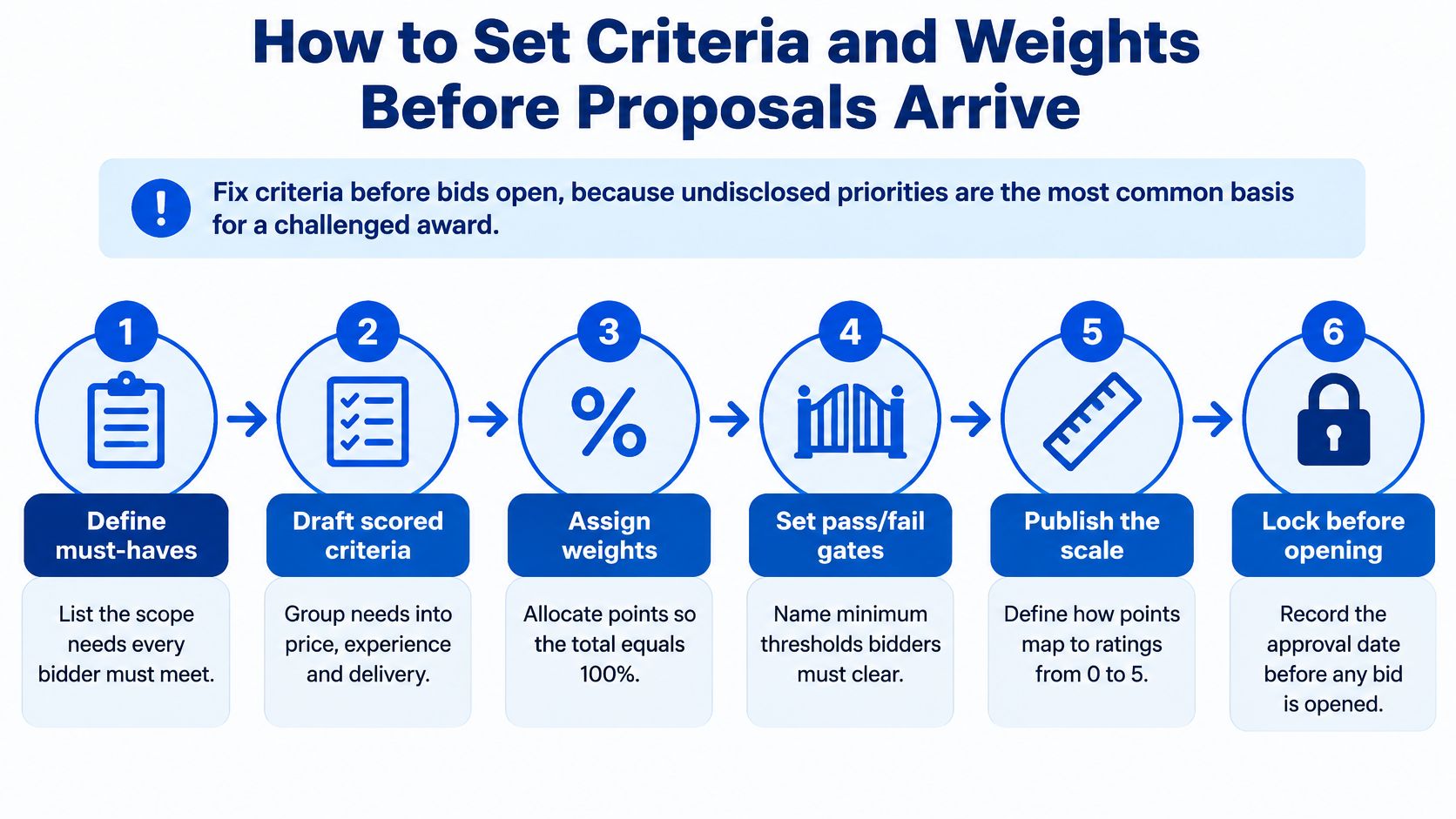
Criteria fixed after bids arrive are the most common reason an award gets challenged. The ranking then reflects priorities that appeared once someone saw a number they liked. The fix is procedural, not analytical, and it runs in seven steps.
The governing principle comes from US federal procurement. Under FAR 15.304 on evaluation factors, every competitive source selection must address quality through at least one non-cost factor, and the solicitation must state each factor that can affect award along with its relative importance. It must also say whether non-price factors are significantly more important than price, roughly equal to it, or less important. Evaluators then work only from what was disclosed.
That principle travels well beyond federal buyers. Publish the model, and nobody can invent a priority later.
- Pull the business outcomes first. Run structured discovery with the people who'll live with the system, covering goals, constraints, timelines and current pain, before any vendor conversation. Our own engagements start exactly there, with discovery before vendor discussions, because criteria written after a sales demo tend to describe the demo.
- Turn each outcome into a measurable criterion. "Improved uptime" becomes a target with a number and a measurement window. "Easier for staff" becomes a named set of workflows and a training commitment. If you can't name the measure, you don't yet have a criterion, you have an aspiration.
- Separate gates from scored criteria. Security certification, data residency and required integrations belong in the pass/fail screen. Score them only once, never both, or the same requirement gets counted twice and dominates the result.
- Assign weights that total 100. Write a one-paragraph rationale for the top three. That paragraph is what you'll read aloud when someone asks why security isn't worth more.
- Declare the price relationship. Say plainly whether non-price factors collectively outweigh price, match it, or trail it, and explain the reasoning in a sentence.
- Publish criteria, weights, gates and scale in the RFP. Vendors respond better to a disclosed model, and evaluators can't wander outside it.
- Freeze before opening. Record the date the model was approved, then log every amendment with its date, the reason, and who signed off. Material changes after bids land mean reissuing, not patching.
Disclosure is the part that gets challenged
A bidder who loses can request a debrief and, in public procurement, a formal challenge. The first question is always whether the evaluation followed the published criteria. If the answer is anything other than yes, the technical merits stop mattering.
The freeze protects you in both directions. It stops an evaluator from adding a favourite consideration, and it stops a stakeholder from raising a new requirement after seeing which vendor handles it best.
Scale Definitions and How to Score Consistently
A weight means nothing until each score level has a written definition and an evidence standard. Two evaluators who read a 3 differently will rank the same bids differently, and the spreadsheet won't warn you.
The scale below has six levels. Keep the labels and the evidence standard attached to each; the wording is the part that does the work.
| Score | Label | What it looks like |
|---|---|---|
| 5 | Exceeds | Meets every requirement and offers added value proven by a reference, demo or contract commitment |
| 4 | Fully meets | All requirements met with minor fixable gaps, backed by at least one verifiable example |
| 3 | Meets with gaps | Core requirements met, and each gap has a written workaround |
| 2 | Partially meets | Some core requirements met, material gaps remain, response is vague or unverified |
| 1 | Does not meet | A core requirement is unmet or the response contradicts it |
| 0 | No response | The requirement isn't addressed |
Federal evaluators are held to the published factors and subfactors only, and the same discipline shows up in transport procurement under 23 CFR Part 636, where proposals may be scored with color ratings, numerical weights or ordinal rankings. The regulation's real demand is narrower and harder: what constitutes excellent, acceptable or unacceptable must be defined, and the record must show how proposal evidence produced the final ranking.
Running the calibration routine
- Score independently first. Each evaluator submits every score before the panel meets. Group sessions held too early converge on the loudest voice in the room.
- Calibrate on one sample. Walk the panel through a single proposal and agree what a 3 and a 4 look like in practice. Fifteen minutes here saves an hour of reconciliation later.
- Cite the evidence for every score. A page number, a section reference or a timestamped demo moment. A vendor evaluation template with a mandatory evidence column makes this the default rather than a virtue.
- Resolve spreads of two points or more. Any gap that wide means the evaluators read the requirement differently. Talk it through, record the resolution, and adjust the definition if it keeps happening.
- Write a reason for every 0, 1 and 5. The extremes carry the most weight and attract the most scrutiny. One sentence each, recorded against the criterion.
A score of 3 without a citation is an opinion. A score of 3 with a page reference is evidence.
The score record is the artifact that defends the ranking. If a bidder asks why it lost, the answer comes from the citations and the consensus notes, not from a total in a cell.
Worked Weighting Examples From Real Evaluations
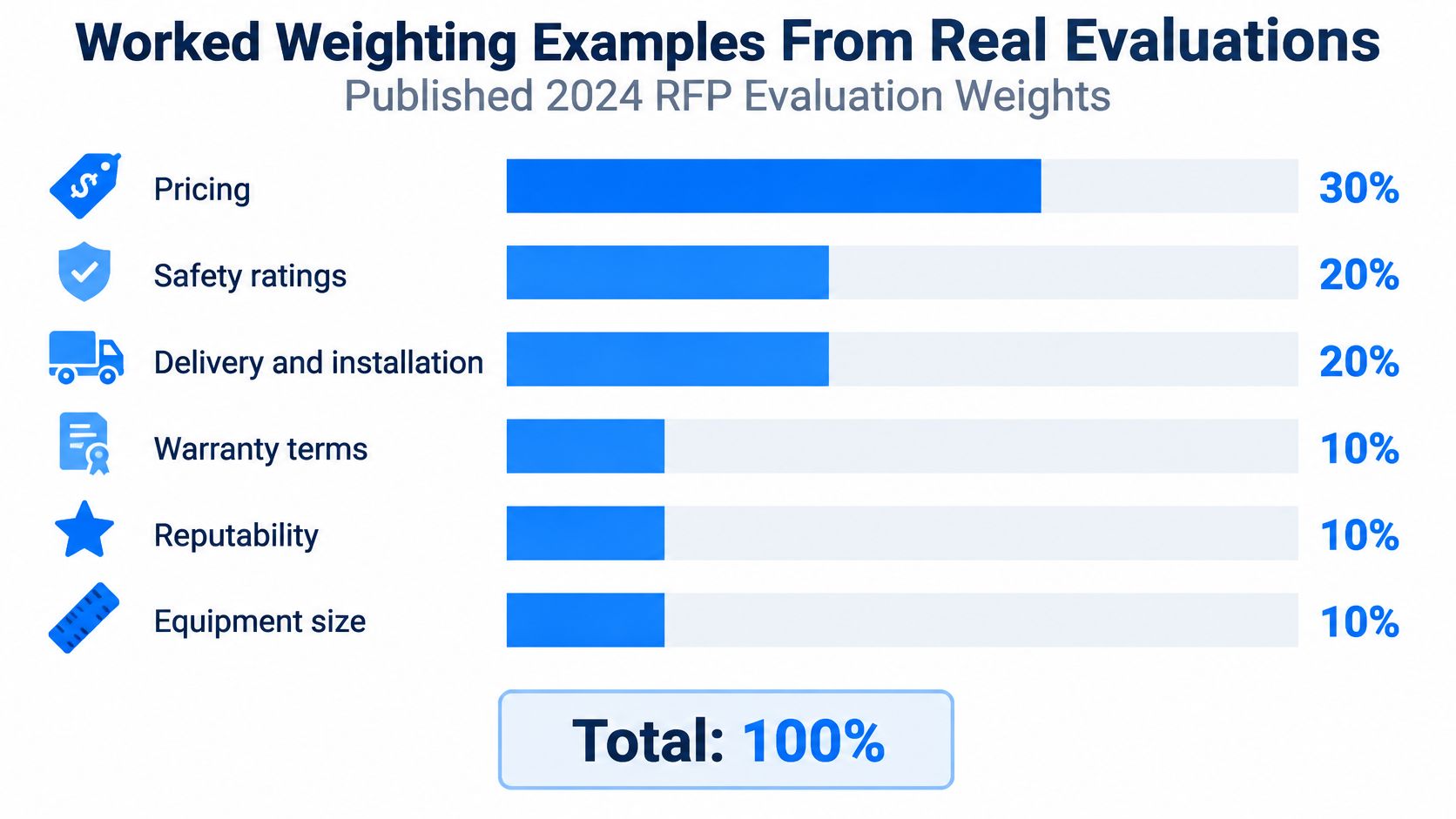
Weights look abstract until you run them. A 2024 RFP evaluation example in Euna Solutions' guide to RFP evaluation criteria assigns pricing 30%, safety ratings 20%, delivery and installation 20%, warranty terms 10%, reputability 10% and equipment size 10%. Price leads in that model, which is normal for equipment buys and a long way from the technology defaults above.
Now run the seven technology criteria with two fictional vendors on a 0-5 scale. Weighted points equal the score divided by five, multiplied by the criterion weight. Cost needs normalizing first: the lowest compliant five-year cost scores a 5, and every other bid's score is the lowest cost divided by its cost, multiplied by 5.
| Criterion | Weight | Vendor A score | Vendor A points | Vendor B score | Vendor B points |
|---|---|---|---|---|---|
| Solution fit | 25 | 4 | 20 | 5 | 25 |
| Total cost of ownership | 20 | 3 | 12 | 4 | 16 |
| Security and compliance | 15 | 4 | 12 | 2 | 6 |
| Implementation capability | 15 | 3 | 9 | 4 | 12 |
| Service levels and support | 10 | 5 | 10 | 3 | 6 |
| Past performance and references | 10 | 2 | 4 | 5 | 10 |
| Lifecycle governance and exit terms | 5 | 4 | 4 | 3 | 3 |
| Total | 100 | n/a | 71 | n/a | 78 |
Vendor B wins by seven points, and the arithmetic shows exactly where. It leads by 5 points on solution fit, 6 on past performance and 4 on cost, which outweighs a 6-point deficit on security and 4 on service levels.
That's the useful part. The gap is a set of specific findings, not a verdict. A buyer who hands the contract to B on the strength of 78 against 71 has skipped the conversation that matters: B scored a 2 on security, and security carries a 15% weight for a reason.
A seven-point gap is a difference to investigate. The sensitivity test in the next section shows whether a five-point weight shift would reverse it, and sometimes it does.
Diagnosing Scores That Look Right but Mislead
A weighted matrix produces a confident total, and confidence is not the same as correctness. Overlapping criteria, loose score definitions and heavy weights on easily marketed capabilities all survive a neat-looking spreadsheet. PlanetBids' 2026 analysis of AI in procurement found accuracy and reliability were the leading AI procurement concern for 49% of respondents, which says buyers already distrust capability claims as a basis for award. Another buyer analysis in the same report found integration depth critical to 90% of surveyed procurement leaders, ease of implementation to 85%, security and compliance to 80% and transparent pricing to 75%.
Those numbers should rearrange a few weightings. What they really argue for is a split between two things most rubrics merge.
Separate importance from verifiability
Importance is a business judgement. Verifiability is an evidence question. A criterion can be highly important and weakly verifiable, which is exactly how demos outscore track records.
Every high-weight criterion needs one of five proofs attached before scoring: a test script the vendor runs against your data, a reference call you place yourself, a proof-of-concept result, a contractual commitment, or independently auditable evidence. If none of the five exists, the criterion is measuring sales quality.
Then test the model itself. Move each weight up five points and down five points, one at a time, and see which way the winner moves.
Sensitivity test: if shifting five points from price to security changes the winner, say so in the award rationale instead of pretending the first total was the truth.
Calculate the spread across evaluators per criterion, not just per vendor. A criterion where the panel's scores sit at opposite ends of the scale is a definition problem, not a consensus.
| Symptom | Likely cause | Fix |
|---|---|---|
| Scores cluster between 3 and 4 | Score definitions too loose | Rewrite each level with an evidence standard and rescore a sample |
| Winner changes after a 5-point weight shift | Close proposals and weights not tied to priority | Run the sensitivity test and document why the weights are what they are |
| Evaluators differ by two or more points | Criteria overlap or are read differently | Calibrate on one proposal and merge overlapping criteria |
| Demo outscores references | Marketed capability weighted above verified capability | Lower demo weight and require reference or test evidence for high-weight items |
| Price dominates the ranking | Price weight too high or cost not normalized | Normalize price and compare five-year total cost of ownership |
| Criteria change after proposals open | Priorities added after bids were seen | Freeze criteria, log amendments and reissue if the change is material |
A documented vendor evaluation process catches these symptoms before award. Fixing them after a challenge is slower and more expensive than tightening a definition in week one.
Scoring Lifecycle Criteria for AI, Cloud and Managed Services
A conventional matrix scores the solution a vendor delivers on award day. It says almost nothing about month eighteen, when the model updates, the subprocessor changes or the service degrades. Public-sector AI procurement analysis from KeySpider's report on AI procurement trends identified four recurring requirements that conventional RFP templates often omit: data sovereignty and residency, hallucination and accuracy controls, accessibility conformance, and vendor notification of model changes.

A proposal can score high on every traditional criterion and still carry none of those controls. The award is defensible. The three-year position isn't.
Lifecycle criteria worth scoring
Add these as their own criterion or fold them into security and service levels. Either works, provided they're measurable and carry points.
- Change-management controls: a written notice period for model or product changes, with the notice delivered to a named contact rather than buried in release notes.
- Rollback rights: a tested rollback within a stated window, confirmed in the contract, not promised in a slide.
- Independent testing: third-party validation results or a customer-run validation you can repeat on your own data.
- Incident reporting time: hours from detection to customer notice, stated as a number with a credit attached.
- Measurable service outcomes: accuracy, uptime or response targets with remedies, rather than "best efforts" language.
- Subprocessor notification: advance notice of new subprocessors and a right to object.
- Data export and transition: export format, timeline and cost, plus transition support at end of term.
Weighted at 5-10% on their own, these criteria change vendor behaviour more than any single feature score. Buyers who ask for export timelines and rollback tests tend to get them written into the master agreement, because the vendor knows the question will be rescored.
Where the risk concentrates
For multi-site and regulated organizations, the strongest proposal isn't the one with the longest feature list. It's the one that stays observable, auditable and replaceable across a three- to five-year term.
Teams that want a second opinion on managed services terms often pair their own scoring with an external reference. This Blowfish Technology managed IT guide covers how managed engagements are scoped and governed, which helps when you're writing lifecycle criteria into a scorecard for the first time.
The governance rows are cheap to add and hard to argue against. A vendor that resists a rollback commitment has told you something worth scoring.
Documenting the Award Decision and Next Step
The award survives on paper. A ranking that can't be reconstructed from the file is a ranking that fails the first serious challenge, and public-sector bidders challenge more often than commercial buyers expect.
The scoring file should hold eight items:
- Published criteria as released, with the date they were finalized.
- Weights, adding to 100%, with the rationale for the top three.
- Gates applied before scoring, and the result for each bidder.
- The scoring scale, including the date it was set and any later revision.
- An amendment log covering every change to criteria, weights or gates, with date, reason and approver.
- Each evaluator's independent scores with cited evidence, plus the consensus notes for every spread of two points or more.
- Sensitivity test results showing whether a five-point weight shift changes the winner.
- Debrief notes for each unsuccessful bidder, stating which criteria fell short without disclosing a competitor's content.
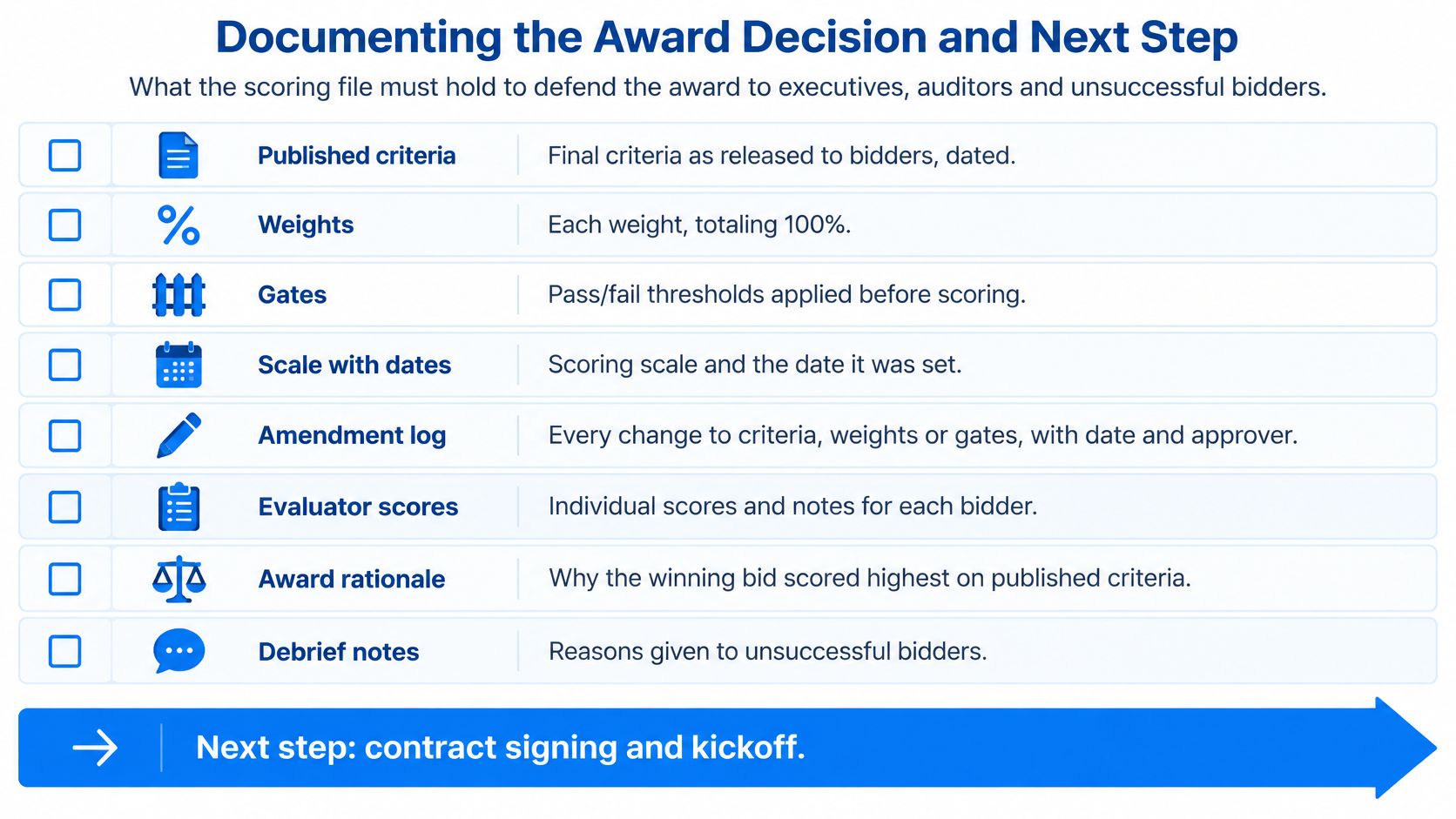
The single next action is to circulate the scoring workbook, criteria, weights, gates and scale included, to every stakeholder who'll sit on the panel, and get written confirmation before the RFP is released. Weights confirmed after bids arrive can't be defended, and a stakeholder who sees the model for the first time at consensus has a legitimate objection you can't answer.
If nobody on staff can run calibration and sensitivity testing, an external reviewer can do it independently. Our position is that we represent the client's interests rather than a vendor's quota, which is why an external check on a shortlist tends to survive executive review. General best practices in IT procurement are a reasonable starting place, but the model that matters is the one your panel confirms in writing before release.
Scoring criteria that survive a challenge are built before the bids arrive, not after the totals surprise someone. MR2 Solutions runs technology selection through a vendor-neutral process that starts with structured discovery, defines weighted criteria and evidence standards up front, then tests the model against the shortlist before anyone signs. If your current scorecard rewards demos over verified delivery, describe where technology is holding your organization back and we'll match you with the right fit from our network of 400+ solution providers. Start at MR2 Solutions and bring the scoring workbook to the first conversation.