
IT Vendor Selection Process: A Step-by-Step Guide

You've got three vendor pitch decks sitting in your inbox, a legacy renewal deadline ninety days out, and two department heads arguing over different feature sets. Meanwhile, finance is asking why the total five-year number keeps creeping upward. That pressure isn't unusual: in G2's 2024 Buyer Behavior Report surveying more than 1,900 global B2B software buyers, 79% reported that the CFO always or frequently held final decision-making power during software selection.
When deadlines tighten, most IT teams fall into the same trap. They run a handful of vendor demos, negotiate a discount on the first-year license fee, and hope implementation goes smoothly. Six months later, integration costs double, security flags an undisclosed subprocessor, and nobody knows how to extract company data from an embedded AI add-on without paying steep exit fees.
A defensible IT vendor selection process fixes that by treating sourcing as a lifecycle control system rather than a one-time purchase. From written requirements and weighted scoring through AI data rights, exit provisions, and post-signature monitoring, every stage produces documented proof that protects your budget and your operations long after launch day.
The Seven Stages of Vendor Selection at a Glance
Say a mid-sized distribution company decides to replace its aging IT help desk after a frustrating two-year run with an underperforming tool. Eager to move fast, the team skips formal written requirements, sits through four polished sales demos, picks the lowest subscription quote, and calls two vendor-supplied references the week before signing. Three months into rollout, critical ERP ticketing workflows still don't sync, the reporting module costs extra, and the team is staring at a second failed purchase.
Skipping early gates almost always costs more time than it saves. Whether you're replacing a help desk, overhauling multi-site networking, or scoping specialized Snowflake data platform services, every complex technology buy needs a clear sequence of stages with named owners and concrete handoffs.
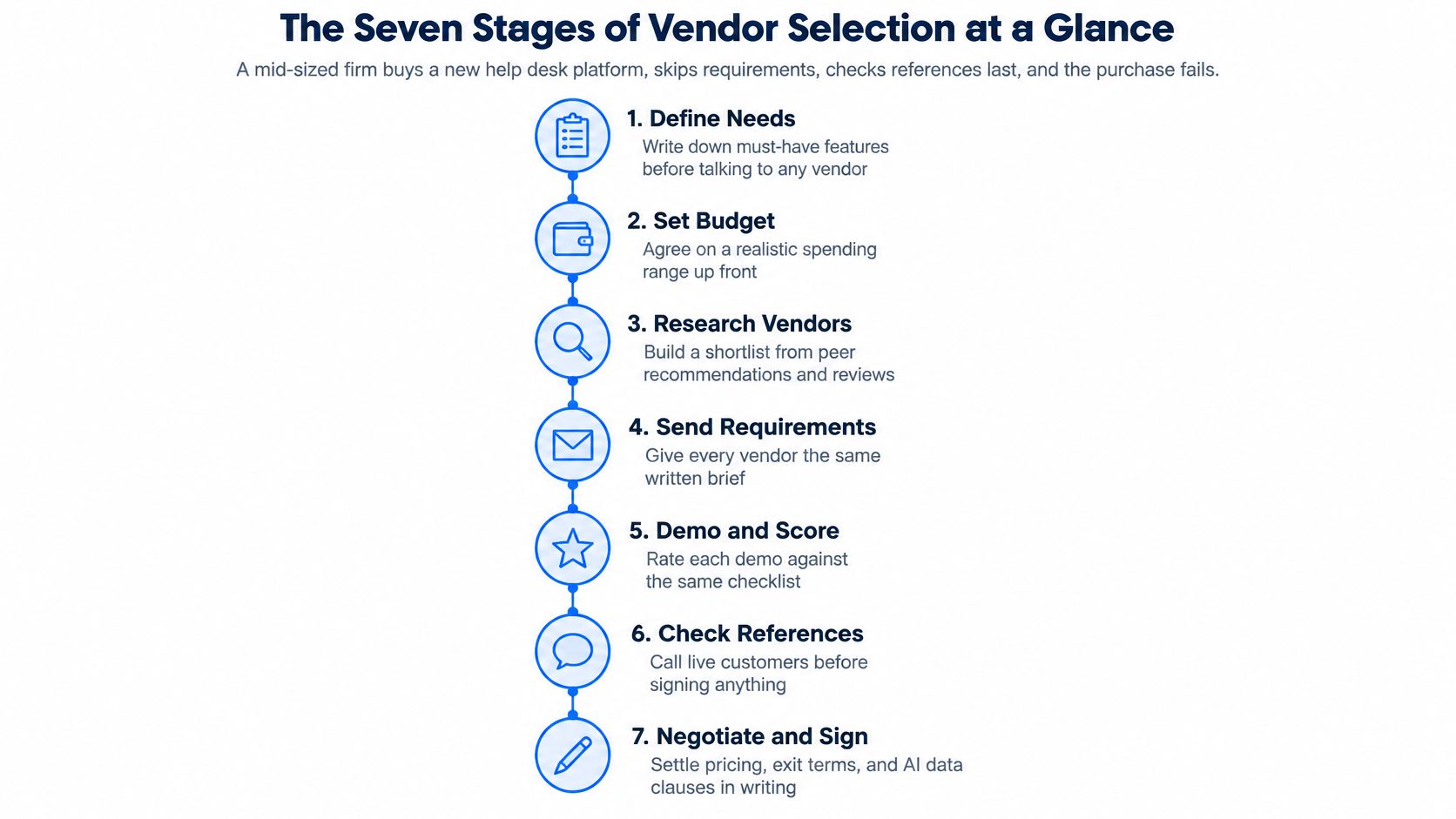
Use the table below as your operating blueprint. Each row defines the artifact that must exist before your team moves to the next stage.
| Stage | Key output | Lead owner |
|---|---|---|
| 1. Define requirements | Requirements document with mandatory gates and weighted criteria | Business sponsor with IT |
| 2. Screen and shortlist | Shortlist of three to five vendors that pass all gates | Procurement with IT architecture |
| 3. Request proposals | Responses in a common RFP or RFI template | Procurement |
| 4. Score proposals | Weighted scorecard with an evidence note for each score | Evaluation panel |
| 5. Validate claims | Demo results, reference findings and total cost analysis | IT and security leads |
| 6. Negotiate and award | Signed contract with service levels, transition and exit terms | Procurement and legal |
| 7. Monitor after signing | Scorecard reviews and a renewal or re-compete decision | Vendor owner in the business unit |
Why Federal Acquisition Discipline Applies to Private Buyers
The seven-stage structure above builds on proven public-sector procurement logic. A U.S. Government Accountability Office study identified three core phases in federal IT acquisition: presolicitation, solicitation, and source selection, during which agencies evaluate competing proposals, negotiate with suppliers, request best-and-final offers, and document the contract award.
That same federal evidence also shows why structured competition and supplier due diligence can't be treated as red tape. In a GAO review of Department of Veterans Affairs IT contracting from fiscal years 2017 through 2021, 76% of IT contract obligations were awarded competitively, yet 30 contractors still received roughly 75% of all IT contract obligations, and past performance served as an evaluation factor in all 19 competitive IT contracts and orders examined. Private-sector buyers face the exact same concentration risk whenever they default to incumbent suppliers without testing the broader market.
Progress test: No stage is complete until its lead owner signs off on the required artifact and files it where every stakeholder can review it.
If your team can't point to the signed artifact from Stage 1, you aren't ready to talk to vendors in Stage 2. That single rule stops rushed decisions before they lock in multi-year regret.
How to Define Requirements and Weight Your Criteria
Most failed technology purchases are decided before the first vendor ever dials into a discovery call. When requirements stay vague, every sales engineer fills in the blanks with whatever features their platform happens to do best, and your evaluation turns into an apples-to-oranges popularity contest.
I'd never let a vendor present a product roadmap until your internal stakeholders agree on what success looks like in writing. Follow these six steps in order to build an airtight baseline:
- Run structured discovery sessions first. Our engagements begin with structured discovery sessions in which business goals, challenges, timelines, and constraints are identified before any vendor discussions occur. Pulling operations, IT, security, and finance into the room early surfaces hidden blockers, such as an upcoming office move or an ERP freeze, before they derail your schedule.
- Write down concrete business outcomes. Skip generic feature wish lists like "modern user interface" or "better analytics." State the operational shift you're paying for, such as cutting average ticket resolution time or consolidating three regional telephony platforms into one unified system.
- Separate mandatory gates from nice-to-have wishes. Mandatory gates are binary pass-or-fail conditions: specific data residency boundaries, an active SOC 2 Type II or ISO 27001 certification, or a native integration with Workday or ServiceNow. If you need a clean way to separate must-haves from wish-list bloat, practical frameworks for turning requirement wish lists into baselines help teams document hard boundaries before inviting bids.
- Convert each outcome into a measurable criterion. Vague promises can't be scored objectively or enforced in a contract. Translate every outcome into a verifiable metric, for example, 99.9 percent service uptime or onboarding a new branch site within 30 days, and review proven technology selection criteria examples so your evaluation doesn't overlook critical operational factors.
- Agree on criterion weights in one cross-functional workshop. Distribute a fixed pool of points, typically 100 points across six to eight weighted criteria, and record the exact stakeholder sign-offs. The most common slip here is letting the loudest executive hijack the weighting conversation; fix that by having finance, security, and operations each rank their own top three priorities independently before walking into the workshop.
- Lock in your tie-break rule right now. Decide how you'll settle a close finish before anyone sees a vendor logo or a price quote. For instance, your panel might agree up front that if two finalists land within a narrow score band, the vendor offering the shorter verified implementation timeline wins.
Turning Your Requirements Document Into a Common RFP Template
A finished requirements document doesn't need to be a 90-page novel, but it must contain four locked elements: your target business outcomes, your binary mandatory gates, your stakeholder-signed weighted criteria, and the named internal owner accountable for verifying each area. Without an owner attached to each requirement, nobody takes responsibility when a vendor skirts a tough question.
Once signed off, convert that document directly into a single common RFP template so every bidder answers the exact same questions in the exact same spreadsheet or document structure. Require vendors to answer every mandatory gate as a plain Pass or Fail on page one, supported by a brief proof statement. Catching a non-compliant bid on page one saves your panel dozens of hours reading glossy proposals from suppliers who can't legally host your data or connect to your core stack.
Screening Vendors and Scoring Proposals
Choosing the lowest upfront bid is the single fastest way to blow an IT budget. Cheap bids almost always hide missing integrations, sluggish rollout schedules, thin support tiers, or costly third-party implementation work that lands on your internal team's plate. Your evaluation should anchor on technical fit, operational alignment, and long-term value, not on vendor preference or sales incentives.
Filtering the Longlist Through Mandatory Gates
Start with a broad market scan, then cut your longlist in two disciplined passes rather than reading ten full proposals back to back:
- Apply binary mandatory gates first. Screen every candidate against your mandatory requirements: verified security certifications like SOC 2 or ISO 27001, required data hosting locations, a minimum track record of live customers in your industry, and native support for your core integrations. Record the exact reason every eliminated supplier failed so nobody resurrects a disqualified vendor three weeks later. When verifying security posture, just as teams learn when vetting compliance consultants before an audit, asking for current third-party attestation reports beats taking verbal assurances at face value.
- Narrow survivors using public evidence. Review publicly available API documentation, independent customer reviews, published architecture guides, and financial filings to trim the field to three to five shortlisted vendors.
- Keep one calibration vendor on the shortlist. Include one credible vendor you expect to place near the bottom of your shortlist. Watching how that supplier scores tests whether your rubric rewards operational fit or accidentally favors slick marketing language.
Building an Evidence-Based Weighted Scorecard
Real-world buying data confirms why price shouldn't dominate your scoring matrix. In a study of technology decision-making in Jordan's manufacturing and export sector that distributed 500 questionnaires to CIOs and information-function leaders with a 54% usable response rate, respondents ranked speed of application as important at 94.1% and vendor reputation at 89.3%, ahead of cost at 88.1%, while 69.3% rated technical support services as important.
Similarly, an Analytic Hierarchy Process vendor-selection study using 16 experts across higher education, healthcare, transportation, local government, and state-owned enterprises evaluated 11 criteria (including cost, quality, commitment, expertise, prior work, contract terms, confidentiality, and location) and ranked product quality as the single most important attribute. The broader academic review in that same paper maps vendor evaluation across six decision domains (administrative, service/product, technology, environmental, risk, and economic) and 15 subcriteria covering integration, supplier dependence, flexibility, delivery speed, and financial capability.
When your panel scores each shortlisted bidder from 1 to 5 on your RFP scoring criteria, enforce one strict habit: no score is valid without an evidence note citing a specific proposal page, architecture diagram, or reference call. Multiply each score by its workshop weight to calculate the weighted total out of 5, as shown in the illustrative scorecard below.
| Criterion | Weight | Vendor A | Vendor B | Vendor C |
|---|---|---|---|---|
| Technical fit with your workflows | 30% | 4 | 3 | 5 |
| Security and compliance | 20% | 4 | 4 | 3 |
| Five-year total cost of ownership | 15% | 3 | 5 | 2 |
| Implementation speed | 10% | 5 | 3 | 4 |
| Support and SLA evidence | 10% | 3 | 4 | 4 |
| References and past performance | 10% | 4 | 4 | 3 |
| Financial stability | 5% | 4 | 3 | 5 |
| Weighted total (out of 5) | 100% | Top rank (sum of weight x score) | Third rank (sum of weight x score) | Second rank (sum of weight x score) |
Notice what the math reveals. Vendor B submitted the cheapest five-year bid (scoring a 5 on cost), yet finishes last overall because of weaker workflow fit and slower rollout speed. Vendor C dominates technical fit with a 5, but its high total cost and lower security score pull it into second place, leaving balanced Vendor A on top.
Running a Sensitivity Test Before You Advance
Never treat a narrow paper score gap as settled fact. Before inviting finalists to hands-on validation, run a weighted sensitivity test: shift each major criterion weight up and down by five percentage points and recalculate every vendor's total.
In the table above, raising the technical fit weight by five percentage points while trimming five-year cost from 15% to 10% lifts Vendor C into a tie with Vendor A, wiping out Vendor A's lead completely. Whenever a modest weight tweak reverses or ties your ranking, bring stakeholders back together to resolve the underlying trade-off explicitly before advancing the top two or three contenders into live testing.
Validating Claims Before You Commit
A polished proposal proves a vendor has a strong bid-writing team, not that their platform works inside your environment. Research on IT outsourcing marketplaces published in the Journal of Information Technology found that buyers' real-world selections were frequently driven by softer, perceptual factors, especially cultural fit, relevant track record, and financial stability, even when formal matrices prioritized other metrics. That same literature identifies 32 IT supplier-selection criteria and shows that criterion importance changes between single-sourcing and multi-sourcing setups, making interoperability and cross-vendor governance critical when multiple tools share data.
Structured hands-on validation bridges the gap between paper promises and day-to-day reality. Put every finalist through five concrete tests before entering final commercial negotiations:
- Run a scripted demonstration using your own workflows. Send finalists three to five real operational scenarios and sanitized sample data a week ahead of time. Do not sit through the vendor's canned sales script, which always skips edge cases and awkward handoffs.
- Stress-test technical and operational plumbing. In a sandbox or short proof of concept, test API integrations, data migration scripts, role-based security controls, support ticket escalation, native reporting, and full data export. Watch how quickly their engineers solve an unexpected error during the session.
- Conduct candid reference calls with comparable peers. Speak with at least two current customers of a similar size and industry. Don't ask whether they like the software; ask what broke during implementation, what cost more than quoted, and how the vendor handled the first major escalation.
- Verify financial resilience and subcontractor reliance. Review financial health indicators and map which critical capabilities the vendor outsources to third-party hosting providers, regional integrators, or AI model APIs. A financially strained subcontractor can cripple a well-funded prime vendor.
- Convert passed tests into contractual acceptance criteria. Every benchmark a finalist proves during validation, from data sync latency to migration error rates, goes straight into the contract's acceptance criteria tied to implementation milestone payments.
Pricing the Real Five-Year Total Cost of Ownership
While technical leads validate product claims, finance and procurement should build a complete five-year total cost of ownership (TCO) model. A low year-one license fee frequently becomes the priciest choice by year three once integration upkeep and renewal uplifts kick in.
| Cost category | What it includes | Often missed |
|---|---|---|
| Implementation and migration | Setup, data moves, configuration and partner fees | Internal project team time |
| Licences and subscriptions | Per-seat or usage fees and tier upgrades | Price increases at renewal |
| Integration | APIs, middleware and testing | Maintaining connectors after go-live |
| Support and escalation | Premium support tiers and response commitments | Service credits that are never claimed |
| Internal labour | Administration, training and oversight | Staff time taken from other work |
| Transition and exit | Data export, parallel running and migration out | The cost of leaving at contract end |
Maintain a single auditable evidence register throughout validation. Classify every requirement as mandatory, weighted, or informational, and attach every demo score, sandbox log, reference note, and TCO worksheet to that register so finance, audit, and leadership can trace how you reached your conclusion.
A vendor who refuses a scripted test with your real workflows or blocks a call with a live customer has already shown you how they'll behave after signature.
Contract Terms That Protect You, Especially for AI
Most procurement teams still assume a lower monthly subscription automatically equals a smarter commercial deal. That assumption breaks down fast when modern platforms embed generative AI across productivity suites, customer service desks, analytics engines, cybersecurity monitoring, and software development workflows.
Standard IT selection guides treat AI as a product feature checklist rather than a contractual and governance risk. Yet as procurement analysis from DS Technologies points out, buyers now need explicit contract language governing data-usage rights, model-training restrictions, auditability, intellectual-property ownership, and exit provisions, because an inexpensive subscription can lock an organization into high switching costs, legal exposure, and supplier concentration risk.

Before your legal team begins redlining, force every shortlisted vendor to answer four direct questions in writing: Can they train shared models on your prompts or operational records? Can you export prompts, vector embeddings, and outputs cleanly? What happens if they swap the underlying model, get acquired, or sunset the tool? And what formal proof verifies deletion?
Six AI and Exit Clauses to Take to Legal
Treat reversibility as a standalone weighted criterion right alongside technical capability. Comparing multiple options across architecture, pricing models, and integration capabilities before committing helps your organization avoid vendor lock-in while you still hold negotiating power. Bring these six clauses into every contract markup:
- Explicit ban on unauthorized model training: Prohibit the vendor and its subprocessors from training shared, public, or third-party AI models on your company data, prompts, or outputs unless you opt in through a separate written agreement.
- Complete export rights for AI artifacts: Require documented APIs and open, non-proprietary export formats for raw records, custom prompts, fine-tuned weights, embeddings, and generated outputs at no punitive extraction fee.
- Model and version transparency: Mandate advance written notice before material model updates, deprecations, or third-party foundation-model swaps that could alter accuracy, latency, or compliance posture.
- Defined transition assistance and exit window: Lock in a realistic multi-month post-termination transition period where the vendor continues service at existing rates and cooperates with your migration to a replacement system.
- Formal deletion certification: Require signed written confirmation that all production data, cached prompts, embeddings, and backups have been permanently purged upon contract exit.
- Commercially realistic termination rights: Pair fair termination-for-cause triggers (including chronic SLA failures or unauthorized subprocessor changes) with clear, reasonable early-exit mechanics instead of steep penalty cliffs.
Settle intellectual-property ownership of AI-assisted outputs and third-party audit rights before anyone signs the master services agreement. Trying to negotiate audit access or IP boundaries after your first commercial dispute never ends in the buyer's favor.
Negotiation reality: A bargain subscription with punitive exit fees and locked data isn't cheap; it's deferred switching cost.
Making the Award Decision and Monitoring After Signing
Award the contract to the vendor whose weighted score survives live validation, TCO scrutiny, and sensitivity testing. Capture that verdict in a concise two-page award memo naming the weighted criteria, the decisive validation evidence, the five-year cost comparison, and the runner-up.
Before signing, negotiate concrete service levels, transition controls, and governance schedules with your preferred finalist, running a best-and-final offer (BAFO) round when competition still gives you commercial advantage. Put every verbal promise, including pricing caps and the exit period, directly into the executed contract, and keep your runner-up formally open until signatures are complete so you can pivot immediately if final negotiations stall.
Managing that full evaluation cycle doesn't have to overwhelm a lean IT department. Our Technology Brokerage-as-a-Service (TBaaS™) framework works alongside internal IT teams, enhancing their decision-making and reducing their workload during evaluation and vendor selection while delivering vendor comparisons, evaluation summaries, solution recommendations, cost insights, and an implementation roadmap aligned with business priorities. Your internal IT leaders keep full authority over the final choice and the operational outcomes.
Turning Selection Into a Post-Signature Control System
Even the sharpest selection process unravels if nobody governs the relationship after launch. Assign a single named owner inside the business unit or vendor management office who holds clear accountability for quarterly performance reviews, service-credit claims, remediation plans, renewals, and eventual exit readiness.
Establish a Day One monitoring baseline tied straight to contract commitments: track uptime, ticket response times, user adoption, security incidents, and actual spend against contracted rates. You also need active visibility well beyond your direct supplier. In the Panorays 2025 CISO Survey, 91% of surveyed CISOs reported increasing third-party cybersecurity incidents, while only 3% said they had full visibility into supply chains extending to fourth- and nth-party relationships. That same survey cites separate 2025 research showing 49% of organizations experienced vendor-related incidents in 2024 and were increasingly monitoring vendor AI usage.
Static annual security questionnaires won't close that fourth-party blind spot. Build ongoing telemetry, mandatory subcontractor disclosure, and strict breach-notification windows into your quarterly governance reviews, backed by proven IT vendor management best practices that keep suppliers accountable through renewal or re-competition.
Take one concrete step this week: review the seven-stage ownership table with your finance, security, and business sponsors, agree on who signs off each artifact, and put your first post-signature scorecard review on the calendar before your next vendor contract begins.
If you want to run a disciplined, vendor-neutral IT vendor selection process without adding months of research and RFP overhead to your internal team, our advisors work right alongside your IT, security, and procurement leads from discovery through ongoing governance. Visit MR2 Solutions to explore how our structured evaluations and curated provider ecosystem help you select, negotiate, and govern the right technology partners with confidence.