
How to Choose an MSP: A Buyer’s Guide for 2026

The most repeated advice on how to choose an MSP is to collect three quotes, compare the per-user rate, and pick the provider with the longest certification list. That process produces a decision you can defend in a steering meeting and regret fifteen months later.
Price and certificates describe what a provider sells. They tell you nothing about who answers at 2 a.m., whether a restore has ever been tested, or whether you can walk away with your data, configurations and firewall rules intact. Buyers who sign on a spreadsheet comparison spend the next two years discovering what the spreadsheet left out.
Treat the search as three tests run before signature: a needs inventory you write yourself, a weighted scorecard you can't bend toward a favorite, and an evidence file you keep next to the contract.
Map Your Business Needs Before You Shop
A low monthly fee becomes the most expensive line in the deal when it buys a provider that can't coordinate with your team, document accountability or survive a transition. The 2024 study of IT outsourcing from the University of Oulu found that outcomes depend substantially on internal IT capability and on the quality of contractual and governance processes. Its recommended practices include researching providers' skills and experience, writing well-structured contracts, enforcing service levels without informal grace periods, using shorter project phases where appropriate, considering multi-sourcing, and strengthening internal capability. A separate review cited in the same study names 11 recurring success factors, among them trust, strategic alignment, communication, governance, management support, and know-how.
None of those live in a vendor deck. They start with an inventory you write before the first call.
- Systems that stop the business. Name the ERP, email, clinic scheduling system, plant-floor network or payment platform whose failure halts revenue, service or safety work. Five named systems is enough; a list of forty is a list nobody maintains.
- Outcomes for the next twelve months. A new office live in 90 days. A passed compliance audit. A migration off a failing on-premise file server. Attach a date to each one.
- The pain you already have. Pull monthly ticket volume, the count of repeat incidents and the after-hours gap from your current provider. Those numbers become the baseline you hold the next provider to.
- What stays in-house, and who owns it. Outsourcing doesn't remove the need for an internal security owner and a vendor manager. Write the names down.
- A budget built on total cost. Onboarding, project work, transition assistance and exit costs belong in the three-year number, not just the monthly fee.
Business needs to define before shopping
| Area | Question to Answer | Example Measure |
|---|---|---|
| Critical systems | Which systems stop revenue or service when down? | Named list of the top five systems |
| Business outcomes | What must the MSP enable in the next 12 months? | New office live in 90 days |
| Current pain | Where do tickets and incidents repeat? | Monthly ticket volume and repeat incident count |
| Internal capacity | Which roles stay in-house? | Named owner for security and vendor management |
| Budget and cost | What total cost is acceptable over three years? | Annual range including onboarding and exit costs |
Turn the inventory into an evaluation standard
The inventory does two jobs. It gives every provider the same brief, which makes proposals comparable, and it exposes the ones that answer with a product catalogue instead of a plan for your environment. It also keeps the budget conversation honest: in 2025, 64% of organizations planned to increase IT budgets and total IT spending was expected to grow 9% year over year, according to Spiceworks' State of IT report. Rising budgets make it easy to buy services the inventory never asked for.
Practical rule: If a proposal can't be mapped line by line to your inventory, it describes the provider's portfolio rather than your business.
Keep the finished list to one page. It goes into every RFP, every reference call and every quarterly review for the life of the contract.
Set Service Levels You Can Hold a Provider To
A service level you can't measure on the first of the month is a marketing sentence. Write one page of metrics for the five systems your inventory called critical, then require every shortlisted provider to answer that page in writing.
Service levels to write into the contract
| Metric | What to Define | Example Target |
|---|---|---|
| First response | Time to acknowledge by severity tier | Critical acknowledged within 15 minutes, 24/7 |
| Resolution | Time to restore or apply a workaround by severity | Critical restored or worked around within 4 hours, high severity within 8 business hours |
| Availability | Uptime per named system, measured monthly | 99.9% with exclusions listed in writing |
| Recovery time objective | Maximum tolerable downtime per critical system | 4 hours for systems that stop revenue or service |
| Recovery point objective | Maximum tolerable data loss per critical system | 1 hour of transactional data |
| Maintenance windows | Who schedules and who approves | Provider proposes, buyer approves 5 business days ahead |
| Escalation | Named contacts at each level | Three levels, escalating after 30 minutes on a critical |
| Service credits | Credit owed when a target is missed | Tiered percentage of the monthly fee, scaled to the size of the miss |
Where averages and grace periods hide the failure
99.9% availability sounds strict until you convert it. That allowance still leaves room for one long outage, and a provider can spend all of it on a single Saturday that closes your order desk for a shift. Measured annually, the number looks healthy. Measured monthly with exclusions listed in writing, it doesn't.
Informal grace periods do the same damage. If the contract promises four hours and the provider routinely delivers six while everyone stays polite, you've bought a four-hour target and a six-hour reality. A target that gets forgiven without comment isn't a target, and the first time you need bargaining power is the worst time to discover you have none.
Say a regional clinic writes two numbers into its agreement: appointment scheduling back within four hours, and no more than one hour of patient record data lost. Those numbers drive different questions. The first asks how fast a system can be restored. The second asks how often backups run and whether a restore has ever been proven. A provider that answers both specifically is a different category of vendor from one promising "rapid recovery".
Pricing interacts with all of this. Before you accept a credit schedule, check where the market sits for comparable scope, and these per-user pricing benchmarks for MSPs from ExtraOrbital give you a range to test a quote that looks unusually low. Our own managed services operations overview is useful context for how those targets turn into daily delivery work, which is the standard a provider's reporting should meet.
Get the metric sheet written and agreed internally before proposals go out. A provider that sees your numbers first will price against them, and a provider that sees them after will argue them down.
Score Shortlisted Providers With a Weighted Scorecard
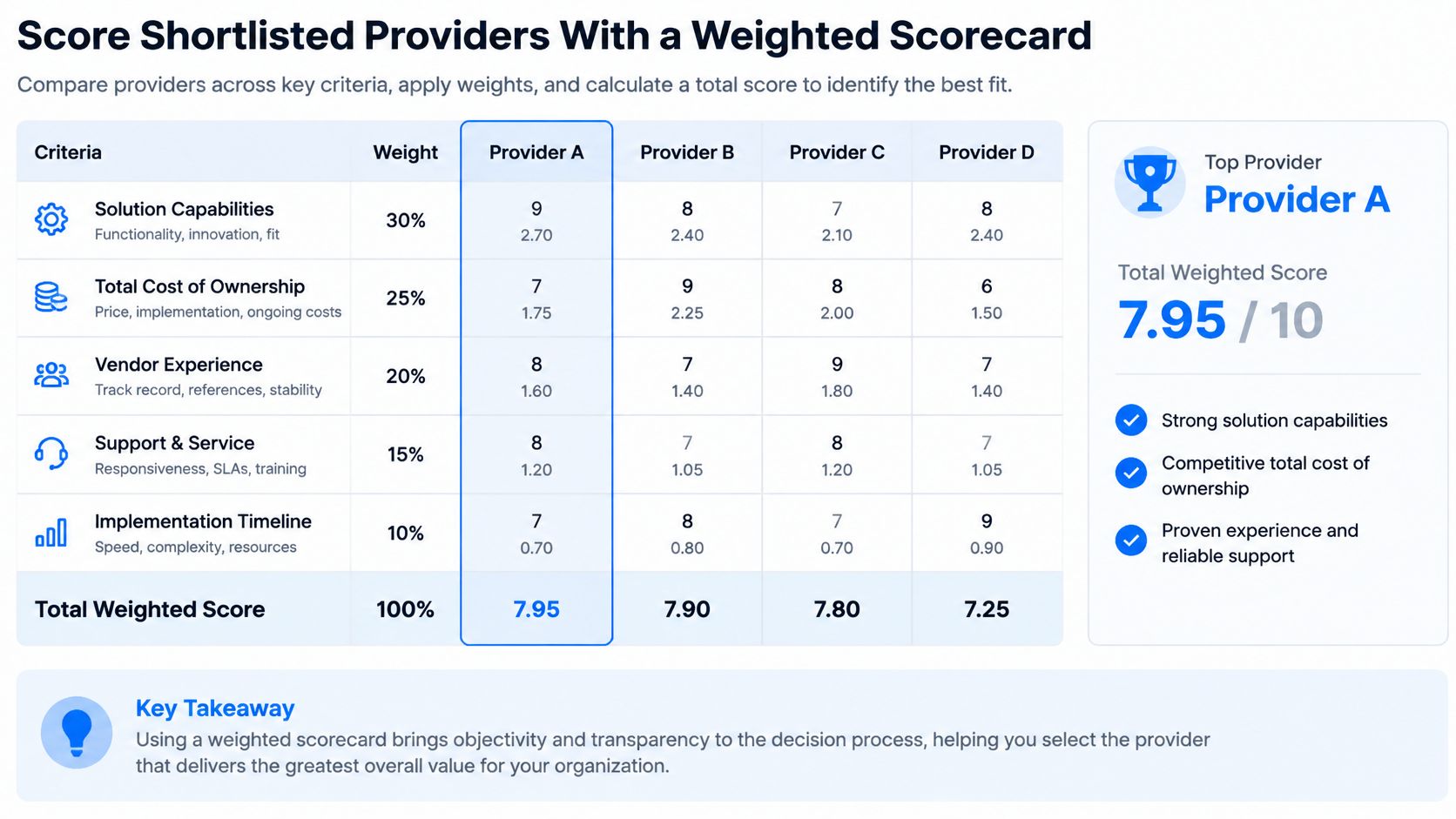
Certifications answer a question you didn't ask. They confirm a provider has documented controls somewhere in its operation; they don't confirm it can meet your recovery objectives or staff your support model. Score the shortlist instead, with weights agreed before the first vendor call so nobody can steer the arithmetic later.
| Criterion | Weight | Evidence to Request |
|---|---|---|
| Security and resilience | 35% | SOC 2 report, tailored control questionnaire, backup restore test results |
| Operational capability | 25% | Staffing model, named certifications, monitoring and ticketing stack |
| Service-level performance | 20% | 24 to 36 months of incident history and SLA attainment |
| Transition and exit capability | 10% | 30-, 60- and 90-day transition plan, migration references, sample export |
| Commercial value | 10% | Total cost assumptions, price escalators, termination fees |
Security and resilience carries the heaviest weight because that's where the money is going: in 2025, 93% of organizations planned to increase cybersecurity spending, according to figures compiled by PureVPN. Commercial value gets the smallest weight because price is the easiest term to renegotiate and the least useful predictor of whether an outage becomes a breach.
Gates that eliminate a provider regardless of score
Six items are pass/fail, not scored. Incident notification, meaning who tells you, how fast and in what form. Privileged-access control, covering who holds admin rights on your tenant and how those rights are withdrawn when an engineer leaves. Data ownership, stated in the contract rather than in a slide. Subcontractor disclosure, because the person on your ticket may work for a company you've never assessed. Backup recovery, with restore test results attached. Termination assistance, priced and scheduled. A provider that fails any of them drops out, whatever its weighted total.
The CIS Controls guidance recommends reassessing providers at least annually and whenever a contract is new or renewed, which is an argument for putting the scorecard on your vendor management calendar instead of leaving it in a procurement folder. It also frames the tiering: classify each provider by data sensitivity, operational criticality, regulatory exposure and concentration risk, then spend your review hours where the impact is highest.
Reserve the sharpest questions for the compliance evidence. A SOC 2 report describes controls inside a defined scope and period. It doesn't prove the provider can hit a four-hour recovery target on your scheduling system, and it doesn't describe a support model it never documented. Treat the report as an entry ticket, then demand response and restoration targets by severity, recovery-point and recovery-time objectives, escalation paths, maintenance rules, service credits and quarterly reporting, and test each one against a business-impact scenario before signature.
Our breakdown of managed IT services cost shows how quotes split into onboarding, per-seat and project lines, which is the detail you need before total cost can be compared at all.
Verify Resilience With Evidence, Not Uptime Claims

An availability figure on a brochure describes an aspiration, not a track record. The Uptime Institute's annual outage analysis reported that 60% of surveyed operators experienced an outage during the prior three years, and 42% reported an outage caused by a third-party supplier. The same analysis cautioned that SLA figures and 99.9x% availability claims are not reliable predictors of future availability.
Ask for 24 to 36 months of anonymized incident data and read it like an audit trail:
- Outage minutes and severity distribution, so you can see whether the damage clusters in a few events or spreads across many.
- Root causes and repeat incidents, because a provider that keeps meeting the same root cause hasn't fixed anything.
- Detection and recovery times, meaning mean time to detect, mean time to acknowledge and mean time to restore.
- SLA attainment, the share of incidents closed inside the written target, rather than an average that dissolves a 14-hour outage into a healthy quarter.
Test the scenario, not the promise
Then put the provider in a room. A tabletop exercise covering ransomware, identity-provider failure, cloud-region loss, telecom outage and the provider itself being unavailable will tell you more in 90 minutes than three reference calls that stay polite. Time each step. Ask who makes the call to fail over, who notifies your executives, and how long the restore took the last time it was rehearsed.
Backups deserve separate proof. Require evidence that they are immutable or otherwise protected from administrative compromise, that restoration tests run on a defined cadence, and that the measured results meet your RTO and RPO. Backups that exist are not backups that restore.
The recurring mistakes are measuring only uptime, accepting aggregate averages that conceal severe incidents, and skipping exit testing entirely. Each one feels efficient at the time and costs a quarter of disruption later.
What to do this week: book a 90-minute tabletop on your most likely failure scenario with each finalist, and record how many minutes each restore step consumes. The provider that finishes fastest with the least improvising is your front-runner.
Test Your Exit Before You Sign
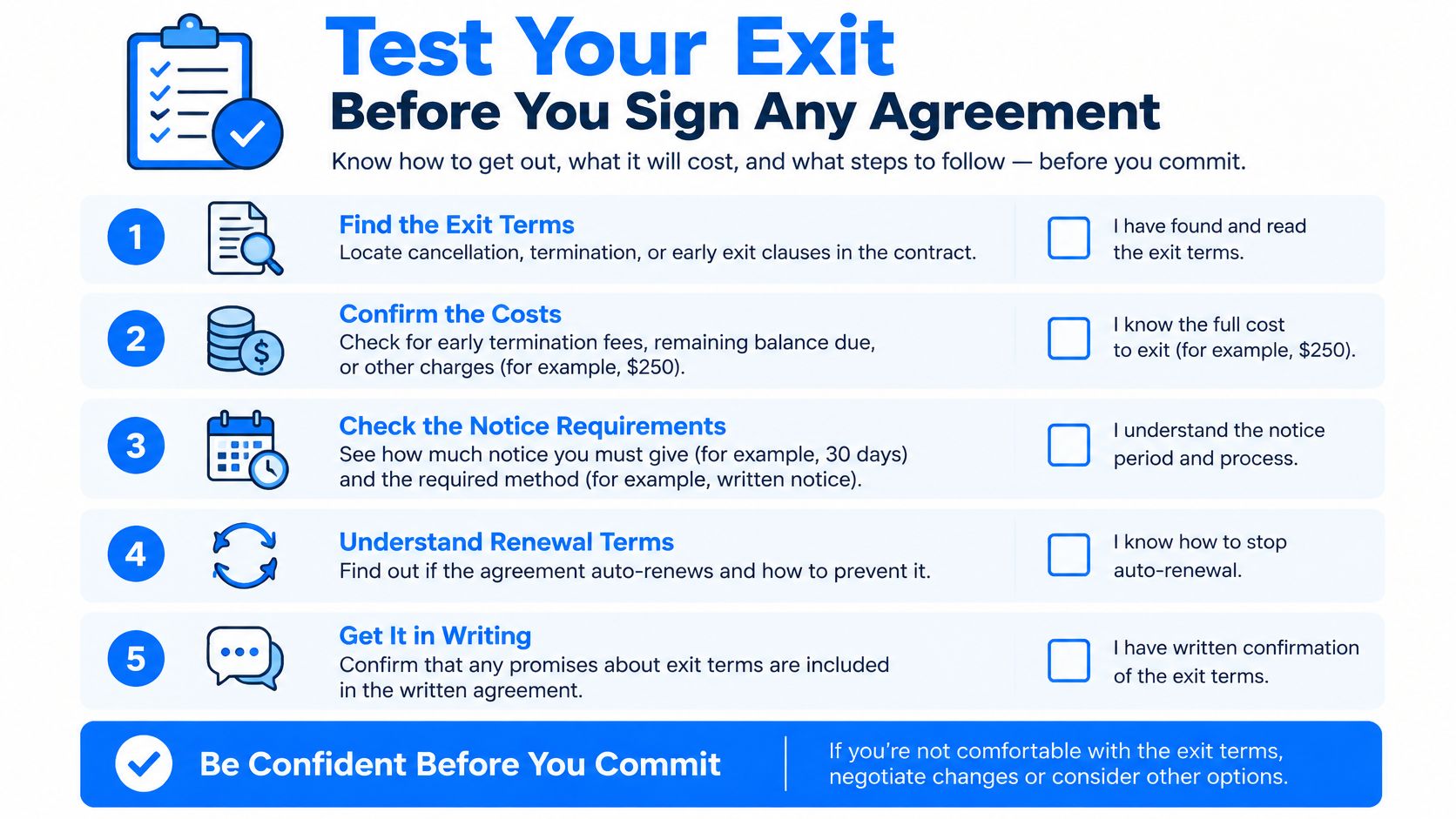
Most selection guides treat exit as a contract clause to negotiate at the end. The Canadian Centre for Cyber Security guidance on managed services names vendor lock-in as a real risk when data can't be moved economically because of penalties, proprietary formats or unclear ownership. It recommends discussing portability before signing, retaining legal ownership of tenant data, and specifying the conditions that permit termination, such as an unapproved change of data location, materially weakened security practices, or an acquisition that fails due diligence.
Score every finalist against eight exit checks:
- Export formats for configurations, tickets and documentation.
- Backup copies you can hold in your own storage account.
- Administrator credentials, and the process for returning or revoking them.
- Knowledge handover, including runbooks and architecture diagrams.
- Transition assistance hours and what they cost after the included allowance runs out.
- Termination fees and notice periods, in numbers.
- Subcontractor disclosure, so you know which dependencies aren't the provider's to release.
- A migration timetable with named owners.
The test question for every finalist
The question isn't "what happens if the MSP misses an SLA". It's whether you can recover systems, evidence, configurations and institutional knowledge without interrupting the business. Firewall rules that exist only inside a provider portal are the classic case: the switch costs more than the original contract, and the "retention mechanism" turns out to be inconvenience rather than service quality.
Due diligence at that depth needs a documented trail, and how DevArmor automates security due diligence is a useful reference for what a repeatable evidence process looks like when questionnaires multiply.
These checks also become your operating baseline after signature. Sound IT vendor management best practices treat portability, documentation and credential custody as standing obligations rather than one-off negotiation points. Close the section by asking each finalist to walk you through a sample export of your own environment, live, on a call.
Evaluate AI Governance Alongside Automation

Every provider now lists AI. The questions that separate them are who approves a use case, what happens to your data inside it, and who owns the incident when a model produces a wrong answer that reached a customer.
The buyer side has moved faster than the selection checklists. KPMG's 2026 managed services outlook, which surveyed 1,224 senior leaders at large global organizations, reported AI management and cybersecurity among the leading investment areas, according to KPMG's managed services research. The same outlook reports that 59% of MSP prospects were concerned about AI-related risks, including AI-enabled phishing, social engineering, shadow AI and insider threats, and that 40% of existing customers valued providers able to explain risks and incidents in plain language.
Put six questions to each provider:
- Approval: who signs off on each AI use case, and is that recorded?
- Data isolation: how is your data kept out of model training?
- Logging: are prompts and outputs retained, for how long, and can you get them?
- Human review: where does a person check a high-impact decision before it lands?
- Incident reporting: how and how quickly is an AI-related incident reported to you?
- Control mapping: can the provider map its controls to your privacy, security and sector rules?
Automation without change control, explainability or incident ownership cuts ticket volume while raising operational and compliance risk. That trade isn't visible in a demo.
If you're also choosing the assistant tooling rather than only the provider, a side-by-side review of BestChatbot AI assistant products from Premier Broadband shows the comparison points worth testing in a pilot. Ask for the provider's AI use policy and incident reporting procedure before you shortlist, not after.
Run the RFP and Reference Calls, Then Decide
Decision rule: pick the provider whose weighted score still holds after references and a tabletop exercise, not the one with the lowest first invoice.
The final stage runs the same way for every provider, which is what makes the comparison fair.
- Send one RFP. Include your five critical systems, the written service levels and the eight exit checks, and require written answers. Verbal assurances don't survive a change of account manager.
- Cut to three. Only providers that pass every gate get a tabletop. Book 90 minutes on your most likely scenario and time each restore.
- Call at least three references in a similar industry, region, architecture and size. Ask for outage minutes, repeat incidents, mean time to restore, and how the provider behaved during the incident, not whether the customer is happy.
- Compare three-year total cost, including onboarding, transition assistance and exit, against the weighted score.
- Choose on the evidence and file the scorecard, the incident data, the tabletop notes and the sample export next to the signed contract.
The historical record explains why the transition and communication questions matter so much. A field study of 30 Dutch IT-outsourcing deals worth more than €100 million, drawn from roughly 700 deals conducted between 2007 and 2010, found 18 successes, a rate near 60%, as published in the lessons from Dutch IT outsourcing study. Three controllable factors distinguished the successes early: following the transition plan, managing demand, and maintaining effective communication inside the supplier organization.
Provider motivation mattered too. Short-term objectives such as increasing margin or sales volume reduced the likelihood of success, while longer-term objectives such as building market share improved it. In practice, that means asking for a detailed 30-, 60- and 90-day transition plan, naming who approves new work so scope doesn't drift, and testing how escalation travels across the service desk, engineering, security and account teams before you rely on it at 3 a.m.
When the shortlist gets hard to compare, outside structure helps. We start with a consultation where you describe where technology is holding you back, then match you with the right fit from our network of 400+ solution providers, so the final two or three candidates are comparable on scope rather than on sales polish.
Choosing an MSP is a decision you'll live with for years, and MR2 Solutions exists to make that decision defensible. Our vendor-neutral brokerage process evaluates providers against your outcomes, security posture, exit terms and total cost, then narrows the field to two or three genuine contenders instead of a stack of quotes. Start with a conversation and we'll match you with providers from a network of more than 400, based on fit rather than sales quota. Visit MR2 Solutions to schedule that consultation.