
Technology Selection Criteria Examples: A Practical Guide

You've got four vendor tabs open, a comparison spreadsheet three people have edited, and a demo on Thursday that will produce another feature list. Everyone in the room can argue about which product looks better. Nobody can say what evidence would settle it. That's the gap good technology selection criteria examples close: they turn a debate about features into a set of tests, documents and contract terms an option either passes or fails.
The shift is small but decisive. Instead of ranking products, you decide what your organization can run, what it will cost across the full service life, and what proof you'll accept. Everything below is written for that version of the decision.
Core Selection Criteria at a Glance
Start with the seven criteria that carry most technology decisions, what sits under each one, and the evidence that proves it.
| Criterion | What to Check | Example Evidence | Role in Scoring |
|---|---|---|---|
| Business fit | Solves the stated outcome on your real workflow | Pilot results on a live process | Score |
| Security and compliance | Data protection, access control, audit trail | Certifications and test reports | Gate |
| Integration and interoperability | Supported identity protocols, APIs, data formats | Working proof of concept | Score |
| Total cost of ownership | Acquisition plus three to five years of support and exit | Life-cycle cost model | Score |
| Implementation and support | Migration effort, service levels, escalation path | Reference projects and signed SLA terms | Score |
| Organizational readiness | Data quality, skills, named process owners | Documented owners and skills plan | Score |
| Scalability and exit | Growth limits, data export, contract exit terms | Export test and exit clause | Gate |
Gates remove options, scores rank them
A gate is a must-have requirement. Fail it and the option leaves the list, no matter how attractive the rest of the proposal looks. A scored criterion compares the options that survive, with weights you set before anyone sees a demo. Mixing the two is where evaluations go wrong: teams give security 15 points, let a weak product win on usability, then discover the audit logging gap during legal review.
Say a 300-person professional services firm is comparing project management platforms. It first removes any tool that can't export its project data in a usable format or can't meet its single sign-on rule. Three options remain. Those three get scored on adoption effort, three-year cost and support response times, and the winner is the one with the best weighted total, not the longest feature list.
The criteria teams forget
- Data export: Ask for a real export of a sample dataset, not a screenshot of an export button. Field mappings and attachments are where exports break.
- Contract exit terms: Notice periods, transition assistance and who pays for migration belong in the agreement you sign, not in a renewal conversation.
- End-of-support dates: A product roadmap that ends before your intended service life turns a good purchase into a forced replacement.
If you're choosing a platform rather than a single tool, this companion piece on how to choose a transformation platform covers the wider architectural version of the same question. Treat the table as raw material for weighting and evidence rules, which is where the work sits.
Business Fit and Organizational Readiness Examples
Write the outcome first, as a measurable change: cut average ticket resolution from two days to one within six months. Business fit asks whether the product delivers that change on your actual workflow, with your actual data and your actual exception cases. A 45-minute pilot on a live process answers more than a 40-page feature matrix.

Readiness is a separate test
Readiness asks a different question: can your organization run this thing once it's bought? Deloitte's State of AI 2025 global report identifies mistakes with real-world consequences (35%), failure to achieve expected value (34%), insufficient high-quality data (30%) and loss of trust from bias or inaccurate outputs (29%) as major adoption barriers. Between 55% and 70% of respondents expected to need at least 12 months to address governance, training, talent, trust and data.
Those aren't product defects. They're operating gaps, and no vendor can close them for you. We evaluate emerging technologies on practical business value rather than hype, which usually means asking who owns the process before asking what the model can do.
What a reviewer can actually check
- Named process owners: One person per workflow, with authority to change the process, not just a department name.
- Validated data sources: A sample pulled from the live system, profiled for completeness and duplicates.
- A skills plan: Who administers the tool, who trains new staff, and what happens when that person leaves.
- An escalation path: Written steps for when output looks wrong, including who can shut the feature off.
- One post-launch metric: The number you'll review at 90 days, agreed before signature.
Consider a hospital evaluating a triage support tool. In the demo it scores well on accuracy, so product fit is high. Then the pilot runs against clinical notes that vary wildly in structure between departments, and the readiness score drops. The right decision isn't to buy the second-best product. It's to fix note templates and assign a clinical data owner first, then re-score.
Score readiness on its own scale. A low readiness score is a work plan, not a reason to keep shopping.
Security and Supplier Risk as a Pass-Fail Gate
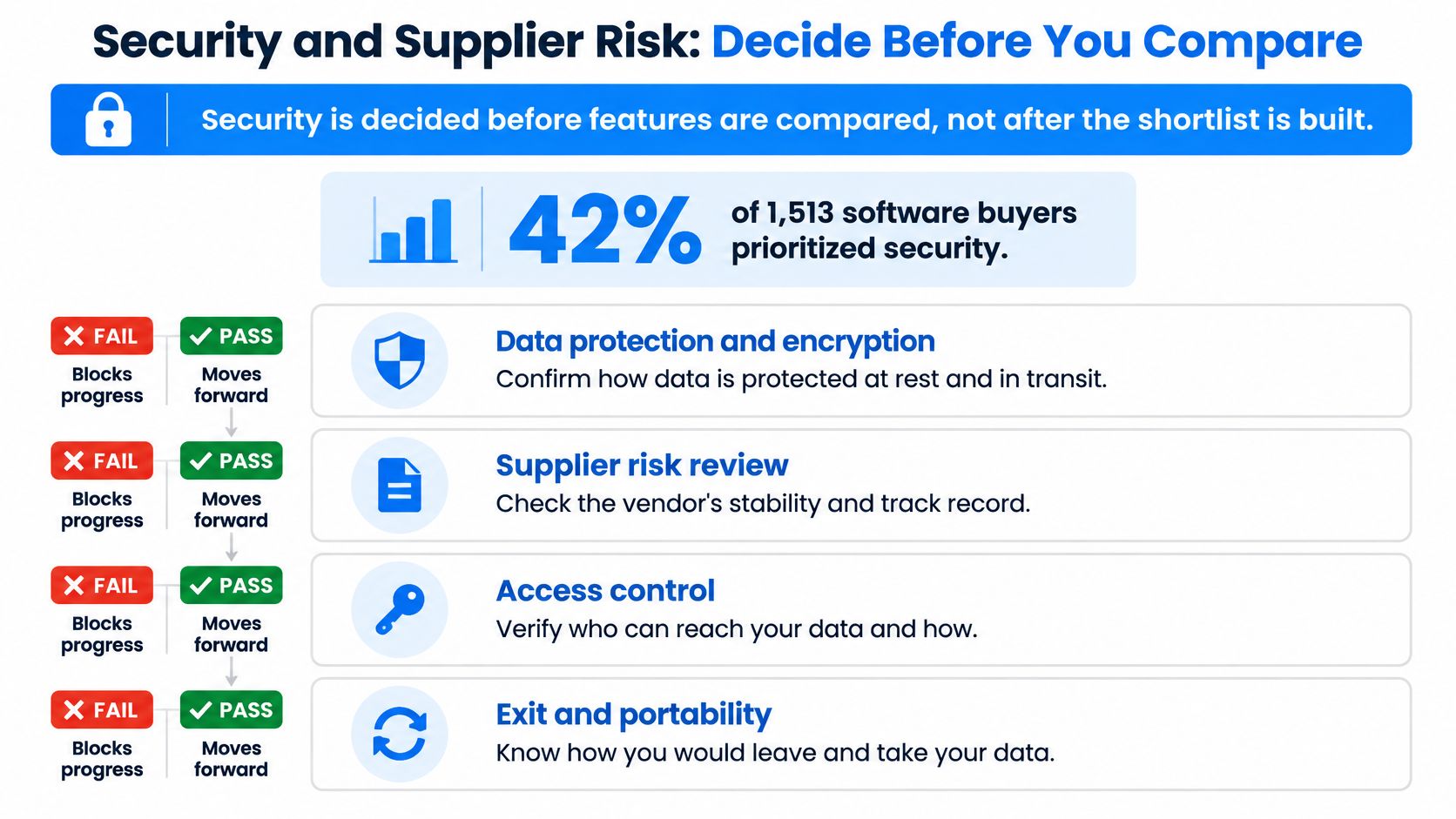
Security gets decided before features are compared, not after the shortlist is built. Gartner Digital Markets' 2023 SMB Software Buying Trends Survey of 1,513 software buyers found 42% prioritized security when evaluating software options, ranking it above product features and functionality. That's a baseline for treating security as a gate rather than one weighted line among many.
Write requirements as measurable statements
"Strong security" isn't a requirement. "All administrative access logged with user, timestamp and action, retained for 12 months, exportable to our SIEM" is. Write these during discovery, in the same document as your functional requirements, and send them with the first round of vendor questions. Verification then has four layers: documentation, demonstration, testing and contract terms. A vendor who passes the first three but won't commit in writing hasn't passed.
Supplier risk belongs in the same gate. NIST's cyber supply chain risk guidance recommends assessing the authenticity and integrity of hardware and software before acquisition and use, and assessing critical suppliers before acquisition. Incomplete supplier visibility is how compromised dependencies and unpatched components walk into your environment.
Security evidence to request before scoring
| Evidence | What It Shows | Typical Source |
|---|---|---|
| Software bill of materials | Components and dependencies inside the product | Vendor documentation |
| Vulnerability disclosure process | How flaws are reported, triaged and fixed | Security policy or contract |
| Patch service-level agreement | Time allowed to fix critical vulnerabilities | Signed SLA |
| Privileged access controls | Who can reach admin functions and how they are logged | Architecture review and live demo |
| Incident notification timeline | How quickly you learn of a breach | Contract terms |
| Component provenance | Where hardware and software parts originate | Supplier attestation |
A public-sector agency sends all six items to every bidder in writing before any demo is scheduled. In that scenario two vendors fail on patch timing alone, and the evaluation team saves weeks of work it would otherwise have spent on products it could never deploy.
If you're evaluating anything that reads or sends mail on a user's behalf, the security guidance for email-enabled agents is a useful supplement on scoping permissions and blast radius. For the control mapping behind these gates, our compliance in IT security work covers how requirements translate into auditable evidence.
Practical rule: list your non-negotiables, mark each one as a gate, and request the evidence in round one, not round three.
Integration and Interoperability Tests That Hold Up
Every vendor says it integrates. Almost none say with what, at what latency, or how much custom code is required. NIST's zero-trust implementation guidance builds on commercially available, interoperable, open, standards-based technologies spanning on-premises and multiple-cloud environments, including hybrid workforces and external partners. Standards-based interfaces limit proprietary coupling, lowering migration costs and preserving your negotiating position at renewal.
Specify the interfaces in writing
Name the supported identity protocols, the APIs and their rate limits, event formats, logging interfaces, network and data-plane requirements, policy integration points, and portability to your target environments. Vague compatibility claims collapse the moment you ask which SAML attributes are consumed or whether logs arrive in a schema your SIEM already parses.
Then build a proof of concept that measures rather than admires:
- Authentication and authorization latency under realistic concurrent load.
- API throughput at your peak volume, plus behavior when the limit is hit.
- Failure recovery, including what happens when the identity provider is unreachable.
- Log completeness against a known set of test actions.
- Policy propagation time from change to enforcement.
- Effort to replace one component with an equivalent.
A manufacturer with 12 sites tests single sign-on against its own directory, forwards logs to its security tool, and times a policy change across two cloud accounts. One vendor needs a custom connector that adds six weeks to the plan. That's not a dealbreaker, but it's a cost and a dependency, and it belongs in the score rather than in a footnote.
Set a pass threshold for each measure before the test starts, so nobody argues about the result afterward.
Lock-in is the other half of this. Our TBaaS™ approach lets you compare multiple options across architecture, pricing models and integration capabilities before committing, so the cheapest connector isn't the only thing on the table. For regulated deployments, add acceptance tests for least-privilege enforcement, centralized telemetry, segmentation and consistent policy behavior across cloud and on-premises resources.
Total Cost of Ownership Across the Full Life Cycle
The quote is the smallest part of the cost. NIST guidance for selecting information-technology security products recommends developing a life-cycle cost estimate for both the status quo and each alternative, then quantifying benefits as dollar savings or cost avoidance where practical. It defines the life cycle as extending from acquisition through disposal, and calls for requirements covering total life-cycle support, ease of use, scalability and interoperability.
That gives you five measurable dimensions: acquisition cost, ongoing support and maintenance, operational usability, ability to scale, and compatibility with existing systems. Modeling the status quo matters more than people expect. If keeping the current system costs less than any alternative over the same horizon, that's a legitimate outcome, not a failed project.
Life-cycle cost components to model
| Cost Component | Example | When It Appears |
|---|---|---|
| Acquisition | Licenses, hardware, setup fees | Contract signature |
| Implementation | Customization, integration work, data migration | First three to twelve months |
| Support and maintenance | Subscription tiers, managed service fees, patching | Every year of service |
| Training and change | Staff training, process rework | Rollout and staff turnover |
| Scaling costs | Added users, sites or data volume | As the organization grows |
| Exit and disposal | Data export, migration away, secure data erasure | End of contract or service life |
Two options, opposite conclusions
A low-cost platform that needs expensive customization, carries migration risk and can't interoperate with your established systems will often lose once those lines are filled in. A higher-priced product can win on automation of routine work, lower support demand, longer useful life and simpler governance. Neither result is predictable from the license price.
Set the horizon at three to five years and build every option in one model with identical assumptions for user volume, growth and labor rates. Use the same loaded hourly rate for internal effort across all options, including the status quo, or the comparison favors whichever product your team already knows. Our technology expense management work exists because these lines drift after signature, and an unreviewed model becomes fiction by year two.
The rows most often left blank are exit costs, data export and secure erasure at end of service life. Ask for them as priced items. Then express the result as cost per user per year, so a finance leader can compare the top two options on one page without reading your assumptions appendix.
Governance and Vendor Support After Go-Live
Selection isn't finished at signature. ISG's 2025 State of Enterprise AI Adoption report found only 31% of studied AI use cases reached full production in 2025, double the 2024 level, which shows how much distance sits between a working pilot and a governed operation. ISG also warns that guardrails, explainability and compliance monitoring aren't always reliable, while bias, model drift and compliance breaches can undermine trust.
The lifecycle scorecard
Score these before you sign, because you'll have no negotiating power afterward:
- Monitoring and drift detection: what's measured, who sees it, and what triggers a rollback.
- Service-level commitments: response and resolution times by severity, with remedies attached.
- Data-use terms: whether your content trains anything, and how that's controlled.
- Change notifications: advance notice of model or product updates that alter behavior.
- Independent assurance: current audit reports or third-party test results, refreshed annually.
- Integration exit costs and a re-selection trigger: a named condition that reopens the decision.
A financial firm writes into its contract that the vendor gives 30 days' notice of model changes and supplies audit logs on request. That single clause converts a governance promise into an enforceable obligation.
Support criteria need the same treatment. Check two or three reference projects of similar size and complexity, estimate migration effort from the vendor's own implementation plan rather than your optimism, and put response times and escalation steps into the signed SLA with named account contacts. For scalability and exit, run a data export test on a sample dataset and confirm in the contract how long export and secure erasure will take at end of service.
What evidence will prove this technology remains safe, compliant, interoperable and economically viable 12 to 24 months after go-live?
Ask every vendor that question and require the answer in writing before signature. The ones who answer with specifics are the ones you can govern.
Build Your Weighted Scorecard Before You Shortlist
Build the scoring model before you see proposals, so the criteria can't bend toward whoever demos best.
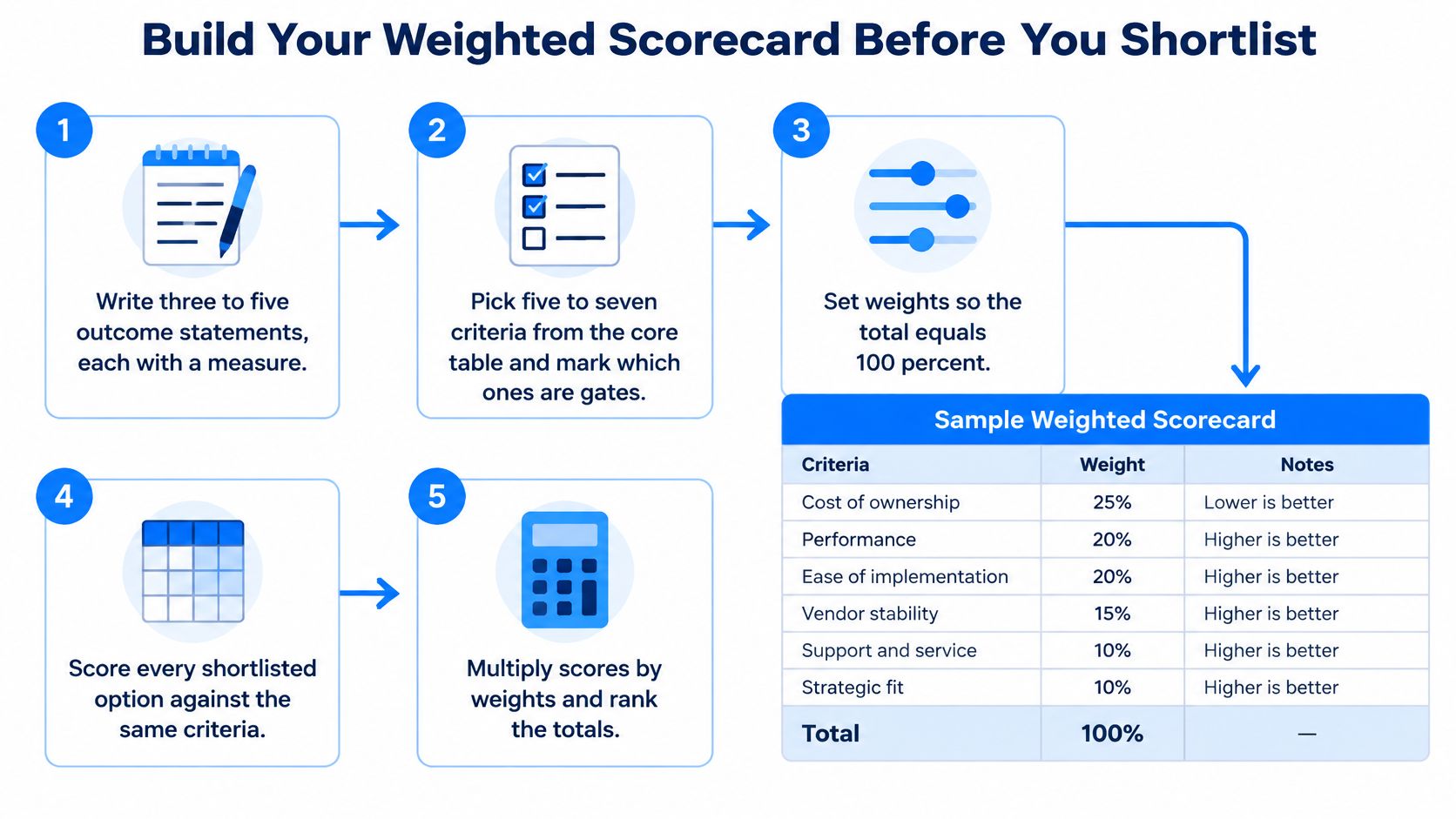
- Write three to five outcome statements, each with a measure and a date.
- Pick five to seven criteria from the core table and mark which ones are gates.
- Set weights for the scored criteria so they total 100.
- Define what a 1, 3 and 5 score means for each criterion, tied to evidence such as a test result or a signed SLA. Vague anchors produce arguments; "5 means export tested and exit clause agreed" doesn't.
- Score each shortlisted option and record the evidence beside every score.
- Complete the proof of concept and the security evidence check before final scoring, not after.
- Record the winner, the runner-up, the reason for the choice and a re-selection trigger such as a price increase or a failed audit.
A worked example: option A is cheaper at signature but fails the integration gate, so it never reaches scoring. Option B passes every gate and wins on three-year cost once support and exit costs are included, which is a different result from the one the license quotes suggested.
Category-specific comparisons help calibrate your anchors before you commit to them. This breakdown of leave management options for UK SMBs shows what a narrow, well-scoped comparison looks like in practice. For the structure itself, start from our vendor evaluation template and adapt the weights to your risk profile.
We also run quick, no-obligation technology assessments to benchmark your environment before criteria get locked, which is often where the readiness gaps surface.
Bring your draft criteria, your gate list and your cost model to MR2 Solutions and we'll test them against your actual environment before you open a single vendor proposal. Describe where technology is holding you back in the consultation form, and we'll match you with the right fit from our network of 400+ solution providers, with the evidence rules and exit terms written in from the start.