
Cybersecurity Compliance Program: Components and Workflows

You passed your last audit, filed the report, and moved on. Three months later, nobody can tell you whether the access reviews, patching, and logging that impressed the auditor are still happening. That gap between audit day and an ordinary Tuesday is where most programs fail.
What a Cybersecurity Compliance Program Covers and Why It Matters
Say a mid-sized clinic passes its annual HIPAA review. The policies are signed, the risk analysis is filed, and the sample of user accounts looks clean. Two months later, attackers log in through a vendor account that still holds standing administrator rights. The review never tested that account, because nobody listed the vendor's access as in scope.
A cybersecurity compliance program is the standing system that prevents that kind of miss. It's how you identify your obligations, turn them into controls with named owners, collect evidence that those controls run, fix gaps, and report results every month. It isn't a binder you rebuild once a year.
Think of a building inspection before a sale. It proves the structure passed on one day. A maintenance schedule is different. It checks the roof, the wiring, and the alarms on a rhythm, and it catches small faults before they become expensive ones.
What the program actually covers
One program has to hold three kinds of obligation at once:
- Internal policies: The rules you've set for passwords, access, backups, and acceptable use.
- Regulatory duties: Requirements that apply because of the data you handle, such as HIPAA, PCI DSS, or GDPR.
- Contract terms: Security commitments customers write into agreements, including audit rights and breach notice timelines.
If you manage those in separate spreadsheets, you'll test the same control three times and still miss the vendor account. A single program maps them together, so one control and one owner can satisfy several duties.
The cost of getting this wrong isn't abstract. The 2025 IBM Cost of a Data Breach study reported a global average breach cost of USD 4.44 million, and organizations needed 241 days on average to identify and contain a breach. That 241 days was a nine-year low, down from 287 days in 2021, and detection and escalation alone averaged USD 1.47 million. One-third of organizations also paid a regulatory fine.
Even at a nine-year low, attackers still had months inside. Shorter timelines don't come from better paperwork. They come from maintained asset inventories, access reviews that take place, logging someone watches, incident exercises, and evidence you can produce without a scramble.
Audit readiness means you can produce paperwork on request. Being in control means the controls work when nobody's asking.
I'd judge every program by that second test. If a control only operates during audit season, you don't have a program yet. You have a project with a deadline.
The Core Components Every Program Needs
Build the components in order. Teams that start by writing policies usually end up with documents nobody can test, because there's no inventory underneath them and no owner beside them. Start with decisions, then scope, then safeguards.
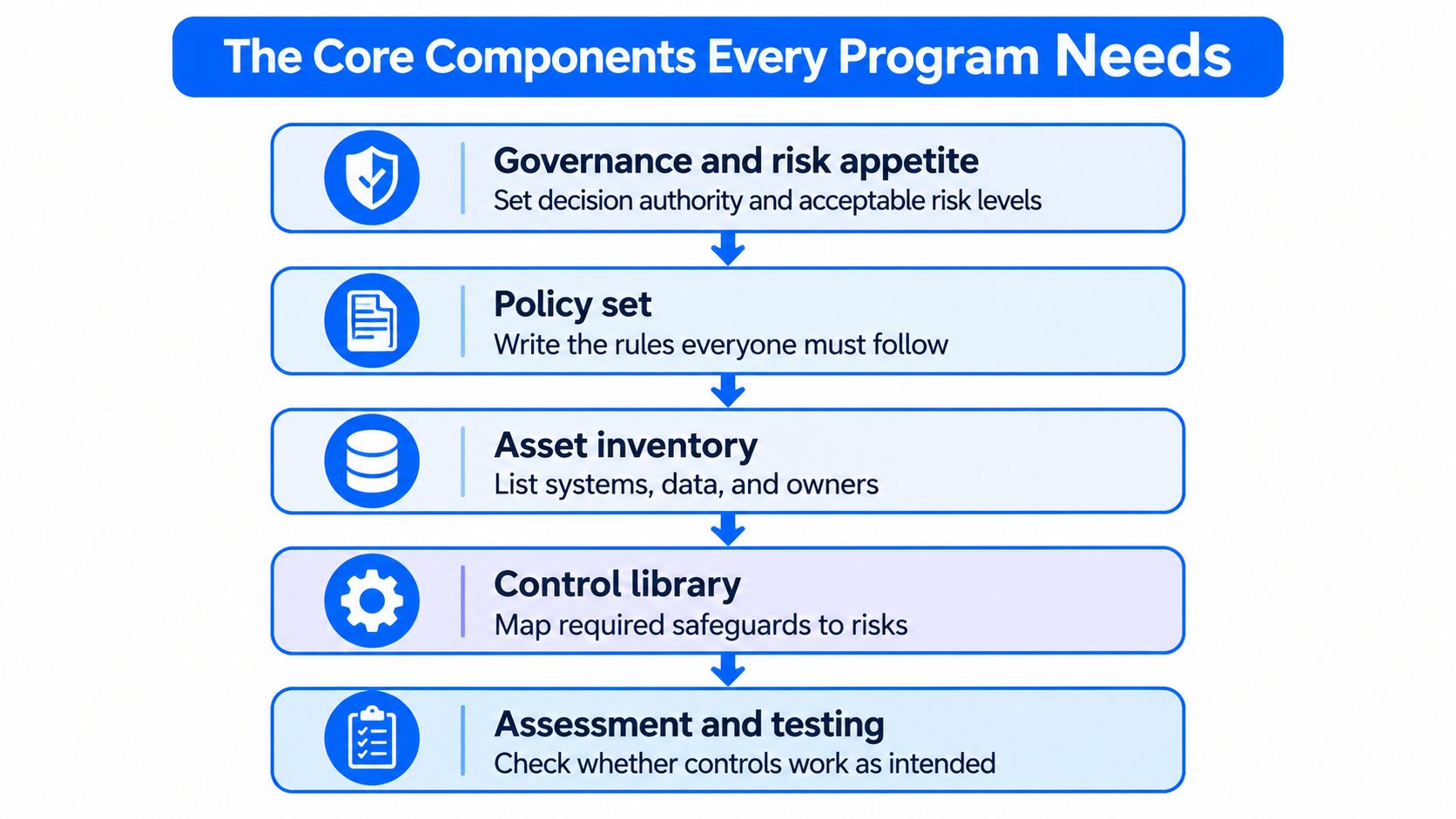
Governance and risk appetite come first. Leadership decides which risks you'll accept, who can approve exceptions, and how security funding competes with other priorities. Without that, every hard finding turns into an argument. The NIST Cybersecurity Framework 2.0 organizes outcomes into six functions, Govern, Identify, Protect, Detect, Respond, and Recover, and its Govern function connects cybersecurity decisions to enterprise risk, leadership accountability, strategy, policy, oversight, and supply-chain expectations.
Next comes the policy set, kept short enough that people can follow it. Then the asset inventory, because you can't protect systems you haven't listed. The control library follows, naming each safeguard, where it runs, and who owns it. Assessment and testing check whether controls work as described, remediation tracking keeps open items visible, and monitoring and reporting show leadership whether the program still holds.
Components, evidence, and owners
| Component | Question it answers | Typical evidence | Accountable owner |
|---|---|---|---|
| Governance and risk appetite | Which risks are we willing to accept? | Approved charter, risk register | CISO with executive sponsor |
| Policy set | What rules must staff and systems follow? | Approved policies, sign-off log | Policy owner in security or legal |
| Asset inventory | What systems and data are in scope? | Asset register, discovery scan results | IT operations lead |
| Control library | Which safeguards are we running, and where? | Configuration exports, MFA and logging records | Named control owners |
| Assessment and testing | Do the controls work as described? | Test scripts, sampled results | Compliance lead or internal audit |
| Remediation tracking | What is open, overdue or formally accepted? | Tickets, signed exception records | Risk owners |
| Monitoring and reporting | Is the program still effective? | Dashboards, leadership packs | CISO and compliance lead |
Use that table as a starter template. If you can't assign a person to a row, delete the row or fix the ownership problem before you write another policy. That discipline is often where outside leadership helps most, and fractional CISO support for building accountable governance can fill the sponsor role when you don't have one in house.
The traceability chain
Each control should trace in a straight line. A regulatory obligation links to a business risk, then to a control objective, an implemented safeguard, an evidence source, a control owner, a testing frequency, and a remediation path. If any link is missing, an auditor will find the gap, usually at the evidence step.
Take privileged access. The obligation is to restrict who can make powerful changes. The risk is unauthorized changes to patient or cardholder data. The control is a quarterly administrator review. Evidence comes from an export of your identity system, whether that's Microsoft Entra ID, Okta, or Active Directory. The IT operations lead owns it, and removals get tracked as tickets with due dates.
Keep that chain in a continuously updated control matrix. Pull evidence from the systems that already generate it, including endpoint platforms, cloud configuration tools, vulnerability scanners, ticketing systems, and log management tools. One tested control then produces evidence for multiple obligations, which cuts duplicate audits and makes gaps visible as operational risk instead of surprises.
Mapping NIST, ISO 27001, HIPAA and PCI DSS Together
These four names get lumped together, but they're different kinds of thing. Merging them into one giant checklist creates confusion about what's mandatory, what's optional, and what an auditor can certify. Keep the categories separate, then map the controls underneath.
NIST CSF 2.0 is a voluntary outcome taxonomy. The NIST announcement of CSF 2.0 notes that NIST established the framework in 2014 for U.S. critical infrastructure and released version 2.0 on February 26, 2024, broadening it to organizations of every size, sector, and maturity level. It's not a prescriptive certification standard. Instead, it gives you high-level outcomes across six functions, with the new Govern function covering oversight, enterprise risk management, policy, accountability, and supply-chain risk.
ISO/IEC 27001 is a certifiable management system. You pursue it because customers demand it or internal policy requires it, and an accredited body can certify that your management system operates within a defined scope. HIPAA is law. If you're a covered entity or business associate handling electronic protected health information, you don't get to opt out. PCI DSS is contractual. It applies wherever cardholder data is stored, processed, or transmitted, and your acquiring bank enforces it.
For a plain-language walkthrough of how healthcare duties sit beside broader standards, HIPAA and security standards explained from Nutmeg Technologies is a useful companion read.
How the frameworks differ
| Framework | Primary focus | Nature and where it applies | Example shared control |
|---|---|---|---|
| NIST CSF 2.0 | Outcomes across six functions | Voluntary taxonomy for organizations of any size | Privileged-access review under Protect |
| ISO/IEC 27001 | Information security management system | Certifiable standard, applied by customer demand or policy | Access control review in Annex A |
| HIPAA Security Rule | Safeguards for electronic protected health information | Legal requirement for covered entities and business associates | Access management and audit controls |
| PCI DSS | Protection of cardholder data | Contractual requirement wherever card data is handled | Review of access to cardholder data environments |
One control, four frameworks
A quarterly privileged-access review shows how mapping pays off. Run it once, document it well, and it supports a CSF Protect outcome on access control. It satisfies an ISO 27001 Annex A access control expectation. It evidences HIPAA access management and audit controls. It also meets PCI DSS requirements to review access to cardholder data environments.
The evidence is the same each time, an identity system export, reviewer sign-off, and tickets for removals. What changes is the mapping reference you attach to it. That's the whole point. You run one good control instead of four mediocre ones.
A practical example of scoping this kind of work carefully is how a healthcare provider achieved HIPAA compliance through cloud migration, where the obligation drove the design rather than the other way around.
Use CSF as the structure for the whole program, layer mandatory obligations on top, and pursue ISO certification only when customers or contracts require it.
One warning. A map written once goes stale fast. Regulations change, scopes drift, and new systems appear. Give the mapping a named owner and a review date, and treat an expired map the same way you'd treat an expired control test.
How the Assessment, Remediation and Evidence Cycle Runs
This cycle is the operating rhythm of the program. Run it on a fixed cadence, quarterly for most controls, monthly for high-risk ones like privileged access and critical patching. Each step has a reason, and each has a slip that auditors see constantly.
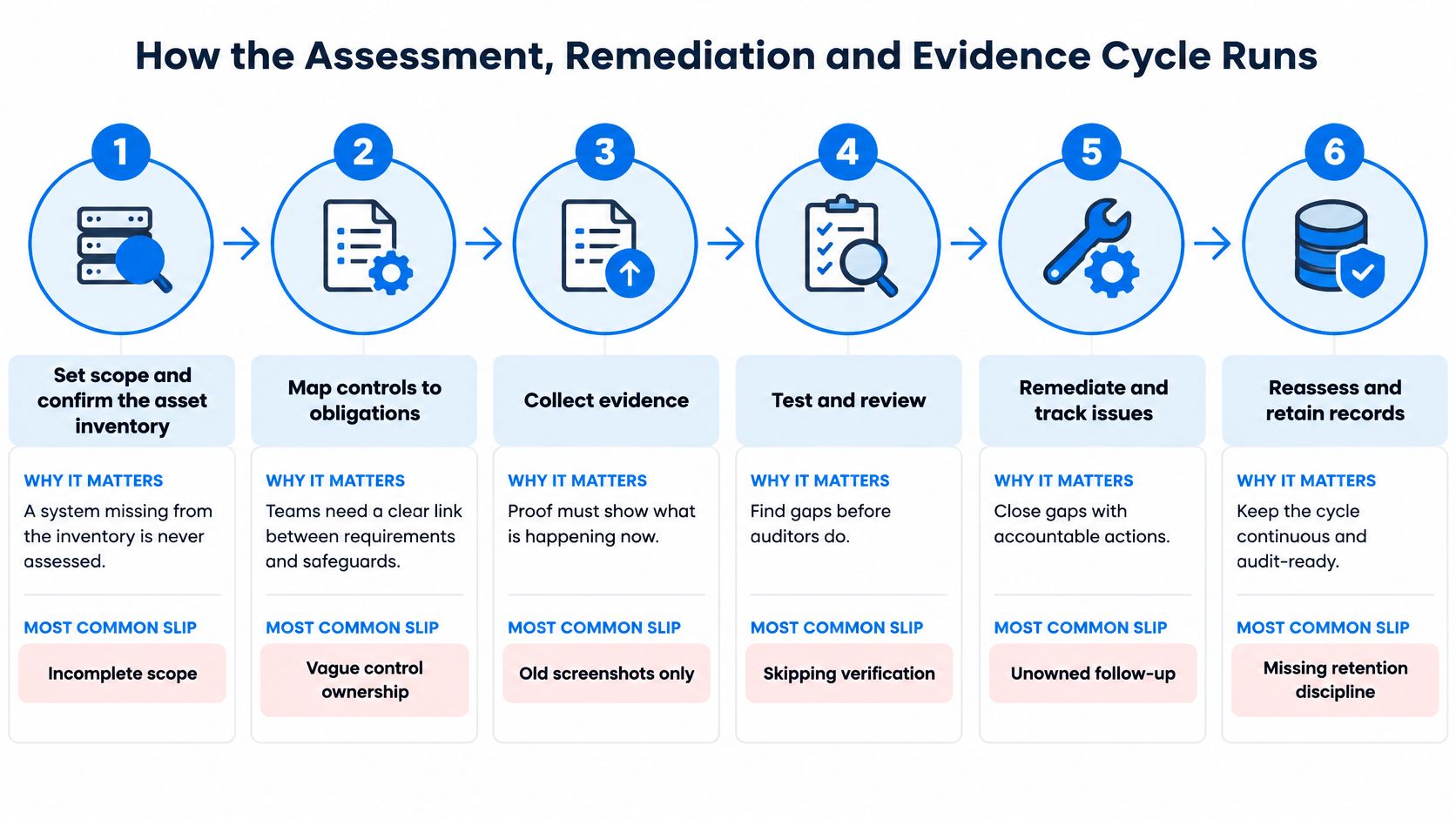
The six steps
- Set scope and confirm the asset inventory. A system missing from the inventory never gets tested, so reconcile your register against discovery scans and cloud accounts first. The common slip is scoping only the production network and forgetting SaaS apps, backups, and vendor connections.
- Run a gap assessment against each test procedure. Test the control itself, not the document describing it. The slip here is accepting a policy as proof. A policy says reviews happen quarterly. Evidence shows whether last quarter's review occurred and who signed it.
- Rank findings by business impact. One unmonitored administrator account on a system holding regulated data outranks ten low-risk documentation findings. The slip is sorting by count or by whichever team shouts loudest, which burns effort on trivia.
- Assign a named owner and a date to every finding. Owners are people, not teams. "IT will fix it" means nobody will. Put a name, a due date, and the risk if it slips, all in the ticket.
- Collect evidence at the moment of fixing. Attach the configuration export, the change record, or the before and after listing to the ticket when the work happens. The slip is rebuilding evidence before an audit, which produces screenshots that prove today's state, not the state during the audit period.
- Retest, then close or except. Someone other than the fixer confirms the control now works. If you can't fix it yet, record a time-limited exception with compensating measures, signed by the risk owner. Open-ended exceptions are just unowned risk with better formatting.
What a finished item looks like
Say a quarterly access review finds 14 orphaned accounts, accounts belonging to people who left or changed roles. The identity lead removes them within two weeks. Evidence is an export from before the cleanup and one from after, attached to the ticket with the change record. A retest confirms zero orphans remain, and the compliance lead closes the item.
Notice what that closed item contains. There's a finding with a date, an owner, a fix, evidence from the system itself, and an independent retest. You could hand that ticket to an auditor, a regulator, or your own leadership and the story holds together.
Compare that with how weak cycles end. Someone marks a ticket done, attaches a screenshot with no timestamp, and nobody retests. The finding reappears next quarter, and the team treats it as new. Repeat findings are the clearest sign your cycle is filing paper instead of reducing risk.
A closed item isn't a closed ticket. It's a control someone retested and confirmed works.
I'd also keep the cycle boring. Same steps, same evidence format, same review meeting each month. Boring is good here. It means a new hire can run the process and an auditor can follow it without a guided tour.
Automating Evidence Without Giving Up Control
The split is simple. Automate repetitive, control-relevant collection work. Keep risk judgments with people. Machines are excellent at checking the same configuration every day. They're poor at deciding whether your organization should accept a risk.
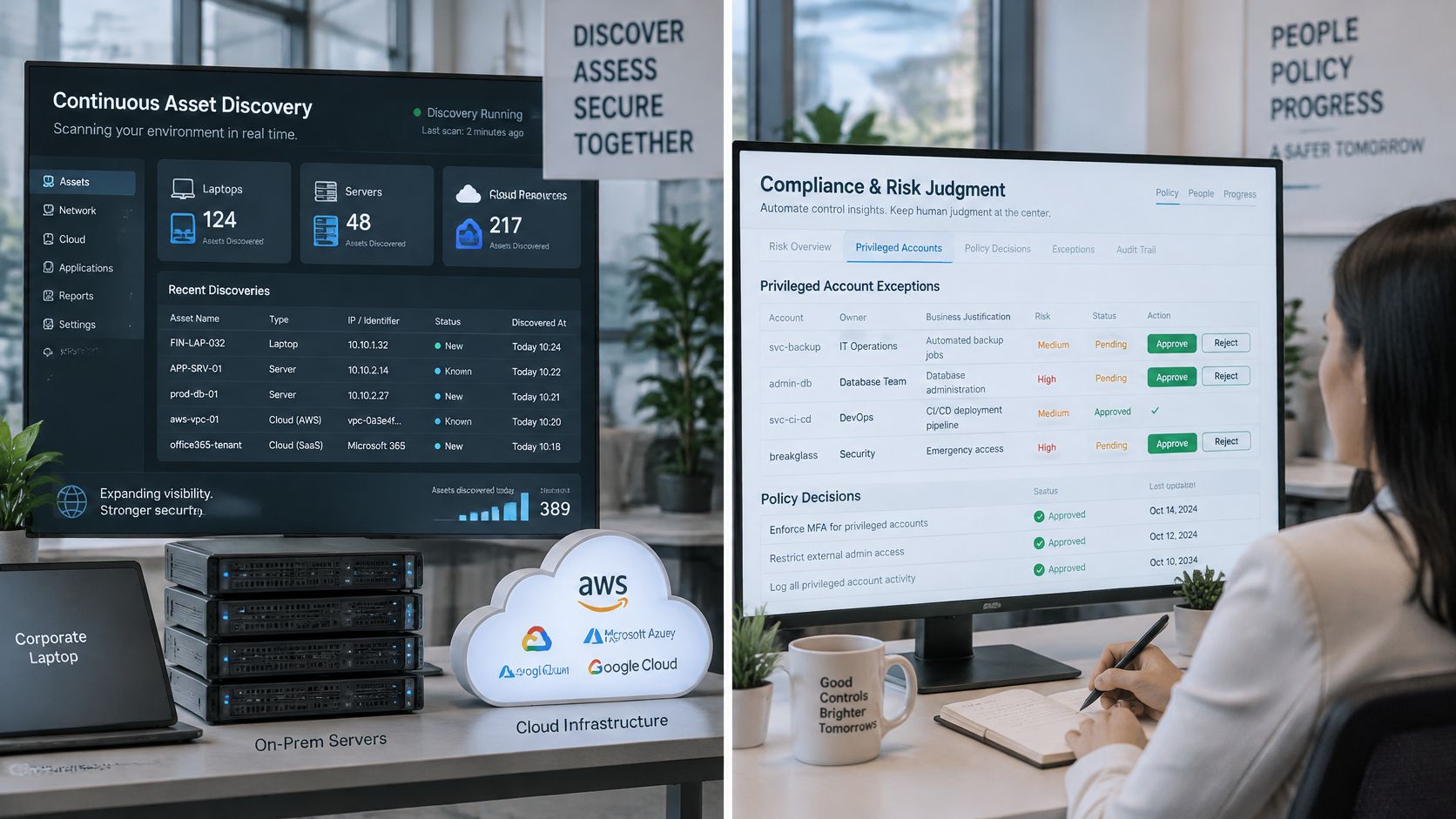
Good candidates for automation include continuous asset discovery, policy-to-configuration checks, privileged-account review lists, vulnerability prioritization, log-retention validation, cloud drift detection, incident evidence preservation, and auditor-ready report generation. Keep human sign-off on risk acceptance, exception approval, and control design. Those decisions need context a dashboard doesn't have.
The economics support the investment. IBM's 2025 analysis of 600 organizations globally found extensive use of AI and automation shortened the breach lifecycle by an average of 80 days and reduced average breach cost by USD 1.9 million, at USD 3.62 million versus USD 5.52 million for organizations that didn't use those capabilities.
How the architecture fits together
Connect your governance, risk, and compliance repository to the systems that generate evidence, through APIs. That means your SIEM, your EDR platform, identity and access management, vulnerability management, cloud security tooling, HR records for joiners and leavers, and IT service management. Controls then get tested continuously instead of sampled by hand once a quarter.
Design the outputs for auditors from the start. You want immutable timestamps, standardized test results, exception records, and clear escalation paths when a check fails. A red dashboard nobody triages is just expensive decoration.
Governing the automation itself
IBM also reported that 63% of studied breached organizations lacked AI-governance policies, and that's the caution. Automation expands access to sensitive data and can make wrong decisions at scale. Govern it like any other powerful tool:
- Approved use cases: List what each automation may do, and what it may not.
- Restricted data access: Give service accounts the minimum access needed to read evidence.
- Model and rule review: Check detection logic and AI behavior before it reaches production, and after major changes.
- Human approval thresholds: Require a person to approve actions above a defined impact, such as disabling accounts.
- Retention and monitoring: Keep automation logs, and watch for unauthorized or shadow AI tools staff adopt on their own.
Practical rule: Automate the evidence, never the sign-off.
If a tool can collect proof, timestamp it, and flag failures, let it. The moment it starts approving its own exceptions, you've traded a compliance problem for a governance one.
Metrics That Show a Program Works, Not Just Passes Audits
A clean audit result shows that controls met expectations during the assessment window. It does not show whether they kept working afterward, or whether they will hold when a supplier is compromised. That distinction matters because Verizon's 2025 Data Breach Investigations Report found third-party involvement in breaches doubled from 15% to 30% in one year. Organizations implementing NIS2 also commonly report challenges involving supply-chain risk, vulnerability and patch management, and business continuity and disaster recovery.
Measure whether the program can detect, contain, recover from, and document failures involving suppliers, legacy systems, or operational technology. If your metrics cannot answer those questions, they measure audit readiness rather than how well controls manage risk between audits.
Three practices make the measures more useful:
- Tier supplier requirements: Set expectations according to the data and systems each supplier can access. A payroll processor and a stationery vendor should not receive the same questionnaire.
- Validate with evidence: Ask tier-one suppliers for test results, relevant certifications, and proof of remediation, rather than relying only on completed forms.
- Link evidence to outcomes: Compare control-test results with incident and recovery outcomes. If a control repeatedly passes while related incidents continue, investigate and redesign it.
Use a smaller set of controls that owners can test consistently. Controls tested throughout the year can surface failures sooner than a large library reviewed only annually. The trade-off is that continuous testing still needs named owners and follow-up, or recurring failures remain visible but unresolved.
Measures worth reporting
| Measure | What good looks like | Review frequency | Owner |
|---|---|---|---|
| Mean time to detect and contain incidents | Falling quarter over quarter against the organization's own prior-quarter baseline | Quarterly | CISO |
| Overdue remediation items | Trending down, with no item past due without an approved exception | Monthly | Risk owners |
| Privileged-access exceptions | Zero unapproved exceptions; each approved exception has an end date | Monthly | IAM lead |
| Asset inventory coverage | Near-complete coverage of in-scope systems; target set by risk owners | Quarterly | IT operations lead |
| Supplier assessment completion | Tier-1 suppliers assessed on schedule; other tiers set by risk | Quarterly | Vendor management |
| Control test pass rate | Rising across quarters, with failures traced to a named fix | Quarterly | Compliance lead |
What leadership should see
Give executives a one-page view of trends, not snapshots. A single green result can hide controls that are deteriorating. Include overdue items and unapproved exceptions, with the owner and status clear enough for leaders to see what needs action.
Close with the two or three decisions leadership must make that quarter. Those may include accepting a defined risk, funding a specific fix, or approving a supplier exception. If the report asks for no decision, it is not helping leadership govern the program.
Pick Your First Three Compliance Priorities
A compliance program is judged between audits, when controls must keep working and evidence must stay current. Start with three practical priorities, using the staff and systems already in place.
First, confirm scope and the asset inventory. Identify systems and data stores that handle regulated information, including vendor accounts with standing access. If the inventory is incomplete, control owners cannot reliably tell what needs protection or testing.
Second, map mandatory obligations to one control library. Connect HIPAA, PCI DSS, or other applicable duties to controls, then name an owner for each one. A control without an owner is unlikely to be maintained. Use these cybersecurity risk management strategies to inform how you assess and address risk.
Third, report one measure monthly. Overdue remediation shows whether assessment findings are being resolved or merely converted into tickets. Add another measure only after reporting the first consistently.
If leadership capacity is the constraint, Fractional IT Leadership provides on-demand CIO and CISO guidance without the full-time cost. Visit MR2 Solutions to start with a Security Assessment that benchmarks your security posture and identifies gaps.