
7 Technology Expense Management Companies to Compare
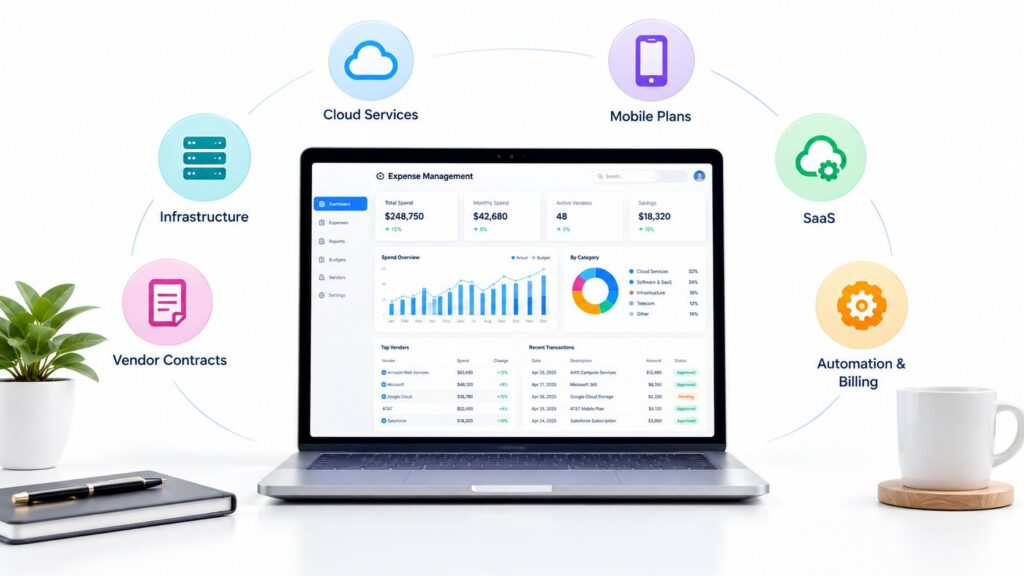
The popular advice is to choose the technology expense management company with the strongest invoice-auditing feature set. That advice is increasingly incomplete. Technology spending now crosses fixed and mobile services, cloud, SaaS, mobility, infrastructure, security, and vendor contracts, so the right provider depends on the spending problem you need to control, not on a generic checklist.
This roundup evaluates each option through coverage, automation, managed-service depth, implementation effort, pricing visibility, and the path to measurable value. A full TEM suite can coordinate several categories, while a focused SaaS-management or FinOps platform may solve one rapidly expanding source of waste better. Buyers comparing broader IT financial management approaches can also compare ITFM solutions before committing to a TEM model.
MR2 Solutions is included as a different kind of option, a vendor-neutral brokerage that helps organizations evaluate and coordinate multiple providers rather than forcing every problem into one platform.
1. Technology Expense Management with MR2 Solutions
MR2 Solutions is suited to organizations whose problem is fragmented technology ownership rather than a single inaccurate telecom invoice. Its Technology Expense Management service brings telecom, cloud, SaaS, mobility, connectivity, security, and infrastructure into one cost and governance review. This approach fits environments where finance manages invoices, IT tracks assets, operations depends on service availability, and no team owns the full technology estate.
The company follows a brokerage-first model. MR2 can assess the environment, compare providers, coordinate procurement, and support implementation through a curated partner network, without tying recommendations to a reseller quota. Its TBaaS framework adds fractional IT and security leadership, connecting cost decisions with architecture, risk, and operating policy. MR2 states that it has operated for 30+ years, supported 500+ organizations, and maintains relationships with 400+ providers, as described on its Technology Expense Management service page.
Best fit and operating model
MR2's main distinction is the path from assessment to continuing optimization. Its audit-to-manage approach examines unused services, overlapping contracts, pricing issues, and vendor-sprawl risks, then continues monitoring after the initial review. That model is relevant to distributed mid-market and enterprise environments where savings can disappear through new purchases, renewals, or departmental subscriptions. Teams tracking recurring subscriptions across departments can also use a dedicated app that tracks subscriptions alongside the brokerage review.
Practical rule: Choose a brokerage model when the hard part is selecting and coordinating several providers, rather than operating one software dashboard.
The trade-off is scope. MR2 is primarily an advisory and coordination service, so partner providers may perform parts of implementation instead of one in-house team handling every task. Smaller organizations may find that engagement broader than necessary. Larger buyers may gain a clearer provider-selection process, vendor neutrality, and ongoing governance, with ROI depending on identified waste, negotiated terms, and how consistently recommendations are implemented.
2. Tangoe Tangoe One for complex multi-vendor estates
Tangoe One fits organizations whose main spending problem is bringing fixed, mobile, and cloud expenses under control across many vendors. Its platform combines invoice automation, inventory visualization, analytics, contract benchmarking, and an AI assistant. Tangoe also provides managed services for sourcing, audits, and ongoing optimization through its Tangoe One platform.
This creates two operating options: internal teams can run the software themselves, or they can add Tangoe-led execution. Inventory accuracy determines how useful either model becomes. An invoice audit may flag a questionable charge, while a dependable record of services, locations, users, contracts, and owners helps determine whether that charge reflects a genuine requirement.
Where Tangoe earns consideration
Tangoe's strongest differentiator is its breadth within traditional TEM. Teams can examine fixed connectivity, mobility, and cloud costs together, while benchmarking gives renewal discussions a reference beyond vendor-provided pricing. Managed sourcing and audit support also suit organizations that lack the staff to operate every workflow internally.
Pricing is not published, so buyers should expect a scoped enterprise discussion rather than a self-serve purchase. Large, distributed estates should budget implementation effort for data normalization, carrier-file differences, inventory reconciliation, and integrations. These requirements shape the ROI case: value depends on sustained control over a complex environment, with savings tied to waste identified, contract terms improved, and corrective actions completed.
The best Tangoe evaluation asks who will own data cleanup, dispute resolution, contract updates, and the actions created by the platform.
Tangoe is a weaker fit when SaaS-license governance or cloud FinOps accountability is the primary problem outside its core TEM coverage. Those buyers may need a specialist platform alongside Tangoe, or a vendor-neutral coordinator to manage the broader program.
3. Calero for telecom, mobility, and SaaS governance
Calero is designed for buyers whose spending problem spans telecom and mobility but is expanding into SaaS. Its unified platform supports telecom and mobile expense governance, while its ConnectIQ automation engine is intended to move findings into operational workflows. That execution layer can trigger actions such as license reclamation or handoffs into accounts payable and IT service-management processes.
The platform also includes SaaS discovery, license recovery, and renewal governance, with market-data management capabilities for data-intensive teams. Buyers can review the provider's current product direction through the Calero technology expense management platform.
Why execution matters
Calero's appeal isn't just that it can expose unused services. The stronger case is that automation can connect an identified issue to a defined action, owner, and downstream system. That reduces the risk of producing another report that finance and IT agree with but never operationalize.
This makes Calero a natural candidate for organizations with a mixed estate. A mobile-service review, SaaS renewal, and market-data subscription may belong to different teams, yet each creates a recurring obligation that needs inventory, ownership, policy, and renewal control. A unified operating model can make those relationships easier to govern.
The caution is complexity. A broad platform can create more implementation decisions, especially around integrations, approval chains, data ownership, and the boundary between finance and IT. Pricing isn't public, so the proposal should spell out which modules, workflows, services, and integrations are included.
Calero is likely to create value where the organization has enough recurring telecom, mobility, and SaaS activity to justify coordinated governance. It's less suitable as a lightweight tool for a narrow subscription-management problem. Buyers should test whether ConnectIQ workflows match their actual processes rather than assuming automation alone will improve them.
4. Sakon for invoice lifecycle and managed payment control
Sakon is best equipped for organizations that need to fix the invoice-to-payment process, especially across telecom and cloud. Its platform ingests invoices, validates them against contracts and policies, routes them for approval, and supports payment through Sakon's payment rails. It also connects invoice data with ERP processes, chargeback, and cloud accounts including AWS, Azure, Google Cloud, and Oracle, as described in its AP automation offering.
This service model differs from a platform that stops at visibility. Sakon can help centralize payment execution through cards, ACH, and checks in multiple currencies, while its workflow surfaces recoveries as draft actions. That makes it relevant where misrouted funds, manual approval work, and inconsistent invoice handling consume as much attention as the underlying overcharge.
The ROI path is operational
Sakon promotes an implementation timeline of roughly 90 days to go live and about six months to ROI, figures stated in its product materials. Buyers should treat those as vendor-promoted planning markers, not guaranteed outcomes. Actual value will depend on invoice quality, contract completeness, ERP integration, approval design, and the organization's willingness to act on exceptions.
The telecom-first orientation is another scope consideration. Sakon can be a strong choice for communications and cloud invoice automation, but teams whose primary issue is SaaS-license utilization should verify the depth of license analytics before selecting it.
Implementation question: Ask who will clean the initial invoice and contract data, who approves exceptions, and who owns payment-policy changes after launch.
Sakon's best use case is a finance and IT environment where the invoice lifecycle itself is the bottleneck. It may be less suitable when the buyer wants a broad strategic brokerage, deep SaaS discovery, or full cloud engineering accountability.
5. Asignet CLM7 for automated validation and lifecycle control
Asignet's CLM7 is built for organizations that want hyper-automation across technology expense validation and lifecycle management. Its scope includes telecom, mobility, SaaS, cloud, and broader vendor spend. The platform applies RPA-driven validation to compare invoices with contracts and usage before payment, then supports inventory, service catalog, MACD, usage-management, and reporting workflows through its CLM7 technology expense platform.
The practical strength is control before money leaves the organization. Contract and usage validation can help teams identify discrepancies earlier than a periodic review, while lifecycle modules provide a place to manage service changes, additions, moves, and disconnects. That combination matters because bad inventory often creates the conditions for recurring billing errors.
What buyers should verify
Asignet's acquisition of Cass's TEM and managed mobility business gives it inherited enterprise experience and customer relationships. At the same time, public references and independent reviews may take time to catch up with the post-acquisition product and service structure. Due diligence should therefore focus on current references, implementation ownership, support continuity, data migration, and the exact capabilities available to new customers.
Pricing isn't public, so a buyer should request a proposal that separates the CLM7 platform from implementation, RPA configuration, managed services, and any ongoing validation work. The platform may be attractive for organizations that want automated pre-payment controls, but automation will only help if contracts, usage feeds, and service inventories are sufficiently accurate.
Asignet is a focused choice for validation and lifecycle discipline. It's not automatically the best fit for a company seeking vendor-neutral sourcing across a broad technology portfolio or a specialist approach to cloud engineering economics.
6. Zylo for SaaS sprawl and renewal governance
Zylo solves a narrower but increasingly urgent problem, SaaS discovery, license utilization, and renewal control. It continuously identifies software usage and spend, supports renewal-calendar management, and orchestrates license-optimization workflows. Its Consumption Cost Management capabilities also address AI and other usage-based software costs, which extends the platform beyond simple seat counting.
The provider's SaaS management platform is purpose-built for teams that need to understand what employees use, what departments own, which renewals are approaching, and where subscription or consumption costs are growing without clear accountability.
Why a specialist can outperform a suite
A full TEM platform may provide SaaS visibility as one module among many. Zylo's advantage is depth in the SaaS operating problem. Renewal execution, license recovery, discovery, and usage-based charges require different data and stakeholder actions than telecom invoice validation. The platform is therefore a strong candidate when SaaS sprawl, shadow IT, and renewal negotiation dominate the savings opportunity.
Zylo isn't a replacement for fixed or mobile telecom TEM. It also won't provide the same cloud cost-allocation model as a FinOps platform such as IBM Apptio Cloudability. Buyers should decide whether they want one broad system or a specialist stack connected through a clear ownership model.
Renewal discipline beats dashboard density. A SaaS tool creates value only when someone owns the renewal decision and can enforce the resulting policy.
Public price points typically aren't listed, so enterprise buyers should ask how pricing changes with application count, data sources, users, managed services, and consumption-cost coverage. For organizations with a large SaaS estate, the ROI path usually runs through avoided renewals, recovered licenses, better negotiation preparation, and reduced shadow spend.
Teams comparing specialist and broader TEM tools should make the category boundary explicit before procurement.
7. IBM Apptio Cloudability for cloud financial management
IBM Apptio Cloudability addresses a different spending problem from traditional telecom TEM: multi-cloud cost visibility, ownership, forecasting, and optimization. It provides dashboards, showback and chargeback, forecasting, rightsizing recommendations, commitment and discount management, and governance across cloud environments through IBM Apptio Cloudability.
Cloud infrastructure requires coordination between engineering, finance, and business owners. Engineering teams influence consumption, finance needs reliable forecasts, and business leaders need workload-level accountability. Cloudability connects those responsibilities by allocating costs to owners and helping teams assess optimization actions instead of treating cloud spend as one undifferentiated bill.
A complement to, rather than a complete TEM replacement
Cloudability suits large multi-cloud enterprises building a mature FinOps operating model. It can improve commitment visibility, reduce dependence on on-demand usage, and connect cost decisions with engineering ownership. Trustworthy outputs require substantial preparation: teams must agree on tags, account structures, business mappings, allocation rules, dashboards, and governance workflows.
Pricing is enterprise and quote-based, while implementation services commonly form part of deployment. Cloudability does not manage telecom or mobile expenses. Organizations seeking broader technology-spend coverage may therefore combine it with a TEM suite, SaaS-management platform, or vendor-neutral coordinator.
The ROI path is clearest when cloud costs are material, distributed across teams, and difficult to assign. Expected returns are less compelling when the primary need is invoice correction or carrier-contract negotiation. In those cases, a cloud financial management platform may address the wrong control point.
For buyers researching cloud cost optimization, the key question is whether the platform will support an operating model with named owners and enforceable actions beyond attractive cloud charts.
Top 7 Technology Expense Management Solutions Comparison
| Product | Implementation complexity | Resource requirements | Expected outcomes | Ideal use cases | Key advantages |
|---|---|---|---|---|---|
| MR2 Solutions (Technology Expense Management) | Moderate, brokerage‑first, end‑to‑end rollout; partner deliveries common | Enterprise IT/finance coordination; leverages MR2 broker ecosystem and fractional CIO/CISO | Continuous audit‑to‑manage savings, vendor consolidation, measurable TCO reduction | Mid‑market & enterprise multi‑vendor estates needing ongoing optimization | Vendor‑neutral brokerage, continuous audits, fractional IT/security leadership, broad provider ecosystem |
| Tangoe (Tangoe One) | High, enterprise scoping and data normalization can be lengthy | Significant: data feeds, inventory cleanup, procurement and analytics resources | Inventory accuracy, invoice automation, ongoing savings, benchmarked pricing | Large, complex telecom/mobile/cloud environments with multi‑vendor estates | Mature AI‑enabled platform, strong analytics and benchmarking, managed services |
| Calero | Moderate‑High, broad capabilities require integration and governance planning | IT/process owners for automation, integrations to AP/ITSM and SaaS sources | Reduced manual effort, faster action via automation, license recovery and governance | Organizations combining network/mobile TEM with expanding SaaS estates | ConnectIQ automation, unified TEM+SaaS capabilities, workflow orchestration |
| Sakon | Moderate, defined ~90‑day go‑live; AP/process changes required | AP and finance integrations, data cleanup, adoption of payment rails | Faster invoice processing, cost recoveries, reduced AP friction | Teams needing end‑to‑end invoice automation and managed payments for telecom/cloud | End‑to‑end invoice lifecycle, managed pay (multi‑currency), fast time‑to‑value |
| Asignet (CLM7) | Moderate, RPA rollout and lifecycle controls; post‑acquisition maturity varies | Automation engineering, contract/inventory data, custom enterprise scoping | Fewer manual reviews, improved billing validation, stronger lifecycle controls | Enterprises seeking RPA‑driven validation across telecom, mobility, SaaS | RPA‑driven invoice validation, integrated lifecycle modules, inherited TEM expertise |
| Zylo | Low‑Moderate, SaaS discovery and renewal integrations required | IT/procurement for SaaS data, renewal workflows, license telemetry | License optimization, renewal governance, control of consumption‑based costs | Organizations with SaaS sprawl and renewal/license management needs | Deep SaaS focus, strong renewal execution, consumption cost management |
| IBM Apptio Cloudability | Moderate‑High, requires tagging, allocation rules and governance setup | Cloud engineering, finance collaboration, tagging/metadata and reporting effort | Improved cloud visibility, forecasting, rightsizing, optimized commitments | Large multi‑cloud enterprises focused on FinOps and cloud cost governance | Mature FinOps capabilities, forecasting, showback/chargeback and rightsizing guidance |
Build the Shortlist Around Your Savings Path
Start by mapping the spending categories and invoice sources before scheduling vendor demonstrations. Identify fixed and mobile telecom, cloud accounts, SaaS renewals, mobility assets, infrastructure services, security contracts, market-data subscriptions, and payment workflows. Then record who owns each category, where the data lives, and whether the current process is software-led, service-led, or mostly manual.
The market's history explains why this exercise matters. TEM companies emerged from telecom expense management in the late 1990s, when enterprises began outsourcing telecom management for cost optimization, billing audits, and vendor negotiations. In the 2000s, web-based platforms automated invoice processing, asset tracking, and reporting, expanding a spreadsheet-driven function into a broader technology expense strategy, as described in this expense management market overview.
Match the provider to the operating problem
Choose a broad TEM suite when telecom, mobility, cloud, and SaaS need shared governance. Choose a focused SaaS platform when renewals, shadow IT, and license utilization are the primary issues. Choose FinOps software when cloud allocation, forecasting, commitments, and engineering accountability are central. Choose managed payment services when invoice routing and payment control are the main bottlenecks. Choose vendor-neutral coordination when several providers may be required and internal teams need help designing the portfolio.
Implementation should be treated as part of the product. Validate integrations, data ownership, inventory requirements, contract ingestion, approval chains, reporting, escalation procedures, and support coverage. Compliance and operating-model design matter especially for regulated and multinational organizations, where local tax, audit, e-invoicing, and policy requirements can make poorly governed automation accelerate bad data rather than reduce spend.
Public pricing is limited across this list. Request a scoped proposal that separates platform fees, managed services, implementation work, integrations, data remediation, and any performance-based economics. That separation makes competing proposals easier to compare and prevents a low initial platform quote from hiding substantial delivery costs.
Define the baseline before signing
Use measurable baselines for invoice accuracy, recovered spend, license utilization, renewal savings, processing effort, cloud commitment coverage, inventory completeness, and exception-resolution time. Telecom invoices commonly contain billing errors averaging 7% to 12% of total spend, while well-managed programs typically recover 15% to 25% of telecom spend in the first year and reach first savings in about 30 to 60 days after audit completion, according to telecom expense management benchmarks. Those benchmarks can frame a business case, but they shouldn't replace an organization-specific baseline.
Automation adoption also remains incomplete. One survey summary reported that 54% of IT and business leaders had adopted some degree of automation for overall IT expense management, while 57% had done so for telecom expense management tasks, according to Asignet's IT expense management analysis. The implication is practical: the winning provider won't necessarily be the one with the longest feature list. It'll be the one that makes ownership, policy enforcement, data quality, and action tracking work across the categories you need to govern.
MR2 Solutions helps mid-market and enterprise organizations evaluate, procure, implement, and govern technology expense management across telecom, cloud, SaaS, mobility, infrastructure, and vendor contracts. Visit MR2 Solutions to discuss a vendor-neutral assessment, coordinated provider shortlist, and ongoing optimization plan built around your actual savings path.