
Sd Wan vs Mpls

The popular advice is simple: SD-WAN replaces MPLS. That advice is also wrong for many enterprises. SD-WAN and MPLS solve different problems, and the most defensible 2026 decision is often a hybrid WAN that keeps deterministic transport for selected workloads while moving flexible, cloud-bound traffic onto internet-based paths.
Enterprise adoption supports that more nuanced view. TeleGeography reported that 63% of enterprises had deployed SD-WAN by 2023, with another 20% in rollout, while MPLS usage fell from 82% of sites in 2018 to 41% in 2023. The direction is clear, but it doesn't prove that every MPLS circuit should disappear. TeleGeography's enterprise WAN analysis describes a market moving toward SD-WAN while MPLS retains a role at specific sites and for demanding applications.
The right question is not “Which technology wins?” It's which sites, applications, and traffic classes deserve which underlay. That distinction exposes hidden migration costs, prevents premature contract exits, and gives the CIO a WAN strategy that matches business risk rather than vendor messaging.
Why SD-WAN vs MPLS Is the Wrong Question in 2026
SD-WAN is an overlay, not a universal replacement for every transport. It can run across broadband, DIA, LTE, and MPLS, then apply policies that steer applications across those paths. MPLS remains a carrier-managed private transport designed for predictable behaviour. Comparing them as if they were identical products creates a flawed investment decision before engineering work even begins.
The market is already in a hybrid phase. A later TeleGeography survey found SD-WAN deployed by 63% of enterprises, with another 15% rolling it out, while 74% of respondents still used MPLS at some locations. The same research reported MPLS at an average of 22% of sites and Direct Internet Access at 54% of sites. TeleGeography's WAN manager survey points to coexistence, not a clean technology swap.
CIO decision rule: Treat MPLS as a scarce performance resource. Assign it only where deterministic behaviour justifies its cost.
The hidden cost of removing MPLS too early is rarely visible in the circuit quote. Teams may need to re-engineer voice, manufacturing control, transaction processing, or legacy applications that were designed around stable paths and carrier-backed service levels. They may also face MPLS exit penalties, stranded managed-router charges, and a dual-run period in which both architectures must be operated.
A more useful evaluation asks four questions:
- Which applications are intolerant of jitter, latency, or packet loss?
- Which sites have regulatory, geographic, or operational constraints?
- Which traffic flows directly to SaaS and public cloud?
- Which MPLS contracts can be resized at renewal rather than terminated immediately?
MPLS still matters in regions where internet quality is inconsistent and in locations such as China and Africa, according to TeleGeography's explanation of current WAN trends. The strategic answer is therefore selective migration. Put the right traffic on the right path, then remove private capacity only after production evidence supports the decision.
SD-WAN and MPLS Explained Without the Jargon
Think of MPLS as a private highway. A carrier manages the road, defines the routes, and can provide service guarantees for latency, jitter, and packet loss. Your organization pays for a controlled path between locations, which makes MPLS attractive for applications that must behave consistently.
Think of SD-WAN as an intelligent traffic controller. It sits above several roads, measures their condition, and directs each application across the path that best matches your policy. Those roads might be broadband, DIA, LTE, or MPLS. SD-WAN doesn't replace the roads. It decides how to use them.
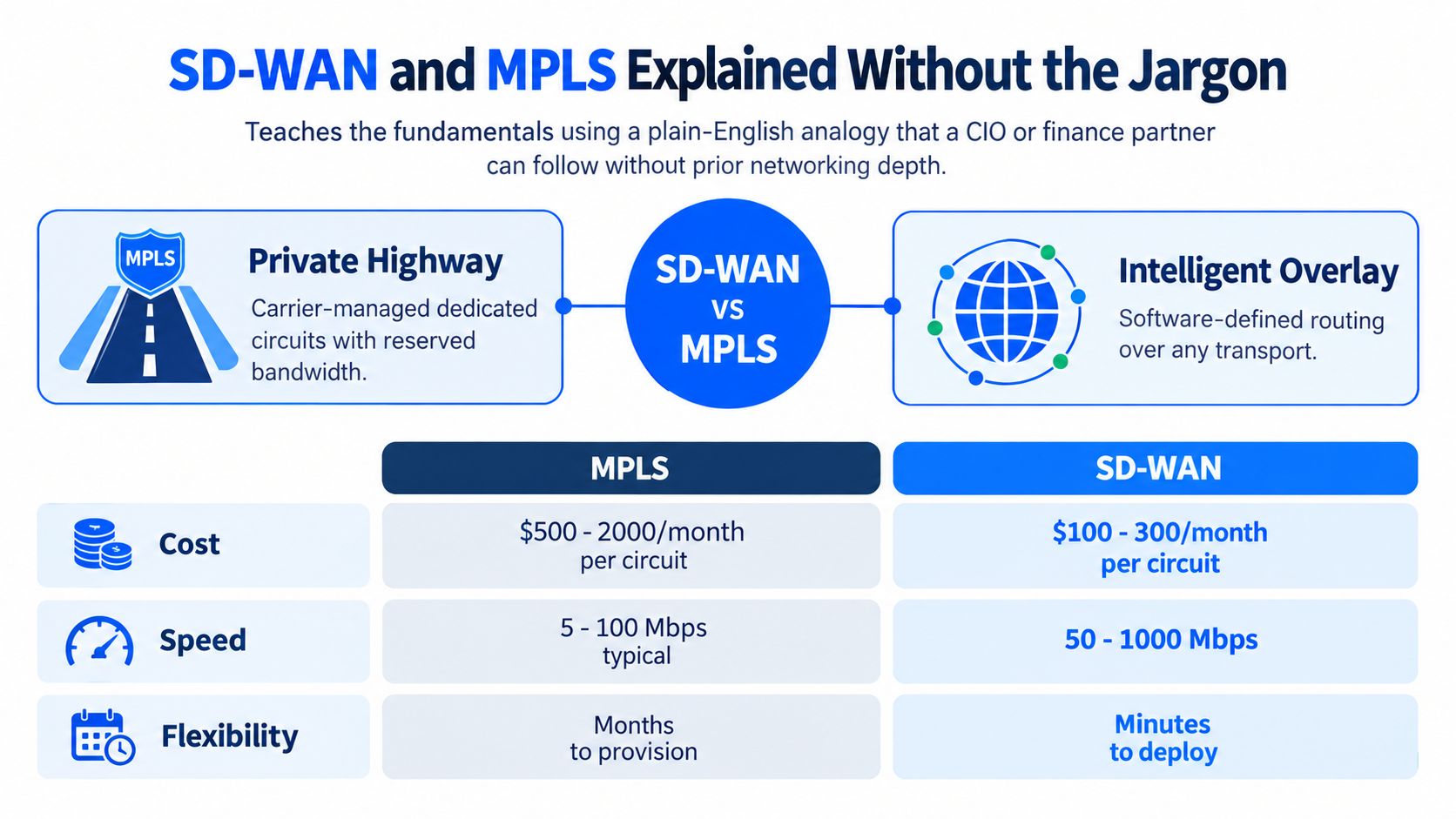
The underlay and overlay distinction
The underlay is the physical or carrier transport. Broadband, fiber, LTE, DIA, and MPLS all belong here. The overlay is the logical network built across those transports. SD-WAN uses encrypted tunnels, centralized policy, and application-aware routing to create that overlay.
This distinction matters during procurement. Buying SD-WAN doesn't guarantee excellent performance if every branch has a poor last-mile connection. LogicMonitor's technical comparison of SD-WAN and MPLS explains the core trade-off: MPLS routes traffic with labels and can support guarantees for latency, jitter, and packet loss, while SD-WAN depends more heavily on the quality of the underlying links and the accuracy of its policies.
What each model means for the business
MPLS gives you predictability. A voice platform, industrial application, or fixed data-center workflow can receive a defined service class. The cost is slower provisioning, less flexibility, and greater dependence on the carrier.
SD-WAN gives you agility and control. A new branch can use available internet connectivity while the orchestration platform applies standardized configuration. Cloud and SaaS traffic can use local breakout instead of returning through a central data center.
Organizations typically choose one of three delivery models:
- Do-it-yourself SD-WAN: Your team owns the appliances, policies, monitoring, upgrades, and troubleshooting.
- Managed SD-WAN: A service provider operates much of the platform and transport coordination.
- SD-WAN with SASE services: Networking and cloud-delivered security functions are integrated into a broader access architecture.
The business outcome should drive the model. Choose MPLS when stable delivery matters more than speed of change. Choose SD-WAN when cloud reach, branch flexibility, and centralized control matter more. Choose both when the estate contains both kinds of requirements.
For a deeper technical walkthrough, see how SD-WAN works.
The Real Side-by-Side Comparison
A feature checklist isn't enough. The decisive differences appear under congestion, during a branch rollout, and when an application moves from a data center to the cloud.
| Dimension | SD-WAN | MPLS | Verdict |
|---|---|---|---|
| Performance | Uses application-aware steering across available links. Results depend on last-mile quality and policy. | Provides deterministic behaviour through labeled forwarding and carrier-managed paths. | MPLS wins for strict performance guarantees. SD-WAN wins when multiple adequate links can be managed intelligently. |
| Jitter and packet loss | Can move traffic away from a degraded path, but cannot repair a poor underlay. | Supports service guarantees for latency, jitter, and packet loss. | MPLS wins for known, QoS-sensitive flows. |
| Security posture | Commonly uses encrypted tunnels, segmentation, firewalls, and integration with SASE. | Offers private isolation, but privacy isn't the same as end-to-end encryption or identity-based security. | SD-WAN wins when the security stack is designed and operated correctly. |
| Cloud access | Supports direct internet breakout and application-specific routing. | Can force cloud traffic through a central location, creating avoidable dependency on the hub. | SD-WAN wins for SaaS and distributed cloud use. |
| Provisioning | Central orchestration and zero-touch deployment can simplify new branches. | Circuit delivery and configuration depend heavily on carrier processes. | SD-WAN wins for rapid expansion and changing estates. |
| Operational control | Gives the enterprise centralized policy and application visibility. | Provides a stable managed service but often less direct control over routing changes. | SD-WAN wins when the team can operate the platform. |
| Failure behaviour | Can fail over across underlays and select paths according to policy. | Uses carrier-managed resilience and defined routing within the private network. | Tie by design: SD-WAN offers path diversity, MPLS offers controlled transport. |
| Scalability | Works across mixed access types and supports incremental site deployment. | Scales more slowly when new circuits or capacity require carrier provisioning. | SD-WAN wins for distributed organizations. |
| Best fit | Cloud-first branches, variable traffic, internet access, and mixed underlays. | Mission-critical traffic, regulated locations, and workloads requiring deterministic delivery. | Hybrid wins when both conditions exist. |
The security row deserves particular attention. MPLS reduces exposure to the public internet, but it doesn't automatically encrypt traffic or enforce identity, segmentation, and least-privilege access. SD-WAN can provide stronger integrated controls, but only if the organization manages certificates, policies, local breakouts, and security integrations consistently.
Operational warning: SD-WAN can steer around a bad link. It can't turn an unreliable broadband circuit into a private, carrier-backed path.
The final decision should therefore be made per traffic class and site profile, not from a single estate-wide score. A regional hub may retain MPLS while its smaller branches use SD-WAN. A single branch may use both, with MPLS reserved for priority applications and internet links carrying general traffic.
Cost and TCO Breakdown
Circuit price is the easiest WAN cost to compare and the least reliable as a complete business case. MPLS carries recurring charges for committed bandwidth, class-of-service options, redundant circuits, and managed routers. SD-WAN shifts the cost shape toward internet access, edge devices, orchestration licenses, security functions, implementation, and operational capability.
A five-year model for a 50-site U.S. footprint should be built from your quotes and utilization data, not from generic market assumptions. The table below is a cost-model template, not a set of market prices. Populate each row with verified supplier proposals before presenting a recommendation to the CFO.
| Cost Category | MPLS (USD) | SD-WAN Hybrid (USD) |
|---|---|---|
| Primary connectivity | Site-by-site MPLS circuit charges | Broadband, DIA, or other internet underlay charges |
| Resilience | Secondary MPLS or private circuits | Diverse second ISP, LTE, or other backup underlay |
| Equipment | Managed routers and carrier hardware | SD-WAN edge appliances or virtual edges |
| Software | Usually embedded in the managed service | Orchestration, security, analytics, and support licenses |
| Implementation | Circuit turn-up, routing, and QoS configuration | Policy design, deployment, application mapping, and migration |
| Operations | Carrier management and internal escalation | Platform administration, policy governance, monitoring, and incident response |
| Transition | Usually limited after steady state | Dual-run operation, testing, and contract overlap |
| Five-year total | Insert supplier-validated estimate | Insert supplier-validated estimate |
Where MPLS becomes expensive
MPLS costs tend to rise with site count, distance, bandwidth commitments, and service-class requirements. Redundant private circuits can improve resilience, but they also multiply recurring charges. A carrier-managed model may reduce internal configuration work, yet it can increase change-order dependence when the business adds locations or modifies application priorities.
MPLS also creates an opportunity cost for cloud-heavy organizations. If traffic must return to a central data center before reaching SaaS, the enterprise may pay for private capacity that doesn't improve the user experience for cloud applications.
Where SD-WAN costs hide
SD-WAN proposals often emphasize cheaper underlay circuits while treating the overlay as a straightforward subscription. That is incomplete. Budget for two diverse access providers where uptime demands it, edge replacement cycles, orchestration, security licensing, professional services, testing, and staff training.
Hybrid migration is particularly expensive if the team doesn't define an exit sequence. Maintaining MPLS while adding broadband can provide a safer transition, but it creates overlapping circuit, support, and monitoring costs. Those costs are justified only when the program has explicit migration gates.
Use a structured technology expense management process to reconcile invoices, renewal dates, unused capacity, cancellation terms, and provider responsibilities. The objective isn't to force SD-WAN into every site. It's to stop paying for transport that no longer matches application demand.
Which Option Wins by Use Case
The best WAN architecture changes with the site portfolio. A retailer, manufacturer, and financial services firm can all be “enterprise” customers and still need materially different transport decisions.
A cloud-dependent retail estate
A 25-site retailer with cloud POS, SaaS inventory, analytics, and digital customer services has a strong SD-WAN case. Dual broadband or DIA links give the branches path diversity, while policy can prioritize payment and store operations over guest or noncritical traffic.
MPLS is difficult to justify as the default underlay when most applications live outside the traditional data center. The decision trigger is cloud dependency combined with branch variability. Keep a private path only where a specific application or site risk proves it necessary.
A global manufacturer with operational traffic
A manufacturer connecting plants may have latency-sensitive operational technology, voice, enterprise resource planning, and general internet traffic in the same estate. MPLS remains appropriate for the flows that require deterministic behaviour and carrier-backed service levels, particularly where production disruption has a direct operational consequence.
SD-WAN can handle secondary internet access, software updates, collaboration, cloud services, and less sensitive traffic. The trigger is application criticality, not a blanket preference for private transport. Segment the traffic, test failover, and keep MPLS for the paths that production systems actually require.
A regulated financial services environment
A financial services firm may need strict controls around data handling, site availability, and documented service performance. That profile supports a hybrid design, with MPLS retained for critical transaction or regulated workflows and SD-WAN used for SaaS, collaboration, guest access, and general internet traffic where policy permits.
The trigger is regulatory and operational exposure. Don't assume private connectivity alone satisfies security obligations. Validate encryption, segmentation, logging, access controls, supplier responsibilities, and regional requirements with the security and compliance teams.
These scenarios lead to a firm recommendation: choose by workload and location. The same branch can have one application on MPLS and another on SD-WAN. An estate-wide migration policy is often less accurate than a site-and-application policy.
Migrating From MPLS to SD-WAN Without Disruption
A safe migration preserves production behaviour while the team learns how real applications perform across the new underlay. The objective isn't to remove MPLS quickly. It's to prove which traffic can move without creating a business incident.
Phase one, inventory the estate
Catalog every circuit, SLA, class-of-service mapping, bandwidth profile, application flow, and renewal date. Include dependencies that rarely appear in network diagrams, such as payment devices, voice gateways, building systems, backup traffic, and third-party connections.
Identify the traffic that must stay stable before you introduce a new path. If application discovery is incomplete, the migration plan is incomplete.
Phase two, design and observe
Deploy SD-WAN alongside MPLS at representative sites. Use monitor-only or low-risk policies first, then baseline latency, jitter, loss, failover, application response, and security events across each underlay.
Translate existing QoS and class-of-service rules into SD-WAN policies explicitly. A legacy priority class doesn't automatically map cleanly to an application-aware overlay. Validate real traffic rather than relying on vendor demonstrations.
Phase three, move traffic in controlled batches
Shift SaaS and general internet traffic first, while keeping latency-sensitive, regulated, and operational flows on MPLS. Define rollback triggers before the change window, and make sure the team can reverse a policy without rebuilding the site.
A managed SD-WAN services approach can help coordinate carrier access, edge deployment, policy migration, monitoring, and escalation when internal teams lack the capacity to operate both architectures during transition.
Phase four, resize and retire
Only reduce MPLS capacity after the SD-WAN path has demonstrated stable performance for the applications assigned to it. Renegotiate contracts around actual critical traffic, cancel redundant circuits when termination terms allow, and archive the final diagrams, policies, test results, and rollback records.
Common failure modes include:
- Premature cutover: Teams move critical applications before establishing a performance baseline.
- QoS translation gaps: Existing MPLS classes disappear without an equivalent application policy.
- Underestimated dual-run cost: Finance budgets the target state but ignores the transition period.
- Weak rollback planning: The team has no tested way to restore the previous path.
- Incomplete application discovery: An undocumented dependency fails after the change.
Migration is complete only when the operating model is stable, not when the new appliances are installed.
Choosing the Right WAN Strategy for Your Organization
A CIO can reach a sound preliminary decision by evaluating traffic, site risk, cost scenarios, and contract timing in that order. The process should produce three models, MPLS-only, SD-WAN-only, and hybrid, across both a three-year and five-year horizon. Do not approve a target architecture from monthly circuit pricing alone.
Start with the traffic profile
Map applications by destination and business consequence. SaaS-heavy traffic, direct cloud access, frequent branch changes, and mixed link availability point toward SD-WAN. Stable site-to-site traffic with strict performance requirements points toward MPLS. A combination points toward hybrid transport.
Score site criticality
Classify sites as critical hubs, regulated locations, production facilities, ordinary branches, or temporary locations. Then record uptime expectations, geography, carrier availability, compliance requirements, and the applications each site supports.
Build the TCO scenarios
Include circuits, diverse underlays, appliances, subscriptions, security services, implementation, internal labor, support, contract overlap, and exit penalties. Model the effect of bandwidth growth and renewal dates rather than assuming every site changes at once.
Tie the recommendation to triggers
Use clear triggers to start deeper analysis:
- Budget pressure: MPLS consumes a material share of WAN spend without a matching business benefit.
- Cloud concentration: SaaS and public-cloud traffic increasingly bypass the private data center.
- Coverage gaps: New branches open in regions where carrier MPLS is unavailable or slow to provision.
- Application change: Business-critical workflows move from fixed data centers to distributed cloud platforms.
- Operational capacity: The team can support centralized policy, monitoring, and security governance.
For a broader perspective on improving network performance before changing transports, review Nutmeg Technologies WAN optimization. Optimization may help where the architecture is sound but application behavior, traffic patterns, or capacity allocation still create avoidable pressure.
The decision should be revisited annually. Carrier pricing, application locations, regulatory requirements, branch strategy, and internal operating capability change over time. A WAN that was correctly designed as hybrid can later become SD-WAN-led, while a new regulated workload can justify retaining MPLS at a previously ordinary site.
MR2 Solutions helps organizations evaluate, design, procure, and govern SD-WAN and hybrid WAN architectures without tying the recommendation to a single carrier or vendor. Visit MR2 Solutions to assess your application flows, contract obligations, site criticality, and total cost before committing to an MPLS reduction or SD-WAN rollout.