
SD Wan Vendors 2026: A Complete Procurement Guide

Most SD-WAN purchases don't fail because a vendor lacks application steering, segmentation, or cloud connectivity. They fail because the buyer chooses a platform that doesn't match the team's operating model. A lean IT department can be overwhelmed by a powerful policy engine, while a global enterprise can outgrow a simplified dashboard and discover that security, support, or multicloud integration sits in another contract.
That distinction matters in a market that has moved well beyond early experimentation. Enterprise SD-WAN installation rose from 18% in 2018 to 47% in 2022, according to TeleGeography survey figures reported by Computer Weekly. Buyers now need to compare licensing complexity, ecosystem lock-in, internal skills, security architecture, cloud on-ramps, and managed-service accountability, not just feature lists.
This guide takes a procurement-first view of the leading SD-WAN vendors. A structured brokerage process, such as MR2 Solutions' TBaaS framework, can shorten evaluation cycles by aligning the shortlist with business outcomes instead of reseller quotas. Use this telecom software guide from OnRoute for wider context, then judge each platform against the way your organization operates.
1. Fortinet Secure SD-WAN
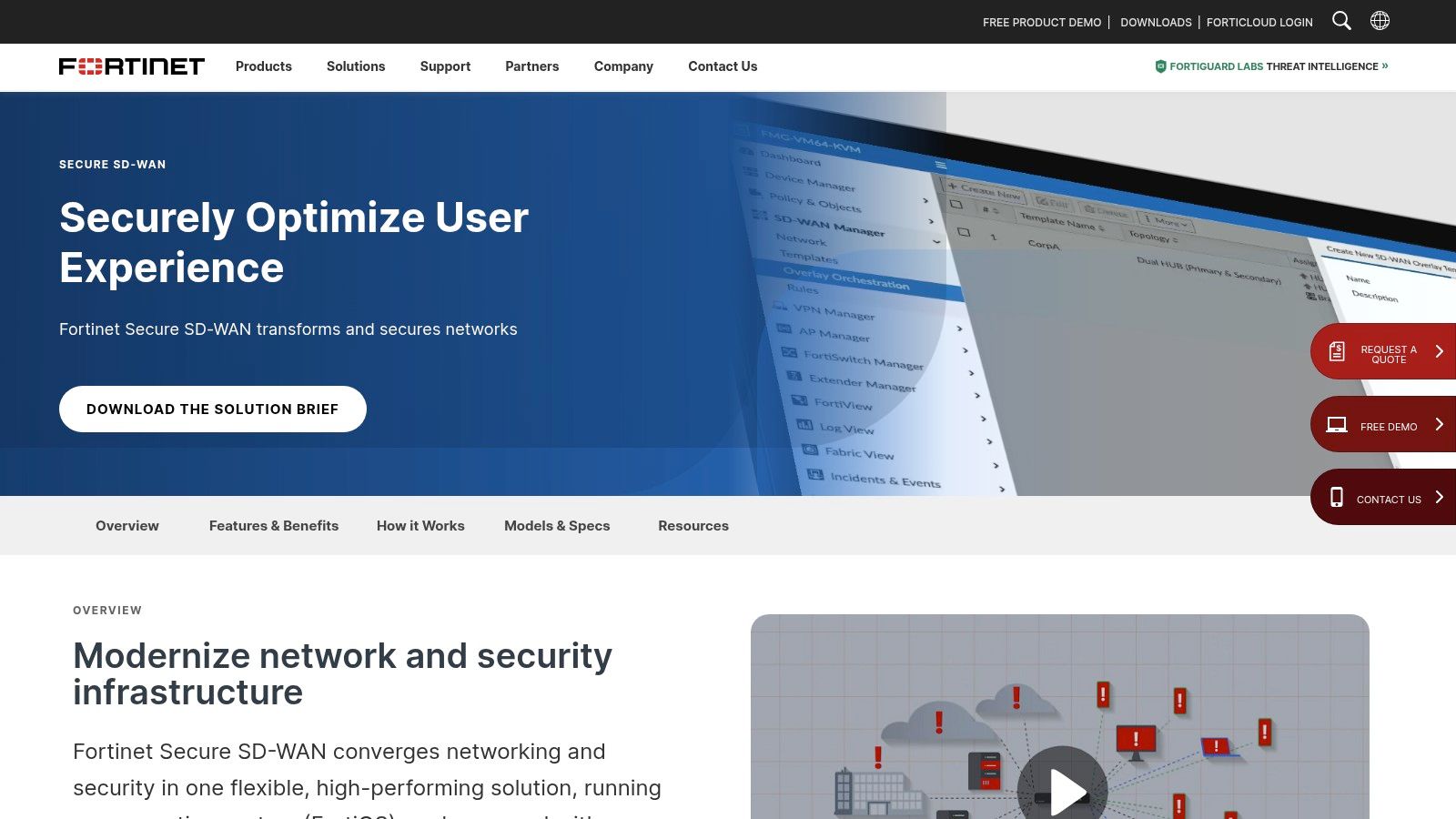
Fortinet Secure SD-WAN is the clearest fit for organizations that want security and WAN control on the same appliance. The platform runs through FortiGate next-generation firewalls, with centralized administration available through FortiManager or FortiGate Cloud. That architecture gives procurement teams one primary vendor for routing, application-aware path selection, firewalling, and branch security.
The operational advantage is straightforward. Network and security teams can work from a shared platform rather than stitching together a router, firewall, and separate SD-WAN controller. FortiGate hardware with ASIC assistance can preserve throughput when security services are enabled, while FortiSwitch and FortiAP extend the same operating model into SD-Branch deployments. Fortinet also supports cloud on-ramps and application or underlay monitoring through its broader product ecosystem. Product capabilities are detailed on the Fortinet Secure SD-WAN product page.
Procurement fit
Fortinet makes the most sense when your organization is prepared to standardize on FortiGate across branch locations. That standardization can simplify purchasing, support escalation, spares, and policy administration. It can also create lock-in. If your environment already contains several firewall and routing platforms, migration effort and skills requirements may reduce the value of the single-vendor model.
Subscription planning needs close attention. Advanced security and management capabilities can depend on licensing tiers, and FortiManager expertise becomes important as the deployment grows. Buyers should request a complete bill of materials covering hardware, subscriptions, management, support, cloud connectivity, and professional services.
Practical rule: Choose Fortinet when consolidating branch security and SD-WAN is a deliberate operating-model decision, not merely a way to reduce the first quote.
For regulated or security-led organizations, Fortinet is a strong shortlist candidate. For mixed-vendor estates, validate interoperability and support ownership before treating the integrated stack as a simplification.
2. Cisco SD-WAN and Cisco Meraki SD-WAN
Cisco offers two distinct procurement paths, and that choice should happen before the proof of concept. Catalyst SD-WAN, rooted in the Viptela platform, suits large or complex environments that need granular routing, segmentation, and policy control. Meraki SD-WAN suits teams that prioritize cloud-managed simplicity, fast branch deployment, and a dashboard that generalist administrators can operate.
Catalyst is the better choice for intricate topology requirements, advanced segmentation, and organizations with established Cisco networking skills. Meraki is more attractive when the priority is operational consistency across distributed sites, with AutoVPN, a straightforward management interface, and virtual MX options for cloud connectivity. Cisco's broad hardware and virtual-edge portfolio allows buyers to cover branches, data centers, and cloud environments through one ecosystem. The two paths are described on Cisco's SD-WAN overview.
Two products, two operating models
The benefit is flexibility. The risk is decision confusion. Catalyst and Meraki don't offer identical policy depth, workflows, licensing structures, or skill requirements. A buyer that selects Meraki for convenience may later find that advanced routing requirements need another architecture. A buyer that selects Catalyst for maximum control may pay for complexity the operations team won't use.
Before a demo, document who will manage changes, how segmentation will be governed, and which cloud environments require direct on-ramps. Cisco's guidance on how SD-WAN works can help non-specialist stakeholders understand the architecture before they compare product screens.
- Choose Catalyst: When policy granularity, routing control, and enterprise-scale governance take priority.
- Choose Meraki: When speed of rollout, centralized cloud management, and limited specialist staffing matter more.
- Reject a blended decision: Don't let separate business units select both families without a documented governance model.
Cisco is a strong fit for organizations that want a broad enterprise support footprint and already operate Cisco infrastructure. It isn't automatically the simplest choice. The procurement team must decide whether it wants one vendor with two operating models or one platform with a narrower administrative pattern.
3. Palo Alto Networks Prisma SD-WAN
Palo Alto Networks Prisma SD-WAN is built for buyers who see SD-WAN as part of an application experience and SASE strategy, rather than as a replacement for branch routers. The platform, which has CloudGenix heritage, emphasizes application-defined policies, autonomous path selection, centralized cloud management, and close integration with Prisma Access.
That positioning changes the buying conversation. Instead of asking only whether a site can reach an application, procurement teams should test how the platform identifies application behavior, responds to path conditions, and coordinates security policy across branches and cloud-delivered services. Strata Cloud Manager provides the centralized management layer, while Prisma Access offers the cloud security path for organizations pursuing a single-vendor SASE design. Palo Alto describes the platform on its Prisma SD-WAN product page.
The SASE commitment
Prisma SD-WAN is most compelling when the organization is already committed to Palo Alto's wider security portfolio or wants to consolidate toward it. The platform can be less attractive as a standalone SD-WAN choice if the business intends to keep another security provider, another SSE platform, or a separate branch firewall standard. In that situation, the promised simplicity may become integration work.
SKU discipline is essential. Buyers should separate the requirements for Prisma SD-WAN, Prisma Access, management, support, and any additional security services. The team must also understand the operational distinction between Prisma SD-WAN and PAN-OS SD-WAN. They are not interchangeable buying decisions, and a vague requirements document can produce the wrong architecture.
Organizations evaluating the security boundary should also review SD-WAN security considerations from MR2 Solutions. Use the proof of concept to test application identification, policy inheritance, failover behavior, logging, incident workflows, and ownership between network and security teams.
The right question isn't whether Palo Alto can provide more security. It's whether your team will operate the integrated security model consistently.
Choose Prisma SD-WAN for application-centric, SASE-oriented programs. Don't choose it because a security-led vendor appears safer on a feature comparison.
4. HPE Aruba Networking EdgeConnect
HPE Aruba Networking EdgeConnect, formerly Silver Peak, is the strongest candidate on this list for a mature, performance-sensitive WAN with demanding traffic-engineering requirements. Its value lies less in a simplified buying story and more in the depth of its path control, orchestration, topology options, and brownfield migration capabilities.
EdgeConnect Orchestrator gives network teams centralized policy, visibility, and lifecycle control. The platform supports physical and virtual edges across branches and data centers, with cloud on-ramps and path conditioning designed for variable underlay quality. Those capabilities make it suitable for organizations that need to keep existing transports in service while gradually changing how applications use the WAN. Technical resources are available through the HPE Aruba Networking EdgeConnect documentation.
Governance is part of the product
EdgeConnect rewards disciplined design. A large deployment can expose the difference between a well-governed policy model and a collection of local exceptions. The platform's flexibility gives experienced teams room to tune traffic behavior, but first-time SD-WAN operators may find the policy and licensing map dense.
Procurement should therefore include operating-process requirements, not just appliance specifications. Ask the vendor to show how administrators will:
- Create policy standards: Define application, segmentation, and failover rules that apply consistently across sites.
- Handle exceptions: Approve and retire site-specific changes without creating hidden dependencies.
- Manage migrations: Move from legacy WAN patterns while preserving application reachability.
- Measure outcomes: Correlate path quality, application experience, and support events in one operating workflow.
EdgeConnect is a good fit for enterprises with network engineering depth, complex branch estates, and a need for granular WAN behavior. It's a weaker fit for a small team that wants the provider to absorb design and day-to-day operations. In that case, select a managed implementation or compare EdgeConnect against a platform with a lighter administrative model.
The purchasing decision should include a governance workshop before the final quote. If your team can't explain who owns Orchestrator policy, escalation, and lifecycle changes, the deployment isn't procurement-ready.
5. Versa Networks Secure SD-WAN
Versa Networks Secure SD-WAN is designed for buyers that want routing, SD-WAN, security, analytics, and multitenancy in one software platform. Its single-pass architecture brings functions such as NGFW, secure web gateway, and intrusion prevention into the same broader stack. That makes Versa especially relevant to managed service providers, carriers, and large enterprises that need to operate multiple customers, business units, or policy domains.
The platform supports application-aware policies, cloud on-ramps, and hardware or virtual edge deployments. Versa also presents subscription options across different term lengths, but flexibility doesn't eliminate the need for careful sizing. The buyer must map each site, security tier, orchestration requirement, edge form factor, and service responsibility to the commercial model. Start with the Versa Secure SD-WAN product information, then request a quote that exposes every dependency.
Where Versa earns its place
Versa is a strong choice when the organization has a complex operating model and wants to reduce the number of separate network and security platforms. Its multitenant orientation can support provider-led delivery and complex enterprise structures. The same breadth can create unnecessary design work for a smaller IT team that only needs basic application steering and centralized policy.
A procurement committee should insist on a service-boundary map. Identify which functions are managed by the customer, which are delegated to an MSP, and which require vendor escalation. Then test how the platform handles:
- Tenant separation: Confirm policy, visibility, and administrative boundaries.
- License alignment: Match subscriptions to actual security and orchestration use.
- Cloud integration: Validate the required on-ramps and routing behavior.
- Operational analytics: Ensure alerts lead to actionable workflows, not another dashboard.
A complete stack only reduces complexity when the operating team can govern the complete stack.
Versa belongs on the shortlist for carrier-grade, MSP, and large-enterprise programs. For smaller teams, a managed Versa service may be more appropriate than a self-operated deployment. Don't evaluate the platform without pricing both models, because the labor required to design and operate the stack can change the commercial result.
6. VMware SD-WAN by VeloCloud
VMware SD-WAN by VeloCloud, now associated with Broadcom, is a practical fit for organizations that prioritize cloud and SaaS access through a provider-friendly operating model. Its cloud-gateway architecture uses hosted gateways to simplify access to cloud services and support partner-delivered managed SD-WAN. Enterprises can deploy edge devices as physical appliances or virtual network functions, depending on the site and cloud design.
That architecture is particularly useful when the business wants its connectivity partner to handle more of the deployment, monitoring, and service coordination. It also suits organizations with traffic patterns centered on SaaS and IaaS rather than a traditional data-center hub. The VMware website provides the vendor's broader portfolio context, but procurement teams should request current product, ownership, support, and renewal documentation directly.
Managed delivery and renewal risk
VeloCloud has a mature presence in carrier and MSP portfolios. That can reduce the burden on internal teams, but it also means the quality of the outcome depends on the provider's implementation method, gateway coverage, escalation process, and willingness to expose operational data. Compare the managed service contract, not only the SD-WAN license.
Broadcom ownership and portfolio changes introduce a procurement issue that shouldn't be ignored. Buyers need clarity on product naming, roadmap ownership, renewal mechanics, support contacts, and the relationship between the SD-WAN platform and any future security products. Advanced security may also require separate SASE components, so don't assume that the SD-WAN quote represents the complete security architecture.
Review SD-WAN edge architecture guidance from MR2 Solutions when defining the edge role in branch and cloud designs. Then require the provider to demonstrate onboarding, outage handling, gateway selection, policy changes, and offboarding.
VeloCloud is a good choice for cloud-first enterprises and organizations that prefer an MSP or carrier to operate the service. It is a weaker fit for buyers seeking a single integrated security stack or maximum independence from service providers. Put renewal protection and exit requirements into the contract before implementation begins.
7. Aryaka Managed SD-WAN and SASE as a Service
Aryaka is the clearest recommendation for organizations that want global SD-WAN without building and operating the full network themselves. The company combines managed SD-WAN and SASE with a private Layer 3 core, global points of presence, last-mile connectivity, edge devices, monitoring, and service-level accountability under one provider relationship. Its model is designed for businesses that value predictable delivery and internal capacity more than granular DIY control.
That difference affects every stage of procurement. Instead of buying an appliance, controller, security subscriptions, circuits, and operational tooling separately, the customer evaluates one managed service with defined responsibilities. Aryaka's products and services portfolio describes the bundled approach, but the contract remains the decisive document.
When managed service wins
Aryaka is a strong fit for lean IT teams, globally distributed organizations, and companies that need to roll out sites without building a large WAN operations function. The provider can coordinate connectivity, edge hardware, security, monitoring, and support. That can accelerate deployment and reduce the number of technical handoffs.
The trade-off is control. Changes move through provider processes, and the customer has less freedom to modify the underlying design than with a self-managed platform. A managed private core can also cost more than running an SD-WAN overlay across commodity internet, depending on the required service scope and commercial terms.
Ask for explicit answers on:
- Change authority: Which policies can your team change directly, and which require a service request?
- SLA scope: Does the commitment cover access circuits, the private core, security, application experience, and support response?
- Exit planning: How will the organization retrieve configurations, replace edge devices, and migrate connectivity?
- Regional delivery: Who owns local access procurement and fault resolution in each operating market?
Aryaka should lead the shortlist when your business wants outcomes delivered as a service. Choose a DIY vendor instead when your network team needs deep control, maintains strong in-house skills, or expects frequent architecture changes outside a provider's standard process.
Top 7 SD-WAN Vendor Comparison
| Solution | Implementation complexity | Resource requirements | Expected outcomes | Ideal use cases | Key advantages |
|---|---|---|---|---|---|
| Fortinet Secure SD‑WAN (FortiGate-based) | Moderate, integrated NGFW+SD‑WAN setup; FortiManager skill needed | FortiGate appliances (ASIC models optional), FortiManager/FortiGate Cloud, subscriptions | Consolidated security + SD‑WAN with strong NGFW controls | Regulated industries, SD‑Branch consolidation, Fortinet-standardized sites | Tight NGFW integration, hardware acceleration, unified stack |
| Cisco SD‑WAN (Catalyst/Viptela) & Meraki SD‑WAN | Varies, Catalyst: high (policy-rich); Meraki: low (cloud-managed) | Catalyst/Cisco appliances and controllers or Meraki MX + cloud licenses; varied skillsets | Catalyst: granular control/segmentation; Meraki: rapid cloud-managed deployment | Large enterprises needing advanced policies (Catalyst); simple branch rollouts (Meraki) | Choice of advanced policy depth or cloud simplicity; broad ecosystem/support |
| Palo Alto Prisma SD‑WAN (CloudGenix) | Moderate–high, app-defined policies and SASE integration; Strata familiarity helpful | Edge appliances/virtual edges, Prisma Access subscriptions, Strata Cloud Manager | Application-aware path selection and experience assurance; SASE convergence | Organizations pursuing SASE or app-performance–driven designs | Strong app visibility and automation; single-vendor SASE option |
| HPE Aruba EdgeConnect (Silver Peak) | High, disciplined Orchestrator design and governance recommended | EdgeConnect appliances/VMs, Orchestrator, experienced WAN engineers | Advanced path conditioning, traffic engineering, predictable WAN performance | Brownfield migrations and performance-sensitive enterprise WANs | Mature path conditioning, robust orchestration and tooling |
| Versa Networks Secure SD‑WAN | Moderate–high, full feature set and multi‑tenancy increase design effort | Versa appliances/VMs, subscriptions, analytics/orchestration platform | Integrated networking + security with strong multi‑tenant analytics | MSPs, carriers, and large enterprises needing consolidated stack | Comprehensive security+networking in one platform; carrier-grade multi‑tenancy |
| VMware (Broadcom) SD‑WAN by VeloCloud | Low–moderate, cloud‑gateway model simplifies deployment; partner-managed options common | Edge appliances/VMs or partner gateways, access to global hosted gateway fabric, licenses | Optimized SaaS/IaaS access and simplified cloud performance | Cloud-first enterprises and carrier/MSP-managed deployments | Global hosted gateway fabric; mature MSP/carrier adoption |
| Aryaka (Managed SD‑WAN / SASE as‑a‑Service) | Low for customer, fully managed service; provider-controlled changes | Managed service contract, ANAP CPE, bundled circuits and SLAs, OPEX model | Predictable global site-to-site and site-to-cloud performance with SLAs | Organizations seeking turnkey global SD‑WAN/SASE and minimal in-house ops | Private global core with PoPs, single contract managed delivery, SLAs |
Turning the Shortlist Into a Decision
The market is large enough to support sustained vendor investment. One estimate places global SD-WAN revenue at USD 19.71 billion in 2024 and projects a 17.5% compound annual growth rate from 2025 to 2030, according to MarketsandMarkets' SD-WAN market analysis. That scale gives buyers more choice, but it also increases the cost of an undisciplined shortlist.
The vendor ecosystem remains fragmented. The 2025 GigaOm Radar for SD-WAN evaluated 31 top solution providers, while a separate market map indexed 162 suppliers in Q3 2026. Procurement teams should expect overlapping feature sets and focus differentiation on integrated SASE, cloud on-ramps, managed-service depth, interoperability, and support quality.
Start with the operating model, not the demo. Decide whether your team wants to run the overlay, delegate it to an MSP, or adopt a managed connectivity service. Then define the business outcomes that matter, such as branch migration, application experience, cloud access, security consolidation, or reduction in support handoffs.
A practical procurement sequence
- Define required outcomes: Translate business priorities into measurable acceptance criteria for availability, application behavior, security policy, onboarding, support, and reporting.
- Run an identical PoC: Give every finalist the same sites, transports, applications, failure scenarios, segmentation requirements, cloud destinations, and support tests.
- Model three-year TCO: Include appliances, subscriptions, support, management systems, circuits, implementation, training, internal labor, managed services, and renewal assumptions.
- Test the security direction: Compare a single-vendor SASE path with a best-of-breed architecture, including policy ownership, logging, incident response, and migration effort.
- Contract for operational reality: Define SLAs, escalation routes, change authority, interoperability obligations, data access, renewal protections, and exit assistance.
The shift toward SASE makes this discipline more urgent. Gartner guidance cited by Fierce Network projects that 60% of new SD-WAN purchases in 2026 will be part of a single-vendor SASE offering, compared with 15% in 2022. That projection doesn't mean every buyer should consolidate. It means every buyer should decide deliberately whether consolidation supports the operating model or creates unused security features and new lock-in.
Interoperability deserves equal weight. Independent enterprise WAN coverage notes that many SD-WAN platforms are proprietary, universal mix-and-match standards are absent, and multi-vendor operation can make end-to-end SLAs difficult. A procurement team should therefore score implementation method, observability, support consistency, migration planning, and handoff quality alongside routing and security functions.
MR2 Solutions can provide a vendor-neutral brokerage path through its Technology Brokerage-as-a-Service framework. Its approach combines discovery, provider comparison, implementation coordination, and governance through a curated ecosystem of 400+ solution providers, with engagement extending from initial assessment through ongoing oversight. For mid-market and enterprise buyers, that model can reduce RFP-driven delays and align the selected SD-WAN vendor with business outcomes rather than a reseller's preferred product.
The right answer is not the vendor with the longest feature list. It's the platform, service provider, or combined model your team can fund, operate, secure, govern, and eventually change without unacceptable friction.
MR2 Solutions helps mid-market and enterprise organizations evaluate, design, procure, and govern SD-WAN through a vendor-neutral Technology Brokerage-as-a-Service process. If you're comparing secure SD-WAN, SASE, managed connectivity, or multicloud options, visit MR2 Solutions to structure the shortlist around your operating model and business outcomes.