
8 IT Vendor Management Best Practices for 2026

A critical SaaS platform renews automatically at a higher price. The contract doesn't say how the company can export its data, and no one is clearly responsible for the vendor relationship. By the time IT spots the renewal notice, procurement has little time to negotiate and the business has no tested alternative.
That kind of problem often starts before anyone signs. Teams select a product without agreeing on risk ownership, negotiate a contract without planning for exit, then let service, security, and cost reviews drift apart. Effective IT vendor management best practices connect those decisions into one operating routine: classify vendors, select them with evidence, set enforceable terms, measure delivery, manage security, control cost, prepare for exit, and keep the underlying records current. Organizations weighing outsourced support can also use an IT department outsourcing playbook to think through responsibilities and service boundaries before selecting a provider.
1. Risk-Based Vendor Tiering and Segmentation
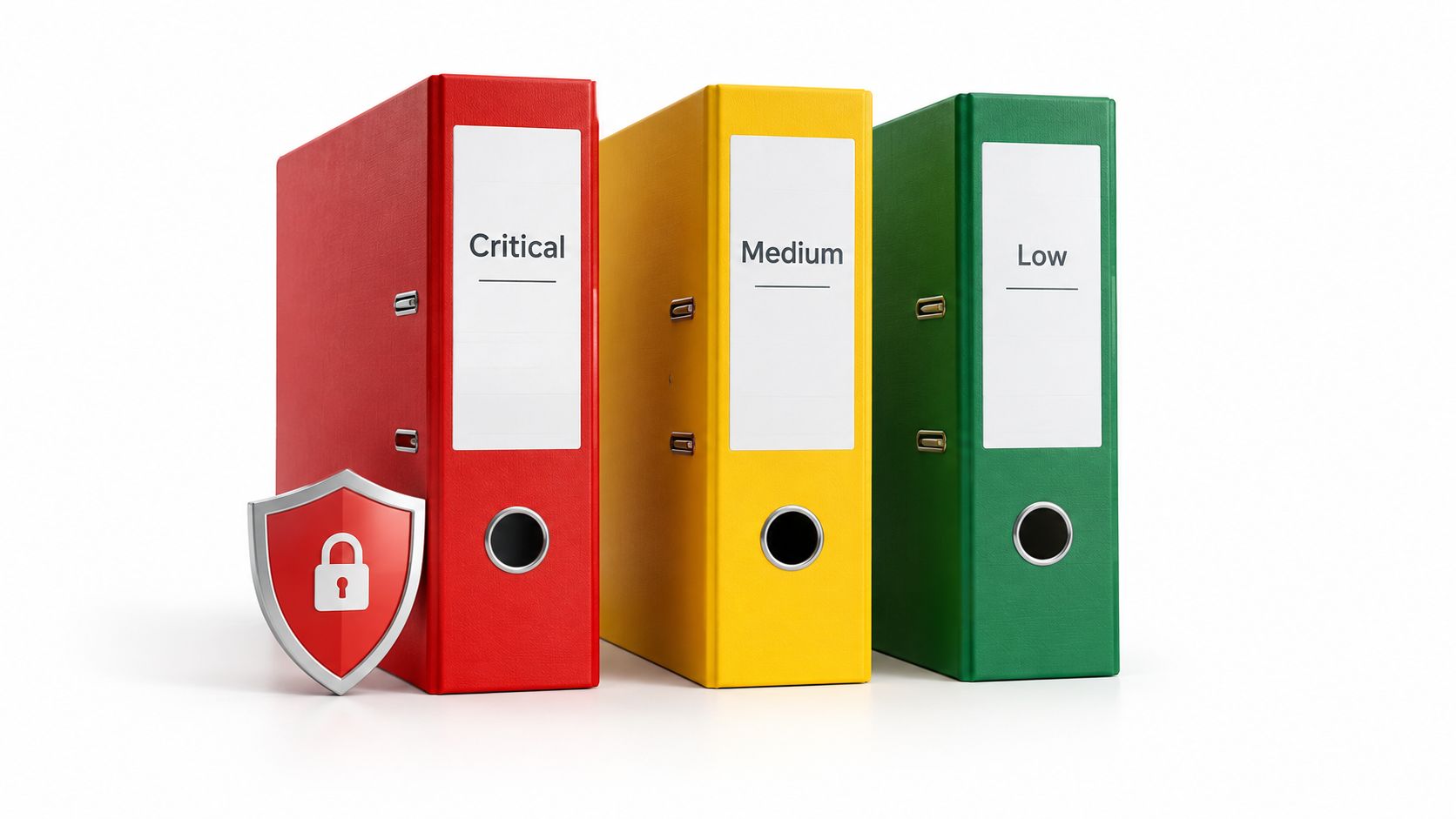
A vendor's purchase price doesn't tell you how much oversight it needs. A provider with access to sensitive information or a role in a critical business process may deserve more scrutiny than a larger supplier with no system access. Tier vendors according to the consequences of a disruption, the sensitivity of the data they handle, and the level of access they receive.
Keep the model simple enough that business owners can apply it consistently. Use a small set of tiers, each with written criteria and clear consequences for due diligence, contract terms, monitoring, and review frequency. For example, a cloud provider hosting protected health information could receive intensive security and continuity reviews, while an office-supplies vendor with no network access follows a lighter process.
Make the tier actionable
Tiering fails when it becomes a label in a spreadsheet with no effect on the relationship. Assign each vendor a business owner and ask that owner and security to confirm the classification together. Store the tier in the vendor inventory, then use it to trigger the right review workflow and evidence requirements.
Reassess the tier when the vendor's service, data access, or system connections change, not just at the original approval. A low-risk software subscription can become important if it gains access to production systems or starts handling sensitive data. At renewal, confirm that the current tier still reflects how the organization uses the service.
Practical rule: If a vendor's failure could interrupt an important process, expose sensitive information, or affect several sites, don't let the vendor self-classify its risk.
The common failure is applying the same questionnaire and approval process to every supplier. That wastes effort on low-impact providers and leaves critical ones with inadequate scrutiny. Risk-based tiers make the rest of vendor governance proportionate, but only when they change what the organization does.
2. Structured Vendor Selection and Due Diligence
A fast purchase can become an expensive deployment if the chosen product doesn't fit the organization's environment. Before inviting vendors to pitch, the business owner and IT should agree on the problem to solve, mandatory requirements, likely integrations, and the consequences of a poor fit. That gives evaluators a basis for comparing providers beyond sales presentations and headline price.
Use a scored evaluation that weighs technical fit, security, support, implementation effort, commercial terms, and ongoing operating costs. Check financial and operational readiness alongside the product's features. For a mission-critical or integration-heavy system, use a pilot or proof of concept to expose problems with identity, data movement, workflows, or support before the award.
Preserve the reason for the decision
Keep the shortlist focused on providers that meet the mandatory requirements, then document why the preferred option won. This record matters at renewal, when the team needs to judge whether the vendor delivered on the original case or whether the requirements have changed. It also prevents a familiar failure pattern: selecting the lowest license price, then discovering that implementation, support, integration, or change requests drive the actual cost.
Security shouldn't be a late-stage formality. Include security and compliance questions in the evaluation itself, and confirm that the evidence applies to the service being purchased. For a structured assessment and selection process, use a technology due diligence checklist to organize the questions and evidence that inform the decision.
A vendor-neutral selection process can help when internal teams lack time or specialist capacity, but outside advice doesn't replace business ownership. The buyer still needs to set priorities, decide acceptable risk, and document trade-offs. A clear decision record is more useful than a long RFP that asks every provider questions no one will use to make a choice.
3. Contract Governance with Clear SLAs, Data Rights, and Exit Terms
A vendor's promises only protect the organization when the contract makes them specific and enforceable. Define the service levels that matter, how the vendor reports them, what happens when targets are missed, and who handles escalations. A contract that says a supplier will provide reliable service but gives no measurable standard leaves the parties arguing about expectations after a problem occurs.
Data terms need the same care. Specify what the vendor can do with organizational data, how it protects that data, which subprocessors it uses, and how it will notify the customer about material changes or incidents. Before signing, settle how the organization can retrieve its data in a usable format, how the vendor will support a transition, and how deletion will be confirmed when the relationship ends.

Put renewal control in writing
Contract owners should track renewal dates, notice periods, security evidence, and scheduled service reviews in one place. Otherwise, automatic renewal can turn a weak agreement into a longer commitment because nobody noticed the deadline. Where the service supports it, link payment remedies or credits to the vendor's actual performance rather than relying on an informal assurance that the provider will make things right.
The most common mistake is treating legal review as the finish line. Procurement, IT, security, privacy, and the business owner should confirm that the final agreement reflects the operating model they intend to use. Negotiate exit rights before the relationship is under pressure, when both sides still have a reason to reach workable terms.
4. Service Performance Management and Scorecards
A signed SLA doesn't manage the service. The relationship needs a routine for checking whether the provider is meeting commitments and whether the service still fits business needs. Agree on a short scorecard with clearly defined measures, such as availability, incident response, resolution time, project milestones, and feedback from the people who use the service.
Don't confuse a dashboard full of metrics with useful oversight. Each measure should connect to an obligation, a business outcome, or a decision the team might take. If a provider reports uptime but users struggle to complete essential work, the review should capture both the technical result and the operational experience.
Make reviews produce decisions
Use regular service reviews to examine performance, unresolved incidents, upcoming changes, risks, and open actions. Give each action an owner and a due date, then check progress at the next meeting. For critical providers, bring the business owner and technical teams together so the provider can hear how its service affects actual operations.
A managed-services team, for example, might report response and resolution performance against contract commitments. If the same issue recurs, the customer should require a corrective plan rather than accepting a new explanation each month. Guidance on managed services operations can help teams connect service delivery, reporting, and operational accountability.
The failure pattern is holding a review where everyone discusses the last month but no one makes a decision. Scorecards should inform remediation, scope changes, renewal choices, or recognition of work that is going well. Keep the measures few enough to review and important enough to act on.
5. Third-Party Cybersecurity Risk Management
A supplier's security can affect the organization even when the supplier doesn't manage its core infrastructure. A vendor account may connect to internal systems, a SaaS integration may exchange sensitive data, or a software update may introduce risk through a trusted channel. Security reviews should reflect the actual service and access involved, not just the vendor's general reputation.
The scale of the business-continuity issue is clear in Gartner's survey of senior executives responsible for third-party cybersecurity risk management. Forty-five percent of surveyed organizations reported a business interruption caused by a third party during the previous two years (Gartner survey findings in IBM's 2025 Cost of a Data Breach report). That makes vendor security an operational concern as well as a technical control.

Match evidence to access
Request security questionnaires and independent assurance reports in proportion to vendor risk. Confirm that the evidence covers the product and service the organization uses. For vendors with access to internal systems, use named, dedicated accounts with appropriate permissions and monitoring instead of shared credentials.
Ask critical providers about subprocessors and other dependencies, and agree on incident notification and cooperation expectations. IBM's 2025 research identified supply-chain compromise as the second-most-prevalent attack vector in the breaches it studied, involved in 15% of cases, with an estimated average cost of USD 4.91 million (IBM's 2025 Cost of a Data Breach report). Those findings support prioritizing closer oversight for providers whose compromise could disrupt critical services or expose regulated information.
Questionnaires alone aren't continuous oversight. Monitor material changes, security incidents, and access arrangements, and test how the vendor will coordinate during an incident. The common mistake is accepting an enterprise-wide report as proof that every purchased service has the controls the organization needs.
6. Total Cost of Ownership and Technology Expense Management
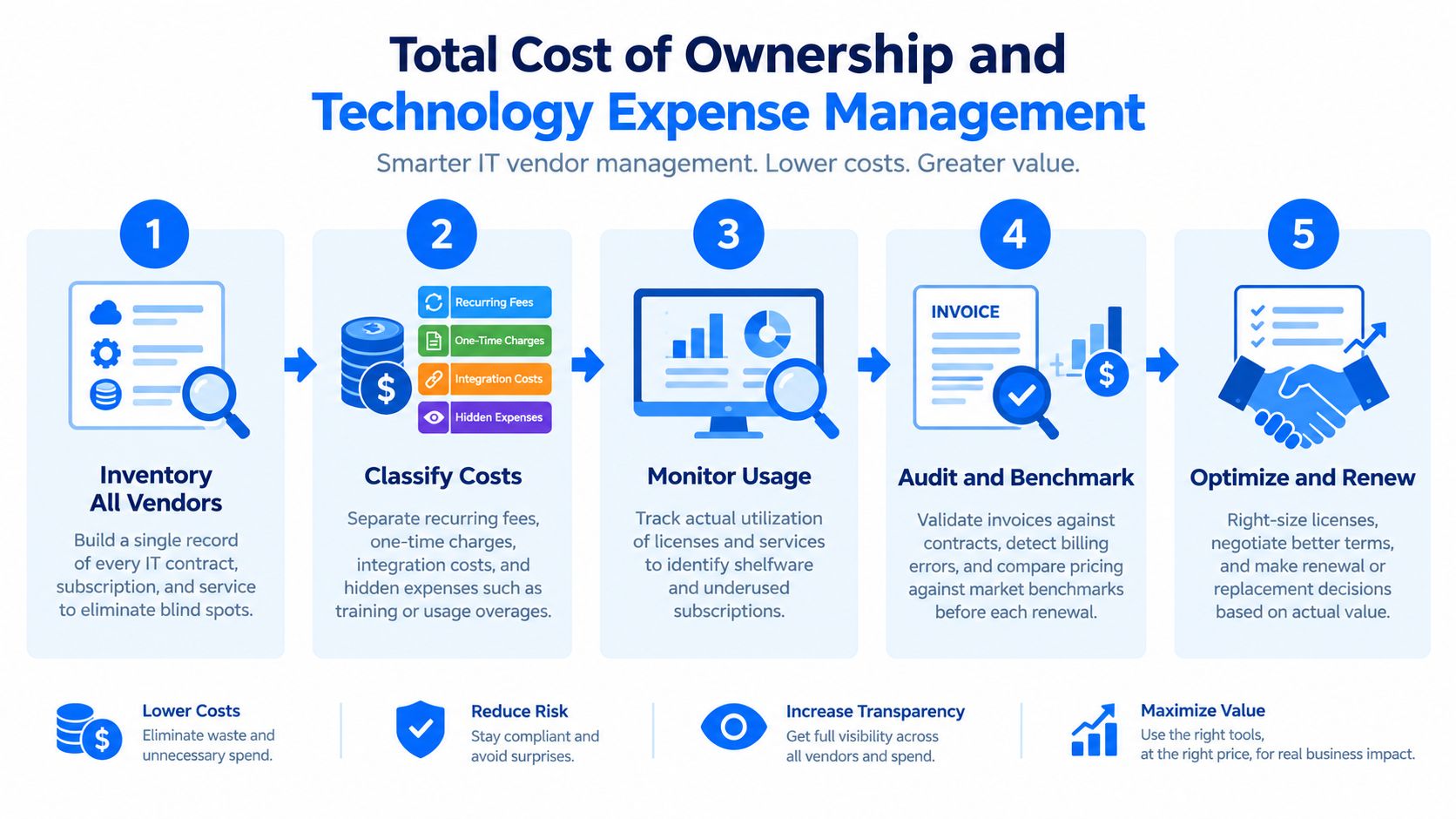
The price on a proposal rarely captures the full cost of a technology decision. Implementation, integration, support, training, overages, internal administration, and eventual migration can all affect the value of a contract. Compare options over the expected relationship, not just by subscription price or initial discount.
Once a vendor is in place, reconcile what the organization pays against what it uses. Bring contracts, subscriptions, invoices, seat counts, and service owners into a shared view. Before each renewal, check actual usage and identify inactive licenses, duplicate tools, unused capacity, or charges that don't match the agreement.
Make renewal a value decision
For a cloud service, compare the committed capacity with the workload it supports. For software, check whether the licensed features and seats still match how teams work. For a managed service, look at the delivered scope and service outcomes alongside the invoice. A price reduction that removes capacity the business needs may create more cost later, so right-sizing should follow evidence rather than a blanket cut.
Technology expense management can support the ongoing work of tracking technology commitments and optimizing spend. The internal process still needs a named owner who can resolve invoice questions and coordinate with finance, procurement, and service teams. Keep enough lead time before renewal to assess usage, negotiate changes, and consider alternatives.
A common failure is reviewing cost only when finance asks for savings. By then, renewal deadlines may limit the options, and the team may have no reliable usage data. Cost governance works best as an operating habit, with regular invoice checks and a documented review before committing to another term.
7. Vendor Lifecycle Governance and Exit Planning
Every vendor needs an accountable owner, including when staff change roles or leave the organization. The owner should know what service the supplier provides, who depends on it, which teams manage the contract, and how issues are escalated. Without that continuity, a vendor relationship can remain active while essential knowledge disappears.
Exit planning belongs at onboarding, not at the point when the organization decides to leave. For critical services, document how the business would continue during a transition, what data and configurations it needs to retrieve, and what support the vendor must provide. Test exports from important systems while the relationship is stable, so the team can learn whether the data is complete and usable before a deadline forces a decision.
Don't treat a termination clause as an exit plan. A workable transition also needs people, data, access changes, and a replacement path.
Close the relationship deliberately
For higher-risk vendors, review the exit plan alongside service and security reviews. Identify dependencies that could make a quick change difficult, such as integrations, custom workflows, or knowledge held only by the provider. Keep alternative providers under consideration where the service is critical, but don't assume that a named alternative can take over without testing compatibility and transition effort.
At offboarding, revoke accounts and credentials, recover organizational assets, return or delete data as agreed, and record confirmation. The failure pattern is focusing on access removal while overlooking operational handover, data retention, and unresolved invoices or support requests. A lifecycle routine should connect onboarding, changes, renewals, and termination so that exit readiness remains part of normal vendor governance.
8. Centralized Vendor Inventory and Regulatory Compliance Alignment
Teams can't manage obligations they can't see. Maintain one authoritative record that connects each vendor to its service, business owner, risk tier, contract, data access, security evidence, key dependencies, renewal dates, and performance history. That record should support daily decisions, not just a periodic audit request.
The need is practical as well as regulatory. KPMG's global survey found that only 17% of respondents rated their third-party risk management data as fully reliable (KPMG's global TPRM report). Incomplete or stale records weaken risk assessments, renewal planning, and leadership reporting. A dashboard can make information easier to view, but it can't compensate for missing owners or inaccurate contract and service details.
Build from the records you trust
Start by capturing the vendors that support important operations or handle sensitive data. Reconcile the inventory against purchase and payment records, contracts, and identity or access data, then investigate gaps. Require purchase requests to identify the vendor and service before approval, so new relationships don't sit outside the governance process.
Map vendors to the obligations that apply to their services and the evidence needed to demonstrate oversight. Keep that mapping specific: a vendor's role, data, and business use determine what the organization needs to verify. As the record improves, use it to identify dependencies that may concentrate risk and discuss those exposures with leadership.
The common failure is buying a vendor management tool before deciding who owns the records and how teams will maintain them. Technology can support reminders, evidence tracking, and reporting, but the organization still needs clear data ownership and change controls. For complex technology environments, vendor consolidation to reduce integration drift can be part of the broader effort to clarify dependencies and simplify oversight.
8-Point IT Vendor Management Best Practices Comparison
| Practice | Implementation Complexity | Resource Requirements | Expected Outcomes | Ideal Use Cases | Key Advantages |
|---|---|---|---|---|---|
| Risk-Based Vendor Tiering and Segmentation | Medium; requires objective criteria and consistent classification | Vendor inventory, business-owner input, and security or procurement review | Governance effort aligned to vendor risk and criticality | Large or regulated environments with many vendors | Focuses limited oversight resources on higher-risk providers |
| Structured Vendor Selection and Due Diligence | Medium to high; involves defined evaluation and approval steps | Requirements, scoring templates, evaluator time, and vendor testing | Better-informed selection decisions and documented rationale | New technology purchases, major renewals, or critical systems | Reduces selection errors and improves transparency |
| Contract Governance with Clear SLAs, Data Rights, and Exit Terms | Medium to high; negotiation and legal review may be needed | Legal, procurement, security, and contract-management support | Enforceable service, security, data, and exit protections | SaaS, outsourced, or data-sensitive services | Clarifies responsibilities and provides remedies and exit rights |
| Service Performance Management and Scorecards | Medium; depends on agreed metrics and reporting routines | Performance data, scorecard tools, and regular business reviews | Earlier issue detection and evidence for renewal or remediation | Ongoing managed services and critical vendor relationships | Supports objective decisions and continuous improvement |
| Third-Party Cybersecurity Risk Management | High for broad or continuous programs; lower for limited assessments | Security expertise, audit evidence, access controls, and monitoring tools | Reduced supplier-related cyber exposure and improved oversight evidence | Vendors with access to systems, networks, or sensitive data | Helps identify and address security weaknesses before incidents |
| Total Cost of Ownership and Technology Expense Management | Medium to high; cost and usage data may be fragmented | Contract and invoice records, usage data, and finance and IT coordination | Better cost visibility, forecasting, and renewal decisions | Organizations with extensive software, cloud, or service spending | Reveals unused spend and strengthens negotiation positions |
| Vendor Lifecycle Governance and Exit Planning | Medium; requires ownership, documentation, and periodic review | Named vendor owners, lifecycle processes, and migration planning | More controlled onboarding, changes, and vendor transitions | Critical services and providers with significant operational dependency | Reduces disruption and access or data risks during exit |
| Centralized Vendor Inventory and Regulatory Compliance Alignment | Medium to high; initial data gathering and integrations can be demanding | Inventory system, cross-department data, and ongoing ownership | Improved visibility, audit readiness, and concentration-risk reporting | Multi-vendor or regulated organizations | Creates a consistent source of vendor and compliance information |
Turning These Practices Into One Repeatable Vendor Routine
These practices work as a connected cycle, not as separate checklists owned by teams that rarely coordinate. Tiering determines how much selection evidence to collect. Selection findings inform contract terms. The contract establishes measurable service and security expectations, and performance reviews show whether the provider is meeting them. Cost reviews then test whether the relationship remains valuable, while exit planning protects the organization if the answer is no.
The inventory ties the cycle together. It gives business owners, IT, security, procurement, and finance a shared view of who provides each service, what the organization depends on, and when decisions are due. When those records stay current, teams can respond to material changes instead of waiting for renewal or an incident to expose a blind spot.
Start with the vendors that could cause the greatest disruption. For each one, confirm the business owner, service scope, risk tier, access to data or systems, contract terms, renewal date, and latest performance and security review. If any of those details are missing, assign an owner and a date to resolve the gap. Then use the same process to expand the inventory rather than trying to perfect every low-risk record before improving oversight of critical providers.
Over time, make each renewal a documented decision. Compare delivery with the contract, review security and operational changes, check actual usage and cost, and decide whether to renew, renegotiate, remediate, or exit. That routine prevents automatic renewal from becoming a substitute for governance and gives leaders a clearer basis for allocating attention.
A practical first step for the next 30 days is to tier the top 10 vendors by data access and operational impact, then confirm the renewal dates and contract owners for every Tier 1 relationship. Use what that review reveals to prioritize the next actions: missing data protections, weak service measures, stale security evidence, or an untested exit path. Small, owned improvements across the lifecycle will do more than a large policy document nobody uses.
MR2 Solutions provides vendor-neutral technology brokerage, including vendor evaluation, procurement support, contract negotiation, cost optimization, and ongoing technology lifecycle management. If your team needs help connecting vendor decisions to operational outcomes, explore MR2 Solutions and its Technology Brokerage-as-a-Service approach.