
Technology Due Diligence Checklist for M&A

A software-heavy M&A deal is re-traded in 30% to 40% of transactions, and diligence findings can drive purchase-price reductions of 5% to 25%. Those figures are not an argument for producing a longer IT inventory. They're an argument for treating the technology due diligence checklist as a direct valuation and negotiation instrument. (CTA Acquisitions explains the financial impact of technology diligence findings)
A target's technology stack determines more than whether the business can operate on the day of closing. It affects the buyer's ability to scale revenue, integrate systems, protect sensitive data, retain customers, meet contractual commitments, and fund the next phase of growth. A weak review hides costs that surface after the deal, when the buyer has less negotiating power and more urgency.
Why Technical Diligence Dictates Deal Valuation
Technical diligence should determine how much the buyer pays and how much capital the deal requires after closing. An application list, network diagram, cybersecurity summary, and cloud description provide inventory. They do not answer the investment question: Does this technology support the investment thesis, or will it consume capital after closing?
The technology due diligence checklist must connect each finding to a business consequence. A fragile monolith can restrict product expansion. A single cloud region can create continuity risk. Unmanaged open-source dependencies can create licensing obligations. A vendor contract that cannot be assigned can interrupt operations during integration. Each finding belongs in the valuation model, purchase agreement, or post-close plan.
The cost of discovering problems late
According to CTA Acquisitions' technology due diligence analysis, on a $50 million SaaS acquisition, a cluster of open security vulnerabilities combined with unresolved open-source licensing risk can reduce the purchase price by $2 million to $4 million. Related indemnity escrows are commonly held for 18 to 36 months.
These figures establish the buyer's operating discipline. The team should identify issues while it can still influence price, escrow, representations, warranties, remediation obligations, and the integration budget. A closing binder full of documents has little value if the findings arrive after commercial terms are fixed.
Classify findings by the action they require:
| Diligence finding | Business implication | Likely deal response |
|---|---|---|
| Immediate control failure | Exposure to interruption, breach, or contractual noncompliance | Closing condition, remediation covenant, or indemnity |
| Structural technology debt | Higher integration and modernization costs | Price adjustment or dedicated post-close budget |
| Scalability constraint | Growth thesis may require replatforming | Revised operating plan and valuation assumptions |
| Unclear ownership or licensing | Rights to operate or commercialize may be disputed | Escrow, representation, warranty, or legal remediation |
This classification keeps technical review tied to deal mechanics. An outdated application may require planned modernization. An unresolved intellectual-property assignment may threaten the buyer's right to use a core asset. Those findings should not receive the same treatment or budget.
Test the investment thesis, not just the environment
Map technical evidence to the buyer's value-creation plan. A cross-selling strategy requires workable data integration and identity architecture. International expansion requires review of data residency, localization, resilience, and support capacity. Margin improvement requires analysis of cloud spend, vendor commitments, automation, and technical staffing.
The review must also cover the operating controls around the stack. Independent M&A guidance includes hardware and software inventories, personnel, technology policies, vendor agreements, cyber-stress tests, disaster recovery, and incident history. It also covers encryption policies, BYOD controls, and records of malware, ransomware, or phishing incidents. (The M&A due diligence checklist from DFIN Solutions covers the broader review scope)
Practical rule: If a technical finding cannot be translated into price, timing, risk allocation, integration effort, or operating capacity, the diligence team has not finished the analysis.
Evaluating Architecture and Security Posture
A server list tells you what the target owns or uses. It doesn't tell you whether the product can survive growth, whether engineers can release safely, or whether a security incident would spread across the environment. The technical core of the checklist must examine how the platform behaves under pressure and how the team controls change.
Start with the product and architecture together. Review the product roadmap, major customer commitments, supported versions, architectural principles, and known technical debt. Then compare those claims with architecture diagrams, source-code samples, dependency graphs, deployment artifacts, incident records, and performance evidence. Inconsistency between the roadmap and the engineering evidence is itself a red flag.
Grade maturity with evidence
A strong evaluation asks for proof rather than assurances. Review whether the target uses automated static analysis, protected branches, documented code-review policies, and repeatable build processes. Examine test coverage trends rather than accepting a single coverage figure. Check whether the team monitors its build and deployment pipelines, can roll back a release, and maintains current runbooks or architecture decision records.
The architecture review should answer practical questions:
- Failure isolation: Can a failure in one service bring down unrelated customer functions?
- Resilience: Does the design use multiple availability zones or regions where the business requirement demands it?
- Capacity: What evidence shows that the platform can support the buyer's growth plan?
- Dependency control: Which internal and third-party services are critical to each transaction?
- Operational knowledge: Can someone other than the original developer diagnose and recover the system?
Technology benchmarking belongs in this review. Bain's technology due diligence framework organizes the work into six workstreams, product evaluation and roadmap, technology and architecture, cybersecurity, data and analytics, organization and processes, and technology benchmarking. (Bain's technology due diligence framework outlines these workstreams) Use each workstream to grade current maturity, near-term remediation cost, and post-close scalability risk.
Treat cybersecurity as a transaction issue
Security diligence must go beyond a policy review. Request vulnerability assessments, penetration-test results, remediation tickets, privileged-access records, multifactor authentication coverage, endpoint controls, incident-response plans, and evidence from previous incidents. Ask the target to demonstrate how it detects, contains, investigates, and learns from security events.
The buyer should also test whether security responsibilities are clear. A policy that assigns responsibility to “IT” without naming accountable owners usually indicates weak governance. Review access to production systems, source code, customer data, cloud consoles, and backup environments. Verify that former employees and contractors lose access when their engagement ends.
The operational consequences are substantial. Cybersecurity problems reportedly delay 62% of M&A deals, and 73% of dealmakers say they would walk away if an undisclosed breach were found. (The technical due diligence checklist from Catio addresses these transaction risks)
For a focused perspective on the relationship between modern AI systems and security controls, buyers can also consult this resource on AI and information security from AI Frontiers. The point isn't to add another generic security document. It's to understand how automated systems, data access, model behavior, and information integrity interact.
Finally, align the technical review with the target's compliance obligations and operating reality. A buyer can use an IT security compliance assessment to organize evidence, identify control gaps, and separate documented safeguards from controls that exist only in presentations.
Uncovering Operational and Licensing Liabilities
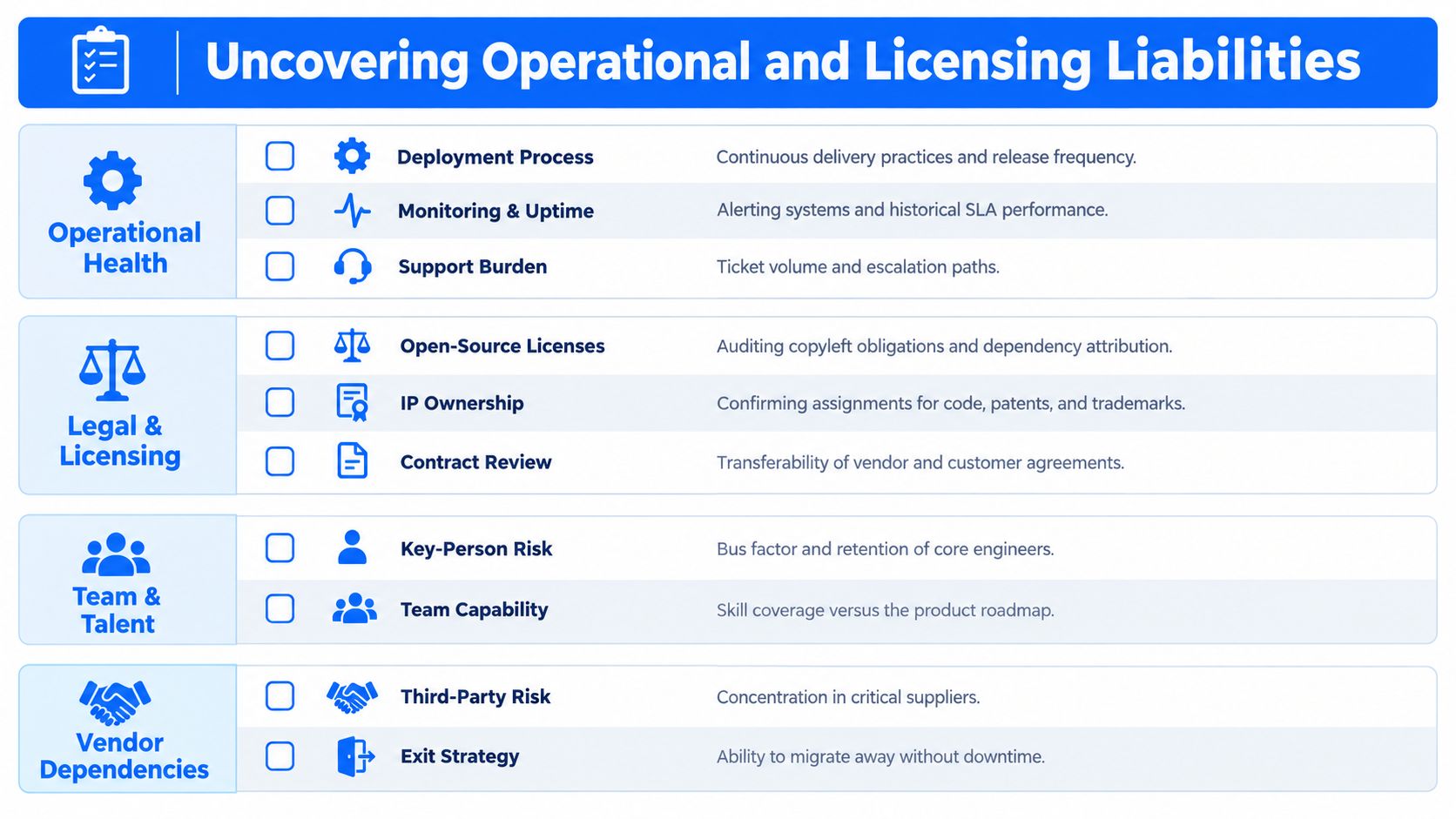
A technically elegant product can still be an operational liability. Buyers inherit the way the target works, including informal processes, undocumented dependencies, overloaded specialists, weak vendor governance, and applications that no one wants to own. The diligence team needs to investigate the operating model behind the architecture.
Begin with an application and service map that names an owner for every critical system. Compare the formal inventory with procurement records, cloud billing, expense reports, identity directories, endpoint data, and interviews with business users. Differences often expose shadow IT, duplicate tools, unmanaged SaaS accounts, and critical workflows that never made it into the official documentation.
Find the workarounds people stopped noticing
Manual interfaces between important systems deserve immediate attention. Ask where employees export data to spreadsheets, rekey customer information, email approvals, or upload files between platforms. These workarounds create error risk and make integration more expensive because the process isn't visible in the system diagrams.
Unsupported or end-of-life applications require the same scrutiny. Identify the business process each application supports, the data it stores, the vendor's support status, available replacement paths, and the skills required to maintain it. A system may appear inexpensive because its license is fully depreciated, while its real cost sits in specialist labor, fragile interfaces, and emergency recovery work.
Review operations through evidence:
- Service management: Examine incident queues, escalation paths, problem records, change approvals, and post-incident actions.
- Continuity: Test disaster-recovery plans against actual recovery dependencies, backup integrity, restoration ownership, and communication procedures.
- People: Identify key-person risk, succession gaps, critical skills, and responsibilities that exist only through individual knowledge.
- Financial control: Reconcile technology contracts, renewal dates, consumption commitments, support fees, and planned replacement costs.
- Policy execution: Compare written policies with access records, device practices, vendor onboarding, and actual exception handling.
Establish rights to the technology
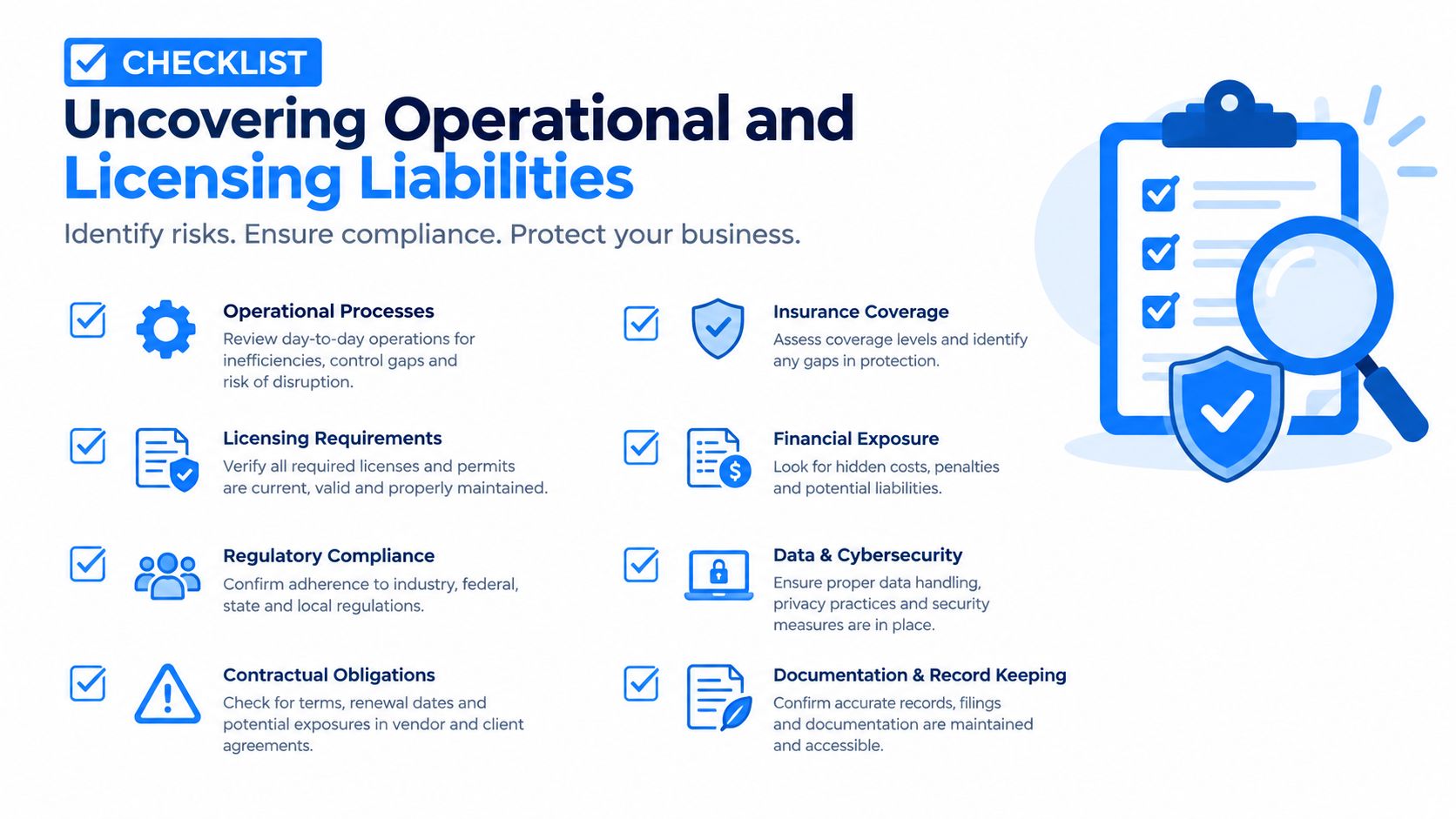
Intellectual-property ownership and software licensing require a separate evidence trail. Request employee and contractor assignment agreements, patent and trademark records, source-code ownership documentation, and open-source inventories. Review whether the target tracks dependency versions, license obligations, attribution requirements, and copyleft exposure.
Don't accept a statement that the company “uses standard open source.” That phrase says nothing about how the target manages obligations across products, customer distributions, embedded components, or modified code. Ask for the software bill of materials where available, then reconcile it with repositories and build pipelines. Legal counsel should assess obligations, but the technology team must first establish what is present.
Vendor contracts can create a different ownership problem. Check assignment and change-of-control provisions, termination rights, service-level commitments, data-return clauses, subcontractor dependencies, and restrictions on geographic use. Map each vendor to the system, process, data set, and customer commitment it supports.
A disciplined technology expense management review can help reconcile invoices, renewals, consumption, and redundant services with the operating inventory. That reconciliation gives the deal team a defensible basis for modeling inherited run-rate costs and post-close rationalization.
Assessing AI and Emerging Technology Risks
AI is not merely another feature on the application inventory. A conventional IT review can confirm that a model exists while missing the questions that determine whether the model is safe, lawful, explainable, and commercially usable.
The buyer should identify every AI-enabled capability, including internally developed models, embedded vendor features, third-party APIs, copilots, automated scoring systems, and workflows that generate or act on content. Then classify what each system does, what data it uses, who relies on its output, and whether a human can challenge or override a decision.
Demand model evidence
For every material AI capability, request a model card, training-data provenance, data lineage, evaluation results, fairness assessments, and documentation of automated decision-making. These materials should explain intended use, known limitations, input sources, output behavior, monitoring practices, and escalation procedures.
FieldSignal's supplier due diligence guidance warns that traditional IT reviews don't adequately cover model behavior, training-data provenance, human-review design, bias testing, or explainability. It recommends requesting model cards, data lineage, fairness assessments, and documentation of automated decisions. (FieldSignal outlines a buyer's framework for AI supplier diligence)
A missing document isn't automatically proof of a defective model. It is evidence that the buyer cannot yet assess the risk. Price the uncertainty, require additional testing, or make evidence production a condition of closing.
Examine the full AI operating chain
The model itself is only one component. Review the data pipeline, prompt or feature construction, model hosting, access controls, logging, monitoring, retraining process, and human review. For vendor-provided AI, inspect the contract for data-use rights, retention, training permissions, service changes, output ownership, audit rights, and portability.
Ask the engineering and product teams how they detect performance degradation or unexpected behavior. Ask compliance and legal teams which decisions require human approval. Ask business owners what happens when the model is unavailable or produces an incorrect output. The answers should align. If product leadership describes an assistive tool while operations rely on its output without review, the target has a governance gap.
The technology due diligence checklist should also test concentration and lock-in. Determine whether the initiative depends on one model provider, one embedding service, one proprietary data set, or one specialist who understands the implementation. Document a credible fallback and exit path, including data export, model replacement, workflow continuity, and customer communication.
Treat AI findings as operating and transaction risks at the same time. An opaque decision system may affect customer trust, contractual commitments, regulatory exposure, and the buyer's ability to change the product after closing. The right response could involve remediation, a restricted use case, a contract change, a dedicated oversight process, or a revised valuation assumption.
Translating Technical Findings into Deal Terms
A diligence report that ends with “high, medium, and low risk” is incomplete. Deal teams need to know what each finding costs, how quickly it must be addressed, who bears the risk, and whether the issue changes the investment thesis.
The translation process starts by separating remediation cost from residual risk. Remediation cost covers the people, tooling, migration, testing, legal work, and operating disruption required to fix the problem. Residual risk remains after the fix, especially where the buyer cannot guarantee recovery, eliminate third-party dependence, or reconstruct missing evidence.
Build a finding-to-economics register
For every material issue, record:
- The evidence: Identify the repository, contract, incident record, architecture artifact, or interview that supports the finding.
- The business exposure: State which revenue stream, customer commitment, process, asset, or compliance obligation is affected.
- The response cost: Estimate internal labor, external expertise, licensing, migration, downtime, testing, and temporary controls.
- The timing: Separate actions required before signing, before closing, during the first integration wave, and during later modernization.
- The risk owner: Assign responsibility to the seller, buyer, joint integration team, or a named executive.
- The deal mechanism: Select a price adjustment, escrow, indemnity, covenant, representation, warranty, closing condition, or integration budget.
This register gives financial sponsors and boards a common language. The CTO can describe the architecture constraint, the security leader can define exposure, and the deal lead can determine how to allocate risk in the purchase agreement.
Match the remedy to the problem
Use a closing condition for an issue that prevents the buyer from safely taking control, such as missing access, unresolved ownership of a core asset, or an uncontained security exposure. Use an escrow or indemnity when the risk is known but the full financial impact may emerge after closing. Use a price adjustment when the buyer can reasonably estimate the cost and wants the economics reflected immediately.
A remediation covenant works when the seller can complete a defined action before or after closing. The covenant should specify evidence of completion, acceptance criteria, deadlines, and consequences for failure. “Improve security” isn't a covenant. “Complete the agreed remediation plan for the identified critical findings and provide independent validation” is closer to one.
Board-level test: Every material technical issue should answer one question clearly: who pays if this becomes more expensive than expected?
The findings should also control integration sequencing. Identity, endpoint security, logging, backups, network connectivity, and privileged access often need early attention because they affect control of the combined environment. Customer-facing migrations, data consolidation, and application rationalization require a different level of dependency analysis.
Don't let a compressed deal timetable eliminate technical judgment. If the seller cannot provide evidence, record the uncertainty and price it. An undocumented environment isn't neutral. It transfers discovery and execution risk to the buyer.
Executing a Vendor-Neutral Evaluation Strategy
Internal teams rarely have enough time, independence, and transaction experience to assess a complex target without blind spots. The target's management team may present its preferred narrative, the buyer's engineers may focus on familiar tools, and incumbent vendors may emphasize products that expand their own footprint. A vendor-neutral process creates distance between evidence and commercial preference.
The right structure begins with a decision charter. Define the investment thesis, material systems, critical business processes, required evidence, assessment owners, escalation rules, and deal milestones before interviews begin. This prevents the diligence team from spending its limited time on low-impact assets while core dependencies remain untested.
Use an evidence-led operating rhythm
A practical evaluation team should combine transaction leadership, architecture expertise, cybersecurity, data governance, legal review, finance, and business operations. Each specialist should work from the same finding register and use consistent rating criteria. The team should distinguish verified evidence, management assertions, open questions, and assumptions that still require validation.
Fractional technology leadership can provide the independence and capacity that a buyer's existing team may lack. A fractional CIO or CISO can challenge optimistic roadmaps, connect technical findings to board-level risk, and coordinate specialists without becoming tied to a particular product vendor.
The provider-selection process also needs discipline. Invite solutions only after the requirements and constraints are documented. Compare total cost, implementation effort, integration impact, contractual flexibility, security posture, support model, and exit options. A curated provider ecosystem can be useful, but it must support objective comparison rather than replace it.
For organizations that need a structured approach to IT procurement, the same principles apply after the transaction. Procurement should preserve the evidence trail, negotiate terms that support integration, and prevent the buyer from inheriting unnecessary lock-in through rushed selections.
Make the output usable after closing
The final deliverable should not be a static technical report. It should include a prioritized remediation backlog, an integration dependency map, a contract and licensing register, an AI risk register where relevant, an owner for each action, and decision points for the board or investment committee.
A vendor-neutral evaluation succeeds when it gives leaders confidence to act. It tells them what the target has, what it can support, what it will cost to change, and which risks should remain with the seller. That is how a technology due diligence checklist protects valuation instead of merely documenting the past.
MR2 Solutions provides vendor-neutral technology assessments, fractional IT and security leadership, procurement guidance, and coordinated implementation support for M&A technology decisions. Visit MR2 Solutions to discuss a structured assessment that connects technical evidence to deal terms, integration priorities, and long-term operating outcomes.