
Sd Wan vs Sdn

The most common advice on SD-WAN vs. SDN is to compare them as rival products and choose the one with the stronger feature list. That's the wrong procurement question. SDN is a broad network architecture; SD-WAN applies software-defined control to wide-area connectivity. A CIO may need both, neither, or one in a specific part of the network.
The decision that matters is where centralized policy belongs: across branch links, inside a data center fabric, or between workloads and services in multiple clouds. Treating those domains as interchangeable leads to mis-scoped requirements and vendor proposals that solve different problems.
Why SD-WAN and SDN Are Not the Same Decision
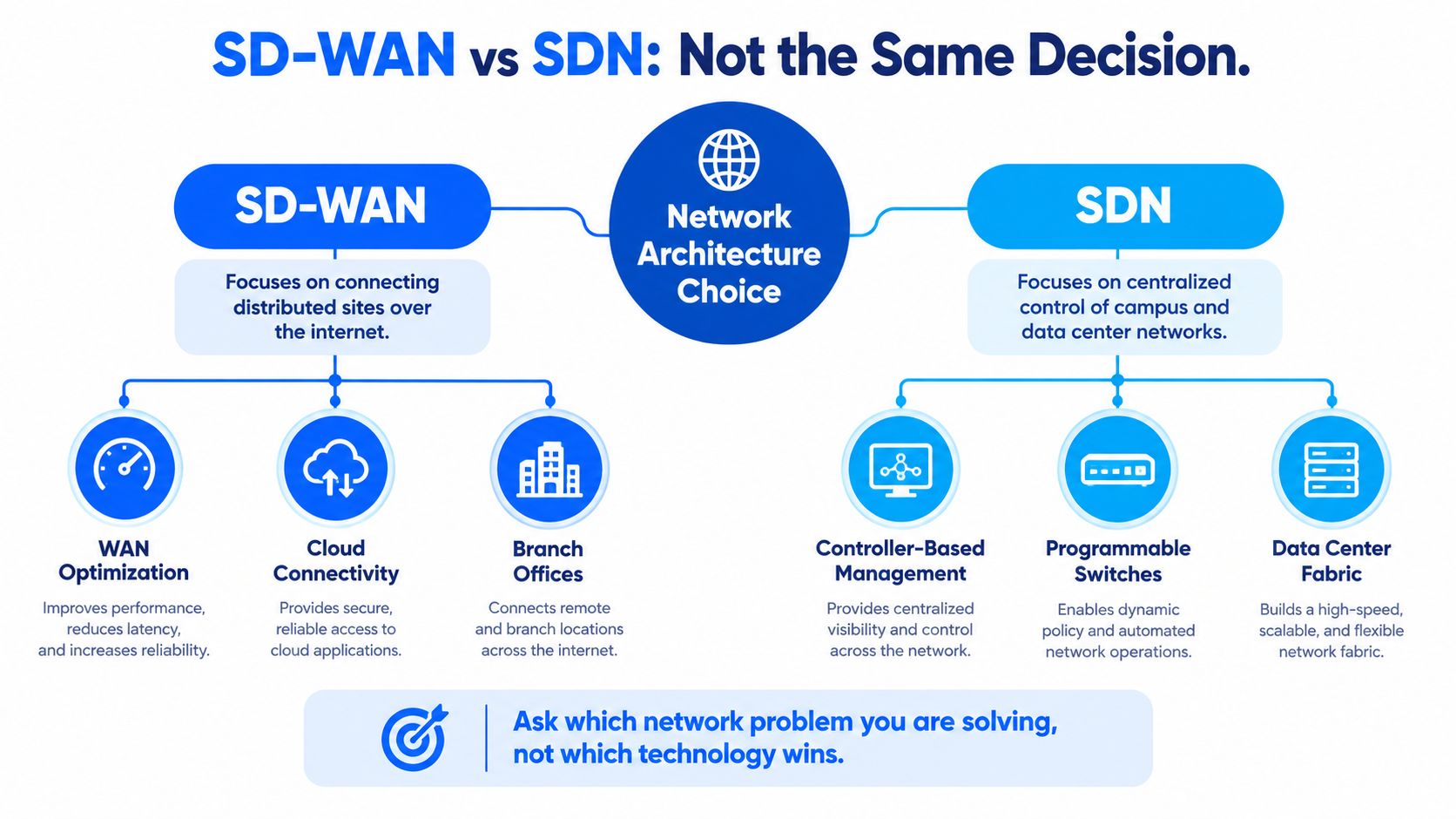
SDN and SD-WAN aren't competing answers to the same architectural question. SDN describes an approach to network control and forwarding. SD-WAN is a WAN-focused platform and service model for managing connections among branches, campuses, cloud services, and data centers. One describes a broad design principle; the other targets a particular operational domain.
That distinction should change the RFP. If the business problem is inconsistent connectivity across distributed sites, an SDN controller for a data center fabric won't answer the requirement. If the problem is policy control between server workloads inside a data center, a branch-focused SD-WAN feature comparison won't tell you whether the fabric can do the job.
Ask which network domain needs centralized policy, then decide where orchestration should sit. Don't ask which label wins.
SD-WAN uses related software-defined ideas, including centralized orchestration, abstraction from underlying transport, automated policy, and application-aware path selection. But an organization can deploy SD-WAN without adopting a full OpenFlow-based SDN architecture. An enterprise might use SD-WAN for branch and cloud connectivity while applying a different SDN approach to its campus or data-center network.
Start procurement by splitting the network into domains:
- Branch and hybrid WAN: Evaluate SD-WAN for transport diversity, application steering, resilience, cloud access, and operational scale.
- Data center and campus: Evaluate SDN-style architectures for programmable control, traffic engineering, and policy consistency within managed networks.
- Multi-cloud: Decide how WAN orchestration, cloud connectivity, and security policy should work together. Don't assume one controller must govern every layer.
The right answer can differ by domain. That's not an architecture failure. It's a more accurate description of what the organization needs to buy and operate.
Defining SDN and SD-WAN on Their Own Terms
Software-defined networking (SDN) separates network control from packet forwarding so administrators can define behavior through software rather than configure each device as an independent decision-maker. A controller can centralize policy and support programmable traffic management, while network devices still forward packets. The scope can include data centers, campuses, service-provider infrastructure, and security policy.
SDN's roots help explain why it shouldn't be reduced to a WAN product category. Stanford's Ethane project developed centralized policy control, and OpenFlow was introduced in 2008 as an interface separating the control plane from the data-forwarding plane. Stanford researchers formally advanced the SDN concept in 2009, and the Open Networking Foundation was established in 2011 to promote OpenFlow and SDN standards (SDN background and history).
Software-defined wide area networking (SD-WAN) applies software-defined control specifically to WAN connections. It gives an organization a way to coordinate heterogeneous links and apply centralized policy to traffic moving among geographically distributed sites. Common capabilities include application-aware routing, encrypted overlays, multi-link aggregation, centralized orchestration, and path selection informed by link conditions such as latency, jitter, packet loss, and bandwidth.
Translate the definitions into procurement language
In a vendor meeting, ask what the proposed control plane governs. Does it configure a data-center fabric, steer traffic among branch links, or coordinate both through distinct components? Ask where policies are authored, where they're enforced, what happens if the controller is unavailable, and which parts of the network retain local forwarding and failover behavior.
The practical distinction is scope, not sophistication. SDN isn't automatically a more complete SD-WAN, and SD-WAN doesn't require an OpenFlow-based SDN fabric. Define each requirement by the traffic domain and operational outcome you need, then evaluate whether a product's architecture matches that boundary.
Architecture and Capability Comparison
The useful comparison isn't a checklist of features. It's a map of which traffic each architecture controls, where policy is applied, and what your operations team must be prepared to run.
| Dimension | SDN | SD-WAN |
|---|---|---|
| Primary scope | Managed networks such as data centers, campuses, and service-provider infrastructure | Geographically distributed WANs linking branches, campuses, cloud services, and data centers |
| Traffic domain | Often used to control traffic within a fabric, including east–west flows | Focuses on traffic across sites and toward cloud or internet destinations |
| Control model | Software controller separates network control from data forwarding | Central orchestration applies WAN policy across edge devices and diverse transports |
| Policy focus | Programmable network behavior, centralized policy, traffic engineering, and QoS | Application-aware path selection, link use, overlays, and WAN resilience |
| Typical transport | The network infrastructure within the controlled domain | Multiple WAN transports, which can include private circuits and internet connectivity |
| Operational demand | Skills in controller architecture, fabric integration, policy design, and automation | Skills in WAN design, application classification, overlay operations, and site migration |
An SDN fabric can optimize traffic inside a data center while SD-WAN directs branch-to-cloud traffic across available WAN links. Those are different traffic directions and operating boundaries. A feature that matters in one domain may be irrelevant in the other.
The control model also changes implementation risk. SDN projects can require integration with switches, controllers, existing automation, and policy workflows. SD-WAN projects can require edge deployment, circuit coordination, application identification, and a migration plan that preserves service at every site. Neither centralization nor software control removes the need for a clear operating model.
For a practical description of edge devices, orchestration, and WAN traffic handling, see how SD-WAN works. Use that operating picture to write separate acceptance criteria for fabric automation and WAN service delivery. Don't let a vendor combine the two into a single “software-defined networking” requirement without stating which domain is in scope.
Performance Considerations Buyers Often Misread
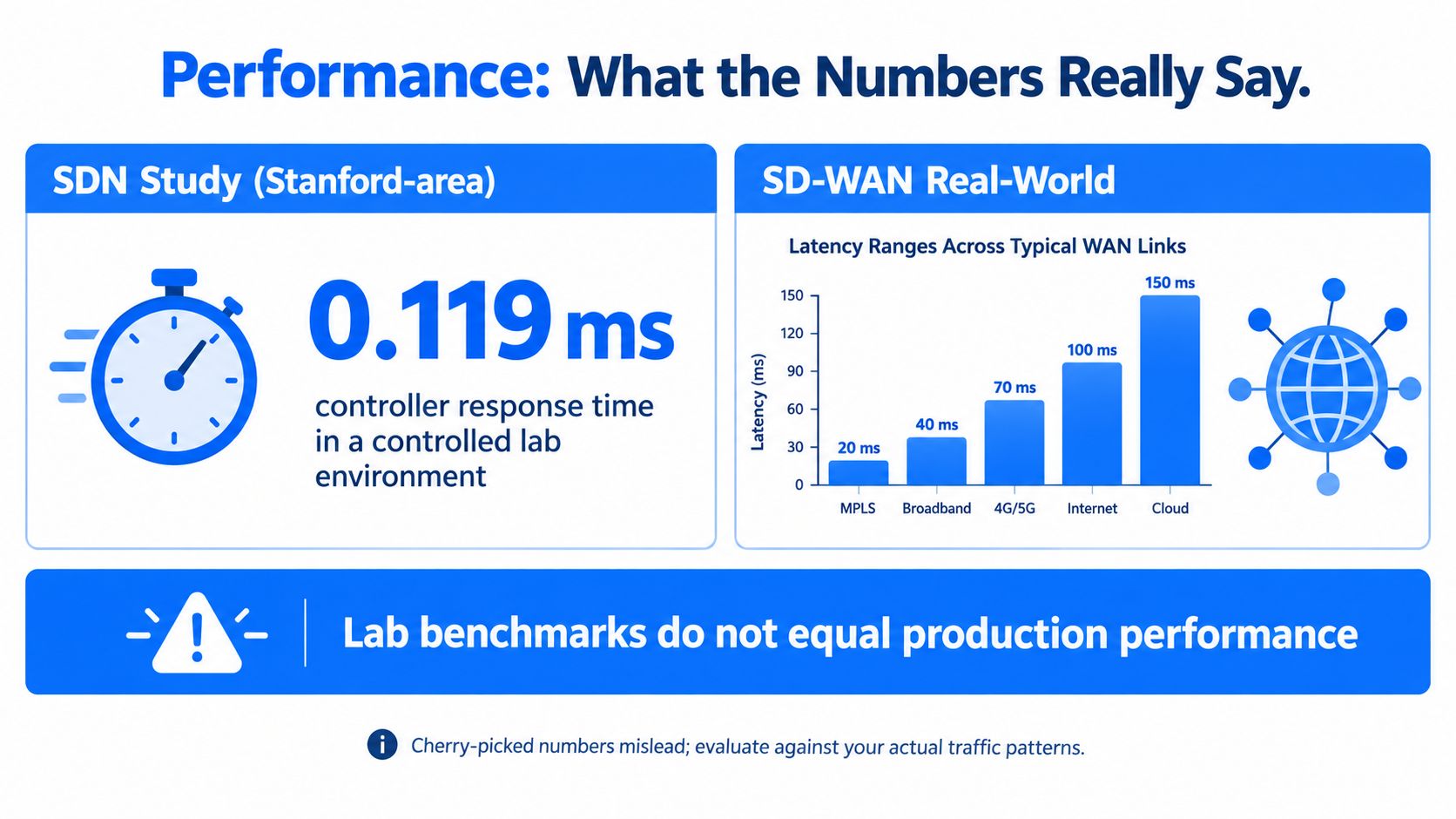
A benchmark is evidence about a particular test, not a promise about your production network. Simulation results can point to useful questions, but they don't settle whether a technology will perform better on your topology, applications, circuits, and security configuration.
One simulated SDN study reported 0.119 ms average latency, compared with 0.09588 ms for a traditional topology in a small, stable test. A separate OpenDaylight-based SD-WAN design reported 35% higher throughput, 40% lower latency, and 50% lower packet loss than its traditional-WAN baseline. Both results are specific to their test setups, and neither should be treated as a universal production benchmark (simulation results and study details).
A separate comparative simulation found a different trade-off: MPLS recorded 10–20 ms latency, approximately 1 Gbps throughput, and below 0.1% packet loss, while SD-WAN recorded 30–50 ms latency, approximately 900 Mbps throughput, and below 0.5% packet loss. Another evaluation of SD-WAN over MPLS produced better measurements than its traditional-MPLS baseline. The contrast underscores why buyers must normalize circuit type, packet size, encryption, traffic mix, topology, and measurement method before comparing results (comparative WAN performance study).
Make the proof of concept reflect production
An Analysys Mason survey of 305 large businesses with 250–999 employees across Germany, Singapore, the United Kingdom, and the United States found that approximately one-third of businesses buying SD-WAN services hadn't extended it to all business locations. The survey was conducted in December 2024 and January 2025. A signed contract is not the same as a completed rollout, so track site coverage and migration completion alongside test results (Analysys Mason large-business SD-WAN survey).
Set a common test plan for every bidder. Measure p95 and p99 latency and jitter, sustained encrypted throughput, loss during link impairment, failover convergence, device CPU and memory, and application quality for voice, video, SaaS, and transactional traffic. Test shared and disjoint overlays under congestion. Require vendors to disclose topology, traffic mix, encryption settings, and whether latency figures are one-way or round-trip.
Where Each Architecture Earns Its Place
A useful decision starts with the network domain that's causing trouble. The same organization can make different choices for its branches, data center, and cloud connections without forcing all three into one control architecture.
Branch modernization
A retailer connecting stores, a healthcare group linking clinics, or a field-services organization supporting remote operations should begin with the WAN. SD-WAN is the relevant tool when teams need centralized provisioning, application-aware path selection, and the ability to coordinate different access links.
The main risks are operational, not just technical. A branch may depend on a legacy circuit, a local application, or a regulatory workflow that can't move on the same schedule as other sites. Keep rollback plans and local survivability in the design. The common mistake is treating contract signature as completion; define rollout acceptance by the sites migrated and the services verified.
Data-center and campus fabrics
When the challenge is east–west traffic, policy consistency across workloads, or programmable control within a campus or data-center network, evaluate an SDN-style fabric. Here, branch path selection is beside the point. The questions are how the fabric integrates with existing switches and automation, how administrators express segmentation policy, and how the network behaves during controller or integration failure.
Sequence the work around application and network dependencies. Start with a clearly bounded domain, validate policy enforcement and recovery, then expand. The procurement mistake is buying a broad “software-defined” label without identifying which switches, workloads, and security rules the system will control.
Multi-cloud connectivity
For workloads spread across SaaS, IaaS, and private environments, SD-WAN can address connectivity and path selection, while cloud-delivered security services can apply controls closer to users and applications. Regulated workloads may need different paths, policy enforcement, and evidence than ordinary SaaS traffic. Make those distinctions explicit before choosing an overlay or management model.
Keep the operating boundaries clear: who owns WAN policy, who owns cloud security, and who investigates a user's connectivity issue? An enterprise networking design and optimization discussion can help frame those boundaries across domains. The mistake to avoid is assuming one platform automatically supplies WAN management, cloud security, and compliance governance as a single outcome.
Total Cost of Ownership and Operating Models
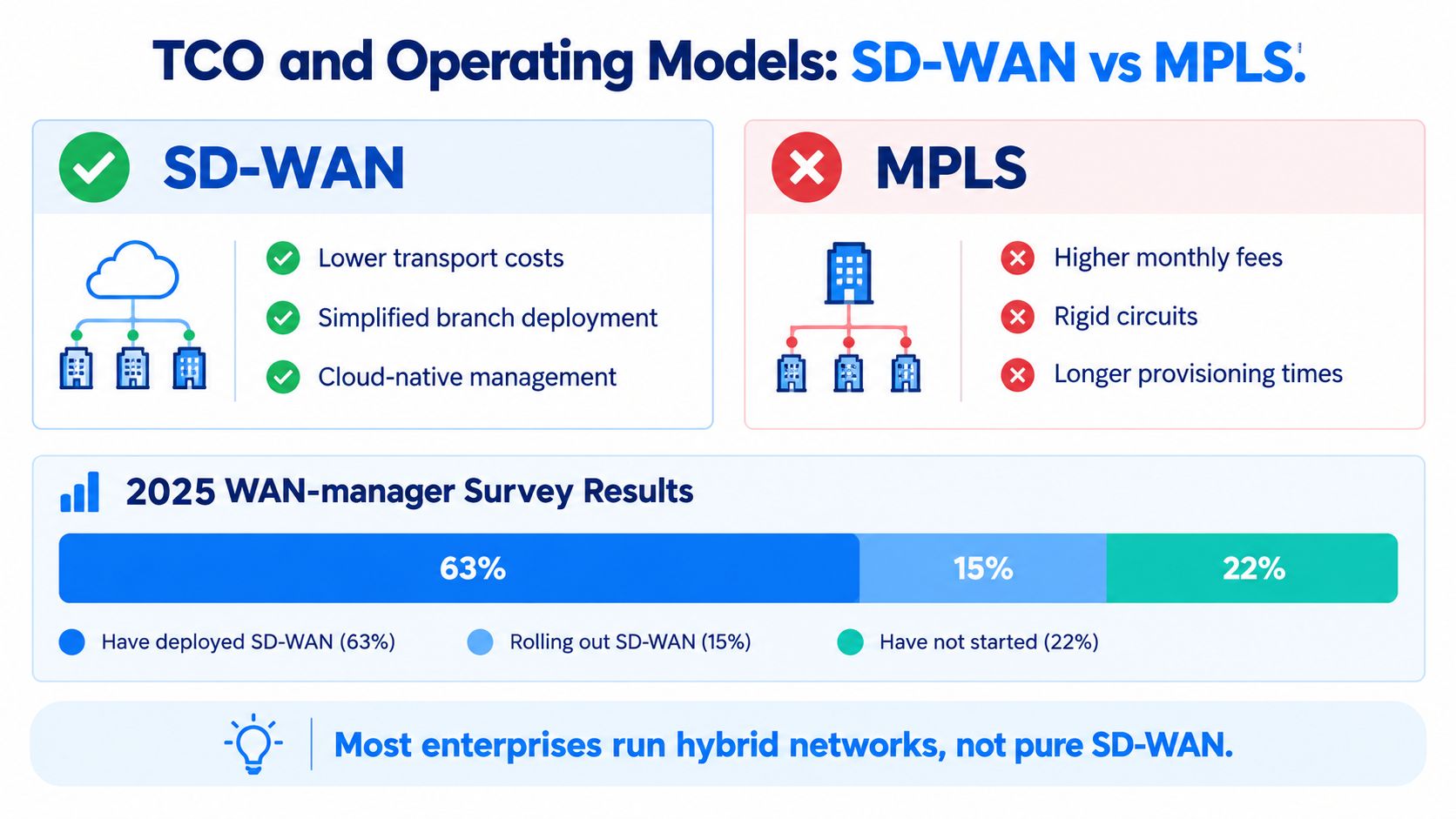
The cheapest WAN proposal is usually the one with the narrowest scope. Price the decision by domain: branch transport, data-center fabric, cloud edges, security inspection, and the team that has to run each one. Circuit savings can be real, but they sit beside circuits that stay in service, overlay licenses, edge hardware, implementation, monitoring, training, and the labor of operating a mixed estate.
A 2025 WAN-manager survey reported that 63% of respondents had deployed SD-WAN on at least part of their network, while 15% were actively rolling it out; it also put median SSE bundle pricing at $7.21 per user per month when sourced from an SD-WAN vendor versus $18.13 per user per month through a managed service provider for small and medium-sized enterprises (survey and SD-WAN/SASE cost context). Treat those as planning inputs for coexistence, staffing, and security bundling, with scope matched before price is compared.
Choose the operating model before the platform:
- Self-managed: Use this when the network team can own design, policy changes, monitoring, incident response, and vendor coordination. Include training and staffing in the cost model.
- Co-managed: Split responsibilities explicitly. For example, the provider may operate the platform while internal staff retain policy approval, security governance, and escalation ownership.
- Fully managed: Consider it when compliance evidence, continuous operations, incident response, or scarce internal expertise makes direct ownership a material risk. The contract must spell out service boundaries and escalation responsibilities.
Security spend belongs in the same spreadsheet, but price the boundary rather than the bundle label. Compare what each SSE offer includes, who operates it, where logs land, and which obligations remain internal. The pricing gap above matters only after those scopes match.
Use SD-WAN service evaluation and implementation support as one reference point when mapping vendor and operating options. Put parallel run costs, transition effort, risk, and internal labor into the same procurement model.
Security, Compliance, and SASE Integration
Security is where the scope question gets expensive. An encrypted SD-WAN overlay protects traffic between sites. It does not decide who inspects SaaS traffic, who retains logs, or who handles a compromised branch at 2 a.m. SDN centralizes policy inside a fabric, which can strengthen consistency, but it also makes controller access, change rights, and audit evidence part of the risk review.
Place controls by domain before scoring vendors. At the WAN edge, test encryption, device identity, segmentation, policy rollback, and isolation of a failed site. In a data center or campus fabric, test controller authentication, approval workflow, config history, east-west segmentation, and behavior when the controller is unreachable. For internet and SaaS traffic, treat SSE as a separate layer: define where inspection occurs, which traffic is exempt, and how policy from the WAN domain hands sessions to the security domain without breaking applications.
Adoption of cloud-delivered security has risen sharply since 2019, so run the handoff test in the proof of concept. Ask each bidder to show a live path from branch to SSE inspection to logging, then break a controller or tunnel and watch what evidence remains.
Require a control map for any bundle: who writes policy, where enforcement happens, which logs are retained, who can export them, and who owns response when enforcement fails.
For regulated estates, make compliance testable: data-plane separation, admin access, retention windows, residency, investigation ownership, and evidence for each controlled domain. A SASE label is a packaging choice, not proof of control.
Procurement Checklist and Decision Matrix
Give procurement and network operations a shared scorecard before vendor demos begin.
| Organizational need | Primary deployment to evaluate |
|---|---|
| Distributed branches and hybrid WAN | SD-WAN |
| Programmable data-center or campus fabric | SDN-style architecture |
| Multi-cloud traffic with cloud security needs | SD-WAN coordinated with SSE or SASE |
| Mixed legacy and modern network domains | Phased, domain-specific orchestration |
Check scope fit, controller dependencies, encryption posture, SSE integration, compliance evidence, support ownership, exit terms, and migration rollback. In the proof of concept, normalize traffic mix, encryption, topology, and circuit conditions across bidders. Measure failover, application policy accuracy, encrypted throughput, latency and jitter under load, and controller recovery. Require a site-by-site migration plan, not a generic deployment promise.

Before the demo, ask which domain needs centralized policy and where orchestration belongs. That answer should shape the shortlist, the test plan, and the contract.
MR2 Solutions helps organizations evaluate, procure, and implement SD-WAN and enterprise networking through a vendor-neutral brokerage approach. If you're defining the boundary between branch, data-center, and cloud orchestration, visit MR2 Solutions to discuss a domain-led evaluation and implementation plan.