
Enterprise Networking Solutions: A Comprehensive Guide

Can your network support AI-driven operations, zero-trust access, and cloud workloads, or is it only keeping yesterday's architecture alive? That question exposes the gap many CIOs miss. A network can deliver connectivity reliably while still lacking the identity data, telemetry, policy discipline, and operational controls needed for safe automation.
Enterprise networking solutions now determine how quickly an organization can adopt cloud services, protect distributed users, connect branches, and recover from disruption. The right decision isn't a shopping exercise for routers, switches, or SD-WAN licenses. It's an operating-model decision that affects risk, workforce productivity, application performance, and total cost of ownership.
Why Enterprise Networking Matters Beyond Connectivity
Most organizations still evaluate networking as a utility. If users can reach applications and sites can exchange traffic, the network appears healthy. That view is incomplete. The network now carries business-critical SaaS sessions, cloud workloads, analytics pipelines, voice and video, partner access, IoT traffic, and security enforcement.
A network outage doesn't remain a technical incident. It can stop customer service, interrupt production, prevent employees from accessing systems, or delay clinical and financial operations. A network architecture that routes every request through a distant core can also create poor application performance even when every circuit is technically available.

Networking became a strategic platform
The foundational shift began well before cloud computing. On January 1, 1983, ARPANET adopted TCP/IP as its production networking protocol, creating an interoperable architecture for connecting different computers, local networks, wide-area networks, vendors, and administrative domains, as documented in the ARPANET historical overview. Ethernet also became an IEEE, ECMA, and effectively ISO/OSI standard in 1983, helping establish a common basis for corporate LANs.
That history matters because enterprise networking has always advanced through interoperability. Today, the same principle applies to hybrid cloud links, identity systems, security platforms, wireless networks, and automation tools. A network that works only inside one vendor's management boundary becomes a constraint when the business acquires another company, adopts a new cloud, or changes its workforce model.
Evaluate business outcomes, not appliance features
A useful assessment asks practical questions:
- Revenue protection: Which applications must remain available during a carrier, cloud, or site failure?
- Workforce productivity: Can users reach SaaS and internal applications without unnecessary backhauling?
- Security enforcement: Can the organization authenticate users and devices before granting resource access?
- Operating cost: How much staff time goes into circuit management, policy changes, troubleshooting, and hardware refreshes?
- Change capacity: Can the team introduce new sites, workloads, or controls without building another parallel stack?
The global enterprise networking market illustrates the strategic scale of this infrastructure. It was valued at approximately USD 215.4 billion in 2024, and Asia-Pacific represented 40.3% of global revenue that year, according to Grand View Research's enterprise networking market analysis. The source projects the market to reach USD 243.0 billion in 2026 and USD 298.3 billion by 2030, with a 5.4% compound annual growth rate from 2025 through 2030.
Practical rule: Treat the network as a business control plane. If a proposed architecture can't improve resilience, security, speed of change, or cost discipline, its feature count is irrelevant.
From Traditional WAN to SD-WAN and Hybrid Models
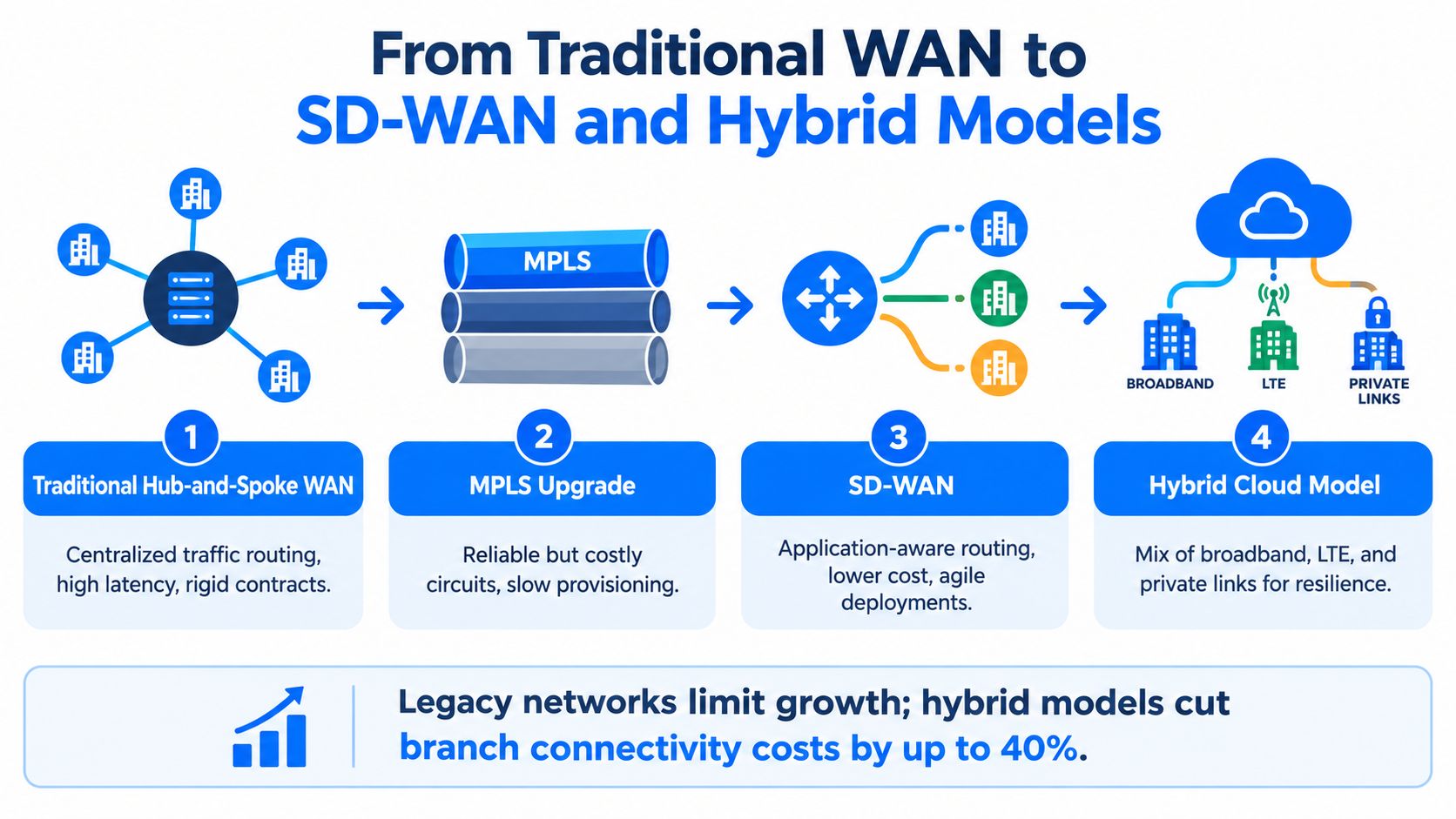
Traditional hub-and-spoke WANs were designed for centralized applications and predictable traffic patterns. Branch users sent traffic to a central data center, where security controls and business systems lived. That arrangement provided control, but it also forced cloud-bound traffic through infrastructure that wasn't designed for direct internet and SaaS access.
MPLS improved predictability and service quality, yet it didn't remove the architectural problem. Provisioning remained dependent on carrier processes, branch changes required careful coordination, and the model often encouraged organizations to buy capacity around a central hub instead of routing applications according to business need.
What SD-WAN changes
SD-WAN separates traffic policy from the underlying transport. It can evaluate application identity, path health, latency, loss, and business priority, then steer traffic across available links. That might include MPLS, broadband, LTE, or private connectivity.
The value isn't just cheaper bandwidth. The larger gain comes from centralized policy, faster site deployment, direct cloud access, and better operational visibility. A branch can use more than one transport without forcing the network team to manage every path as a separate design.
A useful technical explanation is available in this guide to how SD-WAN works, particularly for teams that need to distinguish overlay policy from physical transport.
Migration requires control, not enthusiasm
Do not replace every circuit and edge device at once. Start with an application and dependency inventory, then identify sites where the current WAN creates measurable business friction. Test path selection, failover, security inspection, voice and video behavior, and cloud application access under representative traffic.
A Houston-based small or midsize business may also benefit from the practical questions in this Houston SMB cloud strategy guide, especially when cloud adoption and branch connectivity must advance together.
A sound migration sequence is straightforward:
- Baseline the existing WAN. Record critical applications, routes, outages, provider dependencies, and operational effort.
- Classify traffic. Separate business-critical, latency-sensitive, bulk, guest, IoT, and administrative flows.
- Pilot a limited site group. Include different circuit types and at least one location with known operational constraints.
- Keep rollback possible. Maintain documented configurations and a tested path back to the prior service.
- Retire redundant services deliberately. Remove old contracts and appliances only after performance, security, and support responsibilities are clear.
Hybrid networking is the destination for many enterprises, not a temporary failure to standardize. The architecture should use each transport for the role it performs best, while policy and observability remain consistent.
Comparing Enterprise Networking Approaches
No single architecture solves every enterprise problem. A company with dense office campuses, latency-sensitive data-center workloads, remote users, and cloud applications may need several approaches at once. The decision is to define the boundaries between them and operate those boundaries consistently.
The table below compares the main categories. “Initial cost” is directional because site count, carrier availability, licensing, hardware, and implementation scope vary widely.
| Approach | Initial Cost | Operational Complexity | Scalability | Security | Cloud Alignment |
|---|---|---|---|---|---|
| Traditional WAN | High when dedicated circuits and centralized infrastructure dominate | High, with carrier and site-by-site dependencies | Moderate, but expansion can be slow | Strong central control, weaker fit for distributed access | Limited |
| SD-WAN | Moderate, depending on overlay, edge, and transport requirements | Moderate after standardization, demanding during migration | High for distributed sites and mixed transports | Strong when integrated with segmentation and inspection | Strong |
| Campus networking | Moderate to high, driven by switching, wireless, access control, and refresh cycles | Moderate, with significant endpoint and policy coordination | High within a defined campus design | Strong when access control, segmentation, and monitoring are integrated | Moderate |
| Data-center networking | High, especially for resilient fabrics, interconnects, and security controls | High because dependencies are dense and changes are sensitive | High for well-designed fabrics and workload placement | Strong, but requires disciplined east-west controls | Strong for hybrid designs |
| Hybrid cloud connectivity | Moderate to high, depending on providers, interconnects, and governance | High because identity, routing, security, and cloud operations intersect | High, provided architecture and ownership are explicit | Variable, with governance quality determining outcomes | Very strong |
Choose according to the constraint
Traditional WAN remains defensible where deterministic private connectivity, established operational skills, and tightly controlled application paths matter more than rapid change. It becomes a liability when users access cloud applications directly but security and routing still assume a central data center.
SD-WAN is a strong fit for multi-site organizations that need path diversity, application-aware routing, and centralized operations. It isn't a substitute for security expertise. Teams still need segmentation, identity integration, inspection policy, incident response, and clear ownership.
Campus networking focuses on local access. Its success depends less on WAN selection than on reliable switching, wireless design, device onboarding, and segmentation for employees, guests, facilities, and IoT devices. Data-center networking prioritizes predictable east-west traffic, workload mobility, resilience, and controlled change.
Hybrid cloud connectivity offers flexibility but creates governance pressure. Each cloud introduces routing, identity, logging, policy, and support questions. Before choosing a provider, compare the architecture against the SD-WAN versus MPLS decision factors and document which trade-offs the business accepts.
The cheapest network is rarely the one with the lowest circuit price. It's the one that creates the least avoidable operational work while protecting critical business flows.
A Framework for Evaluating Networking Solutions
A defensible networking decision starts with business requirements, not vendor demonstrations. Ask what the organization must protect, accelerate, change, and operate. Then translate those answers into measurable acceptance criteria.
Start with a current-state baseline
Inventory sites, users, devices, applications, cloud dependencies, circuits, security controls, contracts, skills, and support obligations. Map actual application flows instead of relying on old diagrams. Include administrative paths, backup traffic, partner access, and systems that business teams may have adopted without central IT involvement.
Next, define failure scenarios. Consider a carrier outage, cloud region disruption, compromised endpoint, expired certificate, failed policy update, and loss of key staff. The objective isn't to predict every incident. It's to expose where the architecture depends on hidden assumptions.
Score the decision across five dimensions
Use a weighted scorecard, but don't let a spreadsheet conceal a disqualifying risk.
- Business alignment: Connect network capabilities to revenue protection, productivity, site expansion, application delivery, and resilience.
- Total cost of ownership: Include hardware, licensing, carrier services, implementation, training, migration, monitoring, support, renewal exposure, and eventual exit costs.
- Security and compliance: Test identity integration, device posture, segmentation, encryption, logging, policy enforcement, privileged access, and audit evidence.
- Scalability: Determine whether the design can add locations, users, workloads, and transports without a major redesign.
- Vendor support: Verify escalation paths, service-level commitments, lifecycle policy, skills transfer, documentation, and roadmap transparency.
The infographic's suggested scoring range is 1 to 5, which provides a simple way to compare vendors objectively. Treat the score as a decision aid, not as a replacement for technical validation.
Test the workload you actually run
Headline throughput is insufficient. IETF RFC 9411 defines testing methods for network-security devices using HTTPS over TCP or QUIC, including connections per second, transaction latency, throughput, and concurrent connection capacity. For HTTP/3, the methodology uses secure QUIC connections with TLS 1.3.
Require results for small, medium, and large objects, warm and newly established sessions, TCP and QUIC, multiple concurrency levels, and security inspection enabled. Review median and tail latency, setup rate, sustained throughput, maximum concurrent sessions, CPU utilization, packet loss, and behavior during failover.
When supplier risk influences the decision, include a structured review of protecting your business from suppliers. Network providers, managed security firms, carriers, and cloud platforms all become part of the operational dependency chain.
Common Misconceptions About Network Modernization
AI won't fix an undisciplined network. It will automate the consequences of incomplete inventories, inconsistent configurations, weak change control, and poor telemetry.
Research published in Cisco's 2025 networking research found that 94% of surveyed IT and business leaders expect AI, IoT, and cloud computing to have the greatest impact on their networks over the next two years, with 62% naming AI alone. Yet only 41% had deployed intelligent capabilities such as segmentation, visibility, and control. That gap should change the buying question from “Which AI platform should we purchase?” to “Can our operating model govern automated decisions?”

Misconception one, AI creates readiness
AI needs clean telemetry, stable processes, understandable policies, and reliable rollback. Start with anomaly detection, configuration validation, capacity forecasting, and incident summarization. Treat autonomous remediation as a later-stage capability that requires approval thresholds, audit logs, human escalation, segmented testing, and recovery procedures.
Measure outcomes such as prevented incidents, mean time to repair, verified change accuracy, and false-positive rates. Don't measure maturity by the number of AI features in a product brochure.
Misconception two, a full refresh is always safer
A 2025 industry report identifies shortages in SDN, private 5G, open RAN, and network security skills, along with planning and operations gaps and technical debt from end-of-life equipment, as discussed in Avasant's advanced network services research. Replacing platforms while changing processes and skills can increase risk rather than reduce it.
A staged program is usually more resilient. Replace unsupported components first, add observability and identity controls, isolate systems that can't yet be replaced, and automate repeatable workflows only after the manual process is reliable.
Misconception three, SD-WAN removes security work
SD-WAN can improve routing and policy consistency, but it doesn't eliminate identity governance, segmentation, endpoint assurance, inspection, or incident response. Zero trust must be treated as a networking control model, not merely an identity product.
NIST SP 800-207 states that enterprise networks must not be treated as implicit trust zones. Access decisions should authenticate and authorize both the user and device before a session is established, regardless of whether the request comes from a LAN or the internet. Policy enforcement points mediate traffic, while policy engines evaluate identity, device posture, analytics, and resource sensitivity.
Misconception four, cloud simplifies networking
Cloud removes some physical infrastructure, but it adds routing domains, identity dependencies, service-provider boundaries, logging requirements, and shared responsibility questions. NIST recommends cataloging identities, assets, and data flows before zero-trust migration because incomplete inventories create inaccurate least-privilege policies and unmanaged paths.
Real-World Success Stories in Network Transformation
Publicly documented, fully comparable case studies with verified cost and performance outcomes aren't available in the supplied evidence, so CIOs should resist polished transformation stories that promise universal results. The more useful approach is to examine realistic patterns and the decisions that make them credible.
Consider a healthcare provider connecting clinics, telehealth services, patient systems, and administrative applications. A responsible program would begin by classifying clinical traffic, separating guest and medical devices, validating compliance controls, and piloting application-aware routing at representative locations. The result to demand isn't a generic performance claim. It's evidence that critical workflows remain usable during path failure and that access policies apply consistently.
A financial services organization presents a different constraint. It may need private connectivity for selected workloads, direct cloud access for analytics, strong privileged-access controls, and auditable policy changes. A hybrid model can work when the organization documents data flows, assigns ownership for each control, and tests security inspection under realistic encrypted traffic. The global financial services network transformation example can help frame the kinds of architectural questions leaders should ask, but it shouldn't replace validation of their own environment.
Manufacturing creates another pattern. Legacy campus systems, operational technology, wireless devices, and IoT sensors often cannot be refreshed simultaneously. The practical route is to identify unsupported equipment, isolate high-risk segments, improve monitoring, establish administrative controls, and replace components according to operational criticality.
A transformation story is credible only when it explains the baseline, the constraints, the migration controls, and the evidence used to approve the next phase.
Next Steps for Your Networking Strategy
Start with a current-state assessment, not a product shortlist. Map critical applications, users, devices, sites, cloud dependencies, circuits, security controls, contracts, and operational ownership. Highlight unsupported equipment, undocumented flows, single-provider dependencies, and manual processes that create avoidable change risk.
Then rank modernization work using five filters: business criticality, asset support status, identity and segmentation maturity, telemetry quality, staffing capacity, regulatory exposure, and exit constraints. Replace components that create unacceptable risk. Use isolation, monitoring, configuration governance, and restricted administration where replacement can wait.
Build a roadmap with explicit gates:
- Stabilize: Fix inventory, monitoring, configuration backup, and incident ownership.
- Secure: Implement device-aware authentication, segmentation, least privilege, and policy enforcement around critical resources.
- Modernize: Pilot SD-WAN, hybrid connectivity, campus upgrades, or cloud-edge controls where the business case is strongest.
- Automate: Introduce AI-assisted validation, detection, forecasting, and summarization after telemetry and change processes are trustworthy.
- Govern: Review cost, reliability, policy effectiveness, supplier exposure, and lifecycle status on a recurring basis.
Zero trust, AI-driven operations, and 5G may shape the long-term architecture, but they shouldn't dictate the first purchase. The first investment should remove the constraint that most directly threatens business continuity or prevents safe change.
MR2 Solutions provides vendor-neutral assessment, enterprise networking design, SD-WAN evaluation, hybrid cloud connectivity, cybersecurity guidance, implementation coordination, and ongoing optimization. Use an independent decision process to compare providers, test realistic workloads, and prevent modernization from becoming an expensive parallel stack.
MR2 Solutions helps organizations evaluate, procure, implement, and govern enterprise networking, SD-WAN, cybersecurity, cloud, and related IT services through a vendor-neutral brokerage model. Visit MR2 Solutions to discuss a structured assessment and modernization roadmap for your environment.