
What Is a Fractional CIO and When Should You Hire One

A fractional CIO is a senior technology executive who performs CIO responsibilities part-time while holding operational authority over strategy, governance, and business alignment. The model gives organizations access to executive technology leadership without maintaining a permanent, full-time CIO position.
The need usually becomes obvious in a board meeting. The company has an internal IT manager, several capable vendors, a cloud migration in progress, security questionnaires piling up, and business leaders buying software independently. Everyone is busy, but nobody has clear authority to decide what matters, what gets funded, or who owns the consequences when a project slips.
That's the gap a fractional CIO is meant to close. The role isn't outsourced IT support or a consultant's recommendation. A fractional CIO can set the technology strategy, direct internal IT personnel, manage suppliers, establish governance, oversee cybersecurity, and align investments with business objectives. A 2022 peer-reviewed study of the fractional CIO role interviewed 40 practitioners from 10 countries, showing that the model is associated with experienced executives serving multiple clients while performing responsibilities comparable to those of a full-time CIO.
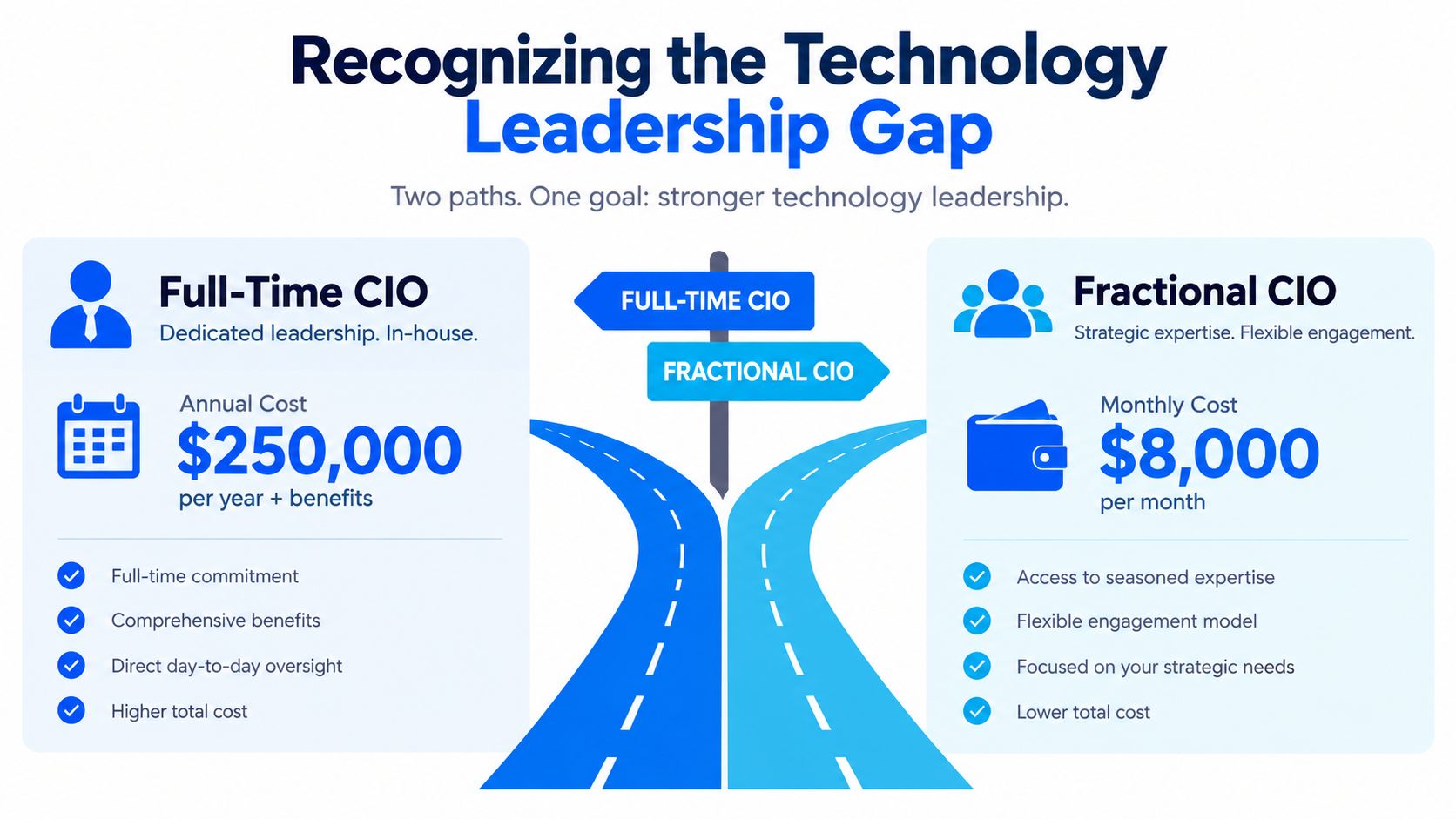
Recognizing the Technology Leadership Gap
A mid-market company often reaches this point gradually. The IT director keeps systems running, the managed-service provider handles tickets and infrastructure, finance negotiates renewals, and department heads select applications for their own teams. None of those decisions is necessarily reckless. The problem is that they don't form a coherent technology portfolio.
Then a strategic trigger arrives. The company acquires another business, customers ask difficult security questions, an ERP replacement becomes urgent, or executives want an AI policy. The internal team can execute tasks, but nobody has the standing to rank competing initiatives, reject a vendor, approve a risk, or explain the technology investment to the board.
A fractional CIO steps into that executive gap. Unlike a consultant who may assess the situation and recommend a solution, the fractional CIO can hold operational authority for the decisions assigned to the role. That can include approving a roadmap, directing internal IT leaders, managing supplier performance, setting architecture principles, and escalating risks to the executive team.
The operating boundary matters more than the title. A fractional CIO shouldn't become a shadow administrator who approves every laptop purchase, nor should the executive be held responsible for outcomes without access to budgets, business-unit leaders, or vendor contracts.
Separate authority from execution
The cleanest model assigns strategic ownership to the fractional CIO and operational execution to the people closest to the work. Internal IT leaders still run service delivery, manage technical specialists, and maintain day-to-day relationships with users. Managed-service providers continue operating the systems covered by their contracts. The fractional CIO sets direction, resolves conflicts, and makes sure execution supports business priorities.
| Fractional CIO Authority | Internal IT Ownership | Shared Governance |
|---|---|---|
| Technology strategy and investment priorities | Daily support and system administration | Roadmap execution and status reporting |
| Architecture principles and major platform decisions | Technical implementation and maintenance | Change control and risk escalation |
| Vendor direction, performance standards, and renewal recommendations | Service coordination and issue resolution | Supplier reviews and remediation tracking |
| Executive reporting and risk visibility | Operational documentation and incident handling | Cybersecurity posture and continuity planning |
| Portfolio sequencing and decision rights | Delivery of approved projects | Budget forecasting and benefits tracking |
Practical rule: If the fractional CIO is accountable for a decision, the engagement must grant access to the information and people required to make it.
The role is most effective when the company writes down who decides, who recommends, who executes, and who must be consulted. Without that agreement, internal leaders may interpret the executive's arrival as interference, while the board assumes the fractional CIO has control that doesn't exist.
The academic research describes the model as a part-time executive governance function for organizations whose technology complexity has outgrown purely operational management. That distinction matters. You aren't hiring a cheaper job title. You're adding senior judgment where delayed or fragmented decisions already carry a business cost.
Understanding the Core Responsibilities and Governance Focus
The highest-value fractional CIO work is governance-driven, not tool-driven. The executive translates business objectives into a time-phased technology portfolio, establishes decision rights, and measures execution through operational and risk indicators.

A useful governance system starts with a portfolio view. Every major initiative should have a business owner, an executive sponsor, an expected outcome, dependencies, a funding path, and a decision date. The fractional CIO then sequences the work instead of allowing every department to label its request urgent.
Turn strategy into a management rhythm
The cadence should be predictable. Quarterly roadmap reviews test whether priorities still match the business plan. Monthly budget and vendor-scorecard reviews expose cost drift and service failures. Project stage gates prevent a weak business case from becoming an expensive implementation. Cybersecurity-risk reporting gives executives a basis for accepting, transferring, or remediating risk.
This structure is different from project management. A project manager may track tasks and milestones for a specific initiative. The fractional CIO decides whether that initiative deserves resources, how it interacts with other work, and what the organization will stop doing to make room for it.
Organizations that need a practical reference for assigning accountability can use this resource on governance framework roles and metrics. The important point is to connect each governance role to a decision or measurable obligation, not merely to create another committee.
Measure the chain from decision to outcome
A fractional CIO should report indicators that reveal whether governance is working. Useful measures include:
- Resilience: Service-availability targets, recovery-time objectives, and recovery-point objectives show whether critical services can withstand disruption.
- Security execution: Vulnerability-remediation service levels, identity and access-control coverage, and open remediation ownership show whether risk findings become completed actions.
- Financial control: Cloud or SaaS cost per user, contract renewal exposure, and budget variance show whether technology spending follows the approved portfolio.
- Delivery discipline: Project delivery variance, stage-gate decisions, dependency risks, and benefits realization show whether initiatives are progressing for the right reasons.
- Operational responsiveness: Mean time to resolve incidents helps executives distinguish isolated disruption from a systemic service problem.
These indicators create a cause-and-effect chain. Clearer priorities reduce conflicting initiatives. Defined decision rights reduce unauthorized technology adoption. Portfolio checkpoints expose schedule, cost, and dependency risks earlier. Supplier scorecards make poor performance actionable.
For a fuller description of the executive remit, a job description of a CIO can help teams distinguish strategic accountability from operational duties. The fractional version may work fewer days, but the standard of decision-making shouldn't be lower.
The fractional CIO also needs authority over cybersecurity oversight, vendor management, digital workplace enablement, data governance, infrastructure modernization, and budget control. That doesn't mean personally performing every technical task. It means making sure each task has an owner, a standard, a deadline, and a path to escalation.
Evaluating When to Use Fractional Leadership Instead of Hiring Full-Time
Fractional leadership works when the organization needs senior judgment intermittently, not when it needs an executive physically involved in every decision every day. The right choice depends on the urgency of decisions, complexity of the technology portfolio, level of board or regulatory scrutiny, maturity of internal leadership, required availability, and cost of delay.
Market estimates place the broader global fractional-executive sector, including fractional CIO, CTO, and CISO roles, above $5.7 billion in 2024–2025, with estimated annual growth of approximately 14%, while demand for fractional CIO and CTO services was reported to have increased 68% between 2023 and 2024. These are market estimates, not official government statistics, but they help explain why established mid-market organizations are considering the model for defined periods and workloads. The fractional CIO FAQ and market overview provides further context for how the model fits changing technology demand.
The decision should start with a threshold test rather than a price comparison.
| Evaluation Criterion | Fractional CIO Fits Best | Full-Time CIO Needed Instead |
|---|---|---|
| Decision urgency | A defined transformation, acquisition, security remediation, or cost-reset program needs executive direction | Technology decisions arrive continuously and require daily executive presence |
| Portfolio complexity | Internal leaders can execute with a clear roadmap and escalation path | Multiple business units, platforms, and regulatory obligations require constant coordination |
| Leadership maturity | An IT director or strong operations team can own daily delivery | The organization lacks a senior internal leader who can run the function between engagements |
| Board scrutiny | The board needs periodic risk, investment, and progress reporting | Technology is a permanent board-level operating concern |
| Availability | A retainer or planned cadence matches the work | Business leaders need immediate CIO participation across the working week |
| Transition objective | The company wants to build internal capability or prepare for a permanent hire | The role itself is a long-term executive seat with no planned reduction in scope |
Know what the model cannot solve
A fractional CIO isn't a substitute for a 24/7 operations function, a missing security specialist, or a compliance officer with clearly assigned accountability. The role can define the security program, prioritize remediation, and oversee suppliers, but technical execution still requires capable people.
Capability scarcity often drives the need. CIOs report difficulty finding AI and machine-learning talent at 38%, cybersecurity talent at 33%, and data and analytics talent at 21%, while 54% say staffing and talent issues pull them away from strategic work, according to the reported 2025 CIO talent findings. A fractional CIO can improve prioritization and leadership capacity, but cannot magically create every specialist skill the organization requires.
For digital programs involving complex operating models, teams can also review a strategy for digital health teams as a complementary planning reference. The same principle applies across industries: strategy must connect technology choices to operating outcomes, not exist as a document separate from delivery.
The model fails when accountability remains vague. A fractional executive who can't access financial data, influence business-unit leaders, or challenge an incumbent supplier will produce recommendations without control. The hidden costs include duplicated vendors, stalled projects, conflicting architectures, and decisions that nobody owns.
If the actual problem is execution capacity rather than executive judgment, IT staff augmentation may be the more appropriate intervention. Hire fractional leadership when the organization needs direction and governance. Hire operational capacity when the direction already exists but the team can't deliver it.
Choosing Engagement Models and Operating Boundaries
The contract structure should reflect the work, but the authority structure should reflect the risk. An hourly arrangement can suit targeted advisory work. A project-based engagement fits a defined acquisition, cloud decision, ERP program, or security remediation effort. A retainer works when leadership needs a continuing governance rhythm. A phased transition makes sense when the company plans to develop an internal successor.
Do not sign a statement of work that lists activities but says nothing about decisions. The engagement should state what the fractional CIO owns, what requires executive approval, and which responsibilities remain with internal IT or suppliers.
Define the boundary before the first meeting
Write the operating agreement around these questions:
- What can the executive decide? Specify authority over roadmap priorities, architecture standards, vendor recommendations, project stage gates, and risk escalation.
- Who owns the budget? The fractional CIO may control portfolio recommendations and forecast changes, while the CFO or executive sponsor retains final financial approval.
- Who receives the reports? Establish whether the CIO reports to the CEO, COO, CFO, board committee, or another executive. Avoid multiple informal reporting lines.
- How does escalation work? Define what triggers immediate escalation, such as a material security exposure, missed recovery objective, major supplier failure, or project variance.
- How will business units participate? The executive needs access to department leaders whose decisions affect adoption, data, process design, and spend.
- What happens at transition? Require documentation, decision logs, vendor records, roadmap ownership, and successor coaching before the engagement winds down.
A fractional CIO shouldn't be accountable for business outcomes while excluded from the conversations that shape them. If the sales team commits to a customer requirement, finance approves a contract, or operations selects a system without technology review, the governance model must address that behavior explicitly.
Match the commercial model to the uncertainty
An hourly model provides flexibility but can encourage activity billing. A fixed project scope creates focus but becomes brittle when discovery changes the work. A retainer supports continuity and makes recurring reporting easier, provided the deliverables describe decisions and outcomes rather than a vague promise of availability.
Organizations comparing options should review practical guidance on fractional executive compensation models, then negotiate beyond the rate. The key questions are access, authority, response expectations, conflicts of interest, documentation, and exit conditions.
A phased model often protects both sides. Begin with assessment and risk triage, move into roadmap and governance, then reduce involvement as internal leaders take ownership. The transition shouldn't be an afterthought. It is evidence that the engagement is building organizational capability rather than creating dependency.
Integrating Fractional Leadership with Vendor-Neutral Technology Brokerage
A fractional CIO makes better decisions when the organization has a disciplined way to evaluate suppliers. Vendor-neutral technology brokerage adds that mechanism. It separates the business requirement from the sales pitch, compares viable providers against agreed criteria, and keeps the decision connected to the roadmap.
The process begins with structured discovery. The team documents the current environment, business constraints, security requirements, service expectations, contractual obligations, and financial objectives. The fractional CIO then converts those findings into selection criteria and decision rights.
That division of labor matters. The executive should decide what problem the organization is solving and what risk it can accept. A brokerage process can organize market discovery, coordinate provider responses, normalize proposals, and support commercial evaluation. Internal technical leaders can test operational fit. Finance can validate the cost model. Business owners can confirm whether the proposed solution supports actual workflows.
Governance should continue after selection
Selecting a supplier is only the beginning. The fractional CIO should establish a scorecard covering service performance, incident response, security obligations, delivery milestones, cost changes, and unresolved dependencies. The scorecard turns a vendor relationship into a governed service rather than a series of informal promises.
This approach is particularly useful in multi-vendor environments. A company may need cloud infrastructure, connectivity, collaboration tools, cybersecurity services, data platforms, and managed support at the same time. A curated provider ecosystem can reduce search friction, but the executive still needs to preserve independence by applying the same criteria to every option.
MR2 Solutions uses a vendor-neutral brokerage and Technology Brokerage-as-a-Service framework to support discovery, evaluation, procurement, implementation, and governance across technology categories. Its data center brokerage service illustrates how structured provider evaluation can complement executive technology leadership without turning the CIO into a reseller.
The combination is strongest when each party has a distinct job. The fractional CIO owns the business case, prioritization, risk posture, and executive accountability. The broker organizes the market and procurement path. The supplier delivers the contracted service. Internal teams validate adoption and operational performance.
Without that separation, brokerage can become another source of recommendations and the fractional CIO can become another layer of meetings. With it, the organization gets a clearer chain from business need to supplier choice, implementation, and ongoing performance.
Measuring Success and Planning Sustainable Transition
A successful engagement produces more than meeting notes and completed assessments. It leaves behind clearer decisions, an owned roadmap, visible risk, controlled suppliers, and internal leaders who understand how to govern technology.
Track outcomes across four categories:
- Governance: Approved priorities, documented decision rights, completed roadmap reviews, and timely risk escalation.
- Security: Assigned remediation ownership, identity and access-control coverage, recovery readiness, and supplier risk visibility.
- Delivery: Project delivery variance, stage-gate decisions, dependency management, and realized business outcomes.
- Cost: Budget variance, vendor performance, contract exposure, and cloud or SaaS cost per user.
Activity reports say what the fractional CIO attended or reviewed. Outcome reports show what changed because of the engagement. Boards need the second type.
Transition planning should begin at the start. Set criteria for reducing involvement, identify the internal owner who will inherit the roadmap, document vendor and risk decisions, and schedule a final governance review. If the organization still can't make decisions without the fractional executive, the engagement has created dependency rather than durable capability.
The right fractional CIO doesn't fill an empty seat. They install a decision system that can survive after the seat is no longer fractional.
MR2 Solutions provides vendor-neutral technology brokerage, fractional CIO and security leadership, structured provider evaluation, implementation coordination, and ongoing governance for organizations that need clearer technology decisions. Visit MR2 Solutions to discuss whether fractional leadership, brokerage, or additional delivery capacity fits your current technology gap.