
CIO vs CISO Roles, Reporting Lines, and KPIs

Your business leaders want the cloud migration accelerated. Your security lead wants unresolved supplier exposure and recovery concerns addressed before launch. The funding request lands on your desk, and suddenly the CIO vs CISO question becomes concrete: who owns delivery, who can challenge the risk, and who makes the call when they disagree?
Decide those rights before you decide whom to hire. A prestigious title won't resolve an unclear mandate, and an extra executive won't compensate for missing implementation capacity.
Why the CIO vs CISO Decision Matters Now
Consider a representative modernization decision. A business sponsor wants a new platform deployed quickly, the technology team has committed to a migration schedule, and procurement is ready to finalize the supplier agreement. Security reviews identify incomplete evidence of recovery testing and unresolved questions about the supplier's access to sensitive information.
Nobody needs to be acting irresponsibly for this disagreement to occur. The sponsor sees delayed business value. The technology leader sees dependencies and delivery commitments. The security leader sees exposure that the organization hasn't explicitly accepted.
Assign the decision before approving the project
My recommendation is to separate the questions. Ask the CIO whether the organization can deliver and operate the platform effectively. Ask the CISO whether the proposed protections and recovery arrangements meet the organization's risk requirements.
Then require the accountable business executive to resolve any remaining trade-off. Neither technology enthusiasm nor a security objection should substitute for an informed business decision.

The roles developed around different priorities. The CISO role is generally traced to the mid-1990s, with Steven Katz appointed Citicorp's first CISO in 1995 after a major hacking incident, a milestone described in the history of the chief information security officer role. That distinction still matters: enterprise technology leadership and dedicated information-risk leadership serve related, but different, purposes.
Practical rule: Don't ask who outranks whom until you've established who must deliver, who must challenge, and who may accept the remaining risk.
For a board considering executive staffing, the immediate task is therefore organizational design, not title selection. Establish the mandates before approving reporting lines, budgets, or performance measures.
A CIO shouldn't be able to make security concerns disappear inside a delivery update. A CISO shouldn't be able to leave a project indefinitely blocked without explaining the exposure, acceptable alternatives, and decision required. The organization needs coordinated leadership, not competing vetoes.
Understanding the Two Executive Mandates
The CIO advances the technology portfolio. The CISO assesses and challenges its cyber risk. Treat that distinction as the starting point for job design, not as a complete allocation of every operational task.
The CIO's remit covers enterprise infrastructure, applications, data, technology budgets, service delivery, and alignment with business strategy. For a hiring committee translating those responsibilities into a position specification, this CIO job description provides a useful starting point. Define the organization's actual scope rather than copying a title from a peer company.
Different questions about the same investment
A CIO evaluating a cloud platform should examine architectural fit, migration feasibility, operating requirements, user adoption, and technology economics. A CISO examining that platform should assess access controls, information exposure, supplier dependencies, incident readiness, and evidence that safeguards work.
For help distinguishing a security executive's remit from a general IT leadership position, nexus IT group's resource on cybersecurity leadership staffing is a useful role-design reference. Use it to sharpen candidate requirements, not to outsource your accountability decisions.
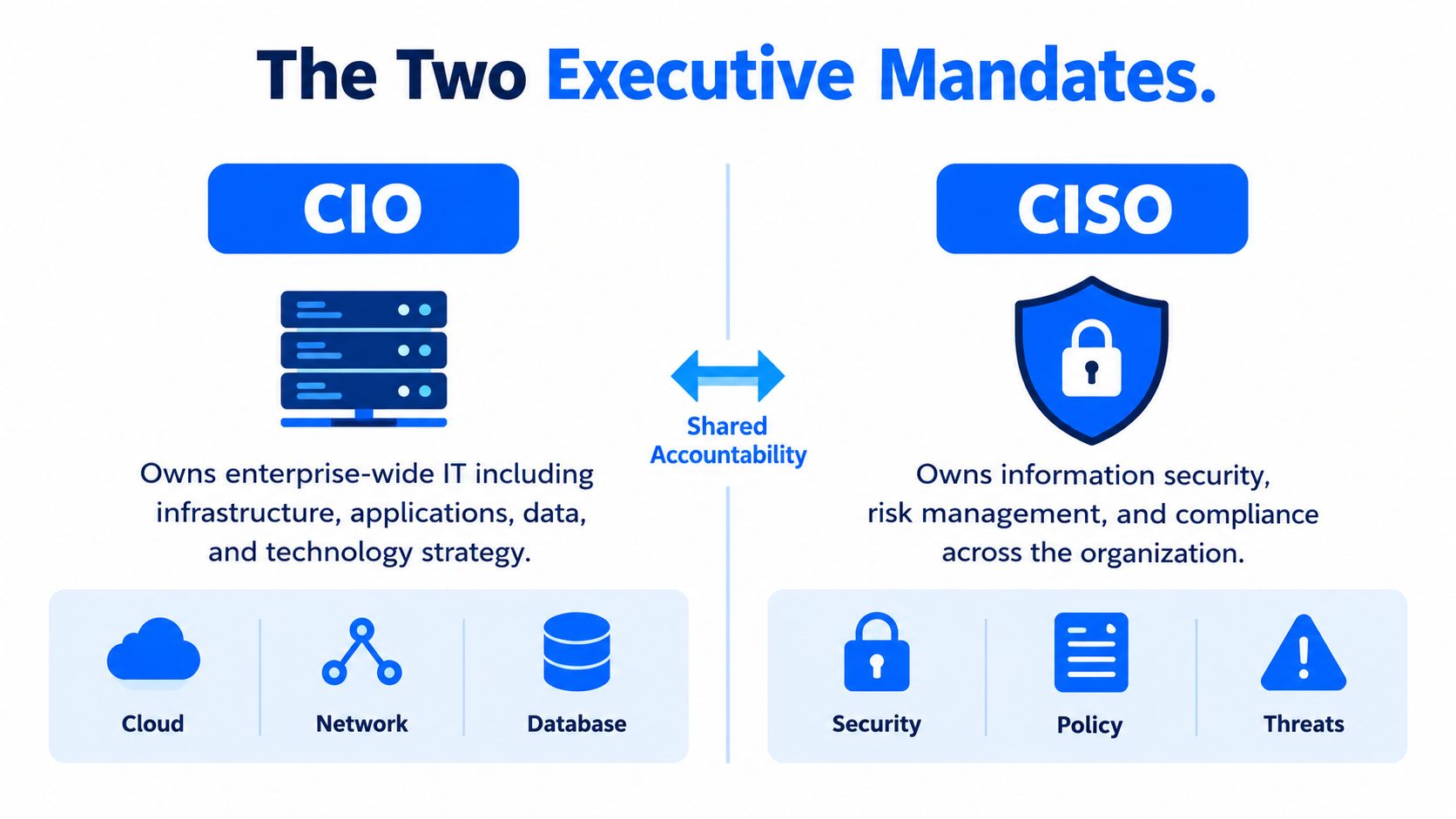
The overlap is substantial in cloud governance, identity, resilience, and transformation. The mistake is treating that overlap as evidence that the positions are interchangeable. They bring different tests to the same proposal.
| Executive lens | Primary question | Expected output |
|---|---|---|
| CIO | Will this technology support the business effectively? | An executable technology and operating plan |
| CISO | Is the associated cyber risk understood and controlled? | Risk requirements, assurance evidence, and escalation where needed |
Separate the mandate from the reporting relationship
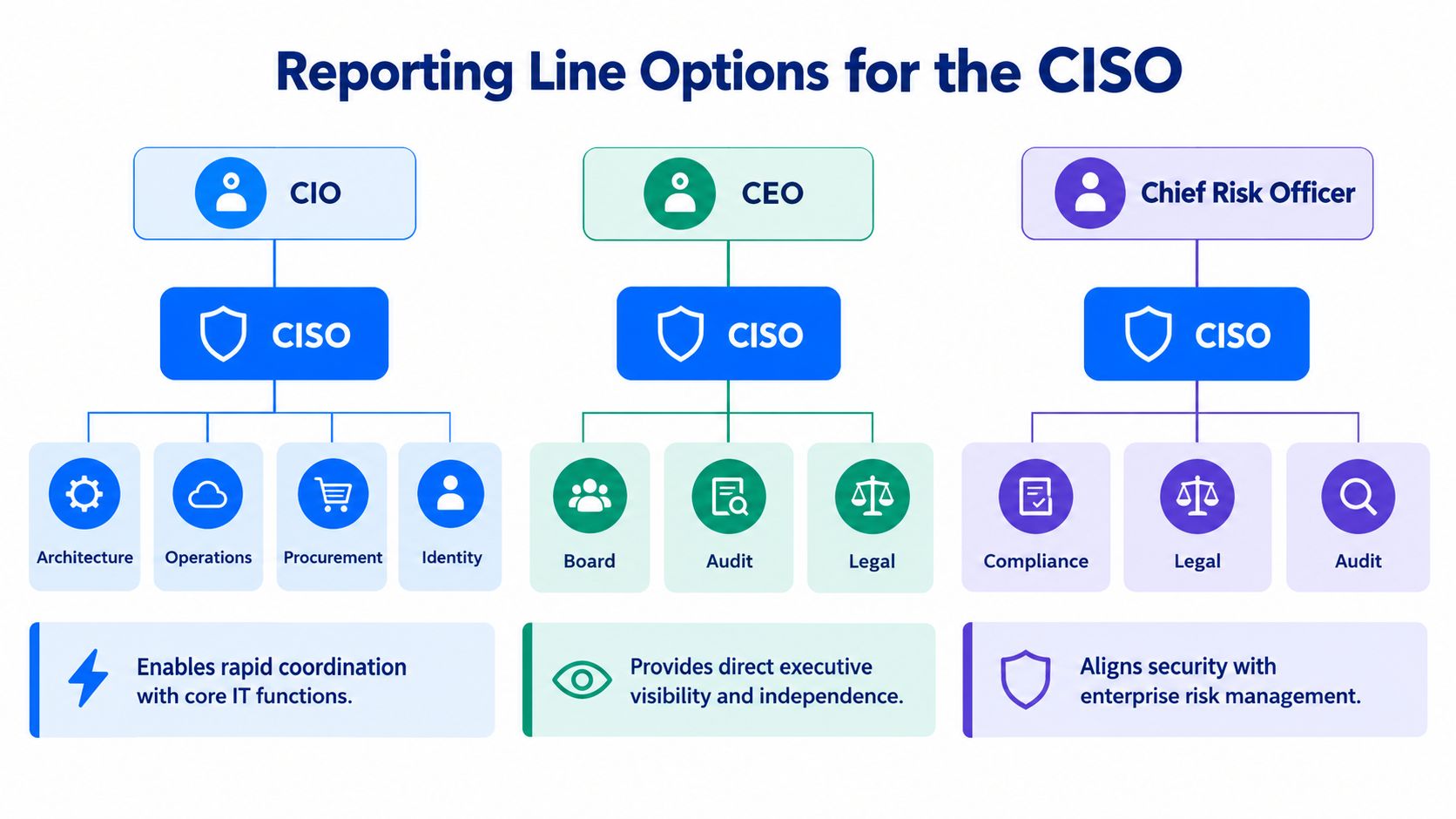
A reporting line doesn't fully describe a CISO's authority. In Heidrick & Struggles' 2025 global CISO survey, 42% reported directly to the CEO, while 30% reported to a CIO, CTO, or equivalent technology executive.
Those findings support a contextual staffing decision, not a universal hierarchy. An executive can report outside technology while still depending heavily on technology teams to implement protections.
Write each mandate in terms of decisions and deliverables. Avoid vague language such as supporting transformation or overseeing security unless the position specification also states what the executive can approve, require, fund, and escalate.
Comparing Responsibilities, Authority, and KPIs
Use accountability, deliverables, authority, performance measures, and executive access to compare the roles. A list of technologies won't tell you whether the organization has assigned the difficult decisions properly.
ISC2's analysis of CISO reporting lines reports that roughly one-third of U.S. CISOs report to the CIO, while 3% report to the CEO, and distinguishes technology implementation from security prioritization and assurance. That operating dependency matters more than whether both executives have similar seniority.
CIO and CISO accountability comparison
| Comparison criterion | CIO accountability | CISO accountability |
|---|---|---|
| Primary accountability | Reliable, scalable technology that advances business objectives | Identification, reduction, and communication of cyber risk |
| Core deliverables | Technology roadmap, architecture, service performance, modernization, budget execution | Security strategy, risk assessments, control requirements, assurance, incident readiness |
| Operational authority | Direct technology teams and coordinate implementation resources | Set security requirements within the approved mandate, validate effectiveness, escalate gaps |
| Technology economics | Manage delivery costs and total cost of ownership | Explain risk-reduction priorities and security investment requirements |
| KPI families | Availability, delivery speed, adoption, service quality, cost | Control coverage, exploitable exposure, remediation, recovery readiness, supplier assurance |
| Executive access | Present portfolio performance and investment decisions | Present material exposure, exceptions, and unresolved security decisions |
Measure delivery and risk without rewarding the wrong behavior
For the CIO, require measures that connect technology operations to business outcomes. Availability should refer to business-relevant services, not infrastructure status. Delivery performance should distinguish releasing a platform from having employees use it successfully.
Technology economics also needs context. A lower operating bill isn't automatically a better outcome if the organization has deferred necessary maintenance or reduced recovery capability.
For the CISO, absence of reported incidents is an inadequate scorecard. Require leading indicators that show whether the organization is addressing exposure and can respond when prevention fails.
- Privileged-access coverage: Show which critical administrative accounts have the required protections and identify outstanding gaps.
- Critical-vulnerability remediation: Track remediation time against agreed severity categories and identify accountable owners.
- Recovery performance: Compare tested restoration results with business-approved recovery objectives.
- Supplier assurance: Identify unresolved findings affecting important services and the status of agreed corrective actions.
Treat these as recommended measurement families, not universal targets. Set thresholds according to business criticality and risk appetite, and document how each measure is calculated.
Shared accountability doesn't mean interchangeable authority. The CIO executes the technology plan; the CISO must be able to assess its security without being required to endorse it.
A useful board discussion pairs outcomes rather than presenting isolated dashboards. If delivery accelerated, ask whether high-risk exceptions increased. If exposure declined, ask whether teams implemented durable protections or merely postponed deployment.
Require evidence behind the status indicator. A recovery objective needs a test result; a closed vulnerability needs validation; a supplier approval needs a documented basis. Measure the work completed and the exposure remaining, not the attractiveness of the presentation.
Choosing the Right Reporting Line and Org Placement
A CISO reporting to the CIO isn't automatically compromised. A CISO reporting to the CEO isn't automatically independent. Choose the reporting relationship that fits the organization, then address its predictable weaknesses.
The 2026 RH-ISAC CISO Benchmark reports that 40% of CISOs report to the CIO and 27% to the CTO. Read these as findings from that benchmark's population, not as directly comparable measures of change against the global survey discussed earlier.
When technology reporting fits
Reporting to the CIO can support close coordination with architecture, operations, procurement, and identity teams. Consider this model when the principal challenge is implementing controls consistently across a technology organization with clear operational ownership.
The conflict appears when the CIO's delivery commitments compete with the CISO's assessment of unacceptable exposure. If the CIO controls the assessment, remediation funding, and escalation route, independent challenge becomes difficult.
- Protect access: Give the CISO a defined route to the executive sponsor and relevant board committee.
- Protect assessment: Preserve the CISO's ability to report findings without delivery-management approval.
- Protect decisions: Require unresolved material exceptions to reach an authorized business decision-maker.
When placement outside technology fits
Direct CEO reporting deserves consideration when the CISO's remit spans enterprise strategy, material business exposure, and cross-functional risk decisions. Placement under a chief risk officer or legal leader can fit organizations where security oversight needs close coordination with broader risk, compliance, and legal responsibilities.
Board access and a management reporting line aren't the same thing. Specify who handles executive management, who approves resources, and how the CISO communicates material concerns to directors.
Outside-technology placement also requires deliberate coordination with IT. Otherwise, the security executive can identify obligations without having an effective route to the teams that must meet them.
Before choosing, examine regulatory exposure, organizational maturity, portfolio complexity, and the breadth of security's remit. Ask whether the proposed manager can understand the issues, resolve resource conflicts, and protect candid reporting.
My test is practical: Can this CISO obtain evidence, influence priorities, and escalate an unresolved material concern without asking permission from the person whose delivery decision is being challenged? If not, repair the authority model. Changing the box on the organization chart alone won't be enough.
Building a Collaboration Model That Works
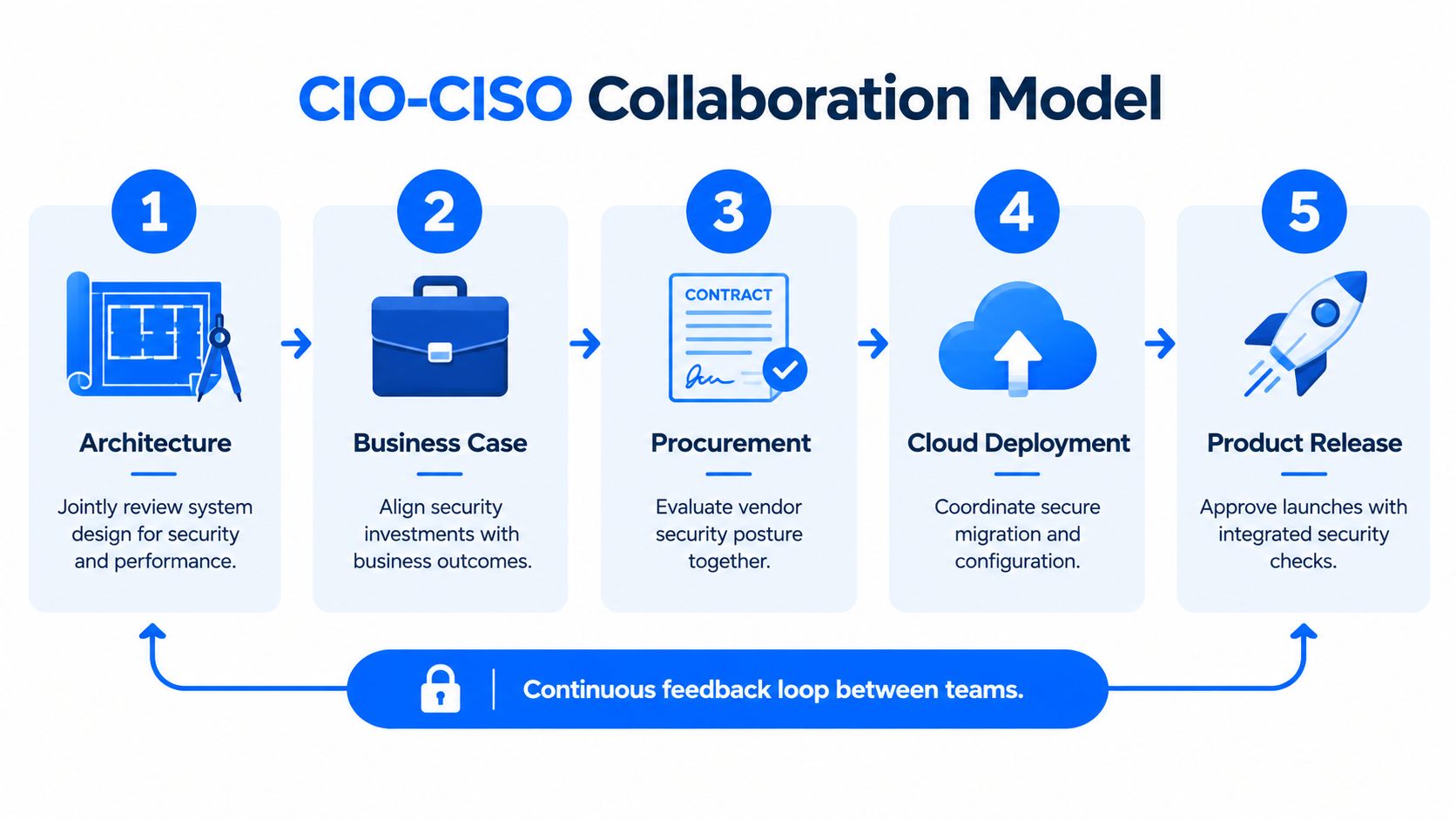
Bring the CIO and CISO together before business cases and architectures are finalized. A security review at the procurement finish line gives leaders fewer useful choices than an early discussion of requirements and alternatives.
In PwC's 2025 Global Digital Trust Insights survey, which covered 4,042 executives across 77 countries, fewer than half said CISOs were involved to a large extent in strategic planning, board reporting, and oversight of technology deployments. Executive visibility shouldn't be mistaken for participation in decisions.
Establish joint investment gates
At architecture review, ask both leaders to assess the proposed design. The CIO should explain operating feasibility and dependencies; the CISO should identify required protections and the evidence needed for acceptance.
At business-case approval, include implementation, security, assurance, and ongoing operating work in the funding request. During procurement, resolve supplier responsibilities and evidence requirements before contractual advantage is lost.
For regulated initiatives, use a documented approach to compliance in IT security to connect obligations with implementation owners and validation evidence. Don't make the security team solely responsible for requirements that depend on operations, procurement, or business-process changes.
Make exceptions actionable
Set shared outcomes such as secure delivery time, recovery readiness, critical-finding closure, and risk-adjusted technology spend. Retain distinct ownership beneath those outcomes so joint responsibility doesn't become an excuse for inaction.
- Missed recovery objectives: Escalate when testing demonstrates that an important service can't meet its approved restoration requirements.
- Overdue critical findings: Require the remediation owner to explain the delay, interim protections, and revised completion commitment.
- Material supplier exposure: Refer unresolved dependencies to the business sponsor before deployment or renewal approval.
- Unfunded mandatory controls: Present the requirement, delivery impact, and available alternatives to the authorized executive.
Decision discipline: Every accepted exception needs a business owner, a documented rationale, compensating controls where appropriate, and an expiry or review date.
The CEO or board should resolve material trade-offs outside delegated authority. Define escalation timing in advance so delivery pressure can't suppress a concern and security review can't hold a justified initiative indefinitely.
Keep a shared decision record. Record what was approved, who accepted the exposure, what must happen next, and what would trigger reconsideration.
Matching Leadership Models to Organizational Scenarios
Match executive coverage to the work and risk, not to headcount alone. The following are representative staffing scenarios, not claims about individual organizations or guaranteed results.
Separate full-time executives for sustained complexity
Consider an enterprise with a broad application portfolio, substantial regulatory exposure, major modernization work, and established technology and security teams. Separate full-time CIO and CISO positions are a sensible choice when each mandate requires sustained executive attention.
The trade-off is coordination overhead. Budget disputes, overlapping architecture reviews, and inconsistent priorities still require active management. Separate appointments are justified when the organization has enough consequential work for both executives and enough operating capacity to execute their decisions.
Combined leadership with independent challenge
A mid-market organization with a more contained portfolio may choose an integrated technology and security leader. That can simplify prioritization and executive communication, but it concentrates responsibility for delivery and assessment in the same person.
Don't describe this arrangement as equivalent to independent security oversight. Add external assurance, a separate escalation route, and explicit approval requirements for material exceptions.
| Leadership model | Appropriate situation | Principal safeguard |
|---|---|---|
| Separate full-time CIO and CISO | Sustained executive workload across both mandates | Coordinated priorities and documented boundaries |
| Combined or hybrid leader | Integrated leadership fits a manageable scope | Independent testing and business-owned risk acceptance |
| Outsourced security leadership | Specialist expertise or external leadership capacity is needed | Retained internal accountability and clear service boundaries |
| Fractional CIO or CISO | Executive judgment is needed without a permanent appointment | Defined authority, availability, and execution ownership |
Outsourcing expertise isn't outsourcing accountability
An organization with capable IT management but limited security leadership may engage an external security executive. Specify whether the engagement covers strategy, assurance, incident coordination, or operational services.
Continuous monitoring and executive leadership are different requirements. Don't assume a leadership retainer includes continuous operational coverage. Confirm the service scope, response arrangements, internal dependencies, and responsibility for supplier coordination.
Fractional leadership as a deliberate operating choice
Fractional coverage makes sense when the organization needs an experienced executive to set priorities, guide procurement, establish governance, or support the board, but doesn't yet require a permanent appointment.
MR2 Solutions provides fractional IT and security leadership, including vCIO, vCISO, and CAIO services, within its vendor-neutral TBaaS offering. Consider that approach alongside direct hiring, combined internal leadership, and other external advisory arrangements.
The risk is appointing a fractional executive who can recommend but can't get decisions made. Name an internal sponsor, identify who executes the work, and agree on availability during incidents and major decisions. Require documented handover materials so organizational knowledge doesn't remain solely with the adviser.
Make the Right CIO and CISO Hiring Decision
Start with the business problem you're asking the executive to solve. Fragmented technology investment, weak service ownership, and an unclear modernization roadmap point toward CIO coverage. Unassessed exposure, weak assurance, and inadequate incident governance point toward CISO coverage.
If both mandates require sustained executive attention, appoint both. If the need is focused, transitional, or constrained by implementation capacity, evaluate a combined arrangement or fractional coverage before committing to separate permanent roles.
Approve the role before opening the search
Write an outcome-based position charter and test it against the work available. A candidate should be able to see what success means, which decisions they own, and where another executive's authority begins.
- Remit clarity: Identify the outcomes and deliverables assigned to the position.
- Reporting line: Name the executive sponsor and the relevant board-access arrangements.
- Escalation authority: Define which issues must bypass routine delivery management.
- Budget and resources: Specify controlled funding, influenced spending, and available implementation teams.
- KPI balance: Pair business outcomes with evidence of control effectiveness and readiness.
- Internal dependencies: Name the operational, procurement, legal, and business owners needed for execution.
- Conflict safeguards: Separate assurance and material risk acceptance from delivery pressure.
Don't hire an executive to fill an operating gap
A CISO can't substitute for engineers who implement controls. A CIO can't replace missing service ownership or delivery capacity merely by producing a roadmap. Fund the specialists, operational support, and remediation work that the appointment will require.
For organizations considering external coverage, fractional CISO services are an option to evaluate against the charter. Require the same clarity about authority, evidence, and internal execution that you'd demand from a permanent hire.
Ask candidates to work through a disputed launch decision. Listen for how they identify business impact, evaluate alternatives, involve the right owner, and document the outcome, rather than whether they instinctively approve or reject deployment.
Make the hiring decision conditional on an executable mandate. If you can't explain what the leader owns, how they obtain resources, and who resolves a disagreement, finish the organizational design before extending an offer.
Through its vendor-neutral TBaaS offering, MR2 Solutions provides fractional IT and security leadership, including vCIO and vCISO services. Visit MR2 Solutions to discuss your technology portfolio, security-governance gaps, and executive workload, then evaluate whether separate, combined, or fractional leadership fits your organization.