
Managed Security Operations Center: How It Works in 2026
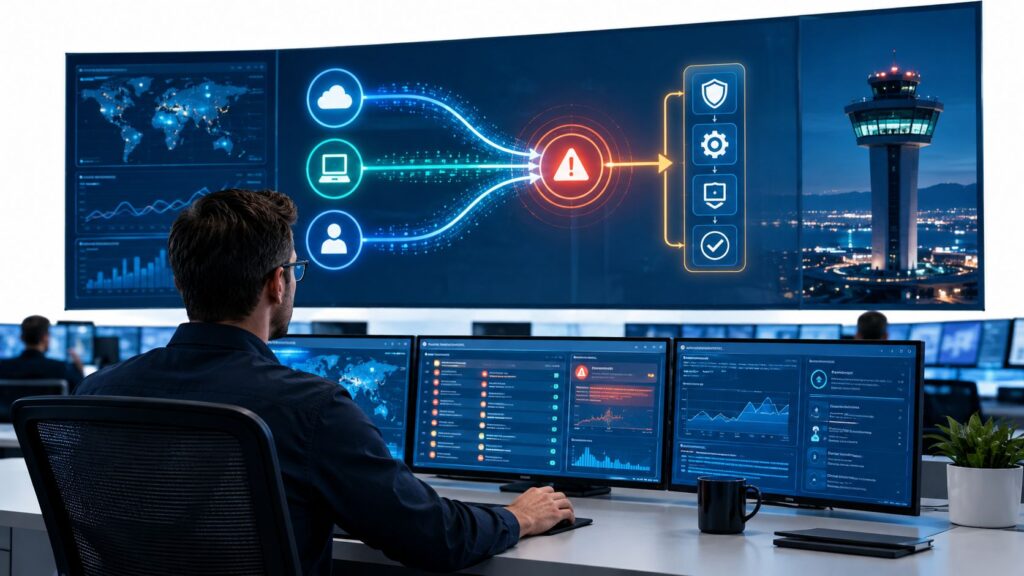
You're the person who signed off on the security stack, and the dashboards look busy. At 2:14 a.m. an accounting laptop starts sending encrypted files to a server nobody recognizes. The only analyst who can read those alerts is asleep. A managed security operations center is built for that hour. It isn't another product name. It's people, clocks, and a written answer to who may act before sunrise.
Vendors sell faster response. The decision that changes the outcome is narrower. Who holds authority in the first 30 minutes, and do the numbers you review show risk falling, or only activity rising? Closed tickets can climb while a mailbox rule sits untouched for days.
What follows is the handoff a night shift needs. Services, operating models, the path from alert to containment, the clocks that prove the work, the split of authority, the compliance deadlines those clocks must fit, and a scorecard you can take into a vendor meeting.
The Four Services Inside a Managed SOC
At 2:14 a.m., an accounting laptop is sending files outside the company. Your SOC provider should be monitoring the relevant signals, but the first question is who can act: the provider, your on-call lead, or both under an agreed playbook. That authority must be clear before an incident, not negotiated while files are moving.
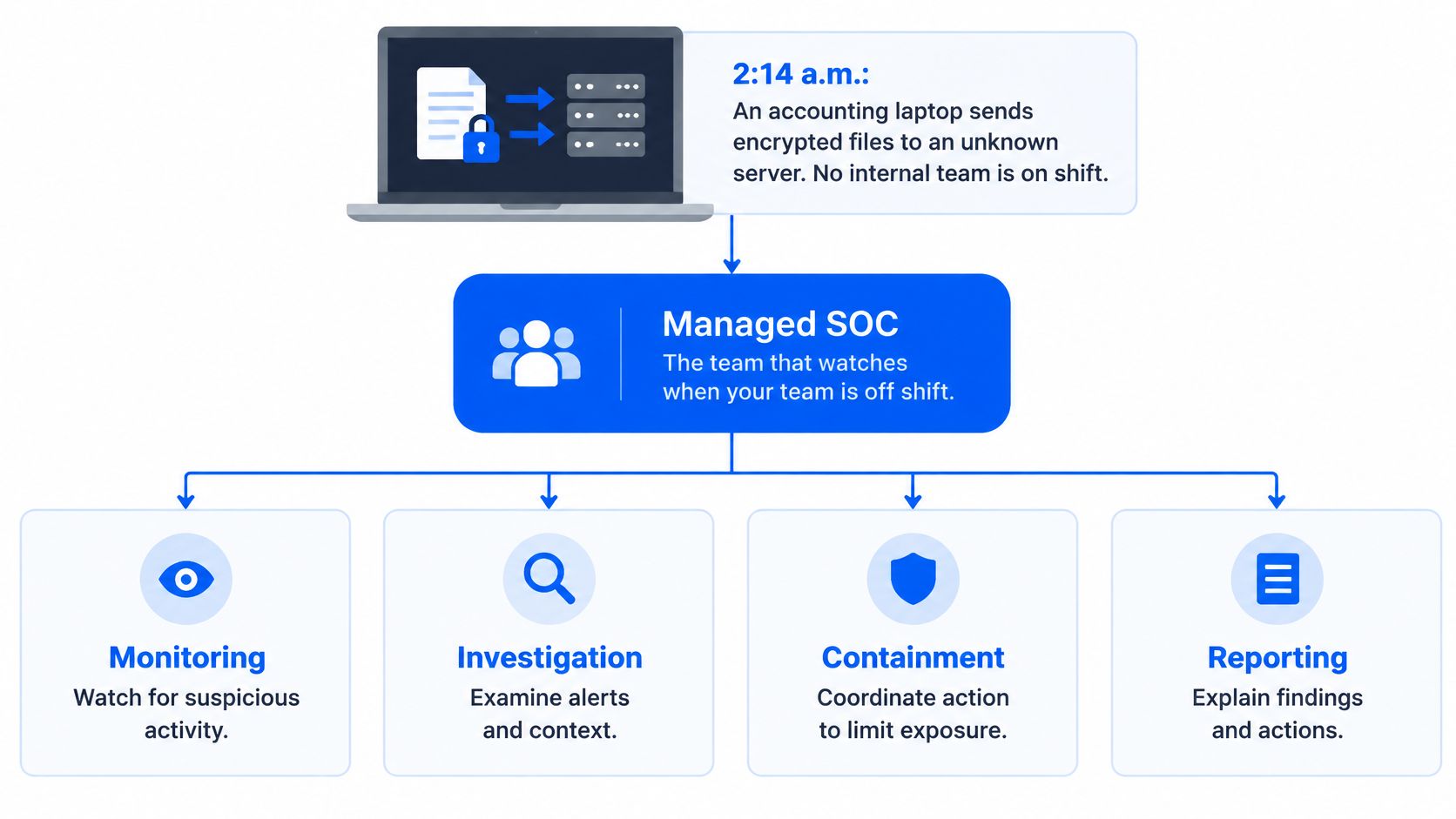
A SOC combines prevention, detection, and response in a dedicated security function. A 2021 academic review of security operations describes work that includes monitoring, analysis, escalation, containment, and reporting. It also cites older 2018 breach-response figures, reporting a mean of 196 days to detect an incident and an average of 69 days to contain it. Those figures are historical, not a current benchmark. Use them to understand why continuous coverage matters, not to predict how quickly a provider will handle your incident.
| Service | What the provider does | What you receive | What you must supply |
|---|---|---|---|
| Monitoring | Watches identity, endpoint, network, cloud, and email logs | Triaged alerts and reports on log-source health | Connected, healthy log sources |
| Detection | Builds and tunes rules, analytics, and behavioral models | A list of detection content and a record of tuning changes | Approval for changes that may affect business applications |
| Incident response | Investigates alerts and supports containment, eradication, and recovery | An incident timeline, actions taken, and outstanding tasks | Clear authority for disruptive actions and named executive contacts |
| Threat hunting | Searches proactively for attacker behavior that generated no alert | Hunt findings, hypotheses, and detection gaps | Asset and business context to judge findings |
A chain, not a menu
These services depend on one another. Monitoring supplies the data detection rules use. Detection gives responders a lead to investigate, while hunting searches for behavior that escaped the alerts. If logs are missing or delayed, a polished hunt report cannot compensate.
Ask the provider to show which sources are monitored, how quickly a meaningful alert reaches your team, and who may isolate a device at 2 a.m. Make the handoff concrete: the provider investigates and recommends action, while your named contact approves disruptive steps unless a written playbook grants that authority. Then assess whether investigations lead to containment and fewer unresolved risks, rather than judging performance by alert volume or tickets closed.
Three Operating Models and Where Each Fits
Pick the model by who is awake and who may touch production, not by the logo on the proposal.
| Model | Who monitors | Who decides on containment | Typical fit | Main risk |
|---|---|---|---|---|
| Fully managed SOC | Provider, 24/7 | Provider inside pre-approved playbooks, you for disruptive actions | No security staff, or no night shift | Provider lacks context for your applications |
| Co-managed SOC | Provider after hours, your analysts in business hours | Your team owns disruptive actions | One to three security staff who need 24/7 cover | Handoff gaps between their shift and yours |
| Detection and response only (MDR) | Provider on endpoint and identity signals | Your team for everything outside that scope | Teams that already run a SIEM | Blind spots in cloud, network, and apps outside scope |
| In-house SOC with overflow | Your team, provider for surge or specialist cases | Your team | Mature teams with recurring peak loads | Gaps remain whenever the provider isn't engaged |
A twelve-person IT shop
A 12-person IT department with one security analyst is usually a co-managed case. That analyst owns the day, knows which finance server can't be isolated during close, and still needs nights and weekends covered. A company with no security staff is usually fully managed, because there is nobody to take the 2 a.m. call. A team that already runs its own SIEM, and only wants eyes on endpoints and identity, fits MDR. Overflow suits a mature in-house SOC that spikes during incidents and doesn't want a second full roster.
Price follows log volume, source count, how far response goes, and which hours are covered. It doesn't follow the headcount you avoided hiring. A cheap overnight watch that can't isolate an endpoint is a paging service.
Three questions you can answer today
- Night coverage: Is anyone on your payroll on shift after hours?
- Disruptive actions: Who must approve disabling an account or isolating a server?
- Log sources: How many identity, endpoint, network, cloud, and email sources are connected?
If the night answer is nobody, don't buy a model that assumes your analyst will validate containment. Managed operations support only helps if the handoff matches the staff you have.
How an Alert Becomes a Contained Incident
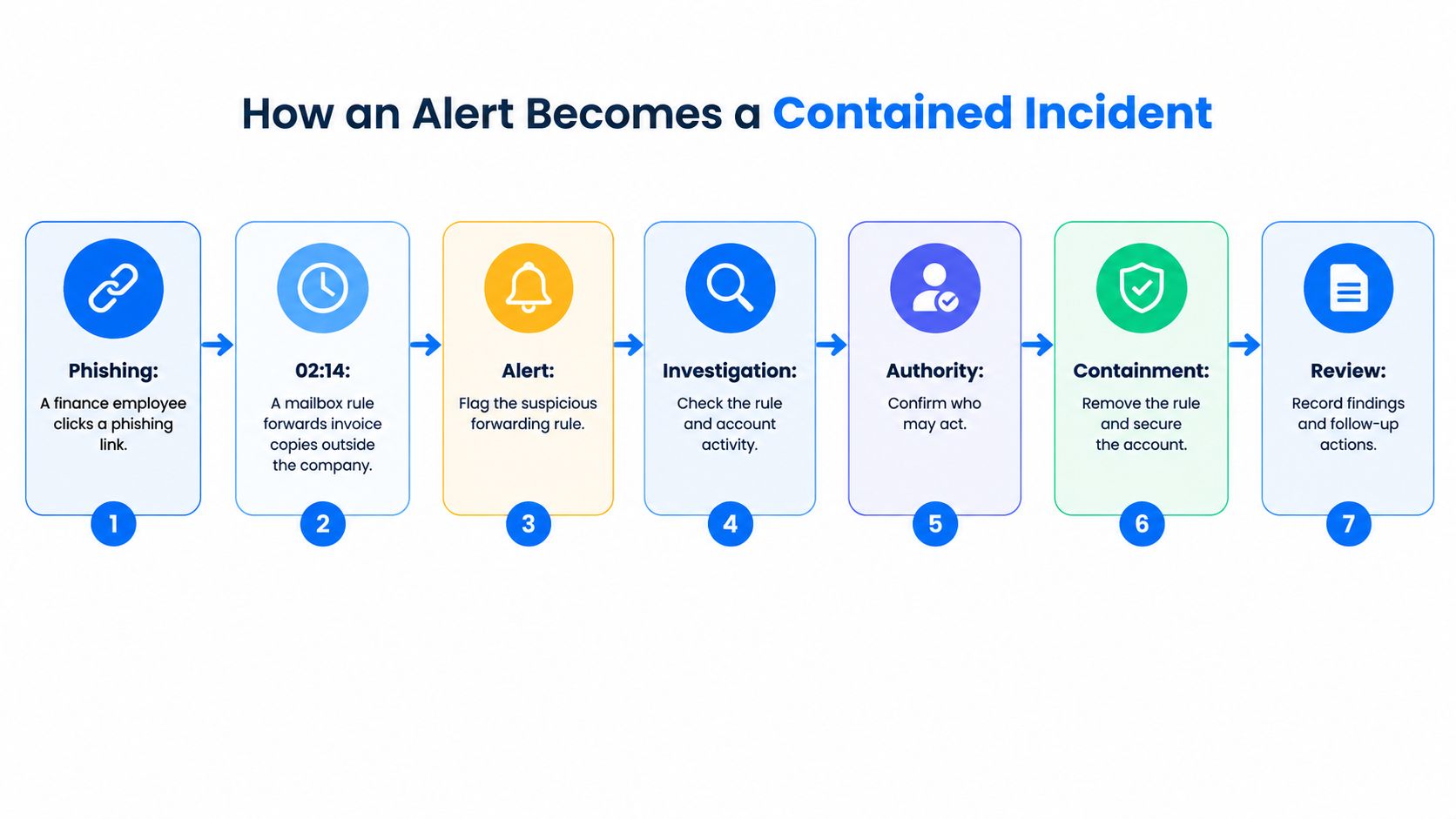
At 02:14, a finance employee clicks a phishing link. A mailbox rule appears and starts copying invoices to an outside address. The provider can isolate a device quickly, but that does not close the incident. The team still needs to remove the rule, establish what was accessed, and fix the detection gap. The first 30 minutes depend on clear authority: analysts should know which actions they can take immediately and who approves disruptive changes.
NIST incident-response guidance provides a framework for incident response. Separately, IBM's 2025 breach study reports a global average breach lifecycle of 241 days and says organizations using AI and automation extensively reduced the overall breach lifecycle by 80 days on average compared with organizations that did not. That figure concerns the breach lifecycle, not identification and containment alone. Automate repetitive, low-risk tasks, but keep a human responsible for actions that could interrupt production.
- Telemetry lands. Email, identity, endpoint, and cloud events reach the SIEM, where they are normalized and time-stamped. Missing or delayed logs weaken the case before an analyst reviews it.
- Automation enriches. SOAR can add IP reputation, asset ownership, user history, and recent logins, then group duplicates. The analyst should investigate one case, not twelve copies of the same alert.
- An analyst validates. Confirm whether the forwarding rule is malicious or part of a finance workflow. Business context matters. A mailbox that sends invoices overnight may be legitimate, but the external destination still needs checking.
- Severity follows the asset. Escalate based on account privileges and what the mailbox can access, not alert volume. A rule on a privileged finance mailbox warrants attention before a noisy laptop alert.
- Containment runs in two lanes. Playbooks can carry out approved low-risk actions, such as temporary endpoint isolation or phishing-URL detonation. Disabling a production identity may require approval. Name the approver and backup in advance; otherwise, the case can stall while the attacker retains access.
- The team closes the loop. Remove the rule, reset credentials, preserve evidence, document the root cause, and tune detection. Track who authorized each disruptive action and whether the change worked.
Practical rule: Require telemetry coverage reporting, playbook rollback, analyst override, and an audit log showing who or what ran each action. A closed ticket without that record does not prove containment.
Metrics That Prove the SOC Is Working
A busy dashboard can hide a quiet failure: an attacker still has access. Alert volume and closed tickets show activity, not reduced risk. A survey of security professionals found that some AI SOC adopters cut investigation time. That is useful only if investigations lead to sound decisions and effective containment. Suppressing alerts can clear a queue while hiding a rare, high-impact attack.
Name the clocks
Use clear start and stop points for each measure. These are practical operating definitions, not a single universal clock framework.
- Mean time to acknowledge: From alert creation to an analyst taking ownership.
- Mean time to validate: From alert creation to confirmation that the activity is malicious.
- Mean time to contain: From confirmation to the action that stops the threat.
- Dwell time: From initial compromise to detection. Track stakeholder notification separately, since it may follow detection and has its own compliance deadline.
Keep remediation separate from containment. Containment stops the immediate threat, while remediation removes the cause and restores affected systems. Combining them into one measure can make a quick isolation look slow because the full repair takes longer.
Track where time is spent: waiting for usable telemetry, analyst review, or an authorized response. Tie the final clock to a business-relevant action, such as isolating a privileged account, quarantining an endpoint, or revoking a cloud token. A ticket closure alone does not prove the threat was stopped.
Write the SLA as a pair
Define clock start and stop points, severity-specific targets, automatic enrichment or escalation expectations, evidence retention, and reporting by asset criticality. Ask the provider to show how it calculates each measure and handles missing telemetry.
A provider may acknowledge an alert quickly while containment waits for your approval. Set separate provider and client clocks in the contract, with a named owner for each stage. Request written assumptions about false negatives, examples of escalation decisions, and an improvement plan when telemetry gaps, false positives, or delayed client action cause a target to be missed.
A green acknowledgement chart alongside slow containment points to a queue or approval problem, not proof that the SOC reduced risk.
Splitting Incident Authority With Your Team
A managed SOC can shrink your monitoring load and still raise your risk if nobody has named who may act.
ENISA's analysis of managed security services flags cost, limited internal expertise, SLA customization, and technical and process integration as real barriers. Outsourcing the watch doesn't outsource the incident. The provider may detect and investigate. You may still have to isolate systems, approve disruptive actions, preserve evidence, contact regulators, brief executives, and run recovery.
| Activity | Provider | Your team |
|---|---|---|
| Detection and triage | Owns it, reports findings inside the agreed clock | Reviews reports and receives escalations |
| Low-risk containment, such as temporary endpoint isolation | Executes inside the playbook | Sets playbook scope and reviews afterward |
| Disruptive containment, such as disabling a production account | Recommends, with evidence | Approves or rejects by a named person |
| Evidence preservation and chain of custody | Collects and hashes logs | Owns custody and legal hold |
| Regulator and customer notification | Supplies timeline and facts | Decides and files |
| Executive and public communication | Supplies technical status | Owns the message |
| Recovery and remediation | Advises on sequencing | Executes and signs off |
Where the matrix breaks
Time zones, subsidiaries on separate systems, several cloud platforms, and regulated notice duties all crack a generic RACI. A playbook written for one tenant fails when the impacted mailbox sits in another subsidiary's directory. Name a deputy approver for each region. If the primary is on a plane, the case cannot wait for landing.
Test it before a long contract. Run a tabletop on ransomware hitting a file server at night. Time how long it takes to reach the person who can isolate that server, and whether evidence collection starts before someone reimages the box. Fractional security leadership is one way to staff that approver when you don't have a full-time CISO on the night roster.
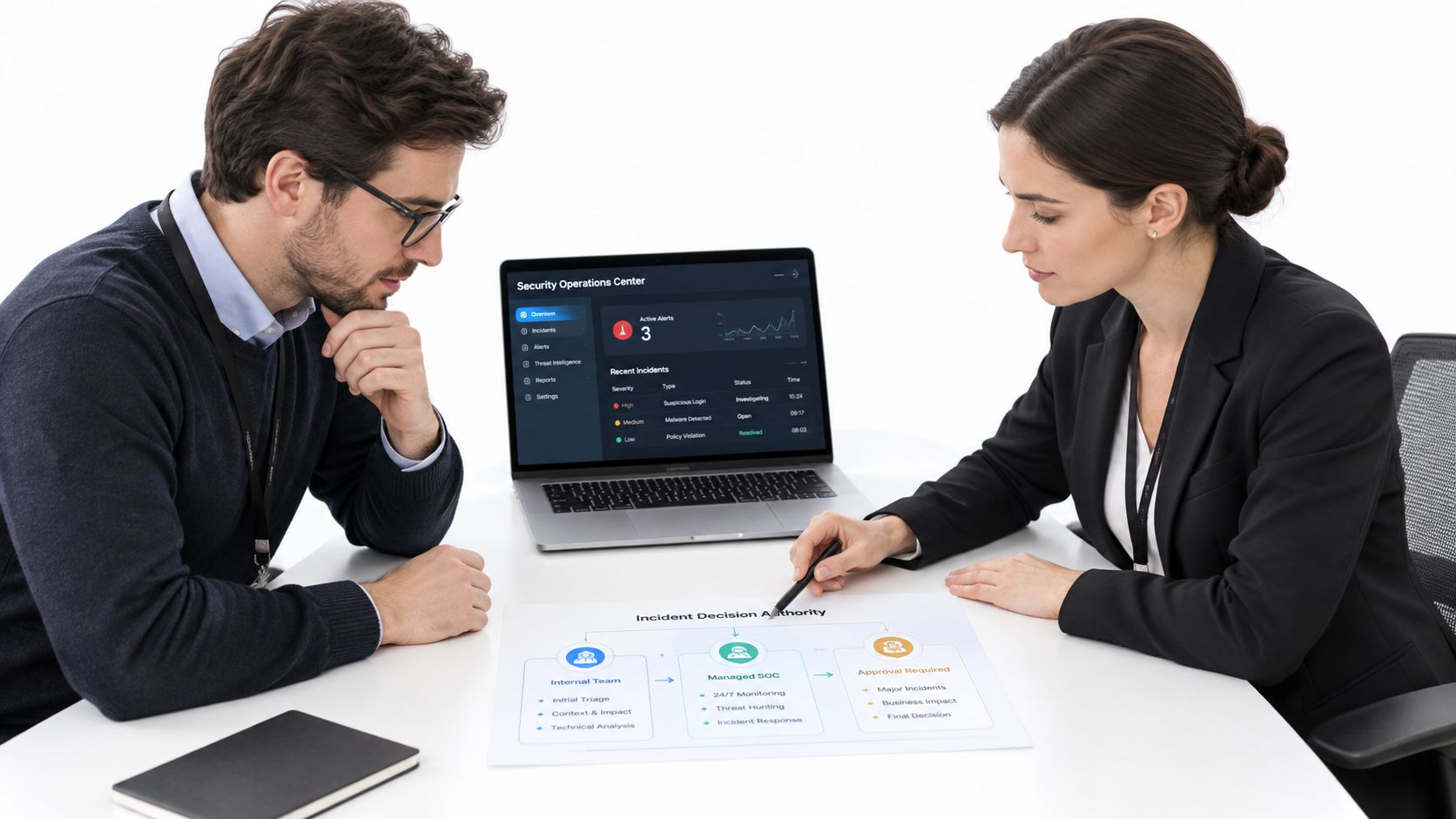
Refuse a contract that says "the provider will respond" without naming the action and the approver.
What happens in the first 30 minutes of a high-severity incident, and who has the authority to act?
Compliance Clocks That Shape the Contract
A breach reaches the SOC at night. The analyst sees personal data in the affected system, but your team learns about it hours later. Contract language must define when the provider escalates and who records that notification. The GDPR's 72-hour notification rule starts when the controller becomes aware of a breach, not when the attack begins. See Purple's explanation of GDPR. If escalation consumes 40 hours, only 32 remain to assess the breach, consult counsel, and notify the supervisory authority.
| Regime | Deadline or retention rule | Contract clause needed |
|---|---|---|
| GDPR | Notify a supervisory authority within 72 hours of becoming aware of a personal-data breach | Set an escalation time limit for personal-data incidents and identify where EU data is stored |
| NIS2 | For significant incidents, early warning within 24 hours and incident notification within 72 hours | Name a 24/7 contact path and escalation SLA for significant incidents |
| PCI DSS v4.0 | Keep logs for at least 12 months, with the latest three months immediately available | Define retention, immediate access to stored logs, and auditor access |
| HIPAA | Retain security documentation for six years | Define documentation and log retention, business associate terms, and auditor access |
Turn each deadline into a named SLA
Put the operational details in the contract schedule. Specify where logs are stored and whether that meets data-residency requirements. List every sub-processor that handles the data. State how auditors can obtain raw logs without waiting weeks for a ticket. IT security compliance work also depends on written ownership and handoffs, not just a policy document.
For each legal deadline, set an escalation SLA with a time limit and a named owner. Ask counsel to confirm the obligations that apply, since jurisdiction and sector affect the rules. At 2 a.m., the SOC analyst should know whom to call, what information to preserve, and whether the provider may take immediate containment steps. Your team must know when the notice clock starts.
If the provider cannot show when it became aware, you cannot demonstrate that you met the notice window.
Score Providers on Outcomes Before You Sign
The trap in a sales meeting is a falling alert count. Suppression can make the chart look healthy while a rare, high-impact path never pages anyone. Your job is to verify outcomes before you sign, not to admire a dashboard or a product name.
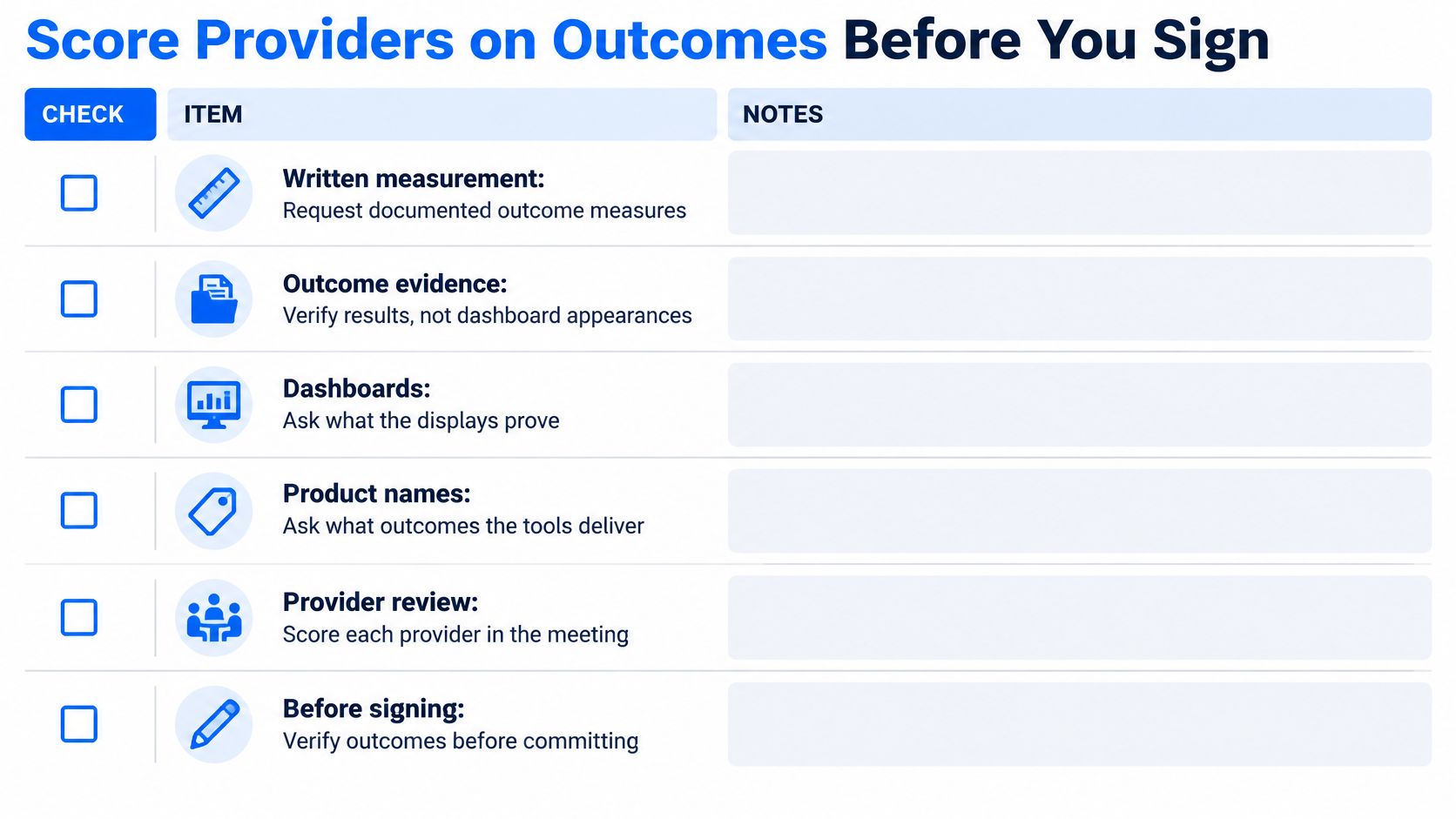
Score each provider in the room, on paper:
- Measurement definitions: Written start and stop points for acknowledge, validate, contain, and dwell, matching the clocks you already set.
- Coverage map: Which log sources are in, and which are not, including cloud and email.
- Analyst coverage: Hours and locations, not a headcount slide.
- Automation control: Playbook precision, rollback, and an audit log of automated actions.
- Authority: A signed responsibility matrix, with named approvers for disruptive steps.
- Practice: Tabletop results from the last twelve months, including a night scenario.
- Misses: False-negative assumptions disclosed in writing.
- Slice: Performance by asset criticality and attack scenario, not one blended average.
Red flags
Walk away from "faster response" with no definitions, from reports that show only tickets closed, and from a provider with no improvement plan when telemetry gaps, false positives, or slow customer containment block the outcome. Ask how they will validate the claim after onboarding, in the first quarter, not at renewal.
List your log sources and coverage hours, write the matrix, shortlist three providers, and score them on that list. A vendor-neutral brokerage such as MR2 Solutions can run the comparison without a resale quota attached to one stack. The question that matters isn't how many alerts they will handle. It's what evidence will show material risk is falling without opening a blind spot.
MR2 Solutions helps CIOs and CISOs compare managed security operations centers on authority, telemetry coverage, and outcome clocks rather than on dashboards. Its vendor-neutral brokerage covers evaluation, procurement, and governance so the night-shift handoff is written before you sign. Visit MR2 Solutions to start that comparison with your log sources and approval list in hand.