
IT Managed Security Services Explained for Buyers

You're not buying a dashboard. You're buying what happens at 2 a.m. when a login looks wrong, a laptop needs isolating, and someone has to decide whether a regulator gets notified. This is the true test of IT managed security services, and it's where most buying conversations go quiet. The tools matter, but accountability and measurable outcomes are the purchase.
What IT Managed Security Services Actually Buy
Gartner reported that worldwide security-services revenue reached $77.1 billion in 2024, representing 9.9% year-over-year growth, while managed security services were the fastest-growing segment, expanding 11.5% during 2024. Buyers aren't spending that way for one more project. They're paying for continuous operations they can't staff alone.
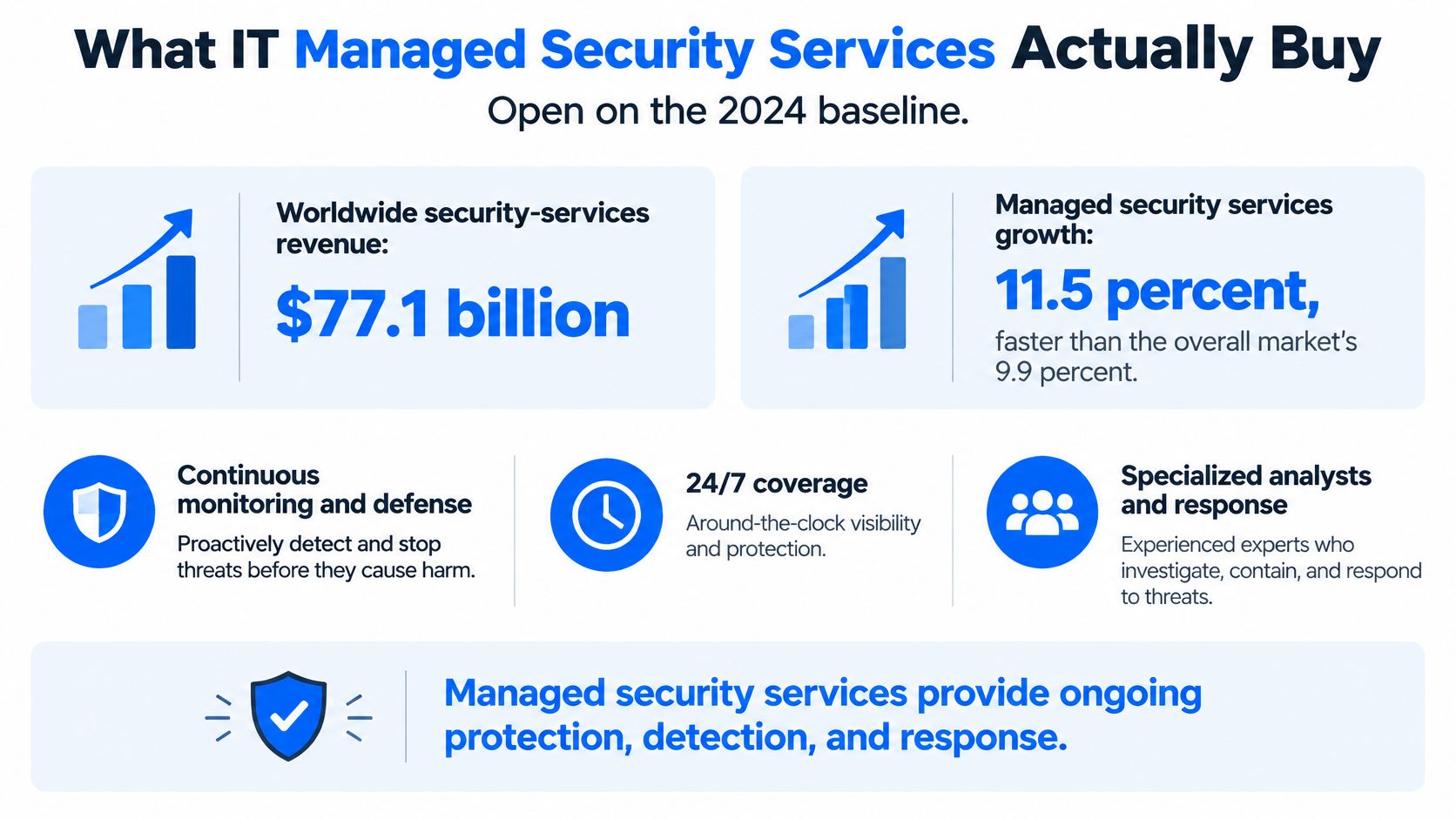
Think of it as a night crew. Your company still owns the building, the locks, and the decision to evacuate. The provider is the trained overnight shift with alarms and radios, acting only inside authority you've written in advance. If that authority is vague, the crew either hesitates or oversteps.
IT managed security services are continuous, outsourced operations for security monitoring, threat detection, incident response, vulnerability management, and security-device administration, staffed around the clock with continually updated tools.
The four outcomes you're actually paying for
For CIOs, CISOs, IT directors, and procurement leads at mid-market and enterprise firms, including regulated industries, the value shows up in four places.
- A shorter exposure window: Suspicious activity gets found and contained sooner, so an attacker has less time to move.
- A response path that works at night: A named analyst triages, escalates, and acts while your team is offline.
- Evidence auditors can use: Logs, timelines, and investigation records support compliance reviews and post-incident questions.
- More predictable operating cost: You trade the cost of hiring, training, and retaining a full bench for a subscription you can budget.
Comparing providers only by product features misses those outcomes. If you're building a shortlist, you can explore seven cybersecurity service providers as one starting point, then score each one against the same operating questions.
Three decisions determine whether the service works. Which model matches the team you have on staff today. Which party owns each incident step when something fails. And which numbers prove risk fell. A provider that can't answer those three clearly is selling you coverage on paper.
MSSP Co-Managed and In-House Models Compared
Security operating models buyers choose
| Model | Who does the daily work | Best fit | Main risk | Cost shape |
|---|---|---|---|---|
| Fully outsourced MSSP | Provider monitors, triages, and handles much of response | Thin team with a 24/7 gap | Buyer loses control unless authority is written down | Subscription, lower internal headcount |
| Co-managed | Shared SOC, client keeps policy and some analysts, provider covers platform, nights, and surge | Team exists but cannot cover nights or specialties | Split authority if no one owns incident declaration | Platform fee plus retained staff |
| In-house SOC | Company owns people, tools, and process | Large firms that can fund and retain a full bench | Fixed cost and hiring failure | Salaries, tools, training, and attrition |
| MDR-led | Provider hunts and contains on endpoints and identity, often with isolation rights | Ransomware and endpoint-heavy risk | Network, cloud, and vulnerability work left uncovered | Per endpoint or outcome price |
| SIEM or platform only | Tool and log pipeline with little or no human response | Buyer already has analysts | Alerts with no owner | License plus ingestion, often a surprise |
Start from the fully outsourced MSSP row, then ask what would push you off it. That model fits when you have almost no security staff and no realistic way to cover nights, weekends, and holidays. The provider runs monitoring and first response, and your job shifts to governance. You set policy, approve disruptive actions, and check reporting. The failure mode isn't technology. It's a contract that never says how far the provider can go without your approval.
When co-managed is the better default
Co-managed works when you already employ analysts or a security lead and want to keep policy and asset ownership inside. The provider supplies the platform, after-hours coverage, and surge capacity during a major incident. You keep people who know which server runs payroll and which cloud account holds customer data. That context makes triage faster and containment safer.
It breaks in a predictable way. Both sides assume the other declared the incident, so notifications stall while alerts pile up. Prevent that by naming one incident lead on your side and one on the provider's side for every severity level.
An in-house SOC gives you maximum control, and maximum fixed cost. You own hiring, retention, training, and tool renewals. That only makes sense where budget and a deep hiring market can sustain coverage across shifts without burning out a small team. If two resignations would leave nights uncovered, you don't have a SOC. You have a fragile roster.
Narrower buys that need a clear boundary
MDR-led engagements are narrower by design. The provider hunts on endpoints and identity and can often isolate a host under pre-agreed rights. That is valuable against ransomware, but it doesn't automatically cover network devices, cloud misconfigurations, or vulnerability remediation. Name what's outside scope before you sign, and assign it to someone else in writing.
A SIEM or platform-only deal is a log pipeline and a console. It is not a night shift. It fits only when your analysts already exist and have time to work the queue. If those analysts were never hired, you'll own expensive alerts that nobody reads.
Pick the row that matches headcount today, not a future hiring plan. A co-managed service sized for your current team beats an in-house model built on requisitions that may never get filled.
How SOC MDR and SIEM Split the Work
These three acronyms overlap because vendors sell them as bundles. They are different layers, and separating them makes scope conversations much easier.
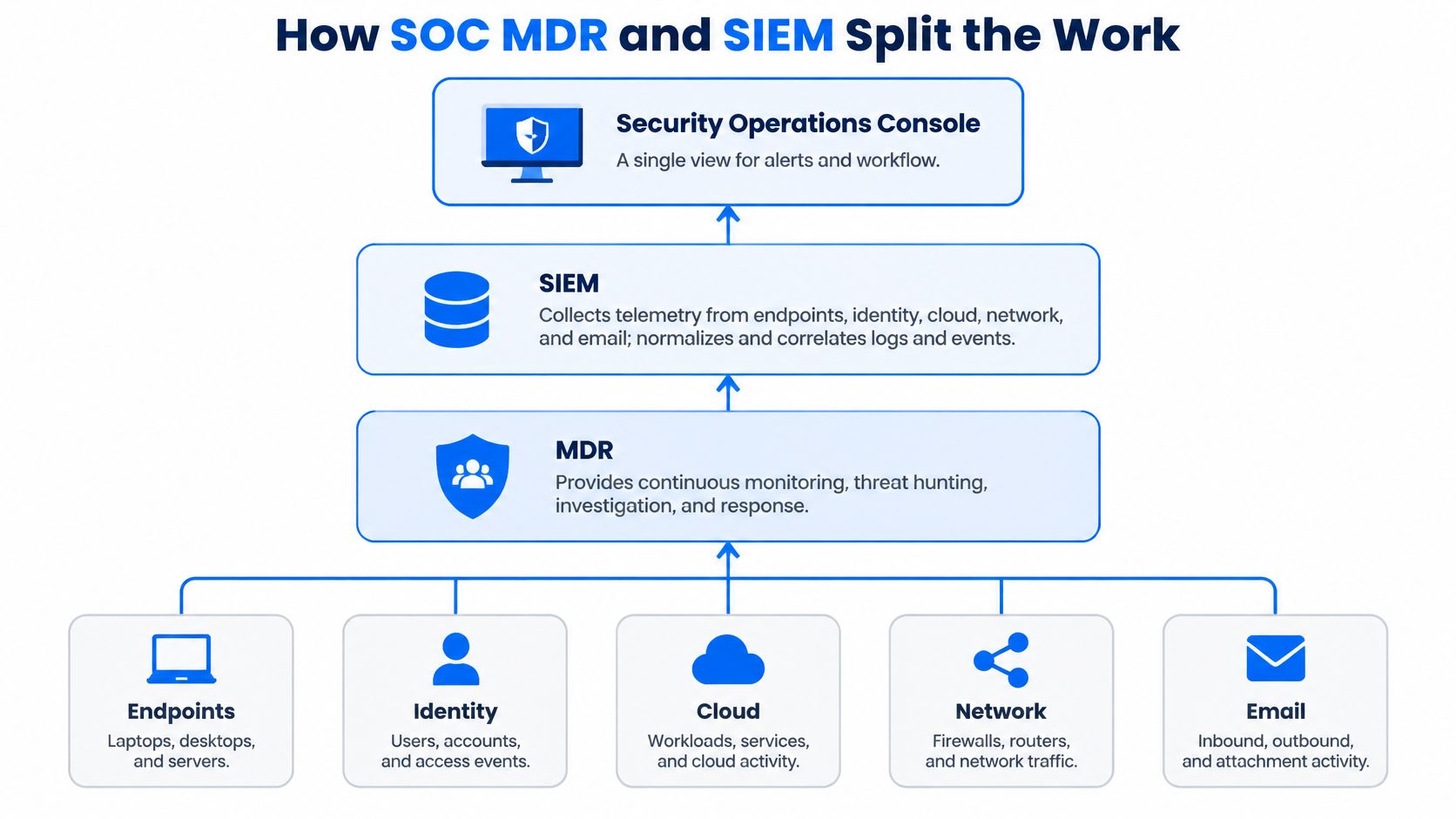
A SIEM is the log and event pipeline. It collects telemetry from endpoints, identity, cloud, network, and email, normalizes it, correlates it, and raises detections. It doesn't answer the phone, interview a user, or isolate a machine. If a critical system never sends logs to the SIEM, that system is invisible no matter how good the console looks.
A SOC is the human and process layer. Analysts watch detections, validate them against asset criticality, triage by severity, and escalate. Those analysts can sit at the provider, inside your company, or split across both in a co-managed model. Many buyers reviewing a managed security operations center are really asking who staffs that layer and what those analysts are allowed to do.
MDR is the outcome layer, usually built on endpoint, identity, and often cloud telemetry. It adds threat hunting plus authority to investigate and contain. That's the difference between renting a dashboard and hiring a responder.
One incident moving through the layers
Say a suspicious login appears from an unusual location. The SIEM correlates it with a password change and a new device enrollment. SOC analysts check whether the account belongs to a finance administrator and whether the behavior matches travel. They decide it doesn't.
The MDR responder or co-managed analyst then isolates the host, often by moving it to a remediation VLAN where it can be examined without reaching production systems. They preserve evidence, reset credentials under your identity process, and hand recovery back with a timeline. Each layer did a different job.
What often sits beside the stack
Buyers frequently assume nearby work is included. It often isn't.
- Vulnerability management: Scanning, prioritization, and tracking remediation to closure.
- Security-device administration: Firewall rules, tuning, and lifecycle work for security tools.
- Threat intelligence: Context that helps analysts judge whether an indicator matters to your industry.
Watch for the edge case that burns buyers. An MDR contract covers laptops in detail, while the exposed system is a SaaS admin role whose logs aren't in scope. The service performs exactly as written and still misses the incident that matters.
Name the assets, the telemetry, and the person allowed to contain, or the offering is still a tool.
Use that test in every proposal review. If a vendor can't list the assets in scope, the log sources connected, and the containment authority by severity, you're not comparing managed services. You're comparing consoles.
Who Owns Each Step When the Service Fails
A fast response promise doesn't tell you who files a regulator notice. ENISA notes that the simultaneous application of DORA, NIS2, and GDPR can create three different breach-notification regimes, while a third-party ICT provider may fall under DORA and NIS2 simultaneously. NIS2 requires an early notification within 24 hours, whereas DORA requires major ICT incidents to be reported within four hours of classification.
Those clocks start whether or not your contract names an owner. That's why the useful buyer question isn't which MDR logo is best. It's which party owns each decision, notification, evidence-preservation step, and recovery action.
Incident duties split between client and provider
| Duty | Client owns | Provider owns |
|---|---|---|
| Alert triage | Priority rules and asset criticality | First-line triage and validation |
| Incident declaration | Declares the business incident | Recommends severity and evidence |
| Regulator notification | Files NIS2, DORA, and GDPR notices | Supplies the evidence pack on time |
| Containment | Authorizes disruptive actions | Isolates only inside pre-agreed bounds |
| Evidence and privilege | Legal privilege and hold decisions | Integrity-protected investigation records |
| Customer communications | External message and timing | Technical facts only, if asked |
| Threat hunting | Approves scope and crown-jewel assets | Executes hunts inside that scope |
| Backup recovery | Restore decision and business acceptance | Runs the agreed recovery steps |
| After-action test | Accepts lessons and control changes | Tabletop and documented fixes |
How to read the split
The provider should move first on technical work. Analysts validate the alert, gather evidence, and recommend a severity with reasons your team can audit. Your side declares whether it's a business incident, because that decision triggers legal, regulatory, and customer consequences the provider shouldn't own.
Containment needs the tightest boundary. Pre-authorize low-disruption actions, such as isolating a single endpoint or disabling a compromised token. Reserve disruptive actions, such as shutting down a production service or a clinical system, for your named approver. In hybrid environments, analysts should correlate endpoint, identity, cloud, network, and third-party logs before taking a disruptive step, since one signal alone can mislead.
Clauses to demand before signature
- Authorization limits: Which actions are automatic, which need approval, and who approves after hours.
- Severity escalation: Time targets and named contacts for each severity, not a generic mailbox.
- Evidence preservation: Complete, integrity-protected records that forensics and regulators can use.
- Incident ownership: One accountable lead on each side, plus continuity and audit rights.
- Recovery handoff: Who restores, who tests, and who accepts the system back into service.
If a proposal promises a 15-minute response but leaves the filing owner blank, it hasn't answered the question that matters under pressure.
Metrics That Show Risk Fell
Alert volume isn't proof of protection. A noisy service can forward thousands of alerts and still leave critical systems uncovered. Tool count and a single response-time SLA have the same problem. They measure activity, not risk reduction.
A 2026 survey reported that 49% of respondents said customers primarily expect faster incident resolution, while 40% measure ROI through reduced incidents or breaches. In the same survey, 32% identified tool sprawl as their largest operational challenge and 26% cited recruiting and retaining security talent. Separate industry figures there put cybersecurity-product complexity as a top barrier for nearly half of MSP respondents, up from 38% in 2025, and difficulty hiring skilled cybersecurity professionals at 39%, up from 29%.
The lesson is uncomfortable. Outsourcing can move complexity to a provider without reducing your exposure. You need reporting that shows exposure shrinking on the assets that matter, which also supports the evidence trail behind compliance in IT security.
Leading and lagging measures of a managed security service
| Measure | Type | Ask for | Misleading substitute |
|---|---|---|---|
| Critical-asset coverage | Leading | Named crown-jewel systems in the log and response scope | Number of tools deployed |
| Detect, triage, contain, recover | Leading | Median and 95th percentile by severity, definitions unchanged | One average response time |
| False positives after tuning | Leading | Noise falling while coverage stays stable | Alerts suppressed to look quiet |
| Remediation age | Leading | Critical findings aged in days, not quarters | Open-ticket total with no age |
| Privileged-access reviews | Leading | Reviews finished on the agreed cycle | A policy that exists on paper |
| Recovery-test success | Leading | Restores proven on critical applications | Backups that have never been tested |
| Breach or major-incident count | Lagging | Read only next to coverage and recurrence | A drop treated as proof of safety |
Require the full timeline
Ask for elapsed time from first activity to discovery, impact assessment, containment, recovery, and management notification. Require median and 95th-percentile detection, triage, containment, and recovery times by severity, with definitions held constant quarter to quarter. The 95th percentile matters because averages hide the slow incidents that cause damage.
Add context that explains impact. Track labor hours, estimated monetary damage, attack vector, exploited vulnerability, and whether the same weakness recurs. Compare the initial impact assessment with the final one. If those keep diverging, your triage rules or asset data need work.
Treat breach count as a lagging signal that is unsafe alone. Fewer reported incidents can mean stronger prevention, or weaker detection. Read it next to coverage, control health, and recurrence.
Buying rule: A smaller service that shows containment time and remediation age on crown-jewel assets beats a cheap service that forwards more alerts.
That rule keeps the conversation honest. You're paying for prevented and shortened incidents, many of which never become visible as breaches. Leading indicators are how you see that value.
What Rollout Looks Like in Three Settings
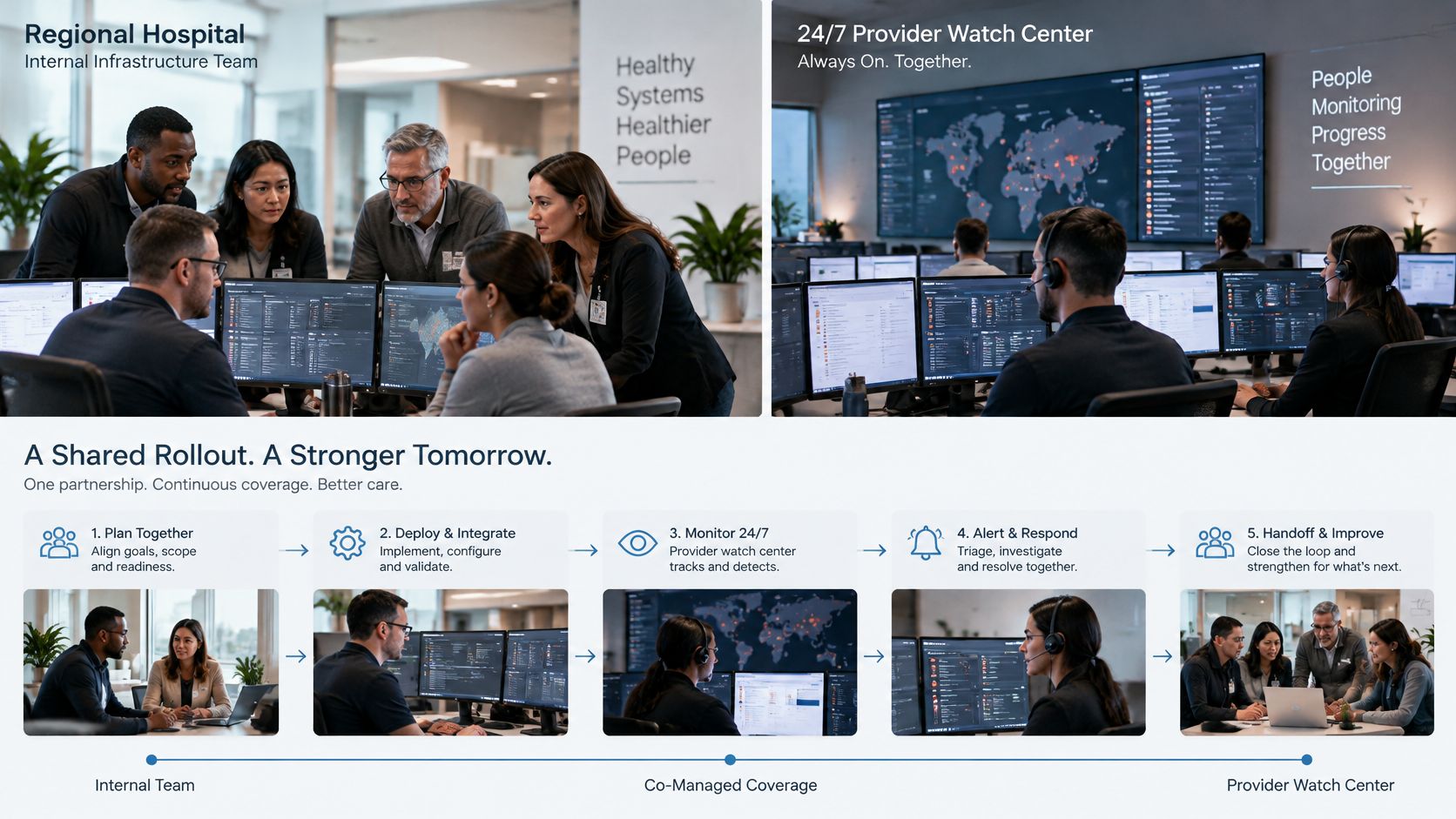
Rollout succeeds when the service becomes part of your incident-response architecture, not a detached alert feed. NIST CSF 2.0 implementation examples specify that incident-response plans should execute in coordination with relevant third parties, with reports triaged, validated, categorized, prioritized, and escalated as needed, and recognize that a managed security provider may perform containment on the organization's behalf.
Three settings, three different fits
Say a regional hospital runs a six-person infrastructure team with no night analyst. A co-managed service watches clinical and identity logs after hours. The hospital keeps patient-communication and regulator-notification ownership and forbids automated shutdown of clinical systems. Coverage improves without handing clinical decisions to an outside analyst.
A multi-site manufacturer with a ransomware history takes a different path. It buys MDR with written authority to isolate a plant-floor endpoint onto a remediation VLAN. Safety-system changes stay inside its own engineering change process. The provider can move fast on IT endpoints, but it can't alter systems where a mistake could injure someone.
A services firm that bought only a SIEM learns the third lesson. Alerts arrive, nobody owns triage, and the queue becomes background noise. It either staffs the analyst role or adds a human response tier. Buying more detection content wouldn't fix an ownership gap.
The shared implementation sequence
- Rank assets first: Order systems by business criticality and regulatory exposure, so monitoring starts where failure hurts most.
- Connect telemetry before go-live: Bring endpoint, identity, cloud, network, and third-party logs together before anyone claims coverage.
- Write authorization boundaries: Define which automated and human containment actions are allowed, and which need your approval.
- Name leads and test the handoff: Assign the incident lead, escalation path, and recovery owner, then run a tabletop that includes the provider.
- Baseline the first 90 days: Capture median and 95th-percentile times with your metric pack instead of judging raw incident counts.
That order matters. Connecting tools before ranking assets produces broad, shallow coverage. Ranking first forces hard choices about crown-jewel systems, evidence needs, and which disruptions your business will tolerate to stop an attack.
Lock the Model Before You Sign
Leave the buying process with one model, one duty split, and one metric pack. A shortlist of logos isn't a decision, because a logo says who watched the console and nothing about who acts, who notifies regulators, or what a prevented incident was worth. Four defaults cover most situations, and they should guide how you structure procurement in IT for this purchase.
- Nights uncovered, policy staying internal: Choose co-managed.
- Almost no security staff: Choose a full MSSP.
- Endpoint containment is the gap: Add MDR to cover that layer, with the rest of the stack still owned.
- Analysts already on staff: Buy the platform and keep the people.
Refuse any proposal that can't name containment authority, the owners of the 24-hour and four-hour notifications, evidence handling, and quarterly median and 95th-percentile times on critical assets. Those items are the service itself, so they belong in the signed scope rather than in an amendment negotiated after the first incident.
Budget realism helps too. ENISA's 2025 Managed Security Services Market Analysis reported survey responses from 83 stakeholders and found most participating entities allocated less than 10% of their budget to MSS, with demand-side organizations investing on average less than 10% of total turnover. Scope has to fit that kind of band rather than an unlimited SOC. Budgets that tight leave little room for paying twice for the same coverage, which makes a clean duty split worth more than a longer feature list.
A vendor-neutral broker such as MR2 Solutions can be one option for comparing providers against your duty matrix and metric pack, scored on operating fit instead of resale quotas.
If you're weighing a full MSSP, co-managed model, or MDR addition, MR2 Solutions helps you compare providers in a vendor-neutral way against your duty split, containment authority, and outcome metrics, then supports selection through implementation and governance. Start that comparison with MR2 Solutions and bring your crown-jewel asset list, current headcount, and notification duties to the first conversation.