
Fractional IT Services: Roles, Costs and Contracts

Your IT director just resigned, a cloud migration is already scheduled, and your insurer wants evidence your security controls work. You don't need more opinions. You need someone accountable for decisions this month, while your team keeps daily operations running. That's the case for Fractional IT Services. Bought well, they're a governance system with decision rights, metrics and a handoff plan. Bought as cheap executive labour, they produce advice nobody owns. Buy the mandate, the hours and the deliverables, not a title.
What Fractional IT Services Are and Who Uses Them
Take a 120-person company whose IT director is leaving. A cloud migration is pending, the cyber insurance renewal lands in three months, and nobody senior remains to choose vendors, set security priorities or defend the budget. Hiring a permanent CIO takes time the company doesn't have.

Fractional IT Services supply senior technology leadership, or named specialist staff, on a part-time, interim or project basis without a full-time hire. We provide on-demand executive IT and security leadership through Fractional CIOs, Fractional CISOs and IT Directors, guiding technology strategy without the full-time cost. You can review that CIO remit through our fractional CIO services.
The Roles in Practice
- Fractional CIO, or vCIO: Owns IT strategy, budget, roadmap and the vendor portfolio. For readers mapping this against permanent structures, this overview of information technology management roles helps separate executive accountability from team management.
- Fractional CISO, or vCISO: Owns the security program, risk register and board reporting.
- Fractional CTO, or vCTO: Owns product architecture, engineering direction and build-versus-buy calls.
- Fractional chief AI officer, or CAIO: Sets AI governance, use-case priorities and approval rules before rollout.
- IT staff augmentation: Adds named technical skills inside your existing team, without changing who leads it.
Think of a fractional leader as a part-time medical director who sets clinical direction for several clinics on a fixed schedule, not a department head sitting in one building every day. Direction is scheduled and accountable. Daily treatment stays with the resident team.
The Alchemy Consulting fractional CIO FAQ places the broader global fractional-executive sector above $5.7 billion in 2024 to 2025, with estimated annual growth of approximately 14%, and describes technology leadership as one of its fastest-growing segments. Cybersecurity complexity, AI adoption and digital transformation drive that demand. Treat those figures as market estimates, not official statistics, because the category mixes consultants, interim executives and advisory firms.
Self-test: Do you need decisions rather than extra hands, is the need time-bound, and can't you yet justify a full-time executive package? Three yes answers make a fractional mandate worth pricing.
Fractional IT Roles Compared at a Glance
Match the option to the constraint. If decisions are missing, hire a fractional executive. If hands are missing, augment the team. If daily operations are failing, buy managed services. Don't expect one model to fix another model's problem.
Our staff augmentation supplements internal teams with experienced technology professionals on a temporary, project-based or long-term basis, letting you add resources without increasing permanent headcount. That solves capacity. It does not create a strategy.
Fractional IT Roles and Staffing Options by Problem
| Option | Owns | Question it answers | Poor fit when |
|---|---|---|---|
| Fractional CIO (vCIO) | IT strategy, budget, roadmap and vendor portfolio | What should we build and fund next? | You need hands-on engineering every day |
| Fractional CISO (vCISO) | Security program, risk register and board security reporting | Are our risks and controls under control? | You need daily security monitoring and engineering work |
| Fractional CTO (vCTO) | Product architecture, engineering direction and build-versus-buy | How should our product and platform be built? | Your product team already has senior architecture |
| IT staff augmentation | Named technical hours inside your existing team | Who can do this specific piece of work now? | You lack direction rather than capacity |
| Managed services | Day-to-day operations against defined service levels | Who keeps our systems running? | You need executive decisions on risk or strategy |
| Permanent executive hire | Full ownership and long-term accountability | Is this a permanent role we will fund? | The need is temporary or project-bound |
Security shows why headcount alone isn't the answer. ISC2's 2025 global workforce study reported that 95% of respondents had at least one cybersecurity skills need, 59% had critical or significant needs, and AI was the most pressing skills need at 41%. Adding people without a decision-maker leaves priorities, independence and regulatory accountability unresolved. If the missing piece is risk ownership, examine our fractional CISO services against that test, not against a monitoring contract.
Three Failure Modes
- Recommendations without delivery: A fractional leader proposes projects your team can't implement, then blames execution.
- Capacity without direction: Augmented specialists stay busy, but nobody decides which work matters or stops low-value work.
- Operations without risk decisions: A managed provider keeps systems available while no executive accepts, transfers or funds the underlying risks.
Before choosing, write down which failure mode you're most exposed to. Choose the option that closes that exposure first, then fill any remaining capacity gap.
Business Benefits and Situations Where They Fit
Fractional leadership pays when a specific decision window is open and waiting for a permanent hire would lose it. Don't buy it for vague transformation. Buy it for a trigger and a 90-day output.
Five Strong Fits
- Startup before funding: The trigger is investor scrutiny without a CTO. In 90 days, a fractional CTO should deliver target architecture, build-versus-buy decisions and a technical hiring plan. A permanent search would finish too late to shape those choices.
- Mid-market acquisition: The trigger is two IT estates, duplicate contracts and incompatible controls. A fractional CIO should produce an integration roadmap, application keep-or-retire list and consolidated vendor plan within 90 days.
- Clinic group facing an audit: The trigger is audit preparation without a security lead. A fractional CISO should build the risk register, assign control owners and prepare board-ready evidence priorities. Hiring permanently before knowing the gaps risks buying the wrong profile.
- CIO departure: The trigger is a six-month leadership gap during recruitment. The interim fractional leader keeps budget, vendor and project decisions moving, then hands documented priorities to the permanent hire.
- AI pilot moving toward rollout: The trigger is staff already using AI tools without clear approval rules. A fractional CAIO should define approved use cases, data boundaries, vendor criteria and human review points before wider deployment.
The benefits are concrete when scope is narrow. You get predictable cost against a full executive package, senior judgment on a defined schedule, and a faster start than a long search. A provider not tied to one product can give an independent view, and a time-bound agreement creates a clean exit. Our TBaaS™ model is designed for organizations of all sizes, and for small to midsize companies with limited IT resources it provides access to experienced advisors and technical expertise they couldn't otherwise support full time.
Know the Limits
A fractional leader is not a daily firefighter. You'll depend on agreed calendar availability, cover arrangements and an internal owner between sessions. Knowledge can also walk out at exit if nobody documents decisions, rationale and open risks.
Write your trigger and required 90-day output before comparing providers. If you can't state both in plain language, you're not ready to buy.
Engagement Models, Pricing and Service Levels
Price turns on three things, hours or days included, seniority and written scope. Compare those first. Don't start with the hourly rate, because a low rate attached to unlimited scope can cost more than a higher fixed fee with a firm cap.
Compare the hours included and deliverables promised, not the rate printed largest in the proposal.
Fractional Engagement Models and What to Specify
| Engagement model | How it is billed | Typical commitment | Terms to specify |
|---|---|---|---|
| Monthly retainer | Fixed fee for agreed monthly hours or days | Ongoing, term set in the agreement | Hours included, response times, reporting cadence |
| Project-based | Fixed fee per defined deliverable | Start and end dates for the project | Deliverables, acceptance criteria, handover steps |
| Hourly or time-and-materials | Billed per hour as work is used | Flexible, often short term | Rate card, hour cap, approval for overruns |
| Staff augmentation | Rate per resource per period | Temporary, project or long term | Skills profile, replacement terms, notice period |
Staff augmentation needs the same discipline. Our guide to what IT staff augmentation involves covers the staffing mechanics, but your agreement still has to name the skills profile, working location or time-zone expectations, replacement terms and end date. If you also need engineering capacity outside a leadership mandate, use a sourcing resource such as Hire LATAM developers as a separate staffing comparison, not as a substitute for executive accountability.
Three Contract Non-Negotiables
- Hours cap with approval: State included hours or days and require written approval before overruns are billed.
- Notice period: State how either side ends the engagement, what handover is owed and when access is removed.
- Exact statement of work: Name services, exclusions, deliverables, meeting cadence and acceptance owners. We outline the specific services we provide in a separate service agreement or statement of work, so insist on the same paper trail from any provider.
We offer TBaaS™ pricing at three levels of engagement. Ask which tier a quote uses and read its statement of work before comparing it with another provider. A tier label means nothing without included time and outputs.
Service Levels That Prevent Drift
- Named lead and backup: One accountable leader and one alternate who can act during absence.
- Response times: Separate targets for security incidents, urgent leadership decisions and routine requests.
- Monthly reporting pack: Decisions made, risks changed, milestones hit, hours used and next priorities for executives or the board.
- Named escalation path: Who receives an issue, who can approve spend and who accepts residual risk.
- Scope review date: A fixed review to continue, reduce, expand or end the mandate.
Security metrics should be just as explicit. NIST's Cybersecurity Framework 2.0 publication supports measurable controls including risk-register closure, incident-response exercise frequency, privileged-access review completion and mean time to remediate, while NIST reports 469,930 U.S. cybersecurity job postings during the measured 12-month period and only 85 skilled workers for every 100 positions demanded. That scarcity strengthens the case for fractional governance, but only when execution owners remain named internally or with a managed provider.
Give every metric a baseline, target and owner. For example, a vCISO might target closing 80% of high-rated risks within 90 days, reported monthly, while operational teams own remediation evidence. The fractional executive owns risk acceptance, policy direction and control priorities. Your team owns implementation.
Ask every provider two questions before discussing price further. What is the hour count in month one, and what's the deliverable at the end of it? A vague answer predicts a vague engagement.
How to Integrate Fractional Leaders With Your Team
A fractional title doesn't fix weak governance. It can make weakness more visible by generating recommendations faster than your organization can decide who owns them.
PwC's 2025 Global Digital Trust Insights survey, covering 4,042 executives across 77 countries, found that fewer than half of organizations involve CISOs extensively in strategic planning, board reporting or technology oversight, and only 15% measure the financial impact of cyber risk to a significant extent. Don't repeat that pattern with a part-time leader and call it progress.
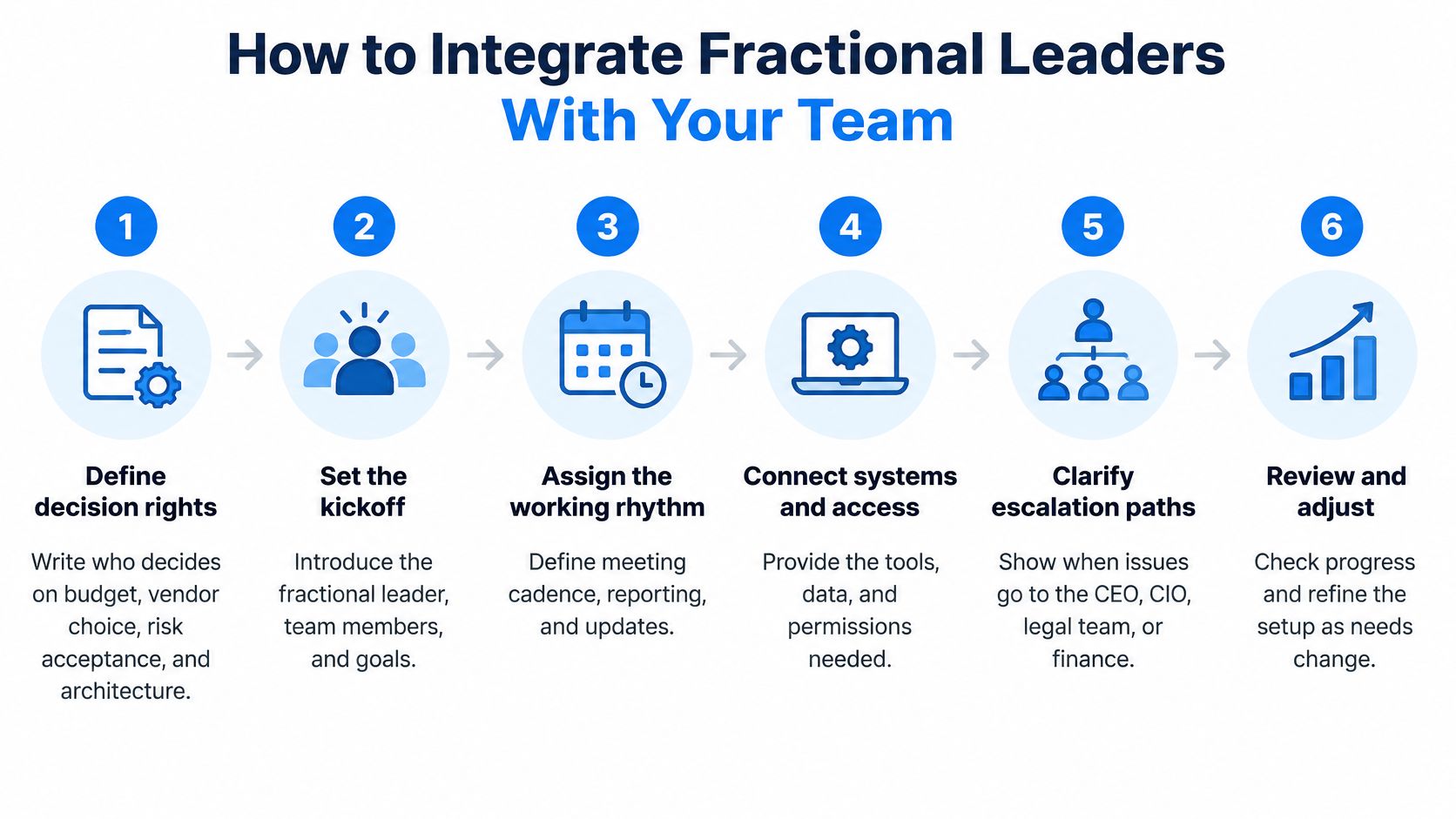
Six Integration Steps
- Define decision rights. Write who decides budget, vendor choice, risk acceptance and architecture. Mark where the CEO, CIO, legal team or managed-service provider remains in charge. This is the step companies skip, then wonder why advice piles up.
- Build a responsibility matrix. Name one accountable owner per workstream. Separate strategy and approval from execution and evidence collection, so nobody assumes attendance equals ownership.
- Set the reporting cadence. Hold a weekly working session with the internal IT lead and send a monthly executive report. Keep decisions, blockers and risk changes in the same pack each month.
- Create a shared risk register. The fractional leader maintains priorities and closure criteria, while internal owners update actions and attach evidence. Don't let the register live in the consultant's private files.
- Name a backup decision-maker. Security incidents and vendor deadlines won't wait for the fractional leader's next scheduled day. Give the backup spending and escalation authority in writing.
- Review at 30, 90 and 180 days. Judge the agreed metrics, then extend, shrink or transition the work to a permanent hire. Don't renew on activity alone.
Our TBaaS™ approach works alongside internal IT teams, enhancing their decision-making and reducing their workload during evaluation and vendor selection. That's the relationship to require. The fractional leader strengthens your operating model rather than building a parallel one.
You'll know integration is working when internal staff bring decision-ready options to the leader, not raw confusion. The leader returns documented decisions, with owners and dates, instead of holding critical knowledge in conversations. At exit, your team should be able to run the register, reporting cadence and vendor priorities without reconstruction.
Choose a Fractional IT Partner Before You Sign
Don't choose on chemistry or a polished capability deck. Test every provider against the same readiness checklist and make weak answers disqualifying.
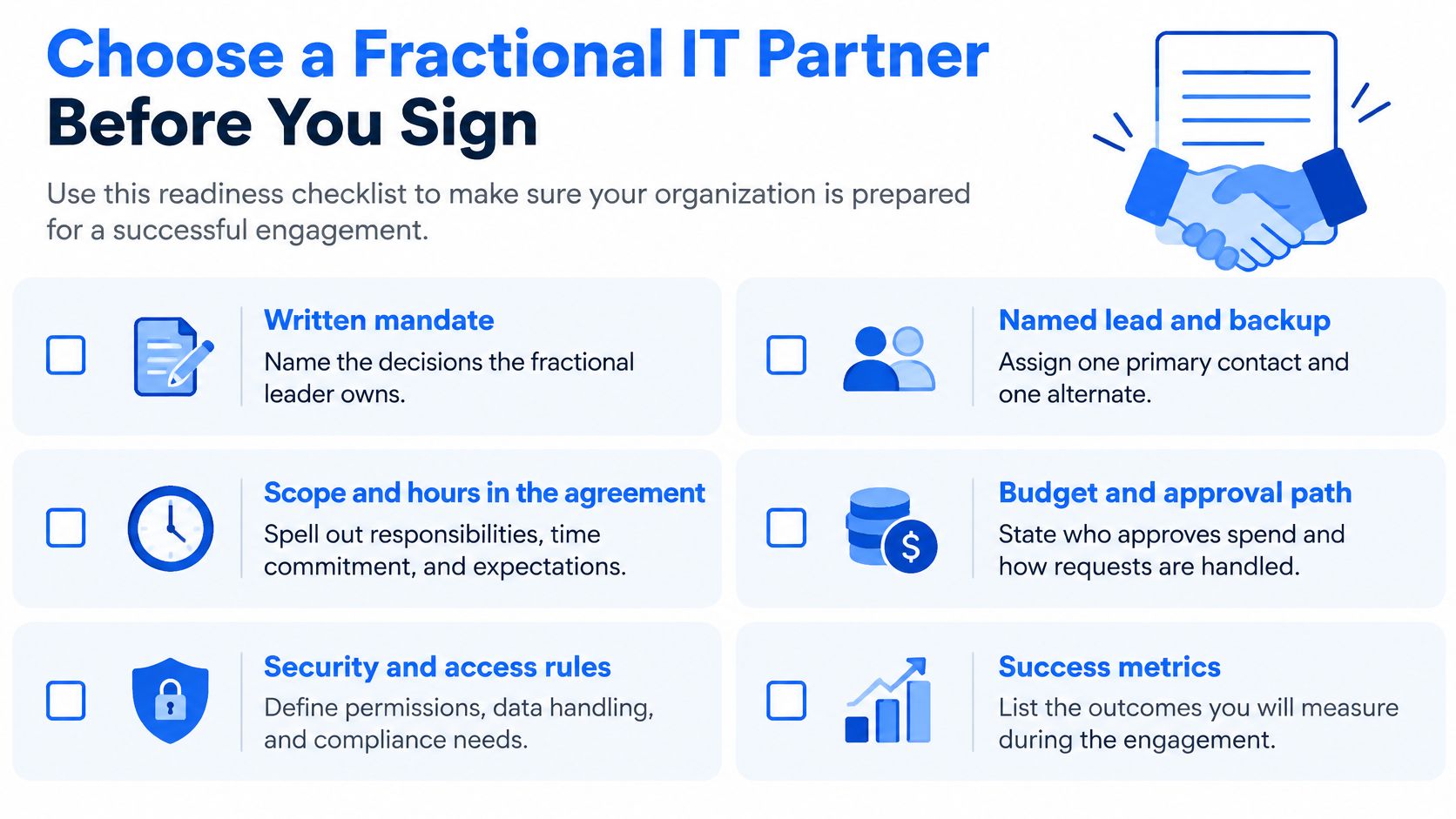
Readiness Checklist
- Written mandate: Name the decisions the fractional leader owns and those reserved for your executives.
- Named lead and backup: Identify both people before signature, not after the first absence.
- Scope and hours in the agreement: Include deliverables, exclusions, meeting cadence and approval for extra time.
- Service-level measures with owners: Tie each measure to a baseline, target and accountable person.
- Exit clause and notice period: Require handover material, access removal and transfer of registers and decision logs.
- Relevant references: Speak with organizations of similar size and sector, and ask what the provider stopped doing when results lagged.
A strong partner starts with your business outcomes, not a product list. MR2 Solutions works as a vendor-neutral technology brokerage, and our TBaaS™ consulting covers multiple technology categories through one point of contact. Through that model, we help organizations objectively evaluate managed service providers, negotiate vendor relationships, optimize service delivery and ensure technology investments support business goals. Our clients include IT executives from Fortune 500 companies and healthcare systems, but test us against the same checklist as every alternative.
If your gap is implementation capacity rather than leadership, a marketplace such as Hire Developers belongs in a separate staffing comparison. Don't let a developer rate distract you from an unanswered governance problem.
Ask every shortlisted provider to quote the same scope, same hours and same deliverables. Then compare reporting quality, backup cover, exit terms and references, not just fees.
Make one decision this week. Pick the single problem you need solved, select the role from the comparison that owns it, write its mandate and metrics, and request two quotes on identical scope. That's how you buy accountability instead of fractional presence.
If you need CIO, CISO or AI leadership without adding a full-time executive, talk with MR2 Solutions about a defined mandate, measurable service levels and a clean handoff plan. Bring your trigger and 90-day outcome, and we'll help you test whether a fractional engagement, staff augmentation or managed service is the right fit.