
Fractional CIO Services Explained: Your Guide

Fractional CIO services provide part-time, high-level IT leadership for organizations that need C-suite expertise without the full-time salary. The model emerged in the 2010s, and by 2024 to 2025 the broader fractional executive market had surpassed $5.7 billion, growing at roughly 14% CAGR, with demand for fractional CIOs and CTOs rising 68% year over year from 2023 to 2024.
That growth reflects a problem many leadership teams recognize. The help desk is operating, vendors are sending invoices, security alerts are appearing, and major initiatives keep moving forward without a clear decision-maker. Technology is active, but it isn't necessarily directed.
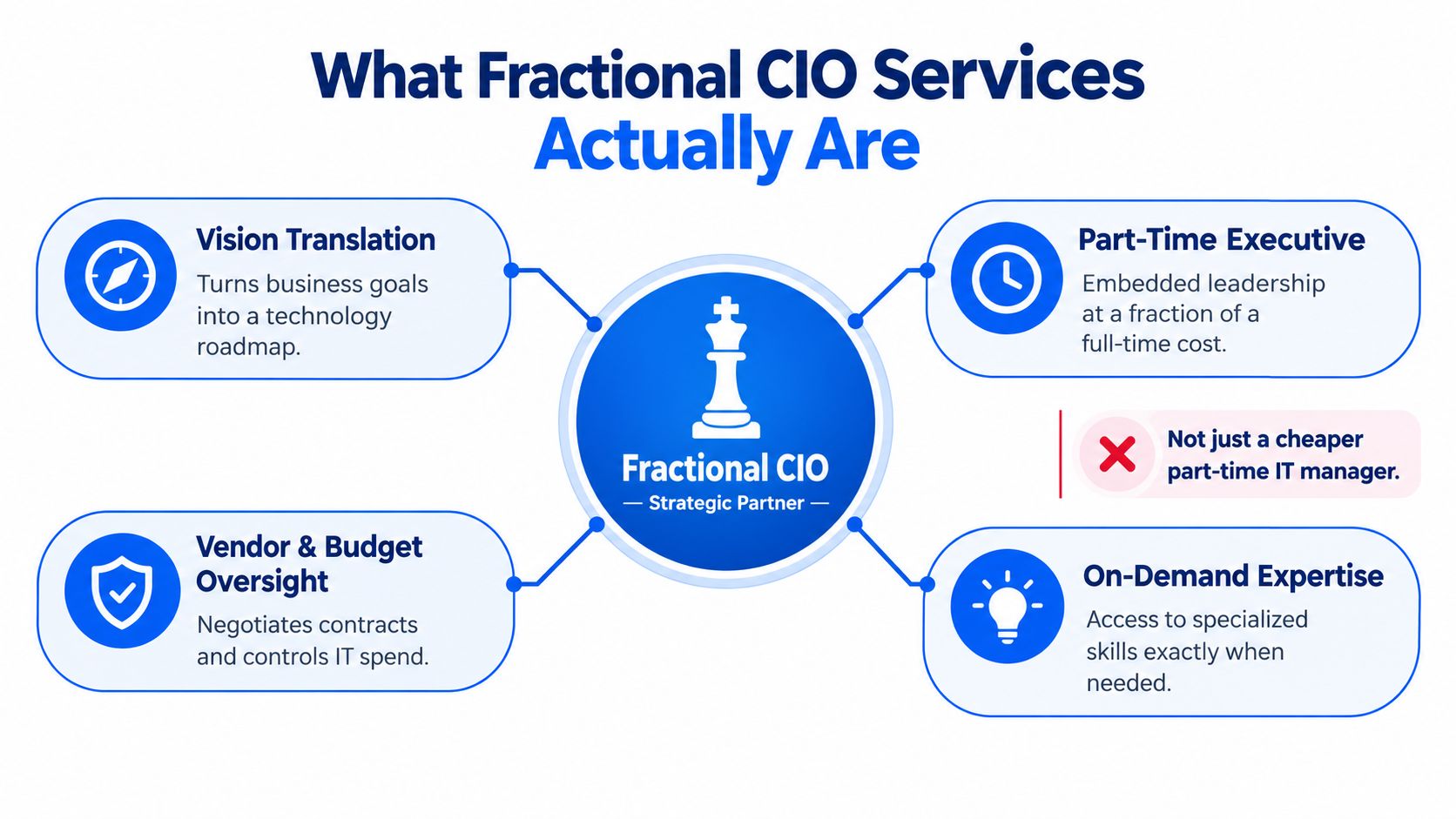
A fractional CIO services engagement adds the missing executive layer. The right leader connects technology decisions to business priorities, establishes accountability, and creates a governance rhythm that internal teams and external providers can follow. The important distinction is that this isn't just a cheaper IT manager. It's a structured way to access strategic leadership when a permanent CIO isn't yet the right fit.
What Fractional CIO Services Actually Are
A fractional CIO is best understood as a part-time CEO for technology. The role doesn't exist to approve help desk tickets or become the most senior person troubleshooting a failing laptop. It exists to decide where technology should take the organization, which risks deserve attention, and how internal teams and vendors will execute the plan.
Consider a growing organization with an internal IT manager, a managed service provider, a cloud platform, and several line-of-business applications. Each party may be competent. Yet the CEO still receives conflicting recommendations, finance sees rising technology spend, and department leaders sponsor disconnected projects. A fractional CIO turns those separate conversations into one business-led technology agenda.
That means translating goals such as opening a new location, improving patient access, protecting sensitive data, or integrating an acquisition into concrete technology decisions. The fractional CIO may recommend a cloud architecture, revise vendor responsibilities, establish cybersecurity oversight, or stop a project that doesn't support the operating plan. The value comes from judgment and coordination, not from occupying a particular office.
Leadership above daily operations
A strong engagement usually complements an existing IT team. Internal staff can focus on service delivery, systems administration, user support, and implementation. The fractional CIO provides prioritization, executive communication, architecture direction, budget scrutiny, and vendor accountability.
The distinction matters because operational competence doesn't automatically produce strategic alignment. A team can keep systems running while postponing identity modernization, accepting unclear vendor scopes, or investing in tools without an owner. Fractional leadership creates the forum in which those decisions are made deliberately.
The model's origin reflects that need. Independent analysis describes fractional CIO services as an extension of the broader rise of fractional executive leadership in the 2010s, when small and mid-sized businesses needed senior technology guidance but couldn't justify a permanent CIO hire. The same analysis connects the model to the gig-economy shift and the expansion of strategic IT needs beyond large enterprises. SIA Partners' analysis of the rise of fractional CIOs places that development in the context of technology becoming strategically important across sectors.
For founders and finance leaders comparing executive support models, the logic is similar to the case for fractional finance leadership. This overview of why startups choose fractional finance executives is useful because it illustrates the broader principle: specialized executive judgment can be introduced before a company needs a permanent executive department.
Core Responsibilities and Strategic Deliverables
The output of a fractional CIO engagement shouldn't be measured by how many meetings the executive attends. It should be visible in the decisions the organization can make, the risks it understands, and the work that moves from discussion to controlled execution.
A practical way to define the role is through People, Process, and Portfolio. These pillars prevent the engagement from becoming a loose advisory arrangement with no durable operating value.
People
The fractional CIO establishes who owns technology decisions and how those decisions reach the executive team. That may include clarifying the relationship between an IT director, security lead, managed service provider, application owners, procurement, and finance.
The deliverables can include a responsibility matrix, an executive reporting cadence, a decision-rights model, and coaching for technical leaders. The goal isn't to displace capable staff. It's to stop capable staff from being forced to resolve strategic conflicts without executive sponsorship.
This pillar also includes communication. A CIO-level leader should be able to explain why an identity project matters to finance, why a vendor contract creates operational exposure, or why delaying a platform decision creates downstream cost and risk. Technical detail still matters, but it must arrive in a form that business leaders can act on.
Process
Process turns good intentions into repeatable governance. A fractional CIO may create a technology planning cycle, investment review criteria, cybersecurity escalation rules, and a standard for evaluating vendors and projects.
A useful operating rhythm typically separates urgent operational matters from strategic decisions. An incident may require immediate coordination, while a cloud migration needs a documented business case, target architecture, sequencing plan, and acceptance criteria. Mixing those conversations guarantees that urgent work will consume every available leadership hour.
Practical rule: If an engagement doesn't define decision rights, milestones, and escalation paths, it isn't governance yet. It's advice.
The process should also produce an accessible record of decisions. Architecture assumptions, contract obligations, risk acceptances, and project dependencies shouldn't live only in one consultant's memory or inside scattered email threads.
Portfolio
The portfolio is the set of technology investments, obligations, and risks competing for attention. A fractional CIO should help leadership see that portfolio as a whole rather than reviewing each request in isolation.
Typical deliverables include:
- Technology roadmap: A sequenced plan connecting business objectives to infrastructure, applications, data, security, and operating capabilities.
- Cybersecurity governance: A prioritized view of controls, ownership, exposure, incident readiness, and compliance obligations.
- Vendor oversight: A structured review of scope, service levels, renewal terms, dependencies, and performance.
- Investment decisions: Clear recommendations on what to fund, defer, consolidate, replace, or govern more closely.
- Project accountability: Milestones, sponsors, dependencies, risks, and acceptance criteria that executives can understand.
This portfolio discipline applies to environments as varied as a multi-site healthcare organization, a manufacturer modernizing plant connectivity, or a public-sector initiative involving smart city IT asset management. In each case, the CIO's contribution is less about selecting a fashionable tool and more about connecting assets and investments to service outcomes.
Comparing Fractional Leadership to Full-Time CIOs
The decision isn't just about choosing the cheaper executive. A full-time CIO and a fractional CIO solve different organizational problems, and either model can fail when the scope is poorly defined.
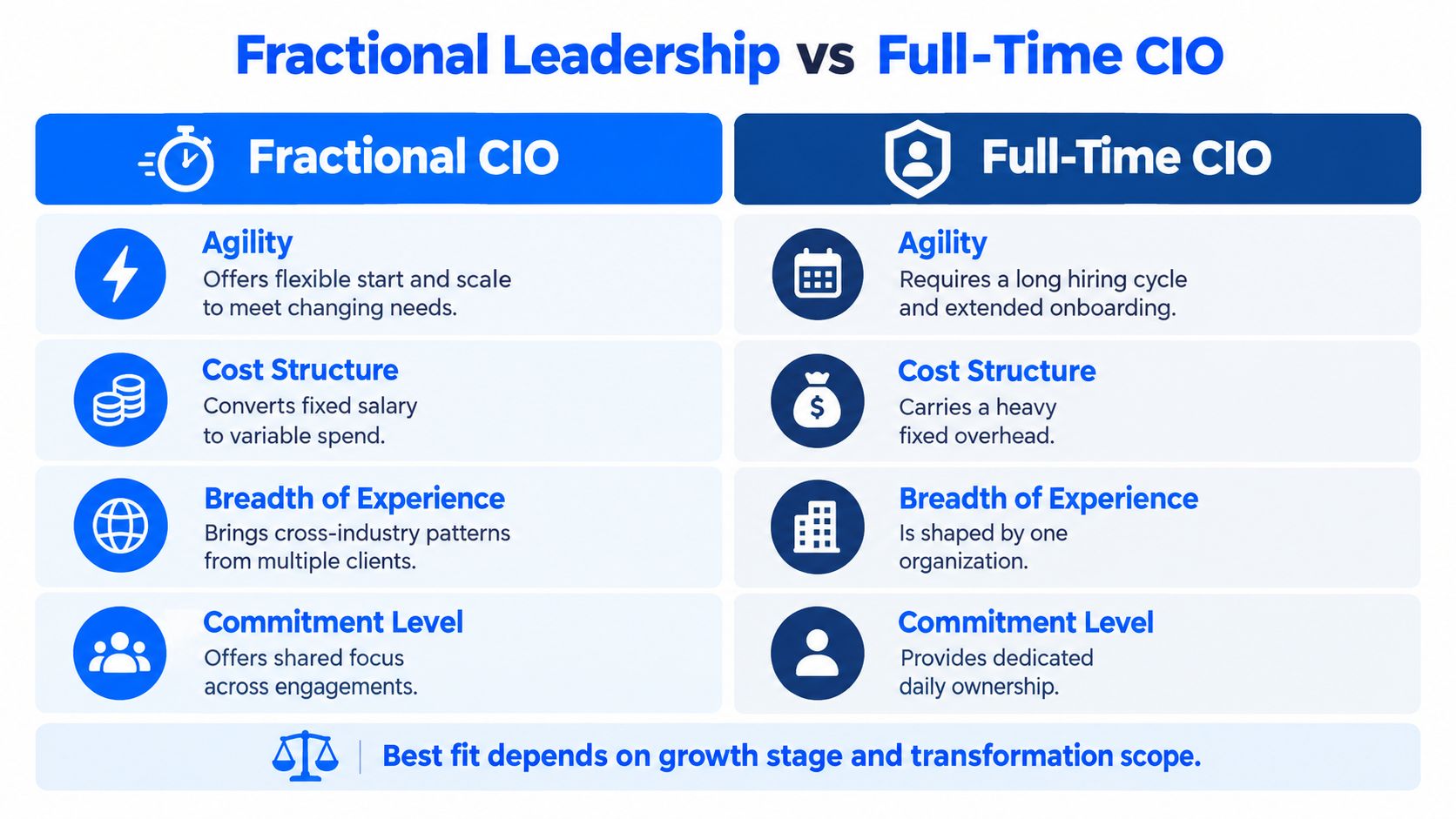
A full-time CIO offers dedicated daily ownership. That depth can be valuable when the organization is managing a sustained transformation, operating a large internal technology function, or requiring constant executive presence across many business units. The executive learns the culture, informal decision networks, operational history, and long-term ambitions in detail.
A fractional CIO offers flexibility and a different kind of breadth. Because the leader works across environments, they may recognize recurring patterns in vendor negotiations, cloud governance, cybersecurity ownership, technology debt, and transformation planning. That perspective can challenge assumptions that have become invisible inside one organization.
The trade-offs that matter
| Decision factor | Fractional CIO | Full-time CIO |
|---|---|---|
| Agility | Can begin with a defined need and expand as priorities become clearer | Usually requires a formal executive search and a longer commitment |
| Cost structure | Converts some executive capacity into variable or scoped spend | Creates a fixed employment structure with salary, benefits, and related overhead |
| Experience breadth | Brings patterns from multiple organizations and technology environments | Develops deep context inside one organization |
| Commitment level | Shares attention across engagements, requiring explicit availability rules | Provides dedicated daily ownership |
| Continuity | Depends on documented handoffs, backup coverage, and provider structure | Depends heavily on one internal executive and the organization's retention |
| Best use | Strategic direction, transformation planning, governance, or interim leadership | Persistent enterprise-wide ownership and continuous executive integration |
The danger is treating fractional leadership as a permanent substitute when the business really needs daily executive ownership. A fractional engagement can also disappoint when leaders expect the executive to solve every operational issue personally, rather than establish a system in which others execute.
The opposite mistake is hiring a full-time CIO before the organization has defined the mandate. A permanent executive without a clear decision domain may inherit a collection of vendor problems, stalled projects, and unclear expectations. In that situation, the company has paid for seniority without creating the conditions for effective leadership.
The right choice depends on transformation scope, internal capability, regulatory exposure, geographic complexity, and the required decision cadence. Organizations that need a strategic layer but aren't ready for a permanent C-suite role may also compare adjacent models, such as fractional CTO services, when product engineering or technical architecture is the primary concern.
Pricing Models and Engagement Flexibility
Commercial structure determines whether fractional CIO services remain useful after the initial assessment. A vague agreement can produce vague work, regardless of the executive's experience. Procurement, finance, and the leadership team should know what access, decisions, deliverables, and escalation support the engagement includes.
Retainer for ongoing governance
A monthly retainer fits organizations that need a consistent executive rhythm. The fractional CIO may attend leadership meetings, review the roadmap, oversee vendors, maintain the risk register, guide budgeting, and support major decisions.
Retainers work when the organization needs continuity rather than a one-time document. The agreement should specify meeting cadence, response expectations, included advisory time, reporting outputs, and the conditions that trigger work outside the base scope.
Project-based work for a defined outcome
A project-based fee suits a contained initiative such as a cloud migration assessment, data-center transition, technology due diligence exercise, cybersecurity program design, or vendor consolidation.
The essential safeguard is a written definition of completion. “Develop a cloud strategy” is too broad. A useful scope identifies the current-state review, target-state options, decision criteria, implementation sequence, assumptions, dependencies, and executive approval point.
Project engagements can later become ongoing governance, but that transition should be deliberate. Otherwise, the organization receives a polished recommendation and has no executive owner for implementation.
Surge capacity for acute needs
A surge model provides concentrated support during an incident, acquisition, regulatory review, major contract renewal, or urgent transformation decision. It can be valuable when the organization needs senior judgment quickly, but it shouldn't be confused with a standing operating model.
Before using surge support, agree on who can authorize work, what information the CIO receives, which decisions remain with the executive team, and how the engagement will hand off to internal staff or a continuing provider. A crisis is the worst time to negotiate basic authority.
Leaders should also separate advisory fees from delivery costs. A fractional CIO may recommend a provider, coordinate implementation, or govern the work without being the party that performs every technical task. Reviewing managed IT services cost considerations can help finance teams distinguish leadership, operations, project delivery, and third-party technology charges.
Integrating Fractional CIO into TBaaS Engagements
Standalone consulting often breaks at the point where strategy meets procurement. An advisor recommends a target architecture, then internal staff must evaluate providers, negotiate terms, coordinate implementation, and explain delays to executives. The recommendation may be sound, but accountability becomes fragmented.
A Technology Brokerage-as-a-Service, or TBaaS, framework closes that gap by treating strategy, provider selection, delivery coordination, and governance as connected responsibilities. The fractional CIO remains vendor-neutral while working inside a structured ecosystem of specialists and solution providers.
From recommendation to governed decision
The process starts with business and operational discovery. Leaders identify the outcomes that matter, the constraints they can't ignore, and the risks that require executive attention. The fractional CIO then translates those findings into a decision framework, not a predetermined vendor shortlist.
That framework can cover:
- People: Who owns the decision, who operates the service, and who approves exceptions.
- Process: How providers are evaluated, how implementation is governed, and how performance is reviewed.
- Portfolio: How the proposed solution fits existing contracts, architecture, security controls, budgets, and future priorities.
A brokerage framework also helps prevent a common conflict. The person giving strategic advice shouldn't be rewarded just for steering the client toward one product or provider. Vendor neutrality allows the recommendation to be tested against business requirements, delivery capacity, integration constraints, and total operating impact.
Continuity beyond the individual executive
The TBaaS model becomes especially valuable when several providers are involved. A cloud partner, managed service provider, cybersecurity firm, connectivity carrier, and application vendor may each perform a narrow role. Without a coordinating owner, every issue becomes a boundary dispute.
A structured fractional CIO engagement creates one governance record for decisions, responsibilities, risks, milestones, and escalations. It can also preserve architecture knowledge and vendor context so the organization isn't exposed when a consultant becomes unavailable.
That doesn't mean the brokerage eliminates every delivery risk. It means the organization has a repeatable mechanism for identifying the risk, assigning ownership, and escalating the issue. This is the difference between buying advice and building an operating capability.
For organizations evaluating this model, the TBaaS approach to smarter technology decisions provides useful context on how vendor-neutral discovery and coordinated execution can work together. The practical test is simple: after the engagement begins, can leadership see which decision is being made, why it matters, who owns implementation, and how progress will be judged?
Key Takeaways for Getting Started
The first step isn't finding a part-time CIO. It's defining the leadership gap. Identify the decisions that keep returning to executives, the initiatives that lack ownership, the vendor relationships nobody governs, and the risks that the current IT structure can't prioritize.
Then require a written engagement design:
- Set milestones: Define the assessment, roadmap, priority decisions, and implementation handoffs.
- Assign authority: Specify what the fractional CIO can recommend, approve, escalate, or manage.
- Document continuity: Require shared records, backup coverage, and a plan for executive unavailability.
- Measure outcomes: Use completed decisions, risk treatment, roadmap progress, vendor accountability, and business alignment as evidence of value.
- Protect neutrality: Make provider selection transparent and separate strategic advice from supplier incentives.
The cheapest individual consultant isn't automatically the safest choice. Market commentary notes that individual consultants remain the largest segment, creating continuity and capacity risks when one person holds the architecture history, compliance context, and vendor relationships. It also identifies trust, executive support, and integration with the internal team as important success factors. Fortium Partners' market map supports the case for evaluating the operating structure behind the executive, not just the executive's résumé.
Fractional CIO services work when they create durable governance. Start with a defined problem, a measurable mandate, and a continuity plan, then choose the engagement model that matches the organization's actual decision load.
MR2 Solutions offers vendor-neutral fractional CIO and security leadership, technology brokerage, provider evaluation, implementation coordination, and ongoing governance through its TBaaS framework. Visit MR2 Solutions to discuss how a structured fractional leadership engagement can bring clearer accountability to your technology roadmap and vendor ecosystem.