
Cybersecurity Regulatory Compliance: A Practical Guide

You have a spreadsheet with five frameworks, three audits due this year, and a board asking whether you're compliant. Your team can name the controls. What you can't yet do is show, for each obligation, who owns it, where the evidence sits, and which deadline applies if something breaks tonight. That's the work of cybersecurity regulatory compliance. It's not collecting more checklists. It's building one set of controls, proving they run continuously, and reusing that proof across every regime that applies to you.
Which Regulations Apply to Your Organization
Think of a regulation like a building code. It sets the outcome a structure must meet, not how you frame the walls. Compliance means meeting the obligations tied to your data, your customers, and your sector, using controls you choose and can defend.
Start with three questions. What data do you hold, such as health records, card data, or personal data? Where do your customers and operations sit? Which sector do you serve? Your answers point to the regimes below.
| Regulation or framework | Who it applies to | Core requirement | Binding status |
|---|---|---|---|
| HIPAA Security Rule | US healthcare providers, health plans and their business associates | Safeguards for electronic protected health information: access control, audit controls, integrity and transmission security | Binding US federal law |
| PCI DSS v4.0 | Any entity that stores, processes or transmits cardholder data | 12 requirements covering network security, access control, logging, testing and policy | Contractual standard enforced by card brands and acquirers |
| GDPR | Organizations processing personal data of people in the EU or EEA | Appropriate technical and organizational measures and breach notification | Binding EU regulation |
| NIS2 | Essential and important entities in EU sectors such as energy, health and digital infrastructure | Cybersecurity risk-management measures, supply-chain security and incident reporting | Binding through national implementing law |
| DORA | EU financial entities and their ICT third-party providers | ICT risk management, incident reporting, resilience testing and a register of ICT providers | Binding EU regulation applying from January 2025 |
| SEC cybersecurity disclosure rules | US public companies and certain foreign private issuers | Disclosure of material incidents on Form 8-K and annual risk-management disclosure | Binding securities rules adopted in 2023 |
| NIST CSF 2.0 | Organizations of any size, sector or maturity | Six functions: Govern, Identify, Protect, Detect, Respond and Recover | Voluntary framework |
| ISO/IEC 27001 | Any organization that wants a certifiable information security management system | Management system with risk-based controls from Annex A | Voluntary standard with third-party certification |
Regimes overlap in practice. Say a US hospital group takes card payments at its clinics. HIPAA covers its patient data, PCI DSS covers its payment systems, and state privacy laws may cover its website and billing records at the same time. None of those cancels the others out.
You need a shared vocabulary to manage that overlap. The NIST Cybersecurity Framework background explains that NIST released CSF 1.0 in 2014, updated it in 2018, and issued CSF 2.0 in February 2024, expanding five functions to six by adding Govern. It's voluntary, but it becomes binding in practice when a customer contract or regulator expects it. Customer audits often add another layer, so reviewing SOC 2 compliance essentials helps you see how trust-services criteria compare with legal duties. Our guide to cybersecurity compliance frameworks shows how to layer them without duplicating work.
Make a decision and start there. An EU financial entity starts with DORA's ICT provider register and incident clock. A US healthcare organization that takes cards starts by scoping HIPAA and PCI DSS together.
How One Control Satisfies Several Regulations
Multi-factor authentication is the easiest place to see the principle. PCI DSS asks for it under Requirement 8. NIST CSF 2.0 places it in PR.AA, its identity and access control category. NIS2 expects it as part of risk-management measures for access control. You don't build three MFA systems. You build one, enforce it everywhere it's needed, and keep one evidence set that three audits can use.
Most regulations ask for the same handful of controls. They differ in wording, scope, and how strict the test is, not in the underlying safeguard. Read the table row by row. Each row is one control you'd build once. Each column shows where that regime asks for it.
| Control area | HIPAA Security Rule | PCI DSS v4.0 | NIST CSF 2.0 |
|---|---|---|---|
| Access control and multi-factor authentication | Access control and person or entity authentication standards | Requirements 7 and 8 restrict access and authenticate users | PR.AA identity management, authentication and access control |
| Logging and monitoring | Audit controls | Requirement 10 logs and monitors all access | DE.CM continuous monitoring |
| Incident response | Security incident procedures | Requirement 12 incident response planning | RS Respond function |
| Vulnerability management | Risk analysis and risk management | Requirements 6 and 11 protect systems and test security | ID.RA risk assessment and PR.PS platform security |
| Business continuity and recovery | Contingency plan | Covered by Requirement 12 policies and risk-management programme | RC Recover function |
| Third-party and supplier risk | Business associate contracts | Requirement 12 third-party service provider management | GV.SC supply-chain risk management |
Turning the Map Into a Working Tool
A table like this is only a starting point. Your working tool is a control-to-obligation matrix, with one row per obligation. For each row, record the control that meets it, the system owner, the systems in scope, the test procedure, where evidence lives, and every framework reference that control serves.
Say your identity provider enforces MFA for remote access and privileged accounts. One matrix row links that control to PCI DSS Requirement 8, HIPAA authentication, and PR.AA. The evidence is the same in each case, a configuration export plus a sample of accounts showing MFA is on. You collect it once, tag it three ways, and reuse it.
Mapping is not compliance. A mapped obligation with no control behind it is a gap. Log it, assign an owner, and set a date to close it.
Differences still matter. Incident response shows why. The ENISA mapping of NIS2 obligations describes an initial notification within 24 hours for qualifying significant incidents affecting essential and important entities. That deadline forces a specific design. You can't wait for forensics to finish. Connect your SIEM or XDR alerts to an incident platform that stamps detection time, validation time, affected services, and the notification deadline. Give an on-call manager authority to approve the first notice using a preapproved template.
Set your baseline this way. For each control area, implement the strictest requirement that applies to your data, then document where a narrower rule covers only a specific data set. If PCI DSS demands the tightest logging retention for your cardholder environment, build to that standard there, and note where a lighter standard is acceptable elsewhere. One strong control, clearly scoped, beats three partial ones.
How to Build a Compliance Program Step by Step
A compliance program is a repeatable cycle, not a binder you update before an audit. The NIST Cybersecurity Framework supports that cycle with its six functions, Govern, Identify, Protect, Detect, Respond, and Recover, and its Govern function expects you to account for legal, regulatory, and contractual obligations. These seven steps turn that structure into daily work.
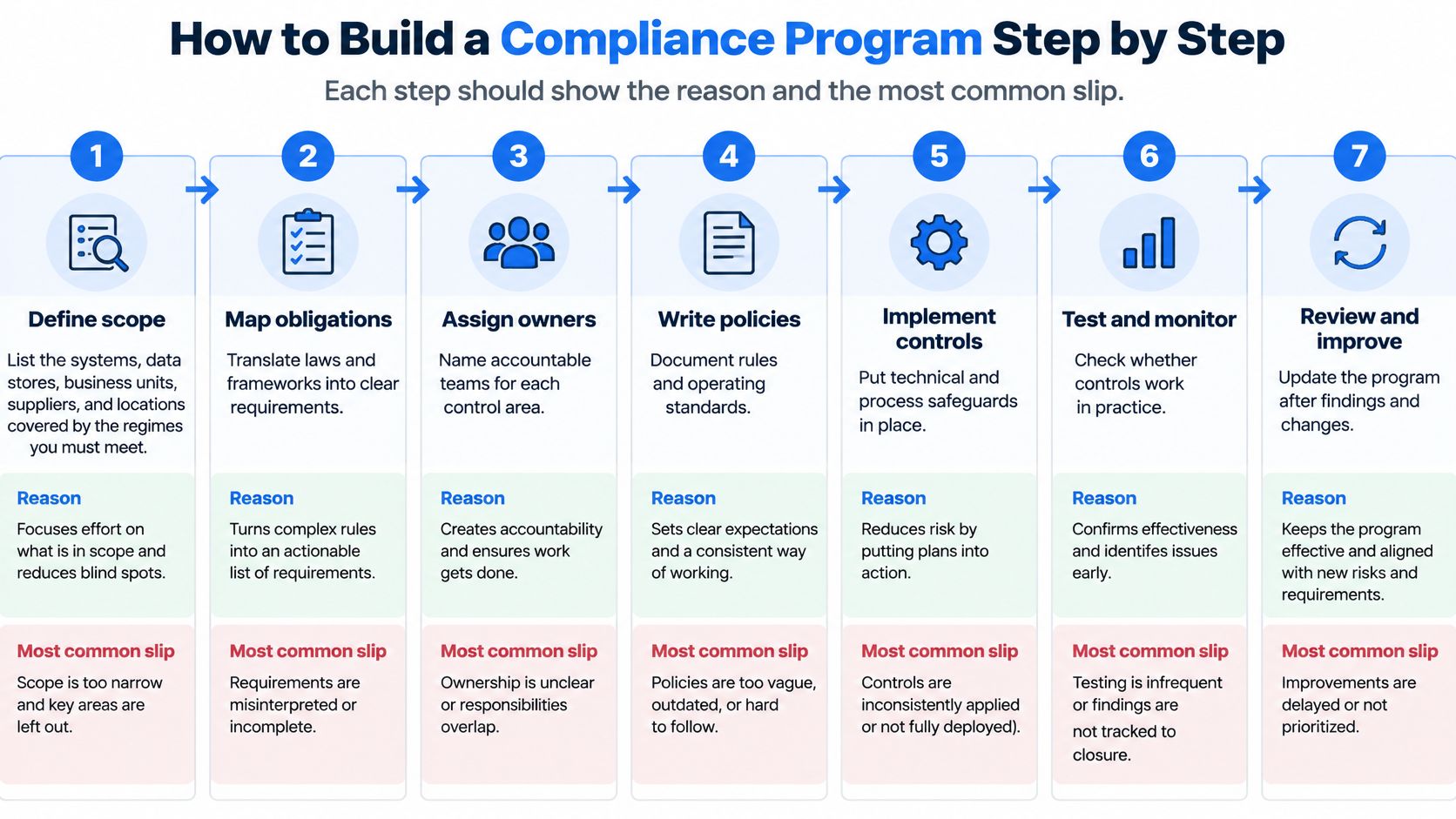
Define scope. List the systems, data stores, business units, suppliers, and locations covered by the regimes you identified. Scope decides what an auditor can test. The common slip is scoping only core IT and missing shadow SaaS that staff bought with a credit card.
Inventory obligations. Turn each regime into a plain list of requirements, each with a named owner. This stops a regulation sitting unread in legal's inbox. The slip is copying the text of a law into a spreadsheet without deciding who answers for each line.
Run a gap assessment. Compare your current controls against the baseline from your mapping, control by control. You'll find where a safeguard is missing, partial, or untested. The slip is trusting a policy document instead of testing whether the control runs.
Assign owners and build the matrix. Link every obligation to a control, a system owner, and a test procedure in one shared matrix. Ownership makes gaps someone's job, not everyone's problem. The slip is naming a team instead of a person.
Implement and document. Deploy the control, then write the procedure your people follow, step by step. Documentation lets a new hire or an auditor repeat the process. The slip is documenting an ideal process that operations never run.
Collect evidence on a schedule. Capture proof that each control ran during the period, monthly or quarterly as the control requires. Scheduled collection spreads the work across the year. The slip is scrambling for evidence only when an audit letter arrives.
Report and review. Take gaps, exceptions, and incident trends to leadership at a set cadence, usually quarterly, and update scope when systems change. Review keeps the program matched to the business. The slip is reporting activity, such as trainings held, instead of open risk.
What Good Looks Like After One Cycle
After one full cycle, every obligation has an owner, a control, and a dated piece of evidence. Exceptions have approvals and expiry dates. Leadership has seen the gaps and accepted or funded them.
Scale the effort to your size. A mid-market team with a small security staff can run steps 1 to 3 with one owner and a single shared matrix, then add system owners and quarterly reporting as it grows. An enterprise should assign an owner for each regime in each business unit and region, and reconcile all evidence in one repository so a single control answers several audits.
Proving Controls Work With Evidence and Audit Readiness
A written policy describes what should happen. Audit evidence shows whether the control ran throughout the period under review and whether anyone checked the results. The distinction is like the difference between a recipe and a record of meals prepared.
Self-reported readiness can differ from operational proof. The BusinessWire survey of EMEA organizations reports that 52% of organizations considered themselves compliant with NIS2, while another 44% planned to comply by the following year. A compliance claim is not evidence that controls operated as required.

Implemented, Operating, and Effective
Separate three states in compliance reporting:
- Implemented: The control exists. A tool has been configured or a procedure written.
- Operating: The control ran as designed during the period being tested.
- Effective: The control achieved its intended risk outcome.
Quarterly access reviews make the distinction concrete. A documented review process is implemented. Managers completing and signing reviews each quarter shows it is operating. Removing access that people no longer need, with records of those removals, demonstrates effectiveness. These are related, but they are not interchangeable.
A control needs evidence of operation across the audit period, not just proof that it was set up.
Evidence Auditors Actually Accept
Use records produced by routine systems and processes: configuration exports from identity providers and firewalls, signed access reviews, sampled log entries, vulnerability scan results paired with remediation tickets, change records, and an exception register showing approvals and expiry dates. Each record should identify its date, system, and producer or approver.
Sampling tests whether evidence covers the period, not just the latest snapshot. An auditor may select several hires, terminations, or system changes and ask for a record of each. If you compare FDA and SOX audit requirements, the same principle applies: a complete, tamper-evident trail supports the control history better than a summary does. Tag evidence to the controls it demonstrates, so one shared control set can support HIPAA, PCI DSS, and NIST obligations. Compliance in IT security depends on keeping that connection clear between requirements, controls, and proof.
Store records in a shared repository with a naming convention staff can follow under pressure. When an audit request arrives, the task should be retrieving evidence, not creating it.
Incident Reporting Deadlines You Cannot Miss
Read these deadlines as parallel clocks. One incident can start several at once, each with a different recipient, and the shortest clock drives your first moves. The clock usually starts when you become aware of an incident, not when your investigation ends, so you'll decide reportability on partial facts.
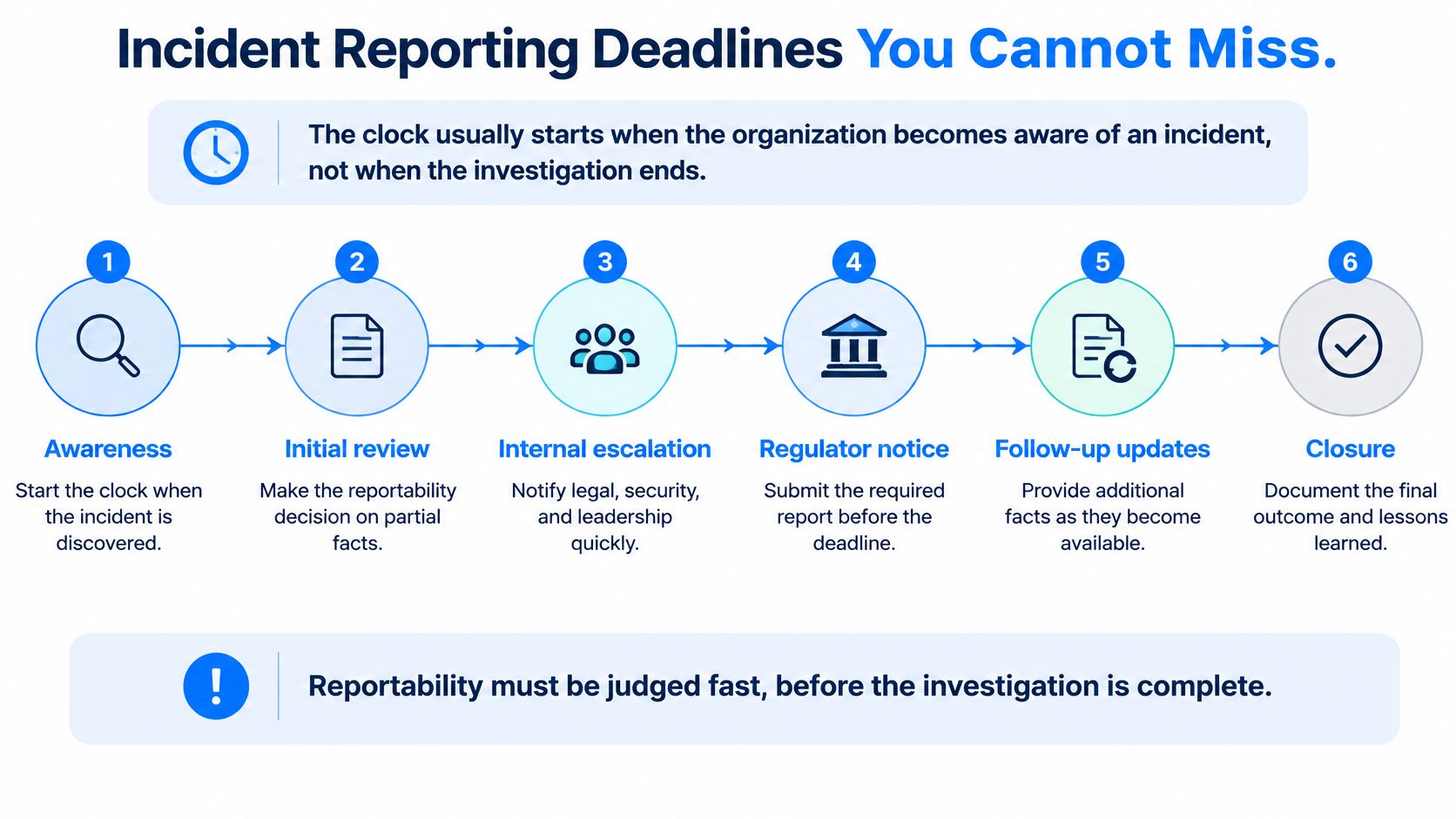
| Regime | Trigger | Notification deadline | Notified party |
|---|---|---|---|
| GDPR | Personal data breach likely to risk individuals' rights | Within 72 hours of becoming aware | Supervisory authority |
| NIS2 | Significant incident | Early warning within 24 hours, incident notification within 72 hours, final report within one month | CSIRT or competent authority |
| DORA | Major ICT-related incident | Initial notification within 4 hours of classification and no later than 24 hours from awareness | Competent authority |
| HIPAA | Breach of unsecured protected health information | Without unreasonable delay and no later than 60 days after discovery | Affected individuals, HHS and media where thresholds apply |
| PCI DSS | Suspected compromise of cardholder data | Immediately, as set by card brand and acquirer rules | Acquirer and card brands |
NIS2 shows the pattern most regimes now follow, staged reporting. You send an early warning with what you know, a fuller notification as facts firm up, and a final report after recovery. Regulators expect updates, so an incomplete first notice sent on time beats a complete one sent late.
Keep the same evidence trail for every event, reportable or not. Record when awareness began, who classified the event, why you judged it reportable or not, and when each notice went out. That trail is what a regulator reviews months later.
Test the process, don't just describe it. In tabletop exercises, measure mean time to detect, classify, authorize, and submit a notification. Those four numbers expose bottlenecks, such as waiting for one executive's approval, before a real incident does.
Board Oversight and Public Disclosure Duties
A security team may still be investigating an incident when executives must decide whether it is material to investors. For public companies, that judgment connects cybersecurity oversight to both urgent incident reporting and annual disclosures.
The SEC adopted its cybersecurity disclosure rules in July 2023. Under the rules, companies generally must disclose a material incident on Form 8-K within four business days after determining it is material, with a narrow delay for national security or public safety. Annual disclosures must describe how the company assesses and manages material cyber risks, how the board oversees those risks, and management's relevant expertise.
Two Distinct Obligations
The incident rule turns on materiality: whether a reasonable investor would consider the information important. A cyber event does not automatically meet that standard. The company must assess materiality while its technical investigation may still be underway.
Set up a standing decision group with security, legal, finance, communications, and investor relations. Define how an event reaches the group, who makes the materiality determination, and what evidence supports the decision. This keeps the legal judgment distinct from the technical question of what happened.
The annual disclosure addresses governance. It should explain who oversees cyber risk at board level, how often directors receive updates, and what relevant expertise management brings. These duties may also apply to non-US companies listed on US markets.
The board must be able to show it asked the right questions and acted on the answers.
What the Board Should See
Give directors a concise report on a set schedule. Focus on decisions and accountability, not a dashboard full of technical measures.
- Top risks: The scenarios most likely to cause significant business harm, described in business terms.
- Open exceptions: Controls that fall short of the required standard, with an owner and an expiry date.
- Incident trends: Response patterns, delays, and changes made after incidents.
- Budget decisions: Funding requests linked to the risks and exceptions they address.
Private organizations do not file these disclosures with the SEC, but clear oversight records can help them answer questions from insurers, lenders, and enterprise customers. A risk-appetite statement sets boundaries for acceptable exposure. A quarterly risk report and decision log then show which exceptions leaders accepted, who approved them, and why.
Governing Third-Party and Supply-Chain Risk
Your suppliers hold your data, run your critical services, and can start your reporting clock without telling you. Yet the facts about them sit in fragments. Procurement holds contracts, legal holds clauses, IT holds asset lists, and business units hold the relationships. The regulator's view and your view don't match.
Sending another questionnaire doesn't fix that. It raises paperwork while visibility stays flat. A vendor can score well on a form and still be a single point of failure you've never mapped.

Build One Dependency Map
Maintain one service and dependency map and keep it current. For each provider, record the service delivered, the data processed, whether it supports a critical function, the contract clauses in force, the incident contact, subcontractors involved, and your exit plan. One map then serves procurement, incident response, resilience testing, and regulatory reporting at once.
DORA makes the cost of fragmentation concrete. A 2025 DORA analysis reported that 46% of financial entities identified the DORA register of ICT providers as their most challenging task, because it requires reconciling information from legal, procurement, IT, and business units. Treat that register as a data discipline, not a one-time filing. Our guidance on IT vendor management best practices covers how to keep that data reconciled across teams.
Clauses That Protect Your Clock
Contracts turn the map into enforceable duties. Require these terms for critical providers.
- Incident notice periods: Shorter than your own regulatory deadline, so a supplier delay doesn't become your missed filing.
- Audit and evidence rights: Access to the reports and records you'd need to prove a control operates.
- Flow-down to subcontractors: The same security duties applied to fourth parties.
- Response and recovery cooperation: Named contacts and participation in your exercises.
- Exit support: Data return, transition help, and timelines agreed before you need them.
Watch concentration risk as you map. If one cloud region or one managed provider supports several critical services, a single outage becomes a multi-service incident with several reporting clocks. Note those concentrations explicitly and agree what you'd do without that provider.
Tie review cadence to criticality. Reassess high-impact providers often, with evidence checks and joint exercises. Review low-impact providers on a lighter cycle. That way, your limited staff time goes where a supplier failure would hurt, and your governance stays defensible instead of uniform and shallow.
If your obligations span several regimes and your evidence is scattered across teams and providers, we can help you build one control set and one audit-ready record that serves them all. MR2 Solutions provides vendor-neutral cybersecurity and compliance support, including fractional CISO leadership, security assessments that benchmark your posture, and coordinated provider governance. Visit MR2 Solutions to talk through your scope, your deadlines, and the fastest route to proof you can defend.