
WAN Optimization vs SD WAN: Which Fits Your Network

The most popular advice in the WAN optimization vs SD-WAN debate is to replace the older technology with the newer one. That's a poor starting point. An application that waits on repeated request-response exchanges needs a different fix from a branch that loses connectivity whenever its broadband circuit degrades.
Choose by application bottleneck, not product category. Your network may need better path control, targeted acceleration, both, or neither. The right decision starts with the transactions users can't complete reliably, then works backward through the application, security stack, and transport.
WAN Optimization and SD-WAN Side by Side
| Criterion | WAN optimization | SD-WAN |
|---|---|---|
| Primary problem | Slow application behavior over an existing link | Path selection and policy across several transports |
| Core techniques | Deduplication, compression, TCP acceleration, caching | Dynamic path steering, failover, segmentation, central policy |
| Transport role | Works over the links already in place | Combines MPLS, broadband, LTE and 5G links |
| Encrypted traffic | Limited payload reduction without authorized access to plaintext | Routes encrypted tunnels; encryption and inspection consume appliance CPU |
| Visibility and control | Per-application performance measurement | Central monitoring and policy across sites |
| Typical buyer | Team fixing slow legacy or file-transfer applications | Team managing many branches and several transport types |
| Question it answers | Why is this application slow over this link? | Which path should this traffic use right now? |
WAN optimization makes suitable traffic perform better over an existing link. SD-WAN decides which link carries traffic and applies network-wide policy. The distinction matters because adding bandwidth, reducing transferred bytes, and selecting a healthier path solve different problems.
The technologies aren't always competitors. Optimization can run alongside an SD-WAN overlay, and an edge platform may offer both functions. Cisco's SD-WAN overview describes an architecture with application-aware connectivity and integrated capabilities, rather than a requirement to treat every network function as a separate appliance.
Start with the complaint
If users report that a legacy file application is slow while other services work normally, investigate that application's behavior before redesigning branch connectivity. Check where the client and server reside, whether transfers contain repeated content, and whether the delay follows round-trip time rather than bandwidth consumption.
If complaints concern branch outages, inconsistent cloud access, or dependence on an expensive MPLS contract, evaluate transport diversity and SD-WAN policy first. An optimization appliance won't create an alternate route when the only circuit fails.
Practical rule: A narrow application complaint deserves a narrow diagnosis. A connectivity problem across applications deserves an architectural review.
Don't interpret this as permission to buy immediately. A slow server, overloaded endpoint, DNS delay, or storage bottleneck can resemble a WAN problem. Establish that the network is responsible before choosing either approach.
Why Each Technology Targets a Different Layer
WAN optimization changes how suitable application traffic crosses a constrained connection. Deduplication avoids retransmitting content already known at the receiving side. Compression reduces compressible payloads, while caching serves reusable content closer to the requester.
Protocol acceleration addresses excessive application exchanges. TCP optimization adjusts transport behavior so a connection can make better use of its available capacity. These techniques target different symptoms, so a feature checklist alone won't establish whether an appliance will help.
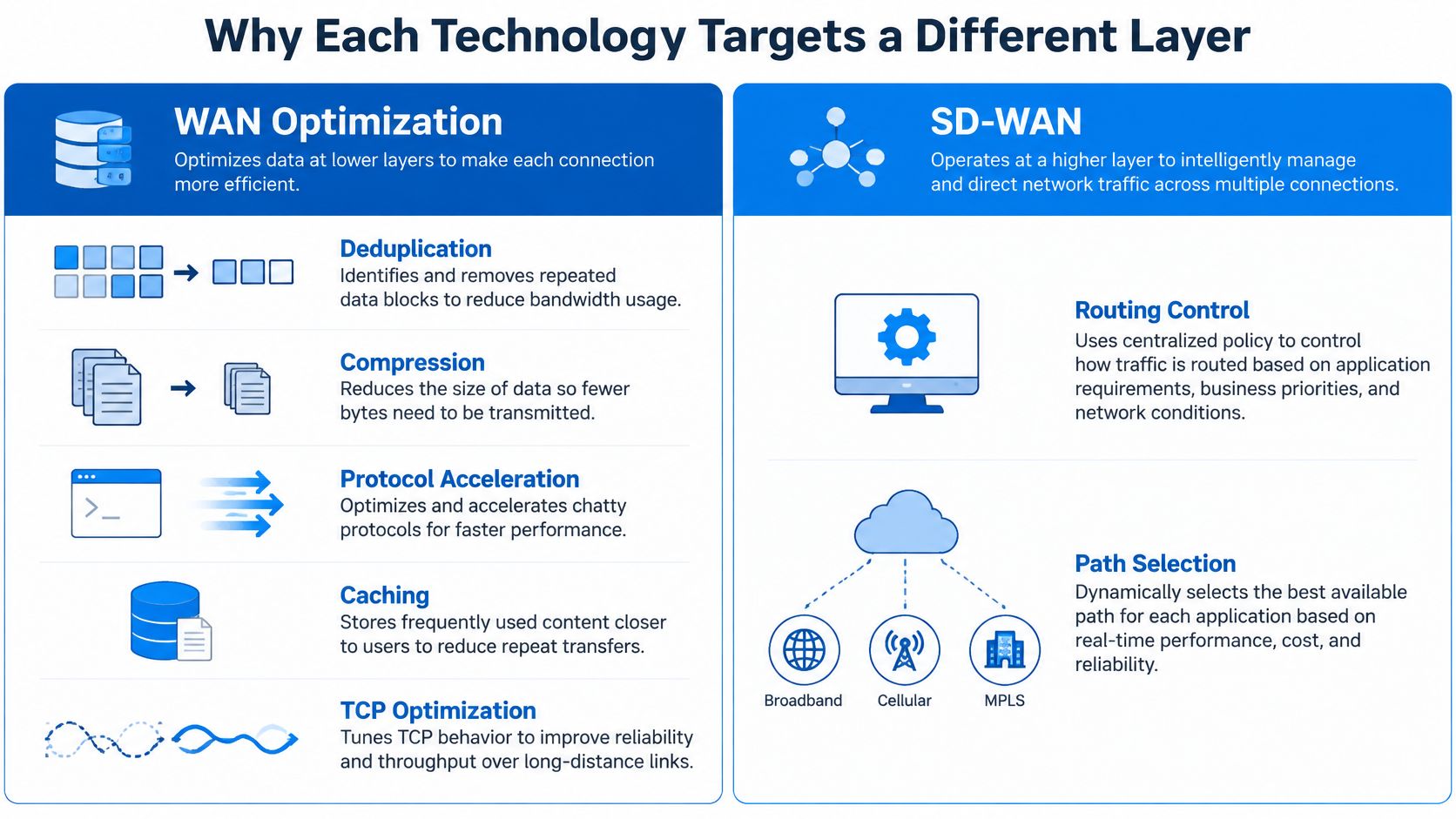
Payload behavior versus routing decisions
Consider a remote plant where a legacy ERP client pauses after each request to a central server. If the client repeatedly waits for responses, an otherwise healthy link can still deliver poor transaction performance. Protocol acceleration may help, but the engineer must first confirm that the application and its security configuration support it.
Contrast that with a branch whose broadband deteriorates every afternoon while a separate connection remains usable. SD-WAN can evaluate link conditions and steer eligible traffic toward the healthier transport. It doesn't need to rewrite the ERP protocol to solve that connectivity problem.
Our explanation of how SD-WAN works provides additional context for the overlay, its underlying connections, and centralized policy.
Adoption reflects an architectural shift
Historical adoption helps explain why SD-WAN became an architecture discussion rather than another acceleration feature. IDC survey findings summarized in Cisco's SD-WAN deployment analysis showed that 40% of enterprises had tried or deployed SD-WAN by late 2018, compared with 10% a year earlier.
That history doesn't prove that an overlay will accelerate your ERP application. It shows why IT teams increasingly evaluate branch connectivity, transport choice, and operational control together. The engineering decision still comes down to whether the application needs fewer inefficient exchanges or a better available path.
Where Each Approach Speeds Up Traffic
| Traffic type | WAN optimization benefit | SD-WAN benefit |
|---|---|---|
| Chatty file transfer, such as CIFS/SMB, over high latency | High for compatible workloads through buffer tuning and protocol acceleration | Low to moderate; routing can't remove protocol chatter |
| Repeated data copied across sites | High through deduplication and caching | Low from routing alone |
| Lossy or congested links | Moderate through TCP tuning | High when a healthier alternate path exists |
| Encrypted SaaS traffic | Low for payload reduction without plaintext visibility | Moderate through path choice and failover |
| Real-time voice and video | Low for conventional caching and compression | High when a better available path exists |
| Single-path link failure | None for restoring connectivity | High only when an independent alternate transport is available |
These ratings describe expected opportunities, not guaranteed outcomes. The most important qualification is available alternative: an overlay can't steer around a failure if every usable tunnel relies on the same failed access circuit.
What measured acceleration actually establishes
In a published WAN-optimization experiment, increasing the CIFS send buffer from 16 KB to 64 KB produced a 1.3× improvement at 50 ms latency, combining 2.5:1 lossless compression with the buffer change produced approximately 3.25× performance, and adding optimization appliances delivered a further sixfold acceleration in the tested application. Those are application-specific experimental results, not universal multipliers for enterprise traffic.
The useful lesson is the mechanism, not the headline gain. Buffer changes helped the tested protocol use the connection more effectively, and compression helped because the tested content could be reduced. Neither result establishes what will happen to an encrypted SaaS session or a live video stream.
For repeated file transfers, distinguish the initial transfer from subsequent transfers. An empty optimization cache and a populated cache represent different operating conditions. Test both, and include changed files rather than sending identical content repeatedly until the demonstration looks impressive.
Measure the user's work
Track transaction completion time, goodput, retransmissions, and byte reduction by application. Goodput means useful application data delivered, not all bytes counted on an interface. A busy circuit can carry retransmissions and overhead while users wait for useful work to finish.
For voice and video, focus on loss, jitter, conversational quality, and session continuity. Prioritization also matters when business-critical traffic competes with bulk transfers; the Nerds 2 You Edmonton QoS guide is a useful companion for thinking through traffic-priority settings, rather than treating every performance problem as an acceleration problem.
A healthy utilization graph doesn't establish that a purchase order, file save, or customer call completed acceptably.
Keep acceptance criteria tied to those activities. Otherwise, a vendor can demonstrate higher tunnel throughput without improving the task that justified the project.
Cost, Cloud and Encryption Trade-offs
The cheapest bandwidth quote isn't the cheapest working architecture. Separate the equipment, subscriptions, staffing, and risk before comparing totals.
| Cost component | WAN optimization | SD-WAN |
|---|---|---|
| Hardware | Appliances or virtual instances at relevant optimization endpoints | Edge devices or virtual CPE at participating sites |
| Transport | Usually retains existing circuits | Can add broadband alongside MPLS or replace selected private links |
| Licensing | Check appliance, capacity, and feature entitlements | Check site subscriptions, controller access, security, and capacity entitlements |
| Staffing | Application-specific tuning and troubleshooting | Central policy administration, underlay management, and exception handling |
| Hidden risk | Diminishing usefulness as eligible traffic disappears | Provider peering, cloud access design, security inspection, and observability |
Price the traffic you'll have
An appliance justified by centralized file services may become less useful after those applications move to SaaS. Encrypted application payloads aren't available for ordinary deduplication unless the architecture provides authorized plaintext access. Already compressed content offers little additional compression opportunity.
Don't budget against yesterday's traffic mix. Compare the application migration roadmap with the optimization renewal date, and identify which flows will remain eligible throughout the commitment.
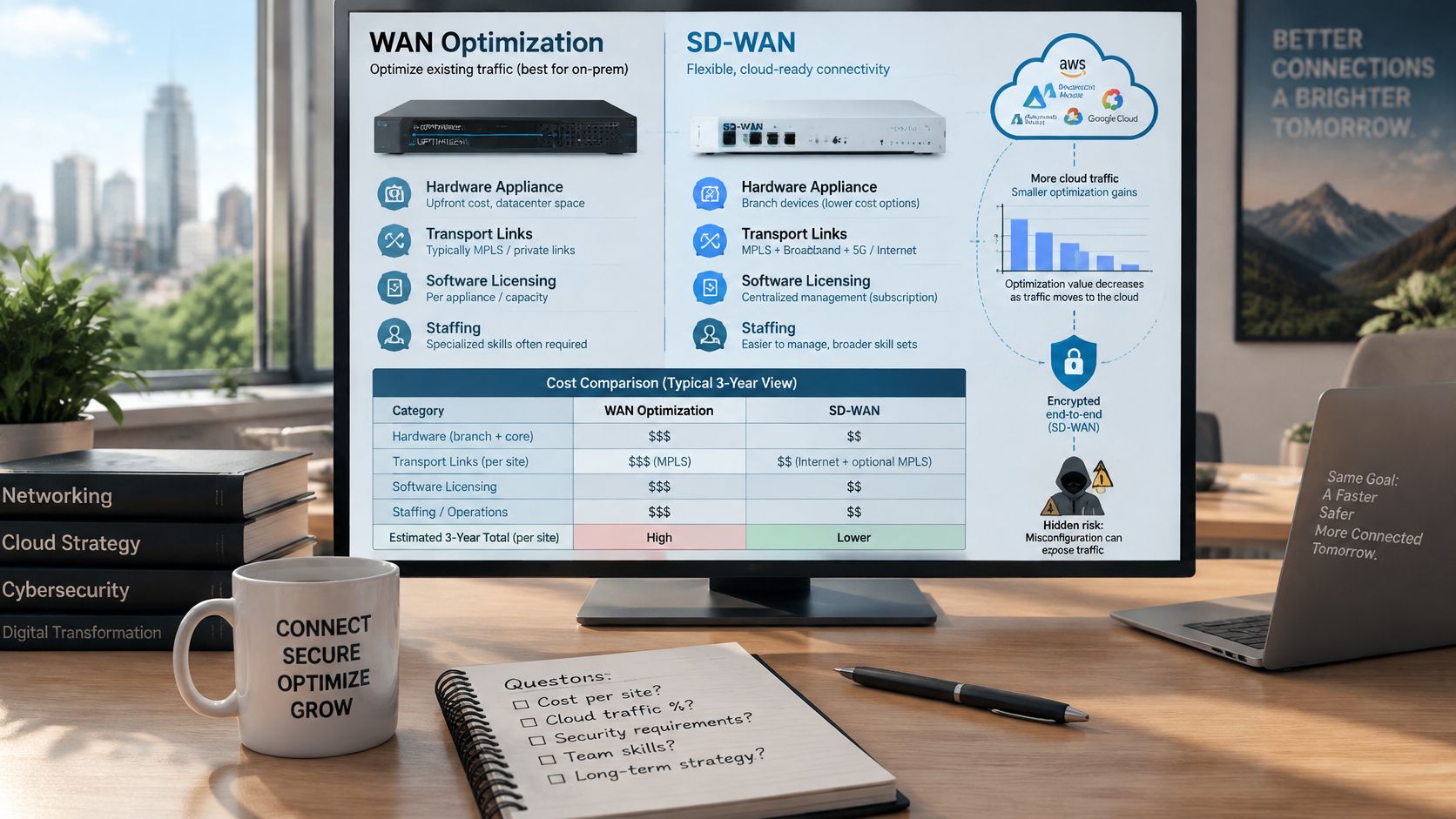
Cheaper transport moves responsibility
SD-WAN's operational value often comes from monitoring, policy, and coordinated failover rather than raw acceleration. But replacing private connectivity with internet access changes what the operations team must investigate when an application slows down.
The access circuit may be healthy while provider peering or the route to a cloud service performs poorly. Security inspection can introduce another processing point, and a poorly chosen cloud on-ramp can send traffic along an unnecessarily long route.
SD-WAN can choose among available paths; it can't remove geographic distance or repair an overloaded SaaS service. Likewise, central management doesn't eliminate engineering work. As sites, application classes, and exceptions grow, the team must keep policy comprehensible and verify that controller decisions match business priorities.
- Include operational effort. Budget for carrier escalation, policy changes, monitoring, and incident ownership.
- Check contract boundaries. Establish who supports the access circuit, overlay, security service, and cloud connection.
- Price resilience transparently. Separate access circuits may still share building entry, power, or upstream infrastructure.
A lower transport bill is valuable only when the costs and responsibilities transferred to the new design are included before cutover.
How to Test Both Options Before Migrating
Use a controlled pilot, not a branch-wide product demonstration. Keep the application workload repeatable and record every change that could influence the result.
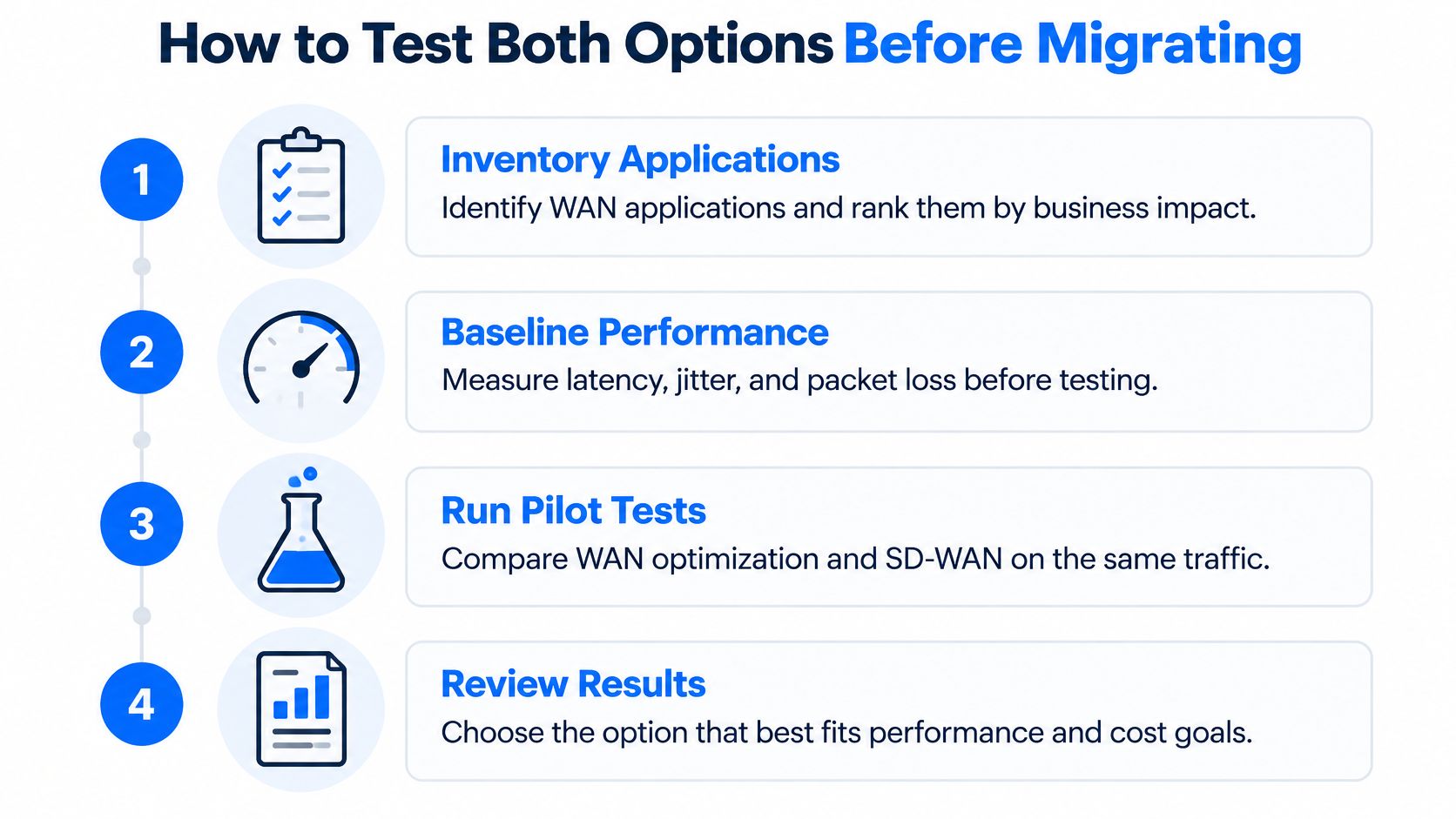
Inventory applications by business impact. Identify the client, server, transport, encryption, and owner for each critical workflow. Start where delay or interruption causes the greatest operational harm.
Baseline the current environment. Record latency, jitter, packet loss, throughput, and transaction completion time during representative operating conditions. Capture packet traces and endpoint resource use so a server problem doesn't get credited to, or blamed on, the network pilot.
Classify the bottleneck. Separate chatty protocols, repeated content, impaired paths, and encrypted SaaS flows. For file workloads, the Fivenines explanation of how to measure storage throughput helps isolate storage limits before interpreting a WAN transfer test.
Test routing on identical underlays. Introduce controlled loss, congestion, and link failure while keeping workloads consistent. An open-source simulation summarized in the SD-WAN performance literature reported 35% higher throughput, 40% lower latency, and 50% lower packet loss versus a traditional WAN, but those simulation outcomes are hypotheses to test, not procurement guarantees.
Enable optimization selectively. Test compatible chatty and repeated-data applications with cold and warm caches. Record useful throughput and byte reduction alongside transaction time, so lower traffic volume isn't mistaken for faster business processing.
Load the complete edge configuration. Enable production encryption, segmentation, logging, and inspection, then test representative packet sizes and concurrent sessions. Watch CPU, dropped packets, fragmentation, and application recovery, not just the advertised interface speed.
Assign an outcome to each application group. Choose routing only, optimization only, both, or no change. Write acceptance and rollback conditions before approving deployment.
Turn evidence into a deployment decision
MR2 Solutions' networking approach follows Assess, Design, Evaluate, Deploy, and Optimize: evaluate infrastructure and gaps, design for growth, compare technologies without vendor bias, coordinate rollout, and improve performance as requirements evolve. Our enterprise network design approach places the pilot within that broader architecture decision.
Through TBaaS™, we help teams compare architecture, pricing models, and integration capabilities before committing, reducing the risk of vendor lock-in. Preserve the test results as evaluation evidence, including unsuccessful scenarios and configurations that required manual intervention.
Which Setup Fits Your Network Situation
| Network situation | Better starting point | Reason |
|---|---|---|
| Few sites on MPLS with slow legacy file transfers | WAN optimization first | Investigate application behavior before changing transport |
| Many branches using cloud applications and needing another transport | SD-WAN | Path control and failover address the requirement directly |
| Growing branch count with encrypted SaaS and legacy TCP traffic | SD-WAN plus targeted optimization | Different application groups need different treatments |
| Regulated sites requiring private circuits | SD-WAN on approved private links, or neither pending compliance review | The compliance outcome constrains transport and inspection choices |
| No measurable bottleneck yet | Neither yet | Establish performance requirements before buying |
Adoption provides context, not a verdict for your network. TeleGeography's WAN Manager Survey, summarized by SDxCentral's SD-WAN adoption analysis, found SD-WAN installed on all or part of the network for 47% of respondents in 2022, up from 18% in 2018.
A retailer with legacy point-of-sale traffic
Consider a regional retailer whose stores maintain reliable connectivity but wait on transactions to a central application. Start with a packet trace and transaction baseline for the point-of-sale workflow. Test optimization only if the protocol behavior and encryption design make it a credible candidate.
The verdict changes if stores also lose connectivity or need consistent policy across a growing estate. Then transport diversity becomes a separate requirement, even if acceleration remains useful for the legacy application.
A manufacturer moving to cloud ERP
A manufacturer consolidating around a headquarters site and cloud ERP should prioritize the route to the service, the security inspection location, and cloud access resilience. An appliance intended to accelerate private file traffic isn't automatically relevant to the new ERP sessions.
The verdict changes if manufacturing systems still depend on latency-sensitive legacy services hosted elsewhere. Keep those flows in the evaluation rather than assuming the cloud migration removes every private-WAN requirement.
We offer SD-WAN for agile multi-site networking, with infrastructure specialists covering networking, SD-WAN, and data centers. That breadth matters when the limiting component sits outside the branch edge.
Decision boundary: A compliance restriction, application redesign, or expanding branch footprint can change the right starting point. Treat the verdict as conditional on architecture, not permanent allegiance to a technology.
Security and Migration Paths
Consider a branch that currently reaches its applications through MPLS and an existing optimization appliance. The migration team wants internet breakout and centralized SD-WAN policy, but the security team still requires controlled access to internal systems.
The first design decision is where inspection belongs: at the branch, a regional hub, or a cloud security service. Encrypted overlay tunnels protect traffic in transit, but they don't replace application authorization, segmentation, or inspection policy. Our SD-WAN security guidance addresses these controls as part of the architecture rather than an afterthought.
Preserve the controls while changing the paths
If optimization needs plaintext visibility, document where decryption occurs, who authorizes it, and how keys and cached content are protected. Don't weaken end-to-end encryption merely to improve a benchmark. Test the selected inspection placement with the production security configuration enabled.
For the branch migration, use a staged sequence:
- Keep the working service available. Retain MPLS and existing optimization while the pilot branch runs the overlay in parallel.
- Pilot independent transports. Validate routing, application identification, segmentation, and a documented rollback configuration before moving critical traffic.
- Move sensitive legacy flows cautiously. Stabilize path policy first, then determine whether those applications still require acceleration.
- Release sites in supportable waves. Match each wave to the team's troubleshooting capacity and compare the same application metrics after cutover.
- Retire circuits after operational evidence. Combine controlled failure tests with observed production behavior, including real incidents where available, before accepting the resilience case.
Make rollback executable
A rollback plan needs named owners, saved configurations, routing reversal steps, and clear triggers. A vague promise to restore the old network won't help if the old circuit has already been disconnected.
Keep the commercial exit separate from the technical cutover. Disconnecting MPLS is a contract decision as well as a routing change, and it should follow validated acceptance rather than a scheduled demonstration.
Confirm Your Architecture Before You Commit
Commit to measured application outcomes, not a binary replacement story. The right design may be SD-WAN alone, targeted optimization, a combined edge, or no new platform.
A TPx managed SD-WAN datasheet describes managed connectivity capabilities, but your acceptance criteria must extend beyond a service feature list. Include application transactions, security-processing overhead, link-failure behavior, and the effort required to operate the design.
- Collect representative evidence. Pull performance history for business-critical applications and classify their bottlenecks.
- Demand comparable benchmarks. Evaluation records should include encrypted throughput, CPU load, representative packet sizes, failover recovery, and per-application visibility.
- Set operational ownership. Identify where the bottleneck sits, who controls it, and how the team will measure performance after migration.
Our TBaaS™ recommendations prioritize technical fit, operational alignment, and long-term value, not vendor preference or sales incentives. We work alongside internal IT teams to reduce evaluation and vendor-selection workload without replacing their decision-making authority.
Don't sign until the proposed architecture explains both the expected improvement and the conditions under which it won't help.
MR2 Solutions offers quick, no-obligation technology assessments to benchmark your environment and evaluate whether SD-WAN, targeted WAN optimization, or a combined design fits your applications. Visit MR2 Solutions to discuss your critical workflows, transport constraints, and a vendor-neutral evaluation path before committing to a migration.