
Cybersecurity Maturity Assessment: How to Run One in 2026

Your board wants a clearer view of cyber risk. A customer has sent another security questionnaire, your insurer wants evidence, and your operations team says the controls are already in place. Yet nobody can confidently say whether the business could recover its critical systems or detect sensitive data moving into an unapproved AI tool.
A cybersecurity maturity assessment should resolve that uncertainty. It should show which capabilities work, where the evidence is weak, and which investments will reduce business exposure. A polished scorecard isn't enough. The useful output is a defensible baseline, tested recovery assumptions, and an action plan somebody owns.
Pick a Framework and Scoring Model First
I would default to NIST CSF 2.0 for a mid-market organization that needs a business-oriented assessment rather than a certification exercise. Start with outcomes, then map the evidence to customer, insurance, and regulatory requirements. Keep those mappings explicit rather than assuming that satisfying one framework satisfies every obligation.
Choose the primary model before collecting evidence. Otherwise, assessors can change the meaning of maturity midway through the engagement, making comparisons unreliable.
Common maturity models and what they produce
| Model | Scale | Best Suited For | Output |
|---|---|---|---|
| NIST CSF 2.0 Implementation Tiers | Partial through Adaptive | Risk-management maturity context | Organization-level context, not a control-by-control effectiveness score |
| NIST CSF Current and Target Profiles | Outcome-based comparison | Prioritized gap analysis | Gap list ranked by business impact |
| CMMC | Required contractual assessment level | U.S. defense contractors handling controlled information | Readiness findings and the applicable assessment or certification outcome |
| CMMI-style capability scale | Initial through Optimizing, with intermediate stages defined in the rubric | Process repeatability and consistency | Score per process area |
NIST Tiers describe how risk management operates, not how many controls work. Deloitte's study of cybersecurity maturity at financial institutions describes the progression from Tier 1, Partial, to Tier 4, Adaptive, moving from largely informal, reactive practices toward continuous adaptation. A repeatable governance process can still oversee poorly configured identity controls.
Separate capability from compliance
CMMC belongs in the decision when defense-contract requirements determine what must be demonstrated. Treat the applicable contractual assessment as a qualification requirement, not an enterprise maturity average. A CMMI-style approach is more useful when managers need to understand whether processes remain consistent across teams and handoffs.
For broader organizational dependencies, the organizational maturity assessment Doczen guide offers context for examining ownership and process development beyond security. Our overview of cybersecurity compliance frameworks can also support the framework-selection discussion.
Decision rule: Pick a primary model. Add another only when a customer, regulator, or material business requirement justifies the extra work.
Record the target and its business rationale before scoring controls. Don't choose the highest maturity tier because it looks ambitious. A defensible target reflects threat exposure, service criticality, and the resources needed to sustain it.
How to Run the Assessment Step by Step
Build the assessment around business services, not departmental boundaries. Payroll, order fulfillment, clinical scheduling, and customer authentication cross infrastructure, applications, suppliers, and human decision-making.
NIST CSF 2.0 provides the underlying Current Profile, Target Profile, gap-analysis, and action-planning approach. It also cautions that Implementation Tiers complement rather than replace an organization's risk-management methodology.
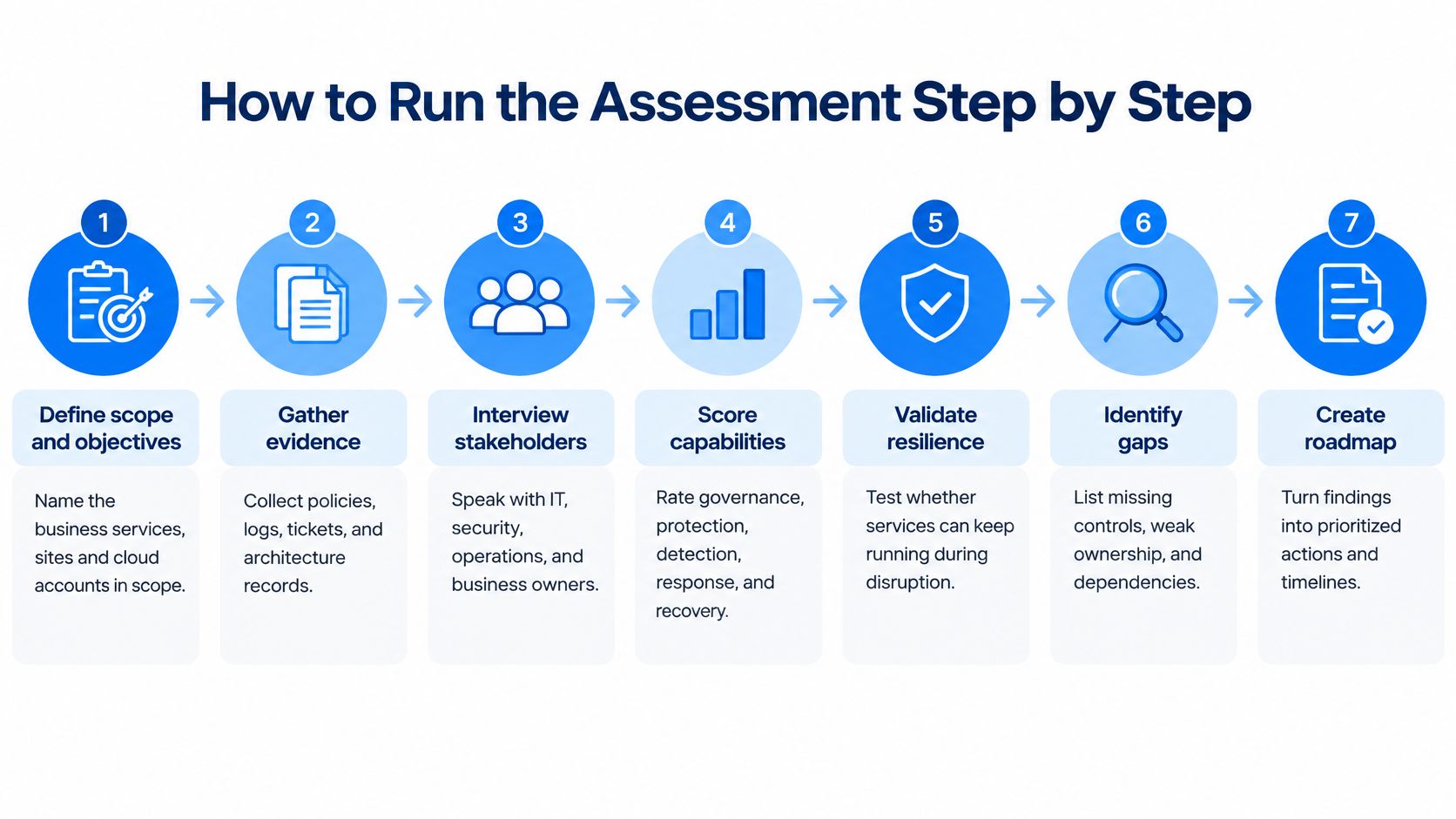
Establish the baseline and destination
Define scope and objectives. Name the services, sites, cloud accounts, applications, and suppliers included, along with explicit exclusions. Scoping by the IT organization chart can leave payroll integrations or outsourced recovery services outside the assessment.
Build the Current Profile. Describe outcomes achieved, including exceptions and uneven coverage. The usual mistake is copying policy statements into the baseline without checking how administrators and users work.
Create the Target Profile. Select outcomes based on mission, customer expectations, threat exposure, and applicable obligations. Don't let an executive's preferred score substitute for a reasoned target, and don't finalize the destination without understanding the starting point.
Collect evidence for each outcome. Assign evidence requests to control owners and include operational records, interviews, and practical tests. An evidence request that asks only for documents will produce a document assessment.
Score capabilities consistently. Record the assessor, assessment date, evidence references, scope limitations, and rationale. Define evidence states in advance, progressing from unsupported claims through ad hoc activity, documented practice, sampled operation, and realistic testing with tracked results.
Compare current and target outcomes. Describe each shortfall in terms of the affected service and potential business consequence. Avoid findings such as “improve access management” that don't identify the missing capability or exposed environment.
Create the prioritized action plan. Give each action an accountable owner, funding estimate, completion condition, and retest date. Don't confuse assigning a ticket with securing the authority and capacity to complete it.
Make scoring reproducible
If you want a numeric rubric, assign ordered values to those evidence states and label it your assessment scale, not an official NIST control scale. Preserve the underlying evidence state in reports so a number never becomes the only explanation.
Keep implementation coverage separate from evidence confidence. A successful test on an isolated application doesn't establish that the same control works across every in-scope service. Record exclusions and sampling limitations beside the result.
For transformation-heavy environments, Ekipa's AI readiness assessment framework can help structure discussions about organizational readiness alongside the security assessment. Use that discussion to identify missing stakeholders and decisions, not to replace technical validation.
The finished assessment pack should contain a scope statement, side-by-side profiles, an evidence log, and a ranked action plan with a reassessment date. Store supporting records in a restricted repository and link findings to evidence identifiers, rather than distributing sensitive logs inside board presentations.
Collecting Evidence That Proves Each Control Works
A written incident-response plan establishes intent. Triage timestamps, escalation records, containment decisions, and exercise results establish whether responders can execute it. Ask an analyst to trace a sampled alert from detection through closure, then ask the affected service owner whether the escalation reached the right people.
Apply that same test to every domain. Map the framework outcome to a specific control objective, identify acceptable proof, and interview both the owner and the people who depend on the control.
Evidence to collect for five control domains
| Domain | Claimed Control | Evidence to Collect | Red Flag |
|---|---|---|---|
| Incident response | Documented playbook | Triage records, escalation times, lessons-learned actions, tabletop results | Plan exists but exercises are overdue |
| Identity and access | MFA and least privilege | Authentication configurations, privileged-access review logs, sampled leaver accounts | Reviews completed late or not at all |
| Backup and recovery | Scheduled backups | Restore-test results, actual recovery time and recovery point | Restores never tested end to end |
| Third-party risk | Vendor questionnaire | Contract clauses, sampled vendor evidence, dependency map | Critical supplier with no named owner |
| AI and shadow tools | AI usage policy | Discovered AI systems, data-flow records, sampled tool usage | Inventory hasn't been refreshed after technology changes |
Test execution, not document quality
IBM's 2025 global breach analysis reports human error as a contributing factor in 51% of breaches. Use that as a prioritization signal, not a universal failure rate or a reason to blame employees. Separate negligent actions, configuration mistakes, social engineering, and poorly designed processes because each requires a different remedy.
Select a fixed sampling window before reviewing records. Include routine activity and exceptions: emergency access, failed backup jobs, urgent supplier onboarding, and incidents handled outside normal working hours. A clean sample selected by the control owner isn't independent validation.
For teams preparing assurance evidence, Loopfour's explanation of SOC 2 Type 2 evidence requirements provides useful context on demonstrating operation over time. Keep that assurance objective distinct from the broader question of compliance in IT security, which also requires clear ownership and requirement mapping.
Self-attestation tells you where to start looking. It doesn't establish that the control operated.
Flag evidence as stale when it predates material configuration, staffing, supplier, or workflow changes. For rapidly changing controls, require a fresh sample rather than relying on a calendar-based exception.
Every evidence-log entry needs the date range, source system, sample size, and confirming person. Also record the control objective, selection method, result, and any limitations, so another reviewer can reproduce the conclusion.
Reading Scores Without Averaging Away Risk
Suppose endpoint protection earns a strong rating while identity management earns a weak one. An enterprise average could look acceptable even though an attacker could use an unmanaged privileged account to disable those endpoint protections. The arithmetic isn't the problem. The decision implied by it is.
Present domain-level results as a heat map, with critical exceptions visible beside the rating. Show coverage and evidence confidence separately so leaders can distinguish a broadly weak control from a promising control assessed on an incomplete sample.
Rank exposure rather than counting findings
Use explicit decision criteria when ordering remediation:
- Business impact: Identify the service, revenue stream, operational obligation, or sensitive information at risk.
- Threat likelihood: Consider credible attack paths and the organization's actual exposure.
- Control dependencies: Identify weaknesses that undermine other safeguards or block remediation.
- Remediation cost: Include engineering effort, service disruption, licensing, and ongoing administration.
- Time to reduce exposure: Distinguish an immediate containment measure from a longer structural correction.
A gap that could prevent delivery of a critical service should outrank numerous low-impact documentation findings. Counting open tickets rewards teams for closing easy items while leaving difficult exposure untouched.
Use cybersecurity risk-management strategies to connect the heat map to treatment decisions. Some risks require remediation; others need temporary containment, contractual treatment, or explicit executive acceptance. The assessment should make those choices visible rather than disguising every finding as the same kind of backlog item.
Closure test: A finding is closed when the agreed evidence demonstrates the required outcome, not when somebody changes its ticket status.
Check the assessors as well
Define exit criteria before remediation starts. For an orphaned privileged account, closure might require confirmed removal, a check for equivalent accounts, and evidence that the leaver workflow now detects the condition. Schedule the retest when assigning the action.
Have independent reviewers assess the same selected outcomes without seeing each other's ratings first. If they disagree materially, inspect the rubric and evidence standard before negotiating a midpoint. Agreement reached through averaging doesn't make an unclear assessment defensible.
Testing Resilience and AI Change Beyond Controls
Consider a mid-market company that passes its audits but relies on a single engineer for backup credentials. Its critical supplier has no agreed recovery-support arrangement, and nobody has rehearsed operations without the primary application. The program may be well documented, but its ability to survive disruption remains unproven.
Wavestone's cyber benchmark identifies Recover as a lagging area, particularly crisis management and resilience capabilities. Treat operational resilience as a separately tested dimension rather than assuming it follows from stronger control documentation.
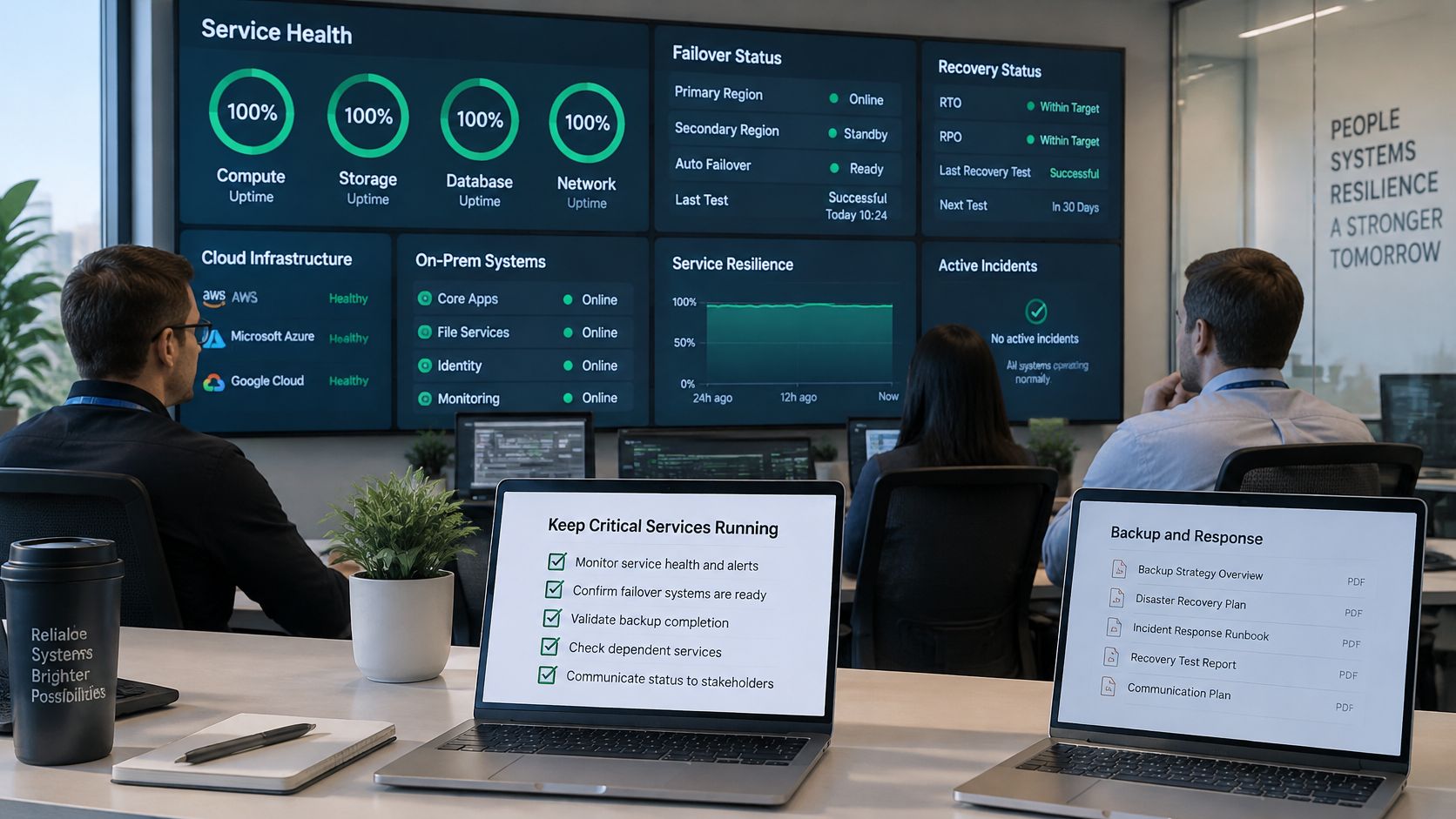
Test business-service survival
Choose a critical service and introduce a credible disruption: unavailable identity infrastructure, corrupted production data, or a supplier outage. Validate actual recovery performance against the business's recovery-time and recovery-point targets, including the dependencies needed to resume useful work.
Watch executive decisions as well as technical restoration. Who can authorize shutdown, accept data loss, approve emergency spending, and communicate with customers? A restored database doesn't mean the business can fulfill orders.
Adding controls won't fix an untested recovery assumption. Require recovery owners to demonstrate workable alternatives when key people, credentials, facilities, or suppliers are unavailable.
Test technology change across control domains
AI introduces a different challenge: the assessed environment can change before the report is approved. Accenture's State of Cybersecurity report, covering 2,286 companies, found that 77% lacked foundational data and AI-security practices, while only 22% had clear generative-AI policies and training.
Establish discovery through procurement, identity-provider application records, cloud inventories, expense review, and authorized monitoring. Reconcile newly discovered tools with model ownership, data ownership, approved use cases, and third-party dependencies, then repeat the review after deployments and material changes.
Test behavior separately from policy. Use approved monitoring and controlled exercises to determine whether sensitive information reaches unsanctioned tools and whether staff know how to report mistakes.
Keep AI change as a distinct test lens, but place its findings in the relevant domains: identity, data governance, supply chain, monitoring, incident response, and executive accountability. A standalone AI score would conceal the cross-functional work needed to control it.
Turning Gaps Into a Board-Ready Roadmap
Give the board a concise decision document, not the evidence repository. Show the domain heat map, the most material risks in business language, the funding requested, and when leaders should expect measurable exposure reduction.
Describe consequences concretely. “Unvalidated recovery for order fulfillment” supports a decision more clearly than “low maturity in backup controls.” Include the executive decision required, especially when remediation competes with delivery commitments.
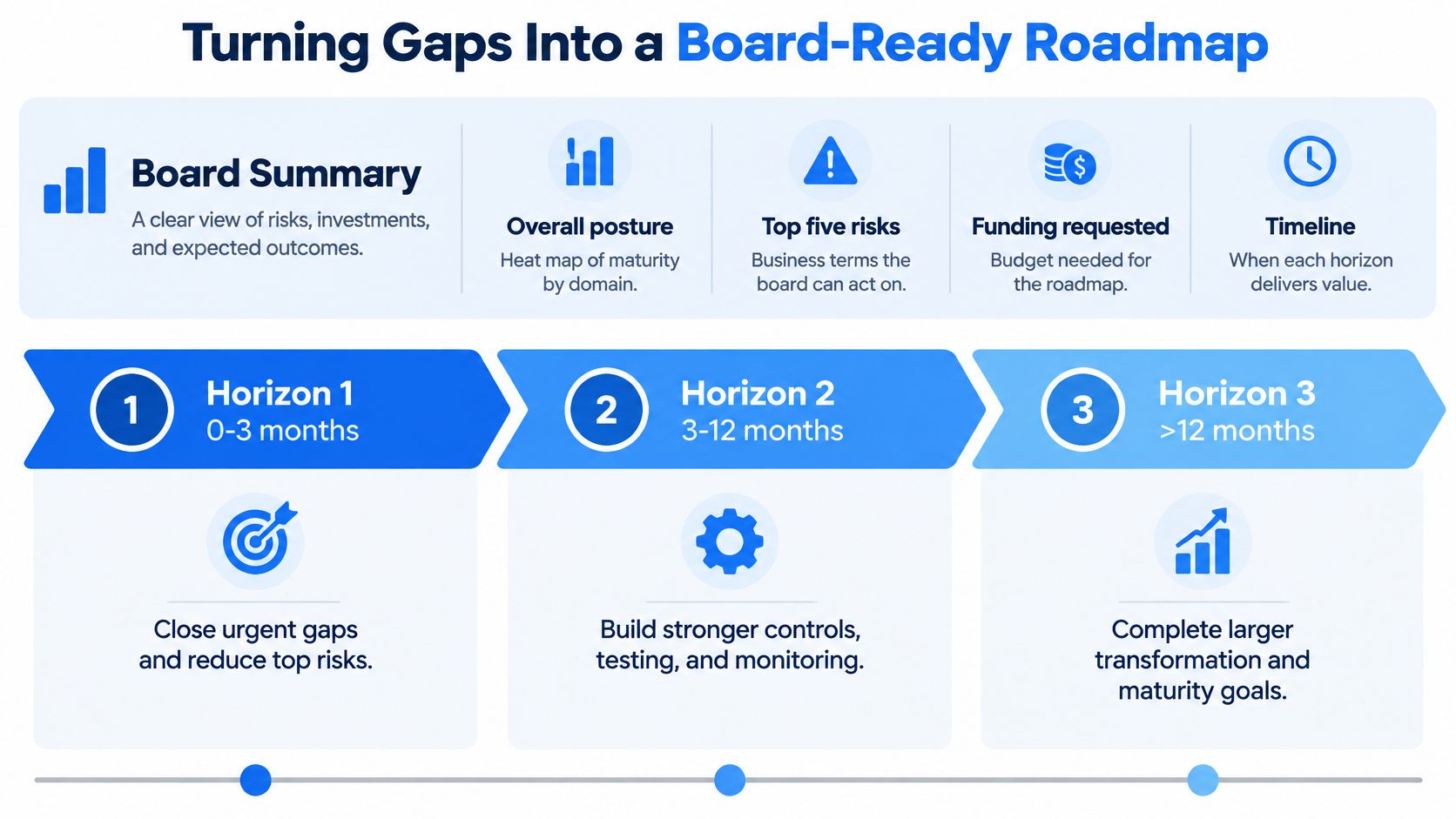
Fund immediate, structural, and target-state work
Organize the roadmap into practical planning horizons:
- Immediate exposure reduction: Remove unnecessary privileged access, establish emergency recovery access, and contain material monitoring gaps.
- Structural improvements: Redesign identity workflows, formalize supplier accountability, and establish service-level recovery exercises.
- Target-state capability: Complete larger architectural changes and embed ongoing measurement into normal operations.
These are recommended planning categories, not universal deadlines. Set delivery dates around dependencies, change windows, staffing, and procurement rather than promising the same schedule for every organization.
The business case should extend beyond avoiding incidents. In the 2022 IBM Institute for Business Value study conducted with Oxford Economics, which surveyed more than 2,300 executives across 25 countries and 18 industries, the most mature organizations reported an average revenue-growth rate 43% higher than the least mature organizations, and 66% of respondents viewed cybersecurity primarily as a revenue enabler. These are correlational benchmarks, not proof that raising an assessment score causes revenue growth.
Track whether the roadmap changes operations
Metrics to track after the assessment
| Metric | What It Shows | Suggested Cadence |
|---|---|---|
| Mean time to detect | Speed of finding intrusions | Monthly |
| Privileged-access review completion | Whether elevated access is re-certified on time | Quarterly |
| Restore-test success rate | Whether recovery works under test | Quarterly |
| Overdue remediation age | How long findings stay open | Monthly |
| Domain heat map | Where risk concentrates across domains | Quarterly |
Treat these cadences as starting recommendations. Define each metric's denominator, scope, exclusions, and owner before reporting it.
Show trends alongside significant failures. An improving restore-test success rate means little if the failed test concerns the organization's most critical service. Ask leadership to review residual risk and delivery obstacles, not merely whether projects remain on schedule.
Schedule Your Baseline Assessment Before Year-End
Reserve the baseline assessment before year-end, but don't make the reporting deadline more important than evidence quality. Work backward from the decision the assessment must support: budget approval, contract readiness, insurance renewal, or a recovery investment.
The executive sponsor should agree in advance to receive uncomfortable findings. Without that commitment, assessors can face pressure to narrow scope, soften language, or postpone tests that might expose operational weaknesses.
Prepare the assessment charter
Use a short readiness checklist before authorizing the work:
- Confirm the model: Name the primary framework, the intended target, and the business reason for selecting it.
- Assign executive ownership: Identify the sponsor who can resolve disputes, accept residual risk, and secure remediation resources.
- Set the baseline date: Decide when the Current Profile represents the environment and how subsequent changes will be recorded.
- Reserve evidence capacity: Give operations, security, procurement, HR, and service owners time to retrieve and explain records.
- Protect sensitive material: Establish access restrictions, approved storage, and handling rules for logs, configurations, and incident records.
- Choose the delivery team: Decide which activities internal staff can perform credibly and where specialist or independent support is needed.
Budget explicitly for evidence retrieval and sampling, rather than allocating the entire engagement to interviews. Export permissions, missing records, supplier responses, and exercise coordination can require more preparation than the conversations themselves.
Decide where outside support adds value
Internal teams are well placed to explain architecture, service dependencies, and operational constraints. Independent assessors add value when specialist testing is required, stakeholders dispute results, or the people operating controls would otherwise be the only people validating them.
At MR2 Solutions, our Security Assessment benchmarks a client's security posture and identifies gaps; we also offer quick, no-obligation technology assessments to benchmark the environment. Choose the starting point that matches the decision you need to make, rather than commissioning a broader engagement without a clear purpose.
A partner doesn't replace the sponsor's ownership of the findings. Keep risk acceptance, funding approval, and business priorities with the organization's accountable leaders.
Before the assessment begins, put the first retest date on the calendar and reserve the people needed to perform it. That commitment turns the baseline from a reporting exercise into an operating cycle.
Our Security Assessment benchmarks your security posture and identifies gaps, giving you a practical starting point for a cybersecurity maturity assessment. Visit MR2 Solutions to discuss your assessment scope or start with a quick, no-obligation technology assessment to benchmark your environment.