
AI Readiness Assessment Scorecard and Steps

74% of organizations say their most advanced generative-AI initiative is meeting or exceeding ROI expectations, and 70% expect to need at least 12 more months to resolve challenges around achieving expected ROI, according to Deloitte's State of Generative AI in the Enterprise. Both figures describe the same companies in the same year. Confidence is running well ahead of evidence.
An AI readiness assessment that outputs a maturity label tells you nothing about which use case to fund on Monday. The version worth running is a portfolio decision. Each use case earns a verdict from documents you can hand to a CFO: a baseline number, unit economics net of operating cost, and a written rule for stopping or scaling.
A strategy slide is not readiness. Neither is a pilot that performs on a clean sample extract. The distance between those two artifacts and a system in production, with a named owner, a rollback path and a monthly bill someone has approved, is where most AI programs stop.
AI Readiness Scorecard You Can Fill This Week
Only 13% of companies globally were fully prepared to use AI and AI-powered technologies in 2024, according to Cisco's 2024 AI Readiness Index, based on a survey of 7,985 senior business leaders across 30 markets. Spending climbed. Readiness didn't. The limiting factor isn't enthusiasm or budget, it's evidence.
Used properly, an AI readiness assessment is a weighted 1 to 5 scorecard applied to one use case at a time. You score what exists today. A roadmap, a vendor deck and an executive promise all score zero until something sits in a repository with a person's name against it.
The six domains and the evidence that earns a 5
| Domain | Weight | Evidence for a 5 | Blocker |
|---|---|---|---|
| People | 15 | Named business and control owners plus a skills inventory and training plan | No accountable owner for outcomes or controls |
| Data | 20 | Lineage, quality measure, privacy class, and refreshable production access | Pilots run only on one-off sample extracts |
| Process | 15 | Quantified baseline, target improvement, and a 90-day exit rule | No baseline or no rule for stopping the pilot |
| Technology | 15 | Integration map, latency budget, security test, and rollback | No rollback or no path into production systems |
| Governance | 15 | Scenario tests, audit trail, human override, and incident response | Policy exists but controls are untested |
| Value | 20 | Unit economics net of inference, integration, review, monitoring, and remediation | Benefits counted without operating cost |
Score each domain against current evidence, then multiply the weight by the score and divide by 5. The weights sum to 100, so the arithmetic hands you a total out of 100 without a formula anyone will relitigate later.
Two rows carry the most weight for a reason:
- Data, weight 20: if the team can only reach a one-off extract, every test result after that is a guess about production behavior.
- Value, weight 20: unit economics after inference, integration, human review, monitoring and remediation. A benefit case that stops at model capability is a sales sheet, not a business case.
A worked total of 59 out of 100
Say an operations team wants to auto-triage inbound supplier documents. The assessor scores People 4, Data 2, Process 3, Technology 4, Governance 2 and Value 3. People returns 12 of 15, Data 8 of 20, Process 9 of 15, Technology 12 of 15, Governance 6 of 15 and Value 12 of 20. The weighted total is 59 out of 100.
A maturity model would file that as "developing" and schedule a follow-up workshop. The blocker rule refuses. Two domains sit at 2, so the use case carries two funding blockers even though the total lands mid-band. Nothing gets purchased until the data row can show lineage plus production access the business can refresh, and the governance row can show a passed scenario test for sensitive-data leakage and unauthorized automated actions.
Scoring rule: a 1 or a 2 blocks funding no matter what the weighted total says.
When the data and technology rows come back low because the systems these agents must read were never built to be read by machines, remediation recipes for agent-friendly sites give you the specific fixes instead of a general instruction to modernize.
Mark every 1 and every 2 on the sheet before you look at the total. The blockers are the plan.
How to Run Five Gates Before Any Go-Live
A company-wide questionnaire gives you an average, and an average hides the one use case that will embarrass you. Run this sequence on a single candidate instead. No gate opens until the previous one has produced its evidence.
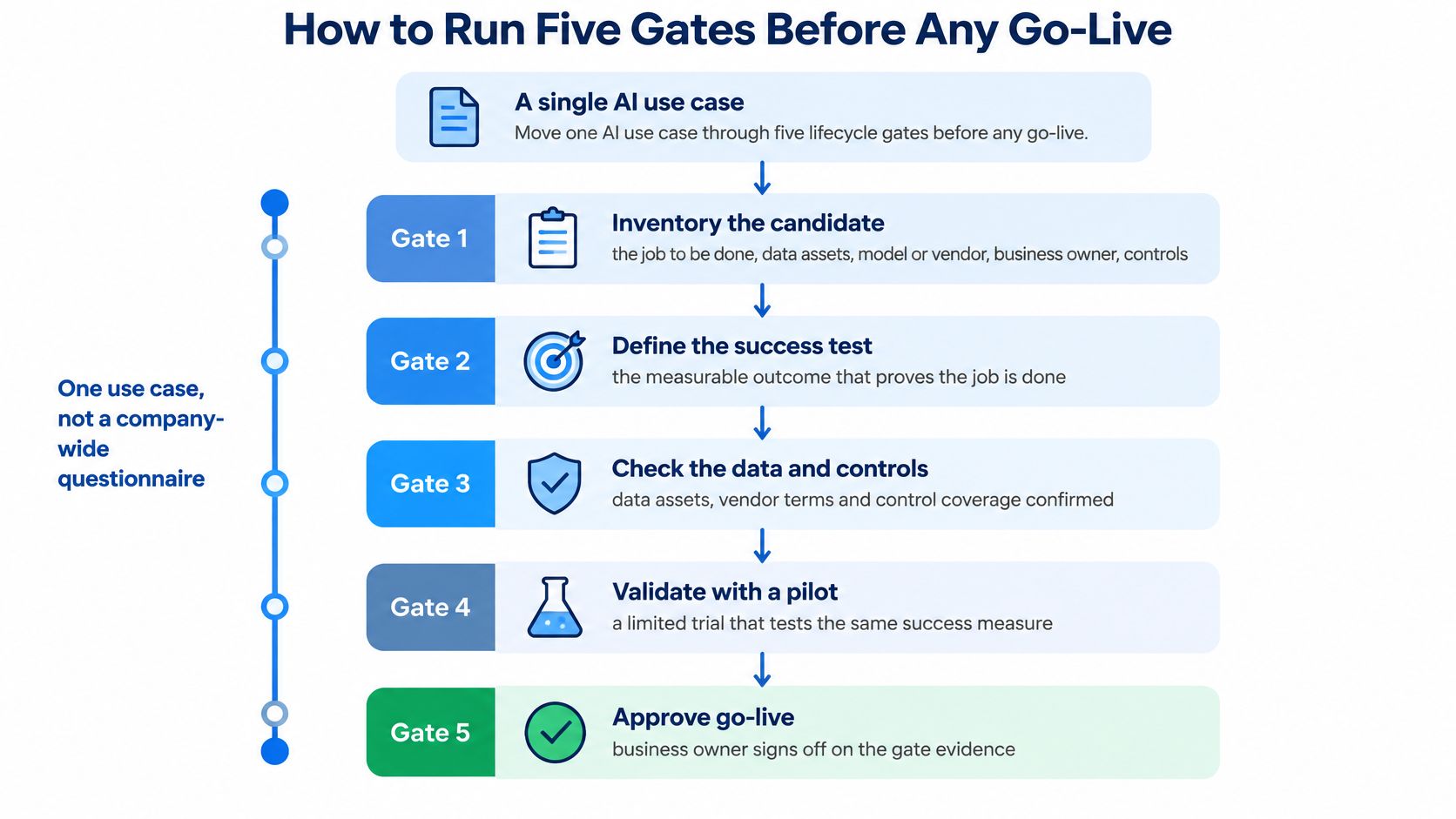
Gate 1. Inventory the candidate. Name six things before anyone scores anything: the job to be done, the data assets, the model or vendor, the business owner, the control owner, and the environment where it will run. Refuse to proceed until each has a person or an asset attached. A blank control owner is a finding, and you got it for free before spending a dollar on evaluation.
Gate 2. Map who is affected and what breaks. List the customers, employees, regulated data subjects and downstream systems touched by the output, and what a wrong answer does to each. This is also where you name the human whose judgment the model is replacing, because gate four needs that comparator and nobody remembers the name by then.
Gate 3. Write the acceptance criteria before anyone tests. Validity, reliability, security, privacy, fairness, explainability, resilience, latency and operating cost, each with a number the sponsor has agreed to in writing. Criteria written before testing are a gate. Criteria written afterwards are a negotiation with someone who already likes the demo.
Gate 4. Test on data that looks like deployment. File the test sets, metrics, tools, assumptions and limitations with the use case. Refuse a single accuracy figure. Demand false-positive and false-negative rates, a confidence interval or a cross-validation note, prediction latency, and a head-to-head against the human or rules process you're replacing. NIST's AI Risk Management Framework asks for documented test sets and metrics, demonstrated validity and reliability under conditions similar to deployment, and recurring evaluation of whether the metrics and controls still do the job. A framework that expects reassessment is telling you the first test is not the last word.
Gate 5. Approve with the operating plan attached. Before sign-off you need monitoring for drift, anomalous events, downtime, response time and failures, plus incident response, rollback criteria and a date to reassess. Security signs. The business owner accepts the residual risk in writing, and the reassessment date goes in the calendar rather than the appendix.
Where the sequence usually breaks
The most expensive miss is a pilot that looks strong on a clean extract and has no path to production data. It tested the model against a sample the data team prepared by hand, so every result describes the sample. The second most expensive miss is a gate four packet with no comparator, which means nobody can say whether the tool is better than the spreadsheet it replaced.
Security and compliance reviews belong in gate three, not in a quarterly meeting after launch. The compliance and technology work that decides which data may be used, what must be logged and how long it's retained is cheaper before a build than after one.
Rollback is the item teams skip most often. A production readiness checklist from GoReplay is a reasonable model for the operational items that need to exist before traffic arrives, and most of them apply to an AI service exactly as they apply to any other.
Staple the gate packet to the scorecard row for that use case. If the packet is thin, the score was wrong.
Stakeholder Roles That Make a Score Defensible
A score without a signer is an opinion with a number attached. Give each role one job and one artifact, and don't let two roles land on the same person.
The executive sponsor, usually the CIO or a business GM, sets the value hurdle and owns the final verdict. The sponsor may not simultaneously be the control owner. Separate the person who wants the money from the person who certifies the safeguards.
The business owner brings three numbers: the baseline metric, the adoption target and the cost of the current process. Without them there's no value row to score, only a claim.
The data owner confirms lineage, quality and whether production access is real rather than promised for next quarter. Security, the CISO or a named delegate, runs or formally accepts the red-team and privacy review and owns incident response. Legal and compliance decide which decisions may be automated and which must keep a human in the loop, jurisdiction by jurisdiction.
Procurement records vendor, model and contract change risk so a silent model update can't pass as the system that was tested last month. Operations confirm latency, uptime and who is on call at 2am. The change lead verifies that the people who must use or override the output have been trained on it.
| Activity | Responsible | Accountable | Consulted | Informed |
|---|---|---|---|---|
| Baseline and adoption target | Business owner | Executive sponsor | Data owner, Operations | Change lead |
| Lineage, quality and production access | Data owner | Business owner | Security, Procurement | Executive sponsor |
| Red-team, privacy and incident response | Security | Security | Legal and compliance | Executive sponsor |
| Automated-decision limits | Legal and compliance | Executive sponsor | Business owner | Operations |
| Vendor and model version record | Procurement | Executive sponsor | Security | Data owner |
| Latency, uptime and on-call | Operations | Business owner | Security | Change lead |
| Training and override readiness | Change lead | Business owner | Operations | Executive sponsor |
| Score sign-off | Business owner, Security and value owner | Executive sponsor | Legal and compliance | Procurement |
The signing rule is simple and firm: business, security and the value owner all sign. IT cannot sign value on the business's behalf, and a CIO who does so has converted a portfolio decision into an infrastructure project.
The sponsor who sets the value hurdle and the person who certifies controls must be different people. When they're the same, nobody is checking the sponsor.
Governance structure that keeps this honest is the same structure that keeps any technology decision honest, which is why the IT governance best practices that define decision rights and escalation paths apply here without modification.
Passing Scores That Still Fail in Operation
Stated confidence is a weak signal. 71% of organizations cannot fully trust autonomous AI agents for enterprise use, even though 46% have governance policies in place, and adherence to those policies remains low, according to Capgemini's research on generative AI in organizations. A separate 2025 study in the same body of work found that 78% of respondents expressed complete trust in AI while only 40% had implemented governance and explainability guardrails.
Workforce capability shows the same pattern of optimism outrunning proof. Wharton research cited by Capgemini identifies recruiting advanced generative-AI skills and delivering effective training as leading challenges, named by 49% and 46% of respondents respectively. Two of the top obstacles are people and training, not models.
Treat those figures as warnings, not as scores. A team that reports confidence has not shown that its controls work under operating conditions. Use the table below as a diagnosis, not a second scorecard. Each symptom points to the domain whose score was too generous, and the fix column names the single action that reopens it.
| Symptom | Why the score was wrong | Fix before you proceed |
|---|---|---|
| Pilot works only on a sample extract | Data was scored without production access | Retest on deployment-like data and record lineage |
| Policy exists but agents are not trusted | Governance was a document, not a test | Run leakage, bad-output, and unauthorized-action scenarios |
| Staff ignore or quietly override the tool | People score ignored the users | Train that role and document a safe override |
| Model or vendor changes after approval | Technology score was a point in time | Retest when the model version or contract changes |
| Errors cannot be reconstructed | No audit trail or on-call owner | Name the control owner and log decisions before go-live |
Assign the fix to a named owner with a date, then rescore only that domain. Don't reopen the whole assessment because one row was wrong, and don't let a fresh average hide the row that failed.
Until the matching fix has an owner and a date, drop the use case back to not ready. Don't average a control failure into a softer total.
If the fix is a retest, make sure you understand what a trustworthy test result looks like before you accept a green tick. This piece on proving test cases are trustworthy covers the evidence standards that separate a genuine pass from a rehearsed one.
A real governance check confirms that incident response, audit trails, human override and decision rights work under load. Prompt injection, sensitive-data leakage, an erroneous recommendation that reaches a customer, an agent taking an action nobody approved, a vendor shipping a new model version: each of those is a scenario you run, record and score. A policy file is evidence that someone wrote a policy.
Fund, Fix or Stop From the Weighted Score
88% of respondents reported regular AI use in at least one business function, yet nearly two-thirds said their organizations had not begun scaling AI across the enterprise, and only 39% reported enterprise-level EBIT impact, according to McKinsey's State of AI in 2025 survey. Regular use is not a funding case. A weighted score earns a decision only when each use case has a baseline, unit economics, and a clear stop-or-scale rule.
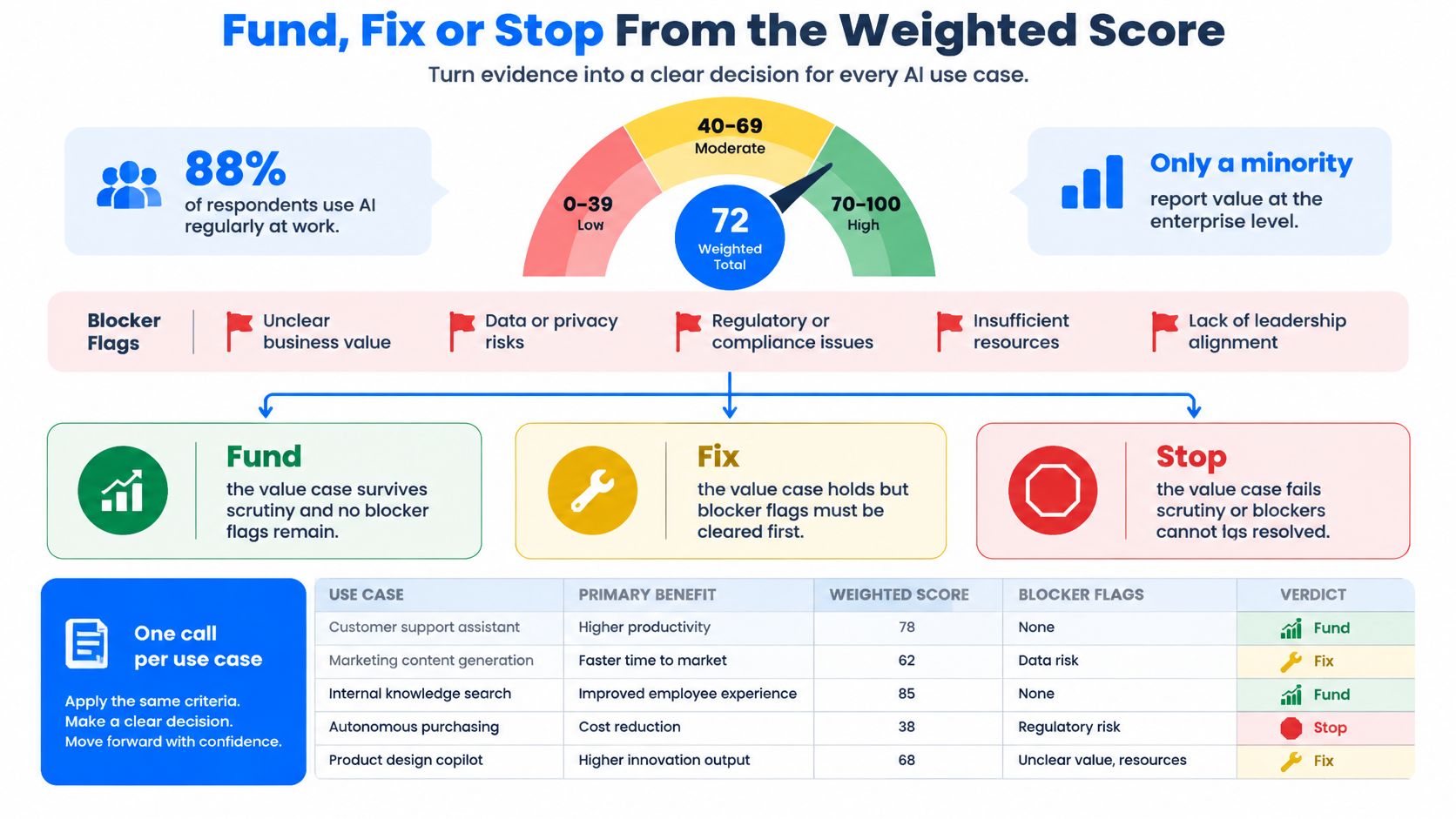
The band decision
| Band | Condition | Single allowed action |
|---|---|---|
| Under 40 | Any total below 40 | Fix blocker domains and rescore only those rows |
| 40 to 69 | No domain at 1 or 2 | Fund one gated use case with a 90-day exit |
| 40 to 69 | Any domain at 1 or 2 | Fix the blocker before any pilot |
| 70 or above | No domain at 1 or 2 | Scale behind monitoring, rollback and reassessment |
| Any score | Critical harm unmeasurable or no post-launch watch | Stop and classify as not ready |
Under 40: fix the blockers. Set an owner and date for each, then rescore only the rows that changed. Hold off on model purchases, pilots, and vendor comparisons until the underlying gaps are addressed. A platform cannot repair a data problem.
Between 40 and 69, with no domain at 1 or 2: fund one use case. Set a stop rule tied to a measurable outcome, name the accountable owner, and agree on a 90-day exit. Fund the next candidate only after finance accepts the first use case's results.
Between 40 and 69, with any domain at 1 or 2: fix the blocker before funding a pilot. The total cannot offset a weak domain. A promising average does not make an untested control or unsupported operating process ready for launch.
At 70 or above, with no domain at 1 or 2: scale with conditions. Require production monitoring, a rollback path, and a reassessment date. Keep other candidates out of active development until the current use case demonstrates its value and can be operated safely. Stop any use case whose critical risks cannot be measured or monitored after launch.
The economic case must include the full operating cost. 51% of organizations using AI reported at least one negative consequence, and nearly one-third of all respondents reported consequences related to AI inaccuracy, according to the same McKinsey survey. Before funding, account for inference, integration, human review, monitoring, and remediation. If the expected value does not hold after those costs, stop or revise the use case.
Before you quote ROI: include inference, integration, human review, monitoring, and remediation. If the value case fails after those costs, it is not ready for funding.
MR2 Solutions' AI Transformation services cover strategy, governance, and adoption. For teams moving from pilots to production, AI transformation strategy, governance, and adoption can support decisions across the existing portfolio. Keep the use case's baseline, unit economics, evidence, owner, and stop-or-scale rule together so leaders can compare funding choices on business value and operational readiness.
If your organization has AI pilots but no shared rule for choosing which to fund next, MR2 Solutions offers a no-obligation technology assessment to benchmark your environment. TBaaS™ provides vendor-neutral evaluation and deliverables such as recommendations, cost insights, and an implementation roadmap. Start by scheduling a consultation so MR2's experts can assess your needs and recommend a path forward.