
Compliance and Technology: What Leaders Need

Organizations using AI and automation extensively cut average breach costs by USD 1.9 million and shortened breach lifecycles by 80 days compared with organizations that didn't, according to IBM's 2025 breach study of 600 organizations. That gap reframes compliance and technology as one financial question. You're not buying controls to fill a binder. You're building systems that can prove, months later, who had access, what changed, and who approved it.
Why Compliance and Technology Now Share One Agenda
Say a leadership team approves a clean policy pack on Monday. By Friday, staff have added two SaaS apps, a cloud storage bucket has changed owners, and someone in marketing is pasting customer notes into an unapproved AI tool. The policies aren't wrong. They're just sitting over an estate nobody fully inventories.
That gap has a price. The 2025 IBM Cost of a Data Breach study covered 600 organizations globally breached between March 2024 and February 2025 and found a worldwide average breach cost of USD 4.44 million, down 9% from USD 4.88 million in 2024. The average lifecycle from identification through containment fell to 241 days, compared with a peak of 287 days in 2021.
Technology choices explain part of the improvement, and governance gaps explain the rest. In that study, 20% of surveyed organizations reported a breach involving shadow AI, adding an average of USD 200,321 to the breach cost, while 63% said they either lacked an AI governance policy or were still developing one. Only 37% had approval processes or oversight mechanisms for AI use, according to IBM's analysis of 600 breached organizations across 17 industries.
The Lock and the Spare Keys
Think of technology as both the lock and the spare keys left under the mat. Identity platforms, encryption, and monitoring tools enforce your rules. Untracked SaaS, stale privileged accounts, and unsanctioned AI create new entrances.
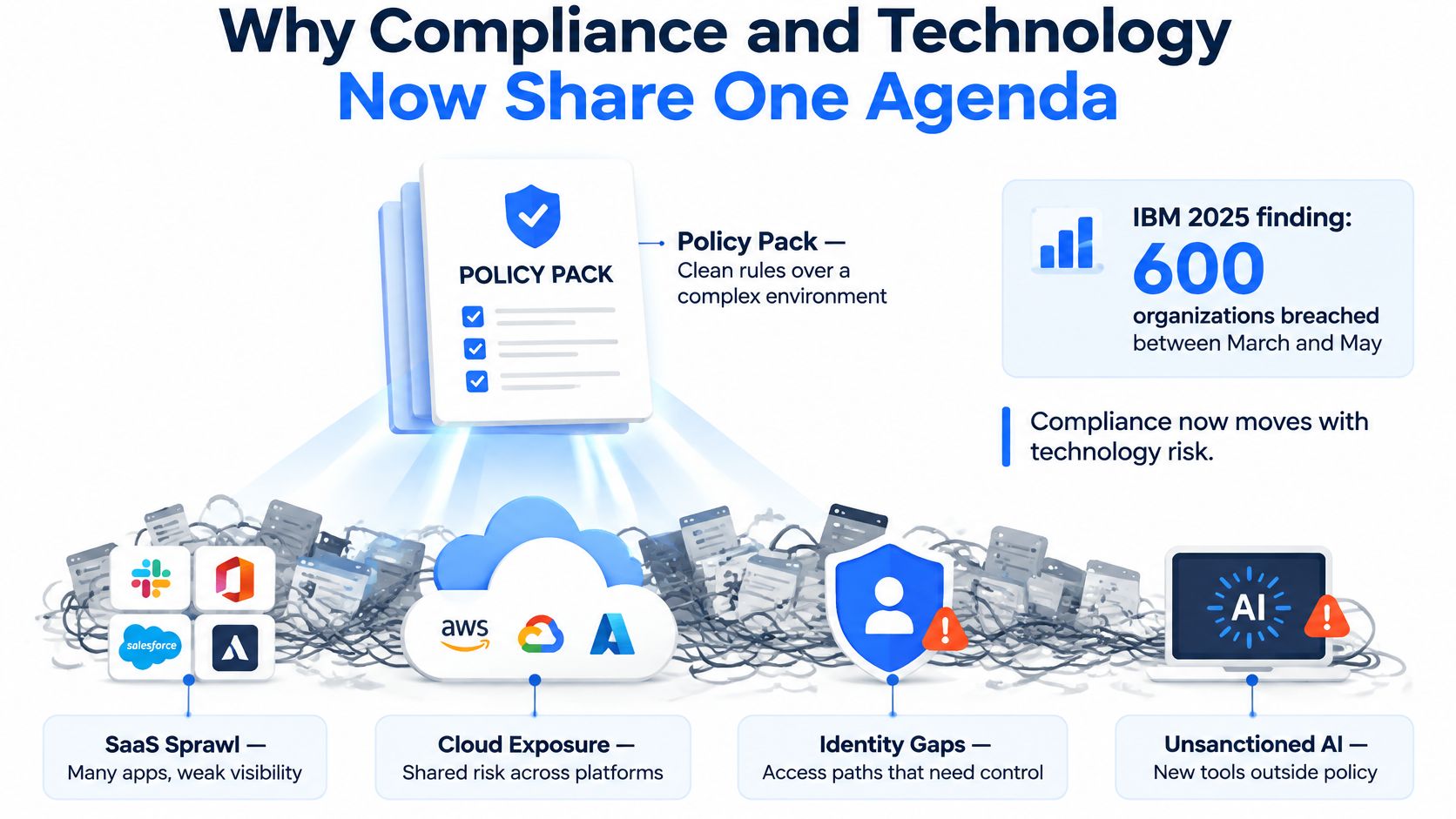
The practical job is narrower than most product pitches suggest. You need one set of control evidence that can answer HIPAA, PCI DSS, SOC 2, and NIST outcome questions without forcing a rip-and-replace of the tools you already run. That means software inventories, access management, data handling records, and third-party oversight have to connect.
If a control runs in one system but its evidence lives in someone's inbox, you don't have proof. You have a scavenger hunt.
Start with the lookup table. Once you know what each framework asks technology to prove, tool decisions get much simpler.
What Each Framework Asks Technology to Prove
Read this table row by row, not as four separate programs. Each row names the proof an auditor, regulator, or customer will ask for, the controls that produce it, and the point where everyday technology use breaks the story.
| Framework | Proof technology must produce | Example controls | Where technology complicates it |
|---|---|---|---|
| HIPAA Security Rule | Confidentiality, integrity, and availability of ePHI, plus access and audit accountability | Identity and access management, encryption in transit and at rest, audit logs, vendor BAAs | Shadow clinical SaaS and incomplete business-associate coverage |
| PCI DSS | A defined cardholder-data environment with restricted access, logging, and tested controls | Network segmentation, tokenization, file-integrity monitoring, retained logs | Connected apps and plugins that silently expand scope |
| SOC 2 | Controls operated across the audit period for Security and elected Trust Services Criteria | Change management, periodic access reviews, monitoring, incident evidence | Point-in-time exports that go stale as SaaS settings change |
| NIST CSF 2.0 | Outcomes across Govern, Identify, Protect, Detect, Respond, and Recover | Shared control inventory mapped to regulations and risk tolerance | Treating the framework as a product purchase instead of a crosswalk |
NIST CSF 2.0 as the Common Language
The U.S. National Institute of Standards and Technology released NIST Cybersecurity Framework (CSF) 2.0 in February 2024, updating a framework first created in 2014 for organizations of any size, sector, or cybersecurity maturity. Its biggest structural change was adding a sixth function, Govern, alongside Identify, Protect, Detect, Respond, and Recover. Govern covers leadership accountability, risk ownership, policy decisions, supply-chain oversight, and alignment with enterprise objectives.
CSF 2.0 doesn't prescribe an architecture or require a product. It defines outcomes and connects them to detailed practices, so you can map one control to a regulation, a contract clause, and your own risk tolerance. For a working example of how those outcomes translate into day-to-day security operations, see this overview of compliance in IT security.
Reading One Row Into a Decision
Take HIPAA. The question isn't whether you own encryption. It's whether you can show that electronic protected health information stayed confidential, intact, and available, with access controls, audit controls, transmission security, and business-associate agreements covering every vendor that touches it. A connected clinical app that syncs patient notes to a vendor without a BAA widens your scope overnight, even if your core EHR is locked down.
PCI DSS works the same way, with a harder boundary. You must define the cardholder-data environment, segment it, log activity inside it, manage vulnerabilities, and protect data with strong cryptography or tokenization. A payment plugin or analytics script that can see card data pulls new systems into scope, and your segmentation diagram stops matching reality.
SOC 2 asks a different question. Can you show controls operated over the whole audit window, not just on the day someone took a screenshot? Security is always in scope, and you can elect criteria such as availability, confidentiality, or privacy. Change management and access reviews carry the weight, because SaaS settings change weekly and a stale export proves very little.
Practical rule: Treat CSF 2.0 as the crosswalk between obligations, not as a fifth certification to buy.
That distinction saves money. You map each control once to a CSF outcome, then cite the same evidence wherever HIPAA, PCI DSS, or SOC 2 asks the same underlying question. The framework gives CIOs and CISOs a vendor-neutral way to document gaps and explain priorities to the board, which is why compliance and technology planning should start here rather than with a vendor shortlist.
Integration and Evidence Lineage Across Three Estates
Only 32% of respondents in a 2025 Forrester study of 527 director-level and senior respondents in North America and Europe used integrated technology across corporate governance and compliance functions; 14% used integrated solutions from the same vendor, according to the study. Many organizations use technology across a broad range of compliance activities. The challenge is connecting those tools so their evidence supports one enterprise-wide account of control performance.
Buying another compliance platform can improve visibility within one function while fragmenting proof across the organization. Each tool may maintain separate asset lists, control names, and evidence files. The result resembles several ledgers that describe the same business in different ways.
One Control Mapped Once
Create the mapping before evaluating platforms. Give each shared control a stable ID, a named owner, and a primary evidence source. Then map that control to every framework that requires it.
| Control | NIST CSF 2.0 | HIPAA | PCI DSS | SOC 2 |
|---|---|---|---|---|
| Access review | PR.AA | Access authorization and review | Restrict access by business need | Logical access criteria |
| Audit logging | DE.CM | Audit controls | Log and monitor all access | System monitoring criteria |
| Encryption | PR.DS | Transmission and storage safeguards | Protect stored and transmitted card data | Confidentiality criteria |
| Change management | PR.PS | Integrity of systems handling ePHI | Tested, approved changes | Change management criteria |
| Incident response | RS | Security incident procedures | Incident response plan | Incident handling criteria |
| Vendor oversight | GV.SC | Business-associate agreements | Service provider management | Vendor management criteria |
Four Layers, One Building
Integration has four layers. The platform layer contains the systems people use. The data layer holds shared records of assets, controls, and owners. The workflow layer assigns approvals and notifications. The reporting layer turns those records into views for leaders.
A polished dashboard cannot repair inconsistent records underneath it. In hybrid environments, workloads span locations, so evidence needs to remain connected to the system performing the control. That is one reason hybrid cloud management belongs in the integration design.
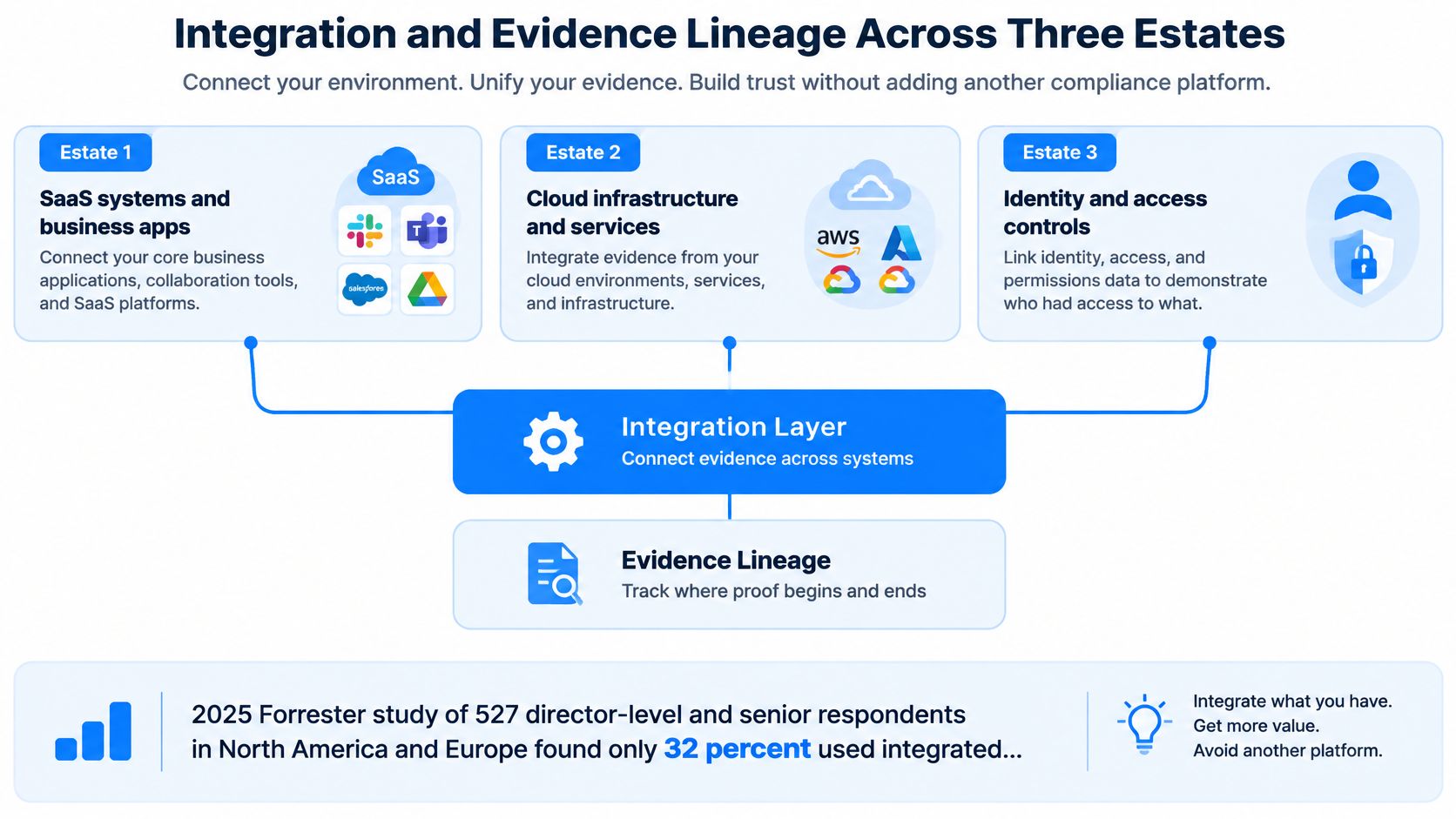
Start with a system of record for assets and control owners, stable control IDs, and evidence lineage. For each artifact, record its source system, timestamp, and collector. Use APIs to pull evidence directly where possible, rather than relying on emailed spreadsheets. Legal and privacy own obligations; security owns control design; IT operations produces evidence; internal audit tests controls.
Three Estates, Same Failure
- Health system: Clinicians install a free transcription app on personal phones. Patient audio leaves the EHR, no BAA exists, and the HIPAA access review misses the accounts. The gap begins with asset discovery.
- Retailer: Marketing adds a checkout plugin that can view card data in the browser. PCI scope expands to systems the retailer has not segmented or logged. Change management failed to catch the exposure.
- B2B SaaS company: An engineer captures a cloud setting in January for a SOC 2 audit ending in July. The setting changes twice in between. The screenshot is genuine, but it does not show whether the control operated throughout the audit period.
Across all three estates, the remedy is a stable control ID, a named owner, evidence from the system that performs the control, and an exception log when practice differs from policy. Evidence lineage connects those pieces. It is a governance decision about how proof is created and maintained, not a feature to buy.
A separate tool for each framework can create four versions of the truth. Auditors need evidence that connects to the control and the system that produced it.
Automation That Shortens Proof Not Just Alerts
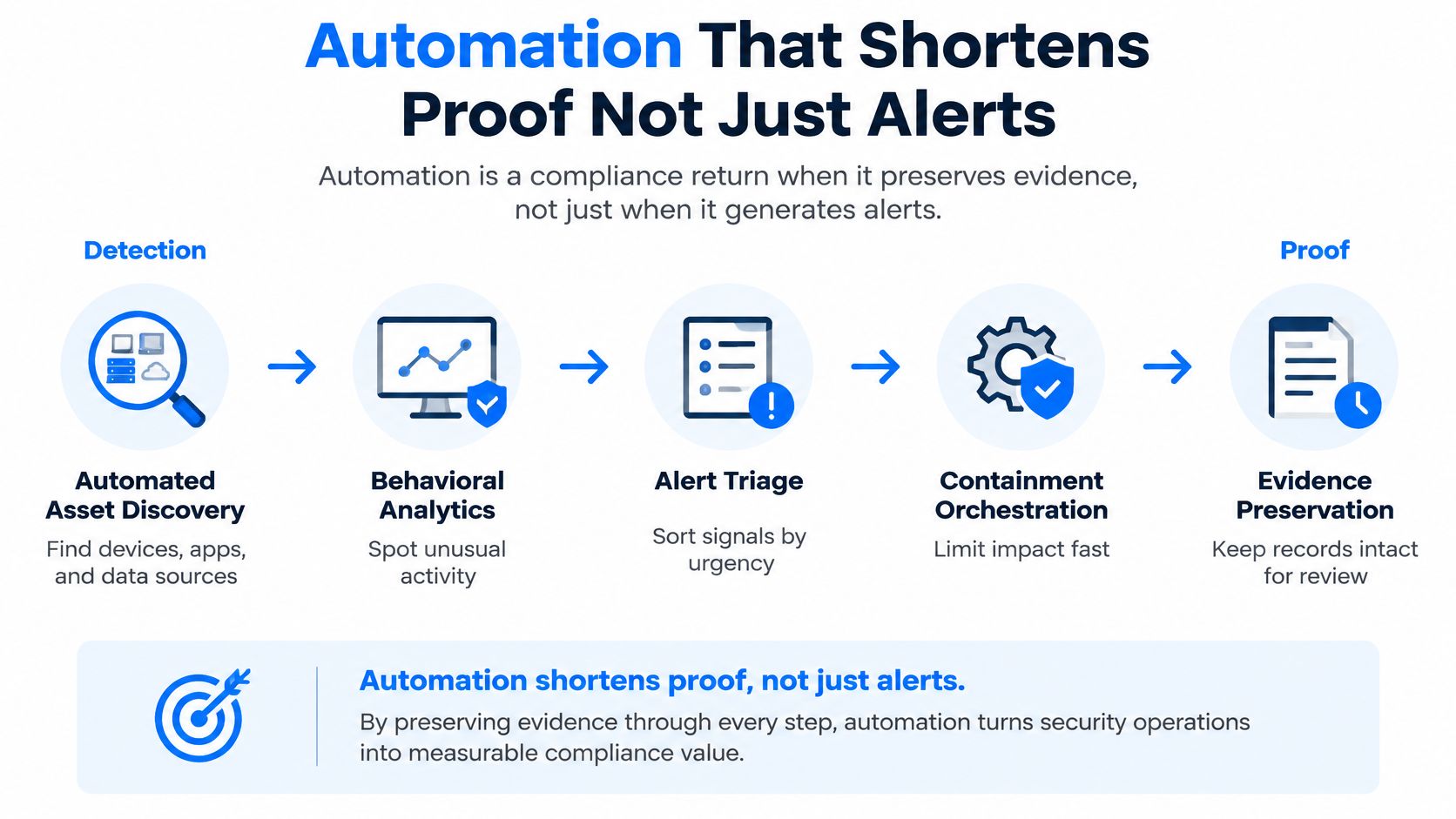
Automation earns its budget when it shortens two clocks at once. The first is attacker dwell time. The second, which teams forget, is the time it takes to prove a control ran.
The mechanism is straightforward. Automated asset discovery finds systems nobody registered, behavioral analytics flags unusual access, alert triage ranks signals so analysts start with the dangerous ones, and containment orchestration isolates a host or revokes a token quickly. Evidence collection running alongside those steps means the record of what happened is created during the incident, not reconstructed from memory weeks later.
Five Evidence Rules for Automated Controls
- Map before you automate: Tie each automated control to a framework requirement and a named owner. An unmapped automation is just a fast action nobody can cite in an audit.
- Keep tamper-evident logs: Preserve timestamps for detection, escalation, containment, and recovery so the sequence can be replayed exactly.
- Require role-based approval: High-impact actions such as isolating a production server or revoking encryption keys need a human approver recorded by name.
- Retain log completeness: Keep enough detail to reconstruct who changed a control setting, when, and from what prior value.
- Measure retrieval time: Time how long it takes to produce a sample of evidence on request. Mean time to detect tells you about security. Retrieval time tells you about compliance.
What to Demand From a Vendor
Judge tools on outcome metrics, not feature lists. Ask for mean time to detect, mean time to contain, privileged-account coverage, log completeness, and control-evidence retrieval time in a live demonstration using your own sample request. A vendor who can't produce evidence during a proof of concept won't produce it during your audit.
Ownership of this work is still unsettled in most organizations. The SANS Institute's 2025 AI Survey found that 35% of surveyed organizations had a formal AI risk-management and compliance program, while 68% believed cybersecurity should help govern AI use. That split argues for feeding security automation directly into governance workflows, so a containment action automatically opens the right review task instead of sitting in a separate console.
An orchestration tool that stops an incident but can't show who approved the action has solved the security problem and failed the audit.
Who Owns AI After the Policy Is Signed
An AI policy can be signed while responsibility for its day-to-day use remains unclear. A month later, a CRM might start summarizing customer calls, yet no one can identify who approved the data the feature reads. The policy is the rulebook; ownership determines who applies it when systems and workflows change.
An EY Europe West survey of 55 companies found that 70% lacked well-defined AI governance models, although approximately 80% were aware of the EU AI Act. Awareness, policy, and operational accountability are different stages of readiness.
Four Use Cases, Four Duties
- Employee productivity tools: If a staff member pastes a contract into a chat assistant, the organization needs acceptable-use rules, data-loss prevention, and an inventory of approved tools. Guidance on governing unapproved AI use at work can help turn those rules into boundaries employees can follow.
- AI embedded in purchased software: A vendor may enable a summarization feature in an update. Procurement and the business owner need to assess the feature, because the organization remains responsible for the data it makes available.
- Internally developed models: When a team trains or fine-tunes a model on company data, it must document data sources, validate model behavior, and set monitoring thresholds.
- Externally hosted generative services: If a department contracts directly for an API, the organization needs clear terms for tenant isolation and data retention, plus a revocation path it can execute without the vendor's permission.
These use cases create different duties for data protection, security, validation, incident response, and vendor oversight. One acceptable-use policy cannot assign those duties on its own. Executive accountability should connect policy to operating roles, including the CIO's responsibilities, so consultation does not become a substitute for a decision-maker.
The Evidence Each Use Case Owes
For every material use case, identify a named owner, purpose, approved data sources, risk classification, monitoring threshold, human-oversight step, and retirement plan. These records give teams a practical way to answer basic questions: what is running, who may use it, what information it can access, and how its use can be stopped.
The supporting controls should fit the use case. They may include AI asset discovery, identity-based access, prompt and output logging where appropriate, model-risk assessments, and an exception workflow for requests outside the approved list. Centralized authentication, tenant-level data isolation, retention controls, auditability, and rapid revocation should also appear in procurement terms where they apply.
More software does not automatically produce better evidence. A specialized AI tool may give one function a clearer view while creating another record that does not connect to enterprise controls. Set an owner for the relationship between AI telemetry, security monitoring, governance records, and incident response. Then teams can trace an alert to the relevant use case and decision instead of assembling separate fragments later.
Budget choices affect that evidence chain. Cisco's 2025 Data Privacy Benchmark Study surveyed more than 2,600 privacy and security professionals across 12 countries; Cisco's 2025 benchmark findings report that 99% anticipated reallocating resources from privacy budgets to AI initiatives. If AI funding comes at the expense of privacy controls, the organization may gain new capabilities while weakening its ability to govern the data those systems use.
Governance Cadence and Board Reporting
Govern works as a rhythm, not a binder. Record one accountable owner per control and per material AI use case in the same system of record that holds the control ID. If the owner changes roles, the record changes the same week.
Run a monthly evidence review with a tight agenda. IT operations shows the latest evidence pull for each control, security confirms the controls still match the estate, and legal confirms the obligations and risk ratings haven't shifted. Anything that can't be pulled live in that meeting becomes an action item with a date.
One Exception Log With Teeth
- Approver: A named person, never a team alias.
- Expiry date: Every waiver ends, so exceptions can't become permanent.
- Compensating control: What reduces the risk while the waiver stands.
- Re-test date: When someone verifies the gap is closed.
Report four figures to the board, every cycle, in the same format. Controls with current evidence, open exceptions past expiry, third parties without completed assessments, and AI systems without an owner or revocation path. Four numbers that move over time tell directors more than a heat map nobody can interrogate.
Schedule an annual crosswalk refresh that checks CSF Govern outcomes against each framework's actual scope, since new SaaS and AI features change scope continuously. Require named approvals for high-impact automated actions throughout, so every action a tool takes traces back to the person who authorized it.
Confirm Ownership Before You Buy Another Tool
Before your next platform evaluation, run a two-week evidence test with what you already own. The result tells you whether your problem is tooling or lineage, and those have very different price tags.
Step 1: Pick one control that serves HIPAA or PCI DSS and SOC 2 at the same time, such as quarterly access reviews. Name its owner this week, in writing, in your system of record.
Step 2: Pull the last 90 days of evidence from the system that performs the control. Not a spreadsheet someone maintains. The identity platform or ticketing system itself.
Step 3: Time the retrieval. Record whether it needed a named hero who knows where things are buried, or a vendor screenshot, to complete. If one person's memory is load-bearing, you've found the finding that matters.
If retrieval fails, fix lineage before licensing anything. A new platform layered over broken asset data produces a more expensive version of the same gap. Score any candidate tool against the test instead. Does it support shared control IDs, API access to evidence, role-based approvals, third-party coverage, and AI revocation? Can it demonstrate each one live?
Where internal staff can't run this test, a vendor-neutral broker can benchmark providers against the same outcomes. MR2 Solutions offers that brokerage role for mid-market and enterprise clients, comparing providers across categories rather than reselling a single product. That's one option among several, and the test above works the same whoever runs it.
Start with a diagnostic of control ownership and duplicate evidence requests across your audit calendar. You'll usually find the same access review collected three times for three frameworks. Collapse it to one collection, keep the tools that shorten retrieval, and make Govern visible to the board in four numbers. That's where compliance and technology stop being separate budgets and start being one accountable system.
MR2 Solutions helps mid-market and enterprise leaders run exactly this kind of vendor-neutral comparison, benchmarking security and compliance providers against your control outcomes instead of a single product roadmap. If you're preparing for an audit cycle or consolidating overlapping tools, visit MR2 Solutions to start with a diagnostic of your control ownership and evidence gaps.