
Tech Due Diligence Explained: Domains, Steps and Red Flags

For private-equity respondents, understanding the true capabilities and scalability of a technology platform was the leading diligence challenge, cited by 21%, in the 2024 KPMG technology M&A survey. That finding reframes tech due diligence. You're not just checking whether a system switches on today. You're testing whether it can carry the growth, compliance work, and integration plan you've already priced into the deal.
Think of it as the difference between a demo and an inspection. A demo shows the product working under friendly conditions. An inspection asks what breaks at higher load, who can fix it, what it costs to run, and which hidden dependencies could turn a sound purchase price into an expensive repair bill after closing.
What Tech Due Diligence Covers and When Buyers Run It
Tech due diligence is a structured review of a target's technology to confirm that it works, can scale, stays secure, and can be operated by the buyer after closing. It covers architecture, software, data, security controls, operations, suppliers, licenses, and the people who keep critical services running. The output isn't a general opinion. It's evidence tied to valuation, closing conditions, and a post-close plan.
The home-inspection analogy helps. You don't buy a house because the lights work during a viewing. You check the wiring, roof, plumbing, and foundation because those items are expensive to discover later. In a technology review, architecture diagrams are the wiring plan, recovery tests check whether the plumbing holds pressure, and license records confirm you own what you're buying.
Why Buyers Worry About Different Things
That 2024 KPMG survey also found that the accuracy and completeness of a target company's financial and operational data ranked among the two leading due-diligence challenges for both corporate acquirers and private-equity investors. Corporate buyers tended to emphasize data-privacy and cybersecurity compliance, while private-equity buyers put platform scalability first. The difference makes sense. A corporate buyer must fit the target into existing obligations, while an investor must prove the platform can support a value-creation plan and a later exit.
| Deal type | Trigger | Central question | Typical depth |
|---|---|---|---|
| Acquisition (M&A) | Letter of intent or pre-close review | Can the platform support the growth and integration plan? | Full review of architecture, security and data |
| Private equity investment | Platform or add-on acquisition | Can technology support the value-creation plan and exit? | Scalability and cost focus |
| Vendor selection | Major platform or outsourcing decision | Does the provider's stack meet our risk and performance needs? | Targeted review of fit, security and exit terms |
| Carve-out or divestiture | Separating a business unit | Can shared systems be separated safely? | Dependency mapping and separation plan |
Practical rule: Start from the deal model, not the server list. Every technical question should test a growth, cost, compliance, or integration assumption in that model.
Timing changes depth, not purpose. A pre-letter-of-intent screen uses limited documents to spot deal breakers before you bid. A confirmatory review after exclusivity uses fuller access to verify claims and price the fixes. In both cases, weak evidence is itself a finding because you can't value what the target can't document.
Six Domains to Assess and the Evidence for Each
Six domains form the spine of a complete review. Score each one separately. Strong product architecture shouldn't hide weak recovery, and a clean security audit shouldn't hide a license that changes when control of the company changes.
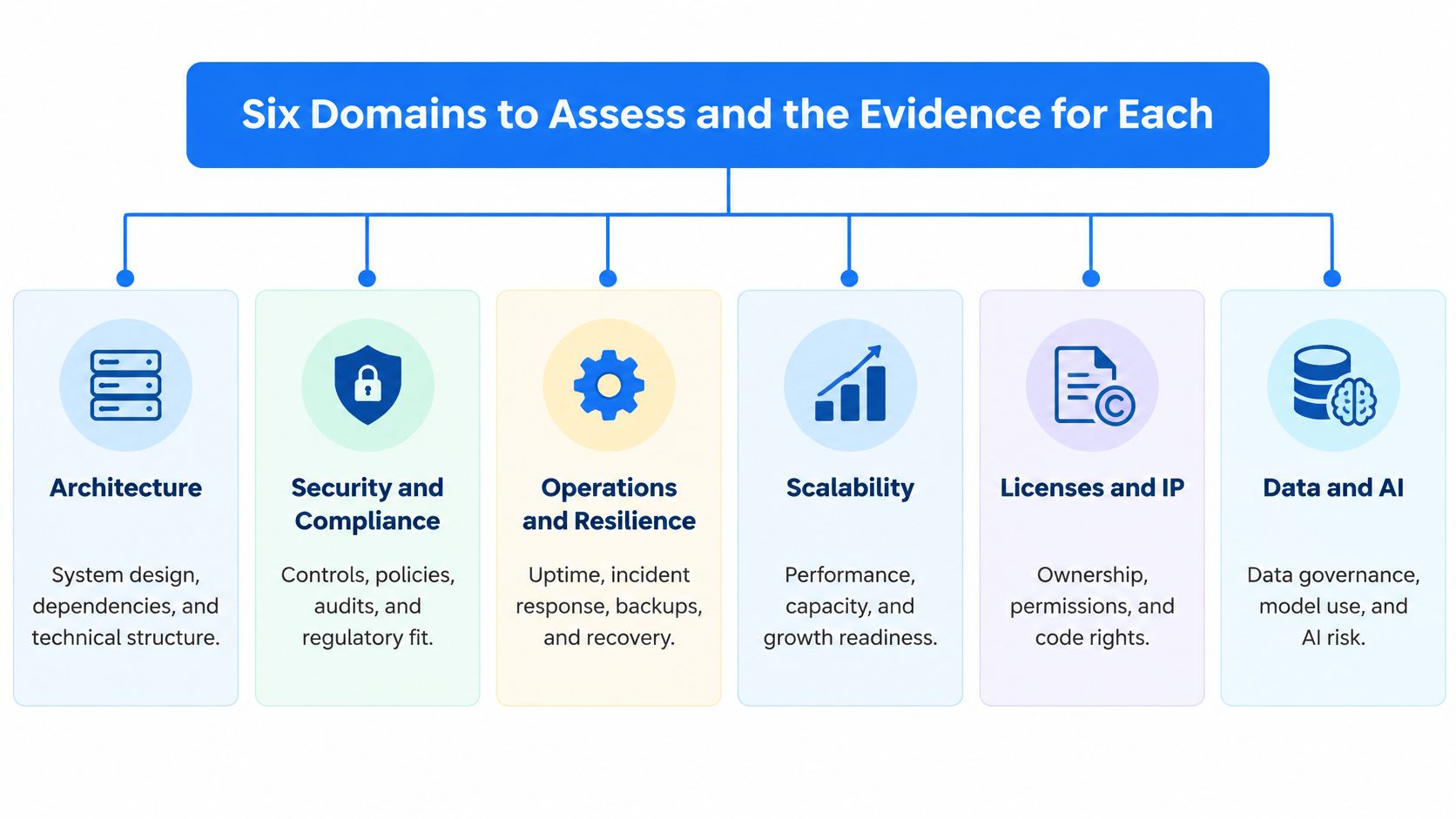
| Domain | Core question | Evidence to request |
|---|---|---|
| Architecture | Can the design handle today's load and planned change? | Architecture diagrams, dependency maps and the technology roadmap |
| Security and compliance | Are controls and breach history acceptable for the data held? | Penetration test summaries, audit reports, incident log and access reviews |
| Operations and resilience | Can services be run and recovered without the current team? | Runbooks, recovery test results and on-call and incident records |
| Scalability | Will performance hold at the buyer's growth assumptions? | Capacity data, load test results and cost-per-unit trends |
| Licenses and IP | Who owns the code and can the buyer keep using it? | License inventory, open-source scan results, IP assignment agreements and change-of-control clauses |
| Data and AI | Can the company prove data rights and model provenance? | Data-processing agreements, model inventories and data retention settings |
Evidence Matters More Than the Question
Anyone can ask, "Is the platform secure?" A good reviewer asks for the last penetration test, the scope page of the audit report, privileged-access reviews, and the incident log, then checks whether findings were closed. Named evidence turns a seller's assurance into something you can test, price, or make a closing condition.
The security row deserves that rigor. In a 2016 study of acquirers reported by CSO Online, 77% believed cybersecurity's importance at acquisition targets had increased significantly during the preceding two years. Compliance problems were among the most common cybersecurity issues uncovered during diligence, cited by 70% of respondents, while 40% identified a lack of a thorough security architecture as common and 40% said they'd discovered a cybersecurity issue after the transaction had already closed.
That last figure explains why qualified reviewers matter. If nobody on the team can read an identity design or challenge a vulnerability backlog, you'll collect documents without understanding them. Our guide to compliance requirements in IT security is useful background when you're deciding which controls deserve specialist review.
Two Rows Readers Often Misread
Scalability doesn't mean the system handles today's customers. Say your model assumes three times the transaction volume after a sales push. You need load-test results, database limits, queue behavior, and cost per transaction at that higher volume, not a chart showing calm performance last Tuesday.
Data and AI isn't an inventory of tools with "AI" in the name. Ask what data entered each material model, under what rights, where it's processed, which underlying model or supplier is used, and whether production settings match the policy. An impressive demo built on data the buyer can't legally keep using isn't an asset. It's a remediation project.
Scope the Deal and Run the Review Step by Step
A review fails before it starts when the scope is just "look at the technology." Scope it against the deal thesis, the access the seller will grant, and the date by which findings must affect price or terms.
Scope Before You Request Documents
Write the deal thesis in one paragraph. Name the value you expect from the technology, the timeline, and the constraints. For example, "double digital sales without rebuilding checkout" points reviewers straight at capacity, payment dependencies, and release practices.
Mark the six domains in or out of scope, with a reason. A carve-out needs deep dependency mapping. A small add-on acquisition may need a lighter architecture review but a full license check. Write down why anything is excluded so the gap is a decision, not an oversight.
Name the three systems or suppliers that would most affect value if they failed. These get interviews and testing first. A minor internal wiki doesn't deserve the same attention as the billing platform, identity provider, or sole data-center contract.
Set the evidence deadline and name who signs off findings. Diligence runs inside a deal clock. If evidence arrives after price and terms are locked, even a serious finding loses its negotiating value.
Check whether your team has the security and AI skills the scope requires. If nobody can assess privileged access, model provenance, or recovery design, bring in outside support for those domains only. A generalist review that misses the one material risk is expensive at any price.
Run the Review Against Claims, Not Brochures
Build the request list from the in-scope domains and send it with a firm deadline. Ask for specific artifacts, such as recovery-test results and open-source scan output, rather than "security documentation." Early gaps tell you where to spend interview time.
Review the data room against the list and flag every missing document. Track each item as received, partial, outdated, or refused. Don't let a polished overview deck substitute for the underlying test report, contract, or configuration export you requested.
Interview system owners and recovery staff. Ask each critical question twice in different forms. "How do you restore the customer database?" and "Walk me through the last restore, step by step" should produce the same answer. Skipping interviews means relying on documents that may describe a system the team no longer runs.
Ask who can perform the restore besides the person you're interviewing. A correct answer from one indispensable engineer is still a continuity risk.
Test the claims. Read penetration reports and certificate scope statements line by line, because a certificate can exclude the very workloads you're buying. Run or request a license and code scan to find copyleft conflicts and copied components. Where the target allows it, check evidence from a recent restore or failover rather than accepting a stated recovery time.
Score each domain, estimate cost and time for each gap, and issue the report with owners and milestones. "Upgrade unsupported database" isn't actionable. "Migrate billing database before integration, owner named, cost range estimated, dependency on payment provider test window" is. Each finding should end as a price adjustment, escrow, closing condition, funded post-close task, or accepted risk.
If you need an outside starting point, we offer structured discovery before any vendor discussions occur, so business goals, challenges, timelines, and constraints are identified first. That vendor-neutral approach also includes a quick, no-obligation assessment to benchmark the environment, with one point of contact across technology categories.
Mapping Third-Party and Supply-Chain Exposure
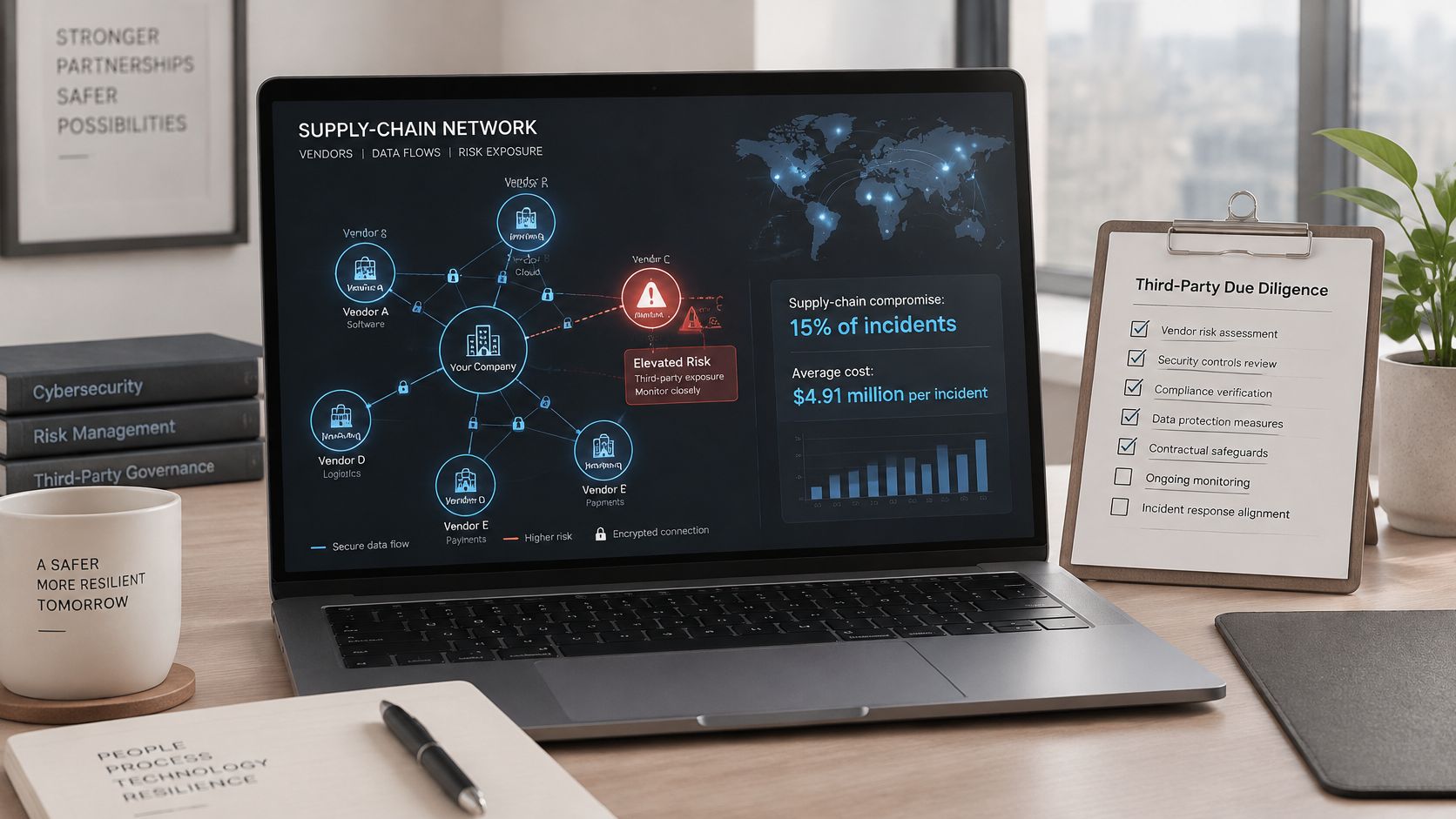
Suppliers aren't a procurement footnote. In IBM's 2025 breach analysis, supply-chain compromise was the second-most prevalent attack vector, representing 15% of incidents, with an average cost of USD 4.91 million per incident. When you buy a company, you inherit its vendors' access, weaknesses, and contract terms on day one.
Turn Supplier Risk Into Deal Numbers
For each critical provider, estimate two things: how likely a compromise or failure is, and what it would do to revenue, data, recovery time, and regulatory duties. Then use that estimate where deal teams decide. Adjust valuation or escrow for expected remediation, sequence integration so a risky provider isn't connected first, check cyber-insurance assumptions, and fund the post-close fixes in the operating budget.
Say a managed service provider holds standing administrator access to production. The contract may be modest, but the blast radius isn't. Replacing standing access with just-in-time access, segmenting the provider's network path, and proving you can revoke accounts quickly may cost real money and take weeks. That belongs in the deal model before signing, not in a surprise budget request after closing.
Separate an Outage From a Compromise
A vendor outage stops a service. A vendor-enabled compromise lets an attacker use the vendor's trusted connection to reach your systems. They need different controls. Tested failover and immutable backups help you recover from either event, but segmentation, least-privilege service accounts, and just-in-time access specifically limit what a compromised supplier can reach.
Request supplier-specific evidence beyond the baseline security documents:
- Subcontractor lists: Know which fourth parties can touch data or systems, not just the company named on the contract.
- Privileged-access design: See which accounts each supplier holds, whether they're shared, and how quickly access can be revoked.
- Breach-notification terms: Confirm how fast the supplier must tell the target, and whether that timing still lets you meet your own duties.
- Recovery-test results: Ask for the supplier's last test and the target's last test of operating without that supplier.
Our overview of IT vendor management best practices helps you structure those questions consistently across providers. The decision criterion is simple. A certification matters less than whether its controls cover the acquired workloads and are backed by operating evidence. A high-risk supplier without compensating controls can create liabilities far beyond its contract value.
Red Flags That Should Change the Deal
A red flag doesn't automatically kill a deal. It changes what you do next: request more evidence, price the fix, make it a closing condition, or walk away when the risk can't be bounded. The pattern to watch is missing documentation. Old technology can be priced. Undocumented technology can't.
No current architecture diagram, or one that doesn't match the running system. Ask for a live walkthrough with the engineer who operates it. If the diagram and the walkthrough disagree, pause and request a corrected dependency map before you rely on any integration estimate.
Critical systems depend on one engineer or one vendor contact. Ask who else can restore service, rotate credentials, and approve emergency changes. If the answer is nobody, price retention, documentation, and cross-training into the first post-close plan.
Recovery has never been tested, or restore time is unknown. Ask for the last test result, including what was restored and how long it took. Without that evidence, treat stated recovery objectives as unproven and consider a closing condition for a supervised test.
Licenses contain change-of-control or copyleft conflicts. Ask for the full license inventory and open-source scan. A component that forces source-code disclosure or a contract that terminates on acquisition can change valuation immediately, so send it to legal counsel with a costed replacement option.
Systems sit past vendor support dates with known exploitable vulnerabilities. Ask for the patch or replacement plan and its cost. Unsupported doesn't always mean unusable, but unsupported, internet-facing, and unpatched is a combination you should price as urgent remediation.
AI claims can't be traced to data rights, model source, or production use. Ask what data entered each material AI system and who bears liability when the model or supplier fails. If the target can't prove provenance, reduce the value you assign to that AI capability.
Security certificates exclude the acquired workloads from scope. Ask for the exact scope statement and any exceptions the auditor recorded. A certificate covering a corporate office network says little about the customer platform you're buying. Request evidence for the systems in the deal.
Technical debt is undocumented. Ask for a register that names each item, its business effect, and the funded fix. Documented, bounded, and funded debt can be a rational choice. Debt nobody has written down is the warning because you can't sequence or price it.
For a broader acquisition perspective, due diligence checks for acquisition red flags from Dealmaker Wealth Society sets out how evaluation findings should shape an acquisition decision. Use that lens alongside the technical evidence. The question is never just, "Did we find a problem?" It's, "Does this problem change price, terms, timing, or our willingness to close?"
Scoring Findings Into a Clear Deal Verdict
A deal verdict should connect each rating to an action. Averaging six domain scores can hide a single serious weakness: one red finding in licensing, recovery, or security may outweigh several green ratings.
| Rating | Meaning | Deal action |
|---|---|---|
| Green | Sound, with low remediation effort | Proceed on standard terms |
| Amber | Fixable issues with a known cost | Proceed with a price adjustment, escrow, or closing condition |
| Red | Material risk to value, continuity, or closing | Renegotiate, restructure, or walk away |
Attach a Price, an Owner, and a Date
Technology debt matters when it threatens the buyer's post-close plan. In KPMG's survey findings on technology debt in M&A, 70% of respondents believe unresolved technology debt can cause operational disruptions, and 60% believe it can lead to cyberattacks. An amber rating for an old platform is too vague to guide a decision. The deal team needs to know whether the issue could interrupt revenue soon or can wait.
Ask what technology investment is needed during the first 100 days to preserve service, meet regulatory obligations, and support the deal thesis. Then show what could happen if the work is delayed. Separate cosmetic upgrades, such as a more polished internal dashboard, from debt that threatens revenue, safety, compliance, or resilience, such as an unsupported identity system or an untested backup for the billing database.
Record the decision in a working table:
- Owner: Identify the person or team accountable after closing.
- Cost range: Give a low and high estimate, with the assumption that affects the estimate.
- Date: Set a milestone against integration events, such as connecting networks or migrating customers.
- Dependency: State what must happen first, such as contract consent, data migration, or access removal.
A material finding without a cost or condition has no clear effect on the deal decision. Cost discipline also matters after closing. Technology expense management can give organizations visibility into current IT spend and identify opportunities to optimize it, helping them assess whether inherited contracts and cloud commitments still fit the integration plan.
A clear verdict has three possible outcomes: proceed, proceed with protections, or walk away. Each should follow from the findings and the buyer's post-close priorities.
For a quick, no-obligation technology assessment that benchmarks your environment, MR2 Solutions begins with structured discovery of business goals, challenges, timelines, and constraints before any vendor discussions. Visit MR2 Solutions to learn more.