
What Is a vCISO? Role, Duties and When You Need One

If your security adviser works part-time, who makes the decisions when they're not in the room? That question gets closer to the value of a virtual chief information security officer than a list of services does. Buying access to expertise is straightforward. Making sure someone approves risks, keeps evidence, and follows through on corrective work takes a clearer agreement.
For executives asking what is a vCISO, the useful answer starts with leadership, not location. The role should help your organization make defensible security decisions while leaving no doubt about who must carry them out.
Who a vCISO Is and Why the Role Exists
A vCISO is an outsourced or fractional security executive who provides the strategic duties of a full-time CISO without being employed full time by one organization.
Think of a fractional chief financial officer who reviews the books, challenges assumptions, and signs off on decisions within their authority without sitting in the office daily. A vCISO offers a similar leadership model for cybersecurity. Their contribution is judgment and direction, not extra hands at a keyboard.
Say a software company has capable IT administrators. They maintain laptops, manage access, and keep systems available, but nobody translates security weaknesses into business priorities. When a customer asks whether the company's safeguards are adequate, the answer gets passed between IT, sales, and legal.
A vCISO gives that conversation an executive owner.
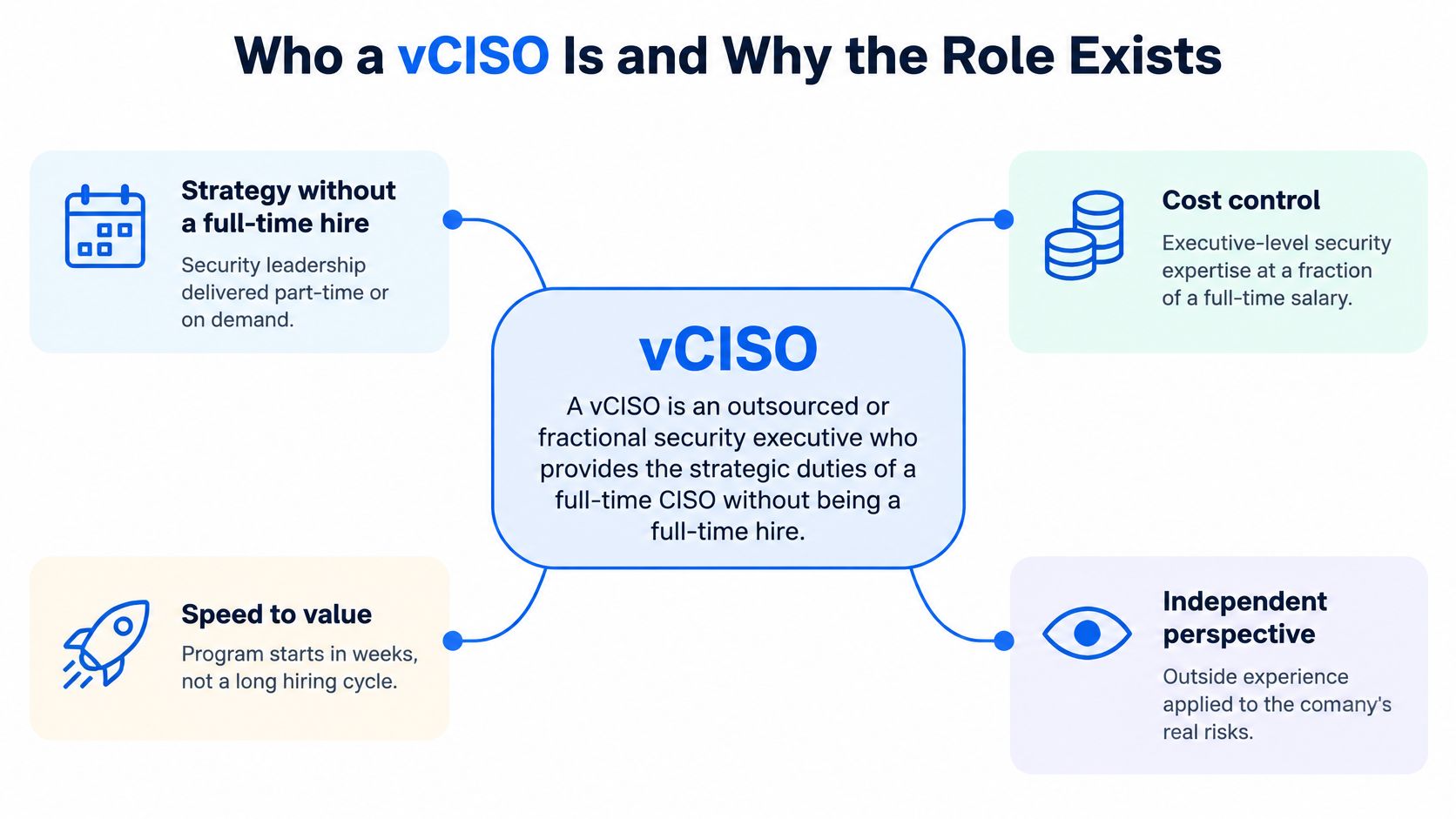
Why organizations use the model
Recruitment helps explain the appeal. ISC2 data cited by Interweave Technologies puts the global cybersecurity workforce gap at nearly 4.8 million unfilled positions in 2024, a 19% increase from 2023. That shortage can make finding experienced security leadership difficult for mid-market organizations.
Fractional leadership offers another way to obtain senior expertise while developing internal capability. Typical candidates include:
- Companies with IT but no security leader, where administrators need priorities and executive backing.
- Regulated organizations, where auditors expect clear responsibility and evidence.
- Businesses facing customer scrutiny, where security questionnaires expose gaps in ownership.
Virtual describes the delivery model, not a lower leadership standard. The work should still connect security to business risk, regulatory duties, and organizational priorities.
Use this self-check: can you name the person who owns security risk decisions and reports them to leadership? If not, you have the leadership gap this role is designed to address.
How a vCISO Differs From Other Security Roles
| Role | Primary focus | Employment | Typical scope and output |
|---|---|---|---|
| vCISO | Strategy, governance, risk decisions and executive reporting | Fractional, part-time or on demand | Whole security program; policies, risk register and board reporting |
| Full-time CISO | Strategy, governance and executive leadership | Full-time employee | Whole security program with daily executive involvement; physical presence follows the employment arrangement |
| Security consultant | A defined technical or assessment project | Project-based contract | One deliverable such as a penetration test or audit preparation |
| Security operations manager | Detection, response and security tooling | Full-time employee | Daily operations, alert handling and team workload |
Quick test: setting rules, framing risk acceptance, and briefing leadership belong to security governance; configuring tools and resolving alerts belong to operations.
ISACA's discussion of virtual CISOs distinguishes CISO responsibilities as strategy, advice, coordination, and management rather than directly implementing firewalls or operating individual tools. A provider might offer both services, but the contract should distinguish leadership from implementation.
A consultant can identify weaknesses through a penetration test and hand over findings. A vCISO determines how those findings affect the wider security roadmap, which business owner must respond, and what leadership needs to decide. The difference is continuing program oversight, not whether the person works remotely.
Where the boundaries sit
A security operations manager keeps the response team functioning: reviewing alert queues, coordinating investigations, and managing technical workload. The vCISO addresses questions such as whether the organization has adequate coverage, which exposures deserve funding, and when unresolved issues require executive attention.
The distinction between technology leadership and security leadership matters, too. Understanding CIO versus CISO responsibilities helps prevent every security decision from becoming an undifferentiated IT task.
For example, IT might recommend postponing a system upgrade to protect availability. The vCISO explains the resulting exposure and recommends safeguards; the authorized business executive decides whether to accept the remaining risk.
A vCISO doesn't replace technical teams, managed detection providers, or legal counsel. The role connects their work through a documented security charter and a recurring review process, rather than treating a vendor list as a security program.
Core Responsibilities of a vCISO
The foundation is governance, meaning how the organization directs security work and holds people accountable. The NIST Cybersecurity Framework 2.0, released on February 26, 2024, includes a Govern function and calls for cybersecurity roles, responsibilities, and authorities to be established and communicated.
A useful vCISO engagement turns that principle into practical work.
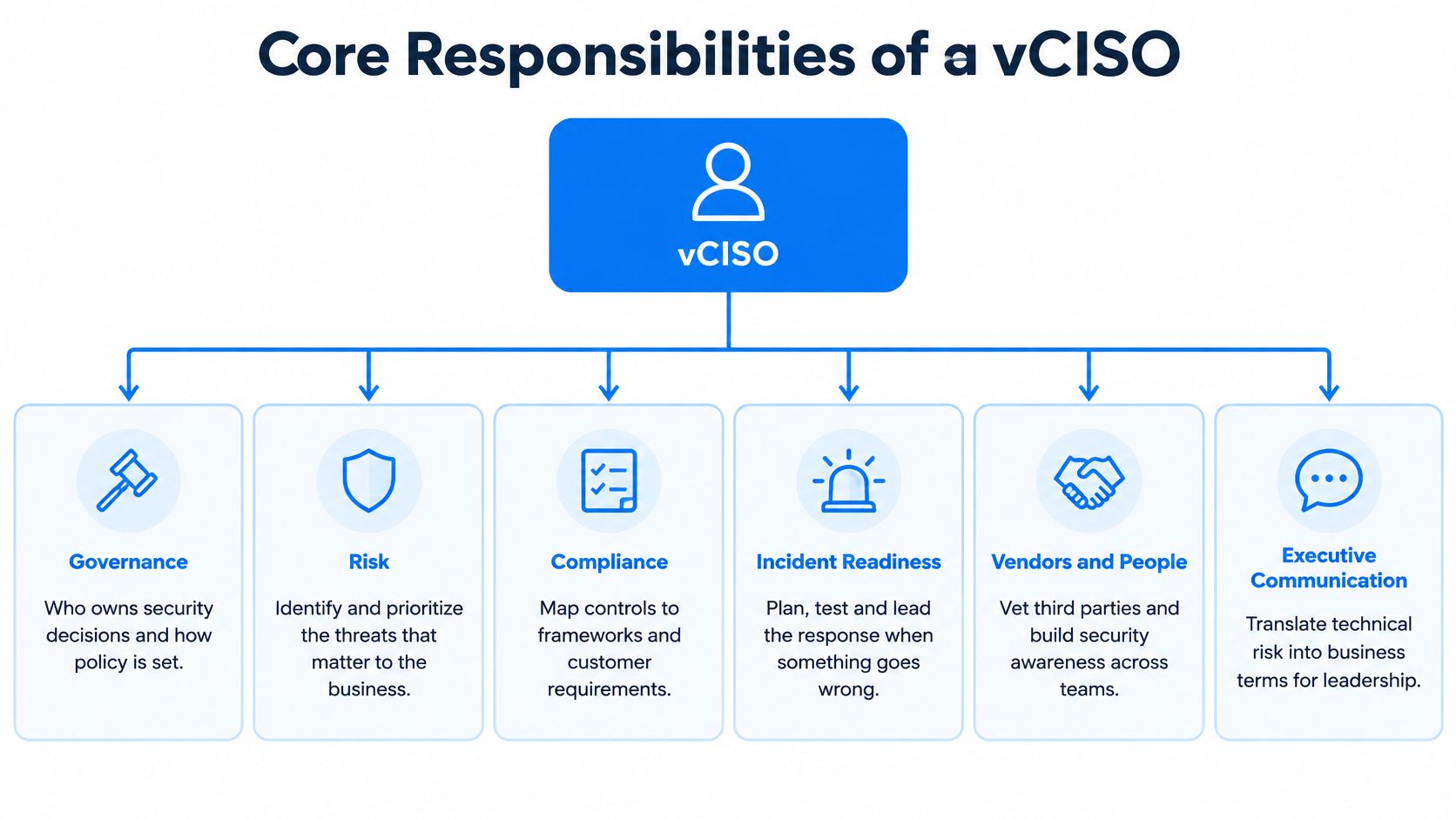
From direction to implementation
Governance. Establish a security charter, policy approval process, and risk tolerance. Identify who can authorize exceptions and who must act when controls aren't working.
Risk. Maintain a risk register that connects weaknesses to affected services, business consequences, and accountable owners. Prioritize remediation using exploitability and business impact, rather than treating every scanner finding as equally urgent.
Compliance. Map controls to applicable frameworks, customer commitments, and regulatory obligations. Coordinate audit preparation and security questionnaires, with evidence behind each answer rather than unsupported assurances.
Incident readiness. Maintain the response plan and define decision-making during an incident. Run tabletop exercises that test who can isolate systems, authorize recovery, and coordinate communications with counsel.
Vendors and people. Review supplier risk and clarify the responsibilities of managed security providers. Work with department leaders on security awareness and processes such as onboarding, role changes, and departures.
Executive communication. Explain exposure, progress, and required decisions in business terms. Present funding choices with consequences, not just product recommendations or technical severity labels.
What the initial work looks like
Consider a hypothetical software firm establishing its first formal security program. The vCISO starts by interviewing service owners, reviewing customer commitments, and examining how access, backups, and incident escalation work.
A cybersecurity maturity assessment can help distinguish missing controls from controls that exist but aren't consistently operated. That distinction matters: writing a new policy won't fix an existing process that nobody follows.
The initial outputs might be a charter approved by leadership, a risk register with named owners, and a policy set matched to the company's actual operations. Each document should connect to a working process. An access policy, for instance, needs an approver, an implementation workflow, and retained evidence of review.
Practical rule: A security document is useful only when someone knows what action it requires and can demonstrate that action happened.
Security Metrics and Board Reporting a vCISO Delivers
| Metric | Question it answers |
|---|---|
| Percentage of assets inventoried | Do we know what we run? |
| Privileged accounts protected by phishing-resistant MFA | How exposed are our most powerful accounts? |
| Critical vulnerabilities beyond remediation target | How long do serious weaknesses stay open? |
| Mean time to detect and contain incidents | How quickly do we stop an attack? |
| Incident-plan exercise completion | Would the response plan work under pressure? |
| Open high-risk third-party findings | Which suppliers put us at risk? |
The CISA Cross-Sector Cybersecurity Performance Goals align with NIST CSF 2.0 and cover outcomes across governance, asset visibility, identity and device security, vulnerability management, incident response, and recovery. They provide a practical baseline for deciding what a vCISO should measure.
The logic matters more than the dashboard. Better asset visibility helps teams find systems they would otherwise leave unmanaged. Phishing-resistant multifactor authentication strengthens protection against credential-based entry, while rehearsed response procedures help people coordinate containment and recovery without inventing the process during an emergency.
Make each report support a decision
Each reporting line should show trend, target, owner, due date, and residual risk. Residual risk means the exposure that remains after current safeguards, including weaknesses that haven't yet been corrected.
A hypothetical report entry could read:
Critical vulnerabilities overdue: Falling since the previous review. Target: Close all overdue internet-facing findings. Owner: Infrastructure director. Due date: Next agreed maintenance window. Residual exposure: An unsupported customer portal remains reachable, with restricted access and enhanced monitoring pending replacement.
That entry gives leadership something to examine. Is the maintenance window soon enough? Does the portal need replacement funding? Has someone with the appropriate authority approved continued operation?
The vCISO should also explain measurement limits. An inventory percentage needs a credible denominator, such as reconciled endpoint, cloud, and network records. Response-time figures need consistent definitions of when detection and containment begin and end.
A completed exercise demonstrates participation, not necessarily readiness. Pair completion status with unresolved lessons, such as an unavailable recovery credential or uncertainty about who could authorize shutdown.
Avoid reporting activity as though it were risk reduction. A count of policies published can make a report look busy while revealing little about whether employees follow them. If a metric never changes a decision, challenge its place in the board pack.
When Organizations Benefit From Fractional Security Leadership
A growing software company receives a large customer's security questionnaire and request for an independent assessment. Sales wants quick answers, IT has scattered records, and nobody can approve the statements. A vCISO's first move is to establish an evidence-backed response process, separating controls that operate today from improvements the company hasn't completed.
For a regional clinic group, the trigger may be uncertainty about patient-data obligations. The vCISO works with counsel and operational leaders to identify applicable requirements, map them to controls, and assign evidence owners. The result should be a defensible action plan, not a security executive offering legal opinions outside their role.
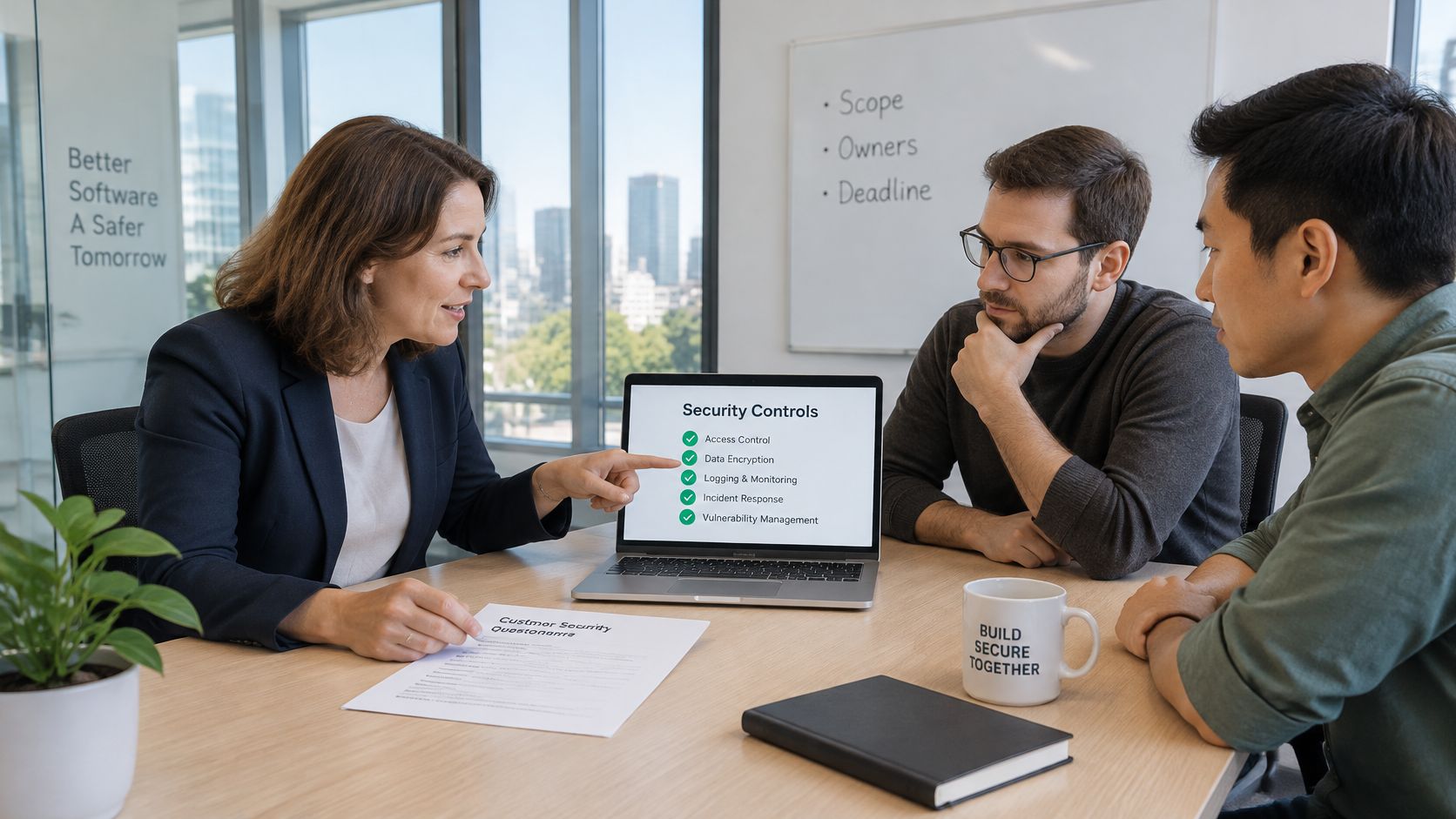
Different triggers require different starting points
After an incident, a company may have technical specialists rebuilding systems but no coordinated executive view. Fractional leadership can establish recovery priorities, document unresolved exposure, and prepare a board update that distinguishes restored services from verified security improvements. Restoring a server isn't the same as proving the original access path is closed.
During an acquisition, a private-equity buyer may need security due diligence before closing. The vCISO organizes evidence, evaluates material gaps, and separates issues requiring transaction decisions from work that can enter the integration roadmap. The useful output is a clear statement of exposure and ownership, not an unqualified assurance that the target is secure.
Some organizations face a broader technology leadership gap rather than a security-specific one. Shiny's guide for organizations considering whether to hire a fractional CIO is a useful adjacent resource when the unresolved work concerns overall technology strategy, investment, and delivery.
When the model won't solve the problem
A vCISO isn't a shortcut to a compliance certificate. An assessor needs a functioning program supported by evidence, not just professionally written policies.
Nor is fractional leadership interchangeable with managed detection. If nobody monitors alerts or contains attacks, adding executive advice leaves that operational gap open. An organization that needs continuous executive involvement may also need a permanent CISO rather than a limited advisory arrangement.
Watch for these poor-fit signals:
- No remediation budget. Findings accumulate without a practical path to correction.
- No internal sponsor. The adviser can recommend action but can't secure participation.
- No willingness to make risk decisions. Leaders expect the provider to absorb responsibility that belongs to the business.
Engagement Models, Decision Rights and First Steps
Before choosing a contract, answer these readiness questions:
- Risk ownership. Who currently owns cyber risk decisions?
- Obligations. Which regulatory duties and customer security commitments apply?
- Reporting. Does the board or senior leadership receive meaningful security reporting?
- Authority. Is there a written security charter?
- Participation. Can an internal executive sponsor commit time to the engagement?
| Model | Commitment | Best fit | Decision authority |
|---|---|---|---|
| Part-time retainer | Recurring fixed hours each month | Steady governance, board reporting and policy oversight | Named internal sponsor keeps final risk acceptance |
| On-demand hours | Hours bought as needed | Occasional gaps, audits, questionnaires or incidents | Decision rights stay with the internal sponsor |
| Project-based engagement | Fixed scope and deliverable | Building a first charter, policy set or roadmap | Ends at handover; ownership moves to internal staff |
| Interim vCISO | Covers an open CISO seat for a set term | Organizations recruiting a permanent CISO | Holds delegated authority for a defined term |
Write down who can decide
Buying vCISO hours doesn't automatically create accountability. The adviser may have no authority over procurement, IT operations, legal, or business continuity.
The capability gap deserves attention: IBM's 2025 Cost of a Data Breach report reported average breach costs of $5.22 million for organizations with a high level of security-skills shortage, compared with $3.65 million for those with little or no shortage, a difference of roughly 43%. That finding doesn't prove a vCISO prevents losses, but it reinforces the importance of matching expertise with execution capacity.
Require a written operating model covering decision rights, risk acceptance, escalation thresholds, deliverables, meeting cadence, control ownership, and incident-period availability. Apply IT governance best practices to distinguish who recommends, approves, implements, and verifies.
Evidence needs an owner, too. For an access review, identify who exports account records, who approves changes, who removes access, and who retains proof.
During provider evaluation, request a sample charter and explicit answers about who signs risk acceptance, how incident availability works, and how the adviser coordinates technical teams and counsel.
Start with an executable agreement
- Name the current decision owner, even if the arrangement is informal.
- List applicable obligations, including contracts and regulatory duties.
- Define initial deliverables, such as an approved charter, an owned risk register, and a usable policy set.
- Choose the engagement model that matches the ongoing oversight required.
- Document decision rights before signing, including evidence retention and handover responsibilities.
Reports arriving on schedule aren't enough if nobody can identify who approved an exception or must fix an open finding. The organization must still own its decisions.
MR2 Solutions offers Fractional CIOs, Fractional CISOs, and IT Directors, providing on-demand executive IT and security leadership without the full-time cost. Visit MR2 Solutions to discuss your security leadership gap and define an engagement around clear decision rights, practical deliverables, and accountable internal owners.