
IT Sourcing Strategy: A Practical Guide for 2026

Your cloud renewal is approaching, finance wants a lower run rate, and the security team still hasn't approved the provider's subcontractors. Meanwhile, a business unit has bought another SaaS application using a corporate card. You're being asked to negotiate a better contract before anyone has agreed on what the organization should buy, retain, or replace.
An IT sourcing strategy resolves those decisions before negotiations start. It also assigns the people, controls, and exit requirements that keep the decision sound after signature.
What an IT Sourcing Strategy Actually Decides
A restaurant kitchen decides which dishes to cook itself, which ingredients to buy prepared, and which suppliers to trust. Buying everything prepared sacrifices control. Making everything from scratch requires skills and capacity the kitchen might not have.
IT leaders face the same trade-off. Your team might retain application architecture, buy a cloud platform, outsource overnight security monitoring, and add contract staff for a migration. The strategy connects those choices rather than treating each purchase as an isolated event.
Procurement buys a contract. Sourcing strategy sets the rules that every contract must follow. Its scope includes network operations, cloud platforms, SaaS applications, security monitoring, service desk delivery, and temporary technical resources.
Make the operating choices explicit
A usable strategy answers:
- What stays internal? Retain capabilities where business context, architectural authority, or sensitive decision-making matter most.
- What comes from providers? Buy capabilities when providers offer a delivery model your organization can supervise and sustain.
- How will providers be chosen and replaced? Establish selection evidence, operating accountability, and substitution requirements before committing.
Say your infrastructure team signs a sensible cloud agreement. Business units then add SaaS tools without architecture review, separate administrators retain privileged access, and nobody consolidates renewal dates. Each purchase may look reasonable, but the combined portfolio has no accountable design.
The problem isn't necessarily poor negotiation. It's that nobody established rules for workload placement, access ownership, integration, and ongoing purchasing.
First assignment: List the sourcing decisions your organization has made by default rather than by design.
Start with who operates critical systems, who can authorize new subscriptions, and who can approve continued dependence on a provider. Those answers expose the decisions a better contract alone won't fix.
How to Build an IT Sourcing Strategy in Six Steps
Start with the portfolio, not the shortlist. If you invite vendors before agreeing on requirements, their product boundaries can become your operating model.
NIST's acquisition and configuration-management guidance identifies market analysis, RFP development, procurement, integration, sustainment, and maintenance as activities that may need representation in configuration-management planning. Apply that lifecycle discipline to sourcing rather than treating supplier review as a purchasing checkpoint.
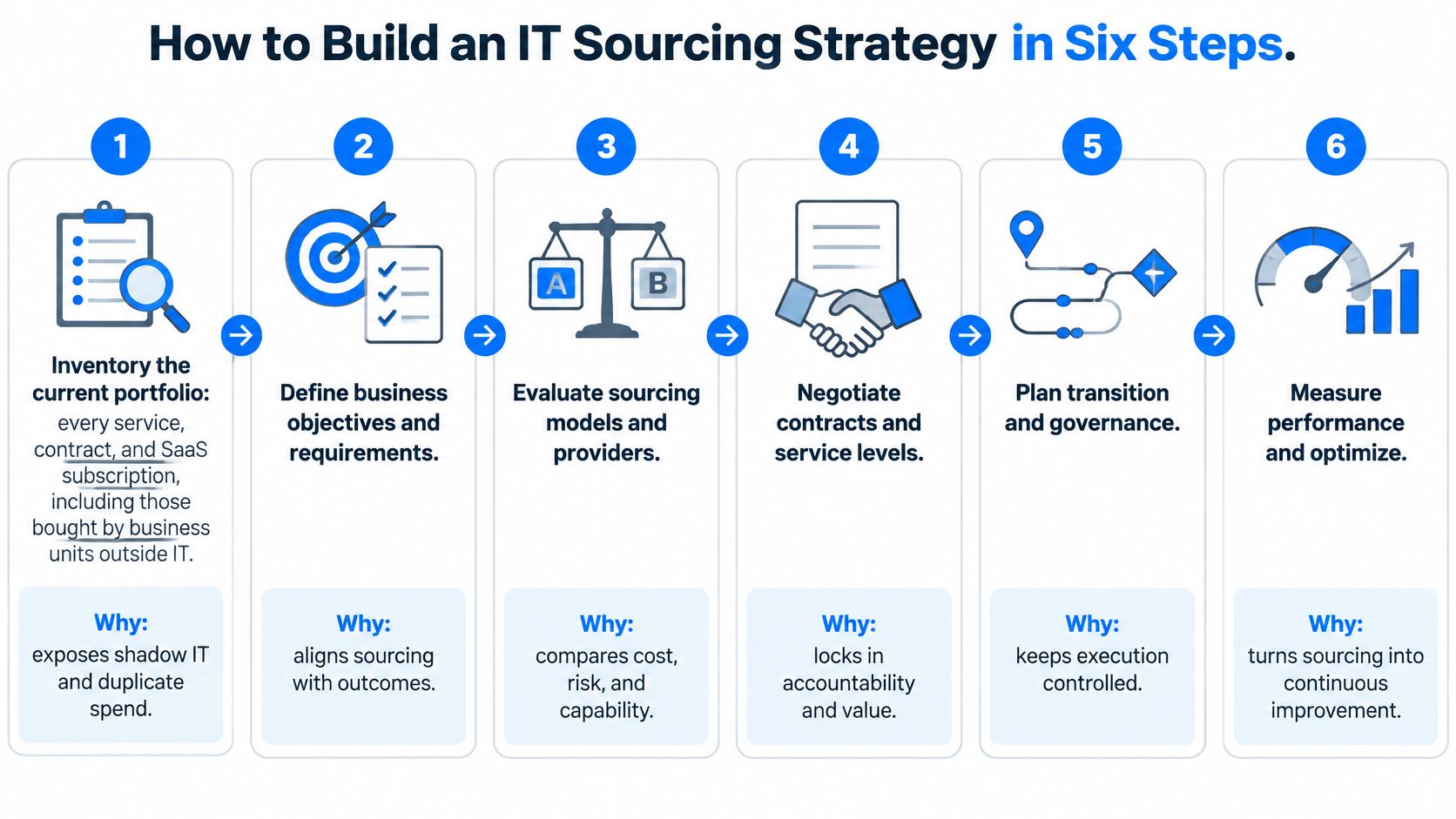
Establish the decision sequence
Inventory the current portfolio. Reconcile accounts-payable records, purchasing cards, identity-provider application lists, cloud billing accounts, and contract repositories, including subscriptions bought outside IT. Record the service owner, supplier, renewal notice deadline, dependencies, and current spend because an incomplete inventory produces an incomplete strategy.
Set outcomes and constraints before vendor conversations. Have business owners, architecture, security, finance, and procurement agree on service expectations, budget ceilings, delivery dates, and regulatory duties through structured discovery. Our discovery process identifies business goals, challenges, timelines, and constraints before vendor discussions, so a sales demonstration doesn't substitute for requirements.
Tier services by business impact. Classify identity, connectivity, cloud platforms, clinical systems, and security operations according to what happens when they fail or become unavailable. Give high-impact services deeper assessment and stronger transition requirements, while keeping commodity purchases proportionate to their risk.
Choose the provider model for each tier. Decide which responsibilities remain internal and which can move to a platform, managed provider, contractor, or combination. Make that allocation before requesting proposals, otherwise suppliers will price different scopes and leave you comparing incompatible offers.
Evaluate providers against a common scorecard. Issue the same requirements, workload assumptions, evidence requests, and contract exceptions to every shortlisted provider. Resolve mandatory security and operational gates before ranking commercial value, so a persuasive presentation can't compensate for an unacceptable dependency.
Assign governance before award. Name the operating owner, schedule acceptance and post-award reviews, capture renewal deadlines, and configure consumption alerts. The reason is straightforward: someone must act when delivery, costs, or supplier conditions depart from the assumptions used to approve the purchase.
Preserve the evidence chain
Maintain a requirements traceability matrix linking business requirement → approved architecture → evaluated supplier → contracted control → deployed configuration → operating owner. Give each requirement an identifier and attach the evidence needed to accept it.
For example, a requirement to retain access to security logs should connect to the logging architecture, the provider's export capability, the contractual retention obligation, and the person who validates the deployed configuration. An unanswered requirement remains open, even if the supplier has signed the agreement.
Set acceptance criteria before implementation starts. The selected vendor or delivery partner should know which performance results, access controls, documentation, and handover evidence are required before the business owner accepts the service.
The common mistake is starting at provider evaluation with an RFP. That produces detailed answers to questions the organization hasn't yet decided are the right ones.
Provider Models and When Each One Fits
The provider model determines how much delivery responsibility and control you retain. It isn't a ranking of provider quality.
Provider models compared by fit, control and risk
| Provider model | Best fit | Control retained | Main risk to manage |
|---|---|---|---|
| In-house delivery | Differentiating systems and core data | Highest | Talent depth and capacity during peaks |
| Staff augmentation | Short skill gaps on a defined project | High over direction, lower over team continuity | Knowledge leaves with contractors at project end |
| Managed service provider | Steady run operations such as monitoring, patching and service desk | Medium, set by service levels | Weak SLA design and dependence on one delivery team |
| Cloud or SaaS platform | Commodity platforms and elastic workloads | Low to medium, set by contract | Lock-in and consumption overruns |
| Multi-provider sourcing | Large estates with distinct network, cloud and security domains | Medium, needs an integration owner | Integration burden and accountability gaps |
| Brokerage-led advisory | Complex decisions where the buyer lacks market visibility | Buyer retains selection authority; advisor supports the decision | Added cost layer and advisor independence |
Match delivery responsibility to internal capacity
In-house delivery fits capabilities that distinguish your business or require close operational judgment. Budget for cover, succession, documentation, and specialist development, not just the salaries of the people currently running the service.
Staff augmentation fits a bounded skills or capacity gap when your managers can still direct the work. Put knowledge transfer and documentation in the delivery plan, rather than discovering at project closure that only the contractor understands the configuration.
A managed service provider fits repeatable operations with measurable responsibilities. For managed services operations, define who detects, diagnoses, remediates, and communicates during incidents, including failures that cross supplier boundaries.
Cloud and SaaS platforms suit standardized capabilities and workloads that benefit from elastic capacity. Accept that the provider controls much of the product roadmap, and verify that your required configurations are supported rather than promised through workarounds.
Separate advice from operational ownership
Multi-provider sourcing fits distinct technical domains when your organization can integrate them. Assign an internal integration owner who can resolve handoffs between network, cloud, application, and security teams.
Brokerage-led advisory fits a different gap: insufficient market visibility or evaluation capacity. It supports discovery, comparisons, and selection; it doesn't remove your responsibility to accept the resulting operating model.
Use a deliberate combination rather than forcing every service into the same arrangement. Reassess the mix at major renewals, particularly when internal skills or business requirements have changed.
Governance That Keeps Sourcing Decisions Accountable
68% of IT leaders say business units procure substantially more cloud and SaaS than central IT knows about, according to Flexera's 2025 IT Priorities Report. Governance must close that visibility gap without turning every routine purchase into a committee exercise.
Governance means decision rights, not more paperwork. Someone must have authority to stop an unsuitable purchase, approve a commercial commitment, accept delivery, and intervene when consumption exceeds the agreed plan.
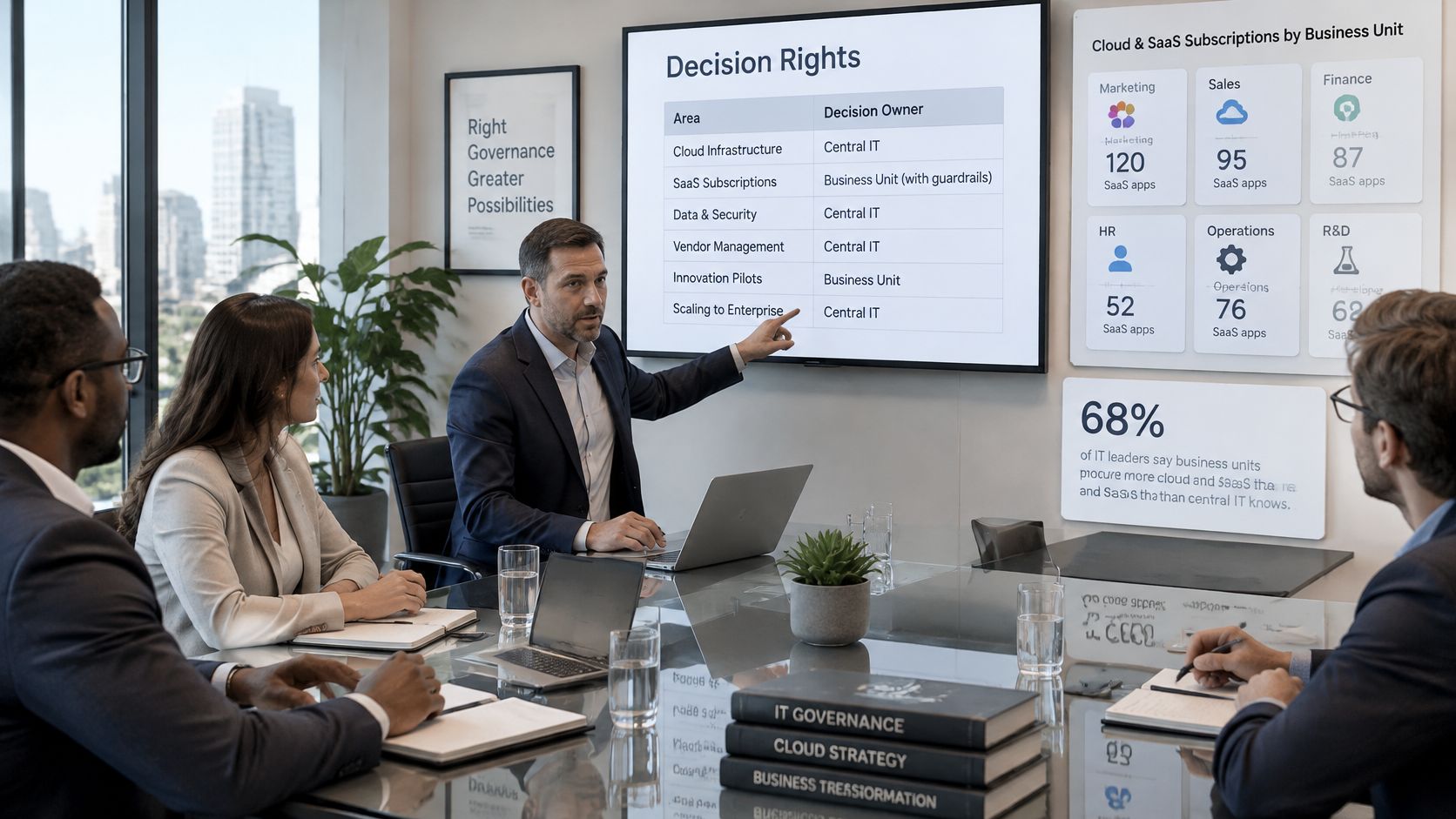
Sourcing roles and decision rights
| Role | Owns | Holds decision right on |
|---|---|---|
| CIO | Portfolio direction and sourcing policy | Tier-one provider selection and strategy changes |
| CFO or procurement lead | Commercial terms and benchmark pricing | Contract award and renewal terms |
| CISO | Security requirements and supply-chain controls | Veto on providers failing security gates for high-impact services |
| FinOps lead | Consumption tracking and unit cost per workload | Spending alerts, rightsizing and commitment changes |
| Business service owner | Outcomes and service acceptance | Acceptance of delivery and escalation of service failures |
| Legal counsel | Liability, data location and termination rights | Approval of exit, data and subcontractor clauses |
Reserve council attention for consequential decisions
Send every tier-one service and every contract above an agreed annual-value threshold to a sourcing council. Finance should set that monetary threshold against the organization's delegated-authority policy, not borrow an arbitrary industry figure.
Keep low-impact renewals with procurement and the business owner unless scope, data sensitivity, or contractual exposure changes. A renewal that adds sensitive data processing isn't routine because the supplier remains the same.
The council should resolve explicit exceptions, not repeat technical evaluations. Its decision record should identify the exception, accountable approver, compensating control, and condition that triggers reconsideration.
Keep authority inside the organization
External advisors can prepare comparisons, challenge assumptions, and reduce evaluation workload. Our role alongside internal IT teams is to strengthen their decision-making, not take away their authority over selection and service acceptance.
Translate IT vendor management practices into an operating routine: suppliers provide evidence, service owners assess outcomes, and decision-makers approve corrective action. Don't let the supplier's account manager become the only person maintaining the action log.
A mid-sized organization needs a named owner per service, a shared review calendar, and a clear escalation path. If those are missing, adding another governance platform won't establish accountability.
Vendor-Neutral Evaluation With a Weighted Scorecard
Use the following as a suggested scoring model, not an industry benchmark. Set the weights before proposals arrive and require every shortlisted provider to answer the same written questions.
Vendor scorecard criteria and starting weights
| Criterion | Starting weight | Evidence to request |
|---|---|---|
| Total cost over the evaluation horizon | 25% | Itemized price model, usage assumptions, renewal uplift terms |
| Security and supply-chain controls | 20% | Security attestations, incident-notification commitment, subcontractor list |
| Service levels and performance | 15% | Proposed SLAs, service credits, historical uptime data |
| Integration and interoperability | 10% | Supported standards, API documentation, reference integrations |
| Exit and portability terms | 10% | Data export formats, migration support, termination fees |
| Operational fit and skills | 10% | Named team profile, support model, time zone coverage |
| Vendor viability and references | 10% | Financial statements, customer references in the same sector |
For a hypothetical evaluation, score each criterion on a five-point scale, multiply the score by its weight, and add the weighted results. Define the evidence required for each rating so evaluators aren't translating personal impressions into apparently objective numbers.
Apply security gates before commercial ranking
NIST SP 800-161 Rev. 1 treats cybersecurity supply-chain risk management as a lifecycle discipline covering design, development, acquisition, deployment, maintenance, and retirement. A completed questionnaire is therefore an input, not a permanent security approval.
Require evidence for incident-notification timelines, subcontractor visibility, access governance, secure development, vulnerability disclosure, data-location constraints, and software component provenance. Convert the relevant commitments into enforceable contractual obligations and validate them before acceptance.
Reassess material changes, including acquisitions, new subcontractors, major code changes, and altered operating conditions. Otherwise, you may continue using a supplier whose current delivery arrangements no longer match the approved risk assessment.
For critical identity or clinical services, treat the combined security and exit weighting as a floor, not a ceiling. Increase it when consequences justify doing so, reducing other weights proportionally.
Let a cheaper bid lose
Consider a hypothetical cloud-platform comparison in which the lower-priced bid earns 3.5 out of 5, while the alternative earns 3.8. The cheaper bidder offers weak export rights and limited migration support, which reduces its exit score enough to outweigh its price advantage.
Record the reason for that difference. A defensible recommendation says the buyer is paying for usable portability and lower transition exposure, not merely selecting the more expensive provider.
Vendor neutrality means judging technical fit, operational alignment, and long-term value. It doesn't mean pretending every provider is equally suitable.
Separate mandatory gates from weighted preferences. A provider that fails a mandatory requirement shouldn't win by collecting points elsewhere.
Managing Cost Beyond the Contract Price
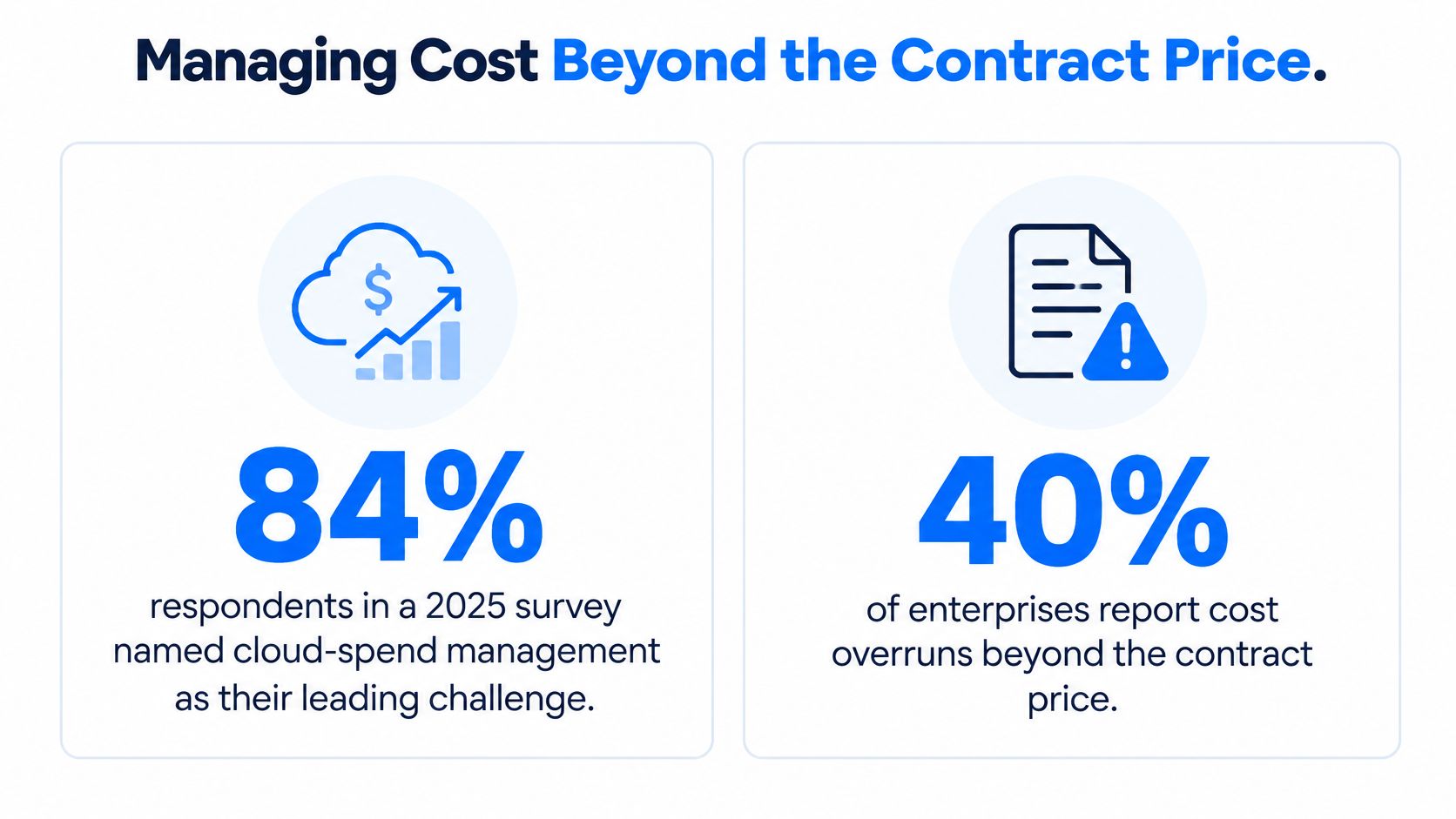
84% of respondents identified cloud-spend management as a leading challenge in Flexera's 2025 State of the Cloud survey of 759 cloud decision-makers and users; the same report found that 40% of enterprises reported annual cloud spending above $12 million in 2024.
Treat the signature as the start of cost control, not the finish. Compare proposals against the cost of operating the service, governing consumption, and replacing it without paying through egress, parallel running, or stalled change.
Visible and hidden costs in an IT sourcing decision
| Cost component | Visible in proposal? | How to estimate it |
|---|---|---|
| Licence, subscription or service fee | Yes | Multiply unit price by forecast volume across the comparison period |
| Integration and migration | Partly | Obtain the implementation estimate and add internal effort |
| Data egress and consumption overruns | Rarely | Model peak usage and transfer volumes per workload |
| Internal management and oversight | No | Estimate monthly service-owner and vendor-manager hours |
| Exit and termination fees | Rarely | Review termination clauses and price a parallel run |
| FinOps tooling and staff | No | Allocate tooling licences and FinOps effort to workloads |
Score the replacement route before award. If export rights, data extraction, termination assistance, or knowledge transfer are weak, the low bid can become the expensive option.
Give consumption a business denominator
Track unit cost per workload, not just the aggregate invoice. Useful measures include cost per supported user, completed transaction, protected endpoint, or accepted AI-assisted task, provided the denominator reflects a real business outcome.
For an IT service-management shortlist, DataLunix's guide to HaloITSM pricing plans can help frame subscription questions. Validate the applicable quotation and add implementation, integrations, administration, and transition costs before comparing alternatives.
Set spending alerts at workload and business-owner level. Specify who investigates an alert, who can authorize additional consumption, and when discretionary usage must pause.
Challenge discounts that restrict movement
Run quarterly rightsizing reviews and review commitments before signing reserved-capacity or multi-year discounts. Architecture should confirm workload stability, finance should validate demand assumptions, and procurement should document the consequence of unused commitments.
A lower unit rate is wasted if the organization pays for unused capacity or keeps unsuitable workloads in place to consume it. Compare the discount with migration costs, remaining commitments, and the value of keeping alternatives available across architecture, pricing models, and integration capabilities.
Use technology expense management to reconcile contracted services with billed and used services. Assign every discrepancy to an owner, then feed recurring variance into renewal, rightsizing, and exit decisions.
Assembling the Sourcing Strategy Document
Build a short set of linked records, not a policy binder that nobody updates. The document should let an authorized colleague reconstruct a decision without searching through procurement emails.
Assemble the operating records
Scope and inventory. Capture services, contracts, and SaaS subscriptions, including business-unit purchases. Link each item to its billing record and operational dependencies.
Service tiers. Record the impact rule, assigned classification, and accountable service owner. Explain exceptional classifications rather than overriding the rule.
Provider model per tier. Record the delivery arrangement and why it fits. Include retained responsibilities so outsourcing doesn't leave necessary internal work unassigned.
Decision rights. Capture the council threshold, delegated approvals, and security veto conditions. Identify who can approve an exception and how it expires.
Scorecard. Preserve the approved weights, evidence requests, evaluator notes, and final recommendation. Keep mandatory failures visible rather than burying them in an average.
Cost model. Store visible and hidden costs, workload assumptions, unit economics, and alert thresholds. Identify who maintains each assumption.
Exit results. Attach test evidence, unresolved blockers, contractual remedies, and the acceptance threshold for critical services. Include the proposed replacement route.
Review calendar. Record renewal and notice dates, post-award reviews, and escalation contacts. Schedule decisions before contractual deadlines remove your options.
Make maintenance someone's job
Keep a named owner per service and a controlled version identifier for the strategy. Refresh the affected records at major renewals or after material changes in provider arrangements, architecture, or regulation.
Don't overwrite the reasoning behind an earlier decision. Preserve the approved version and record what changed, who authorized it, and which assumptions now require validation.
Usability test: A colleague outside the sourcing team should be able to locate a critical service's owner, exit path, and next renewal date without asking its project manager.
If that requires reading the entire document, simplify the index and links. Retrieval is part of governance, not an administrative afterthought.
Test Exit Readiness Before You Sign
More vendors don't automatically mean less risk. Every additional provider creates integration, accountability, and monitoring work, so prefer selective concentration with a documented substitution path for high-impact functions.
The gap between assessment and enforceable obligations matters: European Parliament analysis citing ENISA findings reports that 48% of organizations included cybersecurity requirements in supplier contracts, compared with 54% conducting supplier risk assessments and 63% requiring standards or certifications.
Score demonstrated exit capability
Use this proposed gate: score each test 0 for absent, 1 for documented but unproven, or 2 for demonstrated and contractually supported. That produces a maximum of 20; a suggested tier-one minimum is 16, with a zero for data export treated as an automatic rejection.
- Data export completeness. Export records, attachments, metadata, relationships, and relevant history.
- Usable formats. Open and validate exported content outside the provider's application.
- Migration tooling. Test extraction tooling, rate limits, and transfer sequencing.
- Identity and logging portability. Verify access mappings and retained audit evidence.
- Subcontractor visibility. Identify delivery dependencies and obligations during transition.
- Incident cooperation. Confirm evidence preservation and investigation support through termination.
- Recovery objectives. Validate continuity requirements during replacement.
- Transition assistance. Specify deliverables, staffing obligations, and charges.
- Termination fees. Calculate notice requirements, remaining commitments, and release conditions.
- Parallel-run support. Confirm coexistence, synchronization, access, and final cutover arrangements.
Reject the blocker, not just the low total
A provider that cannot release usable business data is not exit-ready, regardless of strengths elsewhere. Require a sample export and validate it with the receiving team; a contractual statement without a workable extraction process isn't enough.
Take your top shortlisted provider and run these tests in writing. Convert acceptable answers into contractual obligations, resolve blockers before award, and book the first post-award review before signature.
We help organizations compare architecture, pricing models, and integration capabilities before committing, with advisory support spanning discovery, evaluation, selection, and optimization. Visit MR2 Solutions to discuss a sourcing review, and bring your service inventory, next major renewal, and current provider shortlist so the discussion starts with decisions you need to make.