
Vendor Evaluation Process: A Step-by-Step Guide for 2026

You're sitting on three polished vendor proposals, a renewal clock that's down to weeks, and three internal teams pulling in opposite directions. Finance wants the lowest license quote, operations wants the flashiest demo, and security just flagged an unanswered question about offshore data processing.
That pressure is exactly where buying mistakes happen. When teams rush to pick a supplier on price or slide-deck promises, they absorb operational, security, and lock-in risks that don't surface until months after go-live.
A defensible vendor evaluation process treats supplier selection as a risk-tiered decision that keeps running long after the ink dries. It pairs pass-or-fail security and continuity gates with weighted commercial scoring, applies dedicated scrutiny to AI-embedded tools, and verifies real business outcomes at 30, 90, and 180 days.
Seven Stages of the Vendor Evaluation Process
A core payment or identity supplier goes dark on a Tuesday morning. The operations lead opens the vendor folder and finds no tested failover procedure, no pre-qualified alternate provider, and no escalation contact with authority to restore service. That outage is the predictable result of treating procurement as a one-off purchase instead of a repeatable discipline.
The failure rate behind that discipline gap is well documented. In a Deloitte global survey of 170 organizations conducted in 2016, 87% had experienced a third-party incident that disrupted operations, and 11% had suffered a complete failure in a vendor relationship. Buying teams still underweight that exposure when a persuasive demo or an aggressive discount is on the table.
A seven-stage workflow turns exposure into controlled checkpoints. Every stage produces a concrete artifact, belongs to a named owner, and requires a gate decision before work advances.
Vendor Evaluation Stages Outputs and Gates
| Stage | Output | Typical owner | Gate to pass |
|---|---|---|---|
| Define requirements | Requirements list with must-have gates | Business owner with IT | Sign-off on must-have requirements |
| Assign risk tier | Criticality rating and evidence depth per vendor | Security and risk lead | Tier approved by the risk owner |
| Collect evidence | Standardized questionnaire and documents from each bidder | Procurement | Every mandatory question answered or flagged |
| Score proposals | Weighted scorecard with recorded deviations | Evaluation panel | Shortlist limited to vendors passing all gates |
| Validate claims | Demo results, reference notes and pilot outcomes | Technical and business leads | Pilot meets predefined success thresholds |
| Negotiate and select | Contract with SLAs, exit and data terms | Procurement with legal | Signed decision memo |
| Onboard and monitor | Baseline metrics and 30, 90 and 180-day reviews | Vendor manager | Review dates booked and owners named |
The gate column does the heavy lifting. When a submission fails a gate, the process loops back to the previous stage to collect missing proof or narrow the field. You never lower the bar just to keep a popular bidder alive.
Two design choices separate this workflow from a standard RFP checklist. First, the risk tier assigned in stage two sets how much evidence each vendor must produce, so a low-risk tooling supplier answers a short questionnaire while a platform touching customer data faces security, continuity, and financial-stability scrutiny. Vendors embedding AI features into otherwise familiar products get the deeper evidence set regardless of category, because model behavior and data handling rarely appear in standard marketing documentation. Second, the final stage keeps running after signature. The 30, 90 and 180-day reviews compare live service against the baseline metrics recorded at onboarding, which is where most selection processes stop and where vendor performance problems surface.
Who Belongs in the Evaluation Room
Running these seven stages takes five distinct voices from day one: the business owner who owns the outcome, IT for architecture and integration fit, security for risk and compliance controls, procurement for fair process and commercial structure, and finance for five-year cost modeling. Leaving any one of those seats empty until contract review guarantees late-stage rework.
This checkpoint logic isn't limited to enterprise software or network infrastructure. Marketing leaders apply the same staged scrutiny when running agency due diligence for affiliate programs, where partner access to brand reputation and attribution data carries real commercial risk.
Auditability test: Hand your vendor file to an IT director who wasn't part of the project. If they can't reconstruct why the winning supplier beat the runners-up from the written record alone, your process isn't defensible yet.
How to Define Requirements and Assign Risk Tiers
Most bad vendor selections fail before a single RFP leaves the building. A team invites three big-name suppliers for introductory calls, watches slick product walkthroughs, and unconsciously rewrites its own wish list around whichever sales engineer gave the sharpest presentation.
Structured discovery prevents that drift. In our engagements, we run structured discovery sessions to pin down business goals, operational challenges, timelines, and budget constraints before any vendor conversation begins. Put four things on paper first: the exact business outcome you're buying, the hard timeline for go-live, the budget ceiling approved by finance, and the operational impact if the service goes offline for an entire week.
The workflow below captures how those discovery inputs translate directly into a vendor's risk tier before outreach starts.
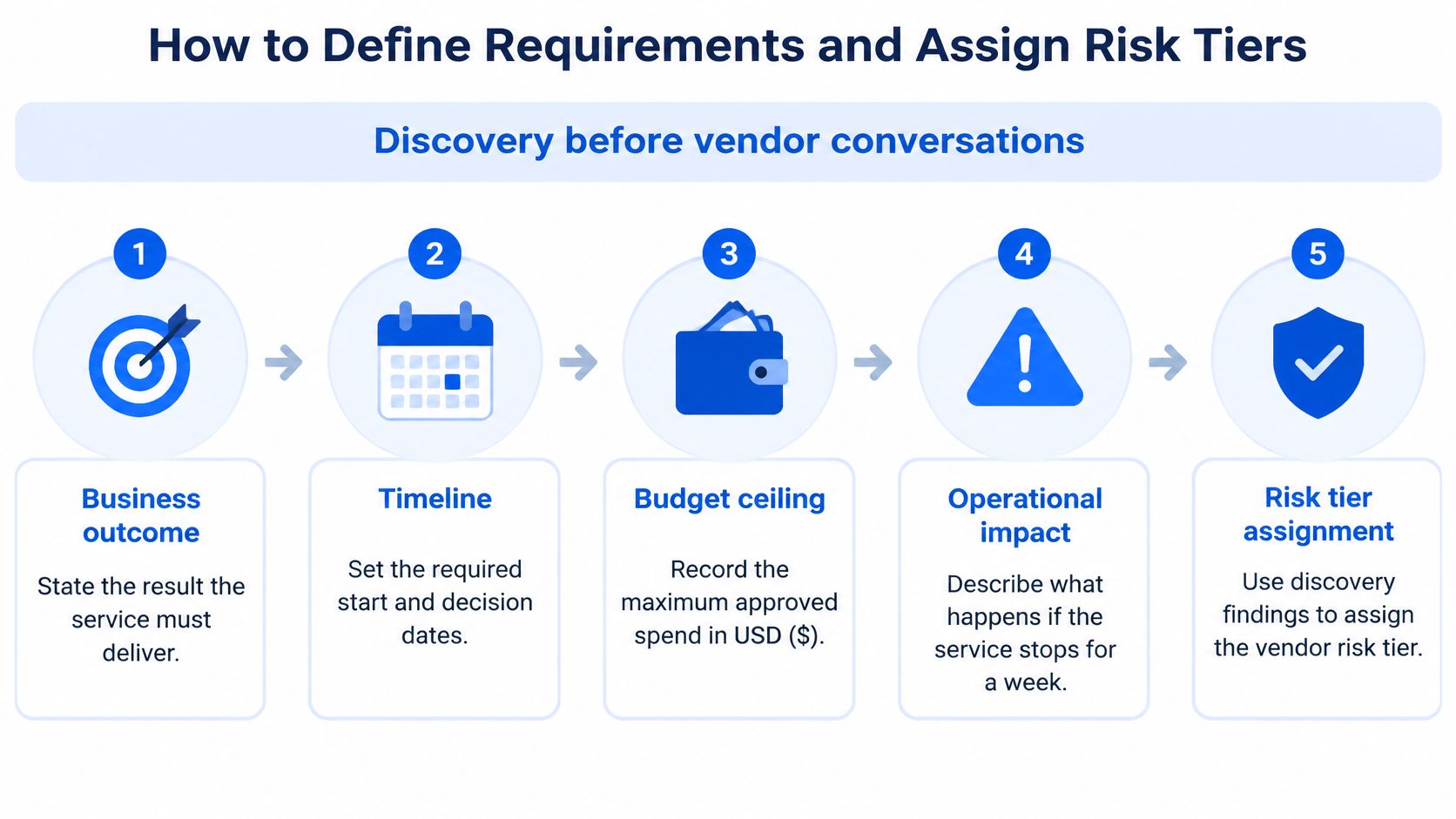
Once discovery is locked, build your requirements and tiering in six clear steps.
- Map processes and data exposure. List every internal workflow the platform will touch and classify the exact data it will store, transmit, or process, including customer PII, payment records, or regulated health files. You can't size due diligence until you know what's at stake.
- Flag critical services early. Mark a service as critical if it handles sensitive data, runs essential infrastructure, or creates high switching costs that would take months to unwind. Treating a core ERP integration with the same light review as a scheduling widget invites preventable outages.
- Assign a risk tier to calibrate effort. Place critical providers in Tier 1 (full pre-award assessment, independent audit verification, and scheduled periodic reassessment), moderate-impact providers in Tier 2 (standardized questionnaire and targeted control checks), and low-impact, easily replaced tools in Tier 3 (lightweight desktop review). Tiering keeps your security team focused where failure hurts most.
- Write pass-or-fail must-have gates. Capture mandatory controls covering cybersecurity, operational resilience, data residency, and regulatory compliance as binary requirements. A bidder either clears these gates or exits the evaluation.
- Weight your differentiating criteria. Assign percentage weights to functional fit, interoperability, implementation capacity, service levels, and total cost of ownership so evaluators compare finalists on business impact rather than personal preference.
- Define recovery and exit conditions upfront. Document your required Recovery Time Objective (RTO), Recovery Point Objective (RPO), data export format, and offboarding assistance before scheduling a single demo, because your bargaining position drops sharply once a vendor knows they're the front-runner.
Minimum Cybersecurity Dimensions to Investigate
For cybersecurity due diligence, NIST SP 1326 establishes five minimum investigative dimensions that belong in your Tier 1 and Tier 2 checklists:
- Supply-chain tiers: Identify upstream hosting providers, open-source components, and critical fourth parties supporting the vendor's service.
- Foreign ownership, control, or influence: Check corporate ownership structures and jurisdictional exposure that could affect data access or sanctions compliance.
- Provenance: Verify the origin, build integrity, and authenticity of software and hardware components entering your environment.
- Supplier stability: Review financial health, leadership continuity, and concentration risk so you spot solvency warnings early.
- Foundational cyber practices: Confirm baseline controls like multi-factor authentication, encryption, vulnerability patching, and access governance.
NIST also recommends integrating supply-chain risk assessment into enterprise risk management rather than treating procurement as an isolated event, and enforcing evidence traceability by mapping every high-weight criterion to an acceptance test, named owner, evidence artifact, and post-contract monitoring metric. Avoid the classic traps of letting vendor demos define your requirements, scoring every criterion equally, taking self-attestations at face value, or ignoring fourth-party concentration risk.
Before anyone contacts a supplier, have both the business owner and the security lead sign the finalized requirements document. That signature stops quiet scope changes once demos begin.
Issuing the Evidence Request and Questionnaire
Turning signed requirements into a fair market comparison requires one standardized evidence request that every bidder answers in the exact same structure. If Supplier A replies with a 90-page marketing brochure and Supplier B sends a custom spreadsheet, your panel will burn weeks translating prose instead of comparing facts.
Open every RFP with a concise cover note stating four items: the target business outcome, the assigned risk tier, the evaluation schedule, and the hard deadline for bidder questions. Giving vendors clear boundaries upfront filters out poor-fit responders early and cuts down on boilerplate filler.
Three Blocks Every Evidence Questionnaire Needs
Structure your standardized questionnaire into three distinct blocks so security, operations, and procurement can review their sections in parallel.
- Security and compliance: Request current independent attestations or audit reports (such as a SOC 2 Type II report or a recognized information-security certificate), exact data storage and processing locations, and active certifications with their scope and expiration dates. Don't accept a summary letter when the full audit report lists qualified exceptions.
- Resilience and delivery: Ask for documented recovery objectives, proof of tested failover drills from the past year, surge-capacity commitments for peak periods, and the named delivery team with a draft rollout plan.
- Dependencies and commercial model: Require a full list of material subcontractors and fourth parties, financial stability documentation, a transparent pricing schedule across all usage and storage tiers, and the exact exit process including export file formats and written deletion certificates.
Every mandatory question must receive either a direct answer or an explicitly flagged gap. Add a simple column next to every response marking whether the claim is self-attested or backed by independent documentation.
A clean "yes" on a security spreadsheet proves nothing on its own. Always separate what a vendor claims from what an independent auditor or technical test actually verified.
Match your verification depth strictly to the risk tier assigned during discovery. A Tier 1 platform warrants the full three-block questionnaire plus independent audit review and technical corroboration, while a Tier 3 tool only needs baseline commercial and privacy confirmation.
Keeping the Q&A Process Fair and Auditable
Route every bidder inquiry through one central register managed by procurement, whether inside an e-sourcing portal or a controlled Q&A log. When one vendor asks a clarifying question about API rate limits or compliance scope, publish the anonymized question and your official answer to every participating bidder at the same time. That single register prevents back-channel coaching, keeps commercial comparisons apples-to-apples, and gives auditors a clean trail of how every finalist received identical information.
How to Score Proposals Against Weighted Criteria
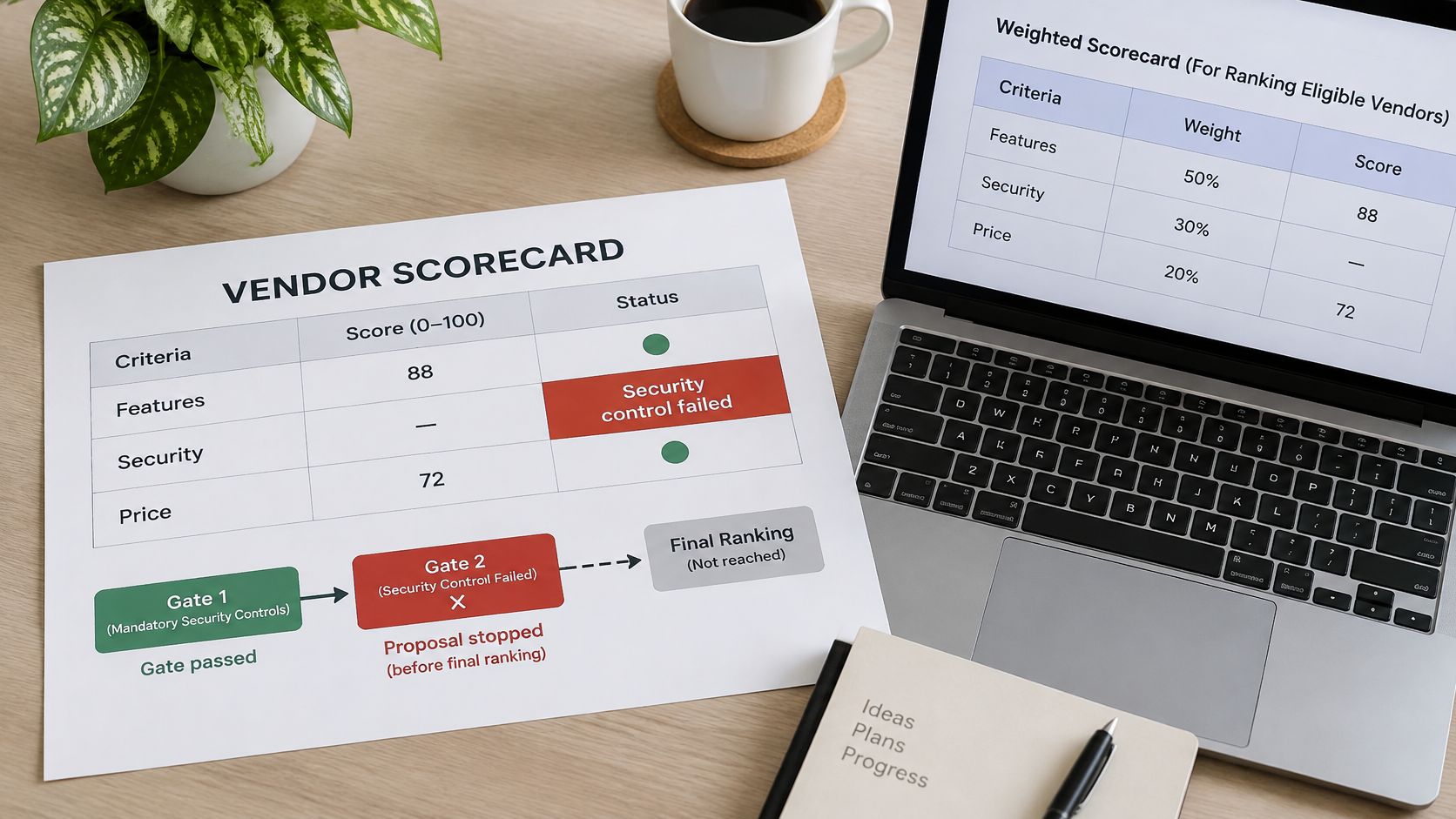
A scorecard distorts the decision when every criterion is treated as tradable. A bidder can look strong on interface quality and price while missing basic encryption or failover controls. Arithmetic alone can still place that vendor at the top. Risk-tiered evaluation fixes that by making certain controls pass or fail before points are counted, then using weighted criteria only to rank vendors that cleared the minimum bar. Extra scrutiny belongs on platforms that touch sensitive data, core operations, or embedded AI features.
Separating hard gates from weighted differentiators creates that structure. Hard gates remove unacceptable risk. Weighted criteria compare the qualified options that remain.
Example Weighted Scorecard for a Critical Platform
| Criterion | Example weight | Evidence to request | Gate type |
|---|---|---|---|
| Functional fit | 25% | Scenario demo on your own workflow | Weighted only |
| Security and compliance | 15% plus pass or fail gate | Independent attestation or audit report | Hard gate |
| Resilience and continuity | 10% plus pass or fail gate | Recovery objectives and tested failover evidence | Hard gate |
| Five-year total cost of ownership | 20% | Five-year cost model including migration and exit | Weighted only |
| Implementation capacity | 15% | Named delivery team, plan and surge-capacity commitment | Weighted only |
| Service levels and support | 10% | Contracted SLA, remedies and reporting schedule | Weighted only |
| Exit and portability | 5% plus pass or fail gate | Data export format and deletion certificate | Hard gate |
The two mechanisms work together. A platform can score five out of five on functional fit and five-year cost, yet fail immediately if it lacks an independent audit report or cannot guarantee structured data export at contract end. For AI-embedded products, keep the same discipline around vendor claims. Require the bidder to identify where the AI is used, what data it touches, which controls govern it, and what evidence supports the claim. If those answers stay vague, the score should stay low even if the demo looks polished.
Score every criterion on one fixed scale, such as 1 to 5, with written definitions for each number before proposals arrive. Require evaluators to cite a specific document, audit page, or test result beside every score, and log any exception or deviation from the rubric in writing. A score without evidence is just preference wearing a number. Keep the evaluator names, rationale, source reference, and scoring date attached to the record so the final ranking can be challenged later without reconstruction.
Closing the Gap Between Risk Awareness and Action
Most IT leaders know supplier vetting matters, yet many teams still apply it unevenly. A NIST review of cyber supply-chain practices highlighted a CrowdStrike survey in which 90% of respondents believed they were at risk of a supply-chain attack and viewed vetting software suppliers as critical, yet only 33% performed that vetting. That 57-percentage-point gap shows what happens when awareness stays in policy language and never becomes a repeatable scoring gate.
NIST case studies describe concrete controls mature programs use to close that gap: cross-functional supply-chain risk councils, dedicated vendor-risk assessment tools, centralized supplier databases, track-and-trace capabilities, and a master security-requirements specification. Those controls matter because scoring breaks down when ownership is unclear, evidence sits in separate inboxes, and security requirements are rewritten for each deal. Put the control, the evidence type, the owner, and the decision rule into the same operating model.
Comparing multiple options objectively before committing also reduces lock-in. Through the TBaaS™ framework, organizations compare providers across architecture, pricing models, and integration capabilities, with recommendations based on technical fit, operational alignment, and long-term value rather than vendor preference or sales incentives. If you are building your own rubric, these technology selection criteria examples help translate business goals into scorable line items. Keep the weighting tied to the risk tier. A Tier 1 platform deserves deeper evidence and tighter gates than a low-impact tool.
Keep three practical rules in front of the evaluation panel:
- Separate minimums from differentiators: Security, continuity, and exit readiness belong on hard gates; features, support tiers, and price belong in the weighted pool.
- Never weight every criterion equally: Giving a dashboard feature the same weight as implementation capacity distorts the final ranking.
- Lock weights before opening bids: Changing percentages after reading proposals turns an objective scorecard into post-hoc justification.
Testing Vendor Claims with Demos, References and Pilots
Many IT teams spend most of their evaluation energy judging the software product and almost none testing whether the supplier can implement and support it under real operating pressure. That blind spot creates a painful outcome: you buy a capable tool that stalls halfway through rollout because the vendor's delivery bench is overstretched.
The most reliable way to prevent that failure is to separate selection risk (is this the right solution?) from implementation risk (can this supplier deliver it in our environment?) and test both before anyone signs a contract. As outlined in NIST's draft supply-chain guidance, validating material claims under real constraints catches operational and capacity gaps that written proposals routinely hide.
Six Validation Checks in Order
Move finalists through a disciplined six-step validation sequence:
- Short-list only gate-passers. Invite no more than two or three finalists who cleared every mandatory security, resilience, regulatory, and financial gate. Putting a non-compliant vendor into demos wastes everyone's calendar.
- Run scenario-based demos on your own data model. Hand each finalist your single highest-risk workflow and real operating constraints, not an open slot for their standard sales script. Watch how their engineers handle edge cases, permissions, and exception routing live.
- Conduct sharp reference interviews. Skip generic satisfaction questions and ask reference customers two specific things: what was the worst outage or delivery incident they experienced with this vendor, and how did the supplier perform during an unexpected demand surge?
- Execute a scoped proof-of-concept. Pilot the highest-risk workflow with measurable pass-or-fail success thresholds agreed in writing before testing starts, covering latency, data accuracy, integration stability, and admin effort.
- Audit security architecture and delivery capacity. Review update mechanisms, subcontractors, incident notification workflows, and actual engineering bandwidth against your internal team's calendar. NIST explicitly warns that organizations shouldn't assume a Software Bill of Materials (SBOM) replaces vulnerability management or a full vendor risk assessment; treat an SBOM as one transparency input, not a complete assurance program.
- Build a five-year total-cost model. Combine license fees with integration buildout, data migration, user training, ongoing support, projected seat or usage growth, and contract termination costs so hidden year-three escalations surface now.
Common Failure Modes to Catch Early
Even experienced procurement panels slip into three predictable traps during finalist testing:
- Under-testing delivery capacity: Checking the platform's feature list while ignoring whether the vendor has dedicated, experienced engineers available on your target start date.
- Overlooking surge capacity and dependency chains: NIST notes that inadequate supplier capacity controls can trigger severe disruption during unexpected demand spikes, especially when upstream cloud or logistics dependencies bottleneck at the same time.
- Leaving acceptance criteria vague: Declaring a pilot "successful" because users liked the interface, rather than verifying hard numbers on throughput, error rates, and recovery time.
Evaluating AI-Enabled Vendors Without Shortcuts
A vendor checklist that asks whether a product "has AI" treats the technology as a simple feature toggle. That question misses the actual risk entirely.
Start with a sharper distinction: does the vendor use AI internally to speed up its own operations, or does its product deliver embedded AI that directly touches your customers, employees, clinical decisions, financial transactions, or regulated data? A supplier using generative AI internally to draft support tickets carries a very different risk profile from a platform running automated eligibility, fraud, or routing models against your production records. Assign your risk tier based on that answer, not on the marketing label.
Consider a concrete scenario. Say a claims-triage vendor retrains its scoring model every quarter on aggregated customer traffic and only notifies buyers after the new model is already live in production. Without contractual guardrails, your team could spend weeks processing biased or inaccurate outputs before anyone realizes the underlying logic shifted. The fix is procedural: high-tier AI products get mandatory change-notification clauses, and anything lower-tier gets periodic output audits instead.
Evidence Required for AI-Embedded Products
According to NIST's Generative AI Profile, AI procurement due diligence must extend well beyond model accuracy and price to cover intellectual property, data privacy, security, content provenance, supplier performance, and continuous monitoring. Demand written evidence across eight specific controls before approving an AI-enabled finalist:
- Training-data governance: Documentation showing data sources, licensing rights, bias testing, and content provenance.
- Data-use restrictions: Explicit contractual bans preventing the vendor from training shared or third-party models on your proprietary prompts, records, or outputs.
- Model-change notification: Mandatory advance notice with a defined lead time before major model swaps, weight updates, or fine-tuning changes hit production.
- Human review pathways: Clear mechanisms for qualified staff to inspect, override, and audit consequential automated outputs.
- Explainability standards: Sufficient logging and rationale visibility so your compliance team can defend automated decisions to regulators or affected individuals.
- AI-specific incident reporting: Defined escalation windows for model drift, data leakage, prompt injection exploits, or hallucination failures.
- Upstream subcontractor controls: Full disclosure of foundation model providers, inference hosts, and API sub-processors sitting behind the vendor's interface.
- Exit and portability terms: Rights to export your fine-tuned weights, prompt libraries, and structured logs cleanly if you switch providers.
That level of scrutiny matters most in regulated verticals. Legal operations leaders, for example, weigh these exact data-isolation and audit controls when they compare law firm automation platforms on Caseledge before exposing privileged client files to AI-assisted document workflows. The same evidence list applies whether you're buying contract review software or a patient-facing triage engine; only the regulatory citation changes.
Avoiding the False Objectivity of AI Vendor Scoring
Buyers aren't just evaluating AI inside vendor products. Many procurement and IT teams are now using or exploring AI tools to assist the vendor assessment itself, from parsing RFP responses to summarizing compliance documentation.
Automated intake saves hours. It also introduces a dangerous illusion of objectivity. An AI-generated vendor score can recycle incomplete evidence, reward glossy security policies over genuine operational resilience, and miss subtle liability exclusions buried in an addendum. The model reads what's written; it can't tell you what the vendor deliberately left out.
Keep one named human accountable for every AI-assisted vendor score. Automation can summarize a 200-page SOC 2 report, but it shouldn't sign off on your risk tolerance.
The practical compromise: let automation handle extraction and first-pass comparison, then require the accountable reviewer to verify every score against the underlying source document before it reaches the evaluation committee.
Treating AI Risk as a Post-Signature Control
Finally, treat AI vendor evaluation as a living lifecycle control rather than a one-time pre-award gate. NIST specifically recommends reassessing risk whenever a third-party model is adapted or fine-tuned. Since vendors retrain and swap models continuously, a point-in-time approval goes stale the moment the next update ships.
Build the reassessment triggers into the contract itself: any model change notification kicks off a fresh risk review, and your team re-tests a sample of outputs against the accuracy and bias baselines recorded during the pilot. Those same baselines then feed the outcome checks your team runs in the months after go-live, so model drift shows up in the data before it shows up in a complaint.
The key question for CIOs and CISOs isn't whether a vendor uses AI. It's whether your team can continuously verify how that AI changes risk, accuracy, and accountability months after contract signature.
Measuring Vendor Performance at 30, 90 and 180 Days
Celebrating at contract signature is one of the oldest habits in IT procurement, and one of the costliest. A crisp RFP scorecard proves a supplier passed your pre-award filter; it doesn't prove the system delivered the business result you paid for six months later.
Data from Deloitte's 2025 Global CPO Survey shows why strong evaluations still unravel after launch. Procurement leaders identified data quality as a top internal risk at 43.97%, while external risks centered on data privacy and security at 68.02% and provider capability and maturity at 43.72%. When pre-award baselines are fuzzy or supplier maturity falls short during rollout, even a top-scoring proposal drifts off course.
Before you award the contract, lock down measurable baselines across seven areas and convert them into contractually governed targets: service availability, incident volume, mean resolution time, user adoption rate, per-unit processing cost, open compliance findings, and employee or customer experience scores.
The milestone timeline below maps how those baselines turn into structured checkpoints during the first six months of operation.
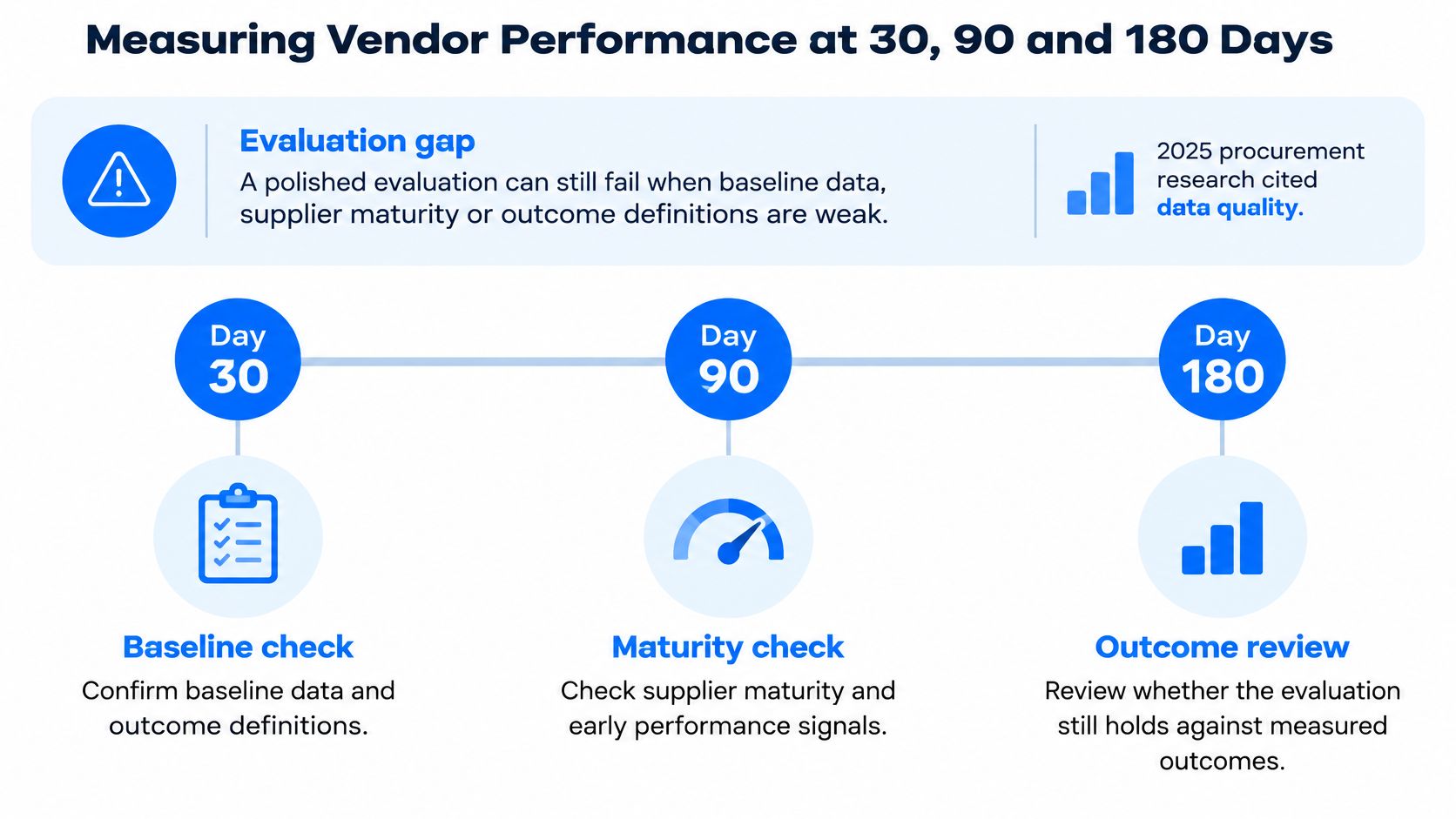
Each milestone should tie directly to a contractual decision rather than a polite status call.
Post-Award Review Checkpoints
| Checkpoint | Metrics compared to baseline | Decision triggered |
|---|---|---|
| 30 days | Adoption, onboarding defects and ticket volume | Agree a remediation plan with the vendor |
| 90 days | Service availability, incident resolution time and cost variance | Apply service credits or re-scope the contract |
| 180 days | Business outcome targets, open security findings and remediation closure | Renew, renegotiate or start the exit plan |
Tying these reviews to structured IT vendor management best practices turns passive contract files into active governance, giving your vendor manager added strength long before an auto-renewal window closes.
Calculating the Cost to Realize Value
Post-award tracking often exposes a painful truth: the lowest-priced or highest-scoring proposal frequently loses on real-world economics. Subscription fees tell only part of the story.
Before finalizing any shortlist, calculate each finalist's full cost to realize value, combining license pricing with implementation engineering, organizational change management, internal skill gaps, security controls, ongoing governance overhead, and migration lock-in. Consider a hypothetical comparison: say Bidder A comes in 20% cheaper on annual subscription fees than Bidder B, yet Bidder A's rigid architecture requires your team to staff a dedicated integration squad for 18 months to maintain custom connectors. Once you add those engineering hours and internal support tickets, the "cheaper" bid costs significantly more to operate.
Close your evaluation with one final operational test: ask the vendor to export live performance telemetry matching your seven baseline metrics during the pilot. Because "you cannot manage what you cannot measure," any supplier that can't produce reliable, auditable performance data on request will break your monitoring plan no matter how tightly the SLA is drafted.
Confirm the Shortlist Before You Sign
Apply one strict signing rule before legal circulates the final executable copy: sign only when the winning vendor has passed every hard gate, its pilot has cleared all agreed success thresholds, and the written decision memo assigns a named internal owner to every remaining open risk. If any of those three conditions is missing, pause the signature.
Six Contract Terms to Lock Before Execution
Every priority you scored during evaluation needs matching enforcement language in the agreement. Verify these six clauses before signing:
- Service-level remedies with real teeth. Pair uptime and response targets with automatic service credits and an explicit termination trigger for chronic SLA breaches.
- A strict incident notification window. Define exact reporting timelines in hours, not vague phrases like "without undue delay," covering both confirmed breaches and material service disruptions.
- Approval rights over subcontractors and data location. Require written advance notice and objection rights before the vendor moves your data across borders or swaps critical fourth-party sub-processors.
- Verified data deletion at exit. Mandate a signed certificate of destruction covering primary databases, backups, and log archives within a fixed window after contract termination.
- A binding portability clause. Specify the exact machine-readable export format (such as CSV, JSON, or Parquet), transition support rates, and handover timeline so switching stays realistic.
- Contracted 30-, 90-, and 180-day reviews. Write the three review milestones, baseline metrics, and remediation triggers directly into the Master Services Agreement or Statement of Work.
Benchmark Pricing Before the Final Round
Never wait until redlines to test whether a vendor's pricing is competitive. Bring current market benchmarks into the room before the final commercial round so you negotiate from verified data rather than the supplier's list price. Reviewing current ranges for managed IT services cost alongside peer contract structures reveals inflated support tiers, aggressive annual uplift caps, and hidden onboarding fees early. We provide guidance and benchmarking insights to help clients negotiate fair pricing and favorable terms with vendors, and we also offer quick, no-obligation technology assessments to benchmark your current environment before commercial talks heat up.
Take one concrete step this week before your next agreement hits the signature queue: put the 30-day post-award review on the shared calendar and write the named vendor manager's name into the decision memo. Governance works when it starts on day one, not after the first outage.
If you're preparing for a complex platform renewal or IT sourcing decision, MR2 Solutions pairs vendor-neutral advisory with structured discovery, objective benchmarking, and a curated network of 400+ solution providers so your team compares architecture, security, and total cost without sales bias. Start with a quick, no-obligation technology assessment to benchmark your environment and tighten your shortlist before negotiations begin. Visit MR2 Solutions to see how our team supports every stage from discovery through post-award optimization.