
Incident Response Plan Template: Roles, Phases and Recovery

Only 25% of businesses had a formal incident response plan, while 43% experienced a breach or attack during the prior year, according to the UK Government's Cyber Security Breaches Survey 2025/2026. That gap changes what an incident response plan template needs to accomplish. Producing a document isn't enough; the team must be able to execute it when normal tools, familiar colleagues, and reliable information aren't available.
What Makes an Incident Response Template Usable
An incident response plan template is a set of decisions made before the pressure starts. It identifies who declares an incident, who can isolate a system, who assesses notification obligations, and how responders coordinate when corporate email can't be trusted.
The useful test isn't whether the document contains every lifecycle heading. It's whether an unfamiliar responder can open it, identify the next action, and find someone authorized to approve that action.
A technically capable team can still stall over basic questions. Does disabling a service account interrupt patient care? Can an outside responder access logs without the identity platform? Who approves an employee message when the communications director is unavailable?
Design for degraded conditions
Build the template around these execution requirements:
- Decision rights: Name the person authorized to approve disruptive actions, with clear limits.
- Named substitutes: Give every operational role an alternate who can perform it.
- Independent access: Store an emergency copy somewhere responders can reach without production authentication.
- Responder onboarding: Document how external investigators obtain approved access, evidence, and business context.
- Observable completion: Define what evidence proves an action worked.
A shorter, role-based plan that has been tested is more useful than a comprehensive document nobody can execute.
Policy explains management intent. The plan translates that intent into operational instructions. Scenario playbooks add the technical detail for particular incidents without burying the core authority model.
The resulting package needs a usable skeleton, a role roster and RACI overlay, severity triggers, response procedures, resilient communications, recovery gates, scenario annexes, and a testing schedule. Treat each component as something to demonstrate during an exercise, not just something to approve.
The Incident Response Plan Template at a Glance
Copy this skeleton into your controlled document repository, then replace job titles with actual owners, approved procedures, and validated contact details. A heading isn't complete until someone can execute the instructions beneath it.
Incident response plan template skeleton
| Template section | What it captures | Typical owner |
|---|---|---|
| Document control | Version, owner, approval authority, review date and change log | CISO or plan owner |
| Purpose, scope and assumptions | Sites, systems, subsidiaries and third parties covered | CISO |
| Incident definitions and severity criteria | What counts as an incident plus S1-S4 definitions and examples | Security lead |
| Roles and escalation | Incident commander, RACI matrix, escalation thresholds, on-call rota | CISO |
| Response procedures by phase | Detection, triage, containment, eradication, recovery actions and exit criteria | SOC or IR lead |
| Communications plan | PACE channels, stakeholder map, approval authority, holding statements | Communications lead |
| Notification and regulatory dependencies | Legal, privacy, insurer, law-enforcement and regulator contacts and deadlines | Legal counsel |
| Evidence and forensics | Chain of custody, preservation steps, tooling, third-party responder access | IR lead |
| Recovery and restoration | Recovery priorities, acceptance criteria, validation and sign-off | IT operations lead |
| Post-incident review | Lessons-learned meeting, corrective-action register, response metrics | CISO |
| Annexes | Scenario playbooks, validated contact lists, vendor SLAs, exercise calendar | Plan owner |
ISO/IEC 27035-2:2023 identifies preparation components including management commitment, security policies, an incident-management plan, an established team, organizational relationships, operational support, awareness training, and testing. The skeleton translates those preparation needs into fields people can use and reviewers can inspect.
Fill the difficult fields first
Start with authority, access, and acceptance, not introductory policy language. Write down whether the incident commander can isolate production systems, how investigators preserve evidence, and who accepts a restored service.
Notification entries need more than a regulator's name. Legal counsel should record the applicable obligation, triggering event, reporting route, deadline, approval process, and evidence of submission. Insurer and supplier entries need policy or contract references, not assumptions copied from another organization.
CISA's Incident Response Plan Basics emphasizes a communications manager, crisis contacts, fallback communications, exercises, after-action reporting, and corrective actions. Give those items executable fields: contact-validation status, fallback activation instructions, exercise evidence, corrective-action owner, and completion approval.
Keep the core plan short enough to use during a bridge call. Move provider-specific commands, forensic collection instructions, and scenario branches into annexes, but retain direct references and emergency access instructions in the master document.
A controlled offline copy matters, too. Record where it lives, who can retrieve it, and how the plan owner replaces obsolete copies after changes.
Incident Response Roles and the RACI Matrix
The incident commander coordinates decisions. The technical lead investigates. Those aren't interchangeable responsibilities, even when a small team assigns both to the same person.
Use this roster as a staffing worksheet. The backup column suggests suitable positions, but the finished plan needs people's names, contact methods, availability, and delegated authority.
Incident response roles and backups
| Role | Core responsibilities during an incident | Typical backup |
|---|---|---|
| Incident Commander | Declares severity, owns the response, approves containment and isolation, runs the bridge | Deputy IR lead |
| Security and IR lead | Leads triage, investigation, forensics and evidence handling | Senior SOC analyst |
| IT operations lead | Executes isolation, containment actions and service restoration | Infrastructure manager |
| Communications lead | Drafts approved messages, briefs employees, customers and media | PR or marketing lead |
| Legal and privacy counsel | Assesses notification duties, regulator and insurer contact, evidence legality | External counsel |
| Executive sponsor | Provides business authority, approves emergency spend, arbitrates risk trade-offs | CIO or COO |
| HR lead | Handles insider cases, employee welfare and safety concerns | HR business partner |
| Scribe and coordinator | Timestamps decisions, keeps the incident log, tracks actions and owners | SOC analyst |
Separate accountability from execution
A RACI matrix assigns accountable, responsible, consulted, and informed parties to activities. Assign one accountable role to each decision, even where several teams execute it.
For containment, the commander might be accountable, IT operations responsible, engineering and legal consulted, and the executive sponsor informed. For regulatory notification, legal owns the assessment and submission process; the technical lead supplies facts rather than independently interpreting obligations.
Include managed providers in the same matrix. A provider that detects suspicious activity doesn't automatically have permission to disable your production tenant. Conversely, an internal approval requirement is useless if the approver can't be reached.
Write a succession clause that activates after the organization's approved acknowledgement window expires. Authority passes to the named alternate without another approval meeting, and the scribe records the transfer.
Rehearse the nontechnical seats
Communications and HR shouldn't encounter the plan for the first time during an incident. Kogifi's resource on incident drills for enterprise marketing teams is a useful companion when designing exercises that include customer-facing teams rather than only technical responders.
For leadership coverage, fractional CISO services are an option when the organization needs security governance without a full-time executive appointment. Regardless of staffing model, the executive sponsor must approve the authority structure.
Don't let the scribe become an unassigned spare duty. Recording decisions, unresolved questions, and action owners protects the technical team from reconstructing the response from chat history later.
Severity Levels and the Escalation Matrix
Start with the incident everyone fears: active ransomware, confirmed exfiltration, or an interruption that threatens safety. The classification must activate decisions, not merely change the color of a dashboard.
The following is an illustrative severity model, not a regulatory schedule or universal response-time benchmark. Set acknowledgement and escalation windows through executive approval, then test whether the on-call arrangement can meet them.
Severity levels and escalation matrix
| Severity | Definition and examples | Acknowledge and escalate | Escalation path | Decision authority |
|---|---|---|---|---|
| S1 Critical | Ransomware detonation, confirmed data exfiltration, safety or production stoppage | Immediate paging; escalate on declaration or missed acknowledgement | Incident commander, CISO, CEO and legal | Commander may isolate IT systems within preapproved limits; safety-critical actions require the designated engineering authority |
| S2 High | Privileged account compromise, exposed cloud storage, malware on a server | Urgent acknowledgement under the approved on-call target; escalate if scope or impact increases | Incident commander and CISO | Commander approves containment; executives informed |
| S3 Medium | Suspicious activity contained to one host, small phishing campaign, policy violation | Acknowledge within the operational support target; escalate when containment assumptions fail | IR lead and IT operations | IR lead approves actions within the playbook |
| S4 Low | Blocked attacks, quarantined malware, spam reports | Normal queue target; escalate on recurrence or evidence of compromise | SOC queue and scheduled review | SOC analyst under approved procedures |
Give each tier separate clocks
Acknowledgement means a named person has accepted responsibility. Escalation means the required decision-maker has been engaged. An automated ticket receipt proves neither.
Record both timestamps. If acknowledgement fails, the paging system should contact the alternate rather than repeatedly notify the same unavailable person.
Severity should reflect business consequences as well as technical indicators:
- Data sensitivity: Identify whether exposed information creates material privacy, confidentiality, or contractual concerns.
- Operational impact: Consider revenue, customer commitments, service dependencies, and recovery options.
- Safety: Include patient, employee, public, and environmental consequences.
- Spread: Assess whether the attacker can cross accounts, tenants, sites, or suppliers.
- Regulatory exposure: Engage counsel when facts could trigger reporting duties.
An exposed storage location doesn't always have the same impact. A public product brochure and sensitive customer records require different assessments, even if the cloud misconfiguration is technically identical.
Classification rule: When assessors disagree and material harm is plausible, use the higher tier until the commander documents a defensible downgrade.
Separate authority to isolate a workstation from authority to disconnect a factory network or suspend a customer-facing platform. The matrix should permit fast, bounded action without pretending every shutdown has the same consequences.
Response Phases from Detection to Lessons Learned
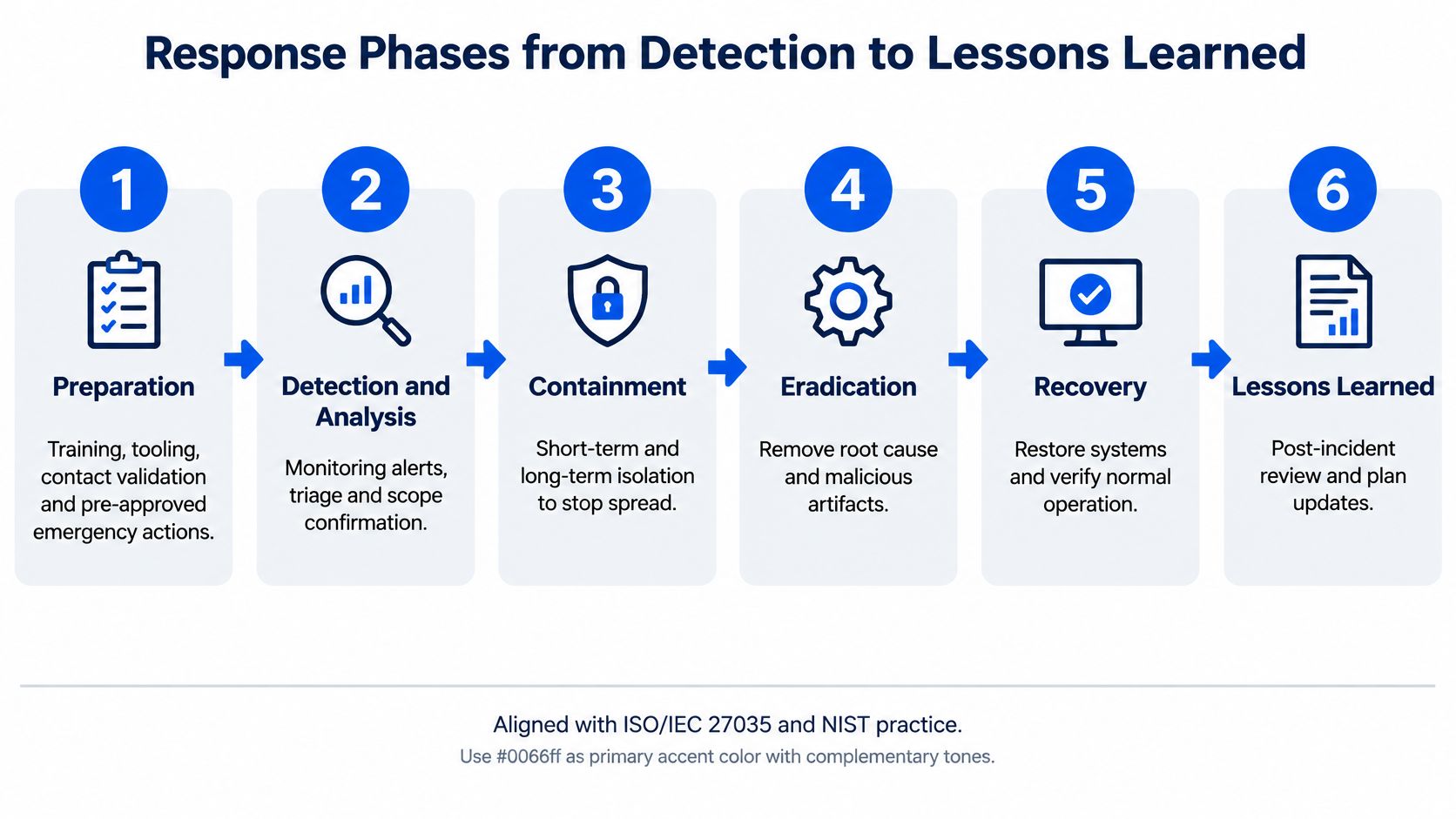
ISO/IEC 27035-1:2023 treats incident management as a connected process encompassing preparation, detection, reporting, assessment, response, and learning. The operational sequence below breaks that work into executable stages without suggesting that investigators must finish each stage before revisiting an earlier finding.
Execute actions against explicit gates
Preparation. Validate contacts, responder access, logging coverage, forensic storage, emergency credentials, and preapproved actions. Confirm that responders can retrieve the plan without production identity services.
Commander's acceptance: Required people, tools, and access have been demonstrated, or gaps have documented risk owners.Detection and analysis. Collect the initial alert, preserve relevant logs, identify affected assets, and distinguish confirmed facts from hypotheses. Record severity, suspected entry point, business impact, and open questions.
Exit criterion: The commander accepts the working scope and containment recommendation, including known uncertainties.Containment. Isolate affected hosts, restrict compromised accounts, block malicious access, and protect backups using approved authority. Preserve volatile evidence where feasible, but don't leave active harm unchecked to obtain a perfect capture.
Exit criterion: Available telemetry supports that spread has stopped, containment controls work, and required evidence is preserved.Eradication. Remove persistence, correct exploited weaknesses, revoke exposed secrets, and rebuild systems when their integrity can't be established. Investigate related identities and management systems rather than treating the visibly affected endpoint as the entire incident.
Exit criterion: The technical lead presents evidence that identified attacker access and persistence have been addressed, and the commander accepts the residual uncertainty.Recovery. Restore through the service's approved acceptance gates, validate business transactions, and activate heightened monitoring. Keep rollback procedures available.
Exit criterion: The service owner accepts operation and the commander records the release decision.Post-incident review. Reconstruct the timeline, compare intended and actual decisions, and assign corrective actions. Separate immediate fixes from structural changes such as logging coverage or approval redesign.
Exit criterion: Findings have owners, due dates, and a method for verifying completion.
Allow controlled movement backward
A newly discovered administrator account during eradication can reopen analysis and containment. Record the change in scope and update stakeholders rather than forcing investigators through an artificial linear checklist.
Briefings run alongside technical work. Keep executive decisions, external notifications, and operational instructions synchronized with the current assessment.
For a broader explanation of how response supports organizational preparedness, TekRecruiter on security resilience provides a useful companion perspective. Where monitoring is external, incorporate the managed security operations center into the workflow with explicit handoffs for evidence, paging, and containment approval.
Crisis Communications and the PACE Model
Corporate email may be unavailable, monitored by an attacker, or dependent on the identity system under investigation. A second application using the same compromised sign-on isn't an independent fallback.
Use PACE, meaning Primary, Alternate, Contingency, and Emergency. Assign channels to those categories, document activation conditions, and practice switching without distributing sensitive incident details through unapproved personal accounts.
Stakeholder communications matrix with PACE fallbacks
| Stakeholder | Briefed by | Primary channel | Alternate channel | Timing target |
|---|---|---|---|---|
| Executive leadership | Incident commander | Conference bridge | Mobile group call | Immediately after critical incident declaration and at agreed checkpoints |
| Employees | Communications lead | Corporate email | Approved SMS or independent broadcast platform | Before employees need to change behavior |
| Customers | Communications lead and account owners | Email plus status page | Phone call for key accounts | Applicable contract deadline and approved incident-specific schedule |
| Regulators | Legal counsel | Official portal or written notice | Phone to the named contact | Applicable legal deadline confirmed by counsel |
| Cyber insurer | Legal counsel | Broker hotline | Approved email quoting the policy number | Policy notification window |
| Law enforcement | Legal counsel | Appropriate national reporting channel | Assigned agent line | When directed by counsel |
| Media | Communications lead | Approved press statement only | Designated spokesperson | Only with an approved statement |
| Suppliers and partners | Vendor manager | Contractual notice email | Phone to the account manager | Contract terms and operational need |
Complete the fallback chain
The table identifies primary and alternate methods. Add contingency and emergency instructions to the annex, such as an independently authenticated emergency bridge and a designated coordination location when telecommunications are unavailable.
Record bridge access details securely. Establish how participants verify identities, how the team distributes replacement credentials, and what information may travel over each channel.
Control facts and approvals
Give the communications manager a stakeholder list, approval route, and holding statements for employees, customers, and media. A holding statement should distinguish confirmed disruption from unverified cause and explain when the next update will arrive.
- Approval: Legal reviews notification obligations; the designated business authority approves external positioning.
- Spokespeople: Only authorized representatives speak to journalists or publish incident statements.
- Recordkeeping: Log the audience, approved wording, sender, channel, and timestamp.
- Corrections: Correct a material factual error explicitly rather than editing a status page without notice.
Carlos Alba Media's newsroom-tested crisis communication advice is useful for preparing spokespeople before an incident. Technical accuracy alone doesn't make a message clear to employees or customers.
Maintain the reporting register alongside cybersecurity regulatory compliance work. Counsel should populate actual legal deadlines, policy conditions, and contractual triggers; don't insert a generic notification window and assume it covers every audience.
The First Hour of a Ransomware Incident
Consider a hypothetical ransomware incident in which shared files begin encrypting and a service account shows suspicious activity. The sequence below illustrates decision order, not promised response times. Several workstreams should proceed in parallel.
From alert to authorized action
- Initial alert: The SOC analyst records the detection time, affected shares, alert identifiers, and observed account activity. The scribe opens the incident log and separates observed encryption from assumptions about entry point or exfiltration.
- Triage: The security lead confirms active ransomware behavior, declares a critical incident under the approved criteria, and pages the commander. The team doesn't wait for a complete malware analysis before beginning authorized containment.
- Command activation: The commander accepts responsibility or the succession rule transfers authority to the alternate. The scribe records who holds command so responders aren't receiving conflicting instructions.
- Containment: IT operations isolates affected hosts and restricts the suspected service account within the approved authority boundary. Before disabling a shared account, responders check its dependencies and arrange a safe alternative where necessary.
Parallel legal and communications work
Legal counsel retrieves the insurance policy, assesses notification triggers, and contacts the broker through the approved route. That call shouldn't depend on the same email tenant the team is investigating.
The communications lead prepares an employee holding statement with concrete instructions: avoid affected shares, preserve suspicious messages, and use the approved reporting route. The statement doesn't claim that customer data is safe merely because investigators haven't confirmed exfiltration.
Bridge discipline: Report what is known, what remains uncertain, what action needs approval, and who owns the next update.
Executive leadership receives the current scope, business interruption, containment status, and decisions requiring business authority. If the primary bridge is inaccessible, participants activate the independent alternate rather than improvising separate conversations.
At the close of this initial response period, the useful artifact is a decision log: owners, timestamps, containment evidence, unresolved questions, and next checkpoints. Encryption stopping is encouraging, but it doesn't establish that attacker access has been removed.
Recovery Criteria and Return to Service
A server booting successfully isn't a recovery acceptance criterion. The service must operate correctly, resist the identified compromise path, and provide enough telemetry for responders to detect renewed activity.
Rank services before an incident by business impact, including safety, revenue, regulatory obligations, and customer commitments. Record dependencies such as identity, DNS, certificates, network connectivity, and upstream databases so the restoration order is technically possible.
Require evidence at each gate
Use a service-specific acceptance checklist:
- Compromise addressed: Investigators have evaluated the affected components and documented the basis for trusting the restored environment.
- Backup validated: The selected restore point has been assessed for integrity, completeness, and signs of compromise, and the restore procedure has been tested.
- Access secured: Exposed credentials, tokens, certificates, and recovery mechanisms have been revoked or replaced as appropriate.
- Weakness corrected: The exploited condition has been remediated or isolated behind an approved compensating control.
- Monitoring active: Required endpoint, identity, application, and network telemetry reaches a trusted destination.
- Business function verified: The service owner validates representative transactions, integrations, permissions, and data consistency.
- Rollback available: Operations can reverse the release without destroying evidence or losing newly created business records.
Define a heightened-watch period appropriate to the incident and service. Specify who reviews alerts, what triggers renewed isolation, and who may end enhanced monitoring.
Separate repair from acceptance
IT operations proposes restoration. The security lead supplies investigation findings and residual risks. The service owner accepts return to service, and the commander records that decision.
Release in stages when the architecture permits it. Start with a restricted user group or limited transaction path, validate behavior, then expand access while observing telemetry and business results.
Sometimes continued isolation is the correct outcome. A legacy system with unresolved compromise may remain disconnected while the business uses a manual process or replacement service.
Capture time to restore for each service and the proportion of acceptance criteria met at release. Record approved exceptions separately, with their owners and expiry conditions, rather than marking incomplete criteria as passed.
Scenario Annexes for Ransomware, Cloud and OT Incidents
Reporting discussed in SANS's guidance on industrial-control-system incident-response tabletops found that 57% of significant incidents involved attack types the security team hadn't prepared for. The same guidance reports that one in five industrial organizations experienced a cybersecurity incident in 2025, with nearly 40% of those incidents disrupting ICS/OT operations.
Preparing only for familiar ransomware behavior leaves important business decisions unresolved. The answer isn't an exhaustive threat encyclopedia. Use concise annexes that preserve the same command structure while changing the technical actions, dependencies, and specialist approvals.
Build annexes around operational differences
| Scenario annex | Instructions that must be specific |
|---|---|
| Ransomware | Endpoint and network isolation, backup protection, encryption scope, legal and insurer coordination |
| Cloud compromise | Provider escalation, audit-log access, tenant boundaries, exposed keys, workload isolation |
| Identity and email compromise | Session revocation, credential replacement, MFA re-enrollment, mailbox rules, delegated access |
| Data exposure | Dataset identification, access history, privacy assessment, affected-party determination |
| Network outage | Security-versus-failure assessment, configuration preservation, carrier escalation, failover dependencies |
| Supplier incident | Shared-access restriction, contractual coordination, provider evidence, downstream impact |
| OT/ICS incident | Engineering authority, safe-state procedures, manual operation, physical access, restart approval |
Each annex should state its activation trigger, prerequisites, authorized actions, evidence sources, business consequences, and completion gates. Reference exact administrative procedures where they exist rather than copying commands into several documents.
For cloud incidents, preserving provider logs and revoking access may need different administrators. Identify both before an incident, including how they authenticate when the normal tenant is untrusted.
Give engineering control over physical consequences
The default IT response of disconnecting a device can be dangerous in an industrial or clinical environment. A controller may support a process that can't safely stop without engineering supervision.
Name the engineering and safety authorities, define the IT–OT boundary, and document who can order a transition to a safe state. Include facilities staff, device suppliers, and manual operating procedures where those roles affect continuity.
Business impact should determine the escalation tier even when the technical indicator looks minor. An unusual login to an engineering workstation can require a different response from the same login pattern on an ordinary office laptop.
Choose exercise variants from actual dependencies: loss of remote vendor support, unavailable identity services, missing control-system logs, or compromised recovery credentials. That approach tests adaptability without expanding the master plan into an unreadable catalog.
Testing, Metrics and Keeping the Template Current
At 2 a.m., a signed annual review does not put anyone on the emergency bridge, preserve logs, or approve isolation of a production service. A wording check and an exercise do different jobs. Keep the review, and treat it as paperwork until an exercise shows the team can act with a role-holder missing and the usual tools unavailable.
ISO/IEC 27035-2:2023 ties preparation to management commitment, defined teams, internal and external relationships, operational support, training, and lessons learned. Keep evidence that those arrangements still work, including named backups and out-of-band paths, rather than a plan that only mentions them.
Use a risk-based exercise calendar
I recommend this starting cadence for a mid-market team, then tighten it when results show a weak decision right or a backup who cannot act.
Run a quarterly tabletop with an unfamiliar scenario, one primary role-holder absent, and incomplete information. The observer should record who had authority to isolate, notify, or spend, and whether the named alternate used it.
Once a year, run a technical simulation in an isolated environment. Demonstrate containment, evidence collection, and restoration without touching production. If identity or ticketing is in the scenario, require the out-of-band fallback the plan names.
Schedule a failover exercise that includes third-party responders, emergency access, and out-of-band communications. Set that interval from business risk and operating constraints. These intervals are planning targets, not universal compliance requirements. Get the calendar approved, and add practice when the same failure shows up twice.
After a provider migration, acquisition, identity redesign, or significant staffing change, recheck only the procedures those changes touch. Confirm the new backup contacts and the fallback channel before the next quarter.
Every exercise needs objectives, scenario injects, observers, safety limits, and evidence-collection instructions. Write the after-action report the same week. Enter each finding in a corrective-action register with an owner, a due date, the evidence that closes it, and escalation when the date slips.
A finding without a decision owner is a note, not a fix.
Measure outcomes without hiding uncertainty
Stamp detection, acknowledgement, classification, containment, eradication, restoration, notification, and closure. Define each stamp so an automated alert receipt is not scored as a human acknowledgement.
Track contact revalidation, corrective actions closed by their due date, and recovery results against the acceptance criteria already in the plan. Keep the first scope estimate beside later revisions. A narrower scope after more evidence is better knowledge, not sloppy reporting.
Measure whether responders made and verified the right decisions, not just whether they moved quickly.
Version control, a named owner, an approved annual review, and out-of-cycle reviews after significant incidents or organizational changes keep the template executable. The owner should assess relevant standards updates and pull obsolete copies out of shared drives and war rooms.
Reviewers can inspect approvals, exercise records, decision logs, completed corrections, and service acceptance records. That set is what supports a claim of operational readiness.
Quick Reference Checklist and Customization Path
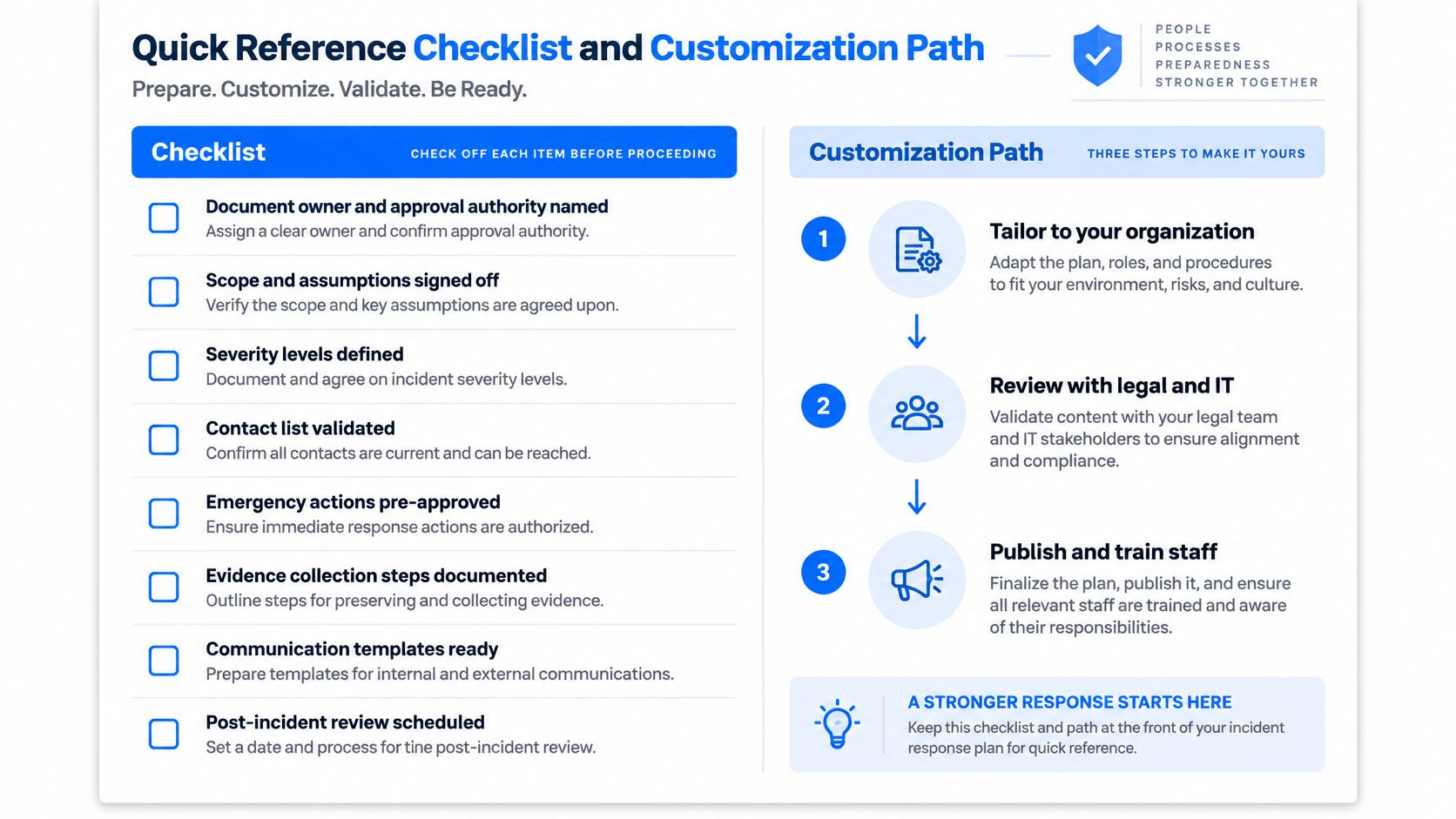
Paste this checklist at the front of the controlled plan. Treat an unchecked item as an assigned action, not a cosmetic omission.
- Ownership: Document owner and approval authority named.
- Scope: Systems, sites, assumptions, and exclusions approved.
- Severity: Acknowledgement and escalation targets set.
- Coverage: Every role has a named alternate.
- Authority: Shutdown and isolation rights approved.
- Fallbacks: PACE channels tested on the approved schedule.
- Briefings: Stakeholders, senders, and timing targets mapped.
- Evidence: Preservation steps assigned to an owner.
- Recovery: Acceptance criteria and signatory defined.
- Testing: First exercise booked.
Follow the customization path
- Appoint the plan owner and executive sponsor.
- Complete the role, severity, communications, and contact matrices.
- Write annexes matching the organization's threats and operating dependencies.
- Obtain executive and legal approval.
- Run a tabletop before treating the plan as operationally ready.
- Review on the approved calendar and after significant incidents.
Teams that want an outside check can ask MR2 Solutions to review the filled-in plan against this checklist before the first tabletop.
We offer cybersecurity services to help businesses protect their operations and meet compliance obligations, along with quick, no-obligation technology assessments to benchmark their environment. Visit MR2 Solutions to discuss your incident response planning needs and identify the decision, access, and recovery gaps to address before your next exercise.